Summary
Table of Content

Personal Care Appliances Market
Get a free sample of this report
Form submitted successfully!
Error submitting form. Please try again.
Thank you!
Your inquiry has been received. Our team will reach out to you with the required details via email. To ensure that you don't miss their response, kindly remember to check your spam folder as well!
Request Sectional Data
Thank you!
Your inquiry has been received. Our team will reach out to you with the required details via email. To ensure that you don't miss their response, kindly remember to check your spam folder as well!
Form submitted successfully!
Error submitting form. Please try again.
Personal Care Appliances Market Size
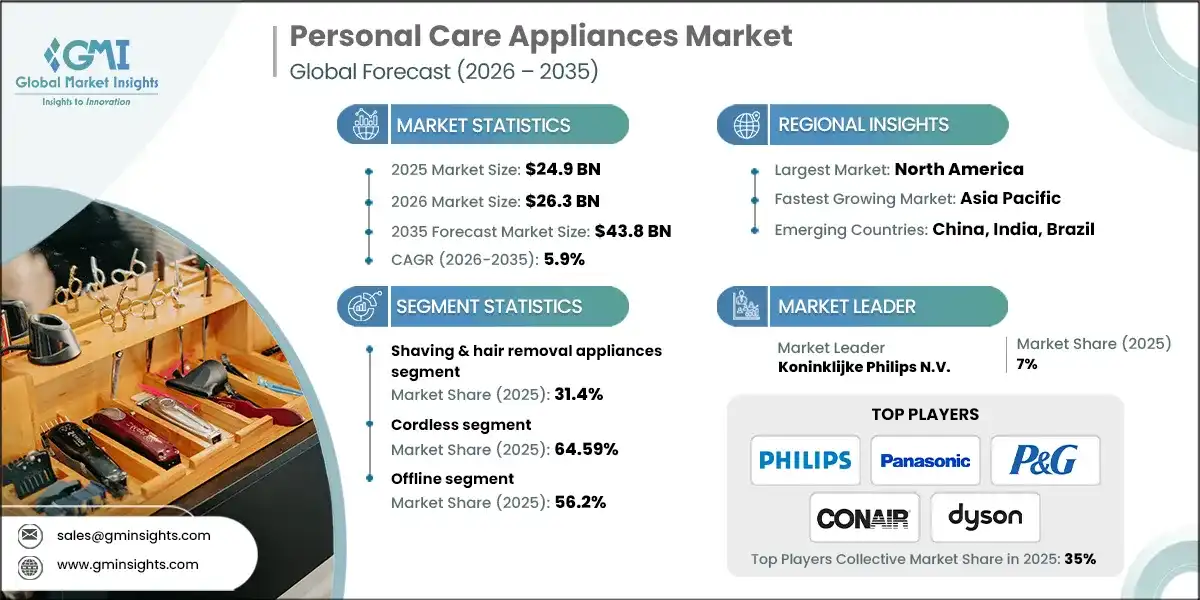
The global personal care appliances market was estimated at USD 24.9 billion in 2025. The market is expected to grow from USD 26.3 billion in 2026 to USD 43.8 billion in 2035, at a CAGR of 5.9%, according to latest report published by Global Market Insights Inc.
Personal Care Appliances Market Key Takeaways
Market Size & Growth
- 2025 Market Size: USD 24.9 Billion
- 2026 Market Size: USD 26.3 Billion
- 2035 Forecast Market Size: USD 43.8 Billion
- CAGR (2026–2035): 5.9%
Regional Dominance
- Largest Market: North America
- Fastest Growing Region: Asia Pacific
Key Market Drivers
- Rise in male grooming & self-care.
- Smart & connected ecosystems.
- Sustainability & eco-design.
Challenges
- High cost of premium devices.
- Proliferation of counterfeit products.
Opportunity
- AI-Driven personalization.
- Travel-friendly & cordless designs.
Key Players
- Market Leader: Koninklijke Philips N.V. led with over 7% market share in 2025.
- Leading Players: Top 5 players in this market include Koninklijke Philips N.V., Panasonic Corporation, Procter & Gamble Co., Conair Corporation, Dyson Limited, which collectively held a market share of 35% in 2025.
Get Market Insights & Growth Opportunities
The rise in operational efficiency and consumer wellness awareness, which is heavily emphasized, has led to the surge in demand for advanced grooming tools as the number of mergers and acquisitions among industry leaders is increasing. The merger of the key players' forces in the business, such as Philips, Procter & Gamble (Braun), and Panasonic, has resulted in a higher level of innovation, a broadened product portfolio, and a stronger presence in the market. On the other hand, traditional methods of manual grooming, such as manual razors or basic hand-held brushes, are less efficient and ergonomically viable for modern users.
The modern personal care systems are a more sustainable option, as they are made with energy, efficient motor technology and are powered by long, lasting lithium-ion batteries, thus limiting environmental impact through less waste. This environmentally friendly practice is consistent with the growing adoption of sustainable practices in consumer electronics and is one of the factors driving the market's growth. The need for smart and connected grooming devices is sharply rising in North America. Moreover, the rise of the middle class and the e-commerce infrastructure expenditure in Europe and parts of the Asia and Pacific region are creating the ground for the commercial viability of this equipment.
As most e, retailers and direct, to, consumer (DTC) brands are demanding faster and less disruptive methods for product delivery, personal care appliances are gaining more popularity being the major choice of pick due to their already, known benefits, such as the personalization of self, care routines and the reduction of the risk of skin irritation caused by manual blades. In fact, the beauty tech market is essentially driven by an increasing awareness of the long, term benefits of a tech, integrated beauty regime, which leads to the broader acceptance of these powerful devices.
Besides that, the continuous enhancements in ergonomic design will certainly contribute in the future to the safety and comfort of the users' operation being further improved. So, the market's strong financial performance is basically the result of the synergy of infrastructure support, an industry, wide focus on smart home integration, and a demand for high, efficiency convenience. The progressive technological innovation of equipment, which is gradually transforming the traditional simple mechanical tools into highly intelligent, application, specific machinery, is one of the key factors behind the market's continuous growth.
The industry has identified a very distinctive shift in the preference for smart sensors as well as complex diagnostic systems that not only improve efficiency but also prolong the device's life when different hair types and skin sensitivities are dealt with. Hence, the manufacturers are heavily concerned with the operator's experience enhancement through the provision of such features as IoT, enabled app monitoring for safety purposes, modular styling heads for perfect maneuverability on irregular facial contours, and integrated AI diagnostics for personalized grooming management.
The market for personal care appliances is essentially a day, to, day lifestyle market, which would be primarily driven by a big pandemic, sized jump in at, home grooming and global trade, resulting in professional and consumer demand for error, free and salon, quality results in private spaces. The principal operational distinction between traditional grooming methods and automated appliances is that the latter electrically and automatically adjust to the user's needs with absolute accuracy and effectiveness, thereby eliminating styling bottlenecks while at the same time, an additional felicitous consequence (data insights for health tracking) is also generated, and the time spent on personal maintenance is drastically reduced.
With most e-retailers and third, party logistics (3PL) providers demanding faster, less disruptive methods for order fulfillment, personal care appliances are becoming a major choice due to their already, known benefits, such as the optimization of floor space and reduction of the risk of workplace injuries caused by heavy lifting.
Indeed, this market is fundamentally driven by an increasing awareness of the long, term benefits of a fully integrated material flow, resulting in a wider acceptance of these powerful devices. Besides that, the ongoing improvements in machine design will help to further enhance the safety and ease of operation of the users. The combination of infrastructure support, an industry, wide focus on smart warehouse management, and a demand for high, efficiency convenience acting as a synergy is thus behind the market's strong financial performance.
One major factor behind the market's continuous expansion is the progressive technological innovation in equipment, which is gradually converting the traditional simple mechanical tracks into highly intelligent, application, specific machinery. The industry is seeing a very clear shift towards the use of smart drive rollers and sophisticated control systems that, on one hand, enhance efficiency and, on the other hand, increase the life of the belt when different load weights and packaging types are handled.
The manufacturers thus are very much preoccupied with the improvement of the operator experience by providing such features as IoT, enabled remote monitoring for the sake of safety, modular conveyor designs for excellent maneuverability on irregular facility layouts, and integrated AI and telematics for fleet management.
The personal care appliances market would primarily be a day, to-day moving machinery market, driven by a big pandemic, sized jump in e-commerce fulfillment and global trade, which in turn has led to a professional and industrial demand for error, free and high, speed distribution spaces. The main operational difference between traditional transport methods and automated conveyors is that the latter electrically and automatically direct the goods with absolute accuracy and effectiveness, thus doing away with handling bottlenecks while at the same time an additional felicitous consequence (data insights for warehouse optimization) is also generated and the time spent on sorting and dispatch is hitting the floor.
Such effectiveness has found favor with very large, scale distribution centers which are looking for even greater throughput and with manufacturing/packaging firms that have a need for a steady and timely supply of the production line. The market composition shows the direct consequence of this demand, as the Belt and Roller conveyor segments have been consistently capturing the largest revenue share, thus accounting for most of the total personal care appliances market revenue in recent years.
The dominance of this segment is a direct result of the performance strength, durability, and high mobility of these machines, which are a perfect fit for the modern professional's need for versatility and rapid deployment.
Such a level of efficiency has attracted large, scale beauty and wellness centers that aim for even higher throughput, as well as home, use consumers who require a regular and timely grooming routine. The market composition is a clear indication of the direct consequence of this demand, as the Hair Care and Shaving segments have been consistently gaining the largest revenue share, thus representing most of the total personal care appliances market revenue in recent years. The dominance of this segment is directly attributed to the performance strength, durability, and high mobility of these devices, which are an ideal solution for the modern professional's need for versatility and quick deployment.
In addition, technology is gradually becoming a very significant factor, and features such as micro and pulsation motors deliver a more customized and precise grooming experience. All these interconnected trends speak about the vibrancy of the market and its ability to satisfy the requirements of a diverse demographic sector. All demonstrated in the market signs of growing further as technology develops and the respective demand continues.
To get key market trends
Personal Care Appliances Market Trends
The personal care appliances industry is witnessing a profound upheaval in its trends as a result of a plethora of innovative products being introduced and technological breakthroughs being achieved by the leaders of the industry. The top, ranked companies are thus supplying to the market cutting, edge automated and cordless units with many, praised features such as smart sensors, AI, guided brushing, and high, torque energy-efficient motors. These enhancements appeal to the evolving expectations of users who desire efficient and easy, to use solutions for grooming and health maintenance.
- Technology advancement and product innovation: The appliances are getting more sophisticated and efficient, which is also seen in the decision to incorporate IoT, enabled app coaching and haptic feedback systems for improved safety and performance. Companies are allocating funds for the development of infrared drying technology and hypersonic motors that not only increase the system's uptime but also make the user experience more comfortable.
- Expansion of e-commerce and subscription services: The excellent health of the direct, to, consumer (DTC) and social commerce sectors were the main contributors to the market growth. Online retail is the largest segment, making up close to 40% of the market. The demand for long, term ecosystem engagement keeps rising because of subscription, based replacement models for brush heads and blades.
- Sustainable design and wellness management: If appliances are properly designed, they become a key factor in energy and e, waste prevention, which ultimately promotes the establishment of circular economy initiatives (e. g., repairability scores). These initiatives are in line with ESG (environmental, social, and governance) objectives and plastic, reduction programs worldwide.
- Emphasis on at, home professional results: Consumers are increasingly focusing on the safety and salon, quality stability of their tools. To this end, they regularly use professional, grade hair removal (IPL) and facial rejuvenation devices to save on costly clinic visits. The permanent requirement of personal appearance upkeep is thus leading to the continuous existence of commercial, grade personal care systems demand, throughout the year.
- Greater incidence of men’s grooming interest: Changing social norms are drawing the attention to self-care among males, which has thus become the main reason for product lines focusing versatility.
Personal Care Appliances Market Analysis
Learn more about the key segments shaping this market
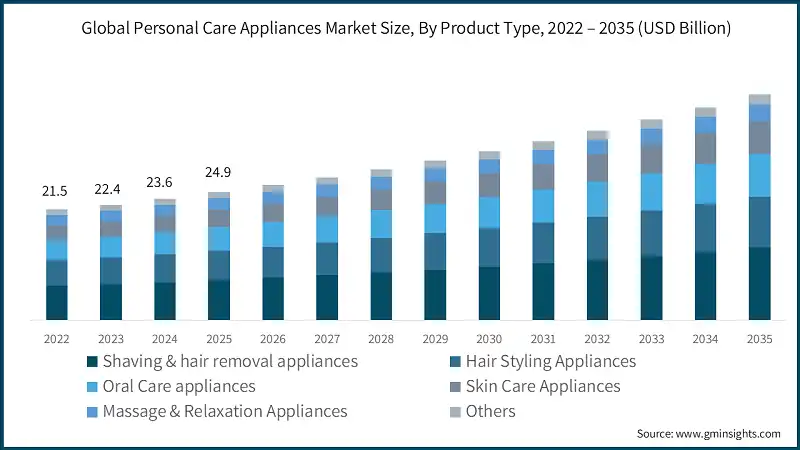
Based on the product type, the market is divided into shaving & hair removal appliances, hair styling appliances, oral care appliances, skin care appliances, massage & relaxation appliances, and others. The shaving & hair removal appliances segment held the largest share, accounting for 31.4% of the global personal care appliances market in 2025.
- The need for precision grooming and the rising popularity of body hair grooming among men is encouraging segment growth.
- Shaving and hair removal appliances hold a significant portion of the market value, indicating a continued professional and consumer preference for high-capacity systems capable of handling daily grooming in private environments.
- Skin care and oral care appliances segments show a healthy growth rate (6.5% and 6.3% respectively), suggesting consistent demand from the wellness sectors where high-speed cleaning and smart diagnostics are prioritized.
- Hair styling appliances are ideal for specialized home and salon setups. Users appreciate the durability of these systems for handling high-temperature styling without compromising hair health.
Learn more about the key segments shaping this market
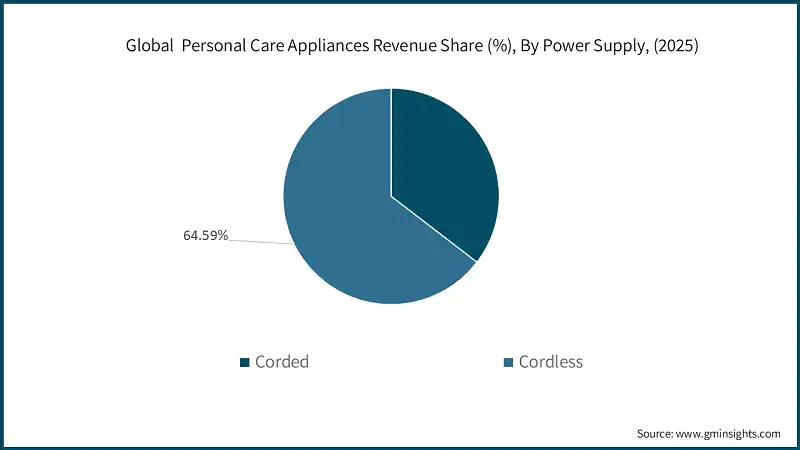
Based on the power supply, the personal care appliances market is segmented into corded and cordless. In 2025, cordless held a major market share of 64.59%, generating a revenue of USD 16.1 billion.
- Cordless personal care appliances offer enhanced productivity, reduced labor constraints, and improved mobility. The integration of technologies like lithium-ion batteries and wireless charging further bolsters their efficiency and reliability.
- Consumers increasingly rely on cordless appliances to meet the growing demand for on-the-go grooming and travel convenience, driving market growth.
- The cordless segment represents the largest portion of the market, reflecting the industry's shift towards portability and smart technology that maximizes convenience and minimizes cord-related clutter.
- Cordless modes, often involving features like USB-C charging and LED battery indicators, highlight the demand for intelligent systems that can self-diagnose battery health.
- The corded segment maintains a solid growth rate of 6.2%, representing cost-effective or high-power solutions for professional salons or hair drying applications where continuous power remains necessary.
Based on the distribution channel, the Personal care appliances market is segmented into online and offline. In 2025, offline held the major market share of 56.2%, reflecting the industry’s reliance on physical retail experience and immediate availability.
- Offline sales represent the largest portion of the market, driven by the critical role of specialty beauty stores and hypermarkets that provide hands-on product demonstrations.
- This dominance is fueled by the need for localized technical support and immediate purchase gratification. Consumers often prefer offline channels for high-end beauty tools to verify ergonomic comfort and build quality.
- Online sales are the fastest-growing channel (CAGR 6.3%), typically involving transactions through e-commerce giants and brand-specific websites, where the ease of comparison and home delivery drives high-volume retail performance.
Looking for region specific data?
North America Personal Care Appliances Market
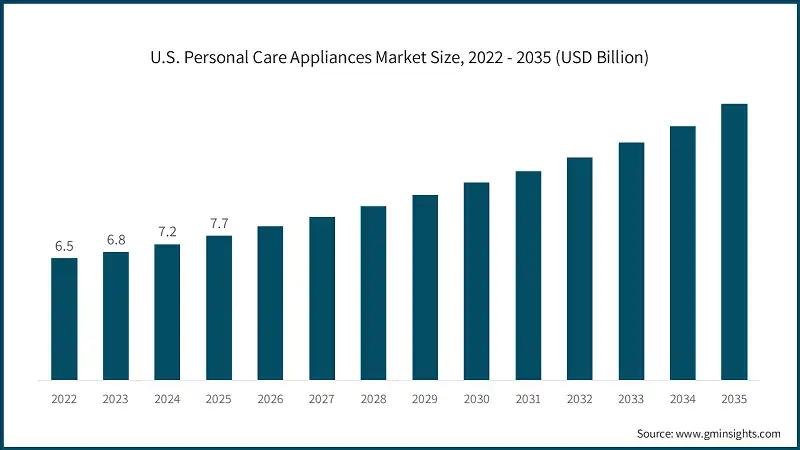
In 2025, North America is a key regional market with an estimated value of USD 9.1 billion and a projected growth rate of 6.7% through 2035.
- The U.S. leads the region, showing a strong growth rate of 6.7%. This growth is driven by a mature market with massive investments in smart home technology and the rapid expansion of the premium grooming sector.
- Personal care appliances are essential tools for modern households, where the transition to high-tech skin and oral care is at an all-time high.
- The North American market meets this need by offering advanced IoT-enabled devices that support personalized health tracking and professional-grade results.
- The demand is further fueled by a focus on self-care and aesthetic maintenance, as consumers look to reduce expensive salon visits and improve grooming efficiency across the continent.
Europe Personal Care Appliances Market
Europe is a significant market estimated at USD 6.8 billion in 2025 with a projected growth rate of 5.6%. Germany leads the region with a growth rate of 6.2% due to its strong engineering base and consumer preference for durable electronics.
- The European market benefits from sustainability initiatives and eco-design regulations, encouraging the adoption of energy-efficient motors and recyclable materials.
- These efforts make Europe a competitive landscape for innovation, particularly in "green" beauty technologies that reduce power consumption through smart thermal control.
- Countries like France and Italy experience steady growth driven by the modernization of professional hair and beauty salons, requiring high hygiene and safety standards.
- The focus on high-quality manufacturing in Europe promotes the integration of ergonomic designs to streamline grooming time and minimize environmental impact.
Asia Pacific Personal Care Appliances Market
Asia Pacific is a rapidly expanding regional market. It has an estimated market value of USD 5.4 billion in 2025 with a projected growth rate of 5.2% from 2026 to 2035.
- India has the highest sub-regional growth rate in the data set (though China remains the largest share), with China valued at USD 1.8 billion in 2025.
- The rapid growth results from massive urbanization and an expanding middle class that requires modern lifestyle grooming tools.
- Rising demand for high-quality production and better personal aesthetics influences the market, as consumers in the region shift from manual grooming to electric platforms.
- Countries like Japan and Australia are also important players, utilizing sophisticated appliances for high-tech oral care and advanced hair styling operations.
Latin America Personal Care Appliances Market
Latin America represents a developing segment expected to reach USD 1.9 billion by 2025, growing at a rate of 5.4% from 2026 to 2035.
- Overall growth is steady as increasing urbanization, and a growing retail sector boosts the demand for professional grooming and hygiene products.
- Market players are focusing on durable, cost-effective equipment to cater to the diverse socioeconomic demographics, which remain the backbone of the region's consumer demand.
- While economic variability exists, the long-term trend points toward increased adoption of electric appliances in urban centers to improve personal grooming standards.
Personal Care Appliances Market Share
Koninklijke Philips N.V. is leading with a 7% market share. Koninklijke Philips N.V., Panasonic Corporation, Procter & Gamble Co., Conair Corporation, and Dyson Limited collectively hold around 35%, indicating a moderately fragmented market concentration with a strong tier of dominant global players. These prominent players are proactively involved in strategic endeavors, such as mergers & acquisitions, facility expansions, and collaborations, to expand their product portfolios, extend their reach to a broad customer base, and strengthen their market position.
Helen of Troy Limited completed the acquisition of Olive & June, a leading pioneer in at-home manicure systems and nail care, to strengthen its Beauty & Wellness segment. This strategic move significantly expanded Helen of Troy’s footprint in the global prestige beauty sector. The acquisition allowed the company to integrate innovative DIY nail technologies, reinforcing its commitment to high-performance, salon-quality results at home. Noel Geoffroy, CEO of Helen of Troy, emphasized that the deal provides a broader range of future-oriented wellness solutions to help consumers tackle evolving self-care needs.
Panasonic Corporation unveiled an array of new digital monitoring attachments for its high-end grooming range, catering to both residential and professional barbering applications. The additions included the Palm Shaver Gen-2 system, a 2D sensor-based grooming tool capable of measuring hair density in real-time. This technology features smart sensors for improved visibility into blade health and robust durability for travel environments. A senior product manager highlighted the company's commitment to enhancing grooming performance by providing users with a comprehensive set of digital tools for predictive maintenance.
Personal Care Appliances Market Companies
Major players operating in the personal care appliances industry are:
- Andis Company
- Colgate-Palmolive Company
- Conair Corporation
- Dyson Limited
- Flyco
- Groupe SEB
- Havells India
- Helen of Troy
- Koninklijke Philips N.V.
- Lion Corporation
- Panasonic Corporation
- Procter & Gamble Co.
- Shiseido Company
- Spectrum Brands, Inc.
- Wahl Clipper Corporation
Dyson Limited expanded its range of hair care platforms with the introduction of the Air wrap i.d., a connected multi-styler compatible with high-speed personalized styling routines via the MyDyson app. Engineered for optimal productivity and precise heat control, this rigid-mount system offered faster operation compared to older manual curling designs. Unveiled at a major 2025 global launch event, its modular attachment and forward-reaching airflow design improved control for diverse hair textures. The design's advantage lies in providing better flow control and eliminating the need for constant manual adjustments during morning routines.
Personal Care Appliances Market Report Attributes
| Key Takeaway | Details |
|---|---|
| Market Size & Growth | |
| Base Year | 2025 |
| Market Size in 2025 | USD 24.9 Billion |
| Market Size in 2026 | USD 26.3 Billion |
| Forecast Period 2026 - 2035 CAGR | 5.9% |
| Market Size in 2035 | USD 43.8 Billion |
| Key Market Trends | |
| Drivers | Impact |
| Rise in male grooming & self-care | The normalization of male-specific grooming routines drives massive demand for specialized trimmers and body groomers. |
| Smart & connected ecosystems | Transitioning to "Smart Bathrooms" requires appliances that sync with mobile apps for real-time coaching and health tracking. |
| Sustainability & eco-design | Consumer demand for "clean beauty" pushes brands toward rechargeable batteries and plastic-free packaging, reducing environmental footprints. |
| Pitfalls & Challenges | Impact |
| High cost of premium devices | The significant upfront cost for high-precision, AI-integrated hair or skin tools acts as a barrier for mass-market adoption. |
| Proliferation of counterfeit products | Low-quality replicas in e-commerce channels undermine brand trust and pose safety risks (e.g., battery fires or skin burns). |
| Opportunities: | Impact |
| AI-Driven personalization | Using sensors to monitor hair moisture or plaque levels opens new revenue streams for personalized subscription-based refills. |
| Travel-friendly & cordless designs | The rise of global travel and "on-the-go" lifestyles creates a need for compact, USB-C rechargeable, and dual-voltage appliances. |
| Market Leaders (2025) | |
| Market Leaders |
7% market share |
| Top Players |
|
| Competitive Edge |
|
| Regional Insights | |
| Largest market | North America |
| Fastest growing market | Asia Pacific |
| Emerging countries | China, India, Brazil |
| Future outlook |
|
What are the growth opportunities in this market?
Personal Care Appliances Market News
- In November 2025, Andis Company (specialized grooming) introduced two new high-production clippers: the eMERGE Cordless (a high-torque rotary motor unit for bulk hair removal) and the beSPOKE Trimmer (featuring a redesigned wireless induction charging system for simplified maintenance). The eMERGE is designed for high-capacity professional work, utilizing a gearbox-driven motor to eliminate blade slippage, while the beSPOKE introduces a side-mounted induction motor system to simplify maintenance on its medium-load platform.
- In July 2025, Koninklijke Philips N.V. launched the OneBlade 360 Pro, a self-propelled grooming unit equipped with a high-efficiency motor and the proprietary SmartAdapt control system. This system automatically adjusts the blade speed based on hair thickness, maximizing energy efficiency; the 360 Pro also boasts a narrow frame for easy integration into compact travel kits.
- In 2025, Havells India will continue to offer their specialized, high-performance modular attachments for the Havells Studio line. This focuses on high mobility and lower overhead for younger consumers that require rapid reconfiguration of their styling tools through interchangeable heads and compact ergonomic handles.
- On January 29, 2024, Koninklijke Philips NV introduced a groundbreaking hair straightener featuring Nourish Care Technology. This straightener includes specially designed serum strips infused with hair-nourishing ingredients, Vitamin E, and Moroccan Argan oil, along with Kerashine care, which styles and nourishes hair while protecting it from heat damage. Technology retains moisture typically lost due to heat, resulting in nourished, healthy-looking hair.
- On January 8, 2024, Panasonic Corporation launched the Palm Shaver (ES-PV6A-W), a compact, five-bladed shaver designed to fit comfortably in the user's hand. It features a five-blade system that captures and cuts every beard texture, ensuring a smooth and close shave. The Palm Shaver's body is made from NAGORI, a sustainable material derived from sea minerals, reducing plastic usage by over 40%.
- In September 2024, Procter & Gamble (Braun) introduced the redesigned Series 9 PRO+, tailored for professional stylists and high-frequency travelers. This new iteration boasted robust performance in beard sortation and skin protection. Powered by a high-efficiency electric drive, it featured a Series III SyncroSonic head, aggressive infeed for diverse hair flat-lying hairs, and various durability enhancements. Operating at a quiet 65 decibels, the Series 9 PRO+ addressed the needs of professionals aiming to broaden their grooming capacity. The President of Braun Intralogistics emphasized its versatility and performance attributes in modern "smart bathrooms."
- In 2024, Conair Corporation continued to emphasize its powerful heavy-duty models, such as the Digital Dryer TR165, which uses a high-performance brushless engine and incorporates their Command Flow automatic speed control to enhance performance on large-scale hair volumes. This focuses on meeting energy standards without the need for complex internal heating fluid additives.
The personal care appliances market research report includes in-depth coverage of the industry with estimates & forecasts in terms of revenue (USD Billion) and volume (Million Units) from 2022 to 2035, for the following segments:
Market, By Product Type
- Shaving & hair removal appliances
- Electric shavers
- Trimmers & epilators
- IPL hair removal devices
- Others (nose & ear trimmers)
- Hair styling appliances
- Hair dryers
- Hair straighteners
- Curling irons and wands
- Hair clippers and trimmers
- Oral care appliances
- Electric toothbrushes
- Water flossers
- Whitening devices
- Skin care appliances
- Anti-aging devices
- Microcurrent
- LED light therapy
- Radiofrequency treatment devices
- Facial cleansing tools
- Facial massagers
- Others (ultrasonic pore extractors)
- Anti-aging devices
- Massage & relaxation appliances
- Hair growth stimulation
- Foot and leg massagers
- Electric body massagers
- Muscle massage guns
- Others
Market, By Consumer Group
- Men
- Women
- Unisex
Market, By Power Supply
- Corded
- Cordless
Market, By End Use
- Residential
- Commercial
Market, By Distribution Channel
- Online channels
- E-commerce platforms
- Company Websites
- Offline channels
- Specialty stores
- Supermarkets and hypermarkets
- Department stores
The above information is provided for the following regions and countries:
- North America
- U.S.
- Canada
- Europe
- Germany
- UK
- France
- Italy
- Spain
- Asia Pacific
- China
- India
- Japan
- Australia
- South Korea
- Latin America
- Brazil
- Mexico
- Argentina
- Middle East and Africa
- South Africa
- Saudi Arabia
- UAE
Frequently Asked Question(FAQ) :
What is the projected value of the personal care appliances market by 2035?
The market is expected to reach USD 43.8 billion by 2035, driven by technological advancements, product innovation, and increasing consumer demand for efficient grooming solutions.
What is the projected size of the personal care appliances market in 2026?
The market is expected to reach USD 26.3 billion in 2026.
How much revenue did the cordless segment generate?
The cordless segment generated USD 16.1 billion in 2025, accounting for 64.59% of the market share.
What was the valuation of the offline distribution channel segment?
The offline distribution channel held 56.2% of the market share and generated significant revenue in 2025, reflecting the industry's reliance on physical retail.
Which region leads the personal care appliances market?
North America led the market in 2025 with an estimated value of USD 9.1 billion and a projected growth rate of 6.7% through 2035. The region's dominance is attributed to strong consumer demand and technological adoption.
What are the upcoming trends in the personal care appliances industry?
Key trends include the integration of IoT-enabled app coaching, AI-guided features, haptic feedback systems, infrared drying technology, and hypersonic motors, enhancing safety, performance, and user comfort.
Who are the key players in the personal care appliances market?
Key players include Andis Company, Colgate-Palmolive Company, Conair Corporation, Dyson Limited, Flyco, Groupe SEB, Havells India, Helen of Troy, Koninklijke Philips N.V., Lion Corporation, and Panasonic Corporation.
Personal Care Appliances Market Scope
Related Reports