Summary
Table of Content

Particulate Matter Monitoring Market
Get a free sample of this report
Form submitted successfully!
Error submitting form. Please try again.
Thank you!
Your inquiry has been received. Our team will reach out to you with the required details via email. To ensure that you don't miss their response, kindly remember to check your spam folder as well!
Request Sectional Data
Thank you!
Your inquiry has been received. Our team will reach out to you with the required details via email. To ensure that you don't miss their response, kindly remember to check your spam folder as well!
Form submitted successfully!
Error submitting form. Please try again.
Particulate Matter Monitoring Market Size
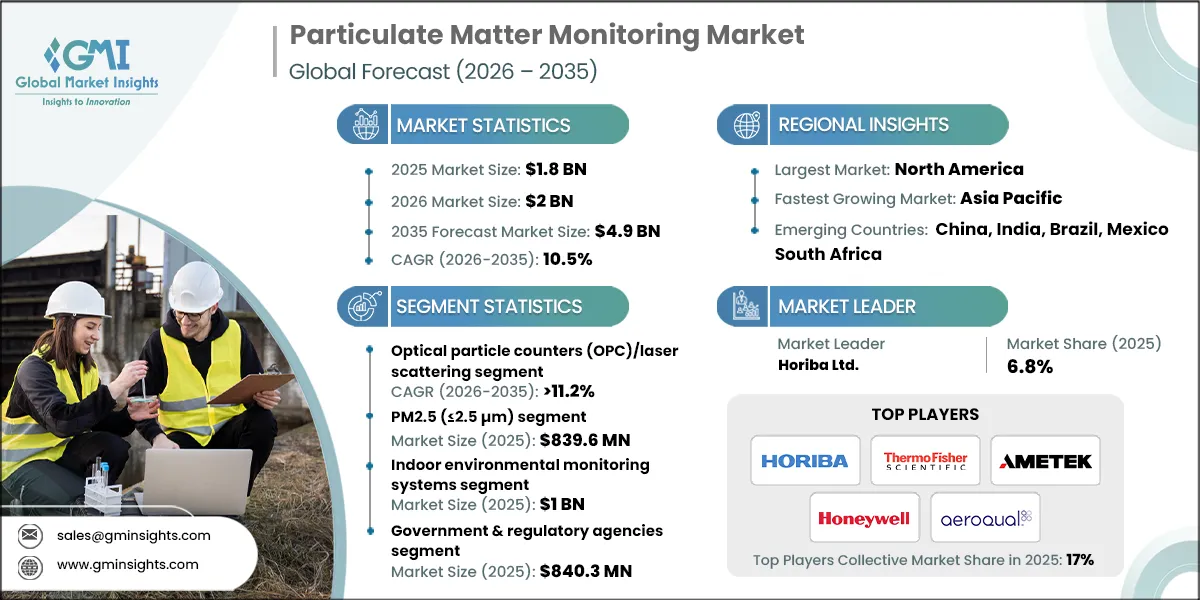
The global particulate matter monitoring market was estimated at USD 1.8 billion in 2025. The market is expected to grow from USD 2 billion in 2026 to USD 4.9 billion by 2035, at a CAGR of 10.5% during 2026–2035, according to latest report published by Global Market Insights Inc.
Particulate Matter Monitoring Market Key Takeaways
Market Size & Growth
- 2025 Market Size: USD 1.8 Billion
- 2026 Market Size: USD 2 Billion
- 2035 Forecast Market Size: USD 4.9 Billion
- CAGR (2026–2035): 10.5%
Regional Dominance
- Largest Market: North America
- Fastest Growing Region: Asia Pacific
Key Market Drivers
- Increasing government laws and standards for monitoring air quality.
- Monitoring of ambient air quality is becoming more important.
- Rising demand of particulate matter levels in automotive and transportation sectors.
- Increasing awareness about the health risks associated of particulate matter.
- Ongoing advancements in PM monitoring systems.
Challenges
- Complex process of Installing and maintaining PM monitoring devices.
- Delays in underdeveloped nations in implementing PM monitoring solutions.
Opportunity
- Expansion of smart cities and digital environmental infrastructure.
- Growing demand for indoor air quality monitoring.
Key Players
- Market Leader: Horiba Ltd. led with over 6.8% market share in 2025.
- Leading Players: Top 5 players in this market include Horiba Ltd., Thermo Fisher Scientific, AMETEK, Inc., Honeywell International, Aeroqual Group Limited, which collectively held a market share of 17% in 2025.
Get Market Insights & Growth Opportunities
PM monitoring focuses on measuring suspended solid particles and liquid droplets in the atmosphere, such as dust, soot, smoke, with an emphasis on PM 2.5 and PM 10 to evaluate the level of air quality. Highly accurate reference stations, portable artificial intelligence sensors with real-time communication capabilities, and IoT-based devices are available to monitor PM concentrations indoors and outdoors. These systems are used to monitor the levels of PM for public health risk assessment, regulatory compliance, and to help manage pollution.
The global trend toward tightening air quality standards and more stringent emissions controls is creating demand for advanced particulate matter monitoring systems. As a result, governments and environmental agencies are increasingly implementing requirements for continuous and reliable PM data in order to ensure compliance, protect public health, and influence urban planning, which provides incentive for investment in monitoring infrastructure and supporting analytics platforms around the world. For instance, in June 2024, EarthSense partnered with Ganeca Environmental Services, to provide its bespoke solutions and services to the Indonesian government and industries to visualize and manage air quality issues.
Growing population and industrialization within emerging markets around the world have led to increasing amounts of airborne particulate matter (and subsequently an increased amount of split carbon). The increase in airborne particulate levels means there will be a requirement for the establishment of dense networks of sensors to monitor the levels of particulate matter in real time, providing local authorities and businesses with the opportunity to respond effectively to the issue, manage sources of pollution and plan sustainable development throughout metropolitan and industrial areas. For instance, in March 2025, Aclima launched mobile labs in 37 to measure fine particulate matter, black carbon, and VOCs to improve local air quality insights.
Advancements in the miniaturization of sensors and the development of semiconductor technologies have enabled the rapid adoption of affordable, low-power particulate matter sensors. These low-cost sensors will enable monitoring capabilities to be expanded into communities, homes and mobile applications and democratize access to air quality data. Using small-scale Air Quality Monitoring will augment the Data we get from Reference-grade Air Quality Monitoring Stations. For example, in September 2025, Sensirion collaborated with Terabee to expand Indoor Air Quality Monitoring to combat air pollution-related illness.
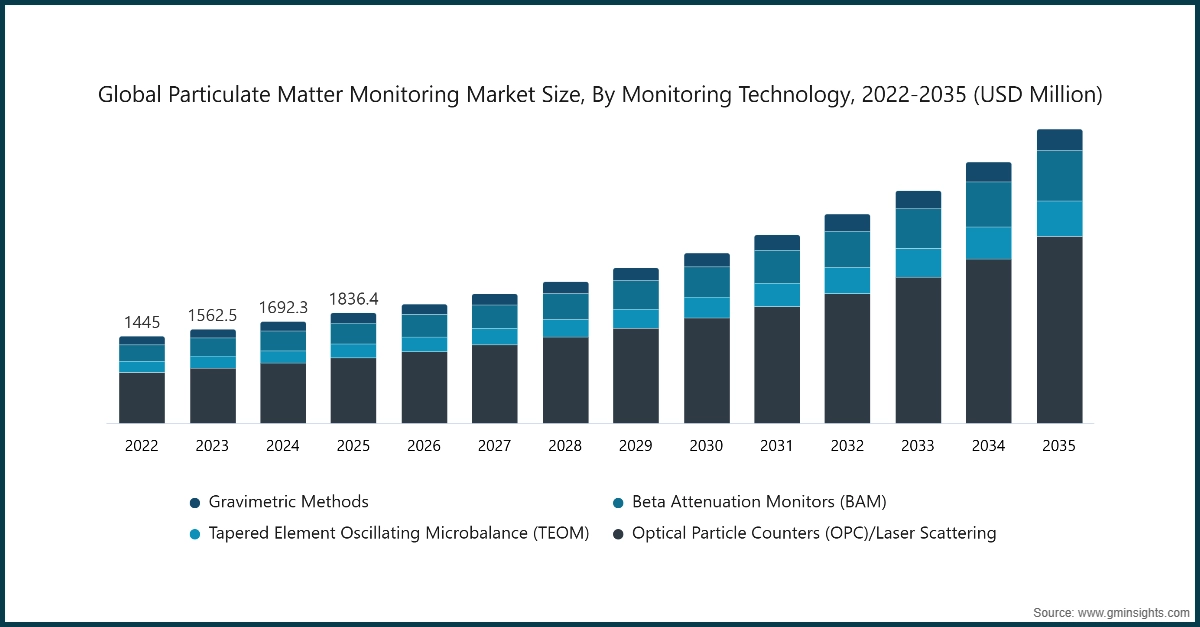
Between 2022 and 2024, the particulate matter monitoring market experienced significant growth, rising from USD 1.4 billion in 2022 to USD 1.7 billion in 2024. A major trend during this period was combination with the Internet of Things (IoT). IoT-connected sensor likely to provide real-time data to users through the cloud and provide analytical dashboards of that data, provide predictive insight, send automated alerts, and integrate seamlessly with existing smart city and environmental management systems. For instance, in December 2025, Aimtron Electronics partnered with Aurassure to launch IoT-based weather and environmental monitoring systems in India.
Artificial intelligence (AI), machine learning (ML) and advanced analytical tools expected to significantly change the way PM is monitored. AI, ML and advanced analytics will enable higher accuracy data analysis, better detection of PM pollution patterns, improved predictive modelling and improved decision making by both policy makers and businesses. Advanced analytics provide better insights into PM levels versus human health, traffic pattern comparisons, and the impact of PM on weather conditions. For instance, in March 2023, Piera Systems Inc. partnered with MACSO Technologies to organize Piera’s state-of-the-art hardware and accurate air quality data with MACSO’s AI/ML software platform to greatly accelerate the development and deployment of new pollutant models.
Growing awareness of the health impacts of fine particulate matter—especially PM2.5—among consumers, employers, and healthcare professionals is boosting monitoring demand. As a result of increased interest in both Indoor and Outdoor Air Quality, we are seeing more Schools, Hospitals, Workplaces and Homes adopting these systems. Community-led initiatives about Air Pollution have also been built around them. For instance, in January 2026, The National Clean Air Programme (NCAP) developed PM2.5 Monitoring to address the Health Issues that get from the massive amounts of Air Pollution present in many parts of India, the NCAP has set a goal of reducing PM2.5 levels by 40% by 2026.
To get key market trends
Particulate Matter Monitoring Market Trends
Cloud-connected Smart Particulate Sensors combined with IoT Platforms and Advanced Analytics are expected to enable Central Air Quality Network monitoring capabilities through centralized location of Particulates in real-time, quicker Access to Particulates for monitoring systems allowing for Increased Speed of Decision Making in Urban Environments, Industrial Zones, Transportation Corridors and Smart Cities.
Growing Demand for Accurate and Reliable Monitoring of Particulate Matter is perceived to be related to the Increased Adoption of Digital Environmental Management Systems and Automation. Connected PM Monitors allow for the Transferring of Data seamlessly among Monitoring Sensors, Monitoring Control Platforms and PM Regulations, therefore Helping Improve Monitor Efficiency, Data Consistency and Responsiveness in Complex Environments. For instance, in October 2025, Ransons Aerospace partnered with Optimare India to develop and produce advanced Pollution Monitoring/Surveillance Systems (PMS/PSS) in India.
- Participation in monitoring particulate matter has exploded in recent years due to the rollout of integrated environmental and data platforms, which allow for real-time analysis, edge computing, and predictive analytics of particulate matter data. The growth of scalable, reliable, and efficient air quality management networks through cloud and hybrid architecture will further support continued growth in the demand for particulate matter monitoring systems.
Particulate Matter Monitoring Market Analysis
Learn more about the key segments shaping this market
The global market for particulate matter monitoring was valued at USD 1.4 billion and USD 1.6 billion in 2022 and 2023, respectively. The market size reached USD 1.8 billion in 2025, growing from USD 1.7 billion in 2024. Based on monitoring technology, the market is segmented into gravimetric methods, beta attenuation monitors (BAM), tapered element oscillating microbalance (TEOM), and optical particle counters (OPC)/laser scattering. The optical particle counters (OPC)/laser scattering segment is estimated to register a significant growth rate of over 11.2% through 2035.
- The optical particle counters (OPC)/laser scattering segment holds the largest share in the particulate matter monitoring market, driven by their high accuracy of their measurements, ability to monitor continuously in real-time, and ability to measure a wide range of particle sizes has created strong demand among those using their products for measuring ambient air quality, emissions, and compliance with regulatory requirements.
- Manufacturers should focus on advancing laser scattering and OPCT technology has created new opportunities by increasing how sensitive sensors are, increasing calibration stability, and providing the ability to analyze more data from fewer sensors. Emphasizing compact size of products, requiring less maintenance, and enabling easy integration of sensors into digital air quality platforms increases competitiveness, complies with regulations, and provides a wider range of applications in urban air quality monitoring, industrial facilities monitoring, and smart city projects.
- The Tapered Element Oscillating Microbalance (TEOM) segment in the particulate matter monitoring market is anticipated to witness significant growth, projected to expand to a CAGR of 10.3% during the forecast period. This growth is driven by growing need for ongoing, instant monitoring of airborne particles; tighter air quality standards and growing purchase of TEOMs by authorities responsible for enforcing air quality regulation; and increasing use of TEOMs by industrial operations to obtain an accurate mass-based measurement of PM for regulatory compliance are the drivers of increasing demand.
- Manufacturers should focus on developing high accuracy/low maintenance TEOM systems that include improved on-line data capturing and remote access monitoring capabilities. A commitment to meeting government and industrial buyers' regulations, system stability, cost-efficiency and integrating with digital platforms for air quality measurement will assist in satisfying the expected increase in demand from governmental and industrial purchases of continuous in-line airborne particulate sampling systems.
Based on the particulate matter size, the market is segmented into PM2.5 (≤2.5 µm), PM10 (≤10 µm), and PM1 (≤1 µm). The PM2.5 (≤2.5 µm) segment dominated the market in 2025 with a revenue of USD 839.6 million.
- The PM2.5 (≤2.5 µm) segment holds the largest share of the particulate matter monitoring market, driven by increasing connection with health risks related to respiratory and cardiovascular disorders. As the amount of regulation, public health education, and the increasing use of PM2.5 data for air quality monitoring in neighborhoods, urban planning, and pollution reduction programs continue to rise, the demand for purchasing PM2.5 monitoring systems remains high.
- Manufacturers should focus on developing smaller and lower maintenance PM2.5 monitoring systems and integrating them into digital air quality networks to support compliance with regulatory standards and increase adoption in urban, industrial, and indoor monitoring settings.
- The PM10 (≤10 µm) segment in the particulate matter monitoring market is anticipated to witness significant growth, projected to expand at a CAGR of 10.2% and reach USD 1.6 billion by 2035. This growth is driven by increasing regulatory requirement for monitoring of coarse particles related to various activities including construction, mining, road dust, and industrial processes, are increasing. Urbanization, improvements to infrastructure, and increased traffic emissions are generating demand for PM10 monitoring. The increased availability of PM10 monitoring systems on the market; along with increased public education about PM10's negative effects on respiratory health; and increased implementation of PM10 monitoring in ambient air quality networks, industrial compliance monitoring, and environmental impact assessments; will all continue to drive strong market growth for PM10 monitoring systems.
- Manufacturers should focus on developing robust and accurate PM10 monitoring systems on the market are built to withstand the rigors of being used outdoors. New technology is available that allows for real time measurements to be made, multiple methods of calibration to be used, and simplified integration of PM10 monitoring systems with centralized air quality monitoring networks. These types of solutions will support compliance with regulatory standards for monitoring, facilitate compliance with regulatory requirements for PM10 monitoring at construction sites, industrial facilities, and through urban air quality monitoring networks.
Based on the product type, the particulate matter monitoring market is segmented into outdoor ambient monitoring systems, indoor environmental monitoring systems, and personal wearable exposure monitors. The indoor environmental monitoring systems segment dominated the market in 2025 with a revenue of USD 1 billion.
- The indoor environmental monitoring systems segment holds the largest share of the particulate monitoring market, driven by growing recognition of the significance of air quality inside buildings, as well as the increasing demand for indoor air quality monitors in workplaces, schools, and healthcare settings due to public concerns about the effects of air pollutants on health, this systemic increase in demand is also driven by the greater number of smart buildings being constructed and the regulatory compliance associated with smart-building technologies.
- Manufacturers should focus on developing systems for continuous and highly accurate measurement of the quality of indoor environments is well proceeding. Seamless interfacing between the measurement system and smart building platforms, combined with low-maintenance and accurate systems, will assist in the establishment of indoor environmental management procedures in workplaces, schools, and healthcare facilities, thereby assisting with the attainment of regulatory compliance and improved management of both indoor air quality and associated public health issues.
- The outdoor ambient monitoring systems segment in the particulate matter monitoring market is anticipated to witness significant growth rate of 10.1%, driven by increasing urban development, industrial development, and road vehicles contribute to the increase in concentrations of air pollutants found in the outdoor ambient environment. Governmental regulations are increasing in number, as are requirements for the measurement of the outdoor ambient environment. Furthermore, because of the smart city's initiatives, research in environmental issues, and public health-related issues, the demand for outdoor ambient monitoring is increasing, and jurisdictions are using outdoor ambient monitoring systems to track and mitigate pollution, as well as to protect the health of their citizens more effectively.
- Manufacturers should focus on developing robust, highly precise, and that measure the outdoor ambient environment in near real time; the many benefits associated with achieving these items will positively impact the efforts aimed at ensuring regulatory compliance, the continued improvement of air quality in urban environments, and protecting the public health of the citizenry. Advanced analytics capabilities and the ability to connect with smart city networks will further increase adoption among users of outdoor ambient air quality monitoring systems, including industrial, municipal, and research users.
Learn more about the key segments shaping this market
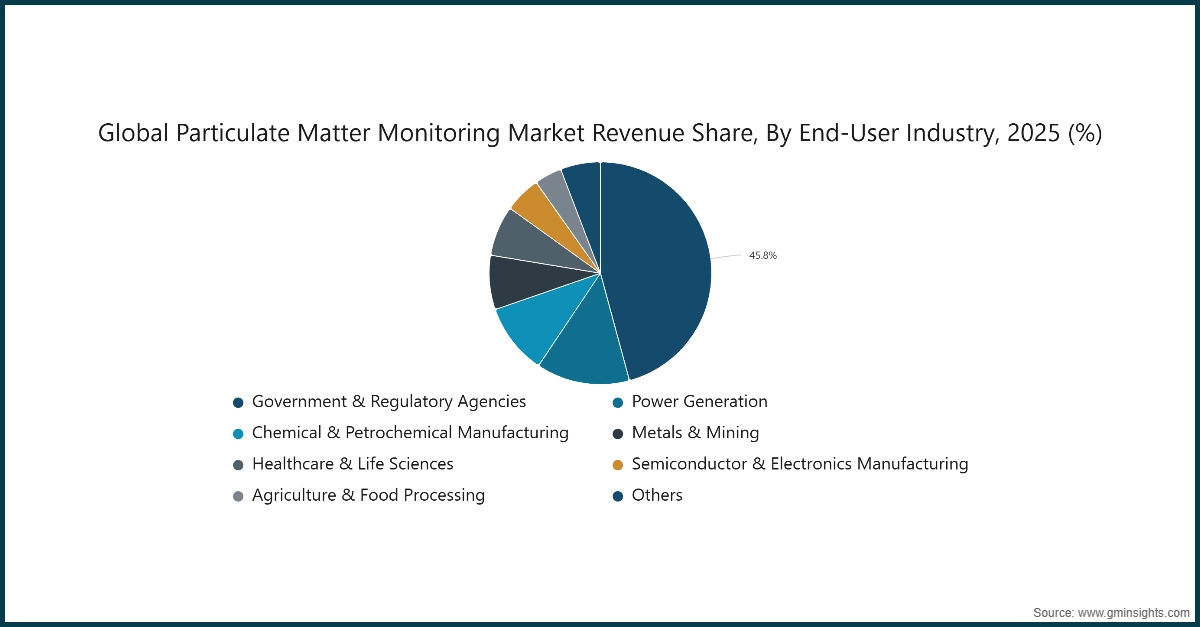
Based on the end-use industry, the particulate matter monitoring market is segmented into government & regulatory agencies, power generation, chemical & petrochemical manufacturing, metals & mining, healthcare & life sciences, semiconductor & electronics manufacturing, agriculture & food processing, and others. The government & regulatory agencies segment dominated the market in 2025 with a revenue of USD 840.3 million.
- The government & regulatory agencies segment holds the largest share of the particulate matter monitoring market, driven by increasing public health exposure and concern about air quality regulations and environmental pollution manufacturing component suppliers must create reliable, accurate, quality, real-time particulate matter monitoring devices specified for use by regulatory authorities.
- Manufacturers should focus on providing information technology and service partners with the data necessary to satisfy public health issues, enforce environmental regulations and grow their position within this very competitive marketplace.
- The power generation segment in the particulate matter monitoring market is anticipated to witness significant growth, projected to expand at a CAGR of 11.1% and reach USD 706.1 million by 2035. This growth is driven by growing number of stringent environmental regulations, there has been an increase in the demand for cleaner energy production, as well as a heightened requirement for monitoring emissions produced by coal, gas and renewables powered generators. As individuals have become more aware of the negative health and environmental impact associated with particulate matter, as well as more stringent regulations from governmental organizations regarding the control of emissions; power producers are turning to more advanced and reliable solutions for real-time monitoring of particulate emissions.
- Manufacturers should focus on providing advanced and reliable particulate matter monitoring solutions for the power generation sector. By emphasizing compliance with environmental regulations, real time emissions tracking and improving operational efficiencies, manufacturers can assist power producers in reducing their air and water pollution, meeting governmental regulatory requirements, supporting sustainable energy initiatives; in turn allowing manufacturers to take advantage of the growing demand for particulate matter monitoring solutions.
North America Particulate Matter Monitoring Market
The North American particulate matter monitoring market dominated around 44% of the revenue share in 2025, rapidly expanding due to stringent regulations on air quality, continuing concerns about the impact of air pollution on human health and the environment, widespread use of advanced monitoring technologies, increased public awareness of the impacts that air pollution has on human health and the environment and large government and private investments in environmental monitoring, smart city initiatives and data-driven air quality improvement solutions.
- Manufacturers should focus on developing accurate, cost-effective and real-time particulate monitoring solutions expected to develop by building the infrastructure necessary to support a network of smart monitoring technologies using cloud-based server technology that meet regulatory compliance requirements, which will enable the monitoring and reporting of real-time particulate matter to support the continued development of smart cities across North America.
Looking for region specific data?
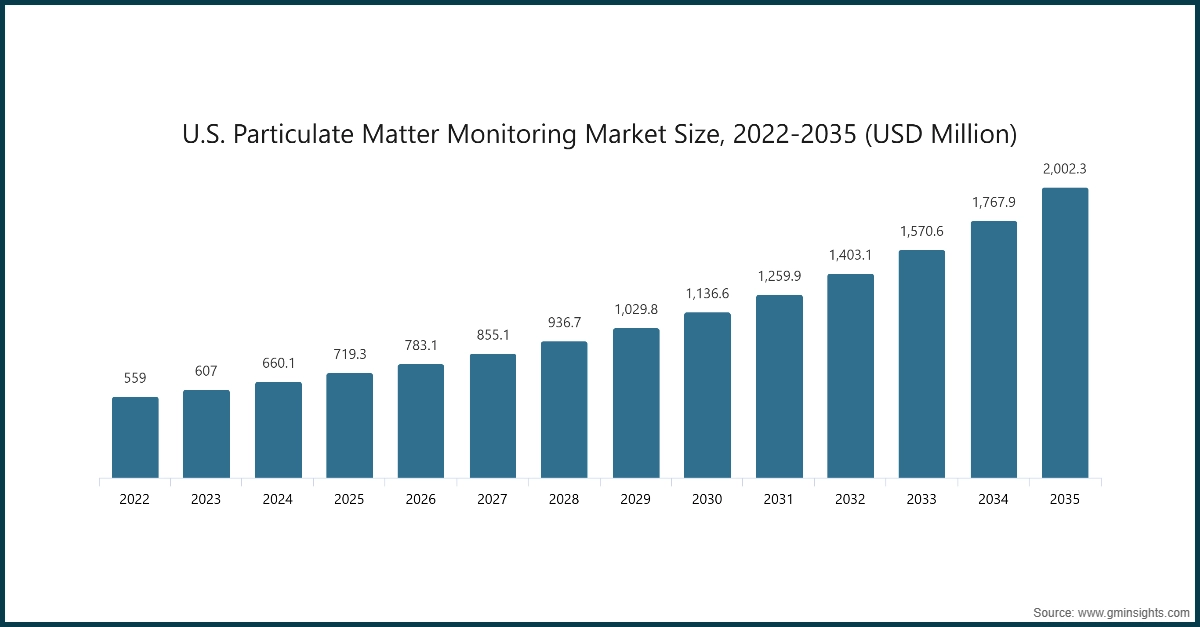
The U.S. particulate matter monitoring market was valued at USD 559 million in 2022 and USD 607 million in 2023, reaching USD 719.3 million in 2025, up from USD 660.1 million in 2024.
- The U.S. continues to lead the particulate matter monitoring industry , driven by rising focus on public health issues, urban air pollution control and smart city initiatives; the presence of a number of significant companies within the industry; increasing federal investment in air quality infrastructure and strict environmental regulations all contributes to the continued dominance of the air quality industry in North America.
- Manufacturers should focus on delivering accurate, actionable, and scalable particulate matter monitoring solutions through technological innovations, collaborative partnerships with government agencies and the use of cloud analytics technologies. These partnerships and technological advances should lead to increased demand for particulate matter monitoring solutions in the U.S. and therefore, increased regional air quality market share.
Europe Particulate Matter Monitoring Market
The Europe particulate matter monitoring industry accounted for USD 456.4 million in 2025 and is anticipated to witness strong growth over the forecast period.
Europe holds a significant share of the particulate matter monitoring market, driven by growing awareness of the health risks associated with air pollution and the beneficial effects of improving air quality. Many governmental and educational institutions are instituting more initiatives to improve the world's air quality by investigating new technologies to monitor air quality in real time.
- Manufacturers should focus on providing advanced, compliant solutions for measuring airborne particulate matter (PM) levels in Europe, emphasizing accurate real-time reporting of data, integration with air quality control systems used by smart cities and industries, and collaboration with regulatory bodies to develop innovative technologies to meet the increasingly stringent environmental regulations that are expected to come into effect; thereby, improving their ability to compete across the European region.
Germany dominates the Europe particulate matter monitoring market, showcasing strong growth potential.
- Germany is experiencing a surge in market growth due to strict environmental regulations, advanced air quality management programs, the public's growing concern about health effects from pollution, and investments in smart city and industrial emission management programs. The growth of technological innovation through Industry 4.0 is helping to further increase the contribution of Germany to the global market.
- Manufacturers should focus on dependable, precise, and scalable particle monitoring solutions throughout Germany, along with real-time particle monitoring solutions using cloud-enabled platforms for particles as well as hybrid deployment models. working with local authorities, research institutions and industrial stakeholders will create opportunities for innovation, ensure compliance with regulatory requirements, and help establish strong brand presence in both urban, industrial and commercial markets throughout Germany.
Asia-Pacific Particulate Matter Monitoring Market
The Asia-Pacific particulate matter monitoring industry is anticipated to grow at a CAGR of 11.6% during the analysis period.
The Asia-Pacific market is experiencing rapid growth, driven by rising industrial automation, smart manufacturing, and the adoption of industry 4.0 has generated increased demand for IoT-enabled networks that support real-time data transmission and cloud-integrated particulate matter monitoring solutions within the manufacturing, energy, automotive, and healthcare sectors. As a result of these trends is accelerating digital transformation and operational efficiency within the region.
- Manufacturers should focus on Developing cost-effective, accurate, and scalable PM monitoring solutions is critical for the Asia-Pacific region, especially with the increasing concerns over pollution in this area. Emphasizing real-time data, IoT integration, and compatibility with Smart City and Industrial Systems help address rising pollution concerns while allowing for compliance with regulations and capturing growing demand across Urban, Industrial, and Commercial Applications.
The China particulate matter monitoring market is estimated to grow at a significant CAGR of 12.4% from 2026 to 2035.
- China leads the particulate matter monitoring industry , driven by rapid urbanization, increasing industrial pollution, rigid government air quality regulations, and increased investment in smart city and environmental monitoring solutions, technological innovations, the increasing use of advanced pm sensors, and the increased awareness among the public about the health effects of air pollution.
- Manufacturers should focus on providing reliable, accurate, and scalable pm monitoring solutions in China, which include real-time sensors, cloud-based platforms, and hybrid deployments is viable.
Latin America Particulate Matter Monitoring Market
The Latin America particulate matter monitoring industry valued at USD 71.9 million in 2025, is driven by increasing levels of air pollution, more stringent environmental regulations, continued urban development, industrial emissions, and increase in need for real time monitoring of air quality.
Middle East and Africa Particulate Matter Monitoring Market
The Middle East and Africa market is projected to reach USD 114.8 million by 2035, driven by rising industrialization, urban pollution, government regulation, health consciousness, and increased usage of advanced monitoring techniques.
In Saudi Arabia, the particulate matter monitoring industry is set to experience substantial growth in 2025.
- Saudi Arabia is emerging as a key growth hub for the particulate matter monitoring market, driven by rising air pollution increases, governments are spending considerable amounts of money on protecting the environment as evidenced by the significant increase in the monitoring infrastructure of smart cities and industries, as well as the increasing demand for advanced PM monitoring equipment.
- Manufacturers should focus on providing accurate, reliable, and scalable PM measurement products in Saudi Arabia. By partnering with regulatory authorities, local industries, and commercial businesses, and focusing on urban, industrial, and commercial applications they will increase their market presence, help meet regulatory compliance, and promote growth in the rapidly growing market segment for PM monitoring equipment.
Particulate Matter Monitoring Market Share
The monitoring particulate matter market is experiencing rapid expansion due to an increasing need for advanced, real-time air quality monitors by industrial, urban, commercial and governmental sectors. Major companies like Horiba Ltd., Thermo Fisher Scientific, AMETEK, Inc., Honeywell International and Aeroqual Group Limited. represent 17.0% of the overall market share and they collaborate with cities, companies, technology suppliers, and universities to spur development through innovation. These partnerships also improve the accuracy of sensors, the reliability of data, and the versatility of systems in a variety of applications used to monitor PM levels.
New companies and small players are coming out with new compact, scalable and energy-efficient forms of PM monitoring applicable to industrial, urban and commercial applications. These new efforts will result in improved air quality management capabilities, operational performance, compliance with federal regulations, and global adoption of advanced forms of PM monitor technologies through better utilization of research and development and partnerships based on technology.
Particulate Matter Monitoring Market Companies
Some of the prominent market participants operating in the particulate matter monitoring include:
- 3M Company
- ACOEM Group
- Aeroqual Group Limited
- AMETEK, Inc.
- Beckman Coulter, Inc.
- Ecotech Pty Ltd
- Enviro Technology Services plc
- GrayWolf Sensing Solutions
- Honeywell International Inc.
- Horiba Ltd.
- Kanomax USA, Inc.
- Met One Instruments, Inc.
- Opsis AB
- Palas GmbH
- PCE Instruments
- Rupprecht & Patashnick Co., Inc. (R&P)
- Siemens AG
- terra
- Thermo Fisher Scientific, Inc.
- TSI Incorporated
Horiba Ltd. is an established provider of particulate matter monitoring technology and has approximately a 6.8% hold on that market share. The company provides robust and reliable monitoring solutions through cloud, on-premise, and hybrid monitoring systems. Furthermore, the company has invested heavily in R&D, and thus, it has a diverse product line that supports its competitive position within the industrial, energy, automotive, and government marketplaces.
Thermo Fisher Scientific has a 3.0% market share within the particulate matter monitoring marketplace with an array of advanced particulate matter monitoring products for enterprise IT, cloud and hybrid deployments. Furthermore, Thermo Fisher uses innovative technology, considerable R&D and an extensive catalog of scalable solutions to address the needs of many different industrial and commercial uses, supporting their growth in multiple industries.
AMETEK, Inc. is a primary manufacturer of particulate matter monitoring technologies within the monitoring industry; therefore, they provide reliable cloud, on-premise and hybrid monitoring systems to the industrial/commercial/governmental enterprises. With a considerable amount of supporting R&D, they provide their customers with a global reach, as well as high performance and scalable systems that will ensure they achieve greater operational efficiencies, improved connectivity and increased technology adoption.
Particulate Matter Monitoring Market Report Attributes
| Key Takeaway | Details |
|---|---|
| Market Size & Growth | |
| Base Year | 2025 |
| Market Size in 2025 | USD 1.8 Billion |
| Market Size in 2026 | USD 2 Billion |
| Forecast Period 2026-2035 CAGR | 10.5% |
| Market Size in 2035 | USD 4.9 Billion |
| Key Market Trends | |
| Drivers | Impact |
| Increasing government laws and standards for monitoring air quality | Increasing government laws and standards for monitoring air quality around 35% of market demand. Stricter government regulations and air quality standards across developed and developing regions are driving demand for particulate matter monitoring systems. Regulatory bodies require continuous and accurate PM data to ensure compliance, enforce emission limits, and support environmental policies, encouraging widespread deployment of monitoring networks. |
| Monitoring of ambient air quality is becoming more important | Monitoring ambient air quality is becoming more important attained 20% to market growth. Growing concerns over deteriorating air quality in urban and industrial areas are increasing the importance of ambient air quality monitoring. Continuous measurement of particulate matter helps authorities track pollution levels, identify hotspots, and implement timely mitigation measures, driving sustained demand for advanced monitoring solutions. |
| Rising demand of particulate matter levels in automotive and transportation sectors | Rising demand of particulate matter levels in automotive and transportation sectors attained 20% of market growth. The automotive and transportation sectors are facing increased pressure to monitor particulate emissions from vehicles, logistics hubs, and traffic corridors. Monitoring particulate matter supports emission control strategies, regulatory compliance, and cleaner mobility initiatives, driving adoption of PM monitoring systems across transport infrastructure. |
| Increasing awareness about the health risks associated of particulate matter | Increasing awareness about the health risks associated of particulate matter drives about 15% market expansion. Rising public and institutional awareness of health issues linked to particulate matter exposure, such as respiratory and cardiovascular diseases, is driving market growth. Governments, healthcare providers, and organizations are investing in PM monitoring to protect vulnerable populations and support preventive public health initiatives. |
| Ongoing advancements in PM monitoring systems | Ongoing advancements in PM monitoring systems contributes approximately 10% of market growth. Continuous technological advancements in particulate matter monitoring systems, including improved sensor accuracy, real-time data reporting, and digital integration, are driving market demand. Enhanced performance, lower costs, and easier deployment enable wider adoption across industrial, urban, commercial, and residential applications. |
| Pitfalls & Challenges | Impact |
| Complex process of Installing and maintaining PM monitoring devices | The installation and maintenance of particulate matter monitoring devices often require skilled personnel, calibration, and regular service. High setup complexity, infrastructure requirements, and ongoing operational costs can discourage adoption, particularly among small organizations and remote locations, thereby hampering overall demand in the market. |
| Delays in underdeveloped nations in implementing PM monitoring solutions | Underdeveloped nations often face delays in adopting particulate matter monitoring solutions due to limited funding, lack of technical expertise, and weak regulatory enforcement. Insufficient infrastructure and competing development priorities slow deployment, restrict market expansion and reducing demand across these regions. |
| Opportunities: | Impact |
| Expansion of smart cities and digital environmental infrastructure | The rapid development of smart cities creates strong opportunities for particulate matter monitoring solutions. Integration of PM sensors with smart infrastructure enables real-time air quality tracking, data-driven urban planning, and automated pollution control measures, driving demand for connected, scalable, and analytics-enabled monitoring systems. |
| Growing demand for indoor air quality monitoring | Rising concerns about indoor air pollution in homes, offices, schools, and healthcare facilities are creating new opportunities for particulate matter monitoring market. Increased focus on occupant health and well-being is driving adoption of compact PM monitors for indoor environments and building management systems. |
| Market Leaders (2025) | |
| Market Leader |
6.8% market share in 2025 |
| Top Players |
Collective market share in 2025 is 17% |
| Competitive Edge |
|
| Regional Insights | |
| Largest Market | North America |
| Fastest growing market | Asia Pacific |
| Emerging countries | China, India, Brazil, Mexico, South Africa |
| Future outlook |
|
What are the growth opportunities in this market?
Particulate Matter Monitoring Industry News
- In June 2024, AMETEK launched the Thermox WDG V HP combustion analyzer; the new product is aimed at high particulate application and monitoring of industrial emissions. The new analyzer adds capability for monitoring process gases and environmental emissions in high particulate applications.
- In July 2024, Spectris acquired Micromeritics Instrument Corporation. The acquisition adds to Spectris' particle characterization and measurement capabilities and reinforces some non-PM monitors, as well as technologies related to sensors and particulate analysis, for use in environmental and air quality monitoring.
- In January 2026, Teledyne made the acquisition of DD Scientific Holdings Limited, a manufacturer of high-performance ambient air and emissions gas sensor products, adding to Teledyne's portfolio of environmental sensor options.
- In July 2025, TSI launched its expanded OmniTrak Environmental Monitoring Solution capabilities featuring Core module for particulate matter and other air quality parameters, which can be outfitted with additional capabilities based on customer application requirements.
- In November 2025, TSI launched the TSI Link Smart Bridge. The cloud-enabled platform enables real-time monitoring of air quality devices, including DustTrak, for enhanced functionality and reporting.
The particulate matter monitoring market research report includes in-depth coverage of the industry, with estimates & forecast in terms of revenue (USD billion) from 2022 to 2035, for the following segments:
Market, By Monitoring Technology
- Hardware
- Gravimetric Methods
- Beta Attenuation Monitors (BAM)
- Tapered Element Oscillating Microbalance (TEOM)
- Optical Particle Counters (OPC)/Laser Scattering
- Professional/Reference-Grade OPC
- Low-Cost Optical Sensors
- Nephelometer
Market, By Particulate Matter Size
- PM2.5 (≤2.5 µm)
- PM10 (≤10 µm)
- PM1 (≤1 µm)
Market, By Product type
Outdoor Ambient Monitoring Systems
Fixed Ambient Monitoring Stations
- Portable/Mobile Outdoor Monitors
- Fence-line/Perimeter Monitors
- Mobile Platform-Mounted Sensors
- Indoor Environmental Monitoring Systems
- General Building IAQ Monitors
- Cleanroom & Controlled Environment Particle Counters
- Industrial Indoor Monitors
- HVAC-Integrated Monitoring Systems
- Personal Wearable Exposure Monitors
Market, By Application
- Regulatory Compliance & Ambient Air Quality Monitoring
- Occupational Health & Workplace Safety
- Industrial Process & Emission Monitoring
- Building & Facility Indoor Air Quality Management
- Personal Exposure Assessment & Epidemiological Research
- Others
Market, By End-Use Industry
- Government & Regulatory Agencies
- Power Generation
- Chemical & Petrochemical Manufacturing
- Metals & Mining
- Healthcare & Life Sciences
- Semiconductor & Electronics Manufacturing
- Agriculture & Food Processing
- Others
The above information is provided for the following regions and countries:
- North America
- U.S.
- Canada
- Europe
- Germany
- UK
- France
- Italy
- Spain
- Netherlands
- Rest of Europe
- Asia-Pacific
- China
- Japan
- India
- South Korea
- Australia
- Rest of Asia-Pacific
- Latin America
- Brazil
- Mexico
- Argentina
- Rest of Latin America
- MEA
- Saudi Arabia
- UAE
- South Africa
- Rest of MEA
Frequently Asked Question(FAQ) :
What is the market size of the particulate matter monitoring in 2025?
The market size was USD 1.8 billion in 2025, with a CAGR of 10.5% expected through 2035 driven by stringent air quality regulations, growing health awareness, and adoption of IoT-enabled monitoring systems.
What is the projected value of the particulate matter monitoring market by 2035? T
The particulate matter monitoring market is expected to reach USD 4.9 billion by 2035, propelled by technological advancements, AI/ML integration, and increasing demand for real-time air quality data.
What is the current particulate matter monitoring market size in 2026?
The market size is projected to reach USD 2 billion in 2026.
How much revenue did the PM2.5 segment generate in 2025?
The PM2.5 (≤2.5 µm) segment generated USD 839.6 million in 2025, due to increasing health risk awareness related to respiratory and cardiovascular disorders.
What was the valuation of indoor environmental monitoring systems segment in 2025?
Indoor environmental monitoring systems held the largest share and generated USD 1 billion in 2025, driven by growing recognition of indoor air quality importance.
What is the growth outlook for the optical particle counters (OPC)/laser scattering segment from 2026 to 2035?
Optical particle counters are projected to grow at a significant rate of over 11.2% CAGR till 2035, due to high measurement accuracy, real-time monitoring capabilities, and wide particle size range detection.
Which region leads the particulate matter monitoring market?
North America held 44% market share in 2025. Stringent air quality regulations, advanced monitoring technologies, and smart city initiatives fuel the region's dominance.
What are the upcoming trends in the particulate matter monitoring market?
Key trends include integration of AI/ML analytics, IoT-connected smart sensors with cloud platforms, digital environmental management systems, and growing adoption of low-cost miniaturized sensors for democratized air quality monitoring.
Who are the key players in the particulate matter monitoring market?
Key players include Horiba Ltd., Thermo Fisher Scientific, AMETEK Inc., Honeywell International, Aeroqual Group Limited, 3M Company, ACOEM Group, Beckman Coulter, Ecotech Pty Ltd, Enviro Technology Services, GrayWolf Sensing Solutions, Kanomax USA, Met One Instruments, Opsis AB, Palas GmbH, PCE Instruments, Siemens AG, TSI Incorporated, and terra.
Particulate Matter Monitoring Market Scope
Related Reports