Summary
Table of Content

Pallets Market
Get a free sample of this report
Form submitted successfully!
Error submitting form. Please try again.
Thank you!
Your inquiry has been received. Our team will reach out to you with the required details via email. To ensure that you don't miss their response, kindly remember to check your spam folder as well!
Request Sectional Data
Thank you!
Your inquiry has been received. Our team will reach out to you with the required details via email. To ensure that you don't miss their response, kindly remember to check your spam folder as well!
Form submitted successfully!
Error submitting form. Please try again.
Pallets Market Size
The growth of the market is attributed to the rapid expansion of e-commerce fulfillment networks, increasing demand from FMCG and food distribution sectors, rising adoption of pallet pooling and rental models, and the growing need for standardized material handling solutions across automated warehousing and global logistics systems. Additionally, sustainability-driven shift toward reusable and recyclable pallet materials and increasing cross-border trade activities are further supporting market expansion.
Pallets Market Key Takeaways
Market Size & Growth
- 2025 Market Size: USD 88.3 Billion
- 2026 Market Size: USD 92.7 Billion
- 2035 Forecast Market Size: USD 154.5 Billion
- CAGR (2026–2035): 5.8%
Regional Dominance
- Largest Market: Asia Pacific
- Fastest Growing Region: Asia Pacific
Key Market Drivers
- Rapid e-commerce fulfillment network expansion.
- Rising FMCG and food distribution volumes.
- Standardization in global logistics and warehousing systems.
- Automation in warehouses requiring standardized pallet formats.
- Increasing adoption of pallet pooling services.
Challenges
- Volatility in timber prices impacting wood pallets.
- Limited recycling infrastructure in emerging markets.
Opportunity
- Expansion of plastic pallets in hygiene-sensitive industries.
- Integration of RFID and IoT-enabled smart pallets.
Key Players
- Market Leader: Brambles Limited led with over 18.5% market share in 2025.
- Leading Players: Top 5 players in this market include Brambles Limited, CABKA, Craemer Holding GmbH, Loscam International Holdings Co. Limited, ORBIS Corporation (Menasha Corporation), which collectively held a market share of 54.9% in 2025.
Get Market Insights & Growth Opportunities
The pallets market is significantly driven by the rapid expansion of e-commerce fulfillment networks. The surge in online retail and compressed delivery timelines is increasing demand for efficient material handling solutions across warehouses and distribution centers. For instance, the Press Information Bureau reported in 2026 that India’s exports reached USD 720.76 billion (Apr–Jan 2025–26), reflecting strong trade and logistics activity. This growth is accelerating warehousing and distribution expansion, thereby increasing reliance on pallets for bulk handling, efficient storage, and high-throughput fulfillment across e-commerce-driven supply chains.
Additionally, the standardization of global logistics and warehousing systems is further driving pallets industry expansion by enabling seamless interoperability across supply chains. Uniform pallet specifications improve compatibility with automated handling systems, reduce inefficiencies, and support cross-border trade. For instance, the Ministry of Commerce and Industry highlighted in 2025 that initiatives such as the National Logistics Policy and Unified Logistics Interface Platform (ULIP) are creating a single-window, data-driven logistics ecosystem integrating 57 ministries and multiple data layers . This standardization of processes and infrastructure is increasing the need for uniform pallet systems to ensure efficient handling, reduced operational complexity, and seamless integration across multimodal logistics networks.
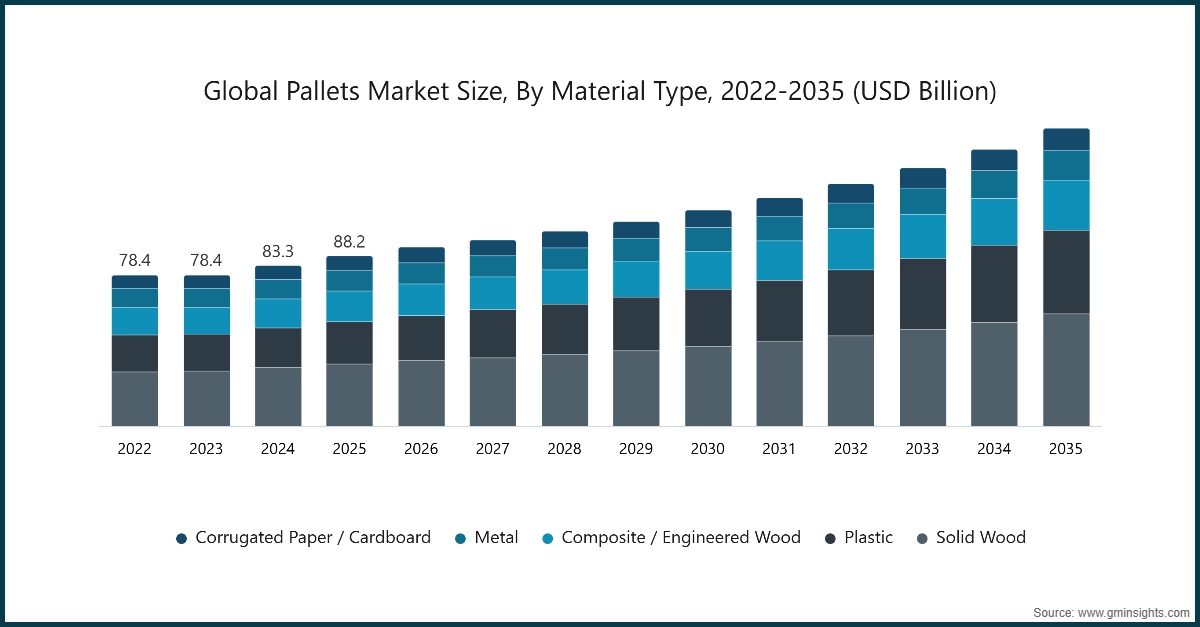
The pallets market increased steadily from USD 78.4 billion in 2022 and reached USD 83.3 billion in 2024, supported by rising global trade volumes and increased investments in warehousing and logistics infrastructure. The expansion of organized retail and strengthening of cold chain logistics significantly contributed to market demand during this period. Additionally, increased focus on supply chain resilience, along with the adoption of reusable packaging solutions and improvements in material handling efficiency, played a key role in accelerating market penetration across industries.
The global pallets market was valued at USD 88.3 billion in 2025. The market is expected to grow from USD 92.7 billion in 2026 to USD 118.4 billion in 2031 & USD 154.5 billion in 2035, at a CAGR of 5.8% during the forecast period according to the latest report published by Global Market Insights Inc.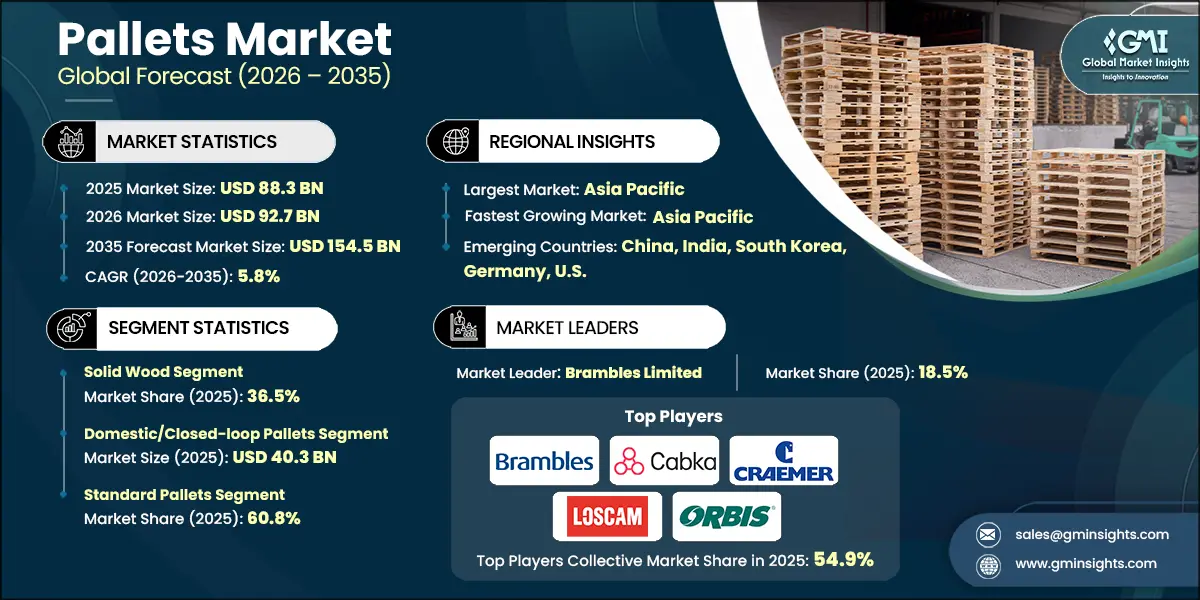
To get key market trends
Pallets Market Trends
- The shift toward circular economy-based pallet systems is reshaping supply chains through increased reuse, repair, and recycling of load carriers. This trend gained momentum around 2021 due to corporate sustainability targets and regulatory pressure on packaging waste reduction. It is expected to continue beyond 2032 as companies prioritize carbon footprint reduction. This transformation lowers lifecycle costs and strengthens sustainability compliance across industries.
- The growing preference for lightweight and ergonomic pallet designs is improving handling efficiency and reducing workplace injuries. This trend began around 2020 as labor shortages and safety regulations pushed companies to optimize manual handling processes. It will continue through 2030 with rising focus on worker productivity and automation compatibility. The impact includes reduced logistics costs, improved safety metrics, and enhanced operational efficiency.
- The regionalization of pallet supply chains is increasing because companies want to decrease their dependence on international raw material sources and their logistics operations. The supply chain disruptions and trade uncertainties which began in 2020 led to this pattern which is expected to continue till 2030. Companies will develop their supply networks through this period which leads to more resilient and decentralized sourcing methods. This process brings benefits of better supply chain performance which reduces shipping expenses and improves the ability to meet local market needs.
- Heavy-duty and export-oriented industries that need pallets with durability and extended lifespan are increasing their use of high-performance composite pallets. This trend began gaining traction around 2022 due to advancements in material engineering and increased export compliance requirements. It is anticipated that this trend will continue to rise steadily in the future until 2032 due to increased demands from various industries for high-performance pallets that are reusable and durable.
Pallets Market Analysis
Learn more about the key segments shaping this market
Based on material type, the pallets market is divided into corrugated paper/cardboard, metal, composite/engineered wood, plastic, and solid wood.
- The solid wood segment led the market in 2025, holding a 36.5% share. Solid wood pallets lead the market because of their availability, cost-effectiveness, and ability to handle heavy loads. The ease of repairing and recyclability of pallets, and their acceptability in the export and manufacturing industries, also contributed to their popularity. In addition, the availability of a strong supply chain and their ability to be used with global handling systems contributed to their position in the market.
- The plastic pallets segment is anticipated to grow at a CAGR of 7% over the forecast period. This is due to the increasing demand from various industries, such as food, pharmaceuticals, and chemical companies, where high levels of hygiene have to be maintained. This is because plastics have high durability, resistance to moisture, and high compatibility with modern material handling equipment, thus providing cost benefits to companies. Furthermore, there is a high level of emphasis placed on sustainability and reusable packaging solutions, thus increasing their adoption.
Learn more about the key segments shaping this market
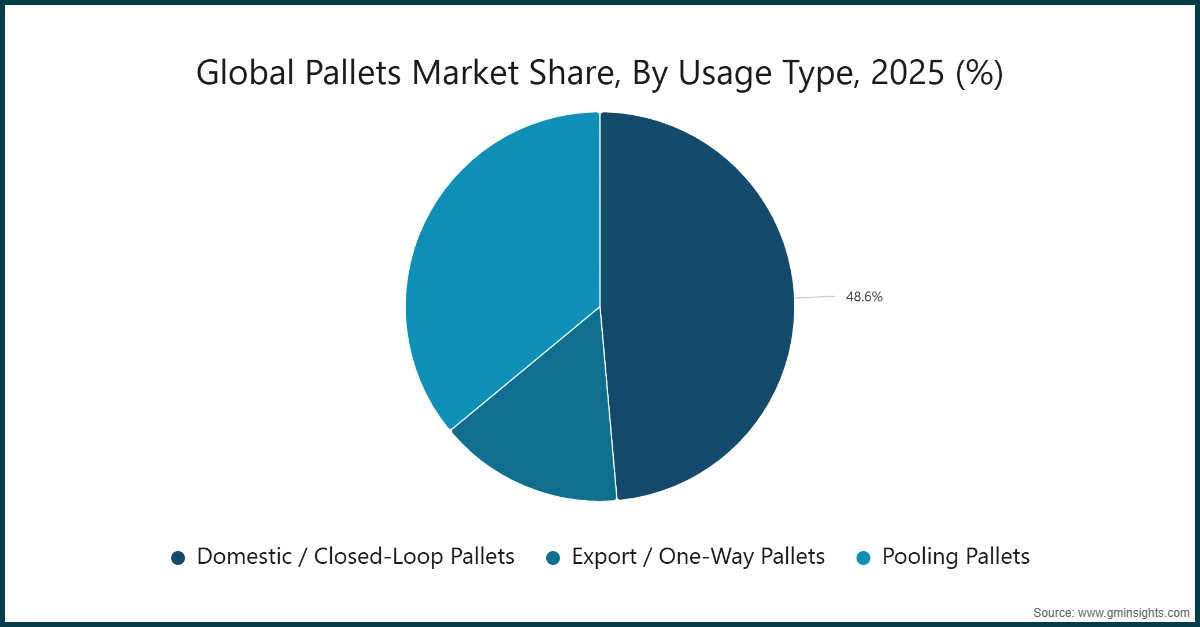
Based on usage type, the pallets market is divided into domestic/closed-loop pallets, export/one-way pallets, and pooling pallets.
- The domestic/closed-loop pallets segment dominated the market in 2025 and valued at USD 40.3 billion owing to its extensive use in internal logistics operations across manufacturing, retail, and distribution networks. The controlled supply chains use these pallets repeatedly which results in cost savings, better asset management and lower damage rates. The system provides stable demand because it enables businesses to move items frequently and manage their warehouse operations efficiently.
- The pooling pallets segment is expected to witness growth at a CAGR of 6.2% during the forecast period. The shared pallet systems enable businesses to lower their initial costs while simultaneously enhancing their supply chain operations which drives market expansion. Companies are shifting toward rental and pooling models to ensure standardized pallet quality and minimize reverse logistics complexity. The model provides businesses with a scalable solution which helps them achieve sustainability goals and reduce expenses which makes it highly beneficial for FMCG, retail and global supply chain operations.
Based on pallet size standard, the pallets market is divided into standard pallets and custom pallets.
- The standard pallets segment led the market in 2025 with a market share of 60.8%. This is because standard pallets are used by all sectors due to their dimensions and compatibility with the global logistics system. The ability of standard pallets to integrate with the global system, the increasing use of automated warehouses and transportation systems are the major factors for the growth of this segment. The use of standard pallets in the manufacturing sector and the retail industry also increases the demand for this segment.
- The custom pallets segment is expected to grow at a CAGR of 6.6% during the forecast period. The growth is attributed to the increasing need for specialized pallets that cater to the demands of handling products with different shapes and sizes. The increasing trend of the usage of these pallets in the chemical, pharmaceutical, and other high-end products industries is also fueling the growth of the market. Custom pallets enhance product safety, optimize space utilization, and improve handling efficiency, making them a key growth area in the evolving market.
Looking for region specific data?
North America Pallets Market
North America held a share of 29.1% of pallets industry in 2025.
- In North America, the market is growing due to the expansion of high-volume logistics networks, increasing warehouse automation, and strong demand from retail, FMCG, and manufacturing sectors. The region has a well-established pallet pooling ecosystem, with widespread adoption of reusable and standardized pallets across supply chains.
- Governments and industry players are investing in logistics infrastructure modernization and supply chain resilience. The region is expected to lead in automation-compatible pallet adoption, with e-commerce, food distribution, and industrial logistics driving sustained demand through 2035.
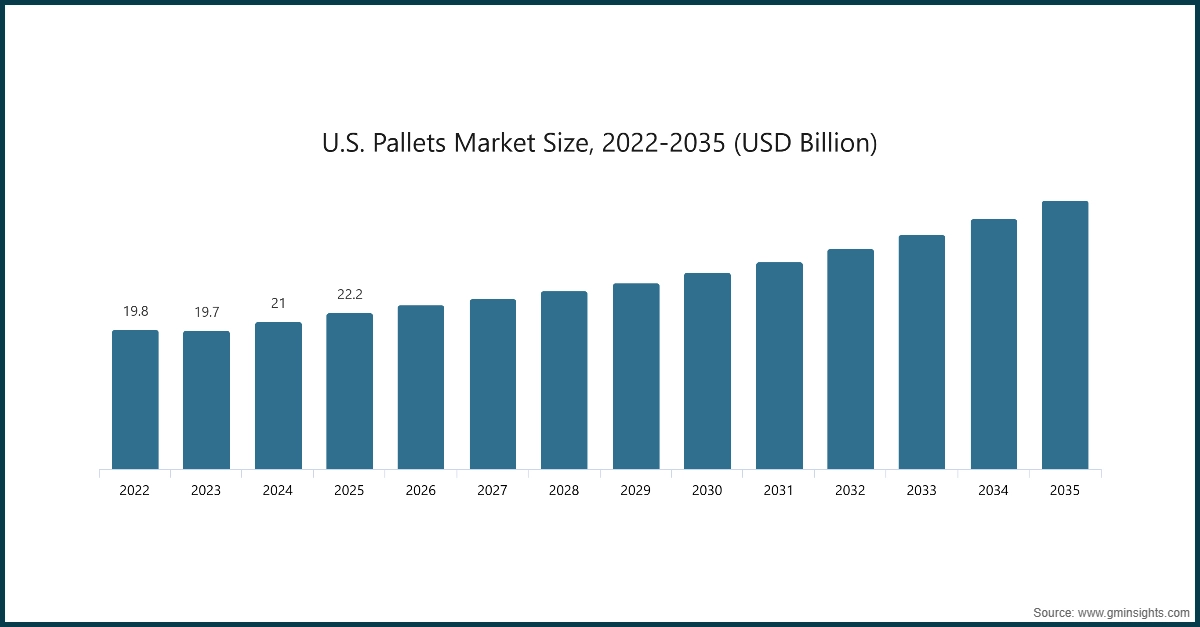
The U.S. pallets market was valued at USD 19.8 billion and USD 19.7 billion in 2022 and 2023, respectively. The market size reached USD 22.2 billion in 2025, growing from USD 21 billion in 2024.
- The growth of the market in the United States is particularly strong due to sustained expansion in e-commerce-driven logistics and warehousing activity. According to the U.S. Census Bureau, U.S. retail e-commerce sales reached USD 300.2 billion in Q1 2025, reflecting continued growth in high-volume goods movement across fulfillment networks.
- Additionally, the pallets industry in the United States is supported by federal investments in freight and logistics infrastructure. In 2025, the U.S. Department of Transportation continued funding under the Bipartisan Infrastructure Law, allocating billions toward freight corridors, port modernization, and intermodal connectivity. These investments are enhancing cargo handling capacity and warehouse connectivity, thereby increasing demand for pallets to support efficient material movement, storage standardization, and high-throughput logistics operations across the country.
Europe Pallets Market
Europe market accounted for USD 2 billion in 2025 and is anticipated to show lucrative growth over the forecast period.
- Europe’s pallets industry is expanding due to the region’s highly structured logistics ecosystem and strong emphasis on standardization and circular economy practices. The widespread adoption of the EPAL Euro pallet system across continental trade routes enables seamless cross-border pallet exchange and high asset utilization in pooled networks.
- Additionally, regulatory focus on packaging waste reduction under EU directives is accelerating the shift toward reusable and recyclable pallet solutions. Countries such as Germany, France, and the Netherlands are investing in automated warehousing and intermodal freight systems, reinforcing demand for standardized pallets compatible with high-efficiency logistics infrastructure.
Germany dominates the Europe market, showcasing strong growth potential.
- The pallets market in Germany is strongly supported by the country’s extensive trade volumes and highly developed freight transport infrastructure, which require efficient and standardized material handling systems. According to Destatis, Germany recorded foreign trade turnover of USD 290 billion with China alone in 2025, reflecting the scale of cross-border goods movement.
- This high trade intensity, combined with continuous freight transport activity and strong industrial output, is driving demand for pallets to enable efficient storage, handling, and seamless logistics. As a result, pallets play a critical role in supporting Germany’s export-oriented supply chains by improving operational efficiency, ensuring compatibility across logistics networks, and facilitating high-volume goods movement across domestic and international markets.
Asia Pacific Pallets Market
The Asia Pacific market is anticipated to grow at the highest CAGR of 6.9% during the forecast period.
- The market in the Asia Pacific region is growing significantly with the rapid expansion of organized logistics infrastructure and the increasing interconnectivity of regional supply chains. The governments of the major economies in the region are actively working to develop the infrastructure of multimodal transportation corridors, modernized logistics and warehouse infrastructure, including the development of port infrastructure, which is increasing the need for pallets as a standardized material handling solution.
- In addition, the emergence of export-oriented manufacturing clusters and intra-Asia trade agreements is improving the interconnectivity of regional supply chains. This is increasing reliance on pallets to enable efficient cargo movement, reduce handling inefficiencies, and support scalability across diverse and high-volume logistics environments in the region.
China pallets market is estimated to grow with a significant CAGR, in the Asia Pacific market.
- China’s market is being shaped by large-scale logistics standardization and rapid expansion of automated warehousing infrastructure. The government’s push toward modern supply chain systems and standardized unit load logistics has accelerated pallet pooling and reuse models across industries.
- The rise of bonded logistics zones, cross-border e-commerce hubs, and high-capacity distribution centers is increasing demand for durable and standardized pallets. Furthermore, the integration of smart logistics technologies, including automated storage and retrieval systems (AS/RS), is strengthening the role of pallets in improving handling efficiency, reducing damage, and supporting high-throughput operations across China’s logistics ecosystem.
Middle East and Africa Pallets Market
Saudi Arabia pallets industry to experience substantial growth in the Middle East and Africa market.
- The market in Saudi Arabia is witnessing a boost with the large-scale transformation of the logistics sector in the country under the Vision 2030 initiative, especially in the development of integrated logistics zones and the expansion of port infrastructure in the country. The development of major logistics zones in the country, including the King Salman Energy Park, is increasing the demand for standardized material handling equipment.
- Moreover, the rapid expansion of the retail distribution network and cold logistics infrastructure, especially in the food and pharmaceutical industries, is increasing the demand for pallets in the country. The increasing trend of automated warehouse and pallet pool systems is enhancing the efficiency of the logistics sector in the country and increasing the potential of Saudi Arabia as a logistics gateway.
Pallets Market Share
The market is led by players such as Brambles Limited, CABKA, Craemer Holding GmbH, Loscam International Holdings Co., Limited, and ORBIS Corporation (Menasha Corporation). These companies collectively held a market share of 54.9% in 2025. This is because of their strong global footprint, product offerings, and supply chain solutions. The scope of their services includes wood and plastic pallets, pooling, and reusable packaging while serving the FMC, retail, manufacturing, and logistics sectors.
These companies have a competitive advantage in the market with their material technology, circular economy, and pooling solutions. Also, their consistent efforts in investing in automation-compatible products, sustainable products, and tracking solutions will help them in increasing their share in the market with the increasing demand for efficient and reusable logistics infrastructure.
Pallets Market Companies
Prominent players operating in the pallets industry are as mentioned below:
- Brambles Limited
- CABKA
- Craemer Holding GmbH
- DNA Packaging Systems
- Falkenhahn AG
- Hemant Wooden Packaging
- Loscam International Holdings Co., Limited
- MAPAC TECHNOLOGY
- Nefab Group
- Nilkamal Material Handling
- ORBIS Corporation
- PGS Group
- Radha Agro Industries
- RAMDEV WOOD
- Rehrig Pacific Company
- Schoeller Allibert
- Shree Ganesh Packers
- UFP Industries Inc.
- WOOD PAKER
- World Steel Pallet Co. Ltd
- Brambles Limited
Brambles Limited provides its customers standardized wooden pallets which they can reuse through its CHEP platform. The company uses circular economy models to create systems which allow pallet reuse while decreasing waste and improving logistics performance for international FMCG, retail and manufacturing operations.
CABKA develops recycled plastic pallets and load carriers through its use of advanced material engineering and its implementation of circular production processes. Its solutions provide industries with durable and lightweight sustainable pallets which operate in closed-loop systems while maintaining environmentally friendly supply chains.
Craemer Holding GmbH develops high-performance plastic pallets which its manufacturing process produces through precision injection molding technology. The company designs products which meet hygienic requirements while maintaining strength for use in food and pharmaceutical and industrial logistics operations.
Loscam International Holdings operates a comprehensive pallet pooling system which distributes returnable packaging throughout the Asia-Pacific region. The company provides standardized pallet solutions which help customers from multinational corporations to regional businesses optimize their supply chains while conducting cross-border operations at reduced costs.
ORBIS Corporation offers a comprehensive portfolio of reusable plastic pallets and packaging systems designed for automation and sustainability. The company integrates material innovation with supply chain optimization services, supporting industries such as automotive, food, and consumer goods with durable and efficient logistics solutions.
Pallets Market Report Attributes
| Key Takeaway | Details |
|---|---|
| Market Size & Growth | |
| Base Year | 2025 |
| Market Size in 2025 | USD 88.3 Billion |
| Market Size in 2026 | USD 92.7 Billion |
| Forecast Period 2026-2035 CAGR | 5.8% |
| Market Size in 2035 | USD 154.5 Billion |
| Key Market Trends | |
| Drivers | Impact |
| Rapid e-commerce fulfillment network expansion | Drives 24% growth by accelerating demand for pallets across last-mile and fulfillment centers, as e-commerce players expand high-throughput distribution networks requiring efficient unit load handling and faster inventory movement. |
| Rising FMCG and food distribution volumes | Contributes 21% growth as increasing FMCG and food distribution volumes necessitate high pallet turnover, particularly in temperature-controlled and high-frequency delivery environments across retail and wholesale channels. |
| Standardization in global logistics and warehousing systems | Accounts for 19% growth by enabling seamless cross-border trade through standardized pallet dimensions, improving compatibility across transport modes, reducing handling inefficiencies, and supporting global supply chain integration. |
| Automation in warehouses requiring standardized pallet formats | Supports 18% growth through warehouse automation systems such as AS/RS and robotics, which depend on uniform pallet specifications to ensure operational precision, reduced downtime, and optimized storage density. |
| Increasing adoption of pallet pooling services | Adds 18% growth by promoting cost-efficient pallet pooling models, allowing companies to reduce capital expenditure, improve asset utilization, and ensure consistent pallet quality across logistics cycles. |
| Pitfalls & Challenges | Impact |
| Volatility in timber prices impacting wood pallets | Restrains market growth as fluctuating timber prices directly impact the cost structure of wood pallets, creating pricing instability for manufacturers and logistics providers, particularly in regions dependent on imported raw materials. This volatility reduces margin predictability and affects long-term procurement planning. |
| Limited recycling infrastructure in emerging markets | Limits growth as underdeveloped recycling infrastructure in emerging markets restricts efficient pallet recovery and reuse, leading to higher disposal rates and increased reliance on virgin materials. This challenges sustainability goals and raises overall lifecycle costs for end users. |
| Opportunities: | Impact |
| Expansion of plastic pallets in hygiene-sensitive industries | Presents significant growth opportunity by increasing adoption of plastic pallets in hygiene-sensitive industries such as pharmaceuticals, food processing, and healthcare, where contamination risks, regulatory compliance, and washability requirements favor durable, non-porous pallet solutions over traditional wood variants. |
| Integration of RFID and IoT-enabled smart pallets | Offers strong potential by integrating RFID and IoT technologies into pallets, enabling real-time tracking, inventory visibility, and asset utilization optimization across supply chains. This enhances operational efficiency, reduces losses, and supports data-driven logistics management. |
| Market Leaders (2025) | |
| Market Leader |
18.5% market share in 2025 |
| Top Players |
Collective market share in 2025 is 54.9% |
| Competitive Edge |
|
| Regional Insights | |
| Largest Market | Asia Pacific |
| Fastest growing market | Asia Pacific |
| Emerging countries | China, India, South Korea, Germany, U.S. |
| Future outlook |
|
What are the growth opportunities in this market?
Pallets Industry News
- In November 2025, CABKA launched a new range of recycled-content plastic pallets designed for heavy-duty industrial applications. The innovation improves load capacity and durability while utilizing post-consumer plastic waste, supporting circular economy goals and reducing dependence on virgin materials.
- In January 2025, Brambles Limited completed the sale of its CHEP India business to LEAP India, strengthening its focus on core pooling markets while enabling localized growth in India. The transaction supports consolidation of pallet pooling operations and enhances efficiency in the Indian supply chain ecosystem.
- In February 2024, Craemer Holding GmbH expanded its presence in industrial plastic pallet applications through continued focus on heavy-duty, injection-molded pallet solutions. This supports growing demand for durable, automation-compatible pallets in manufacturing and high-load logistics environments.
The pallets market research report includes in-depth coverage of the industry with estimates and forecast in terms of revenue (USD Million) from 2022 – 2035 for the following segments:
Market, By Material Type
- Solid wood
- Composite / engineered wood
- Plastic
- Metal
- Corrugated paper / cardboard
Market, By Design
- Block pallets
- Stringer pallets
- Single-face pallets
- Double-face pallets
- Reversible pallets
- Non-reversible pallets
Market, By Usage Type
- Domestic / closed-loop pallets
- Export / one-way pallets
- Pooling pallets
Market, By Offering Type
- Pallet manufacturing & sales
- Pallet pooling & rental services
- Pallet repair & refurbishment
- Pallet recycling
Market, By Pallet Size Standard
- Standard pallets
- Custom pallets
Market, By End-Use Industry
- Food & beverage
- Retail & e-commerce
- Pharmaceuticals & healthcare
- Chemicals & petrochemicals
- Automotive & manufacturing
- Logistics & 3PL
- Agriculture
- Consumer goods
- Others
The above information is provided for the following regions and countries:
- North America
- U.S.
- Canada
- Europe
- Germany
- UK
- France
- Spain
- Italy
- Netherlands
- Asia Pacific
- China
- India
- Japan
- Australia
- South Korea
- Latin America
- Brazil
- Mexico
- Argentina
- Middle East and Africa
- South Africa
- Saudi Arabia
- UAE
Frequently Asked Question(FAQ) :
What was the market size of the pallets industry in 2025?
The global market was valued at USD 88.3 billion in 2025, driven by rapid expansion of e-commerce fulfillment networks and FMCG demand.
What is the projected size of the pallets market in 2026?
The market is expected to reach USD 92.7 billion in 2026, supported by growth in food distribution and standardized logistics systems.
What is the forecasted value of the pallets market by 2035?
The market is projected to reach USD 154.5 billion by 2035, expanding at a CAGR of 5.8%, fueled by pallet pooling adoption and warehouse automation.
Which segment dominates the pallets industry?
Solid wood pallets led with a 36.5% share in 2025, owing to cost-effectiveness, availability, and wide acceptance in export and manufacturing industries.
Which usage type dominates the pallets market?
Domestic/closed-loop pallets dominated in 2025, valued at USD 40.3 billion, driven by repeated use in internal logistics operations across manufacturing and retail.
What was the value of the North America pallets market in 2025?
North America held a 29.1% share in 2025, driven by warehouse automation, strong retail/FMCG demand, and a well-established pallet pooling ecosystem.
Who are the key players in the pallets industry?
Leading companies include Brambles Limited, CABKA, Craemer Holding GmbH, Loscam International Holdings, and ORBIS Corporation, collectively holding 54.9% share in 2025, supported by pooling services, recycled plastic innovations, and automation-compatible pallet solutions.
Pallets Market Scope
Related Reports