Summary
Table of Content

Outboard Boats Market
Get a free sample of this report
Form submitted successfully!
Error submitting form. Please try again.
Thank you!
Your inquiry has been received. Our team will reach out to you with the required details via email. To ensure that you don't miss their response, kindly remember to check your spam folder as well!
Request Sectional Data
Thank you!
Your inquiry has been received. Our team will reach out to you with the required details via email. To ensure that you don't miss their response, kindly remember to check your spam folder as well!
Form submitted successfully!
Error submitting form. Please try again.
Outboard Boats Market Size
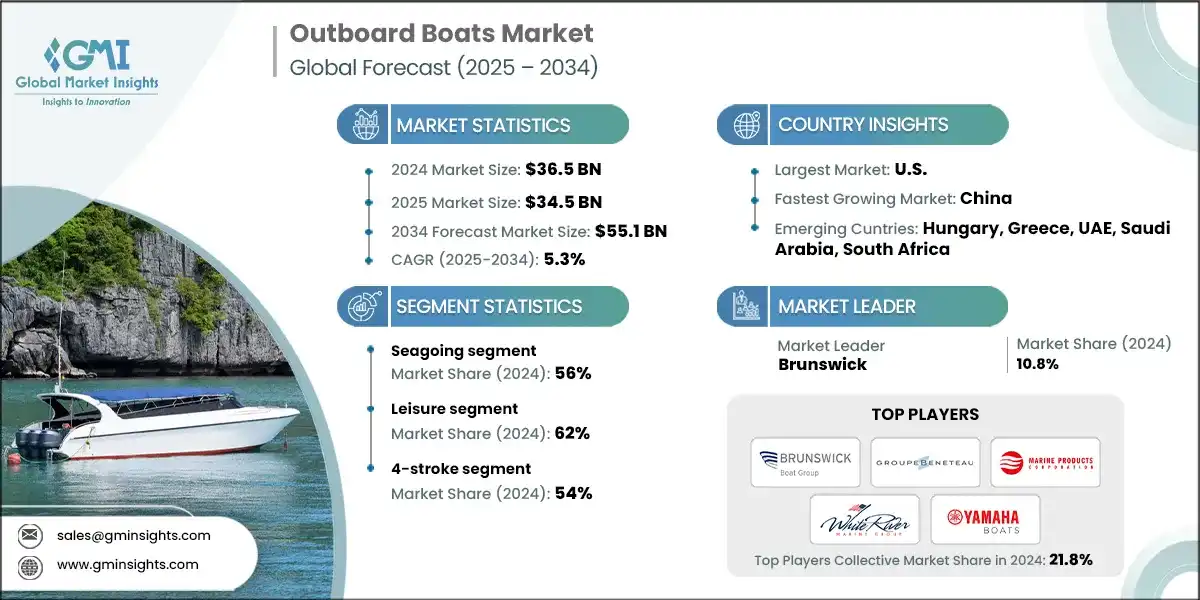
The global outboard boats market was estimated at USD 36.5 billion in 2024. The market is expected to grow from USD 34.5 billion in 2025 to USD 55.1 billion in 2034, at a CAGR of 5.3% according to latest report published by Global Market Insights Inc.
Outboard Boats Market Key Takeaways
Market Size & Growth
- 2024 Market Size: USD 36.5 Billion
- 2025 Market Size: USD 34.5 Billion
- 2034 Forecast Market Size: USD 55.1 Billion
- CAGR (2025–2034): 5.3%
Regional Dominance
- Largest Market: US
- Fastest Growing Region: China
Key Market Drivers
- Rise in recreational boating and leisure tourism.
- Technological advancements in outboard engines.
- Expansion of coastal and inland water infrastructure.
- Growing demand for lightweight trailer boats.
- OEM partnerships and product diversification.
Challenges
- High initial and maintenance costs.
- Seasonal usage and climatic limitations.
- Environmental regulations.
- Limited charging infrastructure for electric boats.
Opportunity
- Growth in Asia Pacific recreational marine sector.
- Electrification and hybrid propulsion systems.
- Expansion of rental and sharing platforms.
- Aftermarket services and customization.
Key Players
- Market Leader: Brunswick led with over 10.8% market share in 2024.
- Leading Players: Top 5 players in this market include Brunswick, Groupe Beneteau, Marine Products, White River Marine, Yamaha Boats, which collectively held a market share of 21.8% in 2024.
Get Market Insights & Growth Opportunities
The outboard boats market is largely driven by the increase in activities of recreational boating and water sports. With increasing numbers of consumers pursuing their leisure in a boat, the outboard powered fishing, day cruising and watersports boats of small size are in demand. A growing disposable income and changing lifestyle choices are causing faster purchasing increases, retail sales, dealer networks and aftermarket services across the globe.
The increased emissions, noise, and fuel-efficiency controls are causing fleet turnover and accelerated turnover of older two-stroke engines. Incentives and prohibition of polluting engines will motivate consumers and fleets to use four-stroke and electric outboards. The environmental control and regionality required in air quality drive the market turnover, after-sales services and the demand for compliant and expensive engines.
The development of marinas and better coastal development and increased marine tourism are increasing boat ownership and usage. Enhanced launch centers, access to financing and enhanced dealer and service networks reduce entry barriers to new boaters. It is also used commercially in fishing, transport, patrol, as well as other activities, that demand an outboard which is propelling volume sales and aftermarket expansion in both the developed and developing maritime markets both because of government investments, and by individual operators.
Companies operating in outboards boats market are engaged in various inorganic growth strategies such as mergers and acquisitions, partnership, and new product launch to stay competitive in the market. For instance, Honda Marine announced partnership with Scout Boats. The collaboration will provide a new type of boat and motor packaging that enhances the enjoyment of boating. It also highlights Honda Marine's goal to lead in marine mobility and offer unified solutions for the market.
Asia Pacific is the growing market because of the increasing disposable incomes, urbanization of coasts and marine tourism extension in India, China and Southeast Asia. The modernization of the ancient fishing fleet, investment by the government in ports and infrastructure, and the rise in the number of boats owned by the locals lower the costs and augment the ownership. Catchup demand of the low-end outboard boat and engines in leisure and business markets is due to low historical penetration.
The dominant share in North America can be attributed to the fully developed boating culture, the level of boat registration, and the presence of a vast network of marina and trailer-boat services that make it possible to own a boat all year round. Holding a strong dealership network, finance, and substantial OEM (Mercury, Yamaha) offer product diversification and service availability. Large disposable income levels and established recreational fishing and watersports cultures support high levels of outboard and aftermarket sales and well-developed consumer financing systems.
To get key market trends
Outboard Boats Market Trends
The growing consumer demand for leisure boating, fishing and water sports is leading to the high demand for outboard-powered boats. Outboard boats are affordable, easy to carry, and maintain which makes them desirable to first-time customers and family. The addition of more marina facilities and water-based tourism activities also increases better penetration of the market in the coastal and inland waterways.
The outboard boat market is being transformed with constant innovations like electronic fuel injection, digital throttle control and hybrid electric propulsion. These technologies are better in performance, lowering emissions, and fuel efficiency that appeals to consumers with environmental concern. Companies that are investing in smart connectivity and integrated engine management are experiencing a competitive advantage in world boating environment.
The recreational boating ecosystem extends the courtesy of investments by governments and the private sector in the construction of marinas and waterfront development as well as boating clubs. Better docking facilities, rental programs, and easy access to waterways are attracting more consumers to own or rent outboard boats, especially in the emerging tourism locations in Asia-Pacific, the Caribbean and Southern Europe.
New composite materials and hull designs have resulted in lighter, more fuel efficient outboard boats. Transportation, storage and maintenance are simplified with the help of modular and trailer designs and the designs are more accessible to weekend boaters. The shift to smaller, multipurpose boats encourages greater volumes of production, fewer purchase processes and increased usage by recreational and business users.
Demand is increasing in great performance outboard boats with the increasing popularity of sport fishing, fishing contests, and recreation marine sports. The boats are more maneuverable, have easier water access at shallow water levels, and are cost-effective in comparison with inboard. The rise in fresh and saltwater fishing activities in North America, Europe, and Asia-Pacific still contributes to the growth of the market.
The need to further cut emissions, and the rising environmental awareness, is speeding up the adoption of electric and hybrid outboard systems. Companies are introducing zero emission models that have better battery life, use no sound, and digitally monitored. As marine charging infrastructure grows, using clean propulsion technologies will be key to shaping the market's long-term growth.
Outboard Boats Market Analysis
Learn more about the key segments shaping this market
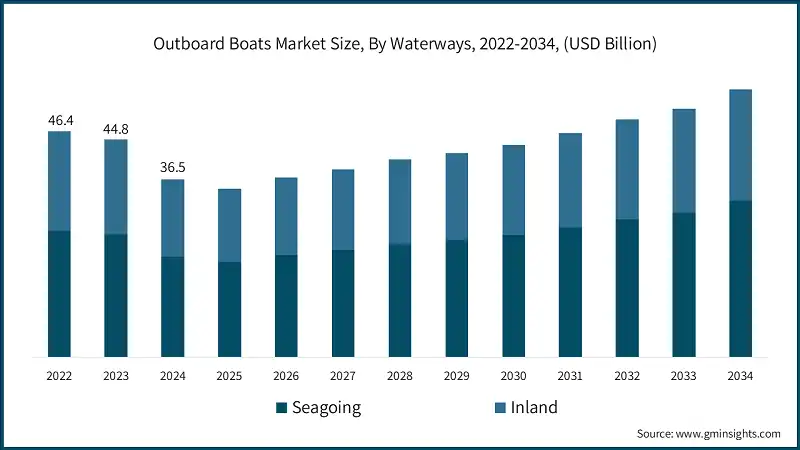
Based on waterways, the outboard boats market is divided into seagoing and inland. The seagoing segment dominated the market, accounting for around 56% in 2024 and is expected to grow at a CAGR of over 5.7% from 2025 to 2034.
- The increasing demand for seagoing outboard boats is driven by the increasing interest amongst people in coastal cruising, island hopping and near shore adventure tourism. They are stable, have a wide range, and power that renders them perfect in open water recreation. Increase in investment in recreational and rental-based seagoing boating activities is also being facilitated by increased investments in coastal marinas and charter services in tropical and temperate coastal areas.
- The high output four-stroke engines and V12 outboard engines have increased the speed, torque, and reliability when used offshore. In harsh sea conditions, these engines have better propulsion efficiency and control. Builders have grown more concerned with tough, oil-coated designs that work in saltwater environments to allow offshore travel to be more extended and the seagoing market segment to be opened up to more customers.
- The trend of marine tourism products, beach resorts and the use of charter boats by individuals globally is increasing the demand of the outboard boat that is seagoing. Operators recommend outboards to its ease to maintain and better fuel efficiency in their routine charter business. The increasing popularity of the luxury tours, fishing charters, and tours of the coasts is the factor that helps this segment to grow continuously.
- Seagoing outboard boats are becoming increasingly popular in the use of coast guards, rescue agencies and offshore service providers on account of their agility and easy engine maintenance. Quick replacement and upgrade of engines offshore increase the uptime of operations. The increasing defense spending and coastal patrols by maritime countries is providing emerging markets to rugged and high performance outboard boats.
- The use of advanced GPS, sonar and digital monitoring systems has enabled seagoing outboard boats to be safer and more productive. Onboard navigation systems, automated engine systems, and electronic helm controls enhance the confidence of the user in a harsh offshore environment. Such intelligent technologies appeal to professional operators and recreational people who demand increased performance, connectivity, and safety of operations at sea.
- Modern seagoing outboard boats benefit from materials like reinforced fiberglass, carbon composites, and marine-grade aluminum. These improvements increase structural strength while lowering weight and fuel use. Optimized deep-V hull designs improve stability and wave-handling ability. This allows outboard-powered vessels to operate safely and efficiently in tough offshore and open-sea conditions.
Learn more about the key segments shaping this market
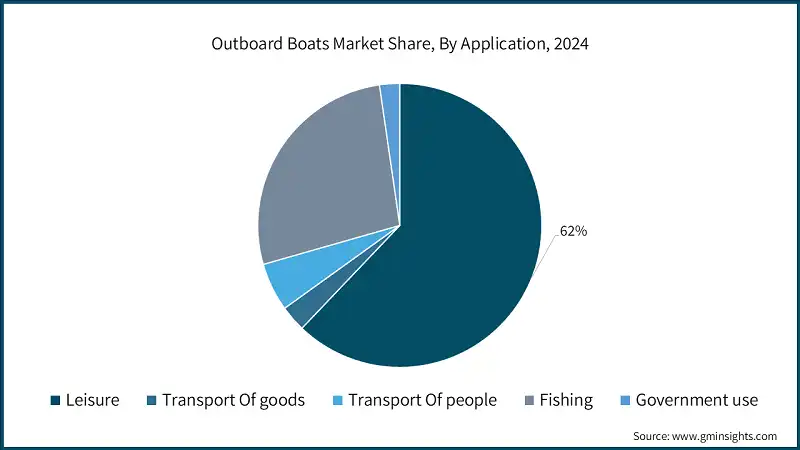
Based on application, the outboard boats market is segmented into leisure, transport of goods, transport of people, fishing, and government use. The leisure segment dominates the market with 62% share in 2024, and the segment is expected to grow at a CAGR of over 5% from 2025 to 2034.
- The increase in recreational water boating activities including cruise, family and short trip oriented exploration is creating expansion in the outboard boats market. Being easy to own, handle, and flexible to use, outboard boats are the favorite among leisure seekers. Increased activities on the weekends in boating, and lakeside tourism also increase consumer demand in the world market.
- New channels of outboard-powered boats are being developed because of the construction of waterfront resorts, houseboat destinations and marine pleasure areas. Experience boating has been included in travel packages by tour operators and hospitality providers. This increased congruity between tourism and recreational boating is a huge boost to the demand of leisure oriented outboard vessels throughout Asia-Pacific, Europe and North America.
- Boating is a leisure activity that is more and more regarded by consumers as a social and family activity. Outboard boats, which were highly safe, stable and versatile, were the perfect fit for this trend. The addition of user-friendly capabilities, like ergonomic seating, Bluetooth entertainment systems, and convenient docking, is being implemented by manufacturers to create comfort onboard as well as the general enjoyment of the family during recreational outings.
- Manufacturers are introducing modern outboard boats characterized by good design aesthetics, enhanced noise insulation and digital control interfaces. High-tech helm, built-in navigation and sumptuous seating make leisure boating a high-end experience. These innovations appeal to lifestyle-oriented consumers who are looking at the attainment of comfort, convenience and performance and this has solidified the outboard boats as the core element of the contemporary marine leisure.
- Online services that provide temporary boat rentals and peer-to-peer sharing business models are transforming leisure boating accessibility. This segment is dominated by outboard boats which are easy to maintain and use. These are the new types of business models that attract younger, more experience-based consumers who are more flexible than owning and they provide leisure market growth and repeat business.
Based on propulsion, the outboard boats market is segmented into gasoline, diesel, and electric. Gasoline-powered outboards remain popular because of their reliable four-stroke technology.
- This technology ensures smooth operation and easy maintenance. Manufacturers have improved combustion efficiency and reduced noise, which makes gasoline engines great for recreational and fishing boats. Their wide availability and long-standing trust from consumers support high adoption in boating markets around the world.
- The most available marine fuel in the world is still gasoline, which is backed by well-developed fuel supply chains and fueling networks. Already in place are the marinas, coastal stations, and docks inland, where convenience is assured to the boat owners through the gasoline distribution. This universal availability is a vital asset to gasoline outboards over the newer alternative such as diesel or electric power outboards.
- Outboards powered by gasoline normally have a lower purchase and installation price than electric or diesel-powered outboards. Their less complex mechanics make them less complex to manufacture, and thus they can set competitive prices. The affordability of gasoline-powered boats and good resale prices make them an effective cost-efficient decision for recreational users and small commercial operators, and sales in entry- and mid-tier markets remain stable.
- Continuous innovations like electronic fuel injection (EFI), variable valve timing and lightweight components made of aluminum have enhanced the outboard performance of gasoline. These improvements provide increased horsepower, enhanced torque, and fuel economy and allow smoother acceleration and increased range. The relevance of gasoline propulsion in current marine environments (recreation, fishing, and utility) is ensured by such improvements.
- The recreational and sport-fishing industries have been depending greatly on gasoline outboards due to their agility, power to weight ratio, and high throttle response. Small boats and runabouts use compact models, and more powerful gasoline engines are used in multi engine offshore applications. Repeated involvement in boating and angling activities in the world keeps on boosting growth in the segment of gasoline.
- The major manufacturers are adding new displacement ranges, intelligent digital controls and integrated joystick systems to their lines of gasoline outboard. Co-operation between engine OEMs and boatbuilders guarantees a smooth propulsion that is compatible, enhancing performance and the user experience. The continued strategy of diversification of products into horsepower lines promotes the competitiveness of gasoline-powered outboards in the overall marine propulsion market.
Based on engine, the outboard boats market is segmented into 2-stoke, 4-stroke, and electric. 4-stroke segment is leading the market with 54% share in 2024.
- Outboard engines with four strokes are more fuel efficient and operate smoothly than the two strokes. They have advanced power generating systems which maximize power output and reduce fuel consumption. Four-stroke technology has become the standard in both recreational and light commercial marine markets worldwide as boaters are finding these engines to be safer on the longer journey, and economical to operate.
- Strict international emission standards and environmental regulations are hastening the process of moving to cleaner propulsion systems. Four-stroke outboards comply or surpass the EPA and EU standards of emission and yield a lower level of hydrocarbons and noise. Their green use of business is attractive to the green consumers and to the regulators and helps them to achieve robust growth in the developed markets where the marine sustainability requirements are stringent.
- The latest four strokes outboards have sophisticated systems like electronic fuel injection, computer controlled throttle and inboard engine diagnostics. These systems enhance acceleration, responsiveness, and usability. Battery-friendly and autonomous with smart displays and remote monitoring can also add more to reliability and performance, appealing to tech-savvy consumers who require more accurate control and real-time data to have safer and safer and efficient boating experiences.
- Four-stroke outboards are being fitted into a wide array of boat models including small runabouts to the offshore cruisers because of their versatility and acceptable power-to-weight ratio. There are now compact to high-horsepower variants available in the market by manufacturers to be used in leisure, fishing and patrol. This flexibility extends market reach resulting in long-term expansion in recreational and professional marine markets.
- The four-stroke engines are designed in a manner that they are durable and do not need frequent oil change and have extended service life as opposed to two-stroke engines. Their more lubricated systems offer less wear and tear and guaranteed long-term performance. Such reliability is important to frequent boaters and commercial operators who are concerned with the lower overall cost of ownership and operational reliability.
Looking for region specific data?
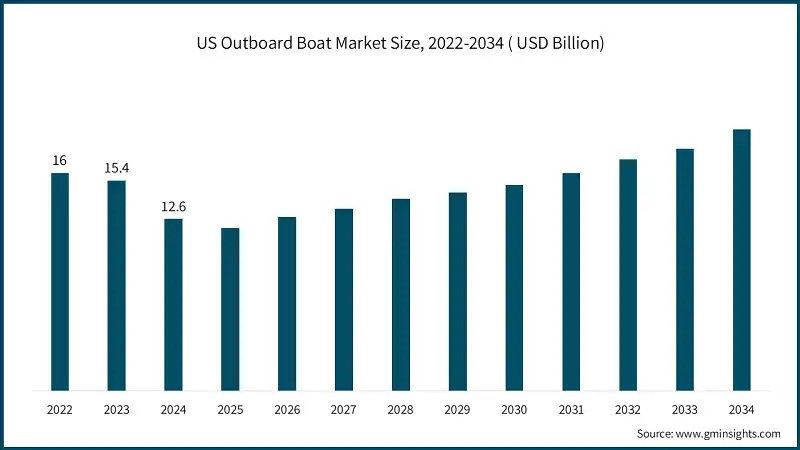
US dominated the outboard boats market in North America with around 86% share and generated USD 12.6 billion in revenue in 2024.
- The US boating culture is among the most established ones in the world with millions of registered recreational boats. The water sports, fishing, and leisure cruising activities contribute to the willingness to buy the outboard-powered vessels continuously. This well-established boating culture, which is backed up by the availability of waterways and strong community participation, is still able to maintain long-term market growth in the country.
- The US has a significant amount of lakes, rivers and coastline networks with marinas, docks and launching facilities. Ongoing government and individual investments in boating infrastructure make it more accessible and convenient to the owners. This has been a well-developed ecosystem that promotes increased outboard boat sales in both freshwater and salt water habitats to support domestic sales growth.
- The US consumer is moving in favor of offshore fishing applications, cruising and sport that have high horsepower, multi-engine configurations. These performance needs have been met by manufacturers such as Mercury Marine and Yamaha who offer powerful V8 and V12 outboards. The propulsion system of bigger, faster boats is driving higher sales of high-quality four stroke and technologically advanced propulsion systems in the US market.
- Sport and recreational fishing is still a valuable cultural and economic activity in the US with millions of fishermen attending yearly. Outboard boats are favored in fresh water and coastal fishing as they are also very agile and dependable. The fact that marine tourism and charter services are gaining popularity also supports demand in coastal and lake areas.
- The use of digital helm systems, GPS navigation, and joystick controls are on the rise to make the boating process in the US. safer and more convenient. Advanced telematics, performance monitoring, and outboard connectivity are all the new features that make it more enjoyable. The high demand of customers who prefer technologically advanced and user friendly boats is the cause of continuous improvements and replacement of recreational and premium boat segments.
The outboard boats market in Germany is expected to experience robust growth between 2025 and 2034.
- Outboard boat demand is being pushed out by the growing interest of Germans in leisure boating along rivers, lakes, and canals. More recreational water activities, which include weekend cruising and sport fishing are being sought by consumers. The well-developed inland waterway system and the rising number of boating clubs in the country is easily accessible and infrastructure filled, which contributes to the steady rise in the boating outboard recreational segment.
- The outboard engines that are used in the choice of modern four-stroke and electric are gaining momentum in Germany as the country remains determined to remain sustainable. The tightened emission and noise standards promote the abandonment of old models made with two strokes. The clean propulsion drive also coincides with national climate objectives and manufacturers have launched outboards that are environmentally friendly or eco-friendly which comply with the European Union marine emission regulations and the local environmental regulations.
- Government programs encouraging water-based tourism along the Baltic Sea, the North Sea and inland water ways are enhancing boating opportunities. Marina improvements, waterfront resorts and charter services are attractions to local and foreign boaters. The subsequent growth in tourism traffic leads to direct demands of the reliable and fuel-efficient outboard boats to be used in the leisure, transport, and rental boat operations.
- German consumers appreciate engineering quality and sophisticated performance. Outboard engines of modern type with lightweight material, noise control, and fuel efficiency technologies are attractive to this preference. Four-stroke outboards are also better suited to the serene inland water and the environmentally conscious lakes of Germany where noise and environmental concerns are becoming more important and demanded.
- Increased disposable income and a change in lifestyle after the pandemic is driving growth in outdoor recreation and recreational boating. German families are buying in large numbers small to mid-size outboard boats as a way of spending weekends and visiting lakes. The presence of affordable financing opportunities and an expansion of interest in outdoor living are expanding the recreational boating consumer market in the country across age groups.
The outboard boat market in China is expected to experience rapid growth between 2025 and 2034.
- The increase in the interest of the Chinese in the leisure and water-based activities is raising the demand of the outboard boats. The market is also changing due to expansion in infrastructure in the cities along the coast and also the inland lakes as well as an increase in the amount of middle-class people who are getting involved in boating and water sports. Recreational outboard boat owners and usage are further triggered by the government initiatives of encouraging domestic tourism and outdoor recreation.
- The efforts of the Chinese to create a maritime economy focus on maritime tourism, development of maritime infrastructure, and water transport. The demand of the small and middle-sized outboard boat is encouraged by investments in marinas, yacht clubs and coastal recreation zones. The policy support in the local boat production as well as the promotion of the best licensing reforms will promote the use by the domestic consumers and charter operators in the key provinces.
- The fast growing and growing affluent population of China is driving the acquisition of recreational goods, such as outboard-powered boats. Increase in disposable income and improvement of lifestyle are changing consumer behavior to high-quality recreational assets. The trend of affording luxury among the urban middle-income customers augers well with the increasing sales of the mid-range outboards and smaller pleasure boats that can be used on lakes and the coast.
- Modern marinas and yacht facilities are being built in such megacities as Shanghai, Shenzhen, and Xiamen along the coast. These projects enhance access, maintenance and fueling services in the docks and make boating easier. The increase in the marina facilities contributes to consumer confidence in owning and creates a constant demand for boats which can be used in urban coastal living.
- Chinese manufacturers are putting in formulating domestic outboard engines and boat manufacture capacity so as to be less dependent on imports. Alliances with international OEMs are shifting technical know how to four-stroke and electric propulsion technology. This localization approach makes it more affordable, available, and competitive in the brand and allows it to penetrate the broad market bases of the recreational and light-commercial boating markets in China.
The outboard boats market in Argentina is expected to experience significant and promising growth from 2025 to 2034.
- The large river networks and the Atlantic coastline in Argentina are also contributing to the recreational boating and water tourism. The increased eco-tourist, fishing charters and recreational cruising of areas such as the Paranaya Delta and Patagonia is increasing the demand to reliable and efficient outboard engines, especially in the mid-horsepower market of tour operators as well as the individuals.
- Argentine consumers are opting to go out and recreational boating, sailing and fishing, and this has been driven by increased disposable income and lifestyle changes. Marinas and boating clubs are also proliferating their facilities and government programs to create waterfront recreational facilities only to boost the outboard engine market, particularly in family boats that operate in inland and coastal waters.
- The growth of the artisanal fishing and aquaculture industries in Argentina is fueling an ongoing trend of the demand of durable and fuel-efficient outboard engines. New 4-stroke and low-emission models are becoming popular with fishermen and small operators to minimize operation costs and meet new environmental regulations to improve sales in coastal and inland fishing communities.
- Advanced outboard engines are becoming more available with the liberalization of import laws and the increase in the number of foreign marine engines brands such as Yamaha, mercury and Suzuki. Increased networks of dealerships and enhanced after sales services are also promoting consumer confidence and replacement demand in the recreational and commercial marine markets of Argentina.
- Following the changes in fuel costs and the environmental consciousness of the population, Argentine consumers are moving towards more efficient and cleaner propulsion technology. The 4-stroke and electric outboard engines are in demand as boat owners and tour operators are looking to have long-term cost savings, also, reduced emissions and less noise operations that will be applicable in the protected waterways and environmentally sensitive areas.
The outboard boat market in UAE is expected to experience significant and promising growth from 2025 to 2034.
- Heavy investments by the government in marinas, ports, and waterfront developments are strengthening the UAE's boating ecosystem. Projects such as Dubai Harbour and Yas Marina further improve access to docking and maintenance facilities. These infrastructural expansions spur leisure boat ownership and attract international manufacturers who position the UAE as the regional hub for outboard boating and marine leisure.
- Sport fishing and other recreational water sports have turned mainstream in the UAE, attracting a local and expatriate audience. Outboard boats are ideal for such water sports because of their maneuverability and durability in saltwater conditions and their ease of maintenance. This leads to increasing activities in fishing tournaments and marine clubs, which significantly contributes to sustained growth in the demand for outboard boats.
- The affluent population and luxury lifestyle of the UAE are pushing investments in leisure and marine recreation. Inhabitants are increasingly considering boating a social and status-enhancing activity. Premium outboard boats, featuring advanced digital controls and comfort, meet the demand for performance and prestige among consumers, thereby driving market growth in premium recreational segments.
- Advantageously located between the Arabian Gulf and the Gulf of Oman, the UAE features ideal boating conditions: all-year-round navigable waters. Such a strategic geographical position makes it attractive for international boat shows, rental operators, and yacht charter businesses. This tourism-driven ecosystem stimulates the sales of outboard boats for leisure, sport, and commercial marine services.
Outboard Boats Market Share
- The top 7 companies in the outboard boats industry are Brunswick, Groupe Beneteau, White River Marine, Yamaha Boats, Marine Products, Grady-White, and Scout Boats, contributing around 23% of the market in 2024.
- Brunswick also leads through continuous innovation in high-performance and electric-ready outboard boats, adding an extra layer of efficiency and connectivity with the Mercury Marine brand via the integrated SmartCraft digital systems. With a broad dealer network, strong aftermarket services, and strategic acquisitions, Brunswick also maintains leadership in both premium and recreational boating segments.
- Groupe Beneteau’s growth strategy for outboard boats involves expanding the portfolio across brands such as Jeanneau and Beneteau itself to satisfy this diverse customer base. The company focuses on modular design, fuel-efficient outboard propulsion, and cutting-edge onboard technology. Strategic investments in hybrid propulsion and digital boat management systems reinforce its position of leadership in sustainable and connected marine solutions.
- White River Marine, part of Bass Pro Shops, capitalizes on its strong retail presence and popular brands such as Tracker and Nitro. The company is focused on value, performance, and accessibility for recreational consumers. Such vertical integration-from manufacturing to retail-allows cost control, consistency of brand identity, and customer loyalty, making it a leader within mass-market outboard boats.
- Bennington Marine maintain their competitive edge through technological innovation and product reliability. Advanced four-stroke outboard engines featuring digital control systems provide superior power-to-weight ratios and unprecedented fuel efficiency. With a solid network of active dealers, integrated boat-engine packages, and a commitment to quality craftsmanship, Yamaha is recognized for both recreational and performance-oriented boating.
- Marine Products, via the brands Chaparral and Robalo, stresses premium design, performance, and customer experience. The company continuously upgrades its outboard models with advanced hull designs and digital interfaces. Its dealer-centric approach, strong customer retention, and targeted marketing of family and fishing boats increase its competitiveness in the mid-to-premium outboard segment.
- Grady-White Boats competes by emphasizing a focus on craftsmanship, durability, and offshore performance. With its well-known SeaV² hull design, this company offers stability and comfort in adverse marine conditions. Continuous innovation in safety, comfort, and ease of use has created a strong brand reputation, especially among high-end leisure and sport-fishing enthusiasts.
- Scout Boats stands apart with its advanced composite construction and sleek, luxury-oriented designs; it also integrates advanced systems such as digital helm controls and fuel-efficient hull technologies. Its focus on innovation, premium materials, and customization options draws in discerning customers, which further reinforces the company's competitive edge within the high-end center console and sport-fishing outboard segments.
Outboard Boats Market Companies
Major players operating in the outboard boats industry are:
- Bennington Marine
- Brunswick
- Carolina Skiff
- Fibrafort
- Grady-White
- Groupe Beneteau
- Marine Products
- Regal Boats
- Scout Boats
- White River Marine
- Competition in the outboard boats market is fierce, with several global and regional participants competing on various parameters of innovation, design, and performance. Prominent manufacturers, including Brunswick Corporation, Groupe Beneteau, and Carolina Skiff, are focusing on heavy investments in advanced propulsion systems, including electric and hybrid-ready models, to further efficiency and compliance with emerging environmental concerns. The companies are focusing on intelligent digital control integration, lightweight materials, and hull design improvements to meet the rising consumer demand for high-speed, fuel-efficient, and connected recreational boating experiences.
- Market players also make efforts toward strengthening brand presence in premium and mass-market segments by expanding their product portfolio and expanding their dealer network. White River Marine Group and Marine Products Corp. maintain accessibility and customer loyalty via integrated sales channels and robust retail relationships. Other manufacturers, including Grady-White and Scout Boats, stress craftsmanship and bespoke customization as part of their luxury brands. Strategic collaborations, product diversification, and sustainability will remain key dynamics influencing competition and long-term growth in the market.
Outboard Boats Market Report Attributes
| Key Takeaway | Details |
|---|---|
| Market Size & Growth | |
| Base Year | 2024 |
| Market Size in 2024 | USD 36.5 Billion |
| Market Size in 2025 | USD 34.5 Billion |
| Forecast Period 2025 - 2034 CAGR | 5.3% |
| Market Size in 2034 | USD 55.1 Billion |
| Key Market Trends | |
| Drivers | Impact |
| Rise in recreational boating and leisure tourism | Growing consumer interest in fishing, cruising, and water sports boosts demand for outboard-powered boats, especially small to mid-sized segments. |
| Technological advancements in outboard engines | Adoption of cleaner, fuel-efficient, and electric outboard engines enhances performance, reduces emissions, and attracts eco-conscious consumers. |
| Expansion of coastal and inland water infrastructure | Investments in marinas, boat ramps, and waterway facilities support easier ownership and increase boating accessibility. |
| Growing demand for lightweight trailer boats | Compact, easy-to-transport outboard boats appeal to new boaters and recreational buyers seeking flexibility and cost-effectiveness. |
| OEM partnerships and product diversification | Boat manufacturers collaborate with engine makers to introduce integrated propulsion packages, improving efficiency and customer experience. |
| Pitfalls & Challenges | Impact |
| High initial and maintenance costs | The cost of advanced four-stroke and electric outboards can deter price-sensitive buyers in emerging markets. |
| Seasonal usage and climatic limitations | Demand fluctuates with weather and boating seasons, affecting consistent revenue streams for manufacturers and dealers. |
| Environmental regulations | Strict emission standards and noise control policies increase R&D expenses for compliance, especially in North America and Europe. |
| Limited charging infrastructure for electric boats | The slow development of marine charging networks restricts adoption of electric outboard models. |
| Opportunities: | Impact |
| Growth in Asia Pacific recreational marine sector | Rising disposable incomes, coastal tourism, and government-backed marina projects in China, India, and Southeast Asia offer significant market potential. |
| Electrification and hybrid propulsion systems | Development of electric and hybrid outboards opens new opportunities for sustainable boating solutions. |
| Expansion of rental and sharing platforms | Boating-as-a-service models are gaining popularity, increasing utilization rates of outboard-powered boats. |
| Aftermarket services and customization | Demand for accessories, retrofits, and maintenance services provides recurring revenue for OEMs and dealers. |
| Market Leaders (2024) | |
| Market Leaders |
10.8% market share |
| Top Players |
Collective market share in 2024 is 21.8% |
| Competitive Edge |
|
| Regional Insights | |
| Largest Market | US |
| Fastest growing market | China |
| Emerging countries | Hungary, Greece, UAE, Saudi Arabia, South Africa |
| Future outlook |
|
What are the growth opportunities in this market?
Outboard Boats Industry News
- In September 2025, Axopar will introduce the Axopar 38 Range, a new mobile app for owners, and expand their BRABUS premium lineup in 2026. The most significant announcement will be the launch of the all-new 38 Range series of boats. The first model, the Axopar 38 Cross Cabin (XC), will debut at BOOT Düsseldorf in January 2026. Three more new models will follow in order.
- In June 2025, ACEL Power, a leader in smart electric propulsion systems and electric outboard motors, announced a partnership with Madrid-based boat builder Vector Náutico. Together, they are launching MOLA-e powered by ACEL, a new line of eco-friendly electric boats designed for coastal and inland cruising. This partnership marks ACEL Power’s official entry into the Spanish market.
- In April 2025, Honda will launch its first outboard engine in the Philippines. The Honda BF350 is Honda’s most advanced outboard motor, featuring a V8 engine designed for longer, smoother journeys.
- In February 2024, Tohatsu announced a partnership with motor builder Ilmor Marine. The first electric outboard will be a 6kW unit (≈ 8.2 hp) set to launch in the US, Canadian, and European markets in 2024. Their collaboration focuses on creating a top line of electric products.
The outboard boats market research report includes in-depth coverage of the industry with estimates & forecasts in terms of revenue ($ Mn/Bn), shipment (units), and fleet size from 2021 to 2034, for the following segments:
Market, By Waterways
- Seagoing
- Leisure
- Transport Of goods
- Transport Of people
- Fishing
- Government use
- Inland
- Leisure
- Transport Of goods
- Transport Of people
- Fishing
- Government use
Market, By Propulsion
- Gasoline
- Diesel
- Electric
Market, By Application
- Leisure
- Transport Of goods
- Transport Of people
- Fishing
- Government use
Market, By Engine
- 2-stroke
- 4-stroke
- Electric
Market, By Horsepower
- Below 200 hp
- 201 to 500 hp
- 501 to 1000 hp
- Above 1000 hp
Market, By Boat
- Center console
- Express cruiser
- Pontoon
- Runabout bowrider
- Others
The above information is provided for the following regions and countries:
- North America
- US
- Canada
- Europe
- UK
- Germany
- France
- Italy
- Spain
- Russia
- Nordics
- Hungary
- Greece
- Asia Pacific
- China
- India
- Japan
- South Korea
- ANZ
- Southeast Asia
- Latin America
- Brazil
- Mexico
- Argentina
- MEA
- South Africa
- Saudi Arabia
- UAE
Frequently Asked Question(FAQ) :
What was the market size of the outboard boats in 2024?
The market size was USD 36.5 billion in 2024, with a CAGR of 5.3% expected through 2034. The market is driven by increasing recreational boating and water sports activities.
What is the projected value of the outboard boats market by 2034?
The market is poised to reach USD 55.1 billion by 2034, fueled by rising disposable incomes, lifestyle changes, and advancements in outboard boat technologies.
What is the expected size of the outboard boats industry in 2025?
The market size is projected to reach USD 34.5 billion in 2025.
What was the market share of the seagoing segment in 2024?
The seagoing segment accounted for approximately 56% of the market in 2024 and is expected to witness over 5.7% CAGR till 2034.
What was the market share of the leisure segment in 2024?
The leisure segment dominated the market with a 62% share in 2024 and is anticipated to expand at a CAGR of over 5% up to 2034.
What was the valuation of the 4-stroke segment in 2024?
The 4-stroke segment held a 54% market share in 2024. These engines are preferred for their fuel efficiency, smooth operation, and advanced power systems.
Which region dominated the outboard boats sector?
The United States dominated the North American market with an 86% share, generating USD 12.6 billion in revenue in 2024. This dominance is supported by a well-established boating culture and strong community participation.
What are the upcoming trends in the outboard boats market?
Trends include growing electric and hybrid propulsion adoption, advances in fuel efficiency and emissions reduction, modular trailer-friendly designs, and rising investments in marinas and water-based tourism.
Who are the key players in the outboard boats industry?
Key players include Bennington Marine, Brunswick, Carolina Skiff, Fibrafort, Grady-White, Groupe Beneteau, Marine Products, Regal Boats, Scout Boats, and White River Marine.
Outboard Boats Market Scope
Related Reports