Summary
Table of Content

OTR Tire Market
Get a free sample of this report
Form submitted successfully!
Error submitting form. Please try again.
Thank you!
Your inquiry has been received. Our team will reach out to you with the required details via email. To ensure that you don't miss their response, kindly remember to check your spam folder as well!
Request Sectional Data
Thank you!
Your inquiry has been received. Our team will reach out to you with the required details via email. To ensure that you don't miss their response, kindly remember to check your spam folder as well!
Form submitted successfully!
Error submitting form. Please try again.
OTR Tire Market Size
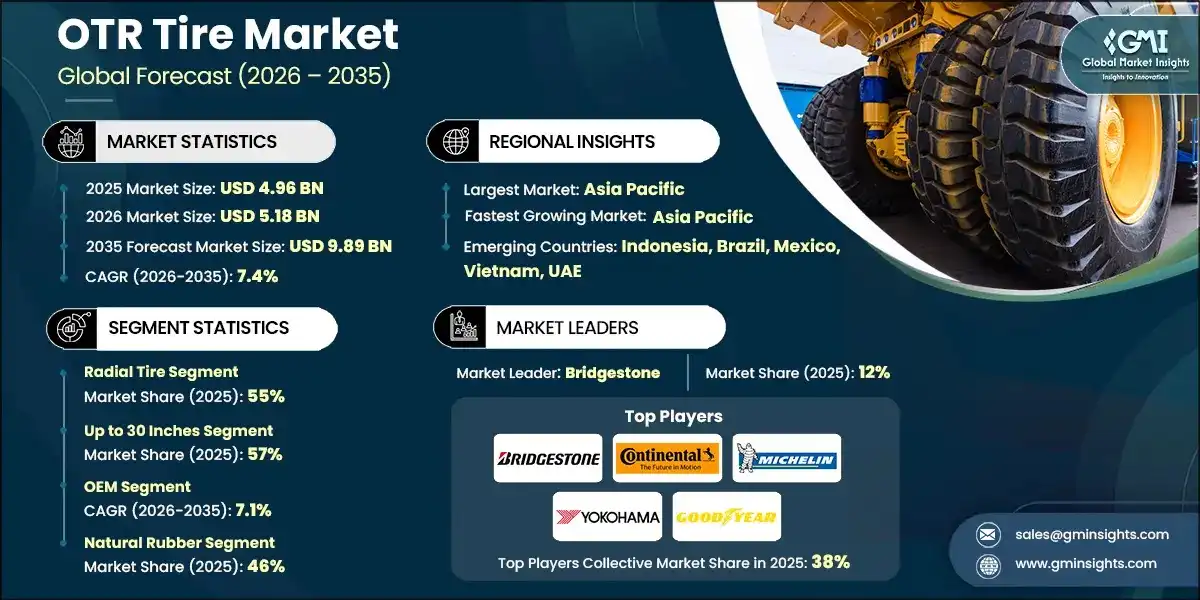
The global OTR tire market size was valued at USD 4.96 billion in 2025. The market is expected to grow from USD 5.18 billion in 2026 to USD 9.89 billion in 2035 at a CAGR of 7.4%, according to latest report published by Global Market Insights Inc.
OTR Tire Market Key Takeaways
Market Size & Growth
- 2025 Market Size: USD 4.96 Billion
- 2026 Market Size: USD 5.18 Billion
- 2035 Forecast Market Size: USD 9.89 Billion
- CAGR (2026–2035): 7.4%
Regional Dominance
- Largest Market: Asia Pacific
- Fastest Growing Region: Asia Pacific
Key Market Drivers
- Expansion of mining and quarrying activities.
- Infrastructure development and construction growth.
- Agricultural mechanization.
- Shift toward radial tire adoption.
Challenges
- Raw material price volatility.
- High failure rates from heat and overloading.
Opportunity
- Growth in emerging mining markets.
- Automation in mining and construction equipment.
- Expansion in port and material handling operations.
- Aftermarket replacement demand growth.
Key Players
- Market Leader: Bridgestone led with over 12% market share in 2025.
- Leading Players: Top 5 players in this market include Bridgestone, Continental, Michelin, The Goodyear Tire & Rubber Company, Yokohama Rubber Company, which collectively held a market share of 38% in 2025.
Get Market Insights & Growth Opportunities
The increased use of heavy-duty equipment such as haul trucks, loaders, and dozers through the ongoing expansion of mining and quarrying operations, coupled with an increasing worldwide demand for mineral and metal extraction, is leading to an increase in the use of durable off-the-road (OTR) tires that can support high load capacities, operate in extremely abrasive conditions and withstand several hours of continuous operation.
Public and private investments in infrastructure roads, bridges, energy projects, industrial zones, and urban development’s worldwide has created an increased need for construction machinery. Excavators, graders, backhoe loaders, and dumpers utilize OTR tire and have increased demand for durable, long-lasting and high-performing tire solutions that will hold up under varying terrain and high levels of operating stress.
In addition, the move towards the use of tractors, harvesters, and advanced agricultural machinery, often through the modernization of agriculture; increased labor demands; and improved productivity will drive the demand for specialized OTR agricultural tires that provide strong traction, reduce soil compaction, and provide a long wear life to support large-scale farming operations throughout emerging and developed agricultural markets.
Fleet operators are shifting from bias to radial OTR tire at a fast pace due to the superior performance of radial OTR tire, which possess longer tread life, better heat dissipation, greater fuel economy and better ride comfort. Mining, construction and industrial equipment users are using radial OTR tire in increasing quantities to improve productivity and reliability and eventually save costs.
To get key market trends
OTR Tire Market Trends
The process of integrating sensors, TPMS and Telematics systems into OTR tire is continuing to expand. With the ability to monitor pressure, temperature and wear in real-time, users are making smart maintenance decisions by reducing their downtime and extending tire lifecycles. The digital involvement is mainly prominent for high-safety, high-efficiency mining and industrial fleets.
Environmental impact continues to drive tire manufacturers to use bio-based raw materials, recycled materials, and low-rolling-resistance compounds. The trend toward greener tire formulations is driven by sustainability initiatives, increased carbon reduction commitments and evolving regulations. These trends promote a shift towards more responsible production, which results in better lifecycle performance for OTR tire.
With the increasing cost of tires and the increasing pressure on fleets to be sustainable, fleets especially in mining and industrial operations, are increasingly turning to retreading, as a cost-effective and environmentally friendly way to extend the life of OTR tire. The improved quality of casings and advanced technology used in retreading are supporting this tremendous growth in retread programs.
As equipment becomes more specialized and automated, tire manufacturers and OEMs are collaborating closely to create custom OTR tire solutions that are optimized for the machinery on which they will be used. These collaborations are resulting in improved performance, increased safety and operational efficiency, and are becoming a major trend in the marketplace.
OTR Tire Market Analysis
Learn more about the key segments shaping this market
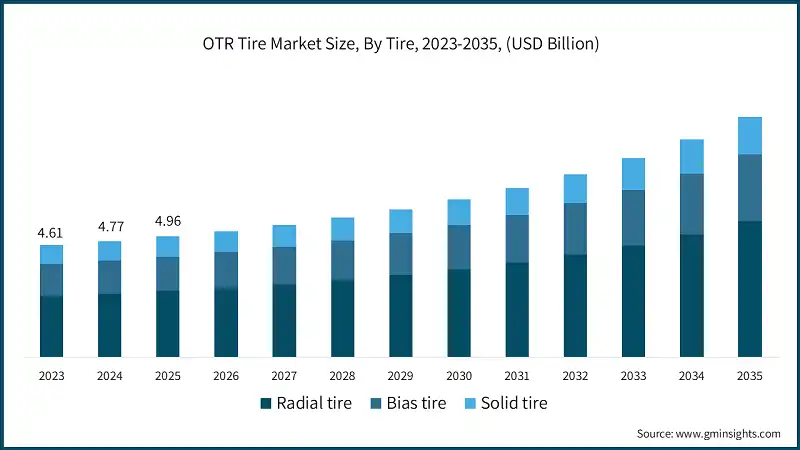
Based on tire, the OTR tire market is divided into radial tire, bias tire and solid tire. The radial tire segment dominated the market, accounting for 55% in 2025 and is expected to grow at a CAGR of over 7% through 2026 to 2035.
- Radial tires dominate in both automotive and off-road applications because of their long tread life and smooth ride. The radial tire design has steel belts attached with cords oriented perpendicular to the direction of travel, providing more traction, fuel efficiency, stability, and heat dissipation.
- The newest innovations are Michelin's XDR 4 SPEED ENERGY tire (debuted at MINExpo 2024) that will offer an increase in fuel efficiency of 3.6% compared with conventional tire designs, and Bridgestone's V-STEEL Z TRACTION tire that increases tire life by 15% due to improved traction.
- Bias tires are made using a diagonal ply construction with a tread and sidewall structure that are dependent on each other, allowing for a much higher load carrying capacity and greater resistance to cuts and impacts than radial tires. Bias tires are best suited for heavy-duty, slow-speed or off-road applications.
- For instance, Titan International has recently launched the AgraVANTAGE R-1 bias tire line that is intended for use on agricultural machinery and specialized equipment; this line of tires has superior flotation and durability in applications where radial tires do not perform well.
- Airless or solid tire designs are more focused on providing maximum puncture resistance as opposed to maximum ride comfort, this is the primary advantage of solid tires over pneumatic tires, especially in applications where exceptional levels of puncture resistance are required.
- For instance, Galileo Wheel's SkidCup tire designed specifically for use on skid-steer loaders and Titan International's Variable Pressure Operation (VPO) Technology (developed with Carlstar) that allow operation below 0 psi.
Learn more about the key segments shaping this market
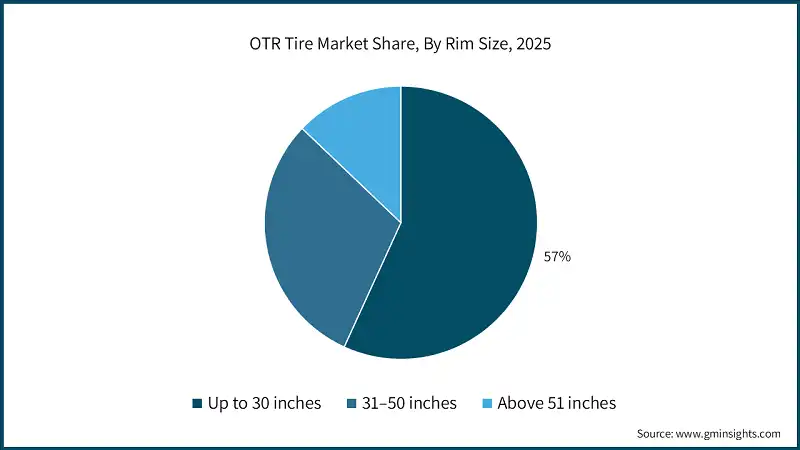
Based on rim size, the OTR tire market is segmented into up to 30 inches, 31–50 inches and above 51 inches. Up to 30 inches segment dominates the market with 57% share in 2025, and the segment is expected to grow at a CAGR of 7.2% from 2026 to 2035.
- The largest OTR tire segment consists of compact construction machines, small agricultural tractors, industrial equipment and light-duty mining vehicles as defined by their ability to maneuver and be flexible in design which are of rim size upto 30 inches. Manufacturers focus on providing cost-effective solutions with features, such as enhanced tread compounds and basic sensors, which appeal to large production volume and lower price sensitive customers.
- The mid-to-large OTR tire segment, 31–50 inches, consists of larger construction, agricultural and material-handling machinery. This segment is driven by continued growth in the developing nations' mining and infrastructure sectors.
- For instance, Goodyear's RL-5K (March 2024) provides a 16% increase in load capacity for large wheel loader applications when compared to prior generations. This segment optimizes productivity by balancing capabilities and operating costs without requiring large equipment investments.
- The above 51 inches segment represents 12.9% of OTR tire sales in the year 2025. Applications for ultra-large tires are rigid dump trucks, large wheel loaders, and specialized mining attachments. 57-inch tires by BKT (MINEXPO 2024) and Michelin's 63-inch XDR 4 SPEED ENERGY.
Based on distribution channel, the OTR tire market is segmented into OEM and aftermarket. The OEM segment dominates the market with 44% share in 2025, and the segment is expected to grow at a CAGR of 7.1% from 2026 to 2035.
- OEM channel caters to tires manufacturers of equipment directly for new vehicles, as it provides insight into demand based on production and technology being integrated into new products. For instance, in November 2024, Titan International entered into a global agreement with Deere & Company to provide them with tires for all agricultural, construction and landscaping equipment.
- The OEM segment is closely correlated with overall trends in the economy in construction, mining and agriculture.
- The aftermarket segment sells replacement tires to dealers, fleets and independent retailers, and is driven by equipment being worn out, damaged or upgraded. For instance, in FY12/25, Yokohama’s YOHT brand will see a projected 20% increase in aftermarket OHT tire sales.
- Fleet operators often replace tires because of their use in heavy-duty mining or construction environments. The aftermarket segment provides higher margins and more value-added services, such as Bridgestone Engineering Solutions or Kal Tire’s KalPRO, and has greater potential for recapping, thus making it strategically more valuable than the OEM segment
Based on material, the OTR tire market is segmented into natural rubber, synthetic rubber and mixed/compound tires. The natural rubber segment is expected to dominate the market with a share of 46% in 2025.
- OTR tire manufacturing is dominated by the natural rubber market due to its elastic properties, resistance to tearing, ability to dissipate heat, and its excellent abrasion resistance, which are necessary for uses in heavy-laden & uneven terrain. Natural rubber meets the global sustainability agenda using renewable materials but faces supply constraints and price volatility from agricultural dependence.
- An instance of this balance is BKT’S use of natural unit resins as a substitute for petroleum resins, where they balance performance, supply stability, and sustainability against the requirements of the industrial and commercial sectors.
- The synthetic rubber market is experiencing exceptional primarily due to stable availability of synthetic rubber, predictable pricing, and the ability to customize the performance of products including cut resistance, flexibility at low temperatures, and resistance to chemicals.
- Yokohama Rubber's partnership with ZEON Corporation provide synthetic rubber from biomass, shows the industry's commitment to producing safe, sustainable alternatives that meet performance standards without depending on the use of natural rubber materials.
- The Mixed Tire market is projected to be the fastest growing segment at a projected CAGR of 9.2% from 2026 to 2035 as the mixing of natural and synthetic rubber with other materials creates a product with the highest possible performance.
- Michelin's introduction of the XDR 4 Speed Energy, which has been engineered to provide low rolling resistance whilst maintaining high durability is one example.
Looking for region specific data?
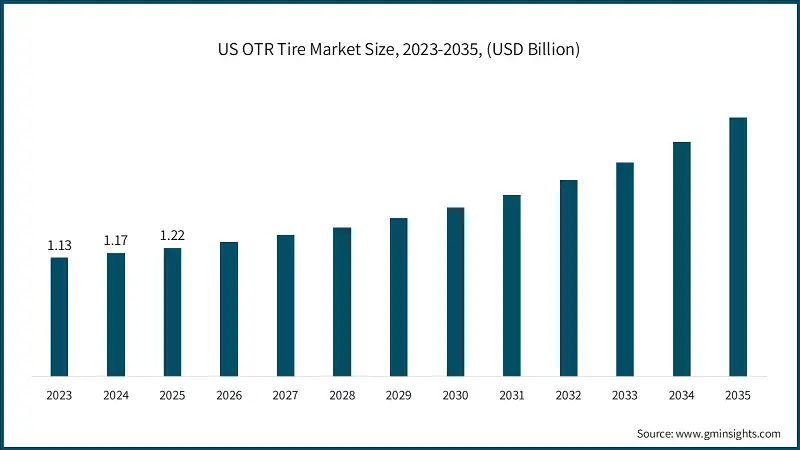
The US OTR tire market reached USD 1.22 billion in 2025, growing from USD 1.17 billion in 2024.
- The mining and construction industries are the largest markets for off-the-road tires, with fleet operators seeking to use radial and mixed-compound tires because they are durability and increased fuel economy.
- Increased development in advanced infrastructure (i.e., highways, urban areas) is the primary driver of growth for mid-to-large-sized tires used in heavy-duty equipment applications.
- In US, sustainability is driving the use of retreading, recycled tire materials, and the sale of tires that are energy-efficient, all of which contribute to improved operational efficiency and environmental compliance.
North America dominated the OTR tire market with a market size of USD 1.48 billion in 2025.
- The continued growth of industrial and agricultural mechanization has contributed to a large volume of OTR tire being purchased to support the various needs of a growing number of industrial and agricultural users.
- The aftermarket has grown at a higher rate than the original equipment manufacturer ("OEM") market due to the significant volume of existing equipment installed and the regularity with which tires need to be replaced.
- The increased use of technology in commercial fleets is a major factor encouraging the adoption of Advanced Tire Technologies, such as TPMS, IoT sensors, and Predictive Maintenance, between fleets.
Europe OTR tire market accounted for a share of 25.6% and generated revenue of USD 1.27 billion in 2025 and is anticipated to show lucrative growth over the forecast period.
- Europe’s mature construction, mining and material handling sectors create steady demand for OTR tire. Increasingly modernized infrastructure, large urban development projects and port upgrades have led to increased use of wheel loaders, excavators and other types of specialized industrial equipment which all need durable, high-quality tires that are optimized to meet the rigors of operating in and on European terrain and to meet Eastern and Western European operational standards.
- A key revenue driver for manufacturers in Europe is the aftermarket. Due to the high level of wear experienced by tires when working in these demanding types of applications and harsh terrain environments, manufacturers are able to maintain high margins and enhance customer loyalty through extensive replacement tyre cycles and retreading programs, as well as enhanced premium service offerings that extend the life of tires used across multiple fleet sectors.
- European regulations encourage the development of energy-efficient, low-rolling-resistance tires as well as recycled or bio-based rubber materials. Furthermore, smart tire technology will support automated tire usage and maintenance tracking that contributes to enhanced safety and efficiency, and lower costs through reduced downtime for repairs.
Germany dominates the OTR tire market, showcasing strong growth potential, with a CAGR of 6.6% from 2026 to 2035.
- The demand for OTR tire in Germany continues to grow due to the country’s vibrant construction, mining and manufacturing industries. The movements towards modernizing infrastructure, expanding industry and improvements in urbanization across Germany have resulted in the proliferation of wheel loaders, excavators and other material handling vehicles that require specialized tires.
- For instance, German equipment manufacturers such as Liebherr and Komatsu build trong OEM tire partnerships with their manufacturers to meet their machine specifications. The manufacturers supply, and work closely with the OEMs, to develop and engineer custom OTR tire that have the necessary performance characteristics to match the OEMs’ specifications, allowing for long-term partnerships.
- The stringent environmental and emissions regulations in Germany force manufacturers to produce eco-friendly rubber, energy-efficient tyress and retreads, thereby enabling them to engage in circular economy activities, but maintain high levels of durability and performance characteristics, especially in heavy-duty applications.
The Asia Pacific OTR tire market is anticipated to grow at the highest CAGR of 8% from 2026 to 2035 with a revenue of USD 1.69 billion in 2025.
- Rapid growth in infrastructure development, urbanization and the utilization of mineral resources across the APAC region has resulted in growing demand for OTR tire. The countries that have contributed the most to this growth in construction, mining, and industrial equipment usage include India, Indonesia, and Thailand.
- High wear rates caused by heavy loads and exposure to abrasive terrains increase the frequency of tire replacements, which provides an opportunity for aftermarket sales. The availability of retreading options and premium level service alternatives are becoming increasingly attractive to fleet operators seeking to enhance their purchase efficiencies.
- The volatility of raw materials has prompted many manufacturers to focus on synthetic and mixed compound materials for OTR tire. To support the regional production of OTR tire, manufacturers are establishing regional production centers that create potentially lower costs through optimized supply chain capabilities and sustainable designs such as those incorporating recycled rubber and bio-based synthetic materials.
China OTR tire market is estimated to grow with a CAGR of 8.4% from 2026 to 2035.
- Demand for OTR tire in China is largely due to the mineral extraction, large-scale construction and industrial machinery employed within the country. Urban infrastructure and port expansion activities are both significant contributors to the mid- and large-sized tire market.
- Collaboration between local original equipment manufacturers (OEMs) and global manufacturers of capital equipment has improved the ability of OEMs to accurately forecast OTR tire demands and to embed advanced technology into their products. With ongoing rapid fleet growth and frequent replacement of OTR tire, there are numerous aftermarket opportunities in China.
- To meet demand and meet government incentives for more energy-efficient, longer-lasting, and more environmentally friendly OTR tire options for many Chinese manufacturers are leveraging advancements in the development and use of synthetic rubber, creating retread programs, and incorporating smart tire technology into their product.
Latin America OTR tire market shows lucrative growth over the forecast period.
- The growth of OTR tire adoption throughout LATAM is a result of continued expansion of mining operations in countries such as Chile, Peru, and Colombia, as well as an increase in infrastructure projects throughout the region for heavy equipment used in excavation and material handling.
- Mining and construction fleets will be replacing large volumes of tires due to higher levels of wear associated with both mining and construction operations. As a result of this continued increase of wear on tires, fleets are increasingly requesting the services of retreads, smart monitoring and lifecycle management.
- Working collaboratively with manufacturers of equipment and utilizing regional production and assembling hubs can significantly improve the overall supply chain resilience, cost optimization and opportunities for custom engineered tires that have been designed specifically for regional environments and applications.
Brazil OTR tire market is estimated to grow with a CAGR of 4% from 2026 to 2035 and reach USD 148.4 million in 2035.
- Brazil has substantial OTR tire demand due to the scale of mining and agriculture operations. Mining companies using heavy machinery will require durable tires that can handle heavy loads and difficult terrain. The Aftermarket in Brazil is growing due to aggressive environments present in the mining and agriculture sectors.
- Many mining and agricultural companies within Brazil, as well as throughout LATAM, are transitioning toward Aftermarket products which will increase the lifespan of tires and help reduce costs of equipment operation over time. By using retreads, premium tread compounds, and predictive maintenance solutions, many companies are finding ways to extend the lifespan of tires, ultimately reducing costs.
- Many companies locally produce and assemble OTR tire within Brazil in order to be more cost-effective and reduce reliance on imports. Companies are also focusing on the use of sustainable materials to align with environmental standards and optimize performance when used in tropical climates.
The Middle East and Africa OTR tire market accounted for USD 208.6 million in 2025 and is anticipated to show lucrative growth over the forecast period.
- M&A activity in MEA, particularly South Africa, Egypt & Saudi Arabia, is spurring growth in mining & infrastructure projects. OTR Tire demand is primarily associated with large scale operations in challenging environments, thus the aftermarket is important for this market segment.
- Given the challenging conditions for operating equipment, the aftermarket plays a significant role in maximizing the uptime and minimizing operational costs. The aftermarket services include retreads, premium compounds, and value-added services, such as fleet monitoring, to provide additional benefits to reduce overall acquisition & operating costs.
- In response to the challenges associated with fuel costs, product performance and regulations/MOE with very limited availability of raw materials, OEM's have been developing energy-efficient, radially phrased, recycled rubber, and smart technology consoles to enhance performance while complying with environmental regulations.
UAE OTR tire market is expected to experience substantial growth in the Middle East and Africa transportation management system market, with a CAGR of 5.8% from 2026 to 2035.
- The demand for OTR tire is growing rapidly because of the rapid growth in urban areas, the expansion of ports, and the industrialization within the UAE. Companies within the UAE will continue to require OTR tire for their construction, materials handling and logistics operations.
- The aftermarket is expanding because of the increasingly harsh operating conditions of the various industries. The use of premium (top quality) tires, retreading, and digital technology solutions will aid in reducing operating costs and improving efficiency.
- Partnerships with the leading global and local equipment manufacturers provide tire companies with the opportunity to implement the latest technologies into their products, create unique solutions, and build their brand presence amongst the mining and construction industries.
OTR Tire Market Share
The top 7 companies in the OTR tire industry are Bridgestone, Michelin, Goodyear Tire and Rubber Company, Yokohama Rubber Company, Continental, Pirelli and Sumitomo Rubber Industries contributing 43% of the market in 2025.
- Bridgestone Corporation has invested ¥25 billion to expand and modernize its Kitakyushu Plant in Japan. The company is the world's largest supplier of mining and construction tires, selling approximately 100 different mining tires under its MASTERCORE product line. The company launched its latest VZT tire in 2024, which provides a 15% longer life and 9% more traction than previous models.
- Michelin is at the forefront of technology related to mining and aviation tires. Michelin has developed and produced radial earthmover tires, as well as 63-inch tires. Michelin launched its newest tire product in 2024, the XDR 4 SPEED ENERGY tire, which improves fuel economy by 3.6%. Michelin puts a strong focus on sustainability and has established several recycling plants worldwide. The company offers many digital solutions to improve the performance of its customers' haul roads and fleets, including the MICHELIN BETTER HAUL ROAD app.
- Goodyear Tire & Rubber Company concentrates on its core consumer and commercial tire segments. Over the next few years, Goodyear plans to introduce several new all-terrain tires that will be available for both electric vehicles and SUVs. The company's Products will continue to focus on optimizing portfolio, margins and brand presence within the adventure and light truck segments.
- Continental has been recognized as the most advanced company in digital tire monitoring technologies and material handling OTR TIRE (off-highway tires). Using V.ply Technology, Continental AG Offers High Stability and Low Rolling Resistance Tires (ELITE SERIES). It is included within the ContiConnect Digital Solutions are the fleet optimization tools for real time monitoring of fleet usage, Maximizing Fleets Usage.
- Yokohama Rubber Company is one of the largest manufacturers of OTR tire and was enhanced by acquiring Goodyear’s OTR Business in 2025. In FY2024, Yokohama’s sales reached a record total of ¥1,094.7 billion, with profits totaling ¥134.4 billion. YOHT (Yokohama OTR Products) are projected to record a 20% growth rate in the aftermarket segment. Some of the more strategic initiatives taken by the company include the increased use of renewable/recycled raw materials, expansion of its factory in Visakhapatnam, India, and the buildout of additional manufacturing plants in Mexico and China to enhance its global footprint.
- Pirelli is a leading premium tire manufacturer with a focus on OTR tire; the company is differentiated from its competitors through advanced technology. Pirelli collaborates with Bosch to create CYBER TYRE (real time monitoring). PROMETEON TYRE GROUP provides Pirelli with a supply of OTR tire for Sale to AB Agri and has developed an engagement with AB Agri and is further cooperating on the update of intelligent tire technology for commercial applications.
- Sumitomo Rubber Industries is a well-established and leading manufacturer of Tires across several segments including Passenger, Commercial, and OTR; the Company is well known for its high quality and innovative product. Sumitomo Rubber operates Globally through an established network of manufacturing and distribution locations and has also begun to expand aggressively into the OTR segment.
OTR Tire Market Companies
Major players operating in the OTR tire industry are:
- Bridgestone
- Michelin
- The Goodyear Tire & Rubber Company
- Continental
- Yokohama Rubber Company
- Balkrishna Industries
- Pirelli
- Sumitomo Rubber
- Titan International
- Triangle
- Bridgestone (Japan) continues to lead the OTR tire market with innovative products, global manufacturing locations, and comprehensive service networks. Bridgestone recently invested ¥25 billion ($220 Million) to upgrade its Kitakyushu Plant to produce mining and construction vehicle tires. In addition to manufacturing tires at its multiple global production facilities including Bloomington and Aiken (USA), Rayong (Thailand), and operates multiple plants in Japan.
- Michelin (France) has established itself as a technological leader and premium manufacturer through the establishment of seven dedicated manufacturing facilities for mining tires. Michelin was the first company to produce a radial earthmover tire which was developed in 1959 and the industry’s first 63-inch tire in 1995.
- Titan International is a major manufacturer of OTR (off-the-road), agricultural and specialty tires in the USA. The Carlstar Group acquisition in 2024 added to Titan's revenue and EBITDA. Some of Titan's key strategic partners include Deere (OEM supply), Goodyear (licensing), Rodaros (Brazilian partnership), VPO (technology for tire production), and launches of AgraVANTAGE bias R-1 and steel belted skid steer tires
- Triangle Tyre is a major supplier of OTR tire to Chinese engineering machinery manufacturers, such as Volvo, Komatsu, Hyundai, and Liebherr. With China being the largest construction equipment market in the world, triangle Tyre Co., Ltd. can take advantage of the continued demand for OTR tire both domestically and globally.
OTR Tire Market Report Attributes
| Key Takeaway | Details |
|---|---|
| Market Size & Growth | |
| Base Year | 2025 |
| Market Size in 2025 | USD 4.96 Billion |
| Market Size in 2026 | USD 5.18 Billion |
| Forecast Period 2026-2035 CAGR | 7.4% |
| Market Size in 2035 | USD 9.89 Billion |
| Key Market Trends | |
| Drivers | Impact |
| Expansion of mining and quarrying activities | Growing global demand for minerals, metals, and aggregates is driving continuous expansion of mining and quarrying operations. |
| Infrastructure development and construction growth | Massive investments in roads, bridges, energy, industrial zones, and urban development projects worldwide are accelerating construction machinery deployment. |
| Agricultural mechanization | Rising adoption of tractors, harvesters, and advanced farming machinery is increasing demand for specialized OTR agricultural tires. |
| Shift toward radial tire adoption | Fleet operators increasingly prefer radial OTR tire due to superior performance benefits such as longer tread life. |
| Pitfalls & Challenges | Impact |
| Raw material price volatility | Compresses manufacturer margins and disrupts pricing stability across the value chain. |
| High failure rates from heat and overloading | Leads to increased downtime, safety risks, and higher warranty or replacement costs for fleet operators. |
| Opportunities: | Impact |
| Growth in emerging mining markets | Drives high-volume OTR tire demand and expands revenue potential for manufacturers in resource-rich regions. |
| Automation in mining and construction equipment | Creates demand for advanced, high-durability tires engineered for autonomous and precision operations. |
| Expansion in port and material handling operations | Boosts adoption of specialized industrial OTR tire designed for continuous, heavy-duty load cycles. |
| Aftermarket replacement demand growth | Ensures steady recurring revenue as fleets require frequent tire replacements due to harsh operating conditions. |
| Market Leaders (2025) | |
| Market Leaders |
12% market share |
| Top Players |
Collective market share in 2024 is 38% |
| Competitive Edge |
|
| Regional Insights | |
| Largest Market | Asia Pacific |
| Fastest growing market | Asia Pacific |
| Emerging countries | Indonesia, Brazil, Mexico, Vietnam, UAE |
| Future outlook |
|
What are the growth opportunities in this market?
OTR Tire Industry News
- In November 2025, Balkrishna Industries (BKT) announced their third quarter FY25 results with 5% YoY growth in volume at 76,343MT along with an 11% growth in revenue ($INR 25.71 billion) despite challenges in Europe. The company also announced that they plan to invest between INR 11 billion and INR 12 billion in FY26, with Phase 1 of the expansion of their OTR tire range by 35,000 MTPA to be completed in the first half of FY26.
- In November 2025, Anuj Kathuria, the President of JK Tyre & Industries for India, said that the company continues to innovate in the OTR market with the introduction of innovative designs for their latest OTR tire to meet the most demanding terrain challenges, and will provide OTR tire with greater durability and efficiency, especially for heavy machinery and construction equipment used for mining operations.
- In October 2025, Titan International announced the launch of their new line of steel-belted skid steer tires called the Carlstar Ultra Guard Steel. The first inventory is expected to be available in North America on or around February 2022. In addition, Titan also announced that they have launched a new tire line called the ITP SAVAGE which is designed to dominate any extreme terrain.
- In October 2025, Titan International announced that they completed a strategic partnership with Rodaros Industria de Rodas Ltda, Brazil's second-largest manufacturer of agricultural and construction wheels. Titan made an initial cash investment of $4 million for a 20% stake in Rodaros, with plans to purchase the remaining 80% in 2029.
The OTR tire market research report includes in-depth coverage of the industry with estimates & forecasts in terms of revenue ($ Mn/Bn) and shipments (units) from 2022 to 2035, for the following segments:
Market, By Tire
- Radial tire
- Bias tire
- Solid tire
Market, By Rim Size
- Up to 30 inches
- 31–50 inches
- Above 51 inches
Market, By Equipment
- Dump trucks
- Articulated dump trucks
- Rigid dump trucks
- Loaders
- Backhoe loaders
- Crawler loaders
- Skid-steer loaders
- Excavators
- Crawler excavators
- Mini excavators
- Wheeled excavators
- Asphalt finishers
- Crawler dozer
- Motor graders
- RTLT-telescopic
- Agriculture tractors
- Others
Market, By Industry
- Construction
- Mining
- Agriculture
- Forestry
- Industrial
- Ports & logistics
- Others
Market, By Material
- Natural rubber
- Synthetic rubber
- Mixed/compound tires
Market, By Distribution Channel
- OEM
- Aftermarket
The above information is provided for the following regions and countries:
- North America
- US
- Canada
- Europe
- Germany
- UK
- France
- Italy
- Spain
- Russia
- Nordics
- Poland
- Romania
- Asia Pacific
- China
- India
- Japan
- South Korea
- ANZ
- Vietnam
- Indonesia
- Latin America
- Brazil
- Mexico
- Argentina
- MEA
- South Africa
- Saudi Arabia
- UAE
Frequently Asked Question(FAQ) :
What was the market size of the OTR tire in 2025?
The market was valued at USD 4.96 billion in 2025, driven by the expansion of mining and quarrying operations and the rising demand for durable, high-capacity tires.
What is the projected value of the OTR tire market by 2035?
The market is expected to reach USD 9.89 billion by 2035, growing at a CAGR of 7.4% from 2026 to 2035, fueled by increased mineral and metal extraction activities and advancements in tire technology.
What is the expected size of the OTR tire industry in 2026?
The market size is projected to reach USD 5.18 billion in 2026.
What was the market share of the radial tire segment in 2025?
The radial tire segment dominated the market with a 55% share in 2025 and is expected to grow at a CAGR of over 7% through 2035.
What was the market share of the
The
What was the market share of the OEM segment in 2025?
The OEM segment accounted for 44% of the market in 2025 and is anticipated to observe around 7.1% CAGR till 2035.
What was the valuation of the U.S. OTR tire sector?
The U.S. market reached USD 1.22 billion in 2025, led by demand from the mining and construction industries for durable radial and mixed-compound tires.
What are the key trends in the OTR tire market?
Key trends include integrating sensors, TPMS, and telematics for real-time monitoring, using bio-based and recycled materials, expanding retreading adoption, and increasing tire–OEM collaborations for specialized machinery solutions.
Who are the major players in the OTR tire industry?
Major players include Bridgestone, Michelin, The Goodyear Tire & Rubber Company, Continental, Yokohama Rubber Company, Balkrishna Industries, Pirelli, Sumitomo Rubber, Titan International, and Triangle.
OTR Tire Market Scope
Related Reports