Summary
Table of Content

OTC Hearing Aids Market
Get a free sample of this report
Form submitted successfully!
Error submitting form. Please try again.
Thank you!
Your inquiry has been received. Our team will reach out to you with the required details via email. To ensure that you don't miss their response, kindly remember to check your spam folder as well!
Request Sectional Data
Thank you!
Your inquiry has been received. Our team will reach out to you with the required details via email. To ensure that you don't miss their response, kindly remember to check your spam folder as well!
Form submitted successfully!
Error submitting form. Please try again.
OTC Hearing Aids Market Size
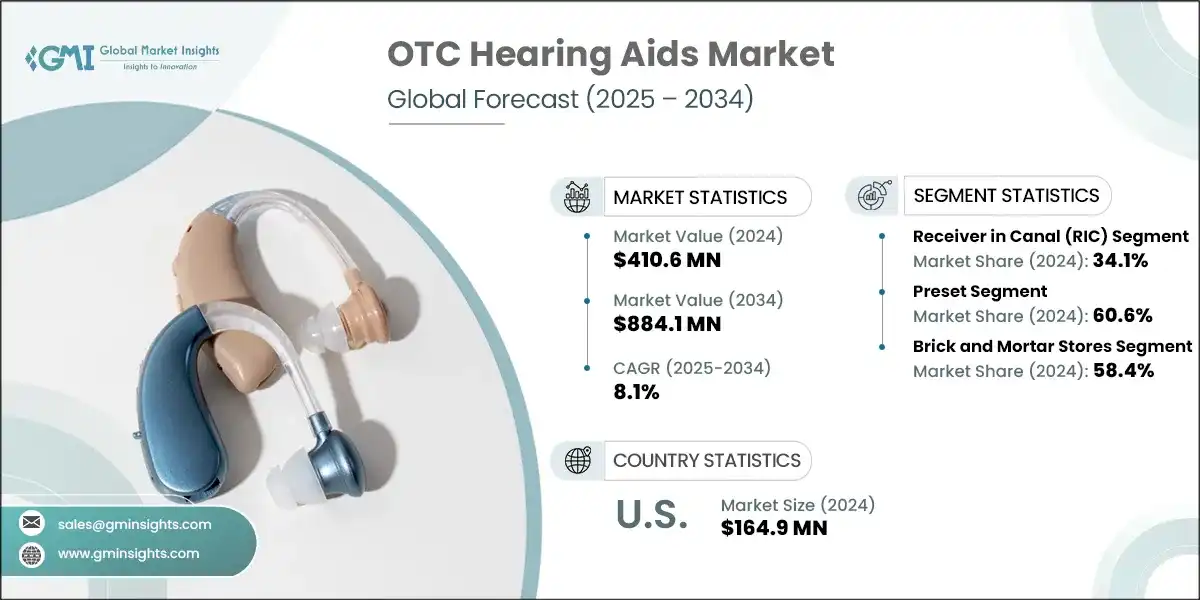
The global OTC hearing aids market was estimated at USD 410.6 million in 2024. The market is expected to grow from USD 437.4 million in 2025 to USD 884.1 million in 2034, growing at a CAGR of 8.1%. The market is driven by rising prevalence of hearing loss, aging population, cost-effectiveness compared to prescription devices, regulatory funding from the FDA, growing consumer awareness, and inadequate insurance coverage for traditional hearing aids encouraging self-managed solutions.
OTC Hearing Aids Market Key Takeaways
Market Size & Growth
- 2024 Market Size: USD 410.6 Million
- 2034 Forecast Market Size: USD 884.1 Million
- CAGR (2025–2034): 8.1%
Regional Dominance
- Largest Market: North America
- Fastest Growing Region: Asia Pacific
Key Market Drivers
- Increasing prevalence of hearing loss.
- Rising geriatric population base.
- Technological advancements.
- Steadily surging awareness and penetration of hearing devices.
Challenges
- Poor awareness and social stigma associated with wearing hearing aids.
- Concerns over device quality and efficacy.
Opportunity
- Penetration in emerging markets.
- Surging need for customized and user-friendly product innovations.
Key Players
- Market Leader: Eargo led with over 27.4% market share in 2024.
- Leading Players: Top 5 players in this market include Eargo, Lucid Hearing, Audicus, Starkey, WS Audiology Denmark A/S, which collectively held a market share of 56.3% in 2024.
Get Market Insights & Growth Opportunities
The increasing adoption of advanced digital technologies, such as Bluetooth connectivity, smartphone compatibility, and app-based sound customization. These tech-enabled features improve user ease and accessibility, especially among tech-savvy consumers, making OTC devices more attractive. The incorporation of smart functions bridges the gap between affordability and high-performance, increasing overall market penetration.
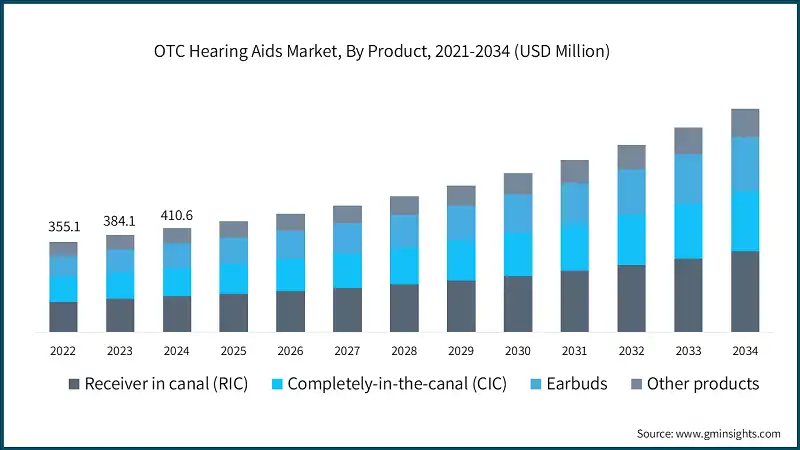
The market declined from USD 355.1 million in 2022 to USD 384.1 million in 2023, registering a CAGR of 8.2% during this period. The growth can be attributed to regulatory shifts such as the FDA’s approval for OTC hearing aids, making them more accessible without prescriptions. Rising awareness among consumers, increasing cases of age-related hearing loss, and the affordability of OTC devices compared to traditional ones further fueled demand. Additionally, expanding retail availability through pharmacies and e-commerce platforms contributed to increased product adoption and market expansion.
The industry is undergoing significant growth, driven by a mixture of economic, demographic, and supervisory factors. One of the significant drivers is the growing prevalence of hearing loss globally, particularly among the aging population. As people live longer, age-related hearing impairment is becoming more common, increasing the demand for accessible and affordable hearing solutions. OTC hearing aids are emerging as a cost-effective alternative to traditional prescription devices, making them highly attractive to consumers.
Over-the-counter (OTC) hearing aids are normally more affordable than prescription models, contributing significantly to their rising demand. While prescription hearing aids average around USD 4,600 OTC alternatives are typically priced at approximately USD 1,600. Moreover, Medicare and several insurance brokers and agents do not cover hearing aid expenditures. Although some insurers offer optional coverage, patients often need to pay additional premiums for these add-on services. As a result, numerous individuals are turning to OTC hearing aids as a more practical and economical option. Another noteworthy driver is regulatory support, especially in the U.S., where the FDA has approved the sale of OTC hearing aids for adults with perceived mild to moderate hearing loss. This regulatory move has not only amplified accessibility but also encouraged innovation and market entry by new players, including consumer electronics companies.
Besides, growing consumer awareness about hearing health and the availability of self-fitting, easy-to-use devices are empowering users to manage their hearing loss independently. Technological progressions such as smartphone integration, Bluetooth connectivity, and enhanced sound quality are also enhancing the appeal of OTC hearing aids, driving their adoption across a wider consumer base.
Over the counter (OTC) hearing aids are FDA-regulated devices designed for adults with perceived mild to moderate hearing loss. They can be purchased directly by consumers without a prescription, medical exam, or professional fitting, offering a convenient and affordable alternative to traditional prescription hearing aids.
To get key market trends
OTC Hearing Aids Market Trends
The market is presently shaped by an intricate fusion of macro and micro trends that are not only escalating its reach but also accelerating innovation across all stages of the product lifespan. On a macro level, global demographic modifications, including speedily aging populations in North America, Europe, and parts of Asia, are driving exponential demand for accessible hearing solutions. Growing healthcare costs and limited insurance coverage for traditional prescription devices are compelling more consumers to explore convenient, lower-cost OTC alternatives.
- In the meantime, micro trends such as augmented consumer self-efficacy, digital literacy, and consciousness of hearing health are driving demand for direct-to-consumer hearing technologies. At the technological front, next-generation OTC hearing aids are embracing breakthroughs in AI-driven sound profiling, environmental noise suppression, and machine-learning procedures that automatically adapt to diverse acoustic environments. These smart devices are progressively incorporating smartphone integration, Bluetooth connectivity, and companion app controls to enable granulated personalization and remote fine-tuning, delivering features exclusive to high-end prescription models.
- Regulatory evolution has also played a pivotal role: the U.S. FDA’s 2022 ruling formalizing OTC hearing aids for adults with perceived mild-to-moderate hearing loss has been a watershed moment, lowering barriers to market entry and stimulating competition. Other global regulators are monitoring this shift with a view to updating their own frameworks, potentially catalyzing broader international market liberalization.
- Product evolution reflects a leap from basic volume-adjustable units toward sleek, transparent, and discreet form factors-such as invisible-in-canal (IIC) designs that appeal to style-conscious consumers. Battery life enhancements, rechargeable lithium-ion power systems, and energy-efficient micro-components are now standard, elevating both convenience and environmental sustainability.
- Manufacturing trends are increasingly focused on cost-effective mass production using automated assembly lines and modular component designs. This approach not only streamlines production but also enables flexible customization and rapid iteration cycles. OEMs are experimenting with localized manufacturing hubs to reduce shipping costs and improve responsiveness to local regulatory standards.
- Taken together, these macro and micro drivers, combined with fast-moving technological upgrades, regulatory gains, product refinements, and manufacturing optimization, are redefining OTC hearing aids as a dynamic, consumer-centric market segment poised for robust growth.
OTC Hearing Aids Market Analysis
Learn more about the key segments shaping this market
The global market was valued at USD 355.1 million in 2021 and USD 384.1 million in 2023, primarily due to the rising prevalence of age-related and noise-induced hearing loss, especially among the aging population.
Based on the product, the market is segmented into receiver in canal (RIC), completely-in-the-canal (CIC), earbuds, and other products. The receiver in canal (RIC) segment accounted for 34.1% of the market in 2024, driven by its greater sound quality, discreet design, and accessible features pleasing to a wide consumer base. The segment is expected to exceed USD 318.9 million by 2034, growing at a CAGR of 8.7% during the forecast period. On the other hand, the earbuds segment is expected to grow with a CAGR of 8.4%. The earbuds segment is experiencing high growth due to rising demand for wireless, portable audio solutions driven by increasing smartphone usage and active lifestyles.
- The segment is driven by increasing consumer demand for lightweight and comfortable hearing aids that offer natural sound experiences. RIC devices feature a detached speaker and microphone design, which lessens feedback and improves audio clarity. Moreover, the flexibility to accommodate varying levels of hearing loss makes RIC models suitable for a wider range of users. Their open-fit style also allows for a more natural perception of ambient sounds, improving overall user satisfaction.
- The second-largest segment, completely-in-the-canal (CIC), held a market share of 27.5% in 2024, driven by the increasing consumer preference for discreet and cosmetically attractive hearing aids that are almost unseen when worn. These devices fit completely inside the ear canal, making them ideal for users looking for privacy and minimal visibility. In addition, developments in miniaturization and digital signal processing have improved CIC performance, allowing better sound quality and comfort. Increasing demand among younger, tech-savvy adults with mild to moderate hearing loss is also driving segment growth.
- The earbuds segment accounted for 23.9% of the market in 2024, driven by increasing consumer preference for discreet, multifunctional, and tech-enabled hearing solutions. Modern earbuds offer seamless integration with smartphones, Bluetooth connectivity, and audio streaming, making them both hearing aids and lifestyle devices. Their stylish, compact design appeals to younger adults with mild hearing loss who seek stigma-free alternatives.
Based on the type, the OTC hearing aids market is bifurcated into preset, and self-fitting. The preset segment accounted for the highest market share of 60.6% in 2024 due to its ease of use, affordability, and immediate availability without the need for customization.
- The preset segment in the market is driven by increasing customer demand for hassle-free, ready-to-use solutions that involve minimal mechanical knowledge. These devices appeal to first-time users and adults seeking simple functionality without intricate setup. Growing retail availability in drugstores and online platforms further enhances access, while advancements in generic sound amplification technology improve performance, making preset hearing aids a practical choice for mild to moderate hearing loss.
- On the other hand, the self-fitting segment is driven by increasing consumer preference for personalized healthcare solutions, rising digital literacy, and advancements in user-friendly software interfaces. These devices empower users to independently calibrate their hearing aids, reducing dependency on audiologists and promoting greater convenience, especially in remote or underserved regions.
Learn more about the key segments shaping this market
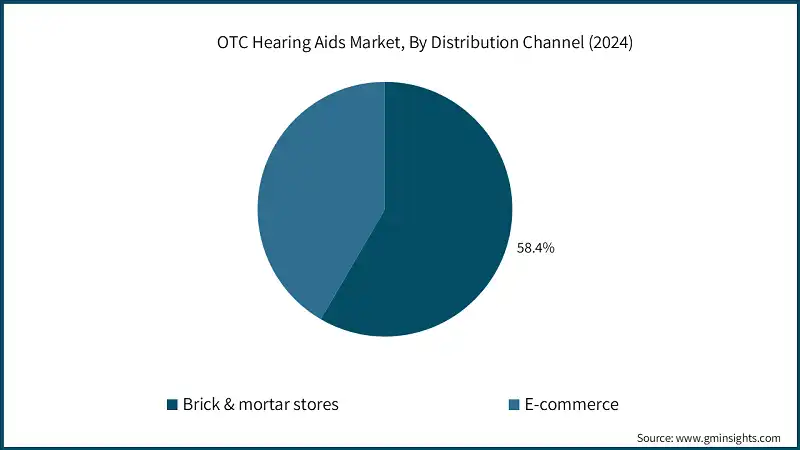
Based on the distribution channel, the OTC hearing aids market is divided into brick and mortar stores, and e-commerce. The brick and mortar stores segment accounted for the highest market share of 58.4% in 2024 due to the personalized in-store assistance and immediate product trials they offer to consumers.
- The brick and mortar stores section is driven by rising consumer preference for in-person spending experiences, mainly among adults who may be less tech-savvy. These stores offer a reliable environment where customers can request advice from trained staff, compare many brands physically, and feel more self-assured in their purchasing decisions. In addition, recognized retail chains benefit from strong brand recognition and community existence, which promotes consumer trust and repeat visits.
- The e-commerce section is driven by the rising preference for suitable, discreet, and contactless buying options, particularly among tech-savvy and aging consumers. Improved online product instruction, virtual hearing tests, digital marketing, and wider accessibility to distant regions further fuel demand, making online platforms gradually attractive for hearing aid purchases.
Looking for region specific data?
North America dominated the global OTC hearing aids market with the highest market share of 42.6% in 2024.
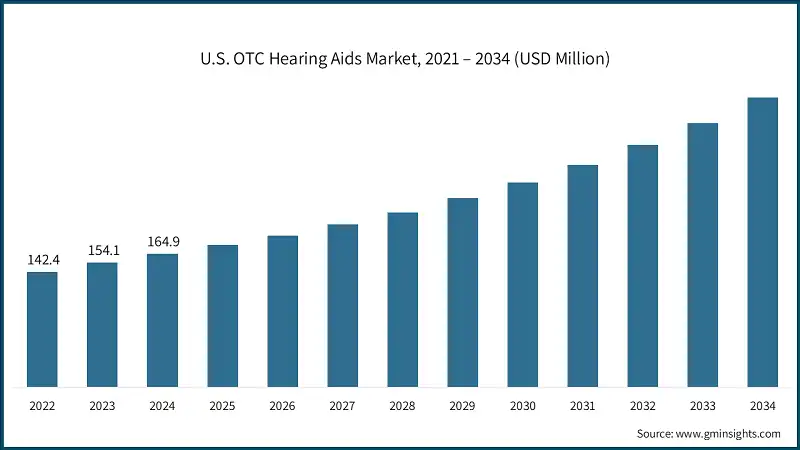
- The U.S. market was valued at USD 142.4 million in 2021. In 2024 the market size reached USD 164.9 million from USD 154.1 million in 2023. The growth of the market is driven by increasing demand for affordable, accessible hearing solutions following FDA regulatory approval.
- North America’s dominance in the market is driven by a combination of demographic, technological, and healthcare system-related factors. The region has a large aging population, particularly in the U.S. and Canada, which contributes to a growing prevalence of age-related hearing loss.
- Consumers in North America are increasingly inclined toward self-managed healthcare solutions, supported by high levels of health awareness, digital literacy, and access to technology. The presence of well-established distribution networks, including e-commerce platforms and retail pharmacies, has enhanced the availability and accessibility of OTC hearing aids.
- Additionally, rising healthcare costs and limited insurance reimbursement for hearing devices are pushing consumers to opt for more affordable, over-the-counter alternatives. Technological advancements, such as AI-based sound customization and Bluetooth-enabled devices, are also fueling product appeal across diverse user segments.
- In the U.S., strong market growth is further driven by an innovation-friendly environment and the presence of major tech and medical device companies investing in next-generation hearing solutions, making devices more user-centric and feature-rich.
Europe OTC hearing aids market accounted for USD 102 million in 2024.
- The Europe market increasing steadily, owing to a combination of positive legislative changes, increased public health awareness, and the region's aging population. Customers in Europe are becoming more proactive in dealing with hearing loss, which has resulted in a desire for self-directed, accessible solutions.
- Government campaigns promoting hearing health and early intervention are further encouraging adoption. Additionally, technological advancements-such as AI-enabled sound processing, wireless connectivity, and smartphone integration-are enhancing the usability and appeal of OTC devices.
- Retail pharmacy chains and e-commerce platforms are also expanding product availability, making it easier for consumers to access hearing aids without the need for specialist appointments. Moreover, rising healthcare costs and limited insurance coverage for traditional prescription hearing aids are motivating consumers to opt for cost-effective OTC alternatives.
- In Germany, one of the leading markets in Europe, demand is being fueled by strong digital health adoption, a tech-savvy senior population, and government support for innovation in consumer medical devices. The country’s well-established healthcare infrastructure is also accelerating product accessibility and market penetration.
The Asia Pacific OTC hearing aids market is anticipated to witness high growth over the analysis timeframe.
- The Asia Pacific market is poised for rapid growth due to several converging factors, including rising geriatric populations, increasing prevalence of untreated hearing loss, and expanding awareness of hearing health. As urbanization and noise pollution intensify across developing nations, hearing impairment is becoming more common, particularly among the elderly.
- Moreover, limited access to audiologists and hearing care services in rural and underserved regions has made self-managed solutions like OTC hearing aids an attractive alternative. The affordability of OTC models is especially appealing in cost-sensitive markets such as India, Indonesia, and the Philippines, where out-of-pocket healthcare spending is high. The rise in smartphone usage and digital literacy is also enabling users to adopt app-connected hearing aids that offer self-fitting and tuning features.
- In China, rapid economic development, a growing elderly population, and increasing government emphasis on improving elderly care services are key growth drivers. Local manufacturers are entering the OTC space with competitively priced, tech-enhanced products, further boosting domestic market penetration.
OTC hearing aids market in Latin America is expected to grow significantly in the coming years.
- The Latin America market stands to grow significantly on account of several factors which are unique to the region. Increased awareness towards hearing health and increasing aged population in countries like Mexico, Argentina and Chile will boost the demand for affordable hearing devices.
- The lack of availability to audiologists and hearing care professionals in rural and underserved areas is leading patients to pursue self-fit hearing solutions, signaling OTC devices as a reasonable alternative. Furthermore, high expense and lengthy lead times from conventional hearing aid channels are driving consumers in the direction of cheaper, more convenient OTC devices.
- Government initiatives aimed at improving healthcare access, along with rising disposable incomes and expanding retail and e-commerce networks, are also playing a significant role in market growth.
- In Brazil, the largest market in the region, the increasing adoption of telehealth services and digital health technologies is enhancing the reach and convenience of OTC hearing aids. Furthermore, Brazil’s large urban population and improving regulatory landscape are contributing to greater product availability and consumer trust.
OTC Hearing Aids Market Share
Leading companies like Eargo, Lucid Hearing, Audicus, Starkey, and WS Audiology Denmark A/S together hold between 55% - 60% of the market share in the moderately consolidated global market. These companies have built strong brands, extensive distribution systems and product ranges to serve a broad consumer base. Their stronghold is also being consolidated as research and development investments continue and newer features, including self-fitting technology, Bluetooth pairing, noise cancellation and sound personalisation via apps - features that are more and more demanded by tech-savvy users - become more established. Big guns still in control While the massive firms are still leading, the market is also seeing a significant surge from startups and mid-sized players driven by commercial interests.
Consumer electronics brands such as Sony and Jabra (a GN Group company) are also entering the OTC hearing aids space, leveraging their expertise in audio engineering and wearable devices to disrupt the market with hybrid hearing-enhancement solutions that blur the line between hearing aids and hearables. These companies are capitalizing on evolving consumer expectations for discreet, multifunctional, and aesthetically appealing devices. Moreover, partnerships with pharmacies, big-box retailers, and e-commerce platforms such as Amazon and Walmart have become key strategies for broadening product availability and improving access.
Geographically, North America accounts for the largest share due to early regulatory support and high consumer awareness, while regions like Asia-Pacific and Latin America are emerging as high-growth territories driven by increasing geriatric populations and underserved hearing care needs.
Overall, market competition is intensifying as companies race to offer customizable, affordable, and easy-to-use hearing solutions. With the growing shift toward consumer-directed care and increasing digitization, the market is expected to continue evolving, with both legacy players and new entrants contributing to a dynamic and innovation-driven competitive landscape.
OTC Hearing Aids Market Companies
Few of the prominent players operating in the OTC hearing aids industry include:
- AUDICUS
- AcoSound
- Audien Hearing
- AUSTAR
- EARGO
- GN Store Nord
- HearX Group
- Lucid HEARING
- MD Hearing
- NUHEARA
- NuvoMed
- sonova
- SOUNDWAVE HEARING
- Starkey
- WS Audiology
- Eargo:
Eargo specializes in virtually invisible, rechargeable OTC hearing aids with self-fitting features and app-based personalization. Its sleek, in-canal design and direct-to-consumer sales model emphasize comfort, discretion, and user empowerment, making it a popular choice for tech-savvy consumers seeking a seamless, medical-grade yet stylish hearing solution.
- Lucid Hearing:
Lucid Hearing offers a wide range of FDA-registered OTC hearing aids with features like Bluetooth streaming, advanced noise reduction, and customizable sound profiles. Partnered with major U.S. retailers like Sam’s Club, it ensures broad accessibility, affordability, and reliable support, positioning itself as a convenient and value-driven hearing care provider.
- Audicus:
Audicus stands out for its direct-to-consumer model and affordability, offering high-quality OTC hearing aids with remote audiologist support. Its subscription plans, online hearing tests, and discreet designs make hearing care accessible, budget-friendly, and hassle-free for consumers looking for professional-level functionality without in-person clinic visits.
- Starkey:
Starkey is known for integrating advanced health features into its OTC hearing aids, such as fall detection, fitness tracking, and AI-powered sound processing. With a strong reputation in audiology, it brings clinical-grade innovation to self-managed devices, bridging the gap between traditional hearing aids and next-gen wellness tech.
OTC Hearing Aids Market Report Attributes
| Key Takeaway | Details |
|---|---|
| Market Size & Growth | |
| Base Year | 2024 |
| Market Size in 2024 | USD 410.6 Million |
| Forecast Period 2025 – 2034 CAGR | 8.1% |
| Market Size in 2034 | USD 884.1 Million |
| Key Market Trends | |
| Drivers | Impact |
| Increasing prevalence of hearing loss | Increasing prevalence of hearing loss is boosting demand for accessible, non-prescription hearing solutions across all age groups. |
| Rising geriatric population base | The rising geriatric population base is expanding the consumer pool requiring affordable and easy-to-use hearing aids. |
| Technological advancements | Technological advancements are enhancing product appeal through features like self-fitting, Bluetooth, and AI-based sound adjustment. |
| Steadily surging awareness and penetration of hearing devices | Steadily surging awareness and penetration of hearing devices is driving higher adoption and reducing care delays. |
| Pitfalls & Challenges | Impact |
| Poor awareness and social stigma associated with wearing hearing aids | Poor awareness and social stigma associated with wearing hearing aids is discouraging potential users from seeking early hearing support. |
| Concerns over device quality and efficacy | Concerns over device quality and efficacy are limiting consumer confidence in adopting OTC hearing aids over professional models. |
| Opportunities: | Impact |
| Penetration in emerging markets | Penetration in emerging markets will unlock untapped demand, fueling volume growth and global market expansion. |
| Surging need for customized and user-friendly product innovations | Surging need for customized and user-friendly product innovations will drive competitive differentiation and long-term user retention. |
| Market Leaders (2024) | |
| Market Leaders |
27.4% market share |
| Top Players |
Collective Market Share in 2024 is 56.3% |
| Competitive Edge |
|
| Regional Insights | |
| Largest Market | North America |
| Fastest Growing Market | Asia Pacific |
| Emerging Countries | India, Brazil, Mexico, Indonesia, South Africa |
| Future outlook |
|
What are the growth opportunities in this market?
OTC Hearing Aids Industry News:
- In October 2022, Jabra announced the availability of Jabra Enhance Plus, which is offered both online and in retail stores. Jabra Enhance Plus is an in-ear device designed to improve hearing while also allowing users to take calls and listen to music, offering multifunctional benefits to consumers.
- In January 2022, Eargo launched Eargo 6, its sixth-generation FDA Class II device that automatically adjusts to different environments. This product launch helped the company expand its customer base and contributed to driving revenue growth.
- In December 2021, GN acquired Lively, an online hearing aid sales and digital marketing platform that enables consumers in the U.S. to access hearing care from licensed professionals. GN was Lively’s exclusive supplier of hearing aids, and this forward integration is expected to enhance the company’s commercial presence in the e-commerce hearing aids sales channel and boost revenue generation.
The OTC hearing aids market research report includes an in-depth coverage of the industry with estimates and forecast in terms of revenue in USD Million and from 2021 - 2034 for the following segments:
Market, By Product
- Receiver in canal (RIC)
- Completely-in-the-canal (CIC)
- Earbuds
- True wireless stereo (TWS)
- Ear-hook
- Neckband
- Other products
Market, By Type
- Preset
- Self-fitting
Market, By Distribution Channel
- Brick and mortar
- E-commerce
The above information is provided for the following regions and countries:
- North America
- U.S.
- Canada
- Europe
- Germany
- UK
- France
- Italy
- Spain
- Netherlands
- Asia Pacific
- China
- Japan
- India
- Australia
- South Korea
- Latin America
- Brazil
- Mexico
- Argentina
- Middle East and Africa
- South Africa
- Saudi Arabia
- UAE
Frequently Asked Question(FAQ) :
What is the market size of the OTC hearing aids in 2024?
The market size was USD 410.6 million in 2024, with a CAGR of 8.1% expected through 2034, driven by the rising prevalence of hearing loss, aging populations, and cost-effectiveness compared to prescription devices.
What is the projected value of the OTC hearing aids market by 2034?
The market is expected to reach USD 884.1 million by 2034, fueled by FDA regulatory funding, growing consumer awareness, and advancements in hearing aid technologies.
What is the projected size of the OTC hearing aids market in 2025?
The market is expected to reach USD 437.4 million in 2025.
How much revenue did the earbuds segment generate?
The earbuds segment is projected to grow at a CAGR of 8.4%, driven by increasing demand for wireless, portable audio solutions due to rising smartphone usage and active lifestyles.
What was the market share of brick-and-mortar stores in 2024?
Brick-and-mortar stores accounted for 58.4% of the market share in 2024, owing to personalized in-store assistance and immediate product trials.
Which region leads the OTC hearing aids market?
North America led the global market with a 42.6% share in 2024, driven by strong demand for affordable and accessible hearing solutions following FDA regulatory approval.
What are the upcoming trends in the OTC hearing aids industry?
Key trends include the adoption of AI-driven sound profiling, environmental noise suppression, machine-learning technologies, and growing consumer self-efficacy and digital literacy.
Who are the key players in the OTC hearing aids market?
Key players include AUDICUS, AcoSound, Audien Hearing, AUSTAR, EARGO, GN Store Nord, and HearX Group.
OTC Hearing Aids Market Scope
Related Reports