Summary
Table of Content

Opto Semiconductor Market
Get a free sample of this report
Form submitted successfully!
Error submitting form. Please try again.
Thank you!
Your inquiry has been received. Our team will reach out to you with the required details via email. To ensure that you don't miss their response, kindly remember to check your spam folder as well!
Request Sectional Data
Thank you!
Your inquiry has been received. Our team will reach out to you with the required details via email. To ensure that you don't miss their response, kindly remember to check your spam folder as well!
Form submitted successfully!
Error submitting form. Please try again.
Opto Semiconductor Market Size
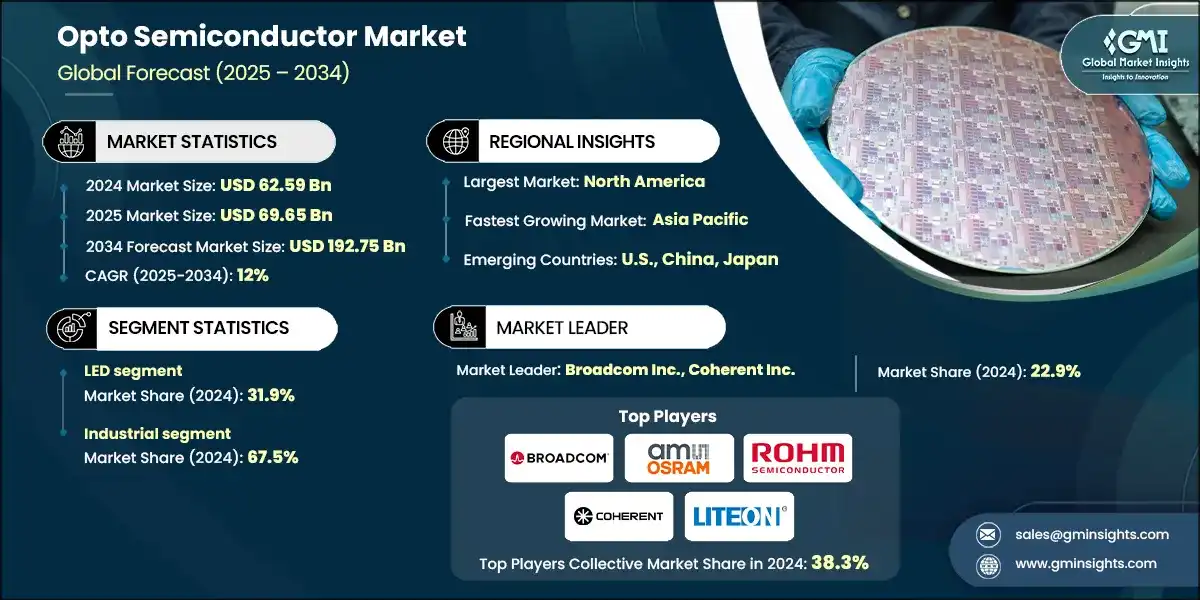
The global opto semiconductor market was estimated at USD 62.59 billion in 2024. The market is expected to grow from USD 69.65 billion in 2025 to USD 121.06 billion in 2030 and USD 192.75 billion by 2034, at a CAGR of 12% during the forecast period of 2025–2034, according to Global Market Insights Inc.
Opto Semiconductor Market Key Takeaways
Market Size & Growth
- 2024 Market Size: USD 62.59 Billion
- 2025 Market Size: USD 69.65 Billion
- 2034 Forecast Market Size: USD 192.75 Billion
- CAGR (2025–2034): 12%
Regional Dominance
- Largest Market: North America
- Fastest Growing Region: Asia Pacific
Key Market Drivers
- Rising adoption of automotive safety and ADAS systems.
- Expansion of consumer electronics and IoT devices.
- Increasing deployment in industrial automation and robotics.
- Demand growth in healthcare imaging and diagnostics.
- Advancements in smart lighting and energy-efficient solutions.
Challenges
- High manufacturing costs and complex fabrication processes.
- Intense competition and pricing pressure from global players.
Opportunity
- Growth in electric and autonomous vehicles.
- Expansion of 5G infrastructure applications.
- Rising demand for wearable health devices.
- Adoption in smart city projects.
Key Players
- Market Leader: Broadcom Inc. led with over 22.9% market share in 2024.
- Leading Players: Top 5 players in this market include Broadcom Inc., ams OSRAM Group, ROHM Semiconductor, Coherent Inc., LITE-ON Technology Corp., which collectively held a market share of 38.3% in 2024.
Get Market Insights & Growth Opportunities
- Growing emphasis about vehicle safety and the transition towards autonomous vehicles is spurring transportation demand for opto semiconductors. Advanced Driver Assistance Systems (ADAS) rely on optical sensors, LiDAR, cameras, & infrared modules to detect obstructions, offer adaptive cruise control, and aid automated braking systems. Governments worldwide are enacting stricter safety regulations, further fueling adoption of these technologies.
- Opto semiconductors are a critical element of bringing accurate, real-time data to such systems, offering reliability under diverse driving situations. As increasing electric and connected vehicle populations emerge, utilization of other opto components in navigation, monitoring, and protection applications is projected to propel market expansion significantly.
- Opto semiconductors are being spurred by strong demand from consumer electronics & IoT devices. Smartphones, smartwatches, home automation units, and wearables are using optical components for applications like biometric sensing, gesture recognition, face recognition, and data communications. Opto semiconductors also enable efficient power management and miniaturization, critical for battery-driven consumer devices.
- Expansion of photonic sensor-based IoT ecosystems from smart homes to industrialized manufacturing is also driving the use of low-power, high-performance photonic sensors further. As customers increasingly demand more intuitive, interactive, & power-conscious products, opto semiconductors are playing an ever-increasing part in making next-generation electronic experiences possible & fueling long-term market expansion.
To get key market trends
Opto Semiconductor Market Trends
- Since 2014, the opto semiconductor industry has experienced a trend toward LED-based lighting solutions, gradually replacing traditional technology. The transition was for efficiency, durability, and energy efficiency, driving widespread adoption of automotive, residential, and industrial segments in accordance with global sustainability efforts.
- CMOS image sensors have been the dominant product trend since 2016, replacing CCD technology. Their use in smartphones, surveillance systems, & medical imaging devices is a result of consumer & industrial demand for compact, high-resolution, low power imaging solutions and supporting diverse applications.
- Optical communication modules have gained more importance since 2018 due to the need for high data rates in data centers, cloud computing, and 5G infrastructure. Opto semiconductors in this trend ensure stable, scalable bandwidth performance that is necessary for developing digital and communication networks.
- LiDAR and 3D sensing technologies have expanded tremendously as a market-defining trend. Their adoption in autonomous vehicles, robotics, and AR/VR systems underscores demand for precise depth sensing, mapping, and immersive interaction, setting the stage for advanced mobility and digital experiences.
Opto Semiconductor Market Analysis

Learn more about the key segments shaping this market
Based on type, the market is segmented into LED, image sensors, infrared component, optocouplers, laser diode, and others. The LED segment accounts for the highest market share of 31.9%.
- The LED segment was the largest market and was valued at USD 19.98 billion in 2024. The LED segment is led by increasing demand for energy-saving lighting technologies in industrial, commercial, and residential markets. Increased sustainability awareness, government incentives for green infrastructure, and the use of smart lighting systems are pushing the use of LED-based opto-semiconductors, with the advantages of increased illumination, reduced energy consumption, and overall cost savings over time.
- The image sensors segment is the fastest growing market and is anticipated to grow with a CAGR of 13.1% during the forecast period. The image sensors market is influenced by growing applications in smartphones, vehicle ADAS, surveillance cameras, & medical imaging devices. Innovations in high-resolution, miniature, and low-power optical sensors are enabling enhanced imaging, precise monitoring, and automatic recognition, which is rendering image sensors an essential element in consumer electronics, healthcare, and automotive systems.
Learn more about the key segments shaping this market
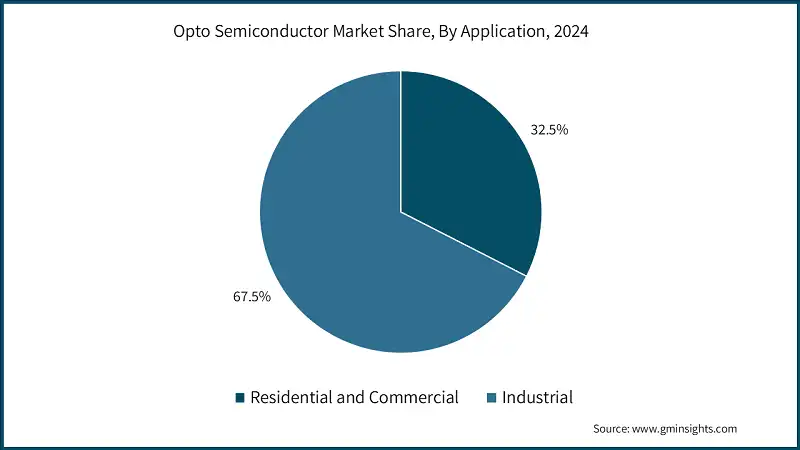
Based on application, the opto semiconductor market is segmented into residential and commercial, and industrial. The industrial segment accounts for the highest market share of 67.5%.
- The residential and commercial application was the largest segment and accounted for USD 20.35 billion in 2024. Residential & commercial segment is driven by increasing adoption of energy-saving LED lighting, smart home solutions, and building smart solutions. Increasing awareness for sustainability, as well as the requirement for automated lighting, security, and IoT-based devices, is propelling the use of opto-semiconductors to enable more energy savings, ease of use, & operational effectiveness in residences & commercial spaces.
- The industrial application is the fastest-growing market and is anticipated to grow with a CAGR of 12.5% during the forecast period. The industrial segment is influenced by the growing use of automation, robotics, and intelligent manufacturing technologies. Opto-semiconductors like optical sensors, image sensors, and laser modules are increasingly utilized for process monitoring, machine vision, and quality control, which enables industries to achieve higher precision, operational efficiency, and productivity in advanced manufacturing and industrial operations.
Looking for region specific data?
The North America opto semiconductor market held 34.5% market share and is growing at a 12.5% CAGR, is driven by ADAS adoption, rising optical communication demand, and expanding healthcare imaging applications.
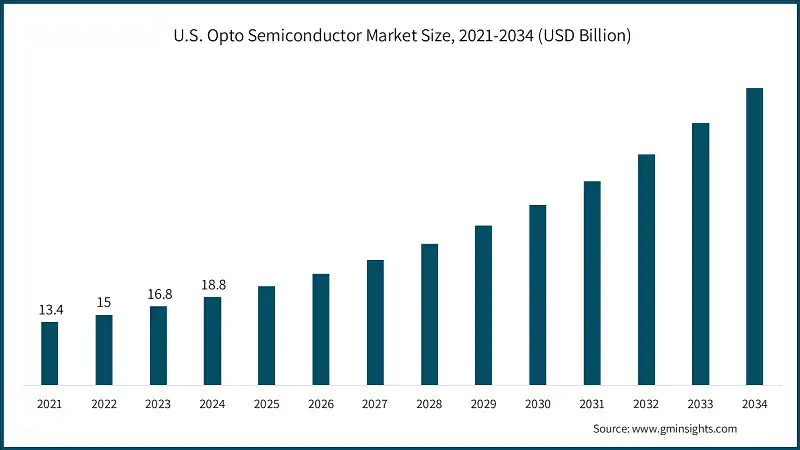
- The market in the U.S. has been expanding steadily, achieving a CAGR of 13% and reaching a valuation of USD 18.84 billion in 2024. The prime growth driver is the rising adoption of automotive safety and Advanced Driver Assistance Systems (ADAS). Rising use of optical sensors, LiDAR, and cameras in vehicles for real-time detection, collision avoidance, and autonomous capabilities is fueling demand for opto-semiconductors in the automotive space.
- The US market presents the opportunity in 5G infrastructure and data communications. Growing demand for high-speed optical transceivers and photonic products for use in data centers, cloud computing, and IoT markets is driving innovation and utilization of next-generation opto-semiconductor devices.
- The Canada opto semiconductor market is projected to grow significantly with a CAGR of 8.8% during the forecast period. The main factor driving the growth in Canada is the introduction of opto-semiconductors to the healthcare imaging and diagnostics sector. Hospitals, research centers, and manufacturers of healthcare devices are adopting optical sensors and imaging modules for advanced diagnostic precision, minimally invasive diagnostic procedures, and digital health tools.
Europe held a 26.3% share and a 11.5% CAGR. Europe opto-semiconductor growth stems from automotive strength and industrial automation, with optical sensors and LiDAR driving connected vehicles and factories.
- The opto semiconductor market in Germany reached a valuation of USD 5.50 billion in 2024 and is anticipated to grow with a CAGR of 12.1% during the forecast period. Germany's expansion in the opto-semiconductor industry is primarily due to its robust automotive and industrial automation sectors. Leading automobile manufacturers and industrial companies are adopting optical sensors, laser modules, and imaging technologies to enhance manufacturing efficiency, motor vehicle safety, and automated processes.
- Germany offers potential in Industry 4.0 and precision healthcare applications. Opto-semiconductors' use in smart factories, robotics, medical imaging, and diagnostic tools is expanding, creating possibilities for suppliers to provide high-performance devices to technology-intensive industries.
- The UK market is anticipated to surpass USD 13.86 billion by 2034. In the UK, the growth of the opto-semiconductor market is primarily driven by the evolution of automotive electronics and intelligent transportation systems. Increasing demand for optical sensors, LiDAR modules, and imaging devices is fueled by higher adoption of ADAS, autonomous vehicle technologies, and connected mobility solutions.
The Asia-Pacific region dominated the opto semiconductor market and accounted for 19.8% of the total market share. Asia Pacific leads the global opto-semiconductor market, fueled by large-scale production in China, Japan, and South Korea. Rising demand for consumer electronics, smartphones, and LED lighting, coupled with automotive and healthcare adoption, strongly drives growth.
- The opto semiconductor industry in China was valued at USD 4.11 billion in 2024 and is anticipated to grow with a CAGR of 13.9% during the forecast period. China opto-semiconductor market is driven by huge industrialization and rapid adoption of customer electronics. The market is expanding for LEDs, image sensors, and laser modules owing to the need for smartphones, smart home appliances, and automotive optical systems, including ADAS and EV sensors.
- China opto-semiconductor industry is driven by massive industrialization and robust adoption of consumer electronics. Smartphone, smart home appliance, and car optical systems like ADAS and EV sensors demand are fueling growth for LEDs, image sensors, and laser modules.
- The opto semiconductor market in Japan has been experiencing steady expansion, achieving a compound annual growth rate of 13.1% and attaining a valuation of USD 2.5 billion in 2024. In Japan, the growth of the opto-semiconductor market is dominated by its advanced automotive and robotics sectors. Strong utilization of autonomous vehicle technology and industrial automation parts is driving the demand for precise optical sensors, laser diodes, and imaging modules.
- The market in India was valued at USD 2.09 billion in 2024 and is predicted to grow with a CAGR of 15% during the forecast period. The growth of opto-semiconductors in India can be traced back to LED uptake and growth in automotive electronics. Demand for energy-efficient lighting as well as smartphones and vehicle safety systems are driving the production and integration of optical sensors, LEDs, and image sensors.
- India presents opportunities in smart city initiatives and data communication infrastructure. A combination of government programs to promote sustainable urbanization and growing data center/internet of things needs is creating sizable demand for opto-semiconductors in lighting, connectivity, and sensing solutions.
Latin America held 10.2% market share and is growing with a CAGR of 10.6%. In Latin America, market growth is primarily driven by increasing adoption of LED lighting and expanding telecom infrastructure. The shift toward energy-efficient systems and rising demand for smartphones are creating steady demand for opto-semiconductors.
The Middle East & Africa opto semiconductor market was valued at USD 5.74 billion in 2024. The Middle East & Africa market is driven by infrastructure development, adoption of LED lighting, and growing use of optical sensors in industrial and defense applications. Demand for energy-efficient solutions remains a key driver.
- The South Africa market is projected to grow with a CAGR of 7.9% during the forecast period. In South Africa, the opto-semiconductor market is primarily driven by the increasing adoption of energy-efficient LED lighting and solar-powered solutions. Rising urbanization and infrastructure development are encouraging the use of advanced optical components in residential, commercial, and industrial lighting systems.
- The Saudi Arabia market is projected to surpass USD 3.83 billion by 2034. In Saudi Arabia, market growth is fueled by the expansion of smart city projects and new transportation infrastructure. The adoption of advanced optical sensors, imaging, and LED systems to be utilized in urban planning and automotive industries is a key driver.
- The opto semiconductor market in UAE accounted for USD 2.56 billion in 2024. UAE's expansion in the opto-semiconductor segment is driven by increasing industrial automation and high-tech building projects. Smart building and commercial complex integration of imaging technologies, LED lighting, and optical sensors is accelerating market adoption.
Opto Semiconductor Market Share
- The top 5 companies Broadcom Inc., ams OSRAM Group, ROHM Semiconductor, Coherent Inc., LITE-ON Technology Corp. collectively hold around 38.3% of the market, indicating a consolidated market concentration.
- Broadcom Inc. has a commanding 14.6% market share. Broadcom Inc. is committed to enhancing its leadership position in optical communication through the expansion of our portfolio of high-performance opto-semiconductors aimed at data centers, the networking market, and the telecom market. It is executing this strategy through investment in continued R&D, acquisitions, and partnerships with cloud service providers to fuel the growth in demand for bandwidth, speed, & efficiency.
- Coherent Inc. holds a major position in the market, accounting for 8.3% of the total market share. Coherent Inc. is a leader in advanced laser diode and optical technologies for the medical, industrial, and communication markets. The company uses a combination of ongoing innovation in precision opto-semiconductors, collaborative partnerships, and diversified applications across semiconductor manufacturing, healthcare imaging, and defense and security to maintain a competitive edge.
- LITE-ON Technology Corp. is a key player in the opto semiconductor market and held 6.2% of the total market share. LITE-ON Technology Corp. is focusing on cost-effective, large-scale LED opto-semiconductor production to cater to diverse consumer & industrial requirements. As a strategy, LITE-ON Technology Corp. company operational efficiency, vertical integration, and collaborative partnerships with global OEMs allow the company to maintain competitiveness in the mass market but also pursue sustainable lighting and electronics commercialization.
- ams OSRAM Group also held 5.1% of the total market share. ams OSRAM Group leverages its strong legacy in lighting and sensing technologies by prioritizing innovation in automotive, consumer, & industrial applications. The company continues to advance energy-efficient and miniaturized solutions, empower by LED, LiDAR, and imaging solutions, to become a leading provider of intelligent opto-semiconductors for emerging mobility and smart infrastructure applications.
Opto Semiconductor Market Companies
Some of the prominent market participants operating in the opto semiconductor industry include:
- Broadcom Inc
- Coherent, Inc.
- Epistar Corporation
- Fairchild Semiconductor International
- IPG Photonics
- JENOPTIK
- LITE-ON Technology Corporation
- Littelfuse, Inc.
- Mitsubishi Electric Corporation
- OSRAM
- Renesas electronics corporation
- ROHM Semiconductor
- SHARP CORPORATION
- TOSHIBA Corporation
- TT Electronics plc
- Ushio America, Inc.
- Vishay Intertechnology, Inc.
- Leaders in the opto-semiconductor market include Broadcom Inc., OSRAM, Mitsubishi Electric Corporation, ROHM Semiconductor, and SHARP Corporation. The strength of these companies is their global presence in this market, achieved through various combinations of R&D footprint, product range. The primary strategies of these companies are to focus on R&D for the development of innovative products, primarily for automotive, consumer electronics, and industrial spaces, to allow them to maintain their technology leadership and a stable revenue growth profile.
- Challengers such as Coherent Inc., Renesas Electronics Corporation, Toshiba Corporation, and IPG Photonics are reinforcing their positions by innovating in their specialized technology businesses in lasers, imaging, and automotive technology. While these competitors do not address each broad market segment, they can be expected to compete aggressively with global leaders in specific application markets due to their experience and specialized innovation pipelines.
- Followers in this space include LITE-ON Technology Corporation, Littelfuse Inc., TT Electronics plc, and Vishay Intertechnology Inc. These companies focus more on cost leadership, volume production, and reliable standard solutions than using disruptive innovation.
- Niche players, for example, Epistar Corporation, JENOPTIK, and Ushio America Inc., serve particular applications, such as LED lighting, medical imaging, and specialized photonics solutions. Their strength is in offering customized, high-performance solutions for specific markets, establishing sustainable positions in segments that are less served by larger multinational players.
Opto Semiconductor Market Report Attributes
| Key Takeaway | Details |
|---|---|
| Market Size & Growth | |
| Base Year | 2024 |
| Market Size in 2024 | USD 62.59 Billion |
| Market Size in 2025 | USD 69.65 Billion |
| Forecast Period 2025 - 2034 CAGR | 12% |
| Market Size in 2034 | USD 192.75 Billion |
| Key Market Trends | |
| Drivers | Impact |
| Rising adoption of automotive safety and ADAS systems | Spurs ~30% growth in sensor and LiDAR component demand. |
| Expansion of consumer electronics and IoT devices | Drives ~28% increase in compact, high-efficiency opto components. |
| Increasing deployment in industrial automation and robotics | Boosts ~32% uptake of optical sensors for precision operations. |
| Demand growth in healthcare imaging and diagnostics | Accelerates ~35% adoption of advanced opto imaging solutions. |
| Advancements in smart lighting and energy-efficient solutions | Enables ~25% growth in LED-based and energy-saving applications. |
| Pitfalls & Challenges | Impact |
| High manufacturing costs and complex fabrication processes | Limits scalability, slows ~20% potential production expansion. |
| Intense competition and pricing pressure from global players | Reduces margins, compresses profitability by ~15–18%. |
| Opportunities: | Impact |
| Growth in electric and autonomous vehicles | Expands demand for advanced sensors, LiDAR, and lighting systems |
| Expansion of 5G infrastructure applications | Drives need for high-speed optical communication components |
| Rising demand for wearable health devices | Fuels innovation in compact, low-power opto sensors |
| Adoption in smart city projects | Enhances use of smart lighting, surveillance, and IoT devices |
| Market Leaders (2024) | |
| Market Leaders |
Top 2 companies hold 22.9% market share in 2024 |
| Top Players |
Collective market share in 2024 is 38.3% |
| Competitive Edge |
|
| Regional Insights | |
| Largest Market | North America |
| Fastest Growing Market | Asia Pacific |
| Emerging Countries | U.S., China, Japan |
| Future outlook |
|
What are the growth opportunities in this market?
Opto Semiconductor Industry News
- In August 2024, India-based Polymatech, a leading opto-semiconductor supplier, announced the acquisition of a US-based semiconductor equipment company specializing in packaging and testing. This strategic move aims to build an integrated chipmaking business, strengthening Polymatech’s position in the global opto-semiconductor and IC manufacturing ecosystem.
- In October 2023, Polymatech Electronics, India’s first opto-semiconductor chip manufacturer, announced its DRHP filing with SEBI on October 5, 2023, aiming to raise USD 90.8 million through fresh equity. The company focuses on designing, producing, and packaging opto-semiconductor chips and LEDs, planning to expand its Tamil Nadu facility.
The opto semiconductor market research report includes in-depth coverage of the industry with estimates and forecasts in terms of revenue in (USD Billion) from 2021 – 2034 for the following segments:
Market, By Type
- LED
- General lighting LEDs
- Automotive LEDs
- Display LEDs
- Signage & indicators
- UV LEDs
- OLEDs
- Others
- Image Sensors
- CMOS image sensors
- CCD image sensors
- 3D/Depth sensors
- Specialized sensors
- Infrared Component
- IR emitters
- IR detectors
- IR receiver modules
- Thermal imaging components
- Others
- Optocouplers
- Laser diode
- Others
Market, By Application
- Residential and commercial
- Industrial
- Automotive
- Lighting systems
- Advanced Driver Assistance Systems (ADAS)
- In-cabin monitoring
- Others
- Consumer electronics
- Smartphones & tablets
- Wearables
- Smart home devices
- Others
- Telecommunication
- Optical communication systems
- Data centers & networking
- Others
- Healthcare
- Medical imaging
- Diagnostics & monitoring
- Biophotonics & life sciences
- Others
- Energy & power
- Others
- Automotive
The above information is provided for the following regions and countries:
- North America
- U.S.
- Canada
- Europe
- Germany
- UK
- France
- Spain
- Italy
- Netherlands
- Asia Pacific
- China
- India
- Japan
- Australia
- South Korea
- Latin America
- Brazil
- Mexico
- Argentina
- Middle East and Africa
- Saudi Arabia
- South Africa
- UAE
Frequently Asked Question(FAQ) :
What is the market size of the opto semiconductor industry in 2024?
The opto semiconductor market was valued at USD 62.59 billion in 2024, with a CAGR of 12% expected through 2034 driven by expansion of consumer electronics and IoT devices.
What is the current opto semiconductor market size in 2025?
The market is projected to reach USD 69.65 billion in 2025.
What is the projected value of the opto semiconductor market by 2034?
The industry is expected to reach USD 192.75 billion by 2034, fueled by automotive ADAS systems, industrial automation, and healthcare imaging applications.
How much revenue did the LED type segment generate in 2024?
The LED segment was valued at USD 19.98 billion in 2024, leading the market with 31.9% share due to rising demand for energy-efficient lighting and smart infrastructure solutions.
What was the valuation of the residential & commercial application segment in 2024?
The residential & commercial application segment accounted for USD 20.35 billion in 2024, driven by smart home devices, IoT-based lighting, and energy-efficient infrastructure adoption.
What is the growth outlook for the image sensors segment from 2025 to 2034?
The image sensors segment is projected to grow at a CAGR of 13.1% through 2034, supported by demand in smartphones, ADAS vehicles, surveillance systems, and medical imaging.
Which region leads the opto semiconductor market?
The U.S. opto semiconductor market was valued at USD 18.84 billion in 2024. Growth is driven by strong ADAS adoption, high-speed optical communication demand, and expanding healthcare imaging technologies.
What are the upcoming trends in the opto semiconductor market?
Key trends include adoption of LiDAR and 3D sensing, expansion of optical communication modules for 5G, shift toward LED-based smart lighting, and integration of CMOS image sensors in consumer and industrial devices.
Who are the key players in the opto semiconductor market?
Key players include Broadcom Inc., ams OSRAM Group, ROHM Semiconductor, Coherent Inc., LITE-ON Technology Corp., Mitsubishi Electric Corporation, SHARP Corporation, Toshiba Corporation, and Renesas Electronics Corporation.
Opto Semiconductor Market Scope
Related Reports