Summary
Table of Content

On-site Solar E-Fuel Market
Get a free sample of this report
Form submitted successfully!
Error submitting form. Please try again.
Thank you!
Your inquiry has been received. Our team will reach out to you with the required details via email. To ensure that you don't miss their response, kindly remember to check your spam folder as well!
Request Sectional Data
Thank you!
Your inquiry has been received. Our team will reach out to you with the required details via email. To ensure that you don't miss their response, kindly remember to check your spam folder as well!
Form submitted successfully!
Error submitting form. Please try again.
On-site Solar E-Fuel Market Size
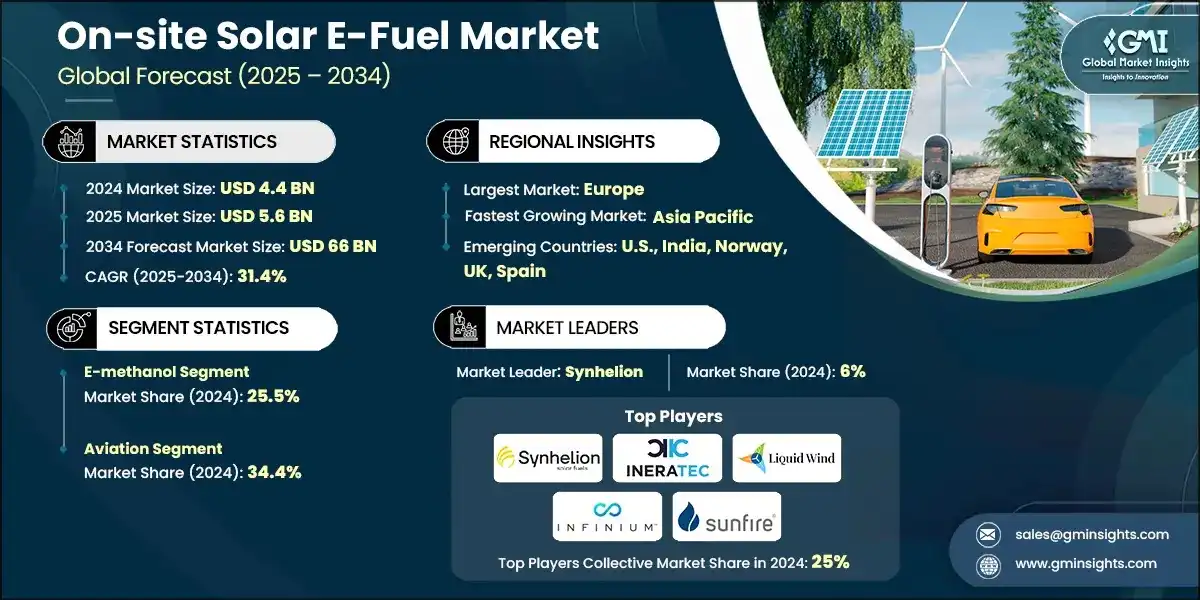
According to a recent study by Global Market Insights Inc., the global on-site solar e-fuel market was estimated at USD 4.4 billion in 2024. The market is expected to grow from USD 5.6 billion in 2025 to USD 66 billion in 2034, at a CAGR of 31.4%.
On-site Solar E-Fuel Market Key Takeaways
Market Size & Growth
- 2024 Market Size: USD 4.4 Billion
- 2025 Market Size: USD 5.6 billion
- 2034 Forecast Market Size: USD 66 Billion
- CAGR (2025–2034): 31.4%
Regional Dominance
- Largest Market: Europe
- Fastest Growing Region: Asia Pacific
Key Market Drivers
- Decentralized energy generation.
- Growing demand for low-carbon synthetic fuels.
Challenges
- High initial capital costs.
Opportunity
- Industrial decarbonization.
- Remote and off-grid applications.
Key Players
- Market Leader: Synhelion led with over 6% market share in 2024.
- Leading Players: Top 5 players in this market include Sunfire, Infinium, Liquid Wind, INERATEC, Synhelion, which collectively held a market share of 25% in 2024.
Get Market Insights & Growth Opportunities
- Rising decarbonization mandates in hard-to-abate sectors including aviation, shipping, and heavy transport is accelerating globally, creating strong demand for e-fuels produced from renewable sources like solar. These sectors face limited electrification options, making synthetic fuels a critical pathway to meet net-zero targets.
- Governments and regulatory bodies are introducing blending mandates and carbon pricing to incentivize adoption. Solar-based e-fuels offer a sustainable solution by converting CO2 and water into hydrocarbons using renewable energy, aligning with climate goals and energy security strategies.
- For instance, the European Commission’s ReFuelEU Aviation regulation mandates a minimum share of sustainable aviation fuel (SAF), including e-fuels, starting at 0.7% by 2030, with targets increasing thereafter. This policy explicitly supports hydrogen-based and solar-derived fuels for aviation decarbonization.
- Technological advancements in solar-to-liquid conversion including solar thermochemical and electrochemical processes are making on-site solar e-fuel production more efficient and commercially viable. Technologies like high-temperature solar reactors and solid oxide electrolyzers enable direct conversion of solar energy into synthesis gas, which is then processed into liquid fuels.
- For instance, in June 2024, Synhelion inaugurated the world’s first large-scale solar fuel plant in Jülich, Germany. The plant successfully produced synthetic crude oil using sun-to-liquid technology and plans to scale up with a commercial facility in Spain by 2025. These innovations reduce energy losses and improve scalability, positioning solar e-fuels as a competitive alternative to fossil fuels.
- Integration of carbon capture with solar e-fuel systems or point-source CO2 capture to create a closed carbon loop. This approach not only reduces emissions but also ensures a steady supply of carbon feedstock for fuel synthesis. Combining solar energy with carbon capture enhances sustainability and compliance with circular carbon economy principles.
- For instance, in October 2023, Aramco and ENOWA announced a joint development agreement to build an e-fuel demonstration plant in NEOM, Saudi Arabia. The facility will produce synthetic methanol and gasoline using green hydrogen and captured CO2, powered by on-site renewable energy.
- Strong policy support combined with the favorable incentives for renewable fuels adoption including introducing of financial incentives, tax credits, and grants to accelerate renewable fuel adoption is augmenting the industry landscape. These measures reduce capital costs for solar e-fuel projects and encourage private investment.
- Policies include blending mandates, carbon intensity targets, and funding for pilot plants, creating a favorable environment for market growth. For instance, in April 2024, the U.S. government announced USD 7 billion in solar for all grants in to expand solar deployment across the country, indirectly supporting renewable hydrogen and e-fuel pathways by increasing solar capacity for integrated projects.
To get key market trends
On-site Solar E-Fuel Market Trends
- Growing corporate commitments to net-zero aviation for e-fuel adoption will augment the market scenario. Airlines and logistics companies are committing to net-zero targets, driving demand for solar-based e-kerosene and e-diesel. These commitments often translate into long-term offtake agreements with e-fuel producers, ensuring revenue stability and encouraging project development.
- In July 2025, SWISS Airlines became the world’s first airline to integrate Synhelion’s solar fuel into its flight operations, marking a major milestone in commercial aviation’s transition to renewable fuels. This is further anticipated to increase the product application across aviation industry, thus complementing the business outlook.
- On-site solar e-fuel projects are adopting modular designs to reduce construction timelines and enable flexible scaling. This approach allows developers to start with smaller units and expand capacity as demand grows, minimizing financial risk and accelerating deployment.
- For reference, in 2024, Norsk e-fuel started developing modular power-to-liquid plants in Port of Rauma in Finland, with facility designed to produce up to 8,000 tonnes of e-fuels (of which 80% will be SAF) on an annual basis. The plant is targeted to be commissioned by 2027, and the modular blueprint enables rapid replication across Europe.
- Collaborations between technology providers, energy companies, and industrial players are accelerating innovation and commercialization. These partnerships pool expertise in solar energy, electrolysis, and fuel synthesis, reducing technical risks and improving project viability will sway the industry dynamics.
- For instance, in February 2025, RES partners with Norsk e-fuel and Prime Capital for a project to produce sustainable aviation fuel in Sweden. The project named ‘Alby’ has planned to produce around 800,000 tons of e-fuel each year. In addition, this will lead to Norsk e-fuel expansion in Sweden, thereby adding to market growth.
- The rapid expansion of solar PV capacity worldwide is lowering electricity costs, making electrolysis-based e-fuel production more competitive. On-site solar generation ensures stable energy supply and reduces dependency on grid power, enhancing project economics, thereby allowing the expansion of the market.
- For illustration, as per the IEA Renewables 2025 report, the solar PV accounts for nearly 80% of global renewable capacity additions, driving down costs and enabling integration with hydrogen and e-fuel projects. This is anticipated to further increase the solar installment owing to availability of sunlight across major regions of the world, including, Asia Pacific, Middle East, & Latin America.
- Aviation is a priority sector for e-fuel adoption due to stringent SAF mandates. Solar e-fuel projects are aligning with these regulations by producing e-kerosene that meets international standards, positioning themselves as key suppliers for airlines. For reference, the EU ReFuelEU Aviation regulation sets SAF blending targets and allocates 20 million ETS allowances to support uptake of renewable fuels, including solar-based e-fuels, between 2024 and 2030.
On-site Solar E-Fuel Market Analysis
Learn more about the key segments shaping this market
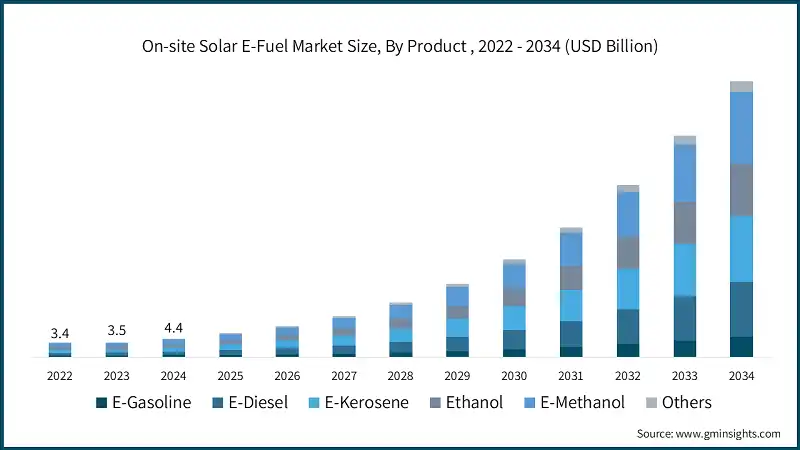
- Based on products, the market is categorized into E-Gasoline, E-Diesel, E-Kerosene, Ethanol, E-Methanol, among others. E-methanol dominated with 25.5% market share in 2024 and is expected to grow at a CAGR of 31.7% through 2034. The market growth is driven by increasing product demand for marine & industrial decarbonization processes.
- E-Methanol is rapidly becoming the preferred e-fuel for shipping and chemical industries due to its ease of storage, transport, and compatibility with existing engines. Solar-powered E-Methanol projects integrate large-scale electrolysis and CO2 capture, offering a scalable solution for hard-to-abate sectors.
- For reference, in May 2025, European Energy and Mitsui launched the Kassø Power-to-X plant in Denmark, powered by a 304 MW solar park. The facility produces 42,000 tonnes of E-Methanol annually, supplying Maersk for green shipping and LEGO for sustainable manufacturing.
- E-Gasoline industry will grow at a rate of 29% through 2034, driven by its major role in automotive decarbonization initiatives. Its compatibility with existing fuel systems makes it attractive for regions where EV adoption faces cost or grid challenges. On-site solar production of E-Gasoline leverages renewable hydrogen and captured CO2, creating a low-carbon alternative to fossil gasoline.
- For instance, in September2024, Mitsubishi Corporation and Exxon Mobil Corporation signed an agreement for a project to produce virtually carbon-free hydrogen with approximately 98% of carbon dioxide (CO2) removed and low-carbon ammonia. In addition, both the companies will advance and offtake of low-carbon ammonia and equity participation in the project.
- E-Diesel market will grow at a CAGR of 31.8% through 2034, driven by its rising demand for heavy transport and off-road applications. Its ability to blend with conventional diesel and use existing infrastructure makes it a cost-effective decarbonization pathway. In addition, falling renewable electricity costs and electrolyzer advancements are improving project economics, while policy incentives accelerate adoption in freight and logistics sectors.
- For instance, in March 2025, the U.S. EPA introduced updated diesel emission regulations, encouraging low-carbon alternatives like E-Diesel. This regulatory push aligns with federal decarbonization goals and supports investment in solar-integrated e-fuel projects for trucking and industrial fleets.
- Ethanol e-fuel industry will reach USD 12.4 billion by 2034 owing to product’s expanding role in renewable fuel standards. Ethanol remains a dominant renewable fuel due to its established blending infrastructure and regulatory support. In addition, Ethanol’s versatility in automotive and industrial applications ensures continued relevance in the e-fuel mix.
- For instance, in June 2023, the U.S. EPA finalized Renewable Fuel Standards for 2023-2025, mandating increased volumes of renewable fuels, including ethanol. These targets encourage innovation in synthetic ethanol production using renewable electricity and captured carbon.
Learn more about the key segments shaping this market
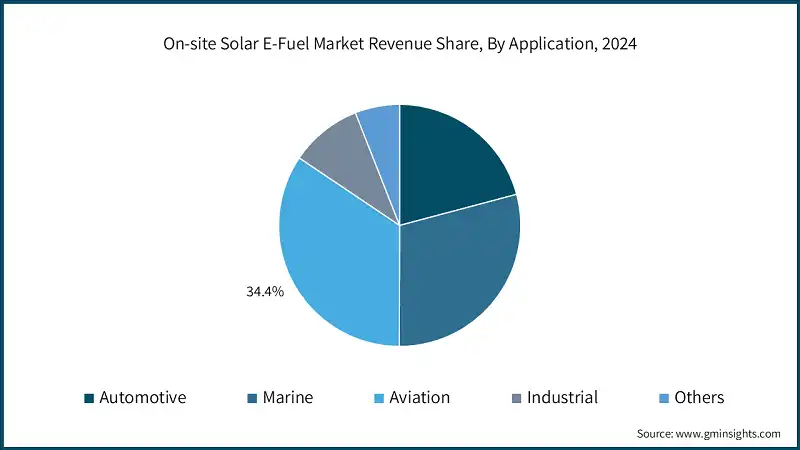
- Based on applications, the market is segmented into automotive, marine, aviation, industrial, and others. The aviation industry held a market share of 34.4% in 2024 and will grow at a CAGR of 31.6% by 2034. Aviation remains the most critical application for solar e-fuels, with e-kerosene emerging as the preferred sustainable aviation fuel (SAF).
- Solar-powered power-to-liquid plants convert renewable hydrogen and CO2 into jet fuel, enabling airlines to meet stringent SAF mandates. Governments and industry players are investing heavily in SAF infrastructure and technology to achieve net-zero aviation targets.
- For instance, in August 2024, the U.S. Federal Aviation Administration (FAA) awarded USD 291 million in FAST grants to projects producing and distributing SAF, including solar-powered e-kerosene initiatives. These grants aim to scale SAF supply chains and support net-zero aviation by 2050.
- Automotive market will grow at a rate of 33% by 2034, driven by rising solar-based e-fuels as a transitional solution for decarbonizing internal combustion engine (ICE) vehicles. Automakers and energy companies are investing in pilot projects to validate scalability and cost efficiency, particularly in regions with abundant solar resources.
- For reference, in August 2024, JERA and Mitsubishi Corporation launched a pilot project in Japan to produce synthetic fuels, including e-gasoline, using solar-powered electrolysis and CO2 capture. This initiative supports Japan’s Green Growth Strategy and aims to supply low-carbon fuels for automotive fleets.
- The marine industry will cross USD 18 billion by 2034. The marine industry is prioritizing e-methanol as a key fuel for decarbonization, driven by International Maritime Organization (IMO) targets for near-zero emissions by 2050. Solar-powered e-methanol production offers a scalable solution for shipping companies seeking compliance with tightening regulations.
- For illustration, in February 2025, the IMO future fuels and technology project advanced regulatory frameworks to accelerate commercialization of low-carbon marine fuels, including e-methanol. The project supports global studies and infrastructure development for solar-integrated fuel production at major ports.
- The industrial applications for on-site e-fuel will grow at 29.7% CAGR by 2034. Industrial sectors such as chemicals, steel, and cement are adopting solar e-fuels to reduce carbon intensity in high-temperature processes. This trend is further driven by corporate net-zero commitments and regulatory frameworks promoting green hydrogen and carbon utilization.
- For instance, in May 8, 2025, the UNFCCC Industrial Transition Accelerator highlighted Asia-Pacific as a priority region for deep industrial decarbonization through Nationally Determined Contributions (NDCs). In addition, governments are incorporating industrial e-fuel targets into long-term strategies to accelerate adoption of carbon-neutral fuels and reduce process emissions.
Looking for region specific data?
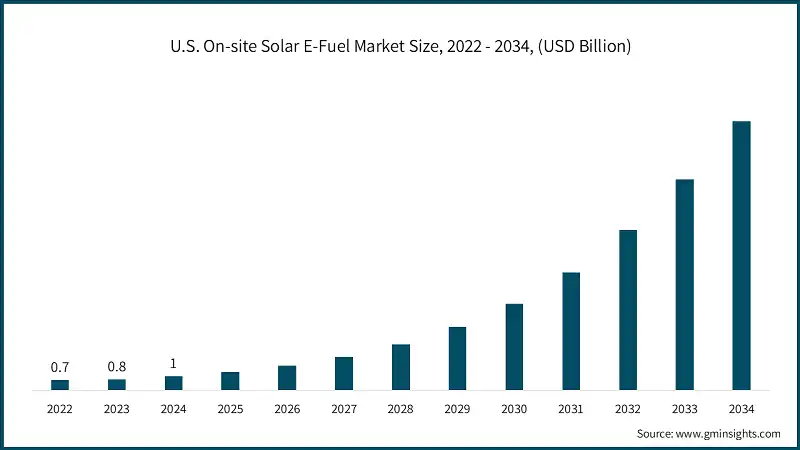
- U.S. dominated the on-site solar e-fuel market in North America and generated USD 1 billion revenue in 2024. North America is witnessing strong momentum in solar-based e-fuel projects, driven by federal incentives and corporate decarbonization goals. The U.S. Inflation Reduction Act and state-level renewable mandates have accelerated investments in solar hydrogen and Power-to-Liquid technologies.
- For instance, in April 2025, Mitsui & Co., Ltd. invested in the U.S. based synthetic fuel manufacturer, Infinium. The aim of the partnership was to accelerate its initiative across the entire carbon value chain including the use of CO2 to produce synthetic fuels, as well as the creation and sale of carbon credits.
- The Europe on-site solar e-fuel market will grow at rate of 29% by 2034. Europe remains the global leader in solar e-fuel adoption, driven by stringent climate policies and Sustainable Aviation Fuel (SAF) mandates under the EU Green Deal. In addition, strong policy frameworks, carbon pricing, and cross-border collaborations are accelerating industrial-scale deployment.
- For instance, in May 2025, France launched the CARB’AERO program, funding solar-powered e-kerosene projects to meet SAF mandates. The initiative supports large-scale Power-to-Liquid plants at strategic ports and airports, reinforcing Europe’s leadership in aviation decarbonization.
- Asia Pacific on-site solar e-fuel market will cross USD 16 billion by 2034, driven by aggressive renewable energy targets and industrial decarbonization strategies. Countries including Japan, Australia, and India are investing in solar-powered hydrogen and synthetic fuel projects to reduce reliance on imported fossil fuels.
- The region’s abundant solar resources and strong government backing for green hydrogen create favorable conditions for on-site e-fuel production, particularly for aviation and industrial applications. Partnerships between technology providers and local energy firms are accelerating commercialization.
- For instance, in June 2025, NTPC Green Energy, India came into a strategic partnership with Honeywell to explore the production of SAF. The Indian company will leverage Honeywell’s eFining technology for the conversion of CO2 emissions from its thermal power plant, along with green hydrogen, into sustainable aviation fuel (SAF).
- Middle East & Africa on-site solar e-fuel market will grow at a CAGR of 31% through 2034. The region is capitalizing on its vast solar potential to become a global hub for renewable hydrogen and e-fuel exports. National strategies including Saudi Vision 2030 and UAE Energy Strategy 2050 prioritize large-scale solar projects integrated with hydrogen and synthetic fuel production.
- Latin America on-site solar e-fuel market will grow by 32% through 2034. The region is leveraging abundant solar resources and growing renewable energy investments. Furthermore, regional initiatives under the RELAC framework aim to achieve 70% renewable electricity by 2030, creating opportunities for solar-integrated hydrogen and e-fuel production.
- For instance, in August 2025, the Government of Brazil presented 'Bethlehem 4x', an initiative to quadruple the production and use of sustainable fuels up to 2035. This initiative is further supported by various countries including India, Japan, and Italy, countries that have already committed to partner in formulating and implementing the sustainable initiative.
On-site Solar E-Fuel Market Share
- The top 5 companies in on-site solar e-fuel industry including Synhelion, INERATEC, Liquid Wind, Infinium, and Sunfire held over 25% market share in the year 2024. Sunfire offers high-temperature electrolysis and Power-to-Liquid technology, enabling efficient solar hydrogen production for e-fuels. Its systems support large-scale industrial and aviation projects, positioning Sunfire as a critical technology provider for solar-based synthetic fuel initiatives worldwide.
- Maersk secures its market share through long-term offtake agreements for solar e-methanol, supporting its ambitious net-zero shipping goals. Collaborating with producers like European Energy, Maersk drives demand for renewable marine fuels, reinforcing its leadership in sustainable maritime logistics and global green shipping initiatives.
On-site Solar E-Fuel Market Companies
Major players operating in the on-site solar e-fuel industry are:
- ABEL Energy
- Aether Fuels
- Andes Mining & Energy
- Brineworks
- Carbon Recycling International
- Circularity Fuels
- Dioxycle
- ETFuels
- Infinium
- INERATEC
- Liquid Wind
- Lydian Labs
- MAN Energy Solutions
- Maersk
- Oxylus Energy
- Prometheus Fuels
- ReIntegrate
- Renewable Hydrogen Canada
- Spark e-Fuels
- Sunfire
- Synhelion
- Synhelion leads the solar e-fuel market with its proprietary Sun-to-Liquid technology, converting concentrated solar heat into syngas for producing e-gasoline, e-diesel, and e-kerosene. Its large-scale projects in Spain and partnerships with aviation and automotive sectors position it as a global pioneer in commercial solar fuel production.
- INERATEC specializes in modular Power-to-Liquid plants, enabling decentralized solar e-fuel production. Its technology integrates renewable hydrogen and CO2 conversion for synthetic fuels, supporting aviation and industrial applications. Strategic collaborations in Europe and Asia-Pacific strengthen its role in scaling solar-based e-fuel solutions globally.
- Infinium develops electrofuels for transportation sectors, including aviation and heavy trucking. Its solar-integrated projects utilize advanced electrolysis and carbon capture technologies to produce low-carbon fuels. With multiple commercial agreements and global expansion plans, Infinium is driving adoption of sustainable fuels across hard-to-abate sectors.
On-site Solar E-Fuel Market Report Attributes
| Key Takeaway | Details |
|---|---|
| Market Size & Growth | |
| Base Year | 2024 |
| Market Size in 2024 | USD 4.4 Billion |
| Market Size in 2025 | USD 5.6 billion |
| Forecast Period 2025 - 2034 CAGR | 31.4% |
| Market Size in 2034 | USD 66 Billion |
| Key Market Trends | |
| Drivers | Impact |
| Decentralized energy generation | Decentralized energy generation reduces transmission losses and enhances energy security. |
| Growing demand for low-carbon synthetic fuels | Growing demand for low-carbon synthetic fuels in aviation and shipping is accelerating adoption. |
| Pitfalls & Challenges | Impact |
| High initial capital costs | High initial capital costs and complex integration with existing infrastructure can hinder scalability. |
| Opportunities: | Impact |
| Industrial decarbonization | On-site solar e-fuels offer a viable path for hard-to-abate sectors to reduce emissions without relying on grid infrastructure. |
| Remote and off-grid applications | Enables energy independence for remote facilities, mining operations, and island economies through localized fuel production. |
| Market Leaders (2024) | |
| Market Leaders |
6% market share |
| Top Players |
Collective market share in 2024 is 25% |
| Competitive Edge |
|
| Regional Insights | |
| Largest Market | Europe |
| Fastest Growing Market | Asia Pacific |
| Emerging Country | U.S., India, Norway, UK, Spain |
| Future outlook |
|
What are the growth opportunities in this market?
On-site Solar E-Fuel Industry News
- In November 2025, NYSERDA awarded over USD 7 million to support projects that integrate solar energy with active farming known as agrivoltaics across New York State. Of this, USD 2 million was allocated through its Environmental Research Program to four initiatives demonstrating the benefits and impacts of co-locating solar panels with agricultural operations.
- In June 2025, Synhelion and INERATEC announced an expanded collaboration to scale solar fuel production globally, combining Synhelion’s solar reactor technology with INERATEC’s modular fuel synthesis systems.
- In January 2025, Boeing entered into a strategic collaboration with Norsk e-fuel to advance the development of one of Europe’s first large-scale Power-to-Liquids (PtL) facilities. This initiative supports the aviation sector’s commitment and ICAO member states’ objective to achieve net-zero carbon emissions by 2050.
This on-site solar e-fuel market research report includes in-depth coverage of the industry with estimates & forecast in terms of revenue (USD Million) from 2025 to 2034, for the following segments:
Market, By Technology
- Fischer-Tropsch
- eRWGS
- Others
Market, By Product
- E-Gasoline
- E-Diesel
- E-Kerosene
- Ethanol
- E-Methanol
- Others
Market, By Application
- Automotive
- Marine
- Aviation
- Industrial
- Others
The above information has been provided for the following regions & countries:
- North America
- U.S.
- Canada
- Europe
- UK
- Germany
- France
- Norway
- Spain
- Asia Pacific
- China
- India
- Japan
- South Korea
- Australia
- Middle East & Africa
- Saudi Arabia
- UAE
- South Africa
- Latin America
- Brazil
- Argentina
Frequently Asked Question(FAQ) :
What is the market size of the on-site solar e-fuel market in 2024?
The market size was USD 4.4 billion in 2024, with a CAGR of 31.4% expected through 2034 driven by rising decarbonization mandates in aviation, shipping, and heavy transport.
What is the projected value of the on-site solar e-fuel market by 2034?
The on-site solar e-fuel market is expected to reach USD 66 billion by 2034, supported by advancements in solar-to-liquid technologies and strong policy incentives.
What is the current on-site solar e-fuel market size in 2025?
The market size is projected to reach USD 5.6 billion in 2025.
How much revenue did the e-methanol segment generate in 2024?
The e-methanol segment accounting for over 25.5% of the market share.
What was the valuation of the aviation application segment in 2024?
The aviation application segment held 34.4% market share in 2024.
What is the growth outlook for the automotive application segment from 2025 to 2034?
The automotive application segment is projected to grow at a CAGR of 33% through 2034, driven by the adoption of solar-based e-fuels for decarbonizing internal combustion engine vehicles.
Which region leads the on-site solar e-fuel market?
The U.S. led the North American on-site solar e-fuel market with USD 1 billion revenue in 2024, supported by rising solar-based e-fuel projects fueled by federal incentives and corporate decarbonization goals.
What are the upcoming trends in the on-site solar e-fuel market?
Key trends include advancements in solar-to-liquid conversion technologies, integration of carbon capture systems, and increasing adoption of blending mandates and carbon pricing mechanisms.
Who are the key players in the on-site solar e-fuel market?
Key players include Synhelion, INERATEC, Liquid Wind, Infinium, Sunfire, ABEL Energy, Aether Fuels, and others.
On-site Solar E-Fuel Market Scope
Related Reports