Summary
Table of Content

Nutraceutical Market
Get a free sample of this report
Form submitted successfully!
Error submitting form. Please try again.
Thank you!
Your inquiry has been received. Our team will reach out to you with the required details via email. To ensure that you don't miss their response, kindly remember to check your spam folder as well!
Request Sectional Data
Thank you!
Your inquiry has been received. Our team will reach out to you with the required details via email. To ensure that you don't miss their response, kindly remember to check your spam folder as well!
Form submitted successfully!
Error submitting form. Please try again.
Nutraceutical Market Size
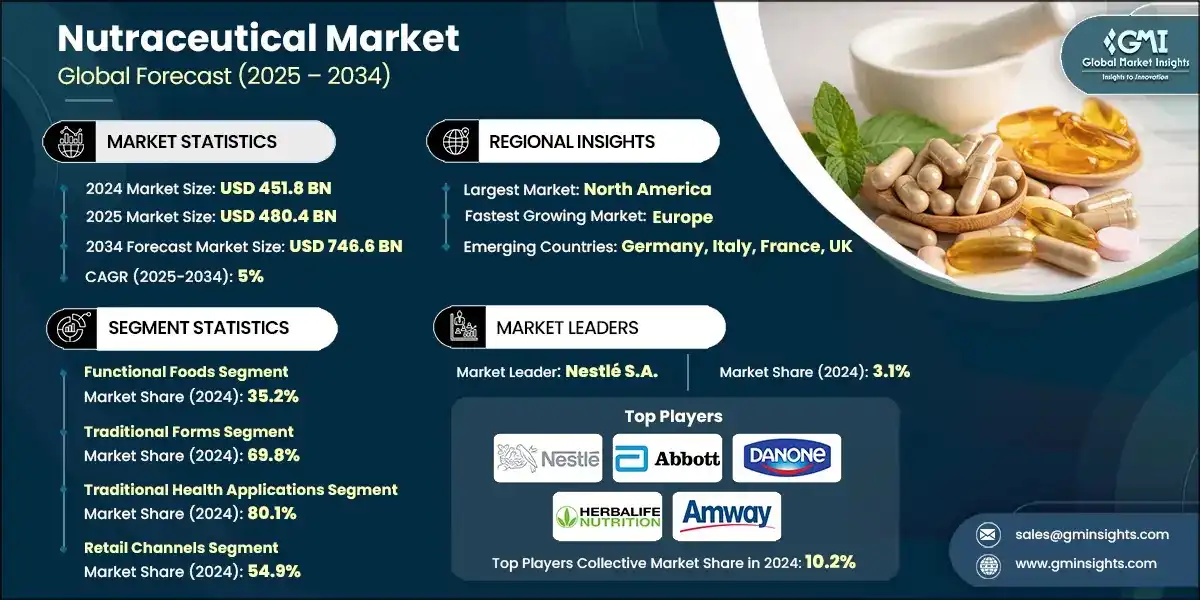
The global nutraceutical market was estimated at USD 451.8 billion in 2024. The market is expected to grow from USD 480.4 billion in 2025 to USD 746.6 billion in 2034, at a CAGR of 5%, according to latest report published by Global Market Insights Inc.
To get key market trends
- The market is booming due to rising consumer awareness about increasing health and wellness problems & chronic diseases. Nutraceuticals include dietary supplements, functional foods, fortified products, and several other products that claim to improve health conditions like enhanced immune function, better cognitive performance, and disease prevention. Increasing numbers of people are beginning to adapt these products as preventive healthcare measures as the world is moving toward healthier lifestyles.
- Huge opportunities abound in the nutraceutical market. With growing demand for plant-based, organic, and clean-label products. The middle-class population is expanding, and increased health awareness is a source of high potential growth in these emerging markets. Advanced technologies, personalized in terms of nutrition, and functional ingredients add efficacy to such products in terms of appealing to consumers.
- Applications are across diverse spectra, including sports nutrition, weight management, bone health, and gastrointestinal health. Consumer trends in fortifying beverages and foods or adopting a new delivery form such as gummies and powders are rapid reflections of change. Companies and their current focus on making innovations, opening channels of communication in a transparent manner, and embracing sustainable practices are undoubtedly set to draw this growth opportunity, thereby defining the future of health and wellness across the globe.
- North America is the largest market for nutraceutical due to advancement in technology and research facilities in U.S. & Canada.
- Europe is the fastest growing region for market, due to increasing focus on the health and wellness sector, the region can enhance its performance in this market in the coming years.
Nutraceutical Market Report Attributes
| Key Takeaway | Details |
|---|---|
| Market Size & Growth | |
| Base Year | 2024 |
| Market Size in 2024 | USD 451.8 Billion |
| Market Size in 2025 | USD 480.4 Billion |
| Forecast Period 2025 – 2034 CAGR | 5% |
| Market Size in 2034 | USD746.6 Billion |
| Key Market Trends | |
| Drivers | Impact |
| Rising health consciousness | Increased consumer awareness about health and wellness fuels demand for nutraceuticals. |
| Aging population | Growing elderly demographics seek supplements to manage age-related health issues. |
| Product innovation | Development of functional foods and personalized nutraceuticals attracts diverse consumer segments. |
| Pitfalls & Challenges | Impact |
| Regulatory challenges | Stringent regulations and lack of standardization hinder market growth. |
| High competition | Intense rivalry among brands leads to price wars and reduced profit margins. |
| Opportunities: | Impact |
| Emerging markets | Untapped regions present significant growth potential for nutraceutical products. |
| Natural and organic shift | Increasing preference for natural ingredients opens new product development avenues. |
| Digital marketing | Leveraging online platforms enhances brand visibility and direct consumer engagement. |
| Market Leaders (2024) | |
| Market Leaders |
3.1% |
| Top Players |
Collective market share in 2024 is 10.2% |
| Competitive Edge |
|
| Regional Insights | |
| Largest Market | North America |
| Fastest growing market | Europe |
| Emerging countries | Germany, Italy, France, UK |
| Future outlook |
|
What are the growth opportunities in this market?
Nutraceutical Market Trends
- The transformation of the market is driven by several trends, and one of those trends is the personalized nutrition revolution, where consumers are beginning to demand personalized solutions to suit their specific health issues. Advances in genomics and data analysis have allowed brands to deliver more personalized supplements and functional foods as a way of improving efficacy and consumer engagement. Aside from this, clean labels and transparency movement are the trending changes in purchasing behavior, which demand consumers afford products with natural, organic and slightly processed ingredients. Brands that are more open to disclosing information regarding sourcing, manufacturing and efficacy of their ingredients naturally become more trusted and loyal.
- Functional foods and beverages expansion is rapidly taking shape by increasing their health-boosting product offerings by adding probiotics, adaptogens and superfoods to everyday items. Digital health integration also revolutionizes this market by bringing more use of mobile applications, wearable devices, or telehealth platforms that allow consumers to effectively monitor their health and customize nutraceutical uptake. It has also enhanced personalized methods besides improving consumer engagement.
- It has also been sustainable and ethical sourcing as a very significant consumer consideration-moving to prefer environmentally friendly products. Those brands that increasingly become sustainable in their sourcing of ingredients and packaging are reducing their ecological footprint and, at the same time, gaining attention from the socially conscious consumers. All these trends make the nutraceutical industry move toward a more personalized, transparent, and sustainable future, creating innovation and growth in this very dynamic sector.
Nutraceutical Market Analysis

Learn more about the key segments shaping this market
Based on product, the market is segmented into functional food, dietary supplements, functional beverages, postbiotics, personalized nutrition products, nutraceutical-medical foods.
- Functional foods account for the largest share of 35.2% in 2024 and will continue to grow at a CAGR of 5.2% through 2034, reflecting a general commercial preference for nutrition integrated naturally into daily dietary routines instead of separate supplementation regimens. This segment gains ground because of the availability in retail stores, the habitual consumption pattern formed, and the regulatory frameworks that allow fortifying foods with vitamins, minerals, and bioactive compounds.
- Dietary supplements are the second-largest segment at 30.2% market share with a 5.3% CAGR, mainly driven by specific health applications and nutrient delivery systems that appeal to health-conscious consumers who are inclined toward specific benefits from their supplements.
- Functional beverages hold 24.9% market share and 4.9% CAGR, a dynamic segment which has witnessed many innovations in delivery formats, flavor profiles, and functional ingredient combinations.
- Personalized nutrition products, at 2.8% market share, are primed for growth acceleration as technologies continue to develop and consumers become increasingly comfortable with personalized solutions for health.

Learn more about the key segments shaping this market
Based on form, the nutraceutical market is segmented into traditional forms, advanced delivery.
- Traditional forms dominate at 69.8% of total market share and 4.9% CAGR, including tablets, capsules, powders, and liquid formulations that consumers recognize and trust. Mostly, this segment undergoes well-established manufacturing processes, cost-efficient production methods, and mass distribution networks ensuring supply in different geographic markets.
- Advanced delivery systems accounted for 30.2% of market share but increased at a higher 5.3% CAGR due to increasing consumer interest in enhanced bioavailability, targeted release mechanisms, and improved convenience factors. This includes liposomal formulations, time-release technologies, sublingual delivery systems, and new encapsulation methods to improve absorption of nutrients and therapeutic efficacy. Innovations in this arena are propelled by drug-manufacturing industry technologies repurposed by nutraceutical applications whereby firms engage in research and development to offer differentiated innovations that can command a premium price.
- The differentiated growth of advanced and traditional types of delivery indicates that the market is evolving into more sophisticated formulations that consumers along with pay more for superior efficacy perceived in these formulations.
Based on application, the nutraceutical market is segmented into traditional health applications, emerging health applications, and others.
- Traditional health applications dominate with an 80.1% market share due to scientifically validated therapeutic areas such as cardiovascular health, immune support, digestive health, and bone health. These applications are substantiated through extensive clinical studies and possess certain regulatory backing, and consumers are also well familiarized with generic health benefits clammed with certain nutrients and bioactive compounds.
- Emerging health applications constitute a 17.6% market share, with a 4.6% CAGR, and are reflective of an expanding scientific knowledge horizon of nutrition in areas such as cognitive health, mood support, sleep optimization, and sports performance. This segment is characterized by innovative ingredient combinations and novel therapeutic targets, as well as by increasingly expanding consumer awareness about nutrition's effects on health in domains previously considered unrelated to nutrition.
- The "Others" category represents a 2.3% market share suggesting that these applications will gradually evolve into mainstream segments by the resolution of scientific validation of new therapeutic targets and the adaptive change in regulatory frameworks to accommodate innovative health claims. Applications in this category include longevity support, protection against environmental toxins, and personalized health optimization from the standpoint of genetic predisposition analysis.
Based on distribution channel, the nutraceutical market is segmented into retail channels, digital & direct channels, specialized channels.
- Retail channels hold the largest share at 54.9% with a 4.9% CAGR and include pharmacies, health food stores, supermarkets, and mass retailers that provide access to the products in physical form with opportunity of consultation face to face. This channel provides all the immediate availability of the product with professional guidance from pharmacists and nutritionists along with consumer preference to view the products before buying them.
- Digital and direct, thus, represent 40.3% of the market with better growth at 5.3% CAGR. This reflects how quickly digital adoption has occurred along various channels of commerce such as e-commerce platforms, direct-to-consumer models, and subscription delivery services. Convenience along with competitive pricing, product variety, and personalized marketing appeals to the experienced workforce of consumers looking for efficiency in their purchasing experience.
- Specialist channels account for 4.8% market share with 3.2% CAGR: these include healthcare practitioner offices and wellness centers and specialized nutrition clinics that offer professional guidance and targeted product recommendations. Thus, with small market share, this channel commands premium pricing and is highly trusted among consumers, especially whenever the therapeutic applications require supervision of a governing professional.
Looking for region specific data?
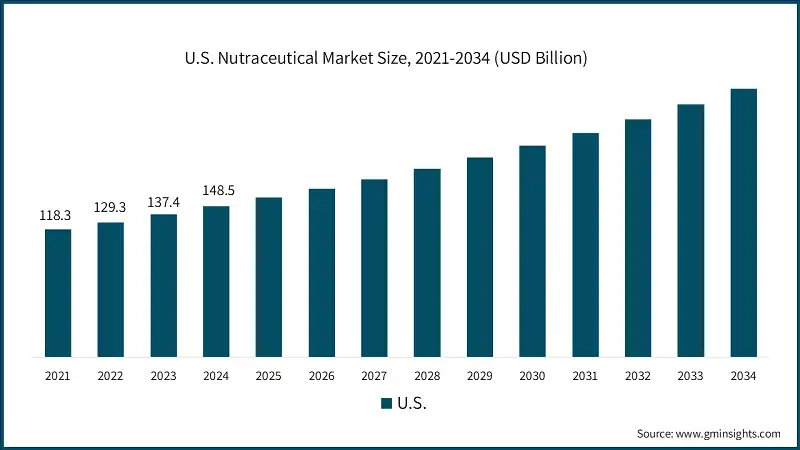
North America accounts for a decent share of the global nutraceuticals market with 42.1% of the market share and 5.1% CAGR.
- Known for the very mature nutraceutical market in U.S. and Canada, North America is heavily endowed with products along with a lot of activities assisting consumers become more aware of their health. This means that healthcare services will have to depend on the innovative product development while, with more and more concern on preventive healthcare, the demand from a growing population base, including both millennials and aging adults, for immunity-boosting, weight management, and general wellness products will fuel market growth. Stringent regulations ensure safety and quality. The booming e-commerce sector and strategic collaborations further bolster market growth.
Europe nutraceutical market accounted for USD 113.5 million in 2024 and is anticipated to show lucrative growth over the forecast period.
- Europe's market is considerably diverse, with significant contributions from Germany, the UK, and France, among others. There has been a growing tendency towards functional foods and dietary supplements among consumers due to the increased awareness about health and aging population. Regulatory standards are stringent, emphasizing product safety, which encourages high-quality innovation. Among the trends for organic, natural, clean label products, the segment of preventive healthcare has developed well in that region, along with a good retail network where constant growth can be ensured.
The Asia Pacific nutraceutical market is anticipated to grow at the CAGR of 4.9% during the analysis timeframe.
- Urbanization, an escalating rise in disposable incomes, and growing awareness towards health are among the factors that drive the region. Most of the countries considered leading this region are China, India, Japan, and South Korea. These countries benefit from a large population base and the traditional use of herbal medicines. There is high market demand for herbal supplements, functional foods & probiotics within the region. Cultural acceptance of natural ingredients and developing middle class population helps to sustain future growth.
Latin America market accounted for 8.9% market share in 2024 and is anticipated to show lucrative growth over the forecast period.
- Latin America's nutraceutical market has been steadily growing given the increasing awareness of health and wellness, the rising middle classes, and the tendency towards a more preventive healthcare approach. Brazil, Mexico & Argentina are the most advanced in this field, as consumers tend to look for natural and herbal products. While some have an international profile, others are domestic brands which focus on price and availability. Emerging regulatory frameworks deal with safety and quality issues.
Middle East & Africa nutraceutical market accounted for 6.9% market share in 2024 and is anticipated to show lucrative growth over the forecast period.
- The MEA area has developed unique trends in the nutraceutical sector with growing awareness about health and wellness among the urban populations. Countries like South Africa, UAE, and Saudi Arabia are part of the increasing demand for dietary supplements, herbal products, and functional foods.
Nutraceutical Market Share
The top 5 companies in the nutraceutical industry include Nestlé S.A., Abbott Laboratories, Danone S.A., Herbalife Nutrition, Amway Corporation. These are prominent companies operating in their respective regions covering 10.2% of the market share. These companies hold strong positions globally due to their experience in market. Their diverse product portfolios, backed by robust production capabilities and distribution networks, enable them to meet the rising demand across various regions.
- Nestlé is the strong global player in the nutraceutical industry, with a product range covering vitamins, minerals, and functional foods. Besides a strong brand, Nestlé s competitive advantage is thus derived from a very extensive distribution network and focus on innovation. Nestlé emphasizes health and wellness in its investments in R&D to continue developing fundamentally obtained science-backed products.
- Abott is a vibrant player in the nutraceutical market space, particularly in health-related dietary supplements and functional foods. Abbott could be differentiated from other companies by focusing on how depending on scientific evidence proves product efficacy and quality. Building on very strong consumer confidence, that consumer trust about Abbott strengthens rigorous clinical research, investments in personalized nutrition, and digital health solutions.
- Danone is an important player in functional foods, particularly in the area of probiotics and nutraceuticals based on dairy. Danone has adopted consumers' trends in product lines that are health and wellness oriented. Danone's R&D, sustainability initiatives, combined with a regional focus on emerging markets, support its growth. The company's reputation is one of quality and innovation.
- Herbalife Ltd. is a specialist in weight management, nutrition & skin care products following a direct selling model that encourages an individual, personalized approach to customers. Its presence strength in brand equity, and global presence create a competitive advantage in the area of weight management. The company's network marketing scheme allows fast multiplication although it is under fire of scrutiny and presents regulatory challenges in some countries.
- Amway operates as a direct-selling model in which it sells various dietary supplements and functional foods. This, combined with an extensive distribution network and a diversified portfolio of products, provides a competitive edge because of the personal approach toward customers. In addition to this expanding and varied portfolio of products, Amway employs strong brand loyalty and an emphasis on quality to perpetuate its presence in the market.
Nutraceutical Market Companies
Major players operating in the nutraceutical industry include:
- Abbott Laboratories
- Amway Corporation
- Athletic Greens (AG1)
- Blackmores Limited
- Dabur India Limited
- Danone S.A.
- Garden of Life LLC
- Glanbia plc
- Herbalife Nutrition Ltd.
- Nature’s Bounty Co.
- Nestlé S.A.
- Otsuka Holdings Co., Ltd.
- Persona Nutrition
- Swisse Wellness Pty Ltd
Nutraceutical Industry News
- In June 2025, Danone acquired majority stake in The Akkermansia Company. Danone has broadened its scope into microbiome science and the advanced applications of probiotics. This strategic acquisition offers Danone the chance to exploit burgeoning consumer traction toward gut health and the emerging postbiotics market segment, which currently shows tremendous growth potential within the overall nutraceutical landscape.
- In May 2025, Danone completed its acquisition of a majority stake in Kate Farms, a pioneer in plant-based medical nutrition, strengthening its position in the medical nutrition segment and expanding capabilities in plant-based formulations.
- In March 2025, Abbott announced a strategic partnership with the Professional Pickleball Association to market Ensure Max Protein among active older adults while showcasing creative marketing strategies that link nutrition products to lifestyle events and subsequent sports participation.
This nutraceutical market research report includes in-depth coverage of the industry, with estimates & forecasts in terms of revenue (USD Billion) and volume (Kilo Tons) from 2025 to 2034, for the following segments:
Market, By Product
- Functional food segment
- Oils & functional lipids
- Biscuits & nutritional bars
- Baby food & infant nutrition
- Fortified cereals & grains
- Functional bread & bakery products
- Nutraceutical confectionery
- Other functional foods
- Dietary supplements segment
- Vitamins & minerals
- Probiotic supplements
- CBD supplements & products
- Pet supplements & animal nutrition
- Nutricosmetics & beauty supplements
- Protein supplements & sports nutrition
- Other dietary supplements
- Functional beverages segment
- Energy drinks & performance beverages
- Sports drinks & electrolyte solutions
- Other functional beverages
- Postbiotics segment
- Metabolite-based postbiotics
- Cell wall component postbiotics
- Enzyme-based postbiotics
- Personalized nutrition products
- Genetic-based formulations
- Microbiome-tailored products
- Metabolomic-driven solutions
- Nutraceutical-medical foods
Market By Form
- Traditional forms
- Capsules & tablets
- Liquid formulations
- Powder forms
- Gummies & chewables
- Advanced delivery
- Nanoencapsulated forms
- Liposomal delivery systems
- Microencapsulated forms
Market By Application
- Traditional health applications
- Sports/energy/weight management
- Cold, flu & immunity support
- Gastrointestinal health
- Joint health & inflammation
- Diabetes management
- Skin & hair health
- Emerging health applications
- Longevity & anti-aging
- Mental health & cognitive function
- Cardiovascular health
- Liver health & detoxification
- Sleep & stress management
- Eye health & vision support
- Respiratory health
- Others
Market By Distribution Channel
- Retail channels
- Brick & mortar stores
- Pharmacies & drugstores
- Digital & direct channels
- E-commerce platforms
- Direct-to-consumer (DTC) models
- Specialized channels
- Healthcare practitioners
- Specialty health stores
- Fitness & wellness centers
- Beauty & cosmetic retailers
The above information is provided for the following regions and countries:
- North America
- U.S.
- Canada
- Europe
- Germany
- UK
- France
- Spain
- Italy
- Rest of Europe
- Asia Pacific
- China
- India
- Japan
- Australia
- South Korea
- Rest of Asia Pacific
- Latin America
- Brazil
- Mexico
- Argentina
- Rest of Latin America
- Middle East and Africa
- Saudi Arabia
- South Africa
- UAE
- Rest of Middle East and Africa
Frequently Asked Question(FAQ) :
Which region leads the nutraceutical market?
North America leads the global market with a 42.1% share in 2024, growing at a CAGR of 5.1%, supported by strong consumer demand and advancements in product innovation.
What are the upcoming trends in the nutraceutical industry?
Key trends include the rise of personalized nutrition, clean label demand, expansion of functional foods and beverages, and the integration of digital health technologies such as mobile apps and wearable devices.
Who are the key players in the nutraceutical market?
Key players include Abbott Laboratories, Amway Corporation, Athletic Greens (AG1), Blackmores Limited, Dabur India Limited, Danone S.A., Garden of Life LLC, Glanbia plc, Herbalife Nutrition Ltd., Nature’s Bounty Co., Nestlé S.A., and Otsuka Holdings Co., Ltd.
Which application dominates the nutraceutical industry?
Traditional health applications dominate the market with an 80.1% share in 2024, driven by scientifically validated areas such as cardiovascular health, immune support, digestive health, and bone health.
What is the projected size of the nutraceutical market in 2025?
The market is expected to reach USD 480.4 billion in 2025.
What is the market share of functional foods in 2024?
Functional foods accounted for 35.2% of the market share in 2024 and are projected to grow at a CAGR of 5.2% through 2034, reflecting a preference for naturally integrated nutrition in daily diets.
What is the market share of traditional forms in the nutraceutical market?
Traditional forms, including tablets, capsules, powders, and liquid formulations, held a 69.8% market share in 2024, growing at a CAGR of 4.9%.
What is the market size of the nutraceutical in 2024?
The market size was USD 451.8 billion in 2024, with a CAGR of 5% expected through 2034, driven by personalized nutrition trends, clean label demand, and digital health integration.
What is the projected value of the nutraceutical market by 2034?
The market is expected to reach USD 746.6 billion by 2034, fueled by advancements in genomics, increasing demand for functional foods, and transparency in product labeling.
Nutraceutical Market Scope
Related Reports