Summary
Table of Content

Nuclear Robots Market
Get a free sample of this report
Form submitted successfully!
Error submitting form. Please try again.
Thank you!
Your inquiry has been received. Our team will reach out to you with the required details via email. To ensure that you don't miss their response, kindly remember to check your spam folder as well!
Request Sectional Data
Thank you!
Your inquiry has been received. Our team will reach out to you with the required details via email. To ensure that you don't miss their response, kindly remember to check your spam folder as well!
Form submitted successfully!
Error submitting form. Please try again.
Nuclear Robots Market Size
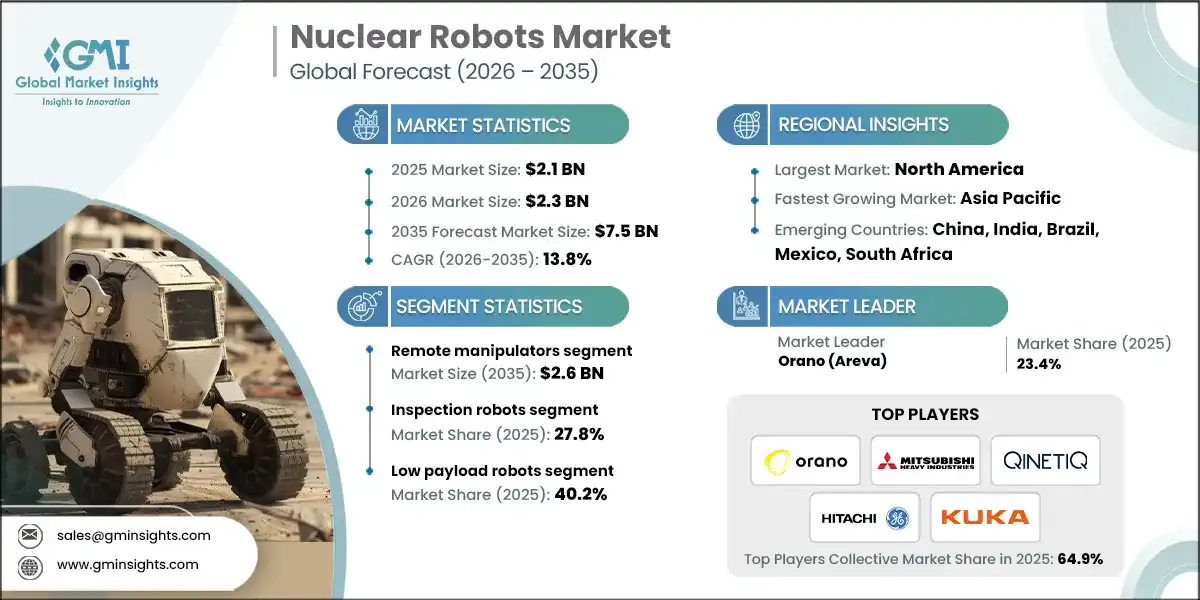
The global nuclear robots market was estimated at USD 2.1 billion in 2025. The market is expected to grow from USD 2.3 billion in 2026 to USD 4.4 billion in 2031 and USD 7.5 billion by 2035, at a CAGR of 13.8% during the forecast period of 2026–2035, according to the latest report published by Global Market Insights Inc.
Nuclear Robots Market Key Takeaways
Market Size & Growth
- 2025 Market Size: USD 2.1 Billion
- 2026 Market Size: USD 2.3 Billion
- 2035 Forecast Market Size: USD 7.5 Billion
- CAGR (2026–2035): 13.8%
Regional Dominance
- Largest Market: North America
- Fastest Growing Region: Asia Pacific
Key Market Drivers
- Increased focus on accident prevention and emergency response preparedness.
- Increasing decommissioning of aging nuclear facilities.
- Labor shortages and skill gaps in nuclear operations.
- Government funding and public sector investment in nuclear safety infrastructure.
Challenges
- High capital and lifecycle costs.
- Limited standardization and interoperability across nuclear sites.
Opportunity
- Expansion of robotics-as-a-service models for decommissioning projects.
- Development of modular, reconfigurable robots for multi-site applicability.
Key Players
- Market Leader: Orano (Areva) led with over 23.4% market share in 2025.
- Leading Players: Top 5 players in this market include Orano (Areva), MITSUBISHI HEAVY INDUSTRIES, LTD., QinetiQ, Hitachi-GE Nuclear Energy, Ltd., KUKA AG, which collectively held a market share of 64.9% in 2025.
Get Market Insights & Growth Opportunities
The rising number of aging nuclear facilities is a major contributor to the growth of the nuclear robots market. Nuclear reactors and fuel cycle facilities in Europe and North America either reaching or surpassing their operational lifetimes. Decommissioning activities are characterized by complex, high-radiation environments that necessitate remote handling, inspection, and waste management to ensure worker safety and regulatory compliance. In line with this, the Nuclear Decommissioning Authority announced a further multi-year partnership in June 2025 for the deployment of autonomous robots at nuclear sites across the UK to improve safety, accuracy, and efficiency of the management of radioactive waste. The size of these public sector contracts confirms the enduring need for advanced robotics, especially for the tasks of site clearance, waste segregation, and the long-term remediation of sites.
Government funding and public sector investment in nuclear safety infrastructure are strengthening demand for advanced nuclear robotics, as large-scale reactor construction and modernization programs require enhanced safety, inspection, and automation capabilities. In October of 2025, the US Department of Commerce declared a strategic collaboration with Westinghouse Electric Company to fast-track a commitment of USD 80 billion towards new nuclear reactor installations. This partnership strengthens commitments to long-term investments in robotic systems to assist with the construction, monitoring, maintenance, safety, and oversight of nuclear sites.
Nuclear robots are purpose-built machines intended for various inspection, maintenance, deconstruction, and waste management tasks in highly radioactive and hazardous nuclear settings. These robots reduce human exposure and enhance safety, accuracy, and operational efficiency.
To get key market trends
Nuclear Robots Market Trends
- The field of nuclear robotics is undergoing a transformation driven by autonomous technology and artificial intelligence that allow the machines to function in difficult and highly radioactive atmospheres with little to no human oversight. Such innovations improves performance, allows for the continuous execution of tasks, and minimizes the need for expert personnel, improving both safety and operational efficiencies in nuclear facilities.
- Decommissioning programs continue to fuel consistent demand for nuclear robots in dismantling, waste handling, and site remediation. These robots help decrease human radiation exposure while ensuring regulatory compliance. Long-term decommissioning pipelines in developed economies support steady adoption of advanced robotic solutions.
- Robotic systems continue to be integrated with digital twins and analytic platforms for the purposes of predictive maintenance and risk assessment. The real-time data captured by the robots increase the visibility of the asset’s condition and allow for improvements in planning and proactive decision-making for nuclear safety management.
- Nuclear robots are expanding their service beyond maintenance into reactor construction and life extension projects. In refurbishing and building, they support inspection, material handling, and safety monitoring, which in turn reduces project risks and supports consistent compliance across extended operational lifecycles.
Nuclear Robots Market Analysis
Learn more about the key segments shaping this market
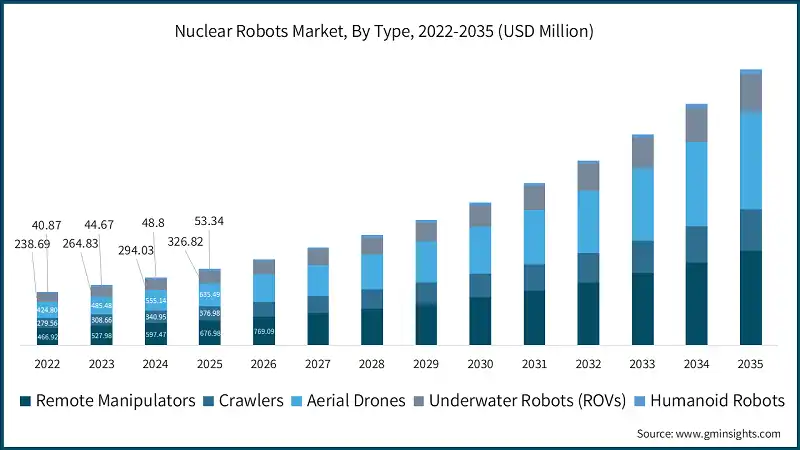
Based on type, the market is segmented into remote manipulators, crawlers, aerial drones, underwater robots (ROVs), and humanoid robots.
- The remote manipulators market is anticipated to reach USD 2.6 billion by 2035. Remote manipulators are being deployed to conduct various tasks in radiation fields due to their ability to safely handle, assemble, and maintain nuclear components. Furthermore, advancements in haptic feedback and control interfaces allow operators to perform manipulations with greater accuracy while minimizing exposure to the radiation.
- The aerial drones market is projected to grow at a CAGR of over 15.4% by 2035. Aerial drones are increasingly being used for quick surveillance and inspections of nuclear sites, including areas that are difficult to access. Drones are equipped with sensors and cameras that relay real-time information on the structural integrity, radiation level, and environmental conditions of a location, thereby improving safety and efficiency.
Learn more about the key segments shaping this market
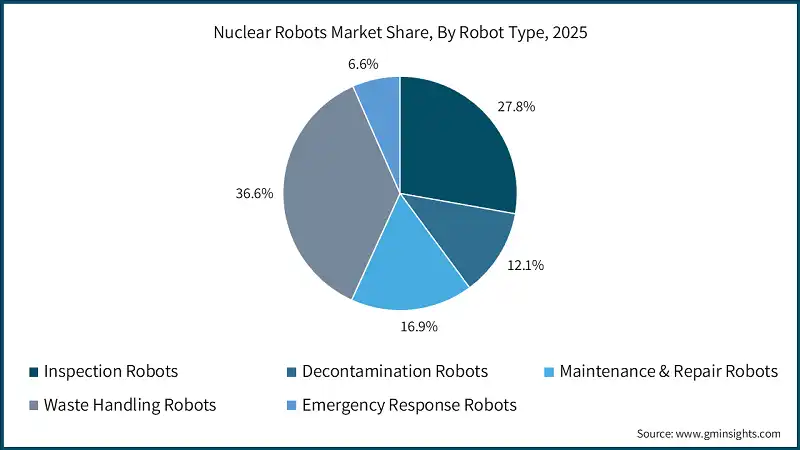
On the basis of robot type, the nuclear robots market is segmented into inspection robots, decontamination robots, maintenance and repair robots, waste handling robots, emergency response robots, and others.
- The inspection robots segment held a market share of 27.8% in 2025. The development of inspection robots is progressing with the addition of AI and sensors to allow for self-directed movement and automatic identification of irregularities. Inspection robots conduct routine and emergency inspections of reactors, pipelines, and storage facilities, minimizing inspection-related manual labor, exposure risks, and downtime.
- Waste handling robots market is projected to reach USD 3 billion by 2035. The deployment of waste handling robots for secure transport, sorting, and processing of radioactive and hazardous materials is growing. The use of automation and precision handling technologies lowers contamination risks and improves compliance with safety regulations across nuclear facilities.
On the basis of payload capacity, the nuclear robots market is divided into low payload robots, medium payload robots, and high payload robots.
- Low payload robots dominated the global market accounting for 40.2% market share in 2025. Low payload robots are used for lightweight inspection, maintenance, and monitoring tasks in confined or high-radiation spaces. Their compact design and maneuverability allow efficient operation in restricted areas while reducing human exposure.
- The high payload robots market is projected to grow at a CAGR of 14.9% by 2035. High payload robots support heavy-duty operations such as component replacement, large-scale decontamination, and material handling. Advances in strength, stability, and control systems allow them to safely manage heavy nuclear equipment and waste in complex environments.
Looking for region specific data?
The North America nuclear robots market held a 38.9% share of the global market in 2025.
- The North American nuclear robotics market is experiencing growth on the basis of the considerable nuclear infrastructure, ongoing large-scale decommissioning, and comprehensive safety and automation regulatory policies. There is a significant increase in AI-powered robotics systems for inspection, maintenance, and waste management.
- R&D in the energy and security sectors is also bolstered by government funding from the U.S. Department of Energy, especially through the Genesis Mission.
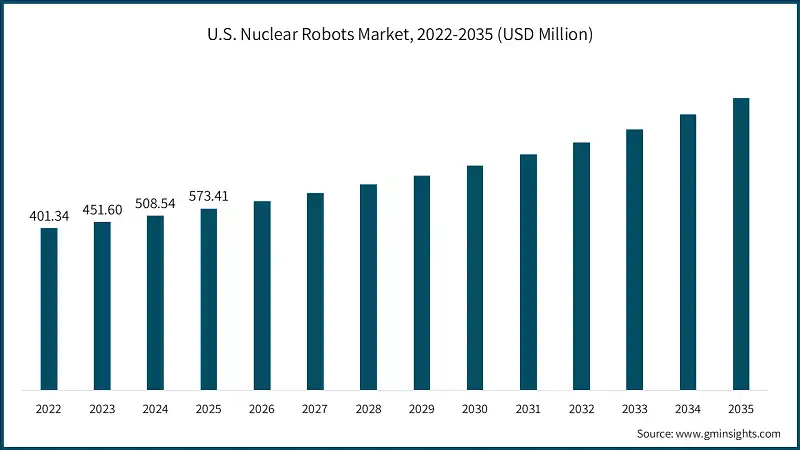
- The U.S. nuclear robots market was valued at USD 401.3 million and USD 451.6 million in 2022 and 2023, respectively. The market size reached USD 573.4 million in 2025, growing from USD 508.5 million in 2024.
- In the United States, nuclear robotics adoption is supported by federal initiatives that integrate advanced technologies into energy infrastructure. According to the U.S. Department of Energy, over USD 320 million has been committed to advance the Genesis Mission’s AI capabilities, which underpin next?generation robotics applications in scientific and energy sectors, including nuclear automation and safety enhancements.
Europe nuclear robots market accounted for USD 618.5 million in 2025 and is anticipated to show lucrative growth over the forecast period.
- The active decommissioning programs and the strict safety regulations foster the growth of the European market. The use of robots for maintenance, inspection, and waste handling is growing, backed by regional investments and regulatory compliance. The diversity in Europe's nuclear facilities, including the nuclear phase-out and the nuclear modernization, fosters the implementation of advanced automation systems in order to improve safety and flexibility in operations.
- Germany dominates the Europe nuclear robots market, showcasing strong growth potential.
- In Germany, government technology policy is advancing nuclear innovation through strategic investment frameworks. The federal cabinet approved a National Fusion Action Plan budgeted at USD 2.3 billion until 2029, aimed at advancing potential commercial fusion studies and the construction of supporting facilities and encouraging the development of a wider ecosystem accommodating robotics and automation in nuclear applications.
The Asia Pacific market is anticipated to grow at the highest CAGR of 16.9% during the analysis timeframe.
- Asia Pacific possesses the fastest developing market for nuclear robots due to the swift rise of nuclear capabilities in China, Japan, and South Korea. New and legacy plants are incorporating robotics for fuel handling, autonomous surveillance, and site inspection. The region’s focus on safety, automation, and workforce optimization makes advanced robotics a critical cross-cutting strategic asset for nuclear value chains.
- China nuclear robots market is estimated to grow with a significant CAGR, in the Asia Pacific market. China’s nuclear robots industry is expanding in line with accelerated nuclear power plant construction and automation strategies. Government funded infrastructure projects, alongside industrial financial assistance, stimulate the use of robots for inspections, maintenance, and safety management across facilities.
- The incorporation of robotics with artificial intelligence and sensor systems is improving operational efficacy while satisfying the country’s goals of energy security and sustaining technological leadership.
Brazil leads the Latin American nuclear robots market, exhibiting remarkable growth during the analysis period.
- The expansion of capacity and modernization of existing facilities are contributing to the growth of the nuclear robotics market in Brazil. The increased emphasis on safety and remote monitoring technology systems for inspections drives the use of robotic systems.
- Future market expansion in the decommissioning, maintenance, and monitoring sectors will be driven by government support for automation in the energy sector and strategic partnerships with foreign robotics companies.
South Africa nuclear robots market to experience substantial growth in the Middle East and Africa market in 2025.
- Government initiatives aimed at improving energy security and infrastructure resilience have led to the development of South Africa's nuclear robotic market. Investments in robotics for inspection, maintenance, and safety operations align with efforts to overhaul the aged Koeberg facilities and to assess new nuclear projects.
- Partnerships with global robotics firms and technology transfer are anticipated to accelerate adoption amidst workforce and safety challenges.
Nuclear Robots Market Share
The nuclear robots industry is highly competitive. The top 5 players in the market are Orano (Areva), Mitsubishi Heavy Industries, QinetiQ, Hitachi-GE Nuclear Energy, and KUKA AG, accounting for a significant share of over 64.9% in the market.
To sustain market dominance, competitors in the nuclear robotics sector are focusing on artificial intelligence, cutting-edge robotics, and autonomous functioning. Companies, including Orano, Mitsubishi Heavy Industries, and QinetiQ, are employing remote surveillance systems and automated decontamination and precision maintenance robots to improve the efficiency and safety of nuclear facilities.
Market players are focusing on expanding their product portfolio and improving client satisfaction through strategic alliances, mergers and acquisitions, and heavy investment in research and development. Growth is further supported by government contracts, infrastructure modernization programs, and partnerships with nuclear facility operators across regions.
Robotic solutions are being designed with radiation-resistant materials, modular designs, and energy-efficient operations to act as key differentiators in the market. Companies are responding to rising safety and automation demands by enhancing marketing strategies, allocating resources toward regional expansions, and developing policies to facilitate adoption in emerging nuclear markets.
Nuclear Robots Market Companies
Prominent players operating in the nuclear robots industry are as mentioned below:
- ABB Ltd.
- Amentum Services, Inc.
- Babcock International Group plc
- Boston Dynamics, Inc.
- Cybernetix (TechnipFMC)
- Framatome
- GE Inspection Robotics
- Hitachi-GE Nuclear Energy, Ltd.
- Honeybee Robotics, Ltd.
- Inuktun Services Ltd.
- James Fisher & Sons plc
- KUKA AG
- Mirion Technologies, Inc.
- Mitsubishi Heavy Industries, Ltd.
- Nuvia Group
- Oceaneering International, Inc.
- Orano
- QinetiQ Group plc
- Veolia Environnement S.A.
- Westinghouse Electric Company LLC
- Orano (Areva)
Orano (Areva) is a leading player in the nuclear robots market with a market share of approximately 23.4%. The company specializes in using sophisticated robotics for inspection, maintenance, and the handling of waste in nuclear facilities. Using AI-based automation, accurate control systems, and radiation-shielded advanced technologies, Orano enhances safety, efficiency, and regulation adherence in nuclear operations.
Mitsubishi Heavy Industries holds a market share of around 16.1% in the nuclear robots market. The Mitsubishi Company prioritizes autonomous robotics, modular decontamination solutions, and remote inspection systems. Mitsubishi Heavy Industries integrates advanced sensors and boosts operational efficiency through strategic partnerships and research and development.
QinetiQ commands a market share of approximately 9.4% in the nuclear robots market. The company maintains a strong focus on developing advanced maintenance and inspection robots that utilize artificial intelligence for autonomous navigational capabilities, threat assessment, and radiation-protective schematics. QinetiQ enhances its competitive advantage by delivering innovative solutions in the sectors of nuclear decommissioning, emergency response, and international waste disposal.
Nuclear Robots Market Report Attributes
| Key Takeaway | Details |
|---|---|
| Market Size & Growth | |
| Base Year | 2025 |
| Market Size in 2025 | USD 2.1 Billion |
| Market Size in 2026 | USD 2.3 Billion |
| Forecast Period 2026 - 2035 CAGR | 13.8% |
| Market Size in 2035 | USD 7.5 Billion |
| Key Market Trends | |
| Drivers | Impact |
| Increased focus on accident prevention and emergency response preparedness | Drives demand for advanced nuclear robots capable of rapid hazard detection, emergency interventions, and risk mitigation. |
| Increasing decommissioning of aging nuclear facilities | Boosts adoption of inspection, maintenance, and waste handling robots to safely dismantle and manage legacy sites. |
| Labor shortages and skill gaps in nuclear operations | Encourages deployment of autonomous and semi-autonomous robots to fill workforce gaps and maintain operational continuity. |
| Government funding and public sector investment in nuclear safety infrastructure | Accelerates R&D and large-scale deployment of robotic solutions across nuclear facilities. |
| Pitfalls & Challenges | Impact |
| High capital and lifecycle costs | Limits small-scale adoption and encourages focus on high-value, multi-functional robotic platforms. |
| Limited standardization and interoperability across nuclear sites | Slows integration of robotic systems, creating demand for modular and adaptable designs. |
| Opportunities: | Impact |
| Expansion of robotics-as-a-service models for decommissioning projects | Enables broader access to advanced robotics without heavy upfront investment, increasing market penetration. |
| Development of modular, reconfigurable robots for multi-site applicability | Enhances flexibility, reduces costs, and supports deployment across diverse nuclear operations and sites. |
| Market Leaders (2025) | |
| Market Leaders |
23.4% market share |
| Top Players |
|
| Competitive Edge |
|
| Regional Insights | |
| Largest Market | North America |
| Fastest growing market | Asia Pacific |
| Emerging countries | China, India, Brazil, Mexico, South Africa |
| Future outlook |
|
What are the growth opportunities in this market?
Nuclear Robots Industry News
- In November 2025, Capgemini and Orano announced the deployment of Hoxo, the first intelligent humanoid robot designed for nuclear facilities, marking a major advancement in physical AI for high-risk environments.
- In July 2025, AtkinsRéalis extended its global strategic partnership with Kinova for another three years, building on six years of collaboration to advance nuclear safety and efficiency through innovative robotics.
The nuclear robots market research report includes in-depth coverage of the industry with estimates and forecast in terms of revenue in (USD Million) from 2022 – 2035 for the following segments:
Market, By Type
- Remote manipulators
- Crawlers
- Aerial drones
- Underwater robots (ROVs)
- Humanoid robots
Market, By Robot Type
- Inspection robots
- Decontamination robots
- Maintenance & repair robots
- Waste handling robots
- Emergency response robots
Market, By Payload Capacity
- Low payload robots
- Medium payload robots
- High payload robots
Market, By End Use Industry
- Nuclear waste handling
- Nuclear decommissioning
- Radiation cleanup
- Nuclear power plants
- Research & exploration
- Others
The above information is provided for the following regions and countries:
- North America
- U.S.
- Canada
- Europe
- Germany
- UK
- France
- Spain
- Italy
- Netherlands
- Asia Pacific
- China
- India
- Japan
- Australia
- South Korea
- Latin America
- Brazil
- Mexico
- Argentina
- Middle East and Africa
- South Africa
- Saudi Arabia
- UAE
Frequently Asked Question(FAQ) :
What is the nuclear robots market size in 2025?
The market size for nuclear robots was valued at USD 2.1 billion in 2025. Growing emphasis on accident prevention, worker safety, and automation in high-radiation environments is supporting market expansion.
What is the market size of the nuclear robots industry in 2026?
The market size for nuclear robots is estimated to reach USD 2.3 billion in 2026, reflecting increased deployment across nuclear decommissioning, inspection, and maintenance activities.
What is the projected value of the nuclear robots market by 2035?
The market size for nuclear robots is expected to reach USD 7.5 billion by 2035, growing at a CAGR of 13.8% during 2026–2035. Growth is driven by aging nuclear infrastructure, large-scale decommissioning projects, and rising government investments in nuclear safety and automation.
Which robot type segment led the nuclear robots market in 2025?
Inspection robots led the market with a 27.8% share in 2025. Their dominance is supported by growing demand for routine and emergency inspection of reactors, pipelines, and storage facilities while minimizing human radiation exposure.
What is the outlook for the remote manipulators segment?
The remote manipulators segment is anticipated to reach USD 2.6 billion by 2035. Advancements in haptic feedback, precision control, and radiation-resistant materials are driving adoption for handling and maintenance tasks in hazardous environments.
What is the growth outlook for the aerial drones segment?
The aerial drones segment is projected to grow at a CAGR of over 15.4% through 2035. Increasing use for rapid surveillance, radiation monitoring, and inspection of hard-to-access nuclear sites is supporting strong growth.
Which payload capacity segment dominated the market in 2025?
Low payload robots dominated the market with a 40.2% share in 2025. Their compact design and maneuverability make them ideal for inspection, monitoring, and light maintenance tasks in confined and high-radiation areas.
Which region leads the nuclear robots market?
North America led the global market with a 38.9% share in 2025. The region’s dominance is driven by extensive nuclear infrastructure, ongoing decommissioning projects, and strong government funding for nuclear safety and robotics R&D.
Who are the key players in the nuclear robots market?
Key players include Orano (Areva), Mitsubishi Heavy Industries, QinetiQ, Hitachi-GE Nuclear Energy, KUKA AG, ABB Ltd., Westinghouse Electric Company, and GE Inspection Robotics. These companies focus on AI-enabled robotics, autonomous systems, and radiation-resistant technologies to strengthen their market position.
Nuclear Robots Market Scope
Related Reports