Summary
Table of Content

North America Soundbars Market
Get a free sample of this report
Form submitted successfully!
Error submitting form. Please try again.
Thank you!
Your inquiry has been received. Our team will reach out to you with the required details via email. To ensure that you don't miss their response, kindly remember to check your spam folder as well!
Request Sectional Data
Thank you!
Your inquiry has been received. Our team will reach out to you with the required details via email. To ensure that you don't miss their response, kindly remember to check your spam folder as well!
Form submitted successfully!
Error submitting form. Please try again.
North America Soundbars Market Size
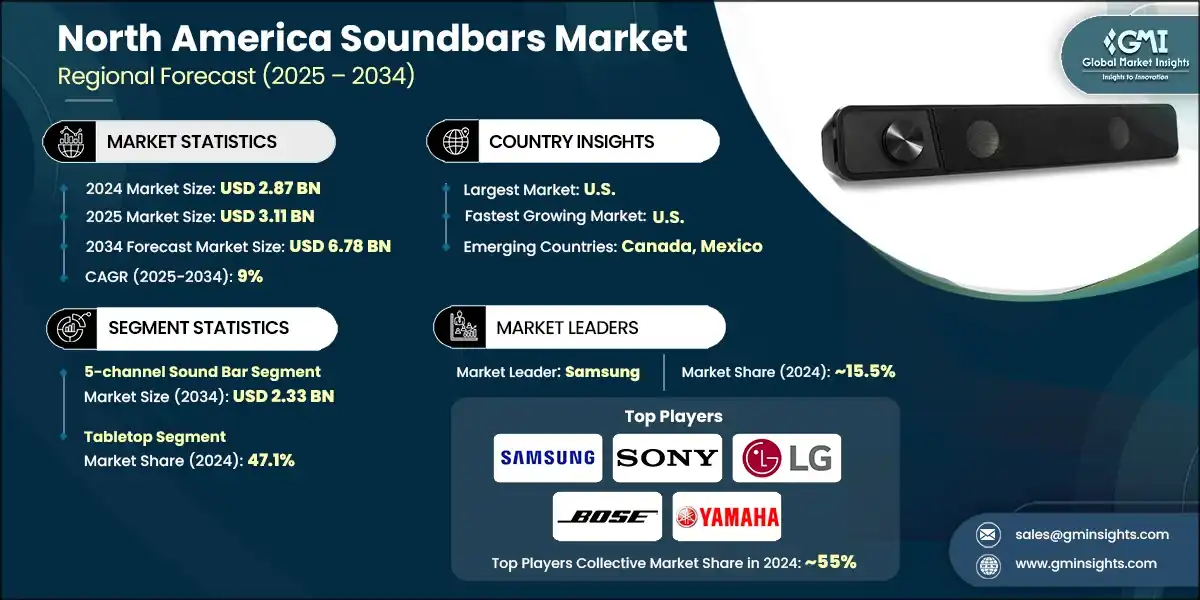
The North America soundbars market was estimated at USD 2.87 billion in 2024. The market is expected to grow from USD 3.11 billion in 2025 to USD 6.78 billion in 2034 at a CAGR of 9%, according to latest report published by Global Market Insights Inc.
North America Soundbars Market Key Takeaways
Market Size & Growth
- 2024 Market Size: USD 2.87 Billion
- 2025 Market Size: USD 3.11 Billion
- 2034 Forecast Market Size: USD 6.78 Billion
- CAGR (2025–2034): 9%
Regional Dominance
- Largest Market: U.S.
- Fastest Growing Country: U.S.
Key Market Drivers
- Increasing demand for home entertainment systems.
- Technological advancements and integration of smart features.
- Growing adoption of flat panel TVs.
Challenges
- Intense competition and price sensitivity.
- Dependence on TV sales and market saturation.
Opportunity
- E-commerce growth.
- Commercial applications in sectors such as hospitality and retail.
Key Players
- Market Leader: Samsung led with over 15.5% market share in 2024.
- Leading Players: Top 5 players in this market include Samsung, Sony, LG, Bose, Yamaha, which collectively held a market share of 55% in 2024.
Get Market Insights & Growth Opportunities
The North America soundbars market is undergoing a change with the combination of immersive audio technologies, the growth of streaming video, and the incorporation of Artificial Intelligence. Object-based audio formats like Dolby Atmos and DTS:X provide immersive three-dimensional soundscapes beyond what traditional surround sound formats provide. Soundbars that support Dolby Atmos are now available from all manufacturers at prices below $250, putting pressure on market incumbents to provide more accessibility while maintaining a differentiation strategy. Samsung utilizes AI-driven content analysis to separate sound to spotlight dialogue, music, and effects on a scene-by-scene basis in real-time. The HDMI 2.2 specification, introduced in January 2025, increases bandwidth to 96 Gbps and adds an indication protocol for improved audio-video latency. Enhanced Audio Return Channel (eARC) offers high-bitrate object-based audio transport at 192 kHz and 24-bit depth while simplifying connectivity and protecting actual fidelity. Next Generation Audio frameworks, such as MPEG-H, Dolby AC-4, and DTS-UHD utilize metadata-driven rendering that allows consumers more options for playback. Recent survey data suggests that over sixty percent of soundbar owners use their devices for music, with the television off emphasizing the category behavior beyond original purpose.
The uptake of soundbars in North America is due to changing lifestyles, aesthetics of minimalism in architectural design, and built-in TV speakers that are not improving as TVs are getting thinner. According to the Consumer Technology Association, 51 percent of U.S. households own soundbars, indicating the product is at least part of mainstream acceptance. The primary reasons for sound bar purchase are due to broken equipment (32 percent), wanting the latest technology (19 percent), and adding another unit to their home (13 percent). Competitive pricing is the primary reason for 58 percent of consumers choosing a retailer, with the selection of products (30 percent) and the location of the retailer (23 percent) also influencing their decisions and located factors along with both twisted (63 percent) of purchases occurred in a physical store.
Additionally, 47 percent of in-store purchasers investigate sound bars on the internet during the process of purchasing them. Millennials and Generation X account for 61 percent of consumer electronics purchases, showing that Generation Z makes 1.6 percentage points year-to-year gain. Compatibility with voice assistants utilizing Amazon Alexa and Google Assistant has become standard and allows for a further depth of interaction with smart home appliances. Research by EY indicates the largest barriers for smart homes are focused on security issues, cost, and compatibility, so it is imperative manufacturers provide transparency regarding interoperability. In Canada, 36 percent of homes have a smart speaker, and 50 percent of households own a 4K television, suggesting that consumers have become more sophisticated.
The market landscape reveals a segmentation into vertically-integration television manufacturers and more narrowly focused audio brands. As an example, Samsung leads in two product categories – televisions and soundbars - each time for 17 years and for over a decade long time on soundbar market share, for example. Samsung integrates proprietary Q-Symphony technology to stream from the television speakers and soundbar speakers, creating an overall product ecosystem lock-in strategy towards Samsung products. Q-Symphony 3.0 now includes a form of neural processing whereby the technology separates and identifies the voice signals and creates an output with stereo to a near 20 channels. In parallel, Sony executes a design and manufacturing strategy with their BRAVIA Theatre series of televisions with a suite of features, including 360 Spatial Sound Mapping and Acoustic Center Sync. Categories of companies are competing on acoustic engineering or multi-room technologies, such as Sonos, too, while at the same time connecting to services, such as Spotify, Apple Music and Amazon Music – as well as ongoing subscription services.
Challenges may arise for Sonos based on a current premium price point limiting available market and other competitors for hardware access based on price point who can subsidize costs at entry point of the value chain, i.e., Apple, Amazon and Google. Within the retail distribution landscape of the United States, Walmart indicates having a 33 percent unit share, Best Buy indicates 24 percent and Amazon 12 percent, while in a breakdown of dollar share Best Buy leads in share at 30 percent. In survey research from the Consumer Technology Association of Mexico and Vietnam were cited as the nearshoring geography from China in the study. Sony sits at a 33 percent share of brand consideration with a 63 percent closing rate based on studied consideration data and Samsung at 30 percent.
The future of evolution lies with the personalization afforded by AI, sustainable products, integration of gaming, and more immersive content. Samsung's SpaceFit Sound, VDE-certified in 2021 is used to apply reflectance to assess the acoustics of a room based on AI, which is not limited to wall distance and density of furnishings. If you recall, sound would traditionally be adjusted by the test tones and not in real-time as content is presented. Next Generation Audio (NGA) can provide personalisation based on metadata cues with elements such as dialogue boost or language selection, offered through HDMI or MHAS. More stations, particularly in North America, broadcasting ATSC 3.0, increase the number of programs that are utilizing NGA. Gaming continues to encourage low-latency modes in receivers/products and further optimizations offered through HDMI 2.1. Including Adjustable Refresh Rates (VRR) and Auto Low Latency Mode (ALLM).
Furthermore, the Latency Indication Protocol of HDMI 2.2 also provides advantages in gaming settings for synchronization. All major manufacturers are attempting the implementation of recyclables in its packaging, implementing up to 50-55% recycled plastics or as in Sony's case, fabric made from recycled PET bottles as part of its ecologically focused initiative, Road to Zero. The integration of DTS:X to support Dolby Atmos also enhances the ecosystem of immersive audio, while Disney+ allows for enhancing not only video, but also audio immersion.
To get key market trends
North America Soundbars Market Trends
Integrating artificial intelligence and machine learning algorithms into soundbar hardware marks an important shift away from static audio reproduction towards dynamic, context-aware sound optimization that improves perceived quality while decreasing the complexity for consumers to set up.
- An example of this evolution is Samsung's SpaceFit Sound technology that employs built-in television microphones and AI algorithms that assess the room's acoustic properties, including distance to walls, surface reflectivity, and amount of furnishing density, to autonomously recalibrate audio output in real time based on the actual content rather than practice test tones, even earning a Spatial Sound Optimization certification from Verband Deutscher Elektrotechniker (VDE) in 2021 as the first solution to achieve third-party certification. Samsung debuted version 3.0 of their Q-Symphony technology also evolving to a neural processing unit (NPU) deployment for on-device machine learning which is able to process voice separation in real time distinguishing between dialogue, background music, and sound effects in addition to upmixing stereo content into up to twenty individual channels through artificial intelligence driven spatial analysis. Next Generation Audio standards, such as MPEG-H, Dolby AC-4, and DTS-UHD, allow metadata-driven personalization characteristics such as adjusting dialogue boost intensity, changing language tracks, and improve accessibility methods while distributing rents in rendering between source device and soundbar processor through audio paths such as HDMI and MHAS.
- Television manufacturers are utilizing control over display hardware to introduce proprietary audio synchronization technologies that offer unique performance advantages when used with their respective soundbars, creating ecosystem lock-in that encourages consumers to buy both products from the same brand and changes competition in the product class. Samsung's Q-Symphony technology syncs the television speakers with any connected soundbar so that the advanced, combined sound creates an enlarged overall soundstage, with the top firing speakers on the television adding background and surround elements complementing the primary channels from the soundbar. The caveat is that the Q-Symphony is only available on compatible Samsung televisions paired with Samsung soundbars, establishing a closed ecosystem that enhances functionality only when the consumer exhibits brand loyalty rather than shop audio from competitors. Samsung has maintained leadership in both television (17 consecutive years) and soundbar (10 consecutive years, from 2023) product categories, creating a large enough installed base to pay off this ecosystem strategy.
- Similarly, Sony has developed this same strategy within its BRAVIA Theatre product family, enhancing the experience with product branded technologies such as 360 Spatial Sound Mapping, Sound Field Optimization (for automatic room adjustment), and Acoustic Center Sync all to sync audio output as needed with screen action when paired with BRAVIA televisions, enabling the audio-video handshake to be optimized with special technologies, which often prove too difficult to deliver only through HDMI Component protocols.
- The North American Soundbar supply chain is presently undergoing a significant adjustment as manufacturers move capacity out of China into Mexico and Vietnam in response to tariff pressures, geopolitical tensions, and efforts to diversify supply with the framework of the United States, Mexico, Canada Agreement (USMCA), albeit with complexities around regulations, rules of origin, and restrictions hindering these efforts. A recent analysis presented by the Consumer Technology Association and Kearney shows that Mexico and Vietnam were the two most likely destinations for manufacturers moving audio-video manufacturing out of China, with companies actively researching and developing manufacturing facilities and source relationships for components in locations such as Mexico and Vietnam to protect them from tariff vulnerability, minimize supply chain risk, benefit from Mexico's proximity to the US providing shorter lead times, and Vietnam's labor pricing and existing infrastructure for electronic manufacturing.
North America Soundbars Market Analysis

Learn more about the key segments shaping this market
Based on the product type, the market is segmented into 2-channel sound bar, 3-channel sound bar, 5-channel sound bar, and 7-channel sound bar. The 5-channel sound bar segment was valued at USD 950 million in 2024 and is projected to reach USD 2.33 billion by 2034.
- The 5-channel sound bar configuration delivers a genuine surround sound experience, utilizing 2 rear, left, right, and center channels for that immersive audio experience when watching movies, gaming, and music. As consumers are putting more emphasis on audio quality at home, the 5-channel systems definitely show a step up from 2 or 3 channels without depth to the sounds and spatial sound effects.
- 5.1 surround sound is recognized as the standard audio format for nearly all streaming video platforms, nearly all Blu-rays, and all gaming consoles. This means 5-channel sound bars are more compatible with the mainstream and popular media users watch in their home - they will experience sound closer to what the creator's intended. This is important in the consumer side - people want a system that syncs with what they already own, without requiring any new equipment to listen to popular media.
- 5-channel sound bars also balance the gap between 7-channel sound bars. 7-channel sound bars are relatively more expensive than 5-channel sound bars, are often more suitable for large areas, and the specs are generally catered to that large, high end user. Although 7-channel sound bars are appealing to consumers, people are also looking for premium sounding systems, without as much of the complexity or expense of a high end home system. 5-channel sound bars are ideal for the middle class, urban, and lower middle-class consumer. The consumer wants to watch and listen to movies in the comfort of their own home at the fraction of the cost of a real theater experience.
- While traditional multi-speaker audio systems and setups are generally better than sound bars, commonly manufacturers of 5-channel sound bars are often implementing wireless technology (or wireless from the manufacturer) and/or virtual surround sound implementations that make the rear-channel or back-channel audio experience even better and reducing a need or need for multiple wired speakers. This is especially practical in downsized apartment and smaller living space situations where a traditional multi-speaker setup is not practical, due to the allotted space in their living area. They also have a very easy installation process which makes them more attractive to non-technical users.

Learn more about the key segments shaping this market
The North America soundbars market by installation type is segmented into wall-mounted, tabletop, and floor standing. The tabletop segment was the leading segment in this market in 2024 with a revenue of USD 1.35 billion and has a market share of around 47.1%.
- Tabletop soundbars are a favorite option because they are very easy to install without any tools or drilling involved. Customers innately place product on TV stands or entertainment units, which is a great solution for renters or if you simply like to rearrange your rooms regularly. Their usability resonates with a mainstream crowd made up of people looking for quick and convenient solutions.
- Most consumers have TVs on a stand or console, which is why tabletop soundbars are the natural selection for product adjacency. Unlike wall-mounted or freestanding, tabletop units fit precisely into the clean line of the furniture layout in the room, whereas mounting and freestanding options would visually obstruct other surfaces or the stand. That compatibility and usability resonates with hop urban consumers who live in small living spaces.
- Tabletop soundbars also tend to be less expensive than wall-mounted or freestanding options, which often require total system accessories, expert installation, and more installation time. Customers can take advantage of comfort and accessibility without going beyond a fair retail price. Even budget-conscious consumers want better sound quality without incurring more costs or time to install.
- Tabletop soundbars are also portable, in that the user can move the unit from one room to another or even a different location, versus establishing fixed wall-mounted or freestanding unit.
Looking for region specific data?
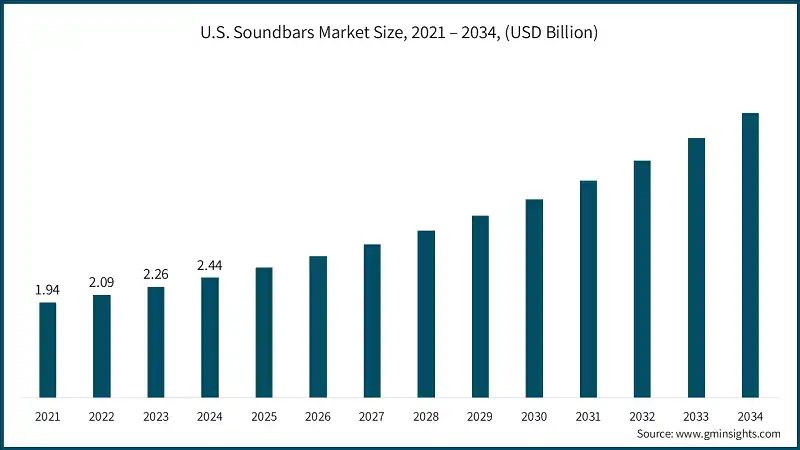
The North America soundbars market shows diverse dynamics across countries, shaped by economic development, and sustainability trends. The U.S. soundbars market was valued at around USD 2.44 billion in 2024 and is anticipated to register a CAGR of 9.1% between 2025 and 2034.
- The U.S. is the largest market creator for home entertainment spending, helped in part by the improvement of household disposable incomes, as well as upgraded lifestyles. The Bureau of Labor Statistics Consumer Expenditure Survey shows that average annual household spending was $77,280 in 2023, and spending categories associated with entertainment spent increased steadily year over year. This indicates consumers have become comfortable spending for premium audio products, such as soundbars, for enhanced streaming and gaming services.
- The demand for soundbars is strongly tied to the penetration of streaming services. The Federal Communications Commission (FCC) states, "More than 53% of U.S. homes have access to fixed broadband speeds equal to or greater than 100/20 Mbps," which supports streaming high definition audio and video. The Pew Research Center notes that "96% of U.S. adults utilize the internet (including broadband which is nearly universal in middle- and high-income households," which promotes the use of soundbars as engaging audio experiences on OTT platforms.
- The Federal Reserve’s 2024 Household Well-Being Report shows that 39% of U.S. adults have family incomes of $100,000 or more, creating a strong base for discretionary spending on electronics. Furthermore, data from the Energy Information Administration indicates that U.S. homes increasingly feature large-screen TVs (40–59 inches in 65% of households), which pairs naturally with soundbars for enhanced audio. This synergy between visual and audio upgrades drives market growth.
- The U.S. Census Bureau reports that the median home size is approximately 1,834 square feet as of October 2025, providing ample space for home theater setups. Larger living rooms and open floor plans encourage consumers to invest in soundbars rather than traditional multi-speaker systems, as they offer a sleek, space-efficient solution without compromising audio quality.
North America Soundbars Market Share
- The top 5 companies in the soundbars market, such as Bose, LG, Samsung, Sony, and Yamaha hold a market share of 55%.
- Bose sustains its competitive position through constant innovation and global expansion. The company invests significantly in its Research & Development operations to provide the benefits of premium audio product experiences, as capitalized on through its generation of products like the QuietComfort Ultra Series, and experimentations with immersive audio technologies for both hardware and software. The Company is also putting significant emphasis on automation and the growth of e-commerce (for example, the company noted an 81% lift in online sales year-over-year for peak seasons). While Bose continues its global expansion through the introduction of new Experience Centers and investment in wearables, the company will continue to build on its footprint in the international space. In other words, Bose's strategy consists of three prongs - innovation, digital connection, and global expansion. This approach helps Bose to manage through an increasingly competitive landscape comprised of the largest tech companies in the world and start-up audio companies.
- LG is applying platform-based services and subscription models to create a differentiator in a work-up market. Strategy initiatives include enhancing hardware with its proprietary operating system webOS, such as with soundbars and TVs, allowing LG to build a high-margin ecosystem of hardware plus the coupling of content. Its subscription services have increased over 75% year-over-year, aiding in client loyalty and revenue generation. The company is also increasing distribution through its online brand shops and on-site care services throughout Asia, while incorporating sustainability into its hardware and AI into customer solutions. LG is competing less on price and shifting towards technology-driven customer value, securing long-term growth and resilience against aggressive competitors.
- Samsung has cemented its leadership in soundbars with an unyielding approach to innovation and ecosystem integration. Its flagship models seamlessly implement AI-enhanced audio optimization with Q-Symphony, which pairs soundbars with Samsung TVs. Samsung has been the global leader for 11 years running. The company reinvests 9–10% of its revenue in research and development to develop exciting features, such as Dolby Atmos and DTS:X compatibility. Samsung has a differentiated strategy at scale, a strong brand, and a global manufacturing infrastructure that keeps it at the forefront of the market, even facing premium audio brands.
North America Soundbars Market Companies
Major players operating in the North America soundbars industry are:
- Bose
- Bowers & Wilkins
- Definitive Technology
- Denon
- Harman Kardon
- JBL
- Klipsch
- LG
- Polk Audio
- Samsung
- Sonos
- Sony
- Southern Audio Services
- VIZIO
- Yamaha
Sony’s strategy is based on premium price point and ecosystem advantage. The company features integration of its BRAVIA soundbars with smart TVs, creating a variety of advanced hardware features such as Dolby Atmos, DTS:X, and AI-driven Voice Zoom. Sony is also engaging more globally with partner brands to improve compatibility, reduce integration costs, and develop its ecosystem for entertainment, including gaming and content, into compelling value propositions. Overall, combining its innovation with engineered sound along with partnered alliances, helps its brand remain prominent and relevant regardless of competition with even stronger tech brands and niche audio brands.
Yamaha defines its strategy on product line extension and the agility to pivot and respond to competition through interventions and new channels to market. This includes outsourcing production, forming ODM partnerships and accelerating development cycles, allowing it to launch various mainstream models of soundbars at faster rates in the marketplace. Yamaha also allows its sound quality and design to be the major initiating product factors along with develop more complex sound with AI and sensibility engineering, built in with their Japanese operational philosophy. Yamaha's product promotion approach is significant, operating through distribution with a broad category of increasing dealer expansion globally. Developing strong connections in the industry building relationships allows for feedback-driven insight basis for planning products. Balancing the development of profitability, cost effectiveness and distribution internationally will help Yamaha maintain stability in the audio segment that is increasing in competitiveness.
North America Soundbars Market Report Attributes
| Key Takeaway | Details |
|---|---|
| Market Size & Growth | |
| Base Year | 2024 |
| Market Size in 2024 | USD 2.87 Billion |
| Market Size in 2025 | USD 3.11 Billion |
| Forecast Period 2025 - 2034 CAGR | 9% |
| Market Size in 2034 | USD 6.78 Billion |
| Key Market Trends | |
| Drivers | Impact |
| Increasing demand for home entertainment systems | Drives the need for enhanced audio solutions, positioning soundbars as a preferred choice for consumers seeking immersive sound experiences. |
| Technological advancements and integration of smart features | Transforms soundbars into multifunctional devices, making them more appealing to tech-savvy consumers. |
| Growing adoption of flat panel TVs | Fuels the requirement for sleek and space-efficient soundbars, since they complement the aesthetic appeal of these televisions while delivering superior audio quality. |
| Pitfalls & Challenges | Impact |
| Intense competition and price sensitivity | Force soundbar manufacturers to focus on cost efficiency while maintaining quality. This challenge can reduce profit margins and slow down innovation in the market. |
| Dependence on TV sales and market saturation | Limits the growth potential for soundbars. Companies need to explore new applications and customer segments to sustain demand and drive expansion. |
| Opportunities: | Impact |
| E-commerce growth | Enables consumers to access a wide range of soundbars online, boosting market demand through convenience and competitive pricing. |
| Commercial applications in sectors such as hospitality and retail | Commercial applications improve the adoption of soundbars, enhancing customer experience in spaces like hotels, restaurants, and retail outlets. |
| Market Leaders (2024) | |
| Market Leaders |
Market share of ~15.5% |
| Top Players |
Collective market share in 2024 is ~55% |
| Competitive Edge |
|
| Regional Insights | |
| Largest Market | U.S. |
| Fastest growing market | U.S. |
| Emerging countries | Canada, Mexico |
| Future outlook |
|
What are the growth opportunities in this market?
North America Soundbars Industry News
- In June 2025, JBL debuted a fresh soundbar series, prioritizing sustainable materials and energy-efficient designs, appealing to eco-conscious consumers. The series also incorporates advanced sound calibration features for optimal performance. JBL's launch aligns with the growing demand for environmentally friendly audio solutions.
- In April 2025, LG Electronics unveiled a new soundbar series, boasting AI-driven sound optimization and Dolby Atmos support, aimed at elevating home entertainment. The series also includes advanced connectivity options, ensuring compatibility with a wide range of devices. This launch highlights LG's commitment to innovation focusing on long-term plans for integrating smart audio solutions to improve user experience.
- In March 2025, Sony rolled out its flagship soundbar, equipped with advanced spatial audio tech and designed for seamless pairing with its Bravia TV range. The soundbar also features voice assistant integration for enhanced user convenience. Sony's latest offering underscores its focus on delivering premium audio experiences.
- In February 2024, Samsung forged a collaboration with Dolby, set to embed Dolby Atmos FlexConnect tech in its forthcoming soundbar models, boosting audio adaptability for diverse room setups. This partnership aims to redefine audio customization for consumers. Samsung's initiative reflects its strategy to stay competitive in the evolving audio market.
The North America soundbars market research report includes in-depth coverage of the industry, with estimates & forecasts in terms of revenue (USD Billion) and volume (Million Units) from 2021 to 2034, for the following segments:
Market, By Product Type
- 2-channel sound bar
- 3-channel sound bar
- 5-channel sound bar
- 7-channel sound bar
Market, By Connectivity
- Bluetooth
- Auxiliary
- Wi-Fi
- Others (HDMI, optical, etc.)
Market, By Installation Type
- Wall-Mounted
- Tabletop
- Floor Standing
Market, By Price
- Low
- Medium
- High
Market, By Distribution Channel
- Online
- Offline
The above information is provided for the following countries:
- U.S.
- Canada
- Mexico
Frequently Asked Question(FAQ) :
What is the market size of the North America soundbars industry in 2024?
The market size was USD 2.87 billion in 2024, with a 9% CAGR expected through 2034 driven by rising demand for home entertainment systems and immersive audio experiences.
What is the current North America soundbars market size in 2025?
The market size is projected to reach USD 3.11 billion in 2025.
What is the projected value of the North America soundbars market by 2034?
The market is expected to reach USD 6.78 billion by 2034, supported by growth in streaming services, larger screen TVs, and AI-powered audio technologies.
How much revenue did the 5-channel soundbar segment generate in 2024?
The 5-channel soundbar segment generated USD 950 million in 2024, driven by increasing preference for immersive surround sound aligned with mainstream streaming and gaming content formats.
What was the valuation of the tabletop installation segment in 2024?
The tabletop installation segment recorded USD 1.35 billion in 2024, capturing the largest share due to easy installation, compatibility with TV stands, and strong appeal among urban consumers with compact living spaces.
Which country leads the North America soundbars market?
The U.S. leads the market with USD 2.44 billion in 2024 and a 9.1% CAGR expected from 2025 to 2034. The industry growth is driven by high broadband penetration, expanding streaming usage, rising disposable incomes, and widespread adoption of large-screen TVs enhancing demand for advanced audio solutions.
What are the upcoming trends in the North America soundbars industry?
Key trends include AI-driven sound optimization, integration with smart home ecosystems, immersive audio formats like Dolby Atmos and DTS:X, and increasing use of sustainable materials in product design.
Who are the key players in the North America soundbars market?
Major companies include Samsung, Sony, LG, Bose, Yamaha, JBL, Polk Audio, Sonos, VIZIO, Harman Kardon, Klipsch, Definitive Technology, Bowers & Wilkins, Denon, and Southern Audio Services.
North America Soundbars Market Scope
Related Reports