Summary
Table of Content

North America Smart Grid Market
Get a free sample of this report
Form submitted successfully!
Error submitting form. Please try again.
Thank you!
Your inquiry has been received. Our team will reach out to you with the required details via email. To ensure that you don't miss their response, kindly remember to check your spam folder as well!
Request Sectional Data
Thank you!
Your inquiry has been received. Our team will reach out to you with the required details via email. To ensure that you don't miss their response, kindly remember to check your spam folder as well!
Form submitted successfully!
Error submitting form. Please try again.
North America Smart Grid Market Size
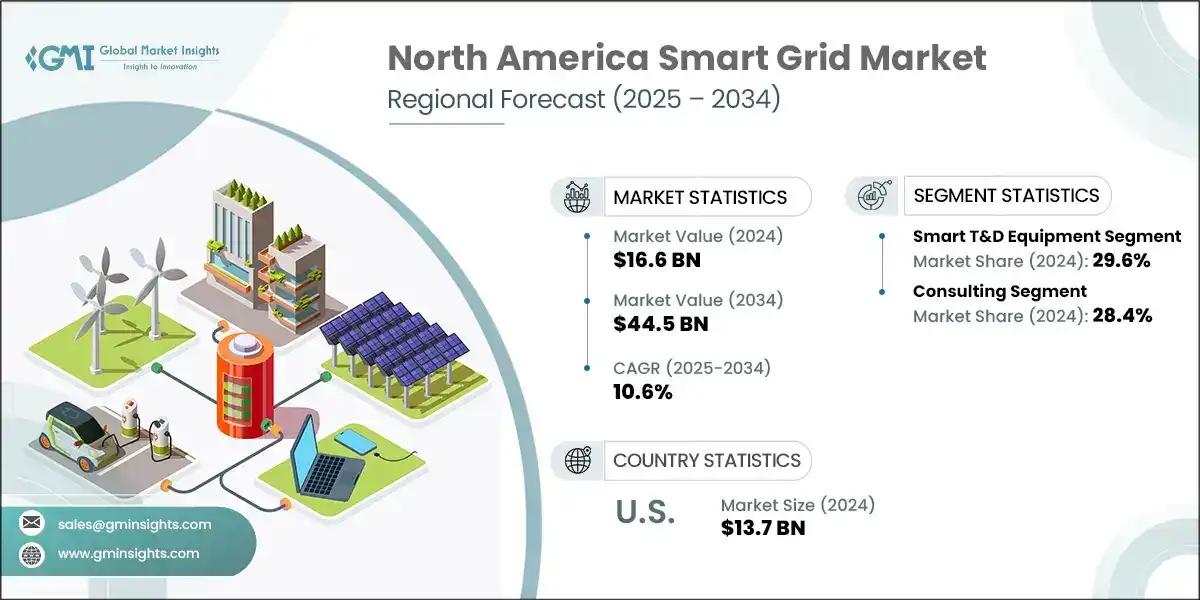
The North America smart grid market was estimated at USD 16.6 billion in 2024. The market is expected to grow from USD 18 billion in 2025 to USD 44.5 billion in 2034, at a CAGR of 10.6%.
North America Smart Grid Market Key Takeaways
Market Size & Growth
- 2024 Market Size: USD 16.6 Billion
- 2034 Forecast Market Size: USD 44.5 Billion
- CAGR (2025–2034): 10.6%
Key Market Drivers
- Increasing need to digitalize the power sector.
- Favorable government regulations and mandates.
- Growing share of renewable energy in the energy mix.
- Reliable and efficient energy consumption.
Challenges
- Rising cyber attacks.
Opportunity
- Expansion of Advanced Metering Infrastructure.
- Rise of Decentralized Energy Systems.
- Growth in EV Infrastructure.
- Smart City and IoT Integration.
Get Market Insights & Growth Opportunities
- Rising electricity demand from urbanization and industrial growth is accelerating smart grid deployments across North America. Strategic partnerships among tech and utility companies are key prime factors enabling innovation, enhancing interoperability, and driving large-scale integration of intelligent grid solutions to meet evolving energy needs efficiently and sustainably.
- Integration of IoT in grid systems is revolutionizing real-time monitoring and control, enhancing operational efficiency. Deployment of edge computing for localized decision-making will enable faster response times, reduce latency, and support decentralized energy resources, strengthening grid resilience and performance across diverse urban and rural landscapes.
- Increasing demand for efficient energy management, spurred by environmental concerns and government regulations. Technological advancements in smart metering, distribution automation, and grid optimization contribute to market growth by enhancing operational efficiency and reliability.
- For reference, in 2025, Avangrid committed USD 41 million to revitalize aging grid infrastructure in Ithaca, New York, focusing on substation upgrades and the installation of 22 miles of new transmission lines. This investment forms part of a broader strategy to modernize the grid, improve reliability, and support future energy demands.
- North America smart grid market will gain momentum, driven by substantial federal and state-level grants and subsidies aimed at accelerating infrastructure modernization. Furthermore, digital substations are emerging as ideal assets for automating grid operations, enhancing fault detection and seamless integration to build a resilient and adaptive power distribution network.
- For instance, in 2025, Iberdrola outlined a USD 20 billion investment plan through 2030 to upgrade and expand grid infrastructure across the U.S. This initiative focuses on modernizing transmission and distribution networks to meet rising energy demand and support the transition to cleaner power. The move reflects a broader industry commitment to building smarter, more resilient, and future-ready energy systems.
- U.S. will witness smart grid evolution owing to the rapid deployment of energy storage systems that enhance grid flexibility and resilience. Utilities are leveraging advanced data analytics for predictive load management, optimizing resource allocation and mitigating peak demand, strategic moves that ensure high service reliability and bolster operational efficiency.
To get key market trends
North America Smart Grid Market Trends
- The growth of the North America smart grid industry is being propelled by several key factors, including the rising integration of renewable energy sources, significant advancements in grid automation and digital technologies, and the widespread adoption of advanced metering infrastructure to enhance energy efficiency and management capabilities.
- Rising focus on strengthening grid resilience and implementing advanced cybersecurity strategies to safeguard infrastructure against potential threats. Additionally, the market is seeing increased collaboration between utilities and tech innovators to create smart solutions that boost grid reliability, operational efficiency, and compliance with evolving consumer and regulatory demand.
- For illustration, in 2024, the U.S. government launched a major initiative to reinforce the national power grid, allocating USD 2.2 billion toward projects aimed at boosting resilience against extreme weather and expanding transmission capacity. This effort spans multiple states and is designed to support growing energy demands from sectors like manufacturing and data centers. It reflects a broader federal commitment to modernizing energy infrastructure and ensuring long-term reliability in the face of climate and technological challenges.
- Regulatory support and investment in grid modernization are also driving the adoption of Distribution and Network Automation technologies. Government incentives and policies aimed at enhancing grid resilience and reducing carbon emissions further propel this market growth.
- Additionally, the increasing incidence of extreme weather events underscores the need for a more resilient and adaptable grid, highlighting the importance of these advanced automation technologies in ensuring uninterrupted power supply and quick recovery from disruptions.
- Key stakeholders in the market are transitioning from traditional grid management to intelligent, data-driven operations by leveraging IoT sensors, edge computing, and digital twins. Grid performance and maintenance schedules are now being optimized using real-time analytics, enhancing reliability, minimizing outages, and maximizing asset efficiency across the network.
- For illustration, in 2025, Mexico introduced a new electricity law aimed at revitalizing its energy sector by balancing state control with private investment. The legislation seeks to modernize outdated infrastructure, improve grid reliability, and attract capital to expand generation capacity. By preserving elements of past reforms while reinforcing the role of the national utility, the law reflects a pragmatic shift toward building a more stable, inclusive, and investment-friendly energy landscape.
- The rising adoption of electric vehicles is creating new opportunities for smart grid integration, particularly in vehicle-to-grid technologies and smart charging infrastructure. Simultaneously, the growing share of renewable energy in the energy mix is driving demand for flexible grid solutions capable of managing intermittent generation.
- The deployment of advanced metering infrastructure is transforming energy management by providing consumption insights. This shift is empowering both consumers and utilities to make informed decisions. Growing digitalization and sustainability goals will boost the adoption of smart meters and will make them an essential tool for optimizing energy use, enhancing grid responsiveness, and driving long-term efficiency across the power sector.
- Furthermore, microgrid installations are gaining traction in remote and disaster-prone areas, offering localized energy resilience. Communication networks are also supporting low-power, long-range connectivity for smart grid devices to improve data flow and coordination while ensuring reliable operations in decentralized energy systems.
- For instance, in 2025, Mexico’s Energy Secretariat (SENER) announced a USD 37 billion to upgrade and expand the country’s electricity infrastructure. This initiative includes new transmission lines, substation upgrades, and integration of renewable energy sources. It reflects Mexico’s broader strategy to modernize its grid, improve energy access, and support long-term sustainability and economic development.
North America Smart Grid Market Analysis
Learn more about the key segments shaping this market
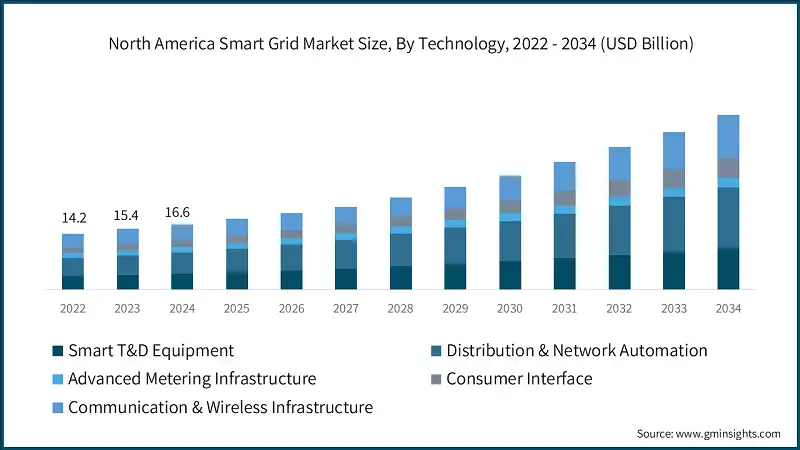
- Based on technology, the industry is segmented into smart T&D equipment, distribution & network automation, advanced metering infrastructure, consumer interface and communication & wireless infrastructure. The smart T&D equipment segment dominated the North America smart grid market accounting for 29.6% share in 2024 and is expected to grow at a CAGR of 10.1% through 2034.
- Smart Transmission and Distribution (T&D) equipment will drive the growth of the smart grid market owing to their advanced technologies to enhance the efficiency, reliability, and resilience of the power grid, addressing the region's increasing energy demands and integrating renewable energy sources.
- The distribution & network automation smart grid market will project at a CAGR of 11.2% till 2034. The increasing incidence of extreme weather events underscores the need for a more resilient and adaptable grid, highlighting the importance of these advanced automation technologies in ensuring uninterrupted power supply and quick recovery from disruptions.
- These technologies significantly enhance the grid's efficiency, reliability, and flexibility, meeting the region's growing energy needs while accommodating a diverse mix of energy sources.
- For reference, Mexico announced a USD 23 billion initiative to strengthen its national electricity infrastructure. The plan focuses on expanding generation capacity, upgrading transmission systems, and increasing private sector involvement. This large-scale investment reflects Mexico’s strategic push to enhance grid reliability, support industrial growth, and accelerate its transition toward a more modern and sustainable energy framework.
- The advanced metering infrastructure will grow at a rate of 5.5% till 2034. AMI encompasses smart meters, communication networks and data management systems, fundamentally transforming how utilities and consumers interact with energy usage.
- The implementation of AMI also enhances outage management and grid resilience. With real-time monitoring, utilities can quickly detect and respond to power outages, often restoring service remotely and more efficiently.
- Smart T&D equipment, distribution and network automation, and advanced metering infrastructure together represent over 60% of the North America smart grid market value, highlighting a concentrated industry landscape. These segments are driven by the increasing demand for flexible grid solutions to handle renewable intermittency and the rapid growth of energy storage deployments.
Learn more about the key segments shaping this market
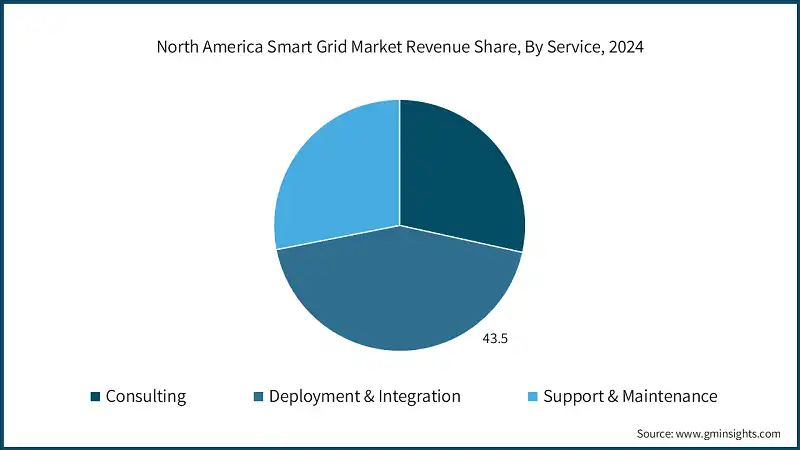
- Based on service, the industry is segmented into consulting, deployment & integration and support & maintenance. The consulting segment had a market share of 28.4% in 2024 and is expected to grow at a CAGR of 9.8% from 2025 to 2034.
- The increasing demand for expert guidance and strategic insights into modernizing energy infrastructure has spurred significant investments in consulting services across the region. These services provide invaluable expertise, aiding utilities in making informed decisions and ensuring the seamless integration of smart grid solutions.
- The deployment and integration services segment had a market share of 43.5% in 2024 with growth rate of 10% up to 2034. The demand for streamlined operations, optimized asset utilization, and compliance with evolving regulatory standards is driving business dynamics positively. These services ensure the successful implementation and interoperability of smart grid solutions, allowing utilities to unlock the full potential of these technologies to enhance grid performance and operational efficiency.
- In 2024, Canada committed USD 362 million to accelerate renewable energy deployment and upgrade grid infrastructure through its Smart Renewables and Electrification Pathways program. This funding aims to support utilities and operators in expanding transmission capacity, integrating clean energy sources, and improving system reliability. It reflects a broader national strategy to build a more sustainable, flexible, and future-ready power grid.
- The support and maintenance smart grid market will witness a growth rate of 12% from 2025 to 2034. Effective technical support and maintenance are essential for sustaining the performance and efficiency of smart grids. They help utilities stay ahead of potential issues, maintain regulatory compliance, and ensure seamless operation of complex grid systems.
- Moreover, these services will play a pivotal role in enhancing grid reliability, promoting sustainability, and ensuring consumer satisfaction. A proactive approach to maintenance and support will be instrumental in achieving a resilient and future ready energy infrastructure.
Looking for region specific data?
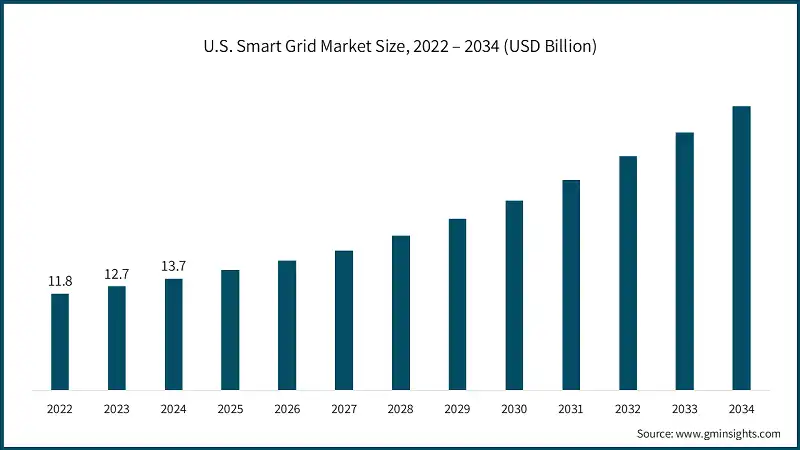
- The U.S. dominated the North America smart grid market with around 82.5% share in 2024 and generated USD 13.7 billion in revenue. The inability of legacy grid infrastructure to support rising electricity demand, combined with the surge in renewable energy integration, is accelerating smart grid deployment across the region.
- Additionally, the use of predictive analytics is improving the forecasting of energy production from renewable sources, aiding in better grid management and stability. Regulatory policies aimed at promoting energy efficiency and reducing carbon emissions are further propelling the adoption of smart grid technologies.
- For reference, in 2024, the U.S. Department of Energy initiated a USD 3.5 billion program to reinforce and modernize the country’s electricity grid. Spanning dozens of states, this effort targets aging infrastructure, enhances protection against climate-related disruptions, and facilitates the integration of clean energy sources. It signals a nationwide commitment to building a more adaptive, secure, and future-ready power system.
- The Canada smart grid market is projected to surge over USD 6.4 billion by 2034. The industry will experience significant growth, driven by a combination of factors including technological advancements, regulatory support, and increasing demand for sustainable energy solutions.
- Government policies and incentives aimed at reducing carbon emissions and promoting energy efficiency are also propelling the adoption of smart grid technologies. The implementation of smart meters and advanced metering infrastructure (AMI) allows for real-time monitoring and management of energy consumption, enhancing grid reliability and operational efficiency.
- For instance, in 2025, Canada announced nearly USD 16 million in funding to accelerate clean energy development across the Maritime provinces. The initiative focuses on modernizing grid infrastructure, advancing carbon capture technologies, and expanding renewable energy access particularly in Indigenous and remote communities. This investment reflects a broader national effort to build a more inclusive, low-emission, and resilient energy future.
North America Smart Grid Market Share
- The top 5 companies in the North America smart grid market are Siemens, GE Vernova, Schneider Electric, ABB and Itron contributing around 45% of the market in 2024.
- The North America smart grid market demonstrates a moderate to high level of market concentration, shaped by the presence of several technology leaders alongside specialized regional solution providers. The competitive landscape is driven by rapid technological innovation, customized grid modernization solutions, and robust service and integration capabilities. Companies differentiate through advanced analytics platforms, scalable infrastructure, and strategic partnerships with utilities and governments.
- Over the past 3 years, the North America smart grid market has experienced a shift toward moderate market concentration, as regional technology providers and independent integrators gain traction especially in areas with aging infrastructure and budget-conscious utilities. Siemens, Schneider Electric, and GE continue to dominate through end-to-end solutions, while Itron and ABB expand their footprint via smart metering and automation platforms. These leaders invest heavily in lifecycle support, offering AI-powered diagnostics, modular upgrades, and cloud-based service platforms to enhance grid reliability and operational efficiency.
- Siemens maintains a strategic leadership position in the North America smart grid market through its extensive engineering expertise and robust service network. The company leverages its advanced grid automation technologies and digital platforms to support utility modernization. Its expanding portfolio of AI-driven diagnostics, modular upgrade kits, and cloud-based service tools enhances operational efficiency, grid reliability, and customer engagement. Siemens also benefits from long-standing partnerships with utilities, enabling rapid deployment and tailored solutions across diverse energy environments.
- GE Vernova maintains a strategic foothold in the smart grid sector through its robust global infrastructure and advanced digital capabilities. The company leverages its expertise in grid modernization and electrification software to enhance grid reliability, flexibility, and resilience. Through strategic partnerships and AI-driven diagnostics, GE Vernova enables real-time monitoring, predictive maintenance, and optimized energy distribution.
North America Smart Grid Market Companies
- In fiscal year 2024, Siemens achieved USD 82.0 billion in comparable revenue, marking a 3% year-over-year increase, and grew profit by 1% to USD 12.3 billion. The company delivered record net income of USD 9.7 billion. Siemens also generated robust free cash flow of USD 10.3 billion, reinforcing its financial strength and operational efficiency.
- In 2024, GE Vernova recorded USD 44 billion in new orders and generated USD 35 billion in revenue, delivering margin growth across all business segments. The company boosted free cash flow by over USD 1 billion and reinforced its substantial USD 119 billion backlog, supported by improved margin quality and operational efficiency.
- In 2024, ABB reported consolidated revenues of USD 32.9 billion, operating through four key business segments: Electrification, Motion, Process Automation, and Robotics & Discrete Automation. The Electrification segment led performance, contributing USD 15.4 billion in revenue, a 6.2% increase compared to the previous year.
Major players operating in the North America smart grid market are:
- ABB
- Belden Inc.
- Cisco Systems, Inc.
- Eaton
- Emerson Electric
- Enel
- Fujitsu
- GE Vernova
- Honeywell International Inc.
- Hubbell
- IBM
- Itron Inc.
- Landis+Gyr
- Oracle
- S&C Electric Company
- Schneider Electric
- Siemens
- Sunverge Energy Inc.
- Uplight, Inc.
- Wipro
North America Smart Grid Market Report Attributes
| Key Takeaway | Details |
|---|---|
| Market Size & Growth | |
| Base Year | 2024 |
| Market Size in 2024 | USD 16.6 Billion |
| Forecast Period 2025 - 2034 CAGR | 10.6% |
| Market Size in 2034 | USD 44.5 Billion |
| Key Market Trends | |
| Drivers | Impact |
| Increasing need to digitalize the power sector | Drives adoption of advanced grid technologies including smart meters, AI-based analytics, and cloud platforms to enhance operational efficiency and real-time decision-making. |
| Favorable government regulations and mandates | Accelerates deployment of smart grid infrastructure through incentives, compliance requirements, and funding programs aimed at modernizing energy systems. |
| Growing share of renewable energy in the energy mix | Necessitates grid flexibility and intelligent energy management systems to accommodate intermittent generation and ensure stability. |
| Reliable and efficient energy consumption | Boosts demand for demand-side management tools, energy storage solutions, and smart appliances that optimize usage and reduce waste. |
| Pitfalls & Challenges | Impact |
| Rising cyber attacks | Escalating threats to grid infrastructure compromise data integrity, disrupt operations, and erode stakeholder trust, necessitating robust cybersecurity frameworks, real-time threat detection, and resilient digital architectures to safeguard critical energy assets. |
| Opportunities: | Impact |
| Expansion of Advanced Metering Infrastructure | Governments across North America are heavily investing in AMI to modernize electricity grids. |
| Rise of Decentralized Energy Systems | The shift toward decentralized, digitized energy networks is unlocking new business models and service opportunities. |
| Growth in EV Infrastructure | The increasing adoption of electric vehicles is driving demand for smart charging stations, load management systems, and vehicle-to-grid (V2G) technologies. |
| Smart City and IoT Integration | Urban development initiatives are incorporating smart grid technologies into broader smart city frameworks. |
| Market Leaders (2024) | |
| Market Leader |
|
| Top Players |
Collective market share in 2024 is 45% |
| Competitive Edge |
|
| Regional Insights | |
| Largest Market | U.S. |
| Fastest Growing Market | Canada |
| Emerging Country | Canada & Mexico |
| Future outlook |
|
What are the growth opportunities in this market?
North America Smart Grid Industry News
- In April 2025, ABB announced a USD 120 million investment to expand its U.S. manufacturing capacity for electrification products. Engineered to support growth in data centers, utilities, and smart buildings, the expansion includes a new facility in Tennessee and increased output in Mississippi. This initiative strengthens ABB’s local supply chain and aligns with its “local-for-local” strategy.
- In April 2024, Eaton launched a pioneering clean energy initiative at its manufacturing facility in Arecibo, Puerto Rico, in partnership with Enel North America. This first-of-its-kind project in the region features a microgrid system comprising 5 MW of solar PV, 1.1 MW of battery storage, and onsite generators. The installation significantly lowers the facility’s carbon footprint, boosts energy resilience, and reflects Eaton’s commitment to driving innovative energy transition solutions that promote resilient, efficient, and cost-effective power systems.
- In February 2024, Landis+Gyr and SPAN announced a strategic partnership aimed at advancing electrification, enhancing grid flexibility, and fostering resilience in the energy sector. By combining their expertise, the partnership seeks to assist utilities in optimizing asset utilization, managing Distributed Energy Resources (DERs), and improving customer engagement amidst evolving regulatory and consumer demands. This collaboration addresses the challenges posed by increasing DER adoption, regulatory focus on electrification, and the imperative to decarbonize the grid while ensuring stability and affordability for customers.
- In February 2024, Schneider Electric collaborated with Itron to enhance energy and grid management for utilities amidst the growing adoption of distributed energy resources (DER). Their integrated solutions digitalize the demand and supply of electricity, optimizing grid capacity and operations to accommodate increasing electricity demand and DER integration. The partnership aims to deliver value across asset management, grid planning and operations, and DER management, addressing the evolving energy landscape.
The North America smart grid market research report includes in-depth coverage of the industry with estimates & forecast in terms of revenue (USD Million) from 2021 to 2034, for the following segments:
Market, By Technology
- Smart T&D equipment
- Distribution & network automation
- Advanced metering infrastructure
- Consumer interface
- Communication & wireless infrastructure
Market, By Service
- Consulting
- Deployment & integration
- Support & maintenance
Market, By Deployment
- Generation
- Transmission
- Distribution
- End use
The above information has been provided for the following countries:
- U.S.
- Canada
- Mexico
Frequently Asked Question(FAQ) :
What was the size of North America smart grid market in 2024?
The market size was USD 16.6 billion in 2024, with a CAGR of 10.6% projected through 2034, propelled by urbanization, industrial growth, and grid modernization efforts.
What is the projected value of the North America smart grid market by 2034?
The North America smart grid market is expected to reach USD 44.5 billion by 2034, fueled by investments in advanced technologies and increasing electrification of transport and industries.
Which technology segment dominated the North America smart grid market in 2024?
The smart T&D equipment segment led the market with a 29.6% share in 2024 and is anticipated to grow at a CAGR of 10.1% through 2034.
What is the growth outlook for the distribution & network automation segment?
The distribution & network automation segment is projected to grow at a CAGR of 11.2% until 2034, led by the need for a resilient grid to address extreme weather events and ensure uninterrupted power supply.
What was the market share of the consulting services segment in 2024?
The consulting services segment accounted for 28.4% of the market in 2024, supported by rising demand for expert guidance in energy infrastructure modernization.
Which country dominated the North America smart grid market in 2024?
The United States dominated the market with an 82.5% share in 2024, generating USD 13.7 billion in revenue, driven by the limitations of legacy grid infrastructure and the integration of renewable energy.
What are the upcoming trends in the North America smart grid market?
Key trends include rising electricity demand due to urbanization and industrial growth, strategic partnerships among tech and utility companies, and investments in grid modernization and digital infrastructure.
Who are the major players in the North America smart grid market?
Major players include ABB, Belden Inc., Cisco Systems, Inc., Eaton, Emerson Electric, Enel, Fujitsu, GE Vernova, Honeywell International Inc., Hubbell, IBM, Itron Inc., Landis+Gyr, Oracle, S&C Electric Company, Schneider Electric, Siemens, Sunverge Energy Inc., Uplight, Inc., and Wipro.
North America Smart Grid Market Scope
Related Reports