Summary
Table of Content

North America Servo Motors and Drives Market
Get a free sample of this report
Form submitted successfully!
Error submitting form. Please try again.
Thank you!
Your inquiry has been received. Our team will reach out to you with the required details via email. To ensure that you don't miss their response, kindly remember to check your spam folder as well!
Request Sectional Data
Thank you!
Your inquiry has been received. Our team will reach out to you with the required details via email. To ensure that you don't miss their response, kindly remember to check your spam folder as well!
Form submitted successfully!
Error submitting form. Please try again.
North America Servo Motors and Drives Market Size
The servo motors and drives industry is experiencing significant expansion on account of the increasing adoption of highly energy-efficient devices in various industrial operations. Furthermore, continuous introduction of new initiatives aimed at developing advanced manufacturing and processing facilities coupled with ongoing technological innovations will further boost the product demand. For instance, in February 2026, Yaskawa America launched its robotic warehouse solutions in the North American market aiming to boost warehouse automation with enhanced efficiency, advanced motion planning, and minimize operational challengers, among other advantages.
North America Servo Motors and Drives Market Key Takeaways
Market Size & Growth
- 2025 Market Size: USD 5 Billion
- 2026 Market Size: USD 5.3 Billion
- 2035 Forecast Market Size: USD 9.4 Billion
- CAGR (2026–2035): 6.5%
Regional Dominance
- Largest Market: U.S.
- Fastest Growing Country: Mexico
Key Market Drivers
- Stringent energy efficient standards by respective governments.
- Mounting investment across industrial operations coupled with flourishing automation initiatives.
- Rapid upsurge across energy-intensive industrial operations.
Challenges
- Significant upfront cost.
Opportunity
- Integration with AI-enabled motion control platforms.
- Growth in renewable energy and electrification applications.
- Adoption of compact and modular servo designs.
Key Players
- Market Leader: Siemens led with over 11.5% market share in 2025.
- Leading Players: Top 5 players in this market include ABB, Danfoss, Fuji Electric, Rockwell Automation, Siemens, which collectively held a market share of 40% in 2025.
Get Market Insights & Growth Opportunities
Ongoing deployment of robotics and automated material handling systems
The expanding installation of robotics and automated material handling solutions across industrial and logistics operations will add to the industry growth. Servo motors and drives are integrated among the core components in these applications, delivering precise motion control and reliable torque management under variable load conditions. Additionally, continuously increasing capital influx across energy-intensive industrial operations across different verticals will further unveil new opportunities for product deployment across the region.
Different manufacturing companies are emphasizing optimizing production facilities with reduced turnaround time and enhanced product quality stimulating the demand for effective automation products & solutions. For reference, ElectroCraft expanded its Michigan facility in the U.S. in January 2025 to enhance manufacturing capacity and minimize dependence on global supply chains. Faster innovation, better quality control, and greater efficiency are enabled through the advanced motion control research and development center, improved motor drive development tools, and in-house PCBA manufacturing.
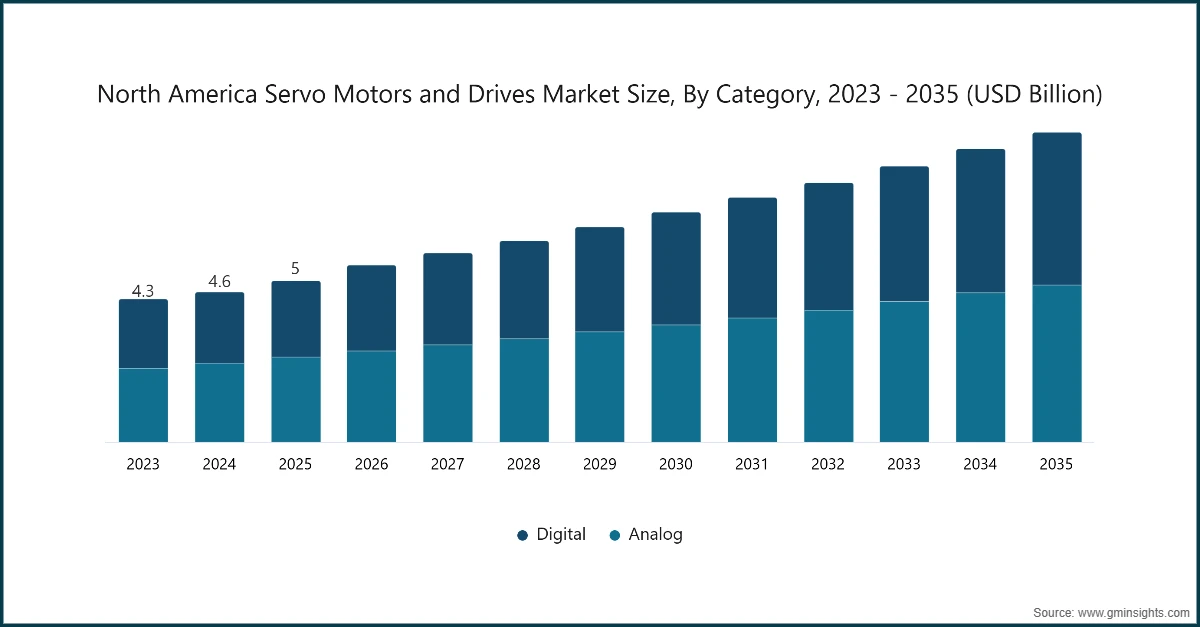
According to a recent study by Global Market Insights Inc., the North America servo motors and drives market was valued at USD 5 billion in 2025 and is estimated to grow from USD 5.3 billion in 2026 to USD 9.4 billion by 2035, at a CAGR of 6.5%.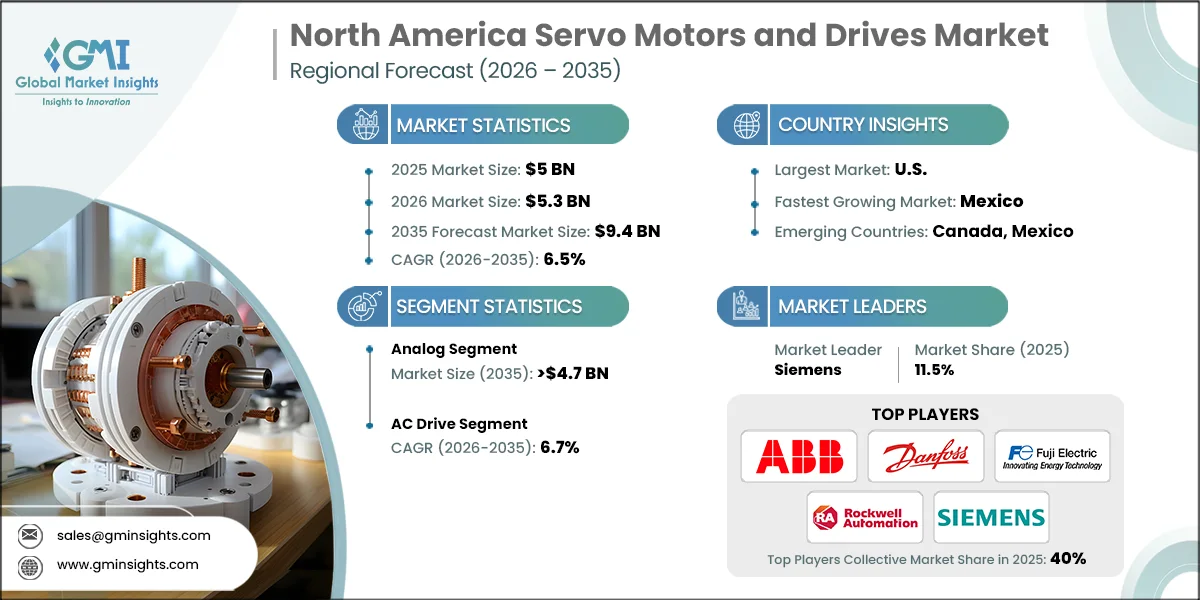
To get key market trends
North America Servo Motors and Drives Market Trends
North America servo motors and drives industry is undergoing substantial restructuring attributed to the ongoing technological advancements, the advent of industrial automation, and growing demand for energy efficient solutions. In addition, continuous technological innovations in servo systems to permit finer control over position, speed, and torque will favor the industry landscape. For example, ECM PCB Stator Tech launched its compact & innovative servo motor series in May 2025, which is designed with an integrated harmonic drive. The product range is mainly produced to cater to ultra-compact applications such as aerospace, robotics, automation, and medical to overcome weight sensitivity and space constraints.
North America Servo Motors and Drives Market Analysis
Learn more about the key segments shaping this market
Learn more about the key segments shaping this market
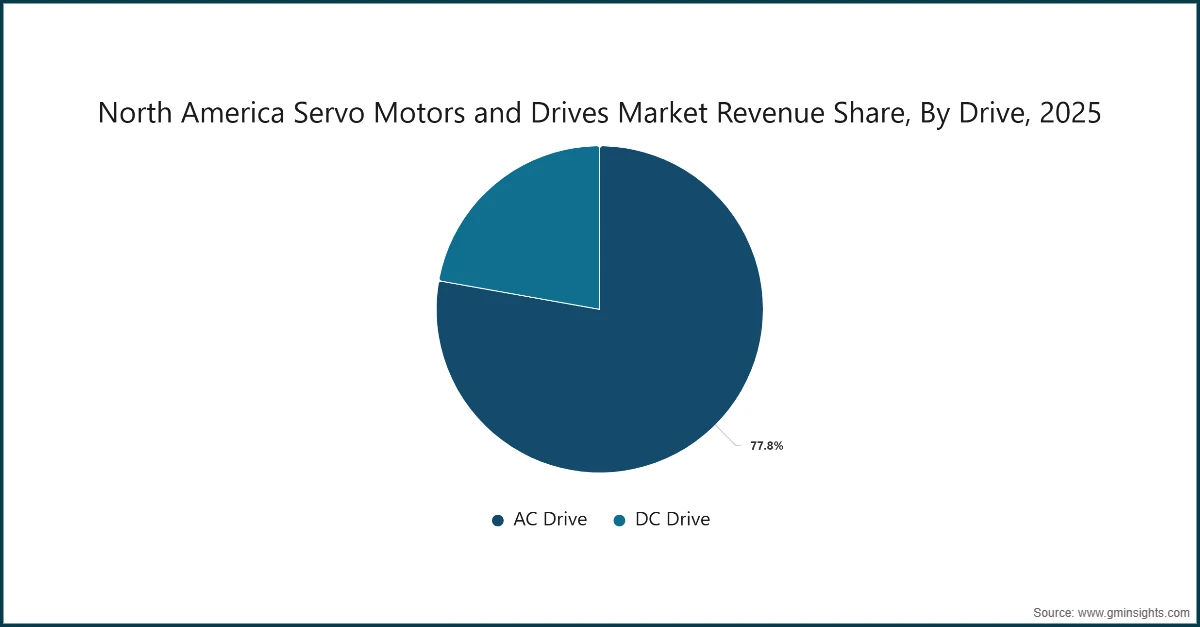
The North America servo motors and drives market from AC drive segment is set to a witness of CAGR of 6.7% by 2035, due to improved operational features that enable effective handling of high current surges, increased torque, high operating speeds, and reduced noise. In addition, ongoing advancements in motor technology along with supportive regulatory policies focused on enhancing operational efficiencies will favor the industry dynamics. Moreover, the regional AC servo motors and drives industry growth is further fueled by increasing demand for high-performance automation solutions across various industries to enhance the operational efficiency innovative products.
Based on application, the electronics and metal cutting & forming verticals have experienced considerable adoption of servo motors & drives to enable coordinated motion and dynamic load adjustments. These products are widely used to meet the demands for precision, speed, and connectivity required across different sized electronics. Equipment OEMs are increasingly designing compact, high-torque-density servo solutions that fit within space-constrained electronics machinery while improving energy efficiency and thermal management.
Looking for region specific data?
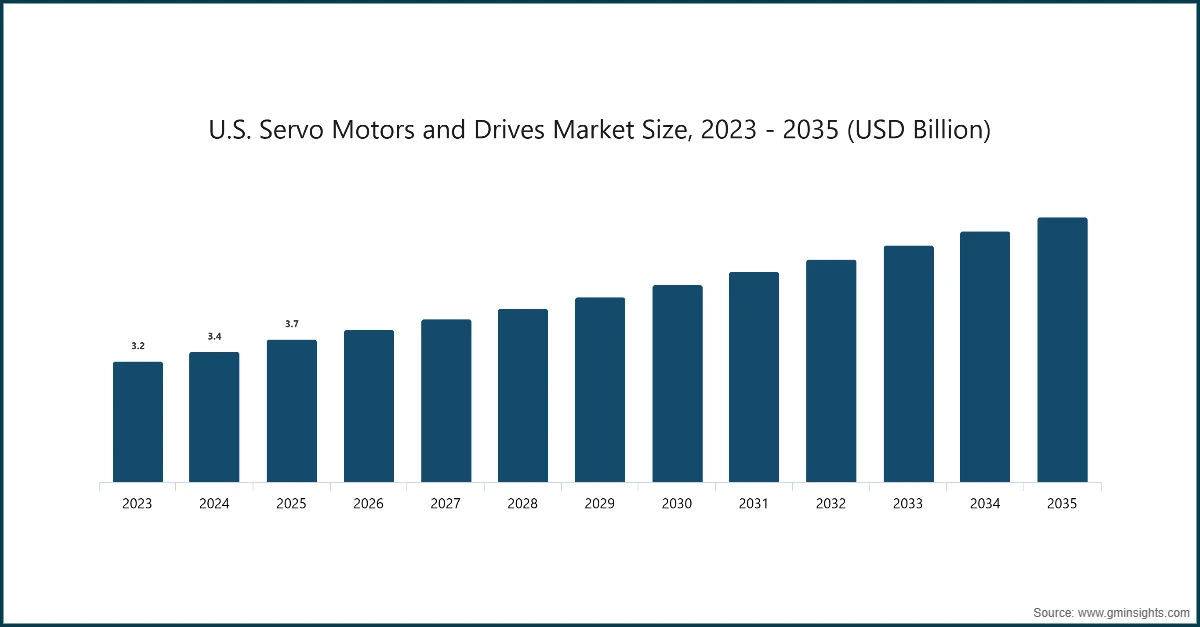
The U.S. servo motors and drives market was valued at USD 3.7 billion in 2025 accounting for above 74% of the regional market size. The national market size is stimulated by a wide range of parameters including advancements in automation, adoption of smart manufacturing practices, and growing emphasis on energy efficiency & sustainability.
Moreover, ongoing resurgence in consumer demand for various goods coupled with growing need to stimulate production in key industries and boost output will favor the product deployment. For example, the U.S. Federal Reserve System reported in September 2024 that the total industrial production index rose by 0.8 percentage points in August, reaching 103.1 from baseline 2017 levels. Additionally, servo motors and drives are being adopted by a variety of verticals due to federal and state-level initiatives that support energy efficiency and the automation of industrial processes.
North America Servo Motors and Drives Market Share
The servo motors and drives industry is characterized by a diverse range of manufacturers operating at various scales. The top 5 companies in the market, including Siemens, ABB, Danfoss, Fuji Electric, and Rockwell Automation, are implementing different strategies to enhance their market position. Moreover, in order to cope with the challenges of industrial operations using innovative solutions, local companies are expanding their product portfolios and initiating new organic and inorganic growth initiatives.
North America Servo Motors and Drives Market Companies
Some of the key players operating across the North America servo motors and drives industry includes:
ABB
Advanced Motion Controls
Allied Motion
Allient
Baumuller
Bosch Rexroth
Danfoss
Delta Electronics
E-Circuit Motors
Festo
Fuji Electric
Hitachi
Ingenia Cat
KEB Automation
Kollmorgen
Mitsubishi Electric
Nidec
Panasonic
Rockwell Automation
Schneider Electric
Siemens
Yaskawa Electric
North America Servo Motors and Drives Market Report Attributes
| Key Takeaway | Details |
|---|---|
| Market Size & Growth | |
| Base Year | 2025 |
| Market Size in 2025 | USD 5 Billion |
| Market Size in 2026 | USD 5.3 Billion |
| Forecast Period 2026-2035 CAGR | 6.5% |
| Market Size in 2035 | USD 9.4 Billion |
| Key Market Trends | |
| Drivers | Impact |
| Stringent energy efficient standards by respective governments | The industry is significantly shaped by the introduction of stern building energy performance directives mandating reduced energy consumption and higher performance across various equipment. Regulatory authorities are pushing manufacturers and end-users to adopt advanced, energy-efficient servo solutions thereby propelling product demand. |
| Mounting investment across industrial operations coupled with flourishing automation initiatives | Various manufacturing companies are growing their capital allocation to support modernized manufacturing facilities while integrating robotics and advanced motion control solutions catering to industry expansion. Moreover, the increasing emphasis on Industry 4.0 with industrial IoT platforms, real-time monitoring systems, and predictive maintenance tools will further proliferate the industry size. |
| Rapid upsurge across energy-intensive industrial operations | Numerous energy-intensive industrial sectors including oil & gas, mining, metals & materials, and heavy manufacturing, among others, are scaling up their production capacities to serve escalating demand, leading to an increased deployment of effective motion control systems. |
| Pitfalls & Challenges | Impact |
| Significant upfront cost | The presence of other drive technologies coupled with the high upfront cost of advanced servo systems, may deter the product adoption. Moreover, innovative servo systems may require compatible ancillary equipment including motion controllers, sensors, communication modules, and software platforms, leading to comparatively higher costs. |
| Opportunities: | Impact |
| Integration with AI-enabled motion control platforms | The incorporation of artificial intelligence and machine learning into servo drive systems enables adaptive control, self-calibration, and real-time performance optimization. This advancement enhances operational intelligence, improves process consistency, and positions vendors to capture emerging demand for autonomous manufacturing solutions. |
| Growth in renewable energy and electrification applications | Increasing investments in renewable energy infrastructure, battery manufacturing, and electrified transportation systems create new deployment avenues for precision servo technologies. These verticals require advanced motion control for assembly, positioning, and material handling, expanding the industry landscape. |
| Adoption of compact and modular servo designs | Rising demand for space-efficient and modular production systems presents opportunities for compact, high-torque servo solutions. Manufacturers offering flexible, scalable architectures can address evolving customer requirements in high-density production environments, thereby expanding their competitive positioning across diverse industrial segments. |
| Market Leaders (2025) | |
| Market Leader |
Market Share of: 11.5% |
| Top Players |
Collective Market Share of: 40% |
| Competitive Edge |
|
| Regional Insights | |
| Largest Market | U.S. |
| Fastest growing market | Mexico |
| Emerging countries | Canada, Mexico |
| Future outlook |
|
What are the growth opportunities in this market?
North America Servo Motors and Drives Industry News
In November 2025, the ACOPOS M4 introduces advanced motion control capabilities through a compact, scalable platform that enhances precision, efficiency, and overall machine performance. The integrated embedded system also provides predictive maintenance capabilities, which enable potential problems to be detected early on and ensure improved operational reliability.
Delta Line launched the IVI100 and IVI110 brushless DC servo motors with integrated motion controllers in October 2025. The IVI100 and IVI110 brushless DC servo motors are the result of the success of the previous models and come with enhanced power, reliability, and ease of installation. The products are designed for intralogistics and industrial applications and combine the motor and electronics for easy installation and maintenance.
Allient Rochester launched the newly developed Pyxmos servo drive in October 2025. This new product provides OEMs with a compact and high-performance platform that simplifies the integration of advanced motion. Its fast control loops, intelligence, and configuration abilities make system development easier and faster for complex industrial applications. The product is suitable for robotics and precision machines and improves the speed, flexibility, and efficiency of the Allient Intelligent Controls portfolio.
In September 2024, Smart Motor Devices announced the extension of its product line to industrial AC servomotors and drives. The product line extension improves the company's offerings and provides customers with innovative motion control solutions for precision, reliability, and efficiency in industrial applications. The new AC servomotors and drives are designed to address the increasing need for high-performance automation solutions in various industries.
North America servo motors and drives market research report includes in-depth coverage of the industry with estimates & forecast in terms of “'USD Million” and “’000 Units” from 2022 to 2035 for the following segments:
Market, By Category
Digital
Analog
Market, By Drive
AC Drive
DC Drive
Market, By Application
Oil & gas
Metal cutting & forming
Material handling equipment
Packaging and labeling machinery
Robotics
Medical robotics
Rubber & plastics machinery
Warehousing
Automation
Extreme environment applications
Semiconductor machinery
AGV
Electronics
Others
The above information has been provided for the following countries:
U.S.
Canada
Mexico
Frequently Asked Question(FAQ) :
What was the market size of the North America servo motors and drives in 2025?
The market size was USD 5 billion in 2025, with a CAGR of 6.5% expected through 2035. The growth is driven by the adoption of energy-efficient devices and advancements in manufacturing and processing technologies.
What is the projected value of the North America servo motors and drives market by 2035?
The market is poised to reach USD 9.4 billion by 2035, supported by technological innovations and increasing demand for automation solutions.
What is the expected size of the North America servo motors and drives industry in 2026?
The market size is projected to reach USD 5.3 billion in 2026.
What is the growth outlook for the AC drive segment by 2035?
The AC drive segment is expected to grow at a CAGR of 6.7% by 2035, led by features like high torque, reduced noise, and advancements in motor technology.
What was the valuation of the analog segment in 2025?
The analog segment is projected to exceed USD 4.7 billion by 2035, propelled by the adoption of advanced systems with improved control capabilities.
What was the market size of the U.S. servo motors and drives sector in 2025?
The U.S. market was valued at USD 3.7 billion in 2025, accounting for over 74% of the regional market size.
What are the upcoming trends in the North America servo motors and drives market?
Trends include compact servo motor designs, integrated harmonic drives, advancements in automation, and increasing adoption of energy-efficient technologies.
Who are the key players in the North America servo motors and drives industry?
Key players include ABB, Advanced Motion Controls, Allied Motion, Allient, Baumuller, Bosch Rexroth, Danfoss, Delta Electronics, E-Circuit Motors, Festo, and Fuji Electric.
North America Servo Motors and Drives Market Scope
Related Reports