Summary
Table of Content

North America Range Hood Market
Get a free sample of this report
Form submitted successfully!
Error submitting form. Please try again.
Thank you!
Your inquiry has been received. Our team will reach out to you with the required details via email. To ensure that you don't miss their response, kindly remember to check your spam folder as well!
Request Sectional Data
Thank you!
Your inquiry has been received. Our team will reach out to you with the required details via email. To ensure that you don't miss their response, kindly remember to check your spam folder as well!
Form submitted successfully!
Error submitting form. Please try again.
North America Range Hood Market Size
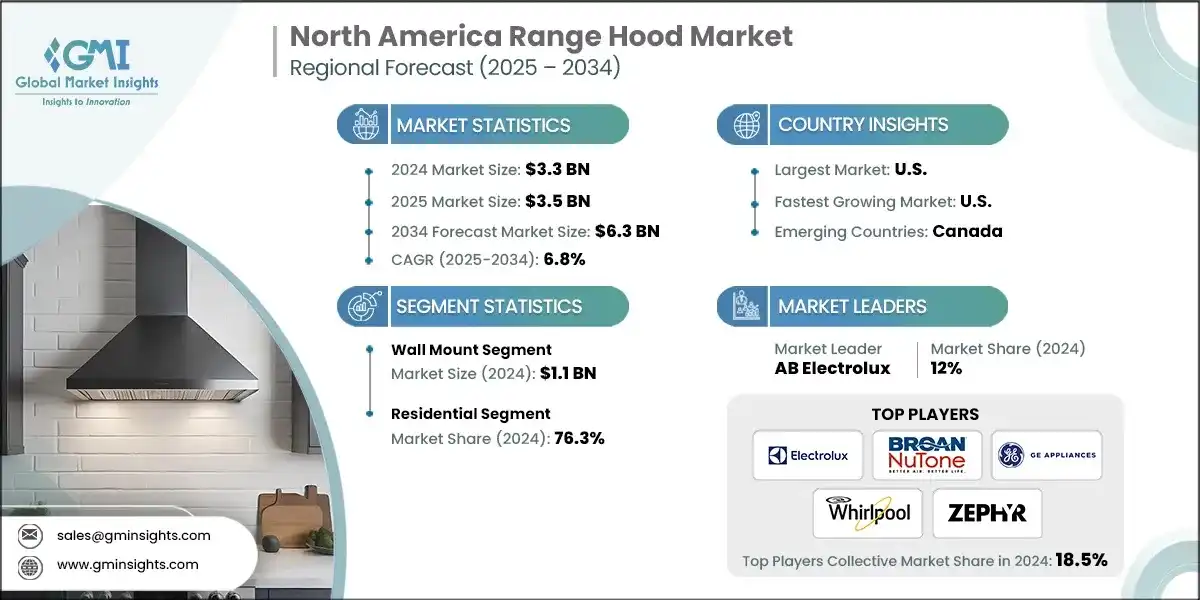
The North America range hood market size was estimated at USD 3.3 billion in 2024. The market is expected to grow from USD 3.5 billion in 2025 to USD 6.3 billion in 2034, at a CAGR of 6.8%, according to the latest report published by Global Market Insights Inc.
North America Range Hood Market Key Takeaways
Market Size & Growth
- 2024 Market Size: USD 3.3 Billion
- 2025 Market Size: USD 3.5 Billion
- 2034 Forecast Market Size: USD 6.3 Billion
- CAGR (2025–2034): 6.8%
Key Market Drivers
- Rising urbanization and housing trends.
- Increasing demand for energy-efficient kitchen appliances.
- Growth of home cooking.
Challenges
- High initial cost of range hoods.
- Limited consumer awareness in small countries.
Opportunity
- Rising demand for sustainability.
- Technological advancements in AI.
Key Players
- Market Leader: AB Electrolux led with over 12% market share in 2024.
- Leading Players: Top 5 players in this market include AB Electrolux, Broan-NuTone, LLC, GE Appliances, Whirlpool, Zephyr Ventilation, which collectively held a market share of 18.5% in 2024.
Get Market Insights & Growth Opportunities
In 2024, the U.S. Census Bureau published data reflecting 1.4 million housing starts, primarily led by urban and suburban developments. The popularity of new homes with modern kitchens, such as nice islands, is supporting the demand for related integrated ventilation solutions. Broan-NuTone partners with builders to provide hoods for multi-family buildings, while GE Appliances concentrates on smart ventilation technologies. Manufacturers are targeting residential construction with builder-grade solutions as well as premium options, which is fostering growth in the North American range hood market.
The U.S. Department of Housing and Urban Development (HUD) reported an 8% increase in multi-family housing permits in 2025 due to rental demand and urban densification, which is attributable to builders releasing these multi-family products. These units require compact and effective ventilation systems to minimize and maximize the space. Both Broan-NuTone's ERV systems and under-cabinet hoods, for example, include dedicated ventilation options and fill a key space efficiency need. Multi-family developments are an important driver for the North American range hood market.
In 2024, the U.S. Department of Commerce reported that appliance sales improved to 14% year-over-year, primarily to the convenience of a larger breadth of product and product availability. Additionally, a key strategy leveraged by Whirlpool includes direct-to-consumer channels that have introduced premium hoods that were supplemented with virtual kitchen design tools. Manufacturers investing in visualization processes based on augmented reality technologies and other online customizations are now positioned to reach the new digital shopper and find growth potential in the North American range hood market.
Federal programs under the Inflation Reduction Act provide rebates for energy-efficient home upgrades, including ventilation systems. These incentives encourage homeowners to replace outdated hoods with compliant models. Electrolux promotes Energy Star-certified hoods as part of eco-friendly kitchen packages, aligning with sustainability trends and driving the North American range hood market.
Further, the USDA reported that home-prepared meals accounted for 54% of food spending in 2024, up from 48% pre-pandemic. This rise in cooking frequency has heightened the need for effective ventilation to manage smoke and odors. Vent-A-Hood addresses this demand with high-CFM island hoods for open kitchens. Positioning range hoods as essential for healthy indoor air quality is a significant growth driver for the North American market.
To get key market trends
North America Range Hood Market Trends
The North American range hood market is evolving, driven by consumer demand for smart, energy-efficient, and aesthetically pleasing appliances.
The North American market for range hoods is experiencing a growth in smart and connected devices as a result of the IoT and smart home technologies. Smart appliance penetration in households is expected to reach 18% by 2025 and 37% by 2029. Consumers prefer features such as automatic airflow adjustments, Wi-Fi, and voice control. GE Appliances is committing USD3 billion in U.S. manufacturing capacity because of demand for cooking and ventilation systems. Broan-NuTone recently marketed ERV systems to improve smart kitchen ventilation.
Energy efficiency is still an important trend in the North American range hood market, driven in part by DOE standards and Energy Star efforts to reduce energy consumption and utility costs. These devices are highlighted by the use of LED lighting, advanced filtration systems and low-noise motors. For example, Broan-NuTone’s Glacier Series hoods and GE’s premium range hoods offer energy-efficient LED task lighting and multi-speed fans and can meet relevant regulations at the federal level.
The trend for modern kitchen renovations is shifting the demand for range hood design towards sleek and low-profile products, within the North American market. In addition, NAHB is projecting that kitchen and bath spending will reach USD 235 billion in 2025. Encouraging premium brands including Bertazzoni and Faber to offer a new minimalist style equipped with matte black and brushed brass finishes coupled with luxury kitchens.
Indoor air quality regulations are impacting the North American range hood market. The U.S. EPA and ASHRAE Standard 62.2 provide guidelines on minimum ventilation rates to limit exposure to cooking-related pollutants. This has increased the prevalence of high-CFM ducted hoods and upgraded filtration systems. Companies like Broan-NuTone and Vent-A-Hood provide units that boast advanced capture efficiency with heat sensors adjusting speeds automatically.
Sustainability remains a trend in the North American range hood market in response to global energy-efficiency initiatives, and programs provided by the U.S. DOE. The IEA is estimating that by 2030, energy-efficient (and often smart) appliances will represent 40% of income appliances in use. Leading manufacturers such as Whirlpool and Electrolux are sourcing recyclable materials and promoting Energy Star-approved models to support consumer demand for sustainable solutions.
North America Range Hood Market Analysis
Learn more about the key segments shaping this market
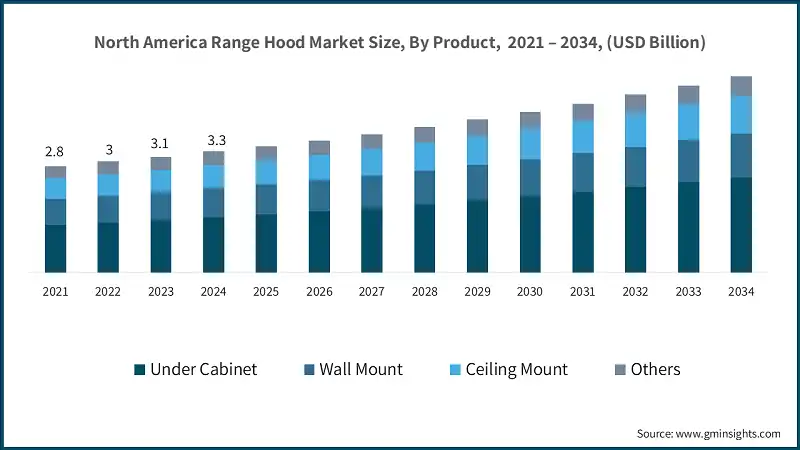
Based on product, the market is segmented under cabinet, wall mount, ceiling mount and others. The wall mount segment held the dominant market share, generating a revenue of USD 1.1 billion in 2024.
Wall-mounted range hoods are experiencing significant growth in the U.S. range hood market due to their practicality and alignment with modern kitchen designs. According to the U.S. Energy Information Administration (EIA), over 80% of American households are adopting energy-efficient appliances by 2025, driving demand for advanced range hoods. Their ability to save space while providing effective ventilation makes them a preferred choice, particularly in urban homes with open kitchen layouts.
- These range hoods are particularly favored for their efficiency in removing smoke, grease, and odors, especially in compact kitchens. For instance, Broan-NuTone’s wall-mounted hoods feature advanced filtration systems that ensure cleaner air circulation. Additionally, the growing trend of smaller living spaces in metropolitan areas has further fueled the adoption of these hoods, as they cater to both functionality and aesthetics.
- Manufacturers are also integrating smart technologies to enhance user convenience. Zephyr, for example, offers wall-mounted range hoods equipped with smart connectivity, allowing users to control ventilation settings via mobile apps. This aligns with the increasing consumer preference for smart home appliances, as highlighted by the Consumer Technology Association, which projects a 15% annual growth in smart kitchen appliances by 2025.
- Furthermore, the emphasis on energy efficiency has led to innovations such as LED lighting and low-noise motors in wall-mounted range hoods. Companies like Whirlpool have introduced models with energy-saving features, appealing to environmentally conscious consumers. These advancements, coupled with government incentives for energy-efficient appliances, are expected to sustain the growth of wall-mounted range hoods in the market.
Learn more about the key segments shaping this market
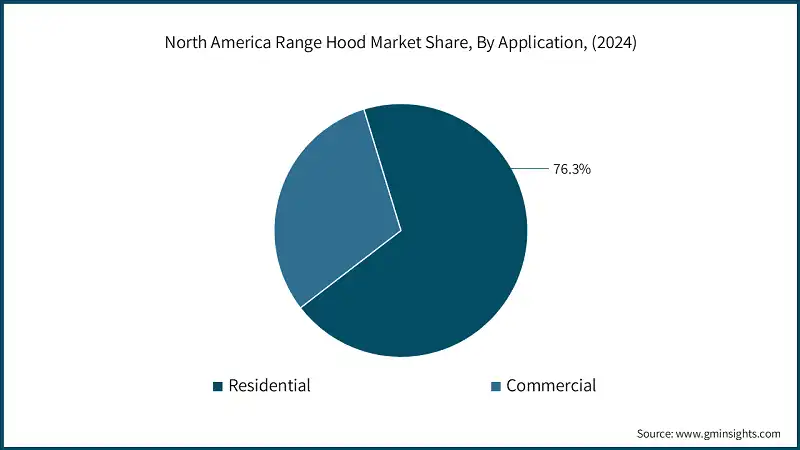
Based on application, the range hood market is classified into residential and commercial. The residential segment dominated the market in 2024, with a share of around 76.3% of the total market share and is expected to grow at a CAGR of 6.9% in the forecast timeframe.
- The residential range hood market in North America is outpacing the commercial segment due to government initiatives and regulations promoting energy efficiency. According to the U.S. Department of Energy, residential energy consumption is projected to decrease by 15% by 2025 due to the adoption of energy-efficient appliances, including range hoods. The ENERGY STAR program has been a key driver, with certified range hoods reducing energy use by up to 70%. This has encouraged manufacturers like GE Appliances and Panasonic to expand their portfolios of energy-efficient models.
- Data from the National Association of Home Builders (NAHB) indicates that kitchen remodelling projects in the U.S. increased by 20% in 2023 and are expected to grow further by 2025. This trend is driving demand for modern, aesthetically pleasing range hoods in residential spaces. Manufacturers such as Elica and BSH are leveraging this opportunity by introducing innovative designs and quieter models that align with open-concept kitchen layouts, which are increasingly popular among homeowners.
- The focus on indoor air quality has also contributed to the residential market's growth. According to the Environmental Protection Agency (EPA), poor indoor air quality affects nearly 30% of U.S. households, prompting homeowners to invest in high-performance ventilation solutions. Fotile and Samsung Electronics have responded by developing range hoods with advanced filtration systems and sensor-based technologies, which are expected to see increased adoption by 2025 as health-conscious consumers prioritize air quality improvements.
- Further according to U.S. Bureau of Economic Analysis (BEA) - consumer spending on household appliances for household appliances reached USD 99.6 billion in 2024 continues to rise in 2025, thus it is expected to grow further boosting the residential range hood market. Brands like Viking Range and KitchenAid are capitalizing on this trend by offering customizable, high-performance range hoods that cater to affluent consumers. These factors, combined with government incentives and evolving consumer preferences, are expected to sustain the residential segment's dominance over the commercial market in the coming years.
Looking for region specific data?
U.S. Range Hood Market
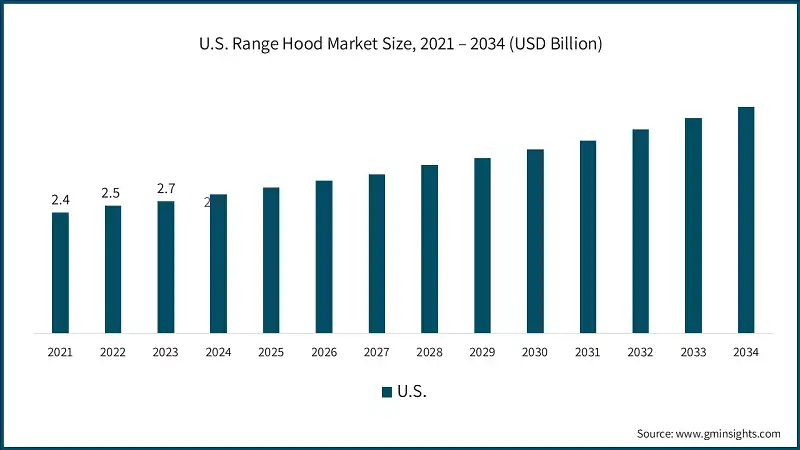
In 2024, the U.S contributed significantly to the range hood market growth in North America, accounting for 85.7% share in the region.
- According to a 2025 report by the Environmental Protection Agency (EPA), 35% of U.S. households are expected to invest in advanced ventilation solutions, such as range hoods, to mitigate health risks associated with cooking emissions and improve overall air quality. Additionally, the U.S. market is expected to grow due to increasing urbanization, rising disposable incomes, and the adoption of smart kitchen technologies. The growing trend of modular kitchens and the integration of IoT-enabled appliances are also contributing to the expansion of the range hood market..
- The rising awareness of indoor air quality and the health risks associated with cooking emissions has significantly boosted the demand for effective ventilation solutions. These systems not only eliminate smoke, odors, and airborne pollutants but also contribute to creating a healthier and more comfortable indoor environment. Additionally, advancements in technology and design have made modern ventilation systems more efficient and visually appealing, further driving their adoption in home renovations.
Canada Range Hood Market
Canada range hood market in 2024 and is expected to grow at 6.7% during the forecast period.
- The market is driven by increasing urbanization and rising consumer demand for modern kitchen appliances. The growing trend of modular kitchens and heightened awareness of indoor air quality are also contributing to market expansion. Additionally, advancements in technology, such as energy-efficient and smart range hoods, are further fueling growth during the forecast period.
North America Range Hood Market Share
The top companies in the North America market include AB Electrolux, Broan-NuTone, GE Appliances, Whirlpool and Zephyr Ventilation and collectively hold a share of 18.5% in the market. These prominent players are proactively involved in strategic endeavors, such as mergers & acquisitions, facility expansions & collaborations, to expand their product portfolios, extend their reach to a broad customer base, and strengthen their market position
Electrolux brings Scandinavian design and advanced airflow technology to the range hood segment, focusing on energy efficiency and quiet operation. Its systems integrate smart sensors for automatic ventilation control, enhancing indoor air quality while reducing power consumption. With modular designs and premium finishes, Electrolux caters to consumers seeking both performance and aesthetics in modern kitchens.
Broan-NuTone is a leading innovator in residential ventilation, offering range hoods that combine powerful extraction with ultra-quiet performance. Leveraging IoT connectivity and advanced filtration systems, Broan-NuTone ensures healthier living environments. Its versatile product portfolio supports quick installation and customization, making it a preferred choice for builders and homeowners prioritizing reliability and smart home integration.
GE Appliances delivers range hoods engineered for precision airflow and seamless kitchen integration. Featuring smart connectivity and adaptive speed control, GE enhances user convenience while optimizing energy use. Its designs emphasize durability and contemporary styling, positioning GE as a trusted brand for consumers seeking high-performance ventilation solutions backed by strong service networks.
North America Range Hood Market Companies
Major players operating in the North America’s market include:
- Air King
- Bertazzoni
- Broan-NuTone
- BSH Home Appliances
- Electrolux
- Faber
- Frigidaire
- GE Appliances
- KOBE Range Hoods
- LG Electronics
- Samsung Electronics
- Vent-A-Hood
- Whirlpool
- Whynter
- Zephyr Ventilation
Whirlpool combines robust engineering with intuitive features in its range hood offerings, ensuring superior grease and odor removal. With advanced noise-reduction technology and energy-efficient motors, Whirlpool products deliver comfort and sustainability. The brand’s commitment to smart home compatibility and sleek design makes it a go-to choice for households focused on functionality and modern aesthetics.
Zephyr redefines premium ventilation with cutting-edge range hoods that blend artistic design and high-performance technology. Known for whisper-quiet operation and energy-efficient airflow systems, Zephyr integrates smart controls and air quality monitoring for an elevated cooking experience. Its focus on customization and luxury finishes positions Zephyr as a leader in the high-end kitchen segment.
North America Range Hood Market Report Attributes
| Key Takeaway | Details |
|---|---|
| Market Size & Growth | |
| Base Year | 2024 |
| Market Size in 2024 | USD 3.3 Billion |
| Market Size in 2025 | USD 3.5 Billion |
| Forecast Period 2025 - 2034 CAGR | 6.8% |
| Market Size in 2034 | USD 6.3 Billion |
| Key Market Trends | |
| Drivers | Impact |
| Rising urbanization and housing trends | Urban growth and increasing residential construction are fueling demand for modern kitchens, where range hoods are considered essential for ventilation and aesthetics. This trend is particularly strong in metropolitan areas with high-rise apartments and premium housing projects. |
| Increasing demand for energy-efficient kitchen appliances | Consumers are prioritizing appliances that reduce energy consumption and comply with sustainability standards. Energy-efficient range hoods are gaining traction due to regulatory support and rising electricity costs, making them a preferred choice in North America. |
| Growth of home cooking | The surge in home cooking, driven by health-conscious lifestyles and remote work culture, is boosting the need for effective kitchen ventilation. Range hoods are increasingly viewed as a necessity to maintain indoor air quality and comfort during frequent cooking. |
| Pitfalls & Challenges | Impact |
| High initial cost of range hoods | Premium range hoods with advanced features often come with high upfront costs, which can deter price-sensitive consumers. This challenge is more pronounced in mid-income households, limiting penetration in certain market segments. |
| Limited consumer awareness in small countries | In smaller North American markets, such as Caribbean nations, awareness about the benefits of range hoods remains low. This lack of education slows adoption, requiring targeted marketing and dealer outreach to bridge the knowledge gap. |
| Opportunities: | Impact |
| Rising demand for sustainability | Drives innovation in eco-friendly materials and energy-efficient designs, positioning brands to meet regulatory standards and appeal to environmentally conscious consumers. |
| Technological advancements in AI | Enhance device intelligence and automation, enabling smarter user interfaces, predictive maintenance, and personalized experiences that boost customer engagement and loyalty.. |
| Market Leaders (2024) | |
| Market Leaders |
12% market share |
| Top Players |
The collective market share in 2024 is 18.5% |
| Competitive Edge |
|
| Regional Insights | |
| Largest Market | U.S. |
| Fastest Growing Market | U.S. |
| Emerging Country | Canada |
| Future Outlook |
|
What are the growth opportunities in this market?
North America Range Hood Industry News
- In October 2025, Electrolux reported double-digit organic sales growth in North America during Q3 2025, driven by premium kitchen appliances, including ventilation solutions under the Frigidaire brand. The company emphasized energy efficiency and integrated design as part of its transformation strategy.
- In August 2025, GE Appliances announced a USD 3 billion U.S. manufacturing investment plan to expand production of ranges and ventilation systems. The initiative includes reshoring gas range production from Mexico to Georgia and modernizing plants for advanced automation and smart connectivity features.
- In April 2025, BSH announced market share gains in North America and expanded its Experience and Design Centers to strengthen premium appliance visibility. The strategy includes promoting high-end cooking and ventilation products under Bosch and Thermador brands, aligning with luxury kitchen trends.
- In February 2025, at the International Builders Show, Broan-NuTone showcased its Broan ONE Energy Recovery Ventilator (ERV), designed for multi-family ventilation projects. While primarily an ERV launch, the innovation reinforces Broan-NuTone’s leadership in indoor air quality and complements its range hood portfolio with advanced airflow and smart integration features.
- In August 2024, Zephyr released a series of range hoods featuring Airflow Control Technology and intuitive ICON Touch Controls. By focusing on advanced technologies, Zephyr aims to differentiate its products in the competitive North American market and attract consumers interested in innovative kitchen ventilation options.
The North America range hood market research report includes in-depth coverage of the industry, with estimates & forecast in terms of revenue (USD Billion) and volume (Thousand Units) from 2021 to 2034, for the following segments:
Market, By Product
- Under Cabinet
- Wall Mount
- Ceiling Mount
- Others
Market, By Application
- Residential
- Commercial
- Restaurant
- Hotel
- Café
Market, By Distribution channel
- Direct Selling
- E-Commerce
- Others
The above information is provided for the following region and countries:
- North America
- U.S.
- Canada
Frequently Asked Question(FAQ) :
What is the market size of the North America range hood market in 2024?
The North America range hood industry was valued at USD 3.3 billion in 2024, driven by rising housing construction, modern kitchen adoption, and increased awareness of indoor air quality.
What is the projected value of the North America range hood market by 2034?
The market is expected to reach USD 6.3 billion by 2034, growing at a CAGR of 6.8%, supported by smart home adoption, energy-efficiency incentives, and premium kitchen renovations.
What is the market valuation for 2025?
The market is projected to reach USD 3.5 billion in 2025, driven by robust construction activity, strong appliance sales, and growing demand for energy-efficient ventilation solutions.
Which application segment dominated the range hood market in 2024?
The residential segment dominated with 76.3% market share in 2024, fueled by kitchen remodeling trends, ENERGY STAR adoption, and rising indoor air quality concerns.
Which product segment led the North America range hood market in 2024?
The wall-mounted range hood segment led the market with USD 1.1 billion in 2024, supported by modern kitchen renovations, compact home layouts, and growing preference for smart, energy-efficient ventilation.
Which region leads the North America range hood industry?
The U.S. leads the North American market, accounting for 85.7% of the regional share in 2024, driven by high appliance spending, urban housing growth, and strong demand for smart ventilation solutions.
Who are the leading companies in the North America range hood market?
Major players include AB Electrolux, Broan-NuTone, GE Appliances, Whirlpool, and Zephyr Ventilation, collectively holding 18.5% market share in 2024.
North America Range Hood Market Scope
Related Reports