Summary
Table of Content

North America Die Cutting Machine Market
Get a free sample of this report
Form submitted successfully!
Error submitting form. Please try again.
Thank you!
Your inquiry has been received. Our team will reach out to you with the required details via email. To ensure that you don't miss their response, kindly remember to check your spam folder as well!
Request Sectional Data
Thank you!
Your inquiry has been received. Our team will reach out to you with the required details via email. To ensure that you don't miss their response, kindly remember to check your spam folder as well!
Form submitted successfully!
Error submitting form. Please try again.
North America Die Cutting Machine Market Size
The North American market for die-cutting machines is in an era of fundamental evolution as manufacturers have started to seek out machines that provide cleanly and precisely cut edges while maintaining production flexibility across multiple industries such as packaging, print, crafts, electronic, and automotive and that can process a wide variety of materials without interrupting production as much. Therefore, both manual and digital die cutting machines are taking the forefront and are appealing to different kinds of customers. Manufacturers of traditional die cutting machinery have an established reputation of providing well-built equipment, while newer manufacturers, who provide machine designs that are easier to use with much less set-up time, are beginning to attract potential new customers.
North America Die Cutting Machine Market Key Takeaways
Market Size & Growth
- 2025 Market Size: USD 486.4 Million
- 2026 Market Size: USD 505.6 Million
- 2035 Forecast Market Size: USD 781.1 Million
- CAGR (2026–2035): 5%
Regional Dominance
- Largest Market: U.S.
- Fastest Growing Country: U.S.
Key Market Drivers
- Growing Demand for Precision in Packaging and Printing.
- Automation and Technological Advancements.
- Expansion of E-Commerce and Customization Trends.
Challenges
- High Initial Investment and Maintenance Costs.
- Skill Gap and Operational Complexity.
Opportunity
- Adoption of Digital Die Cutting for Short Runs.
- Sustainability and Eco-Friendly Materials.
Key Players
- Market Leader: BOBST Group led with over 16% market share in 2025.
- Leading Players: Top 5 players in this market include BOBST Group, Heidelberger Druckmaschinen, Koenig & Bauer, Esko/Kongsberg, Masterwork Machinery, which collectively held a market share of 51% in 2025.
Get Market Insights & Growth Opportunities
One of the main drivers for die cutting machine manufacturers is the continued trend toward customization and short-run production. In terms of customization, brands desire innovative packaging that sets them apart from their competitors; meanwhile, smaller businesses are looking for machine solutions that will allow them to develop unique packaging without a complicated production process. Consequently, manufacturers now provide machine models with features such as easy-to-use controls, quiet operation and reduced material wastage; while at the same time, larger industries are switching to a more automated production equipment base to handle increased production demands and accelerated production schedules. In addition to trends toward customization and short-run production, sustainability has become a significant trend for die cutting machine customers. More customers are favoring the purchase of machines that support the use of recycled materials or use less energy, thus pushing manufacturers to rethink their design concepts and improve operational efficiencies.
The North America die cutting machine market was estimated at USD 486.4 million in 2025. The market is expected to grow from 505.6 million in 2026 to USD 781.1 million in 2035, at a CAGR 5% according to latest report published by Global Market Insights Inc.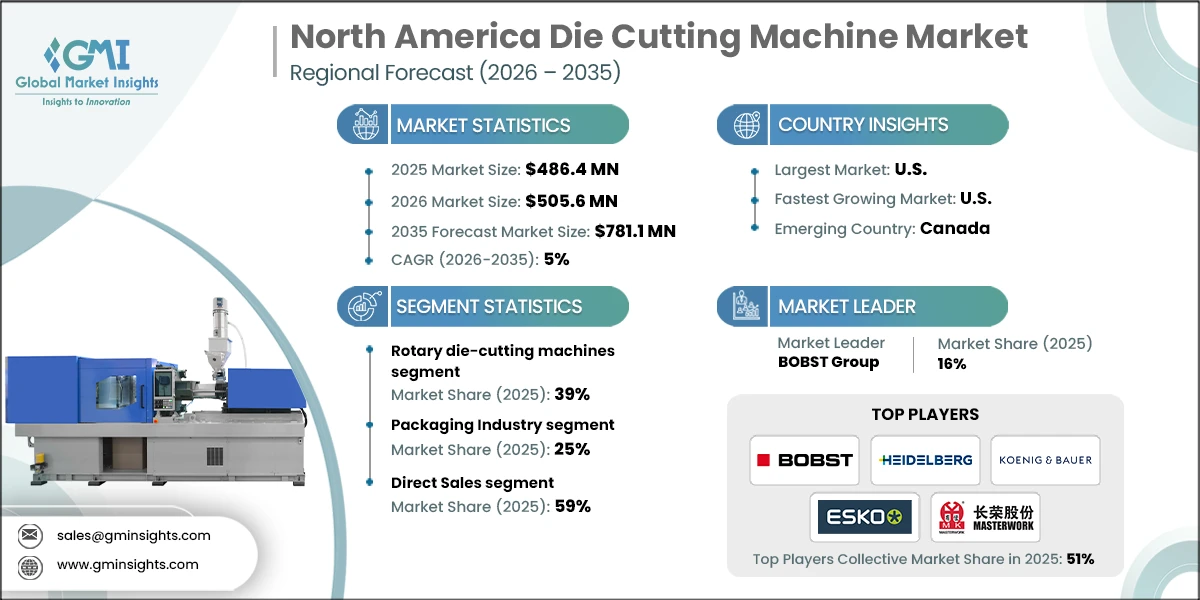
To get key market trends
North America Die Cutting Machine Market Trends
The North American die-cutting machines market is undergoing a significant transformation, shaped by technological advancements, evolving manufacturing landscapes, and strategic business imperatives. Key trends are dictating investment decisions and operational strategies for companies aiming to enhance efficiency, flexibility, and sustainability in their production processes.
- Automated solutions. As more retailers move their operations online, they need to provide packaging that is secure and can withstand the rigors of shipping. Additionally, as consumers demand more unique and individualized products, manufacturers are responding by designing products with greater focus on aesthetics, personalization, and functionality. Digitalization, automation, and sustainability initiatives are all key enablers of this growing market opportunity.
- Growth of the Packaging & Labeling Industries - Expansion of the Packaging & Labelling Markets is being driven primarily by E-commerce and the direct-to-consumer channels of marketing; as more companies rely on Amazon to ship their products from warehouses, it brings in an entirely new way of packaging their product.
- Along with increased use of social media to promote their brand and increase brand recognition, this will create new demand for die cutting machinery. In today's global marketplace, there is also increased need for product differentiation; product differentiation and the importance of eco-friendliness will drive the growth of this area in the coming years. Sustainability, as well as the desire for consumers to be eco-friendly, has made sustainable label production an essential ingredient in the manufacture of consumer goods, as well as packaging materials.
North America Die Cutting Machine Market Analysis
Learn more about the key segments shaping this market
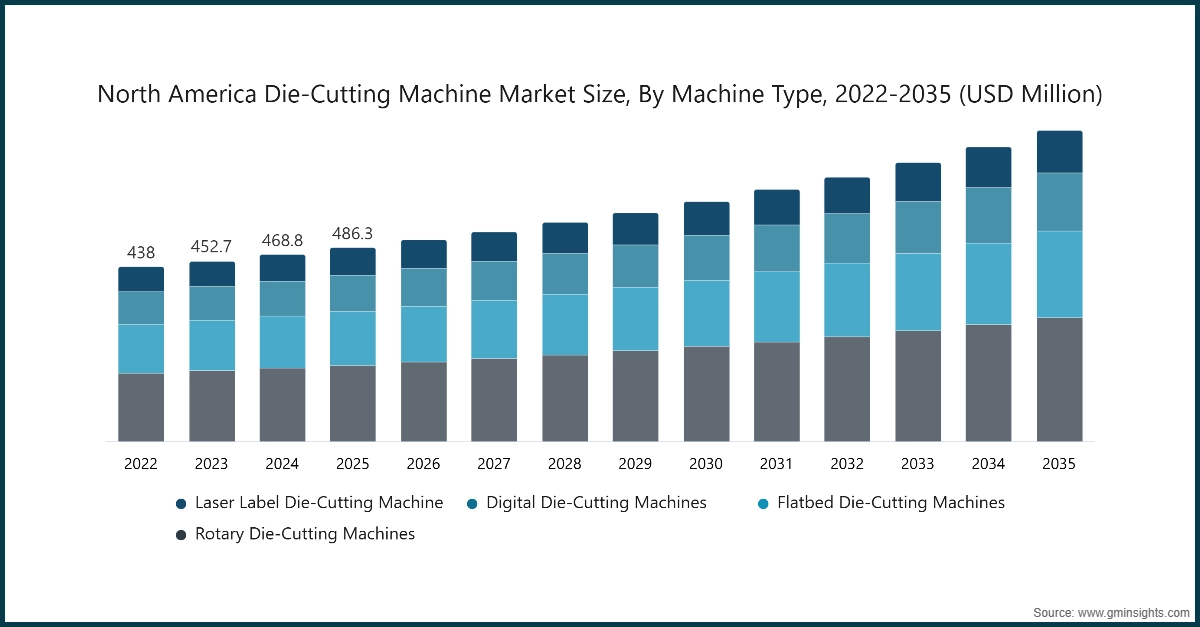
- The die-cutting market consists largely of two types of machines, in particular rotary die-cutting and flatbed die-cutting machines. Both types of machines meet different industrial converting demands, but both are necessary to ensure that various converting activities occur on an industrial scale.
- Rotary die-cutting machines are specifically designed for high-speed, high-volume production applications. These types of machines can process an entire host of different substrates to produce labels, packaging, tape, flexible materials and more at extremely high speed. They operate in a continuous motion manner, which provides excellent repeatability. As such, these machines are critical to the following industries: consumer packaged goods (CPG), automotive parts, electronics and medical consumables. Additionally, rotary die-cutting machines reduce cycle times, increase automation opportunities and can be integrated with printing, laminating and inspection systems to create large integrated production lines.
- Conversely, flatbed die-cutting machines provide cutting precision and cutting depth for applications that contain thick, rigid or complex materials. Flatbed die-cutting machines provide the highest level of accuracy when die-cutting such products as corrugated boxes, folding cartons, foam, gaskets and specialty materials.
- Flatbed die-cutting machines are ideal for short and medium production runs, custom packaging production runs and die-cutting very detailed designs or down to deep cutting depths. Together, rotary die-cutting and flatbed die-cutting machines dominate the die-cutting market by providing both mass manufacturing capabilities as well as specialized manufacturing capabilities for very high precision applications. As a result, they provide the foundation upon which die-cutting operations within the packaging, printing, automotive and industrial manufacturing sectors are built, and they effectively meet the changing and challenging demands of these industries.
Learn more about the key segments shaping this market
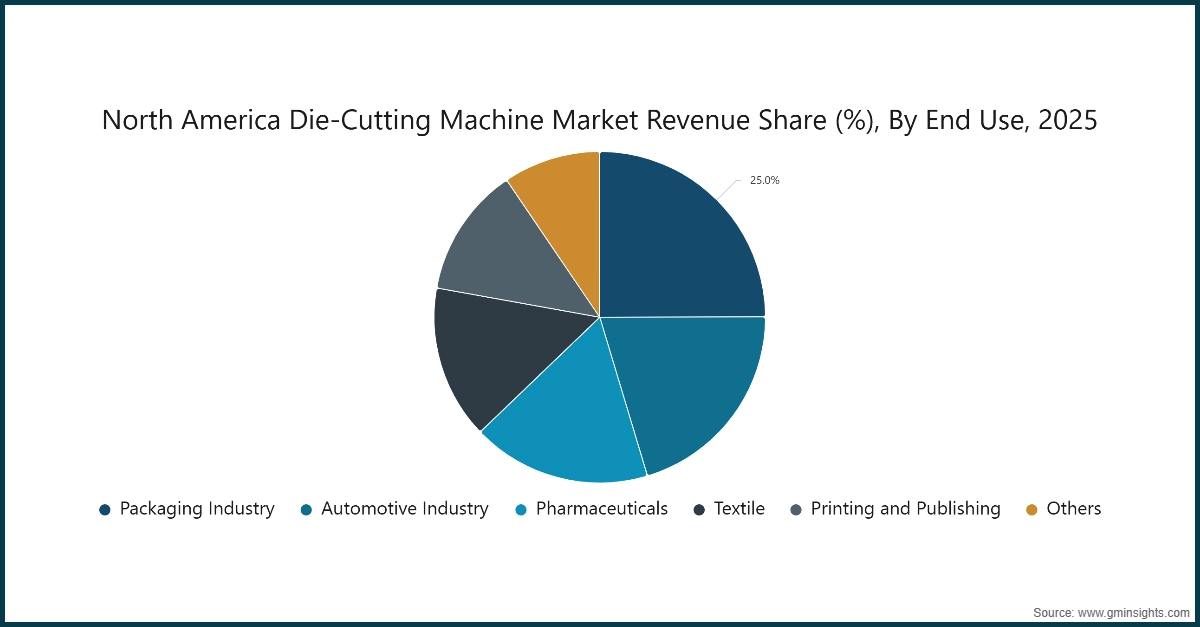
Based on the end use, the North America die cutting machine market is segmented into packaging industry, automotive industry, pharmaceuticals, textile, printing and publishing and others (electronics, etc.). In 2025, packaging industry held a major market share of 25%, generating a revenue of USD 121.5 million.
- The packaging industry, which is heavily influenced by an increasing demand for precisely cut materials to manufacture products like boxes, cartons, labels, and flexible packaging, continues to primarily drive this North American die-cutting machine market. With the continual growth of the e-commerce and consumer goods industries in this area, the demand for innovative packaging designs for enhancing consumer appeal has continued to grow. Because there is an increasing focus on sustainability, brands are transitioning into more eco-friendly packaging solutions.
- Due to the significant contribution of advanced die-cutting machines, more efficient material usage, and eliminating the waste associated with traditional/paper-based design methods, the packaging industry is now the fastest-growing segment in the North American die-cutting machine market due to the high-volume demand for custom packaging and environmental issues associated with packaging manufacturing.
- The automotive industry represents the second-largest segment in the North American die-cutting machine market. The need for highly accurate precision components (gaskets, seals, insulation, and interior trim) in North America’s automotive manufacturing continues to rise with the addition of lightweight materials and advanced automobile features.
- As the automotive industry develops more electric and smart car technologies, the need for automated die-cutting equipment to support new design specifications has increased significantly. Although the automotive industry does not have the application volume of the packaging industry, its global emphasis on precision, the variety of materials used, and the implementation of additional components in its products due to evolving consumer needs, has expanded the application of die-cutting equipment.
Based on the distribution channel, the North America die cutting machine market is segmented into direct sales and indirect sales. In 2025, direct sales held a major market share of 59% and grows with a CAGR of 4.5% from 2026 to 2035.
- The North American die-cutting machine market is growing rapidly as companies continue to use Direct Sales to reach their customers. Companies in this region are developing Direct Sales Relationships with customers, thereby creating closer business relationships and offering solutions tailored to their specific needs
- Most of the buyers of die-cutting machines (i.e., companies engaged in high-precision manufacturing such as package/automotive manufacturers) require extensive consultation and demonstration of the machine, along with support after purchase, due to technical sophistication and capital investment associated with die-cutting machines. By selling directly, manufacturers in North America have access to their customer's requirements, can customize their equipment/configurations, and ensure they have been properly installed and trained in how to operate them. This creates an environment of trust and loyalty to manufacturers since customers are purchasing directly from the manufacturer, thereby eliminating the need for distributors/retailers. This results in a more competitive pricing structure and quicker delivery to the customers within North America.
- The explosive growth of direct sales in North America is driven by the increased demand for advanced features (e.g., IOT connectivity, quick-changeover capabilities, energy efficiency) within die-cutting machinery. In many cases, customers are interested in the value associated with advanced features but require assistance in fully understanding the benefits associated with the advanced feature (due to the complexity of the equipment).
- Therefore, by maintaining an ongoing direct line of communication with customers (through regular updates and continuing assistance) manufacturers can demonstrate technological upgrades to customers and continue to assist the customer with obtaining upgrades or maintaining their die-cutting machines. Additionally, larger companies (enterprises and global brands) within North America prefer to purchase directly from the original equipment manufacturer (OEM).
Looking for region specific data?
North America Die Cutting Machine Market
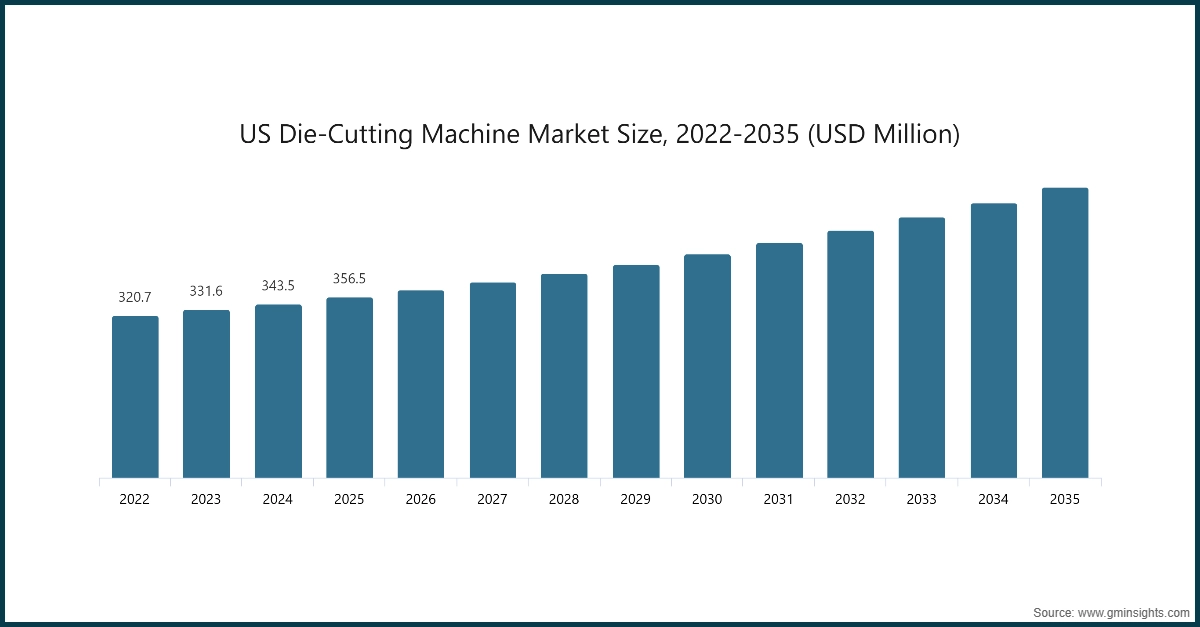
The U.S. dominated the North America die cutting machine industry, accounting for around 73% revenue share and generating around USD 356.5 million revenue in 2025.
- A strong manufacturing and packaging ecosystem has fueled the U.S. die-cut machine market through a focus on automation, scalability, and precision. Die-cutting technology is also critical to many other industries, including packaging and printing, automotive, and electronic, all which support and drive constant advances in die-cutting technologies and automation.
- U.S. manufacturers invest in systems that increase production speeds, decrease manual intervention, and provide support for the wide variety of advanced production materials, including medical devices and electrical insulation layers. Due to these aspirations for continuation of innovation, the U.S. has taken the lead in the adoption of digital and fully automated die-cutting systems. This rapid increase in digital and fully automated manufacturing reflects the overall technology-oriented and advancement-focused approach of the U.S. manufacturing sector.
- There are many small and medium manufacturing companies in the U.S. market, and the presence of so many of these companies also contributes to the market's adoption of versatile and economical die-cutting machinery. These manufacturers require die-cutting equipment to support high-mix, short-run production, which is becoming more prevalent in today's rapidly evolving global economy and the die-cutting industry globally.
- These factors also demonstrate that die-cutting manufacturers have an obligation to develop die-cutting systems that focus on operational efficiency, technological advancements, and the potential to integrate new and advanced cutting technologies into their manufacturing systems. In addition to being a leader of innovation for die-cutting systems, the U.S. die-cutting machinery market will continue to be a competitive and forward-thinking industry supplier for all of these industries while also meeting the evolving needs of manufacturers across multiple industries.
North America Die Cutting Machine Market Share
BOBST Group is leading with 16% market share. BOBST Group, Heidelberger Druckmaschinen, Koenig & Bauer, Esko/Kongsberg, Masterwork Machinery collectively hold around 51% indicating moderately fragmented market concentration. These prominent players are proactively involved in strategic endeavors, such as mergers & acquisitions, facility expansions & collaborations, to expand their product portfolios, extend their reach to a broad customer base, and strengthen their market position.
- BOBST is a global supplier of equipment and services for the packaging industry, including high-performance die-cutters, folder-gluers, and flexo presses. They hold a significant position in North America due to their robust, innovative technology and extensive service network, which supports diverse applications in folding cartons, corrugated boards, and flexible packaging, ensuring high production efficiency and reliability for converters.
- Heidelberg is a leading provider of comprehensive solutions for the print media industry, offering offset presses, digital printing machines, and postpress equipment, including precise die-cutting systems. Their strong, established installed base in commercial and packaging print across North America, coupled with a reputation for precision and reliability, ensures high customer loyalty and continued market penetration for their finishing solutions.
- Koenig & Bauer is the world's second-largest printing press manufacturer, providing a wide range of sheetfed and web offset presses, digital presses, and post press solutions, including advanced die-cutting machines. They are significant in North America for their robust, large-format die-cutting equipment catering to high-volume packaging and specialty print applications, supported by a dedicated sales and service infrastructure ensuring reliable operational uptime.
North America Die Cutting Machine Market Companies
Major players operating in the North America die cutting machine industry are:
- BOBST
- Heidelberger Druckmaschinen AG
- Koenig & Bauer AG
- Komori Corporation
- Duplo International
- Berhalter AG
- Hunkeler AG
- Winkler+Dünnebier GmbH
- Delta ModTech
- Preco, LLC
- Rollem USA
- Masterwork Machinery (MK)
- SANWA Co., Ltd.
- Sysco Machinery Co., Ltd.
- Esko (Kongsberg)
Esko provides integrated software solutions for packaging, labels, and wide format, while Kongsberg manufactures versatile digital cutting tables. Their combined offering holds a dominant position in North America's digital finishing and short-run production market. They deliver complete workflow solutions for packaging prototyping and highly flexible, precise digital die-cutting, favored by converters for agility and speed across various materials.
Masterwork Machinery (MK) is a major Chinese manufacturer of high-end printing and packaging equipment, including advanced die-cutting and hot-foiling machines. They are gaining significant traction in North America by offering high-performance, automated die-cutting solutions at competitive price points. Their growing service capabilities and strategic partnerships appeal to converters seeking efficient, cost-effective alternatives for packaging production.
North America Die Cutting Machine Market Report Attributes
| Key Takeaway | Details |
|---|---|
| Market Size & Growth | |
| Base Year | 2025 |
| Market Size in 2025 | USD 486.4 Million |
| Market Size in 2026 | USD 505.6 Million |
| Forecast Period 2026-2035 CAGR | 5% |
| Market Size in 2035 | USD 781.1 Million |
| Key Market Trends | |
| Drivers | Impact |
| Growing Demand for Precision in Packaging and Printing | Increasing need for high-quality, accurately cut materials in packaging, labeling, and printing industries is driving adoption of advanced die cutting machines. |
| Automation and Technological Advancements | Integration of CNC systems, digital controls, and automated feeding mechanisms enhances efficiency and reduces labor costs, fueling market growth. |
| Expansion of E-Commerce and Customization Trends | Rising e-commerce activities and demand for customized packaging solutions are creating significant opportunities for die cutting machines in corrugated and flexible packaging. |
| Pitfalls & Challenges | Impact |
| High Initial Investment and Maintenance Costs | Advanced die cutting machines require substantial capital expenditure and ongoing maintenance, which can deter small and medium enterprises. |
| Skill Gap and Operational Complexity | Operating modern automated systems often demands skilled labor and training, posing challenges for companies with limited technical expertise. |
| Opportunities: | Impact |
| Adoption of Digital Die Cutting for Short Runs | Growing preference for digital die cutting solutions in short-run and on-demand production offers new revenue streams for manufacturers. |
| Sustainability and Eco-Friendly Materials | Increasing focus on recyclable and biodegradable materials in packaging creates opportunities for machines capable of handling diverse substrates efficiently. |
| Market Leaders (2025) | |
| Market Leader |
16% market share |
| Top Players |
Consolidate share of 51% |
| Competitive Edge |
|
| Regional Insights | |
| Largest market | U.S. |
| Fastest growing market | U.S. |
| Emerging countries | Canada |
| Future Outlook |
|
What are the growth opportunities in this market?
North America Die Cutting Machine Industry News
- In January 2025, Komori Chambon completed 100% acquisition of CPS Canadian Primoflex Systems Inc. (Cambridge, Ontario), a leading flexographic printing press and converting technology provider serving North America. This acquisition, rebranding CPS as Komori Primoflex Systems, strengthens Komori's end-to-end paperboard converting capabilities and North American presence to capture growth in sustainable packaging driven by environmental demand.
- In October 2024, Formax (Dover, New Hampshire) launched the Cut-True DDC50 Automatic Digital Die Cutter featuring QR code recognition, dual-action cutting/creasing, and no-physical-dies digital production for on-demand packaging and labels. This product positions Formax to capture the mid-production on-demand print finishing market with faster turnarounds, mixed-job automation, and reduced tooling costs for custom packaging applications.
- In September 2024, Maxcess International acquired International Cutting Die Inc. (ICD) of Melrose Park, Illinois, a manufacturer with over 50 years' experience in precision solid cutting dies and tungsten carbide technology. This acquisition expands Maxcess's presence in the growing nonwoven market and integrates ICD's proprietary technologies across RotoMetrics platforms to offer comprehensive wide-web and narrow-web die-cutting solutions global.
- In February 2024, Foster Printing Company (Santa Ana, California) purchased a Koenig & Bauer iPress 145 K PRO blanking die cutter and Allpro 145 folder gluer for spring 2024 delivery. This acquisition enables Foster to offer one-stop-shop printing, die-cutting, folding, and gluing services, capture the folding-carton market, and handle overflow finishing work with higher speeds and versatility across multiple substrates.
- In December 2023, S. Walter Packaging installed two BOBST VISIONCUT 106 LER Autoplaten flatbed die-cutters at its LPI division in Milwaukee, bringing the group's total to three units. This investment has nearly half of makeready times, doubles run speeds and automates inline blanking to improve efficiency and capacity for folding cartons and specialty packaging across its 300,000+ sq ft manufacturing footprint.
The North America Die Cutting Machine market research report includes in-depth coverage of the industry with estimates & forecasts in terms of revenue (USD Million) and volume (Thousand Units) from 2022 to 2035, for the following segments:
Market, By Machine Type
- Rotary die-cutting machines
- Flatbed die-cutting machines
- Digital die-cutting machines
- Laser label die-cutting machine
Market, Mode of Operation
- Semi-automatic
- Automatic
Market, By Application
- Boxes
- Cartons
- Labels and stickers
- Decorative items
- Rubber gaskets
- Others (flyers, etc.)
Market, By End-Use
- Packaging industry
- Automotive industry
- Pharmaceuticals
- Textile
- Printing and publishing
- Others (electronics, etc.)
Market, By Distribution Channel
- Direct sales
- Indirect sales
The above information is provided for the following regions and countries:
- U.S.
- Canada
Frequently Asked Question(FAQ) :
What is the market size of the North America die cutting machine in 2025?
The market size was USD 486.4 million in 2025, with a CAGR of 5% expected through 2035, driven by growing demand for precision in packaging and printing, and expansion of e-commerce and customization trends.
What is the projected value of the North America die cutting machine industry by 2035?
The North America die cutting machine market is expected to reach USD 781.1 million by 2035, propelled by adoption of digital die cutting for short-run production.
What is the current North America die cutting machine industry size in 2026?
The market size is projected to reach USD 505.6 million in 2026.
How much revenue did the packaging industry end-use segment generate in 2025?
The packaging industry held the largest end-use share of 25%, generating USD 121.5 million in 2025, driven by increasing e-commerce growth.
What was the market share of the rotary die-cutting machines segment in 2025?
The rotary die-cutting machines segment held accounted for over 39% of the market share in 2025, owing to their high-speed continuous motion operation.
What is the growth outlook for the direct sales distribution channel in the North America die cutting machine market?
The direct sales channel dominated the distribution market with a 59% share in 2025, growing at a CAGR of 4.5% from 2026 to 2035, as high-precision manufacturing buyers require extensive consultation.
Which country leads the North America die cutting machine market?
The U.S. dominated the North America die cutting machine market with approximately 73% revenue share with generating USD 356.5 million in 2025, supported by rapid adoption of digital and fully automated die-cutting systems.
What are the key trends shaping the North America die cutting machine market?
Key trends include e-commerce-driven packaging demand, automation and digitalized equipment adoption, sustainability focus, IoT-enabled quick-changeover machines, and rising need for customized short-run production.
Who are the key players in the North America die cutting machine market?
Key players include BOBST Group, Heidelberger Druckmaschinen, Koenig & Bauer, Esko/Kongsberg, Masterwork Machinery, Komori, Duplo International, Delta ModTech, Preco, Rollem USA, and SANWA.
North America Die Cutting Machine Market Scope
Related Reports