Summary
Table of Content

North America Asphalt Mixing Plants Market
Get a free sample of this report
Form submitted successfully!
Error submitting form. Please try again.
Thank you!
Your inquiry has been received. Our team will reach out to you with the required details via email. To ensure that you don't miss their response, kindly remember to check your spam folder as well!
Request Sectional Data
Thank you!
Your inquiry has been received. Our team will reach out to you with the required details via email. To ensure that you don't miss their response, kindly remember to check your spam folder as well!
Form submitted successfully!
Error submitting form. Please try again.
North America Asphalt Mixing Plants Market Size
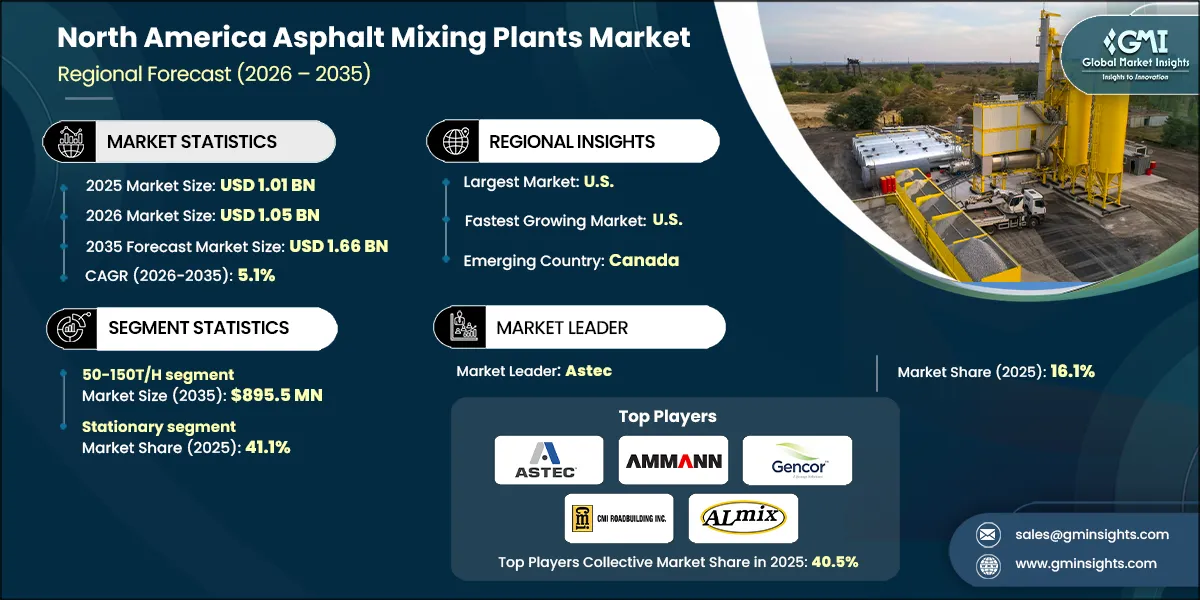
The North America asphalt mixing plants market was valued at USD 1.01 billion in 2025. The market is expected to grow from USD 1.05 billion in 2026 to USD 1.66 billion in 2035, at a CAGR of 5.1%, according to latest report published by Global Market Insights Inc.
To get key market trends
The North American market for asphalt mixing plants is undergoing rapid expansion as a direct result of increasing government support and improvements in Technology. For example, the United States Federal Government has enacted the Infrastructure Investment and Jobs Act (IIJA). This legislation provides USD 1.2 trillion for infrastructure development - including road building and upgrades. Increasing the demand for new technologically advanced asphalt mixing plants.
Urbanization and increased infrastructure spending are contributing factors to the growth of this segment in North America. The U.S. Census Bureau estimates that over 80% of Americans live in urban centers therefore requiring vast amounts of new roads and constant maintenance of existing roads. Manufacturers such as Astec Industries are developing new technology to meet the need for increased production and sustainability of asphalt mixing plants, including the implementation of smart control system technology.
The increasing focus of Environmental Regulations and enforcement by the U.S. Environmental Protection Agency (EPA) is also influencing the direction of this market. The EPA has implemented guidelines that require construction equipment to meet strict federal emission standards. Consequently, manufacturers such as Ciber Equipamentos Rodoviários have also developed systems to incorporate the use of Recycled asphalt pavement materials into their production processes. This advances sustainability and reduces the impact on the environment.
Further the industry is experiencing rapid modernization through technological advancements such as IoT and artificial intelligence (AI). Examples of these advancement include the use of smart systems by Lintec & Linnhoff to improve energy consumption while producing high quality product to meet the increasing need for high performance infrastructure (HPI).
Additionally, the overall growth of the North American asphalt mixing plants market is being driven by a combination of government support through funding, increasing level of urbanization, expectations regarding environmental regulations, and an ongoing technology development cycle, all of which will continue to drive market growth as companies develop products to meet the needs of the changing infrastructure landscape.
North America Asphalt Mixing Plants Market Report Attributes
| Key Takeaway | Details |
|---|---|
| Market Size & Growth | |
| Base Year | 2025 |
| Market Size in 2025 | USD 1.01 Billion |
| Market Size in 2026 | USD 1.05 Billion |
| Forecast Period 2026-2035 CAGR | 5.1% |
| Market Size in 2035 | USD 1.66 Billion |
| Key Market Trends | |
| Drivers | Impact |
| Sustainability in construction practices | The growing focus on reducing carbon footprints and adopting eco-friendly materials is driving demand for asphalt plants that support warm mix asphalt and energy-efficient burners. Manufacturers are innovating to meet green certifications and emission standards, making sustainability a key differentiator. |
| North America urbanization and large-scale infrastructure projects | Rapid urbanization and government-backed infrastructure programs, including highways, airports, and smart cities, are boosting the need for high-capacity North America asphalt mixing plants. This trend is particularly strong in emerging economies where road connectivity and urban development are priorities. |
| Rising popularity of warm mix asphalt (WMA) | WMA technology is gaining traction due to its ability to lower production temperatures, reduce fuel consumption, and minimize greenhouse gas emissions. Asphalt plant manufacturers are increasingly integrating WMA capabilities to cater to sustainability-conscious contractors. |
| Pitfalls & Challenges | Impact |
| Stringent environmental regulations | Compliance with strict emission norms and dust control requirements adds complexity and cost to plant design and operation. Non-compliance risks penalties and project delays, making regulatory adherence a critical challenge for manufacturers and operators. |
| High initial investment and operating costs | Asphalt mixing plants are capital-intensive, requiring significant upfront investment and ongoing maintenance. This cost barrier often limits adoption among small contractors and in regions with budget constraints, slowing overall market penetration. |
| Opportunities: | Impact |
| Modular and mobile plant solutions | Demand for modular and mobile plants is rising as contractors seek flexibility for remote projects and quick installations. These solutions reduce setup time and transportation costs, creating new growth avenues for manufacturers targeting infrastructure projects in diverse geographies. |
| Advanced AI & IoT integration for optimized production | Smart technologies are transforming asphalt plant operations by enabling predictive maintenance, real-time monitoring, and energy optimization. AI and IoT integration improve efficiency, reduce downtime, and enhance sustainability, making plants more attractive to tech-driven contractors. |
| Market Leaders (2025) | |
| Market Leader |
16.1% market share |
| Top Players |
Collective market share in 2025 is 40.5% |
| Competitive Edge |
|
| Regional Insights | |
| Largest Market | U.S. |
| Fastest growing market | U.S. |
| Emerging countries | Canada |
| Future outlook |
|
What are the growth opportunities in this market?
North America Asphalt Mixing Plants Market Trends
Changing innovation and technology transformation are important for the growth of the North America asphalt mixing plants market.
- Technological innovations such as automation, integration of IoT devices in manufacturing processes, and artificial intelligence are contributing to the growth of the asphalt mixture plants industry. Automation, for example, maximizes equipment productivity while complying with regulatory requirements for environmental protection. Ammann Group has developed state-of-the-art asphalt mixing plants equipped with advanced electronic control systems that increase productivity and decrease energy consumption, thereby supporting the world's sustainability targets.
- Strong growth of the asphalt mixing plant market in the United States results from increased urban development and increased government investment in infrastructure. In 2023, the Federal Government allocated over USD 1.2 trillion through the Infrastructure Investment and Construction Act for infrastructure construction, particularly in support of road building and maintaining roads. The federal government's commitment will stimulate demand for asphalt mixing plants nationwide.
- In addition, increasing demand for new and improved pavement products and the need to rehabilitate older pavements are causing many companies to develop new types of asphalt mixing plants that can manufacture superior quality pavements while reducing their operating costs, as is the case with Astec Industries.
- The current and aging road infrastructures throughout both North America and Europe represent a significant maintenance cost going forward, with the U.S. Federal Highway Administration (FHWA), allocating approximately USD 60 million in 2023 to improving these highway systems as well as to enhance asphalt mixing technology to allow for better quality and safer roads to be built in North America.
- Environmental issues are changing the forecast of the market as Governments now impose more stringent regulations regarding air quality management and promote the use of recycled product. For instance, the European Union requires that new road construction uses a percentage of recovered asphalt pavement to produce new roadway surfaces; thus, forcing innovations in RAP compatible equipment.
North America Asphalt Mixing Plants Market Analysis
Learn more about the key segments shaping this market
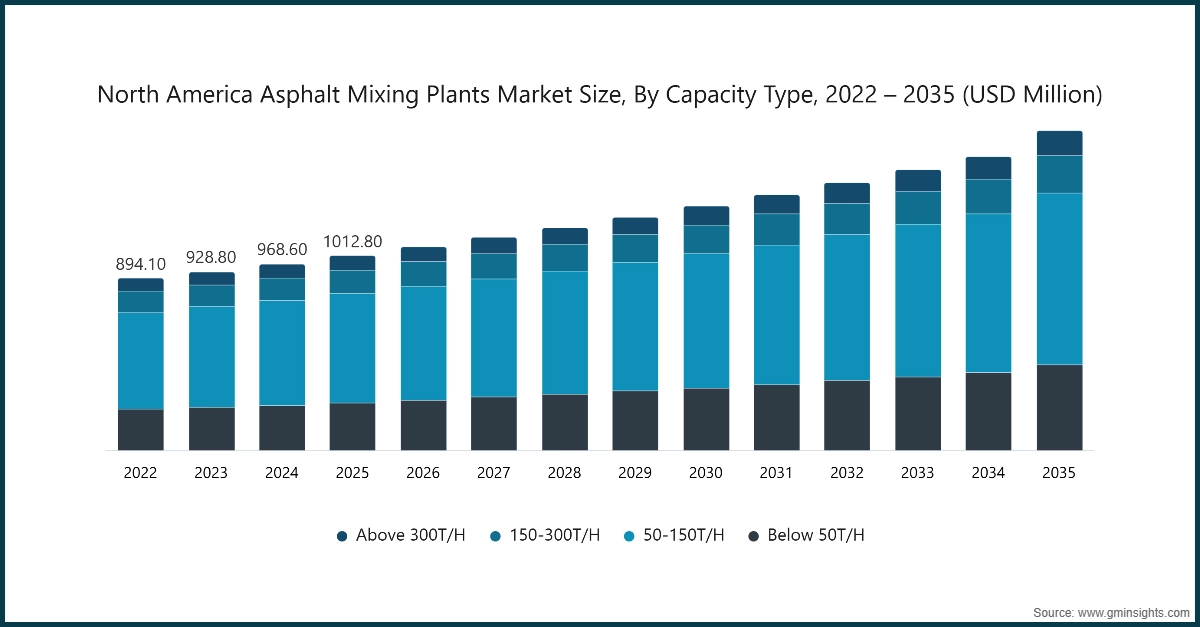
Based on the capacity type, the North America asphalt mixing plants market is divided into below 50T/H, 50-150T/H, 150-300T/H, and above 300T/H. The 50-150T/H dominated the market, generating a revenue of USD 566.2 million in 2025 and is expected to reach USD 895.5 million by 2035.
- This dominance is attributed to its suitability for medium-sized projects, such as city road construction, infrastructure upgrades, and regional highway extensions. These plants offer consistent production and operational flexibility, meeting the demand for quality and cost-effective solutions in urban and semi-urban areas.
- The U.S. Department of Transportation (DOT), under the Infrastructure Investment & Jobs Act (IIJA), has allocated USD 72 million for highway infrastructure projects. This investment is expected to drive the demand for asphalt mixing plants, which are essential for supporting the country's growing road construction and maintenance activities.
- The Ammann Group and Astec Industries have developed advanced asphalt mixing plants tailored to North America's needs. These models feature modular designs, energy-efficient burners, and automatic control systems, enhancing productivity and reducing operational costs. Such innovations make them the preferred choice for contractors handling medium-sized construction projects.
- The North American asphalt mixing plants market has experienced significant growth, with TPH plants offering production capacities of 50 to 150 tons per hour playing a key role. The U.S. has allocated over USD 1.2 trillion under the IIJA to modernize transportation systems, driving demand for these plants in highway upgrades and connectivity improvement projects.
- This category of asphalt mixing plants excels in balancing production rates and costs while delivering high-quality output. Their versatility makes them suitable for various construction projects, meeting stringent standards and maintaining their leadership in the asphalt mixing plant market.
Learn more about the key segments shaping this market
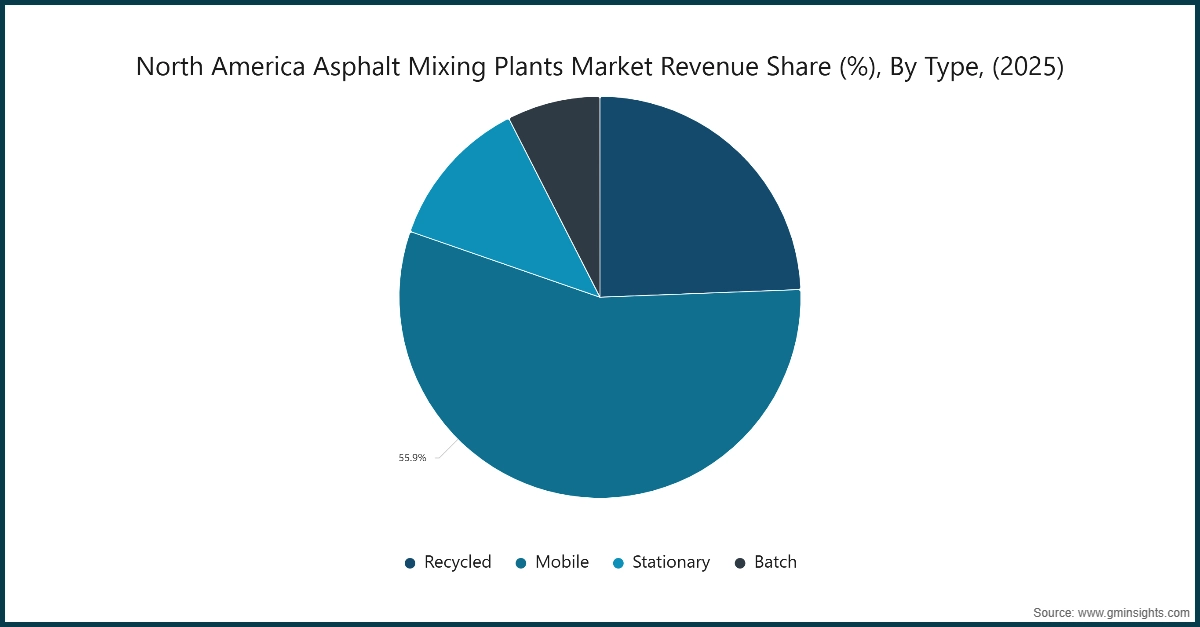
Based on type, the North America asphalt mixing plants market is segmented into recycled, mobile, stationary, and batch. The stationary segments held the largest share, ccounting for 41.1% of the market in 2025.
- Asphalt drum mixers are by far the most common type of asphalt mixing plant on the market, giving this type of plant the largest share of the overall asphalt mixing plant market. Because of the demand for large volumes of asphalt for the construction of major infrastructure projects, this mixing plant meets the needs of large-scale infrastructure projects best.
- Asphalt mixing plants utilize state-of-the-art technology to maximize efficiency and ensure quality assurance. Various companies such as Ammann Group and Astec Industries have developed stationary North America asphalt mixing plants that incorporate advanced technology, including advanced control systems and energy-efficient burners, for the purpose of maximizing output. The Ammann ABP 400 Universal is an example of a stationary asphalt mixing plant that can produce approximately 400 tons/hour and is designed specifically for high-capacity production requirements.
- Stationary asphalt mixing plants in the United States, known for their high production capacity, play a critical role in supporting infrastructure development. According to the Federal Highway Administration (FHWA), the United States has over 4 million miles of public roads, with ongoing maintenance and expansion projects driving the demand for asphalt. The National Asphalt Pavement Association (NAPA) reports that approximately 94% of the 2.8 million miles of paved roads in the U.S. are surfaced with asphalt, highlighting the importance of these plants in meeting the country's infrastructure needs.
- In addition, stationary plants are adaptable to the wide range of asphalt mixtures that are used in paving projects, thus are more versatile than mobile plants. For instance, if the need to produce different grades or styles of asphalt for different uses such as urban street and highways, companies like Astec provide stationary plant that provide custom solutions according to the requirements.
Looking for region specific data?
U.S. Asphalt Mixing Plants Market
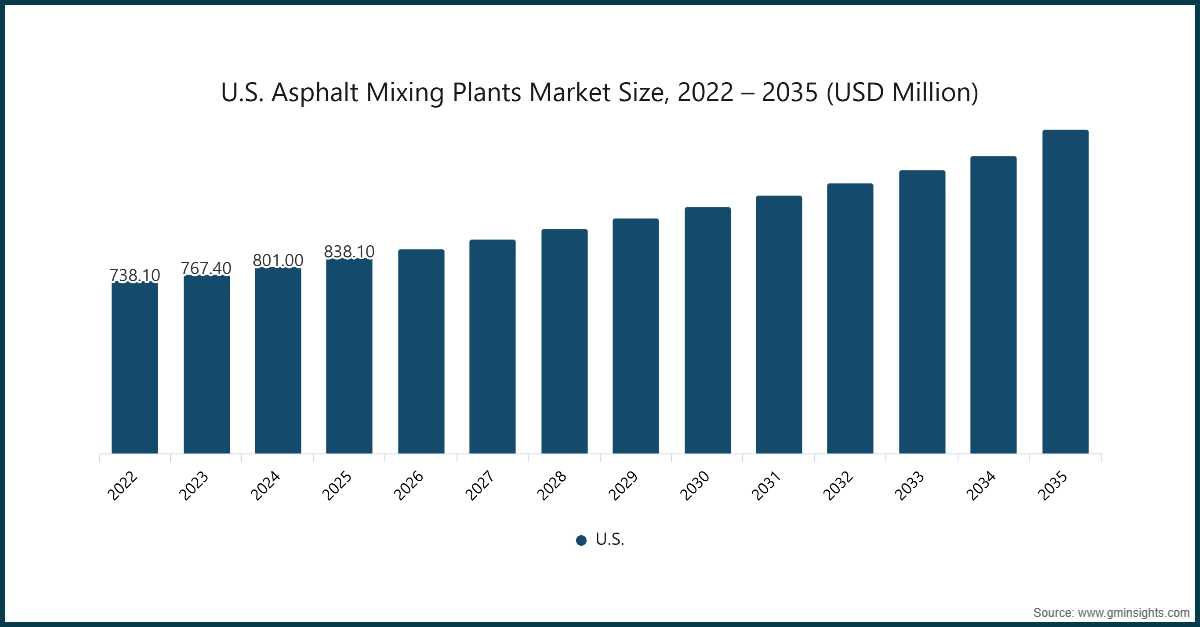
In 2025, the U.S. dominated the asphalt mixing plants industry growth in North America, accounting for 82.8% of the share in the region.
- Significant government investments in infrastructure, a well-established road system, and tight regulations all contribute to the U.S.'s dominance in the North American market for North America asphalt mixing plants. The Infrastructure Investment and Jobs Act (IIJA), among other programs, has made a substantial commitment to the transportation sector through more than USD 550 million in funding over the next five years for Transportation, Water and Energy Projects.
- The U.S. Environmental Protection Agency (EPA) has established regulatory limits on air emissions from hot-mix asphalt plants. As a result, businesses and municipalities must utilize advanced technology to meet these regulations. New Source Performance Standards (NSPS) and ENERGY STAR are examples of programs designed to promote energy efficiency and compliance with regulatory requirements.
Canada Asphalt Mixing Plants Market
Canada market is expected to grow at 4.7% during the forecast period.
- The Canadian market is driven by increasing infrastructure development projects, including road construction and maintenance, supported by government investments in transportation networks. Rising urbanization and the need for durable, high-quality pavements are further fuelling demand for advanced asphalt mixing technologies that enhance efficiency and sustainability.
North America Asphalt Mixing Plants Market Share
The top companies in the North America asphalt mixing plants industry include Astec, Ammann, Gencor , CMI and ALmix and collectively hold a share of 40.5% of the market in 2025. These prominent players are proactively involved in strategic endeavors, such as mergers & acquisitions, facility expansions & collaborations, to expand their product portfolios, extend their reach to a broad customer base, and strengthen their market position.
Astec Industries, offers portable, relocatable, and stationary asphalt plants designed for durability and production flexibility. Its solutions integrate automation and telematics foroptimized performance across diverse applications. The company maintains strong aftermarket support with parts and service networks worldwide.
Ammann America offers advanced North America asphalt mixing plants, including batch and continuous types, designed for efficiency and low emissions. Its plants feature intelligent control systems for precise mix quality and energy optimization. Ammann ensures reliability through comprehensive service and parts support worldwide.
Gencor Industries specializes in drum mix and batch asphalt plants with a focus on fuel efficiency and environmental compliance. The company incorporates patented heat transfer systems and ultra-low emissions technology. Gencor maintains a robust aftermarket network for technical assistance and plant upgrades.
North America Asphalt Mixing Plants Market Companies
Major players operating in the North America asphalt mixing plants industry are:
- ADM
- Ahern
- ALmix
- Ammann
- Astec
- BDM
- CMI
- CWMF
- Gencor
- Meeker
- Phoenix
- Stansteel
- Tarmac
- Triaso
- Wirtgen
CMI Roadbuilding manufactures portable, relocatable, and stationary asphalt plants tailored for large-scale infrastructure projects. Its designs emphasize high production rates and reduced operating costs. The company provides full-service support, including installation, training, and maintenance programs.
ADM offers EX Series, SPL Series, and MileMaker asphalt plants in portable and stationary configurations. Its counter-flow technology delivers improved fuel efficiency and lower emissions. ADM backs its products with strong customer support and parts availability across North America.
North America Asphalt Mixing Plants Industry News
- In January 2026 Astec Industries completed the USD 67.5 million acquisition of CWMF Corporation, expanding its asphalt plant portfolio and strengthening its Infrastructure Solutions segment. This move enhances Astec’s ability to deliver portable and stationary plant solutions. The acquisition positions Astec for greater market share and improved margins in North America.
- In December 2025 Gencor announced plans to introduce next-generation asphalt plant technologies focused on higher RAP utilization and advanced emissions control. This innovation aligns with sustainability trends and infrastructure modernization goals. The initiative reinforces Gencor’s leadership in eco-friendly asphalt production.
- In July 2025 ADM launched the EX 8845 High-Capacity Counterflow Asphalt Plant, its largest model to date, designed for up to 425 TPH production and 50% RAP capability. The plant emphasizes fuel efficiency and low emissions for large-scale projects. This launch strengthens ADM’s position in high-capacity asphalt solutions.
- In June 2025 Ammann introduced the ACC Alpine continuous asphalt plant in North America, offering capacities up to 600 TPH and advanced RAP integration. The plant features innovative control systems for precision and energy optimization. This launch supports Ammann’s expansion in the U.S. market with sustainable solutions.
- In Feb 2025, At World of Asphalt 2025, Ammann America launched its Alpine Series counterflow drum?mix plant offering 300–600 tph capacities with “Connected Worksite” digital integration, linking plant, paving, and compaction in real time. This system enhances scheduling, quality control, and documentation across the jobsite.
The North America asphalt mixing plants market research report includes in-depth coverage of the industry, with estimates & forecasts in terms of revenue (USD Million) and volume (Thousand Units) (from 2022 to 2035), for the following segments:
Market, By Capacity
- Below 50T/H
- 50-150T/H
- 150-300T/H
- Above 300T/H
Market, By Type
- Recycled
- Mobile
- Stationary
- Batch
Market, By Automation
- Fully Automatic
- Semi-Automatic
- Manual
Market, By End Use
- Road construction
- Highway & expressway projects
- Airport runways
- Urban infrastructure
- Industrial & commercial sites
The above information is provided for the following countries:
- U.S.
- Canada
Frequently Asked Question(FAQ) :
Who are the key players in the North America asphalt mixing plants industry?
Key players include ADM, Ahern, ALmix, Ammann, Astec, BDM, CMI, CWMF, Gencor, Meeker, Phoenix, Stansteel, Tarmac, Triaso, and Wirtgen.
What are the environmental trends impacting the North America asphalt mixing plants market?
Stricter air-quality regulations, wider use of recycled asphalt pavement (RAP), innovation in RAP-compatible equipment, and adoption of sustainable asphalt production technologies.
Which country dominated the North America asphalt mixing plants sector in 2025?
The United States dominated the market in 2025, accounting for 82.8% of the regional share. This dominance is attributed to significant government investments, a well-established road system, and stringent regulations.
What is the projected revenue of the 50-150T/H segment by 2035?
The 50-150T/H segment is expected to reach USD 895.5 million by 2035, led by increasing demand for high-capacity asphalt mixing plants.
What is the expected size of the North America asphalt mixing plants industry in 2026?
The market size is projected to reach USD 1.05 billion in 2026.
What was the market share of the stationary segment in 2025?
The stationary segment accounted for 41.1% of the market share in 2025, propelled by its efficiency in large-scale infrastructure projects.
What is the projected value of the North America asphalt mixing plants market by 2035?
The market is poised to reach USD 1.66 billion by 2035, fueled by increased urban development, government funding, and demand for advanced asphalt mixing technologies.
What was the market size of the North America asphalt mixing plants in 2025?
The market size was valued at USD 1.01 billion in 2025, with a CAGR of 5.1% expected through 2035. The growth is driven by government infrastructure investments and advancements in technology.
North America Asphalt Mixing Plants Market Scope
Related Reports