Summary
Table of Content

Natural Food Colors Market
Get a free sample of this report
Form submitted successfully!
Error submitting form. Please try again.
Thank you!
Your inquiry has been received. Our team will reach out to you with the required details via email. To ensure that you don't miss their response, kindly remember to check your spam folder as well!
Request Sectional Data
Thank you!
Your inquiry has been received. Our team will reach out to you with the required details via email. To ensure that you don't miss their response, kindly remember to check your spam folder as well!
Form submitted successfully!
Error submitting form. Please try again.
Natural Food Colors Market Size
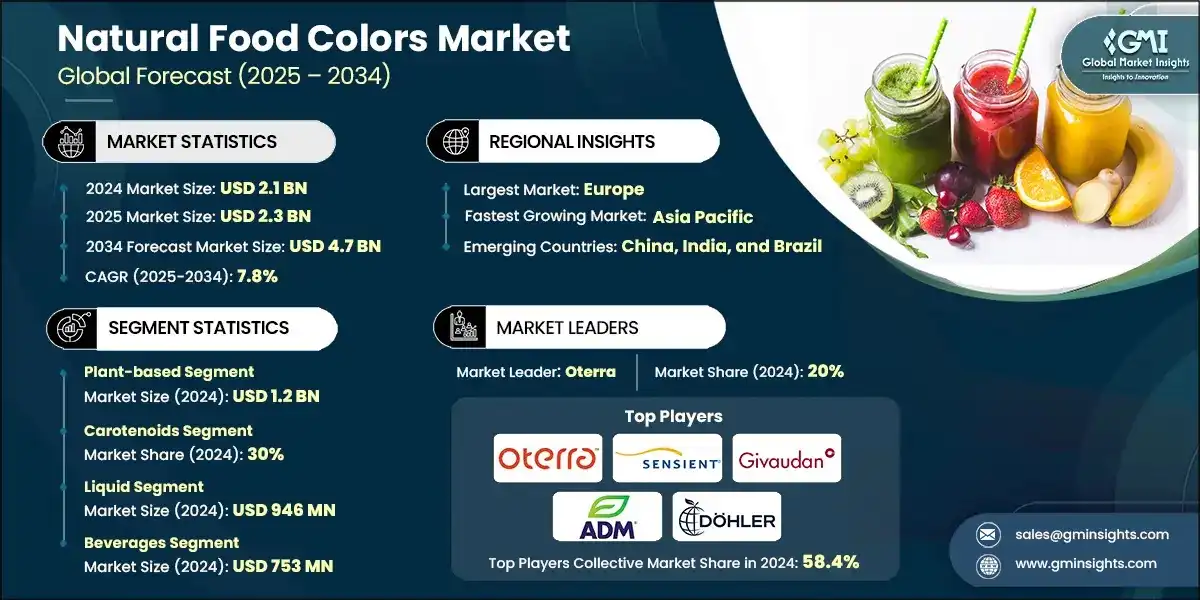
The global natural food colors market was estimated at USD 2.1 billion in 2024. The market is expected to grow from USD 2.3 billion in 2025 to USD 4.7 billion in 2034, at a CAGR of 7.8% according to latest report published by Global Market Insights Inc.
Natural Food Colors Market Key Takeaways
Market Size & Growth
- 2024 Market Size: USD 2.1 Billion
- 2025 Market Size: USD 2.3 Billion
- 2034 Forecast Market Size: USD 4.7 Billion
- CAGR (2025–2034): 7.8%
Regional Dominance
- Largest Market: Europe
- Fastest Growing Region: Asia Pacific
Key Market Drivers
- Regulatory mandates drive synthetic dye phase-out acceleration.
- Consumer clean label demands fuels natural color adoption.
- Industry reformulation commitments create immediate market demand.
Challenges
- Natural blue color availability remains critical industry gap.
- Cost premiums limit widespread commercial adoption rates.
Opportunity
- Precision fermentation technology enables scalable cost-competitive production.
- Plant-based food growth drives specialized color solution demand.
- Regulatory approvals unlock previously inaccessible application segments.
Key Players
- Market Leader: Oterra led with over 20% market share in 2024.
- Leading Players: Top 5 players in this market include Oterra, Sensient Technologies Corporation, Givaudan, Archer Daniels Midland Company, Döhler GmbH, which collectively held a market share of 58.4% in 2024.
Get Market Insights & Growth Opportunities
- The global natural food color industry is in a state of significant transition as a result of changing consumer preferences, shifts in regulations, and advancements in food processing and biotechnology innovation. With the acceleration of the global phase-out of synthetic dyes, the market for clean-label, plant-based, and nature-identical colorants is poised to accelerate at an exponential rate.
- The market is expected to grow impressively through 2034, bolstered by new technologies, sustainability mandates, and widespread reformulation by the world's leading food manufacturers seeking safer and more straightforward ingredient alternatives.
- National governments are implementing stricter regulations around synthetic dyes, therefore helping to push manufacturers toward natural solutions. The FDA, JECFA, and a number of regional governments continue to align and harmonize regulations to facilitate better integration into the marketplace for new colors.
- Evolving technologies, such as AI-assisted pigment design, resources that enable precision fermentation to scale, and development of encapsulation technologies will allow for more stability, cost-effective ingredients, and enhance their use
- By geography, Europe holds the leading position in the market due to strict regulations related to synthetic dyes and the strong consumer demand for clean-label foods. North America is in second place induced by large corporate reformulations and FDA regulations.
- Asia Pacific is the fastest growing region supported by growing processed food markets in China and India as well as abundant raw materials.
To get key market trends
Natural Food Colors Market Trends
- The U.S. FDA and HHS have signaled a major transition away from the use of petroleum-based synthetic dyes for food colorings before 2026, both by banning specific colors and facilitating businesses to cease utilizing major synthetic colors voluntarily. Top-tier consumer food companies, including Nestlé, Walmart, and Kraft Heinz, have declared their transition from certified synthetic food colors before 2025-2027. The establishment of state legislation on food labeling, such as California's Food Safety Act, and stricter laws on synthetic dyes in West Virginia, lend support to this national regulation.
- From a global secular trend, heightened regulation brings about widespread reformulation by businesses across product categories to adopt natural colors, which ensures that food manufacturers are more accountable for their color standards, while the FDA employs its tracking system for color additives. Natural colors are demanding higher visibility in the marketplace, while U.S. consumers are swiftly adopting clean-label, natural food coloring products across all food categories.
Natural Food Colors Market Analysis
Learn more about the key segments shaping this market
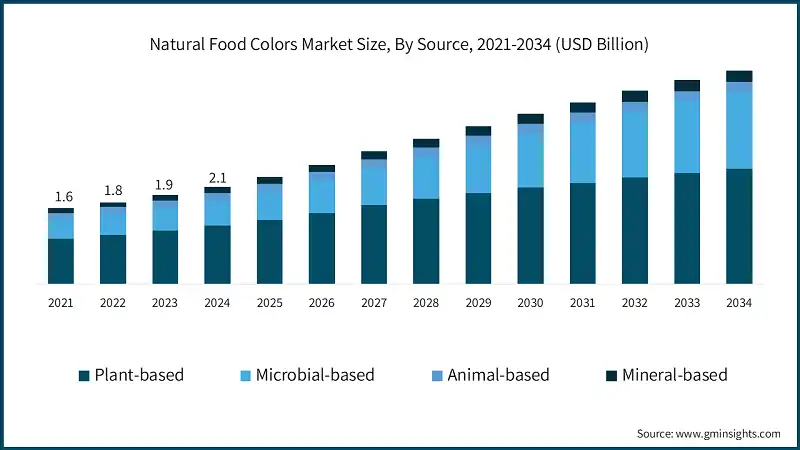
Based on source category, the market is segmented into plant, microbial, animal, and mineral
- The market for plant-based natural food colors was valued at USD 1.2 billion in 2024, while growing at a CAGR of 6.7% from 2025 to 2034. The main advantage of this segment is attributed to the wide availability of raw materials like carrots, marigolds, berries, red cabbage, leafy greens, and beetroot for example which offer carotenoids, anthocyanins, chlorophylls, and betalains along with them.
- Microbial-based colors segment was valued at USD 559 million in 2024, with a CAGR of 11.8% expected through 2034. Pigments in this market are derived from precision fermentation previously as a new source of bacteria, yeast, fungi, and microalgae like spirulina phycocyanin and fungal reds.
- Animal-derived colors, primarily carmine from cochineal insects, only capture 1.2% of market share in 2024, largely due to ethical concerns about consumption of animal products, and dietary issues, however they are favored for their color intensity and stability.
- Mineral-derived colors also emerging as a natural substitute for synthesizing white colors, largely due to regulatory issues. Food product manufacturers are diversifying their sources of ingredients in response to changing regulations and consumer behavior, which are driving innovation across supply chains and engineering towards the sourcing of sustainable and transparency of ingredients.
Learn more about the key segments shaping this market
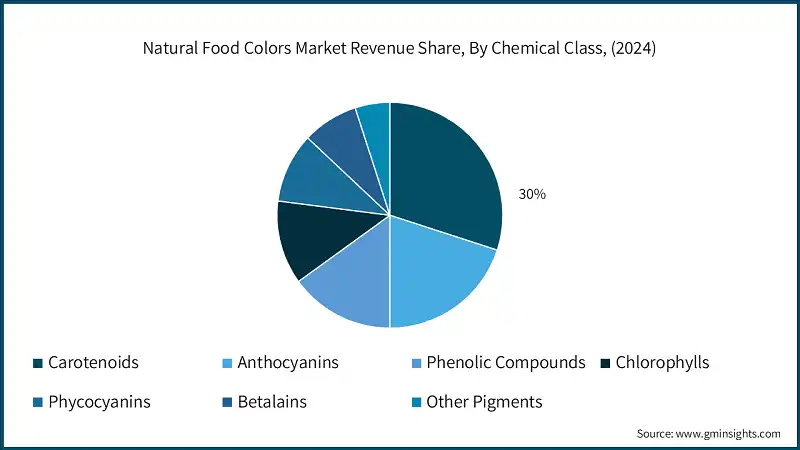
Based on chemical class, the market is segmented into carotenoids, anthocyanins, phenolic compounds, chlorophylls, phycocyanins, betalains, and other pigments.
- Carotenoids attained nearly 30% of market share in 2024 while delivering a variety of colors ranging from yellow to red along with growing nutritional support such as provitamin A. They are found in beverages, dairy, and processed food since they are conventional production methods with existing regulatory approvals.
- Anthocyanins market reached USD 430 million in 2024. These pigments are derived from sources like berries and red cabbage and display a wide range of colors from red to blue depending on pH. They have antioxidant properties which add value to the formulators and endure advanced stabilization to withstand heat means.
- Betalains also bring rich color options to the product lines adding red hues to the color palette, while chlorophylls provide functional green hues all these colors are becoming larger and larger to meet the clean label demand in the industry.
- Phycocyanins sourced from spirulina a natural blue, was accounted for 10% of the market share in 2024 which meets a real need for stable natural blue pigments. New technology has garnered advancements aimed at increasing their heat and light stability. Phenolic compounds and other pigments also have broad color functionality.
Based on form, the market is segmented into liquid, powder, emulsions & oleoresins, paste/gel, and other forms
- Liquid natural food colors represented the largest market share in 2024, with around USD 946 million. These formulations provide higher precision and vibrancy on color performance.
- Powdered natural colors tend to be more stable and easier to use than liquid formats. They are also poised to have the widest range of applications, especially for bakery products, spice blends, and dry mixes.
- In 2024, pastes and gels represent USD 215 million as it constitutes a concentrated color carrier, especially in bakery and confectionery filling applications that require high-intensity colors. Pigment solubility and relative stability make oleoresins and emulsions particularly favored solvent or oil-based colorants in fat-based food applications.
- Emerging product applications are new formats of colors to match niche markets like pet food, pharmaceutical, and nutraceutical markets. There are also many types of natural colors that may reconcile the desired function and sensory requirements with transparency.
Based on application, the market is segmented into beverages, processed foods & snacks, bakery & confectionery, dairy & dairy alternatives, meat & plant-based alternatives, pharmaceuticals & nutraceuticals, pet food, and other applications
- In 2024 the beverages category was the largest segment in the natural food colors market with the total value of USD 753 million. This category covers alcoholic, soft drinks, juices, as well as sports drinks and functional beverages. For all of these items, consumer comfort for acceptance relies heavily on their visual aspect. The 'clean label' trend and the increasing scrutiny the consumer takes on ingredients has created a need for natural colors in beverages that focus on clarity and health perspective.
- Processed foods and snacks accounted for a market value of USD 387 million in 2024. Processed foods and snacks include a wide variety of options such as convenience food and ready-to-eat meals and snacks. In this segment, sized and hue consistency, along with stability during processing, is important to the overall product. Natural color can also play a large role in the overall product aesthetic and assist brands in delivering on the consumer demand of clean label and sustainable products, similar to beverages.
- The meat and plant-based alternatives segment is expected to register at a 15.87% CAGR through 2034, with a total value of USD 172 million in 2024. This is a fast-growing category, which is less than value than the previous, but requires more specialized coloration to replicate the color of real meat and the color it attains after it is cooked.
- Processed foods and snacks require similar color, appearance, and processing characteristics for the various products intended. They use natural pigments for purely functional or aesthetic purposes in pharmaceuticals and nutraceuticals, sometimes as antioxidants.
Looking for region specific data?
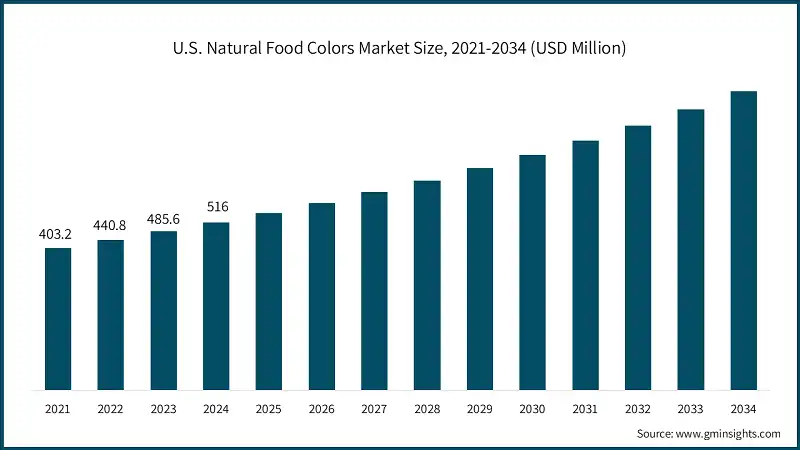
North America natural food colors market size exceeded USD 645 million in 2024 and is expected to grow at a CAGR of 7.3% from 2025 to 2034.
- The growth can be attributed to changing regulatory frameworks, such as the FDA’s intentions to phase out synthetic dyes, along with state-based regulations. Furthermore, the proactive reformulation of large food companies helps increase demand for natural food colors.
Europe is the largest natural food colors market with a revenue of USD 731 million in 2024, growing at a CAGR of 7.4% from 2025 to 2034.
- Europe’s position in the market can be attributed to strict regulations from the EFSA that upholds the use of natural ingredients, high consumer health awareness and clean-label product offerings. Key participants of the industry such as Döhler, Symrise, and GNT Group develop innovation and technology in this region.
Asia Pacific natural food colors market is forecast to grow at a CAGR of 10.1% and estimated to reach a market value of USD 569 million in 2025.
- The growth is driven by rapid industrial growth in key markets such as China and India, growing food processing market, ready access to raw materials and disposable consumer incomes. In addition, lower production and extraction costs provide a competitive advantage for manufacturers in this region.
Latin America natural food colors market is steadily expanding and is projected to reach a value of around USD 142 million by 2025.
- Market growth is the result of an expansion of food processing sectors in Brazil, Argentina, and Mexico, the rising consumer preference for clean-label and natural products, and government regulatory agencies aiming to improve food ingredient transparency and food safety. The region has many agricultural resources that provide sufficient raw materials for extracting colors from plants.
MEA is gradually growing and accounted for 6% of market share in 2024 and is expected to grow with a CAGR of 8% from 2025-2034.
- The growth of the market is driven by accelerating urbanization, the rising demand for processed and packaged foods, and an increase in health consciousness among consumers. Government regulatory agencies in countries like the UAE and South Africa are falling more in line with global market standards to restrict synthetic additives and are helping promote a shift to natural alternatives.
Natural Food Colors Market Share
The top 5 companies in the natural food color sector are Oterra, Sensient Technologies Corporation, Givaudan, Archer Daniels Midland Company, and Döhler GmbH. These are significant players in their respective areas and represent 58.4% of the total market share in 2024. These companies have a solid market presence globally because they have operated in the natural food color market for long periods of time. Their diversified product offerings, related facilities, and global distribution allow them to support the growing demand of their customers across regions.
- Oterra is a known leader in the market for its vertically integrated platform combining ecological extraction and fermentation technologies. The company is a result of consolidation, focusing on plant-based meat color solutions principally in ColorsFruit and FruitMax.
- Sensient Technologies Corporation leads the advanced extraction and color matching technologies industry, acquiring Biolie in 2025. The company offers unique natural colors such as Vertafine for pet foods and also offers a strong technical services operation with stability testing and other regulatory aspects. The company’s global manufacturing delivers those consistent products in every market.
- Givaudan has grown its natural colors portfolio by acquiring DDW in 2022 bolstering growth in innovation and market access. The creative combination of the two companies leads to developed integrated ingredient solutions of colors, flavors, and functional ingredients. The Sense Colors division is a leader in biotechnology-derived natural colors such as the FDA-approved Everzure, a Galdieria extract blue.
- Archer Daniels Midland Company (ADM) uses its expansive agricultural supply chain to manufacture inexpensive and reliable plant-based color, focusing on carotenoids and alternatives to titanium dioxide, such as PearlEdge.
- Döhler GmbH has a solid European base with experience in processing natural ingredients and in clean-label formulations. In addition to the work with coloration, it is developing natural colors for their antioxidant and nutritional value. Technical expertise includes extraction, microencapsulation, and sustainable sourcing reflecting the growing demand for environmentally and functional products.
Natural Food Colors Market Companies
Major players operating in the natural food colors industry include:
- Archer Daniels Midland Company
- Chromologics ApS
- Döhler GmbH
- Givaudan
- Ingredion
- International Flavors & Fragrances Inc.
- Kalsec Inc
- McCormick & Company
- Oterra
- Phytolon Ltd
- ROHA Group
- Sensient Technologies Corporation
- Symrise AG
Natural Food Colors Market Report Attributes
| Key Takeaway | Details |
|---|---|
| Market Size & Growth | |
| Base Year | 2024 |
| Market Size in 2024 | USD 2.1 Billion |
| Market Size in 2025 | USD 2.3 Billion |
| Forecast Period 2025 – 2034 CAGR | 7.8% |
| Market Size in 2034 | USD 4.7 Billion |
| Key Market Trends | |
| Drivers | Impact |
| Regulatory mandates drive synthetic dye phase-out acceleration | Accelerates synthetic dye phase-out, driving industry shift to natural colors, boosting demand and innovation. |
| Consumer clean label demands fuels natural color adoption | Growing clean-label demand boosts natural color adoption, emphasizing transparency and health-conscious choices. |
| Industry reformulation commitments create immediate market demand | Reformulation commitments drive immediate natural color demand, accelerating product development and supplier growth. |
| Pitfalls & Challenges | Impact |
| Natural blue color availability remains critical industry gap | Limited stable natural blue colors restrict applications, slowing growth and innovation in key product segments. |
| Cost premiums limit widespread commercial adoption rates | Higher natural color costs limit adoption, especially in price-sensitive manufacturers and markets. |
| Opportunities: | Impact |
| Precision fermentation technology enables scalable cost-competitive production | Precision fermentation enables scalable, cost-effective natural color production, overcoming supply and stability challenges. |
| Plant-based food growth drives specialized color solution demand | Plant-based food growth increases demand for specialized natural colors that mimic meat, driving innovation. |
| Regulatory approvals unlock previously inaccessible application segments | Approvals expand natural color use into restricted applications, broadening market potential and product variety. |
| Market Leaders (2024) | |
| Market Leaders |
20% market share |
| Top Players |
Collective market share in 2024 is 58.4% |
| Competitive Edge |
|
| Regional Insights | |
| Largest Market | Europe |
| Fastest growing market | Asia Pacific |
| Emerging countries | China, India, and Brazil |
| Future outlook |
|
What are the growth opportunities in this market?
Natural Food Colors Industry News
- In May 2023, the Exberry Compound Red was launched by GNT. This new plant-based natural food concentrate makes red meat alternatives brownish during grilling or frying. It is produced from carrots and vegetable oil, thus forming a clean-label ingredient.
- In April 2023, Sensient Colors, a division of Sensient Technologies, formulated a new natural green color known as Vertafine for pet foods. This offers pet food manufacturers the opportunity to satisfy the ever-increasing consumer demand for natural colors.
This natural food colors market research report includes in-depth coverage of the industry, with estimates & forecasts in terms of revenue (USD Million) and volume (Tons) from 2025 to 2034, for the following segments:
Market By Source
- Plant-based
- Fruits
- Vegetables
- Herbs
- Spices
- Microbial based
- Fermentation
- Algae
- Yeast
- Animal-based
- Mineral-based
Market By Chemical Class
- Anthocyanins
- Carotenoids
- Betalains
- Chlorophylls
- Phycocyanins
- Phenolic compounds
- Other natural pigments
Market, By Form
- Liquid
- Powder
- Paste/gel
- Emulsions & oleoresins
- Other forms
Market, By Application
- Beverages
- Bakery and confectionery
- Dairy and dairy alternatives
- Meat, seafood and plant-based alternatives
- Processed foods and snacks
- Pharmaceuticals and nutraceuticals
- Pet food
- Other applications
The above information is provided for the following regions and countries:
- North America
- U.S.
- Canada
- Europe
- Germany
- UK
- France
- Spain
- Italy
- Rest of Europe
- Asia Pacific
- China
- India
- Japan
- Australia
- South Korea
- Rest of Asia Pacific
- Latin America
- Brazil
- Mexico
- Argentina
- Rest of Latin America
- Middle East and Africa
- Saudi Arabia
- South Africa
- UAE
- Rest of Middle East and Africa
Frequently Asked Question(FAQ) :
What is the market size of the natural food colors in 2024?
The market size was USD 2.1 billion in 2024, with a CAGR of 7.8% expected through 2034 driven by shifting consumer preferences toward clean-label products, regulatory phase-out of synthetic dyes, and advances in food processing and biotechnology.
What is the projected value of the natural food colors market by 2034?
The natural food colors market is expected to reach USD 4.7 billion by 2034, propelled by precision fermentation technology, reformulation commitments by major food manufacturers, and growing demand for sustainable ingredients.
What is the current natural food colors market size in 2025?
The market size is projected to reach USD 2.3 billion in 2025.
How much revenue did the plant-based source segment generate in 2024?
Plant-based natural food colors generated USD 1.2 billion in 2024, with a CAGR of 6.7% expected from 2025 to 2034.
What was the valuation of the liquid form segment in 2024?
Liquid natural food colors held the largest market share and generated around USD 946 million in 2024, providing higher precision and vibrancy in color performance.
What is the growth outlook for the microbial-based segment from 2025 to 2034?
Microbial-based colors are projected to grow at a CAGR of 11.8% through 2034, driven by precision fermentation technology and demand for scalable, sustainable color production from bacteria, yeast, fungi, and microalgae.
Which region leads the natural food colors market?
Europe leads the market with USD 731 million in 2024, growing at a CAGR of 7.4% from 2025 to 2034. Strict EFSA regulations, high consumer health awareness, and strong clean-label demand fuel the region's dominance.
What are the upcoming trends in the natural food colors market?
Key trends include adoption of precision fermentation and synthetic biology, AI-assisted pigment design, advanced encapsulation technologies for improved stability, and development of specialized colors for plant-based meat alternatives.
Who are the key players in the natural food colors market?
Key players include Archer Daniels Midland Company, Chromologics ApS, Döhler GmbH, Givaudan, Ingredion, International Flavors & Fragrances Inc., Kalsec Inc, McCormick & Company, Oterra, Phytolon Ltd, ROHA Group, Sensient Technologies Corporation, and Symrise AG.
Natural Food Colors Market Scope
Related Reports