Summary
Table of Content

Naphthalene Market
Get a free sample of this report
Form submitted successfully!
Error submitting form. Please try again.
Thank you!
Your inquiry has been received. Our team will reach out to you with the required details via email. To ensure that you don't miss their response, kindly remember to check your spam folder as well!
Request Sectional Data
Thank you!
Your inquiry has been received. Our team will reach out to you with the required details via email. To ensure that you don't miss their response, kindly remember to check your spam folder as well!
Form submitted successfully!
Error submitting form. Please try again.
Naphthalene Market Size
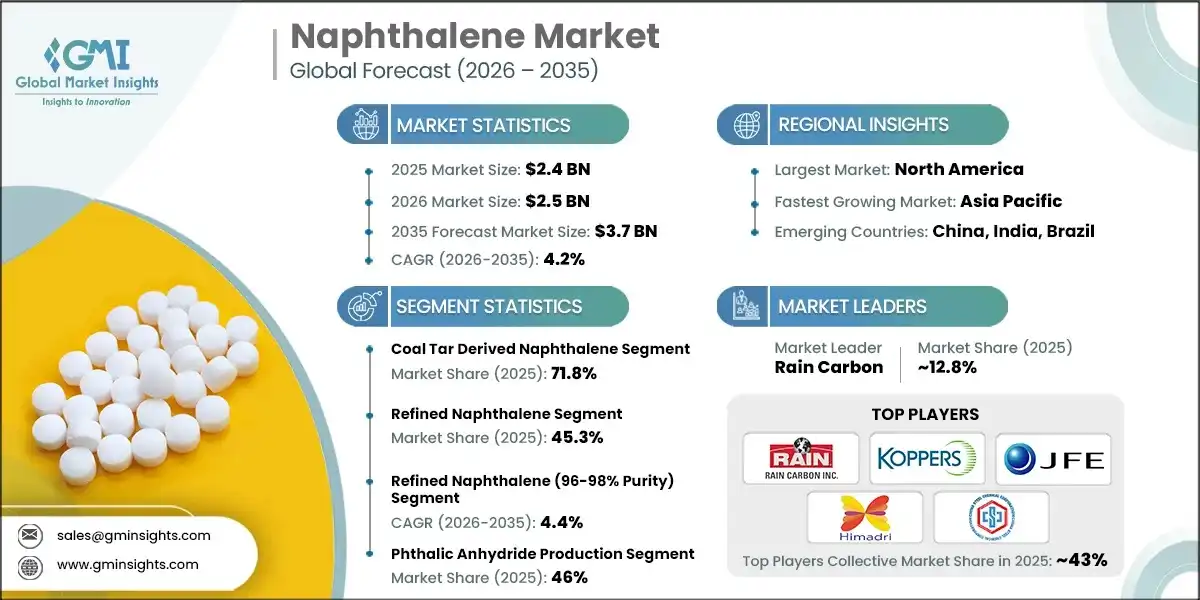
The global naphthalene market was valued at USD 2.4 billion in 2025. The market is expected to grow from USD 2.5 billion in 2026 to USD 3.7 billion in 2035, at a CAGR of 4.2%, according to latest report published by Global Market Insights Inc.
Naphthalene Market Key Takeaways
Market Size & Growth
- 2025 Market Size: USD 2.4 billion
- 2026 Market Size: USD 2.5 billion
- 2035 Forecast Market Size: USD 3.7 billion
- CAGR (2026–2035): 4.2%
Key Market Drivers
- Expanding phthalic anhydride production capacity globally.
- Growing construction industry & infrastructure development.
- Rising specialty chemical applications & product innovation.
Challenges
- Environmental regulations & PAH (Polycyclic Aromatic Hydrocarbon) concerns.
- Dependence on phosphate fertilizer industry byproduct availability.
Opportunity
- Advanced purification & specialty grade development.
- Sustainable production & recycling technologies.
Key Players
- Market Leader: Rain Carbon led with over 12.8% market share in 2025.
- Leading Players: Top 5 players in this market include Rain Carbon, Koppers, JFE Chemical Corporation, Himadri Specialty Chemical Ltd., China Steel Chemical, which collectively held a market share of 43% in 2025.
Get Market Insights & Growth Opportunities
- Naphthalene (C10H8) is a polycyclic aromatic hydrocarbon primarily derived from coal tar distillation and petroleum refining processes. Available in various forms including refined naphthalene, alkyl naphthalene, and naphthalene solid, with purity grades ranging from crude (90-95%) to pure (99%+), this versatile organic compound serves as a critical raw material in phthalic anhydride production, surfactants manufacturing, construction chemicals, and traditional applications.
- Currently, North America dominates the naphthalene market, accounting for approximately 45.6% of global market value in 2025, driven by established phthalic anhydride production facilities, robust construction industry demand for water reducing agents, and mature chemical manufacturing infrastructure. Asia Pacific represents the fastest-growing region with expanding industrial applications, while Europe maintains significant market presence with diversified end-user applications across chemical intermediates and specialty products.
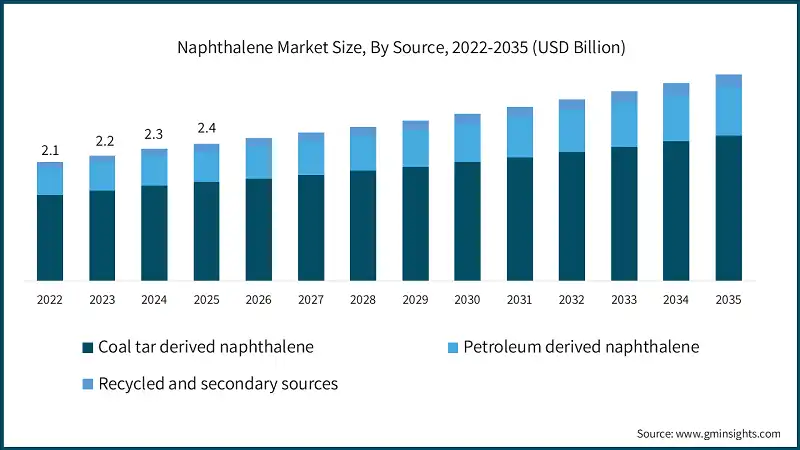
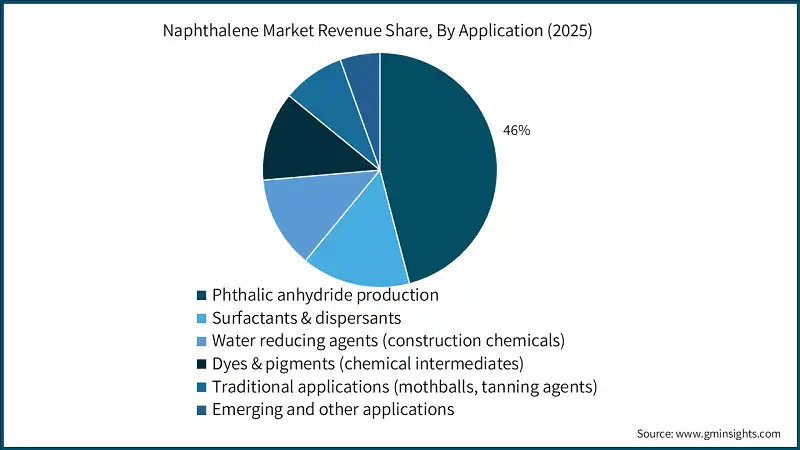
- Phthalic anhydride production represents the largest application segment, accounting for approximately 46% of the market, reflecting the dominant role of naphthalene as a key feedstock for plasticizers, resins, and polyester production globally, followed by surfactants & dispersants and water reducing agents for construction chemicals. Among source types, coal tar derived naphthalene leads with approximately 71.8% market share, followed by petroleum derived and recycled sources, reflecting the predominant coal tar distillation infrastructure and established supply chains.
- The convergence of expanding phthalic anhydride demand, growing construction chemicals applications, and emerging specialty chemical uses creates a dynamic environment for the global naphthalene market. As manufacturers invest in advanced purification technologies, sustainable production methods, and product grade diversification, the market continues to evolve, ensuring sustained global demand across diverse end-user sectors and geographic markets.
To get key market trends
Naphthalene Market Trends
- Advanced purification technologies and grade optimization are revolutionizing naphthalene production, enabling producers to achieve superior purity levels from 99%+ for specialty applications, enhanced crystallization control, and improved consistency from both coal tar and petroleum sources. These technological improvements address critical quality requirements for demanding applications in phthalic anhydride synthesis, electronic-grade chemicals, and pharmaceutical intermediates, significantly enhancing product performance characteristics and reducing impurity levels through advanced distillation, crystallization, and hydrogenation processes.
- The sustainability transformation is reshaping the naphthalene industry as producers demonstrate increasing commitment to environmental responsibility through optimized distillation processes, emission control systems, and circular economy initiatives including recycling from secondary sources. This shift encourages investment in PAH emission reduction technologies, energy-efficient purification methods, and waste minimization strategies, with several major producers implementing comprehensive environmental management systems to address regulatory requirements regarding polycyclic aromatic hydrocarbon handling, workplace safety standards, and stakeholder expectations for sustainable chemical production.
- Strategic vertical integration between coal tar processors, petroleum refiners, and naphthalene purification operations is creating stable supply patterns and optimizing value chain efficiency across the aromatic chemicals ecosystem. These integrated operations enable coordinated production planning with upstream coke oven operations and downstream phthalic anhydride facilities, improved feedstock utilization rates, and reduced logistics costs, positioning vertically integrated producers with competitive advantages in supply reliability, cost structure, and technical service capabilities compared to standalone naphthalene merchants.
- Geographic capacity expansion in Asia Pacific, particularly in China, India, and Southeast Asian countries, is fundamentally reshaping global naphthalene supply dynamics, with significant coal tar processing and petroleum refining capacity additions generating increased naphthalene availability to serve rapidly growing regional construction chemicals, phthalic anhydride, and surfactants industries. These investments reduce import dependence for regional consumers, improve supply chain responsiveness, and enable closer technical collaboration with downstream customers in high-growth construction and chemical manufacturing markets, while creating competitive pressure on established North American and European producers.
- Product form diversification and specialty naphthalene development are emerging as critical differentiation strategies, with producers expanding beyond traditional refined naphthalene to offer alkyl naphthalene derivatives, naphthalene sulfonates, and custom formulations for specific applications. This trend addresses evolving requirements in construction chemical formulations, specialty surfactant synthesis, and advanced dispersant applications, enabling premium pricing and stronger customer relationships through customized product specifications, technical support services, and application development collaboration with formulators and end-users in construction, textile, and agrochemical industries.
Naphthalene Market Analysis
Learn more about the key segments shaping this market
Based on source, the naphthalene market is segmented into coal tar derived naphthalene, petroleum derived naphthalene, and recycled and secondary sources. Coal tar derived naphthalene dominated the market with an approximate market share of 71.8% in 2025 and is expected to grow with a CAGR of 4% from 2026 to 2035.
- Coal tar derived naphthalene dominates due to its well-established production infrastructure within integrated steel mill coking operations, superior yield economics from coal tar distillation processes, and consistent quality characteristics meeting requirements across phthalic anhydride production, construction chemicals, and traditional applications. This source provides the optimal balance between production scale, cost-effectiveness, and reliable supply continuity, leveraging the extensive global coal tar processing infrastructure developed alongside steel industry operations. Its established position in major naphthalene-consuming regions, particularly North America and Asia Pacific, coupled with proven technical performance across diverse applications, solidifies its leading market position with strong integration into steel industry value chains.
- Recycled and secondary sources represent the fastest-growing segment with a CAGR of 4.9% from 2026 to 2035, driven by increasing environmental sustainability initiatives, circular economy adoption, and regulatory pressures to reduce primary resource consumption in chemical manufacturing. Advanced recovery technologies enable efficient naphthalene reclamation from industrial waste streams, spent process materials, and post-consumer sources, meeting quality specifications for various applications. Growing corporate sustainability commitments, government incentives for recycled chemical utilization, and technological improvements in purification processes for secondary naphthalene drive accelerating adoption, particularly in Europe and developed Asia Pacific markets with stringent environmental regulations and established circular economy frameworks.
Based on form, the naphthalene market is segmented into refined naphthalene, alkyl naphthalene, naphthalene solid, and other forms. Refined naphthalene dominated the market with an approximate market share of 45.3% in 2025 and is expected to grow with a CAGR of 3.6% from 2026 to 2035.
- Refined naphthalene dominates due to its critical role as the primary feedstock for phthalic anhydride production, serving as the preferred form for large-scale chemical synthesis applications requiring high purity, consistent quality, and optimal reactivity characteristics. This form provides superior performance in oxidation processes for phthalic anhydride manufacturing, chemical intermediate synthesis, and specialty chemical production where liquid or molten naphthalene handling offers operational advantages. Its established position in integrated chemical complexes with direct pipeline connections between naphthalene distillation units and phthalic anhydride reactors, coupled with proven process economics and technical reliability across plasticizer, resin, and polyester value chains, solidifies its leading market position in major chemical manufacturing regions globally.
- Other forms represent the fastest-growing segment with a CAGR of 4.9% from 2026 to 2035, encompassing specialty naphthalene derivatives, emulsions, dispersions, and custom formulations tailored for emerging applications in advanced materials, specialty surfactants, and innovative chemical processes. Advanced formulation technologies enable development of naphthalene-based products with enhanced solubility, improved handling characteristics, and application-specific performance attributes for niche industrial segments. Growing demand for specialty chemical solutions, increasing customization requirements from end-users in agrochemicals and textile industries, and technological innovation in naphthalene derivative chemistry drive accelerating adoption, particularly in high-value specialty applications requiring differentiated product forms beyond conventional refined, alkyl, or solid naphthalene offerings.
- Naphthalene solid occupies a significant segment with 19.9% market share in 2025, serving traditional applications including mothballs, toilet deodorant blocks, tanning agents, and industrial fumigants, alongside emerging uses in controlled-release formulations and specialty industrial applications. This form provides convenient handling, storage stability, and controlled sublimation characteristics essential for consumer products and industrial applications requiring solid-phase naphthalene. Its established market presence in traditional applications, particularly in developing economies with continued demand for naphthalene-based household products, maintains steady consumption supported by a CAGR of 4.7% through 2035, with growth driven by industrial applications in leather processing, wood preservation, and specialty chemical formulations requiring solid naphthalene as a raw material or intermediate.
Based on product grade, the naphthalene market is segmented into crude naphthalene (90-95% purity), refined naphthalene (96-98% purity), pure naphthalene (99%+ purity), and specialty grades and custom products. Refined naphthalene (96-98% purity) dominated the market with an approximate market share of 39% in 2025 and is expected to grow with a CAGR of 4.4% from 2026 to 2035.
- Refined naphthalene (96-98% purity) dominates due to its optimal purity-to-cost ratio for major industrial applications, particularly phthalic anhydride production, construction chemical synthesis, and surfactant manufacturing, where ultra-high purity is not essential but consistent quality and minimal impurities are critical for process efficiency. This grade provides the ideal balance between purification costs and performance requirements, meeting technical specifications for catalytic oxidation processes, sulfonation reactions, and chemical intermediate synthesis without the premium pricing associated with 99%+ purity grades. Its established position in global phthalic anhydride production facilities, proven compatibility with existing manufacturing infrastructure, and cost-effectiveness for large-volume industrial consumption solidify its leading market position across chemical manufacturing regions in North America, Europe, and Asia Pacific.
- Specialty grades and custom products represent the fastest-growing segment with a CAGR of 5.3% from 2026 to 2035, catering to demanding niche applications requiring tailored purity profiles, controlled impurity specifications, specific crystal morphologies, or custom formulations for specialized end-uses in pharmaceuticals, agrochemicals, and advanced materials. Advanced purification and customization technologies enable production of naphthalene grades with application-specific characteristics including ultra-low sulfur content, controlled aromatic impurity profiles, and pharmaceutical-grade quality meeting stringent regulatory requirements. Growing demand for differentiated chemical solutions, increasing customization requirements from specialty chemical manufacturers, and expanding high-value applications in life sciences and advanced materials drive accelerating adoption, particularly in developed markets with sophisticated specialty chemical industries requiring premium-grade naphthalene products.
Learn more about the key segments shaping this market
Based on application, the naphthalene market is segmented into phthalic anhydride production, surfactants & dispersants, water reducing agents (construction chemicals), dyes & pigments (chemical intermediates), traditional applications (mothballs, tanning agents), and emerging and other applications. Phthalic anhydride production dominated the market with an approximate market share of 46% in 2025 and is expected to grow with a CAGR of 3.4% from 2026 to 2035.
- Phthalic anhydride production dominates due to naphthalene's critical role as the primary feedstock for catalytic oxidation processes producing phthalic anhydride, which serves as an essential intermediate for plasticizers (particularly for PVC applications), unsaturated polyester resins, alkyd resins for coatings, and various specialty chemicals. This application represents the largest single-use category globally, with established naphthalene-to-phthalic anhydride production facilities operating continuously across major chemical manufacturing regions. Its fundamental importance in the plastics, coatings, and construction materials value chains, coupled with stable long-term demand from automotive, building & construction, and consumer goods industries, solidifies its leading market position despite mature growth rates reflecting the established nature of phthalic anhydride applications in developed markets.
- Emerging and other applications represent the fastest-growing segment with a CAGR of 5.1% from 2026 to 2035, encompassing innovative uses in advanced materials, specialty polymers, agrochemical intermediates, pharmaceutical synthesis, carbon fiber precursors, and novel chemical processes leveraging naphthalene's unique aromatic structure. Technological innovation and research & development activities continuously expand naphthalene's application portfolio beyond traditional uses, with growing interest in high-performance materials, specialty chemical synthesis, and sustainable chemistry applications.
- Increasing investment in chemical innovation, expanding specialty chemical industries in emerging markets, and development of naphthalene-based solutions for advanced industrial applications drive accelerating adoption, particularly in high-value segments requiring differentiated chemical intermediates and specialty aromatic compounds for next-generation products.
- Surfactants & dispersants occupy a significant segment with 15% market share in 2025, utilizing naphthalene sulfonates and alkyl naphthalene derivatives as critical raw materials for concrete admixtures, textile processing aids, agrochemical formulations, industrial cleaning products, and specialty dispersing agents across diverse industries. This application leverages naphthalene's aromatic structure for producing high-performance surfactants with excellent dispersing, wetting, and emulsifying properties essential for industrial and specialty applications.
- Its established position in construction chemicals (particularly superplasticizers for high-performance concrete), textile industry applications, and agrochemical formulations maintains robust demand supported by a CAGR of 4.9% through 2035, driven by infrastructure development, construction industry growth in emerging economies, and increasing adoption of high-performance chemical additives across industrial sectors globally.
Looking for region specific data?
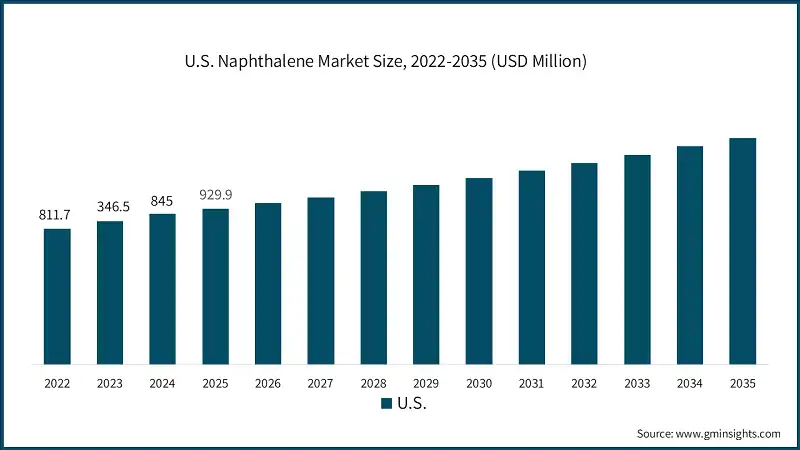
The U.S. naphthalene market accounted for USD 929.9 million in 2025.
- The strong momentum for naphthalene in North America comes primarily from the United States, wherein consistent demand is driven by well-established phthalic anhydride production facilities consuming naphthalene for plasticizers and unsaturated polyester resins, extensive coal tar distillation infrastructure integrated with coke oven operations, and robust construction chemicals sector utilizing naphthalene sulfonates as superplasticizers for concrete admixtures.
- Constant emphasis on infrastructure modernization and building construction, sophisticated chemical manufacturing base producing specialty surfactants and dispersants, and established naphthalene refining capabilities across phthalic anhydride synthesis, construction water reducers, and dye intermediates consistently elevate the country's market position. The presence of major naphthalene producers including Koppers and Rain Carbon with coal tar distillation facilities ensures sustained supply and market leadership.
The naphthalene market in Germany is estimated to experience significant and promising growth from 2026 to 2035.
- Naphthalene growth in Europe is an integral component of the market due to strong phthalic anhydride production heritage, mature coal tar processing from steel industry coking operations, and well-established construction chemicals manufacturing. In Germany, producers are focusing on refined naphthalene grades meeting stringent specifications for phthalic anhydride oxidation processes, naphthalene sulfonates for high-performance concrete superplasticizers, and specialty alkyl naphthalenes for surfactant applications.
- Germany's leadership in construction technology and chemical precision manufacturing, combined with strong automotive plasticizers demand, construction sector requiring advanced concrete admixtures, and dyes & pigments industries utilizing naphthalene intermediates, positions the market for sustained expansion as manufacturers prioritize high-purity naphthalene for demanding chemical synthesis applications.
The naphthalene market in China is estimated to experience significant and promising growth from 2026 to 2035.
- Asia Pacific is the fastest-growing region in the market and includes China, India, Japan, South Korea, and Southeast Asian nations. China remains the most essential growth driver, increasingly driven by massive coal tar availability from the world's largest steel production capacity generating abundant naphthalene feedstock, explosive infrastructure construction requiring naphthalene-based concrete superplasticizers, and expanding phthalic anhydride capacity for domestic plasticizers production.
- The country is experiencing both increased coal tar naphthalene recovery from coking operations and rising consumption across construction water reducing agents, phthalic anhydride feedstock for PVC plasticizers, and naphthalene sulfonates for textile dispersants, thus becoming the dominant regional player. Regional momentum is fueled by urbanization driving concrete admixture demand, chemical industry expansion, and construction boom across megacities.
The naphthalene market in Saudi Arabia is estimated to experience significant and promising growth from 2026 to 2035.
- The naphthalene market keeps steadily growing in the Middle East and Africa catered by expanding petroleum refining operations producing petroleum-derived naphthalene, massive construction projects requiring concrete admixtures, and developing petrochemical complexes. Development of integrated refinery-chemical facilities, mega infrastructure initiatives, and industrial diversification drives demand for naphthalene across the region. In Saudi Arabia, petroleum-derived naphthalene from catalytic reforming units, Vision 2030 infrastructure megaprojects consuming naphthalene-based superplasticizers for high-performance concrete, and emerging phthalic anhydride production capacity drive increased naphthalene adoption for construction chemicals, plasticizers feedstock, and specialty surfactant manufacturing supporting the Kingdom's economic diversification beyond oil production.
Brazil is estimated to experience significant and promising growth from 2026 to 2035.
- Brazil is contributing to the naphthalene market in Latin America owing to its expanding construction sector demanding concrete admixtures, domestic steel industry generating coal tar naphthalene from integrated mills, and growing chemical manufacturing base. With Brazil's infrastructure development accelerating and demand for naphthalene in construction superplasticizers for bridges and buildings, phthalic anhydride production for plasticizers, and naphthalene sulfonates for agrochemical dispersants growing steadily, particularly in São Paulo industrial corridor and Rio de Janeiro metropolitan region, the market shows promising potential.
- Industries are maintaining growth trends with increasing adoption of naphthalene-based water reducing agents for ready-mix concrete, chemical intermediates for dyes production, and surfactants for textile processing, supported by domestic coal tar processing from steel mills and imports serving construction and chemical sectors.
Naphthalene Market Share
The naphthalene industry is moderately consolidated, with players such as Rain Carbon, Koppers, JFE Chemical Corporation, Himadri Specialty Chemical Ltd., and China Steel Chemical collectively accounting for a significant market share of 43% in 2025, supported by their integrated coal tar processing capabilities and long-term relationships with downstream chemical manufacturers.
- Naphthalene producers are actively engaged in process optimization and R&D to improve coal tar distillation efficiency, enhance naphthalene purity, and reduce sulfur, quinoline, and polycyclic aromatic hydrocarbon impurities. Continuous innovations in fractionation design, crystallization control, hydrogenation, and impurity removal enable manufacturers to meet specifications for phthalic anhydride, dyes, resins, and specialty chemical applications, supported by advanced analytical controls such as GC–MS and HPLC.
- Through strategic collaborations with phthalic anhydride producers, dye and pigment manufacturers, agrochemical companies, and resin formulators, suppliers strengthen market positioning and demand stability. These partnerships support co-development of application-specific grades, secure long-term offtake agreements, and enable integration across the coal tar value chain, improving supply reliability while supporting regulatory compliance and sustainability initiatives.
Naphthalene Market Companies
Major players operating in the naphthalene industry are:
- Atom Scientific
- CDH Fine Chemical
- China Steel Chemical
- Deza
- Dong-Suh Chemical Ind. Co., Ltd.
- ExxonMobil Chemical
- Himadri Specialty Chemical Ltd.
- JFE Chemical Corporation
- King Industries
- Koppers
- PCC Group
- Rain Carbon
- Tulstar Products
Koppers is a global integrated producer of carbon compounds and commercial wood treatment products, operating coal tar distillation facilities producing refined naphthalene and related aromatic chemicals. The company's Carbon Materials and Chemicals division processes coal tar from steel industry coke ovens into high-quality naphthalene for phthalic anhydride production, construction chemicals, and specialty applications. With manufacturing facilities across North America, Europe, and Asia Pacific, Koppers supplies refined naphthalene grades meeting stringent quality specifications for chemical synthesis, surfactants, and industrial applications, maintaining a leading position in coal tar-derived naphthalene production globally.
Rain Carbon is a leading vertically integrated producer of carbon-based products including refined naphthalene, coal tar pitch, and specialty chemicals derived from coal tar distillation operations. The company operates advanced distillation facilities processing coal tar into high-purity naphthalene serving phthalic anhydride manufacturers, construction chemical producers, and specialty surfactant industries worldwide. With production assets strategically located in North America, Europe, and India, Rain Carbon delivers consistent quality naphthalene products across multiple purity grades, supporting diverse applications from commodity chemical feedstocks to specialty high-purity grades for demanding industrial applications.
Himadri Specialty Chemical Ltd. is India's largest manufacturer of coal tar pitch and carbon materials, operating integrated coal tar distillation facilities producing refined naphthalene and advanced carbon products. The company's chemical division processes coal tar into high-quality naphthalene serving domestic and international markets for phthalic anhydride production, construction chemicals, and specialty surfactants. With state-of-the-art distillation technology and quality control systems, Himadri supplies various naphthalene grades including refined, pure, and specialty formulations, supporting India's growing chemical manufacturing sector while expanding exports to Asia Pacific, Europe, and Middle East markets.
JFE Chemical Corporation, a subsidiary of JFE Holdings, is a major Japanese producer of coal chemicals including naphthalene derived from integrated steel mill coke oven operations. The company's chemical business processes coal tar into refined naphthalene and aromatic chemicals serving Japan's phthalic anhydride industry, construction chemical manufacturers, and specialty chemical sectors. Leveraging advanced distillation technology and stringent quality management systems, JFE Chemical supplies high-purity naphthalene products meeting demanding specifications for chemical synthesis, industrial applications, and specialty uses, maintaining strong market presence in Japan and expanding throughout Asia Pacific region.
Naphthalene Market Report Attributes
| Key Takeaway | Details |
|---|---|
| Market Size & Growth | |
| Base Year | 2025 |
| Market Size in 2025 | USD 2.4 billion |
| Market Size in 2026 | USD 2.5 billion |
| Forecast Period 2026-2035 CAGR | 4.2% |
| Market Size in 2035 | USD 3.7 billion |
| Key Market Trends | |
| Drivers | Impact |
| Expanding phthalic anhydride production capacity globally | Driving substantial naphthalene consumption as phthalic anhydride remains the dominant application, supporting plasticizers, unsaturated polyester resins, and alkyd resins production across automotive, construction, and consumer goods industries |
| Growing construction industry & infrastructure development | Increasing demand for naphthalene-based water reducing agents (superplasticizers) in concrete admixtures, driven by urbanization, infrastructure projects, and high-performance concrete requirements in emerging economies |
| Rising specialty chemical applications & product innovation | Expanding naphthalene applications in surfactants, dispersants, dyes, and pigments production, driven by diversification strategies and technical advancement in chemical intermediates manufacturing |
| Pitfalls & Challenges | Impact |
| Environmental regulations & PAH (Polycyclic Aromatic Hydrocarbon) concerns | Create compliance challenges for producers and end-users, requiring investment in emission control technologies, workplace safety measures, and environmental management systems across the value chain |
| Dependence on phosphate fertilizer industry byproduct availability | Creates supply vulnerability tied to phosphate fertilizer production cycles, potentially affecting Naphthalene availability and pricing dynamics globally |
| Opportunities: | Impact |
| Advanced purification & specialty grade development | Offers opportunities for premium positioning in high-purity applications including electronics, pharmaceuticals, and specialty surfactants, enabling market differentiation and higher value capture |
| Sustainable production & recycling technologies | Present significant growth potential through circular economy initiatives, secondary source utilization, and green chemistry approaches, addressing environmental concerns while expanding supply sources |
| Market Leaders (2025) | |
| Market Leaders |
~12.8% |
| Top Players |
|
| Competitive Edge |
|
| Regional Insights | |
| Largest Market | North America |
| Fastest Growing Market | Asia Pacific |
| Emerging Country | China, India, Brazil |
| Future Outlook |
|
What are the growth opportunities in this market?
Naphthalene Industry News
- In July 2024, The American Chemistry Council (ACC) and the American Petroleum Institute (API) launched the Naphthalene Workgroup to address increasing regulatory scrutiny of naphthalene by U.S. federal agencies. The initiative will respond to the EPA’s planned draft IRIS assessment for 2025, monitor its pre-prioritization under TSCA, and review the ATSDR’s draft toxicological profile released in May 2024. The workgroup also aims to engage regulators and stakeholders on the continued industrial importance of naphthalene across fuels, polymers, surfactants, dyes, and chemical manufacturing.
The Naphthalene market research report includes an in-depth coverage of the industry with estimates and forecast in terms of revenue in USD Million and volume in terms of Kilo Tons from 2022–2035 for the following segments:
Market, By Source
- Coal tar derived naphthalene
- Petroleum derived naphthalene
- Recycled and secondary sources
Market, By Form
- Refined naphthalene
- Alkyl naphthalene
- Naphthalene solid
- Other
Market, By Purity Grade
- Crude naphthalene (90–95% purity)
- Refined naphthalene (96–98% purity)
- Pure naphthalene (99%+ purity)
- Specialty grades and custom products
Market, By Application
- Phthalic anhydride production
- Surfactants & dispersants
- Water reducing agents (construction chemicals)
- Dyes & pigments (chemical intermediates)
- Traditional applications (mothballs, tanning agents)
- Emerging and other applications
The above information is provided for the following regions and countries:
- North America
- U.S.
- Canada
- Europe
- Germany
- UK
- France
- Spain
- Italy
- Rest of Europe
- Asia Pacific
- China
- India
- Japan
- Australia
- South Korea
- Rest of Asia Pacific
- Latin America
- Brazil
- Mexico
- Argentina
- Rest of Latin America
- Middle East and Africa
- Saudi Arabia
- South Africa
- UAE
- Rest of Middle East & Africa
Frequently Asked Question(FAQ) :
What was the market size of the naphthalene market in 2025?
The global market was valued at USD 2.4 billion in 2025, with a CAGR of 4.2% expected through 2035, driven by advancements in purification technologies and sustainability initiatives.
What is the projected value of the global naphthalene market by 2035?
The market is expected to reach USD 3.7 billion by 2035, fueled by increasing demand for high-purity naphthalene in specialty applications and environmental management systems.
What was the market share of coal tar derived naphthalene in 2025?
Coal tar derived naphthalene held a dominant market share of 71.8% in 2025 and is projected to grow at a CAGR of 4% from 2026 to 2035.
What was the market share of refined naphthalene by form in 2025?
Refined naphthalene accounted for 45.3% of the market share in 2025 and is expected to grow at a CAGR of 3.6% from 2026 to 2035.
What was the market share of refined naphthalene (96-98% purity) by product grade in 2025?
Refined naphthalene (96-98% purity) dominated the market with a 39% share in 2025 and is projected to grow at a CAGR of 4.4% from 2026 to 2035.
Which application segment led the naphthalene market in 2025?
Phthalic anhydride production led the market with a 46% share in 2025 and is expected to grow at a CAGR of 3.4% from 2026 to 2035.
What was the valuation of the U.S. naphthalene market in 2025?
The U.S. market was valued at USD 929.9 million in 2025, driven by strong industrial demand and advancements in production technologies.
What are the key trends in the naphthalene industry?
Key trends include advancements in purification technologies for higher purity levels, sustainability initiatives such as emission control and recycling, and investments in energy-efficient purification methods and waste minimization strategies.
Who are the major players in the global naphthalene market?
Major players include Atom Scientific, CDH Fine Chemical, China Steel Chemical, Deza, Dong-Suh Chemical Ind. Co., Ltd., ExxonMobil Chemical, Himadri Specialty Chemical Ltd., JFE Chemical Corporation, King Industries, Koppers, and PCC Group.
Naphthalene Market Scope
Related Reports