Summary
Table of Content

Nanoelectromechanical Systems Market
Get a free sample of this report
Form submitted successfully!
Error submitting form. Please try again.
Thank you!
Your inquiry has been received. Our team will reach out to you with the required details via email. To ensure that you don't miss their response, kindly remember to check your spam folder as well!
Request Sectional Data
Thank you!
Your inquiry has been received. Our team will reach out to you with the required details via email. To ensure that you don't miss their response, kindly remember to check your spam folder as well!
Form submitted successfully!
Error submitting form. Please try again.
Nanoelectromechanical Systems Market Size
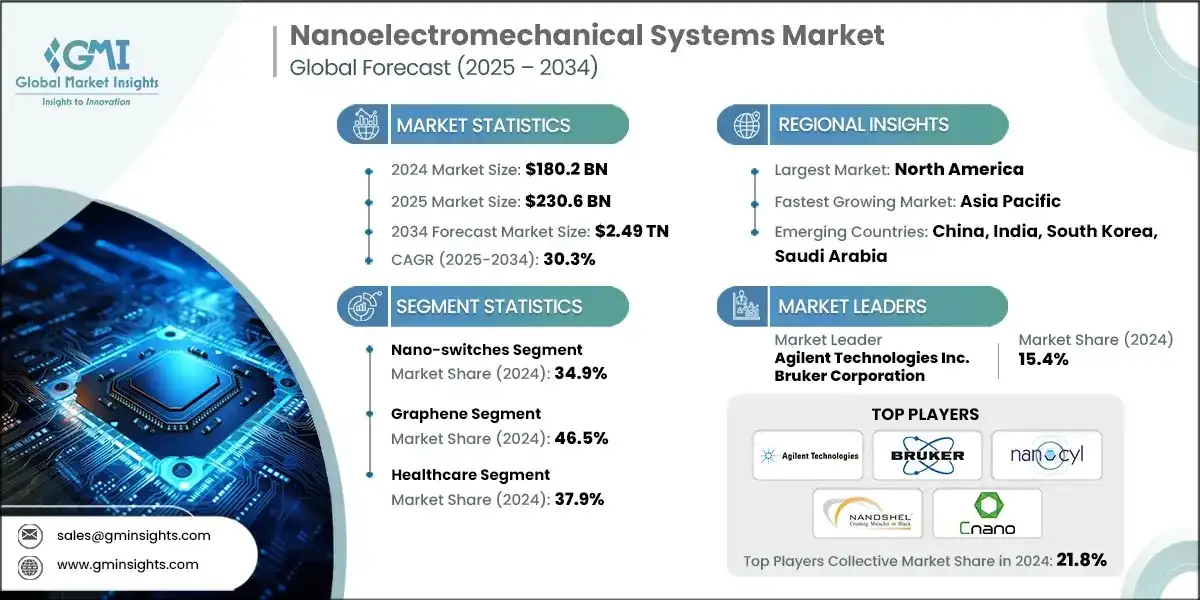
The global nanoelectromechanical systems market was estimated at USD 180.2 billion in 2024. The market is expected to grow from USD 230.6 billion in 2025 to USD 826.4 billion in 2030 and USD 2.49 trillion by 2034, at a CAGR of 30.3% during the forecast period of 2025–2034, according to Global Market Insights Inc.
Nanoelectromechanical Systems Market Key Takeaways
Market Size & Growth
- 2024 Market Size: USD 180.2 Billion
- 2025 Market Size: USD 230.6 Billion
- 2034 Forecast Market Size: USD 2.49 Trillion
- CAGR (2025–2034): 30.3%
Key Market Drivers
- Miniaturization of electronic devices.
- Advancements in nanotechnology and materials science.
- Emerging applications in biomedical and biosensing.
- Integration with IoT and smart devices.
- Growing demand from defense and aerospace sectors.
Challenges
- Complex and costly manufacturing processes.
- Reliability and standardization concerns.
Opportunity
- Expansion of NEMS in point-of-care diagnostics.
- Integration of NEMS in next-gen wearables.
- Adoption in quantum computing and high-frequency communication.
- Government and academic R&D initiatives in nanotech.
Key Players
- Market Leader: Agilent Technologies Inc. led with over 15.4% market share in 2024.
- Leading Players: Top 5 players in this market include Agilent Technologies Inc., Bruker Corporation, Nanocyl SA, Nanoshell Company, LLC, Cnano Technology Limited, which collectively held a market share of 21.8% in 2024.
Get Market Insights & Growth Opportunities
- As electronic devices tend to reach a smaller size while increasing functionality, the trend of ultracompact components is on the rise. Nanoelectromechanical systems (NEMS) fit this trend perfectly, since they provide an ultra-high performance nanoscale sensing, actuation, and signal processing. There are many application areas for NEMS, including smartphones, wearables, biomedical implants, next-generation consumer electronics, etc., where size is a major constraint. This trend towards miniaturization is forcing manufacturers to pursue NEMS, since they need to meet the performance and form-factor specifications being revised by these modern devices.
- Recent advances in nanotechnology and materials science, including graphene, carbon nanotubes, & next-generation silicon nanostructures, have enhanced the potential of NEMS dramatically. These advanced materials exhibit higher mechanistic strength, electrical connectivity, & higher energy efficiency at the very small scale. Existing and ongoing research continues to uncover new functionalities and processing methods, resulting in NEMS devices that can begin to approach reliability, sensitivity, and practicality for commercial applications. This rapid technological progress has heightened the availability and use of NEMS in many fields and applications, such as biomedical diagnostics, environmental monitoring and quality assessment, and next-generation computers.
- The global nanoelectromechanical systems market is categorized into application segments, sensing & control applications, tools & equipment, solid-state electronics and biomedical devices. Under application segments, sensing & control applications have accounted for 39% of the market share in 2024. Sensing and control applications will drive the NEMS market due to the increasing demand for ultra-sensitive, low-power sensors in various industries, including healthcare, automotive, and industrial automation. NEMS devices can sense very small changes in specific physical situations, making them useful probes for highly accurate and precise measurements, which encourages adoption in smart systems and rapid control technologies.
- In 2024 North America held the largest share in the global market at 37.6%, worth USD 67.7 billion. The NEMS market in North America is rapidly expanding due to government funding, advanced research infrastructure and a broader adoption of these technologies in healthcare, defense, electronic devices and more. The increased focus on sensor miniaturization and energy efficiency combined with growing demand for nanoscale technologies is stimulating regional development and innovation.
To get key market trends
Nanoelectromechanical Systems Market Trends
- Recent trend observed in the market are increasing adoption of advanced materials such as piezoelectric, ferroelectric, and 2D materials (graphene, MoS2) that will aid in development of multifunctionality in single device. Use of advanced material will enhance device performance and reduces component count.
- This trend is expected to create new opportunities for payers as they can invest in R&D for advanced material and secure IP in advanced fabrication methods. This will help in differentiating their product and attract new customers.
- Another trend observed in the market is rise of IoT ecosystems and wearable devices which is pushing demand for ultra-low power NEMS sensors and actuators that enables in longer operational life of product. This trend drives large-scale adoption in consumer electronics, healthcare monitoring, and industrial edge-sensing, where reliability, miniaturization, and biocompatibility are critical.
Nanoelectromechanical Systems Market Analysis

Learn more about the key segments shaping this market
Based on product type, the market is segmented into nano-tweezers, nano-cantilevers, nano-switches, nano-accelerometers, and nano-fluidic modules. The nano-switches segment accounts for the highest market share of 34.9% and the pouches segment is the fastest-growing segment with a CAGR of 31.9% during the forecast period.
- The nano-switches segment was the largest market and was valued at USD 62.8 billion in 2024. The nano-tweezers market is fueled by the rising demand for high-precision manipulators for use in molecular biology, genetics, and nanomedicine. These manipulators allow for the isolation and manipulation of nanoscale objects, such as DNA, proteins, and individual cells, that are required for single-cell analysis and targeted drug delivery applications.
- Applications of nano-tweezers are increasingly being used with optical, magnetic, and electrically-based system combination technologies to enhance controllability & selectivity. A strong trend exists for the development of automated & AI-empowered tweezing systems that will provide a higher level of precision for nano-manipulation. Their continued miniaturization is enabling the addition to lab-on-a-chip capabilities for real diagnostics and single molecule analysis. The potential use in point-of-care testing environments is limitless.
- The nano-cantilevers segment is the second fastest growing market and is anticipated to grow with a CAGR of 30.7% during the forecast period. Nano-cantilevers are gaining traction due to their high sensitivity and mechanical responsiveness, making them ideal for biosensing applications such as early disease detection, environmental monitoring, and chemical sensing. The miniaturization and shift toward label-free detection systems are also helping to grow this need. The renewed funding, both public and private, of nanotechnology, as well as the increased emphasis of personalized medicine and rapid diagnostics, are major contributors to the uptrend in this market segment.
- Producers of nano-cantilevers should focus on enhancing sensitivity and durability to strengthen applications in biosensing and environmental monitoring. Developing modular designs adaptable to multiple industries will drive competitiveness. Partnerships with semiconductor firms can accelerate commercialization and broaden global market penetration.
Learn more about the key segments shaping this market
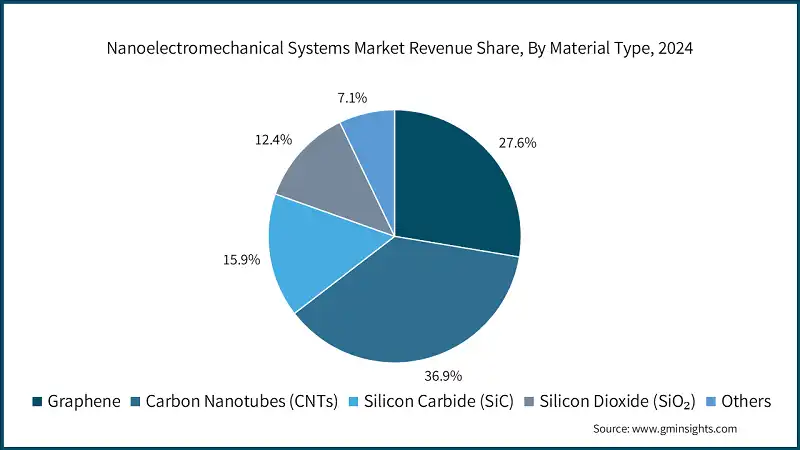
Based on material, the nanoelectromechanical systems market is segmented into graphene, Carbon Nanotubes (CNTs), Silicon Carbide (SiC), Silicon Dioxide (SiO2), and Others. The graphene segment accounts for the highest market share of 46.5%.
- The graphene was the largest segment and accounted for USD 49.8 billion in 2024. Graphene is emerging as an extremely sought-after material in NEMS due to its improved electrical conductivity, mechanical strength, and flexibility. It’s very thin thickness along with high mobility carriers render it highly suitable for high-frequency transistors, nano-switches, and sensors. The interest is also being created due to the need for faster, low-energy electronic devices in future communication and computing systems. Graphene's biocompatibility is also driving it into biosensors and medical NEMS devices.
- Increased activity on integrating graphene with flexible and wearable electronics and creating novel applications in health monitoring and soft robotics. Transition towards multi-layer graphene architectures is enhancing device performance and longevity. Furthermore, large-scale and low-cost methods of graphene synthesis, including chemical vapor deposition (CVD), are gaining increased commercial interest, triggering mass-market adoption in various NEMS applications.
- The carbon nanotubes (CNTs) is the fastest-growing market and is anticipated to grow with a CAGR of 31.9% during the forecast period. Carbon Nanotubes are extensively used in NEMS due to their superior strength-to-weight ratio, thermal conductivity, and electrical properties. Their high aspect ratio and nanoscale diameter make them ideal for use in ultra-sensitive sensors, actuators, and resonators. Growing use in nano-switches, memory devices, and field emission displays coupled with increasing demand for lightweight, high-performance components in aerospace, automotive, and healthcare industries is driving CNT adoption strongly.
- Recent trends focus on the functionalization of CNTs for increasing substrate compatibility and sensing properties. Interest is also increasing in the use of CNTs in hybrid NEMS structures with more than one nanomaterial for offering multifunctional applications. Additionally, advances in mass production techniques for ensuring defect-free large-scale growth of CNTs are facilitating their commercial use for electronic and electromechanical systems. Producers of CNT-based NEMS should enhance structural uniformity and integration with semiconductor platforms. Investment in improving reproducibility will drive trust among industrial clients. Strategic partnerships with aerospace and healthcare companies can unlock opportunities in sensing, energy storage, and diagnostic applications.
Based on the end use, the nanoelectromechanical systems market is segmented into automotive, consumer electronics, industrial, healthcare, and others. The healthcare segment accounts for the highest market share of 37.9% and is projected to grow with a CAGR of 31.7% during the forecast period.
- The healthcare segment was the largest market and was valued at USD 68.2 billion in 2024. The healthcare industry is increasingly using NEMS for diagnostics, drug delivery, and patient monitoring due to their high sensitivity, biocompatibility, and small size. A few of the applications of NEMS are biosensors for early detection of diseases, implant devices, lab-on-a-chip diagnostic devices, and minimally invasive surgical tools. Growing demand for customized medicine and real-time monitoring of health is propelling the adoption of NEMS technologies in clinical and home-care settings.
- There is competitive expansion in wearable and implantable NEMS devices for continuous health monitoring, including glucose sensors, cardiac monitoring, and neural probes. There is also the development of smart drug delivery systems based on nano-actuators. Moreover, integration with AI and cloud-based healthcare platforms is enabling real-time analysis and remote diagnosis, making NEMS a chief enabler to the future of digital healthcare.
- The consumer electronics segment was the second fastest growing segment and is anticipated to grow with a CAGR of 30.6% during the forecast period. Consumer electronics is among the largest end-user markets for NEMS with demand for tiny yet high-performance components in smartphones, wearables, tablets, and smart home devices. NEMS have more use in motion sensors, microphones, pressure sensors, and switches due to their very small size and low power usage. The proliferation of IoT devices and growing consumer requirements for rich-feature, portable devices are the prime drivers for this segment.
- There is a strong trend towards stretchable and flexible NEMS devices for integration into next-gen wearables as well as foldable technology. Voice interfaces and gesture-controlled technologies are also propelling the advancement of ultra-sensitive nano-sensors. Producers should prioritize ultra-compact, energy-efficient NEMS components to meet rising demand in smartphones, wearables, and IoT devices. Emphasizing affordability and integration flexibility is crucial. Collaboration with global electronics brands will help scale production and strengthen competitiveness in consumer markets.
Looking for region specific data?
The North America nanoelectromechanical systems market held 37.6% market share and is growing at a 28.9% CAGR. North America’s growth in the NEMS market is driven by strong R&D investments from both public institutions and private tech giants.
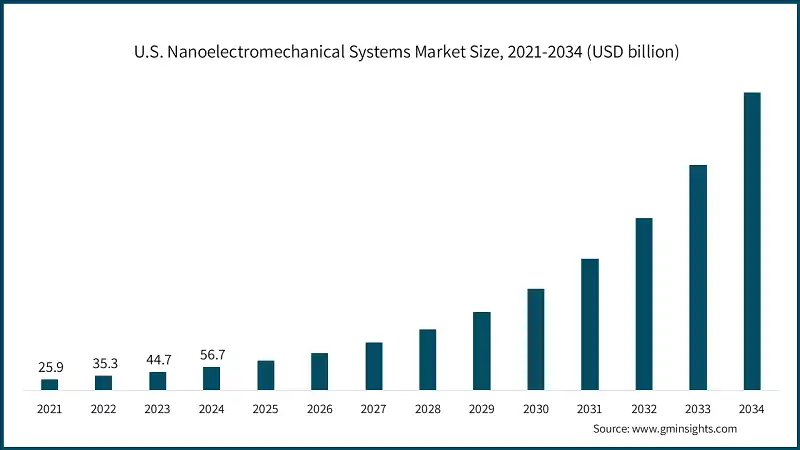
- The market in the U.S. has been expanding steadily, achieving a CAGR of 29.4% and reaching a valuation of USD 56.7 billion in 2024. The U.S. government supports leading technology companies, universities, and federal research programs that are developing solutions that leverage nanotechnology. Rapid adoption of NEMS in the defense, aerospace, consumer electronics, and healthcare industries, strong intellectual property protection, and a mature VC ecosystem, has accelerated growth in the NEMS market.
- The U.S. market has great opportunities to further develop commercial feasibility for NEMS product solutions, especially personal health care, quantum computing, and autonomous vehicle system solutions. Focus and discussions on reshoring semiconductor manufacturing and associated Federal funding acts like the CHIPS and Science Act, creating opportunities and stimulating domestic manufacturing of nano-scale components. The focus of country spending on the inclusion or deducing the inclusion of NEMS in federal funding for next-gen communication ties directly into potential growth of U.S. domestic players with national defense systems and overall national communication infrastructure development.
- The Canada nanoelectromechanical systems market is projected to grow significantly with a CAGR of 25.8% during the forecast period. Canada’s NEMS market is supported by increasing investment in nanotechnology research, its strong academic ecosystem, and growing interest in clean and high-performance electronic systems. Canada’s focus on clean technology, health-innovation, and advanced manufacturing has some interesting synergy with NEMS devices. Canada also has government support through grants and collaborative research/industry opportunities and is particularly important in the areas of biomedical devices and environmental sensing, which are the dominant use cases for NEMS adoption.
- In terms of opportunity space in Canada, NEMS has the potential to expand applications in the area of resource monitoring. The niche position of Canada in having a leading role in medical nanodevice innovation can be leveraged even more with direct partnership agreements between universities and startups to strengthen field in low & ultralow dimension sensing. Finally, growing interest in AI and edge computing provides an ideal environment for NEMS to be integrated into the low-power and ultra-sensitive sensors marketplace for smart infrastructure and wearables.
Europe held a 24.3% share and a 29.8% CAGR, Europe’s NEMS market is being propelled by government-led initiatives in precision healthcare, sustainable manufacturing, and nano-innovation.
- The Germany nanoelectromechanical systems market reached a valuation of USD 11.2 billion in 2024 and is anticipated to grow with a CAGR of 29.5% during the forecast period. Germany long history of precision engineering and automotive development, along with extensive industrial automation investments, will only serve to accelerate the NEMS adoption curve. Germany push to focus on smart manufacturing through its "Industry 4.0" ambitions will push demand for ultra-compact, high-precision sensing technologies. NEMS are being examined for applications in advanced robotics, factory automation, and next-gen automotive sensors, in line with Germany's legacy in high-end manufacturing and export-driven markets.
- There are also considerable opportunities in the biomedical and environmental monitoring areas. Due to Germany's established healthcare delivery system, strong environmental regulations, and highly-developed environmental policy, it is a natural market for NEMS-based diagnostic sensors and pollution detection devices. In addition, Germany has a rich R&D ecosystem, with heavy leverage of institutional/educational partners, such as Fraunhofer and Max Planck, providing a valuable asset for NEMS development and commercialization across both academic and private industry.
- The UK nanoelectromechanical systems market is anticipated to surpass USD 160.2 billion by 2034. In the UK, the rapid growth of the life sciences and electronics sectors is a key driver for the NEMS market. The increasing utilization of biomedical research and wearable health technology means there is demand for high-sensitivity miniaturized sensors. NEMS are being integrated into ground-breaking research and commercial products for health monitoring, the diagnosis of diseases, and compact biosensing systems. This is especially true for universities and supply chain start-ups.
- The UK is considerably full of opportunities for NEMS, both regarding academic-industry collaborations and early-stage technology development. There are schemes with government backing, such as Innovate UK and Catapult centres pushing R&D in nanotechnology and advanced materials that provide funding and infrastructure support for NEMS technologies.
The Asia-Pacific region dominated the nanoelectromechanical systems market in terms of growth and accounted for 33.9% CAGR. The Asia Pacific region is witnessing rapid growth in the NEMS market due to increasing semiconductor manufacturing, rising healthcare investments, and government support for nanotechnology in countries like China, Japan, and South Korea.
- The China market was valued at USD 15.3 billion in 2024 and is anticipated to grow with a CAGR of 34.7% during the forecast period. The NEMS market is being driven by China's powerful semiconductor manufacturing ecosystem and ongoing investment from the Chinese government on next-generation electronics R&D. The accelerated adoption of nanotechnology in telecommunications, defense, and consumer electronic applications is driving component-level demand for miniaturized, high-performance components (NEMS-based sensors and NEMS-based actuators).
- China's opportunity lies in the NEMS-related and NEMS-based systems that are used to develop and integrate NEMS into large, scale-based applications (5G infrastructure, AI hardware, and autonomous systems). As the government ramps up its push for self-reliance in micro/nanoelectronics, these local NEMS innovations may be strongly supported and adopted by both the government and industry in specific healthcare diagnostic applications and, it is believed, in applications aligned with smart manufacturing.
- The Japan nanoelectromechanical systems market has been experiencing steady expansion, achieving a compound annual growth rate of 33.3% and attaining a valuation of USD 9 billion in 2024. Japan excellence in precision engineering, nanomaterials, and new sensor technologies helps it serve as a prominent catalyst for the advancement of NEMS technologies. Japan's focus on miniaturized healthcare devices and high-end MEMS applications in automotive safety systems could help scale large amounts of commercial products with NEMS components.
- The increased demand for wearable health technology, micro-robotics, and sophisticated metrology devices will ultimately open new avenues for growth in the NEMS market in Japan. Partnerships between universities and major electronics companies help pave the way for breakthroughs, new products, and commercialization of ultra-sensitive, low-power devices using NEMS technology.
- The India nanoelectromechanical systems market was valued at USD 7.8 billion in 2024 and is predicted to grow with a CAGR of 35.9% during the forecast period. India's rising investment in nanotechnology and growing electronics manufacturing sector create potential for the development of the NEMS market. There are positive growth drivers from governmental initiatives like "Make in India," which stimulate support for indigenous R&D around defense and medical technologies that generates innovation in nanoscale device engineering.
- There is a growing opportunity for NEMS in low-cost medical diagnostics, environmental monitoring and industrial automation in India. As demand for smart sensors and energy-efficient systems increase, local startups and research institutes are well positioned to commercialize NEMS technologies that suit regional needs.
Latin America held 6.5% market share and is growing with a CAGR of 27.7%. In Latin America, the growth of the NEMS market is primarily driven by emerging investments in medical technology and environmental monitoring. Countries such as Brazil and Mexico are focusing on adopting nanoscale devices for disease diagnostics, pollution detection, and precision agriculture, backed by improving research infrastructure and international partnerships.
The Middle East & Africa nanoelectromechanical systems market was valued at USD 10.9 billion in 2024. The MEA region is experiencing growing interest in NEMS due to increasing demand for smart infrastructure and energy efficiency.
- The South Africa market is projected to grow with a CAGR of 23.3% during the forecast period. The increasing demand for diagnostic devices and healthcare technologies in South Africa is stimulating the NEMS market. The demands in South Africa for improving healthcare access and infectious diseases, increasing interest in smaller, more affordable biosensors and diagnostic platforms to take advantage of the strong points of NEMS. The expanding electronics and academic research base in South Africa is looking to access nanoscale technologies to achieve localized innovations.
- South Africa allows for NEMS opportunities; in public health and environmental monitoring applications, NEMS-based biosensors for the detection of diseases in rural areas can provide scale and affordability. South Africa's environmental challenges also require advanced sensors for the monitoring of air and water qualities. The emerging partnerships between the government, universities for projects based nanotechnology and biomedical innovations provide further opportunity for commercialization of NEMS.
- The Saudi Arabia nanoelectromechanical systems market is projected to surpass USD 47.5 billion by 2034. Saudi Arabia's efforts to diversify its economy and embrace technology as part of its Vision 2030 program are increasing demand for various advanced sensor technologies, including NEMS. Investment and projects across digital healthcare, smart infrastructure, and industrial automation sectors represent possibilities for the adoption of nanoscale sensors. The acceleration of the NEMS business is a direct result of the country's initiative to reduce oil dependency and focus on developing technology sectors.
- In Saudi Arabia, opportunities exist for the deployment of NEMS as part of smart city initiatives, monitoring oil fields, and for medical diagnostics. With large investment and megaprojects such as NEOM and others being launched across the GCC, there is current and growing demand for small and energy efficient sensor that can be deployed in distributed, real-time data collection in urban settings, healthcare systems, and industrial needs. Research institutes and new innovation centers provide options for collaboration and piloting NEMS technologies.
- The UAE nanoelectromechanical systems market accounted for USD 3.3 billion in 2024. The rapid digital transformation and fast-paced ICT developments in the UAE and its leadership for smart technology adoption provide overall growth factors for the overall NEMS market. The investments the UAE is making in health innovation, autonomous systems, and next-gen infrastructure justifies the demand for highly sensitive and energy-efficient sensors and actuators. Furthermore, the UAE sends a strong message about becoming a tech hub, pushing early adoption of new and emerging nanotechnologies such as NEMS.
- NEMS provides extensive opportunities in various sectors in the UAE including smart health, aerospace, and environmental management. The UAE's strong ambitions in the space sector and growing interest in precision medicine correspond well with the capabilities of NEMS. Government strategies promoting innovation like the UAE National Innovation Strategy, and its collaboration with the global R&D community creates attractive opportunities for piloting and scaling NEMS-based solutions.
Nanoelectromechanical Systems Market Share
- The top 5 companies Nanocyl SA, Nanoshell Company, LLC, Cnano Technology Limited, Agilent Technologies Inc., and Bruker Corporation collectively hold around 21.8% of the market, indicating a consolidated market concentration.
- Agilent Technologies Inc. dominates with 9.8% market share. Agilent Technologies focuses on new developments in nanomechanical testing and precision measurement systems to enable innovation across the life sciences and semiconductor market. Agilent employs its breadth of R&D resources to drive celestial improvements in atomic force microscopy tools and their integrations of NEMS solutions into their broader tool set. Agilent collaborates with research institutions and continues to improve the use of application-specific instruments, positioning themselves as the market leader through continuing technical improvements through disciplines' strategic push to influence transformative technology.
- Bruker Corporation holds a major position in the market, accounting for 5.6% of the total market share. Bruker is focusing on growing its nanoscience instrumentation portfolio that includes atomic force microscopy and the characterization of nanoscale materials. The company also investing more on R&D and innovation to support advanced applications in materials science, biomedical engineering and electronics.
- Nanocyl SA holds a major position in the market, accounting for 2.2% of the total market share. Nanocyl SA focuses on carbon nanotube (CNT) technology, providing advanced materials that aid in the development of the NEMS technologies. The company is committed to providing additives and composites based on engineered CNTs for applications in electronics, automotive, and aerospace segments. Nanocyl puts a strong emphasis on above average material quality and customization, thus helping with integrations of CNTs into nanoscale mechanical and sensing components.
- Nanoshell Company, LLC has a focused strategy developing proprietary nanoshell-based materials to meet the demand for biosensing, nano-optics, and actuation. Nanoshell Company, LLC partners with academic institutions and other healthcare companies to R&D specific nanomaterials for research and diagnostic applications. Core to Nanoshell Company, LLC’s business model are nanoshell products with uncompromised purity and performance capabilities to ultimately facilitate a next-generation of NEMS-based biomedical innovations.
- Cnano Technology Limited is committed to establishing mass production of carbon nanotubes for flexible electronics, sensors, and energy devices. To achieve this goal, it will improve the scalability and consistency of its nanomaterials products to meet increasing industrial requirements. Cnano is actively seeking partnerships and opportunities to expand into new markets to strengthen its position and assist in providing industrial processes for economical NEMS manufacturing options.
Nanoelectromechanical Systems Market Companies
Some of the prominent market participants operating in the nanoelectromechanical systems industry include:
- Broadcom Corporation
- Bruker Corporation
- Cnano Technology Limited
- Electron Microscopy Sciences
- Fraunhofer-Gesellschaft
- Inframat Advanced Materials LLC
- Interuniversity Microelectronics Centre
- JBC S.L
- Merck KGaA
- Nanoshell Company, LLC
- onex technologies inc
- Raymor Industries Inc.
- Showa Denko K.K.
- Sun Innovations, Inc.
- Ubiquiti Inc.
- Broadcom Corporation, Bruker Corporation, and Merck KGaA have positioned themselves as leaders in the NEMS market. All companies have extensive global footprints, strong R&D capabilities, and a robust range of nano-enabled technologies. They are also continuing to invest in NEMS-related innovations across the semiconductor, life sciences, and material testing segments, positioning themselves to remain ahead of the technology curve and fulfill broad market demand at a fast pace.
- The challengers are Showa Denko K.K., Interuniversity Microelectronics Centre (IMEC), and Fraunhofer-Gesellschaft. Each has substantial technical knowledge and research assets within the NEMS domain, but their commercialization is considered to lag. However, given their engagement in academic-industry collaborations and innovation that requires considerable resources, their profile can shift to lead with sufficient scaling strategy.
- Raymor Industries Inc., Cnano Technology Limited, Electron Microscopy Sciences, and Ubiquiti Inc. are categorized as followers. While these companies participate in the NEMS business, they have limited industry impact and scope of business. These companies usually focus on specific materials, devices or integration technologies and typically sell to larger companies or niche applications with limited market control.
- Nanoshell Company, LLC, Inframat Advanced Materials LLC, Sun Innovations, Inc., JBC S.L., and Onex Technologies Inc are targeted niche players in the NEMS market. These companies tend to provide specialized technologies like nanoshell fabrication, advanced coatings, and custom instrumentation. Their market strengths are being agile, customizable, and catering to highly specific market needs, usually with collaboration with a research lab or specialized end-user.
Nanoelectromechanical Systems Market Report Attributes
| Key Takeaway | Details |
|---|---|
| Market Size & Growth | |
| Base Year | 2024 |
| Market Size in 2024 | USD 180.2 Billion |
| Market Size in 2025 | USD 230.6 Billion |
| Forecast Period 2025 - 2034 CAGR | 30.3% |
| Market Size in 2034 | USD 2.49 Trillion |
| Key Market Trends | |
| Drivers | Impact |
| Miniaturization of electronic devices | Drives 30% growth in demand for ultra-compact, low-power NEMS components across industries. |
| Advancements in nanotechnology and materials science | Enables 35% improvement in NEMS sensitivity and performance, accelerating R&D adoption. |
| Emerging applications in biomedical and biosensing | Fuels 40% expansion in NEMS-based diagnostic and monitoring device deployment. |
| Integration with IoT and smart devices | Supports 33% increase in NEMS sensor integration for low-power, always-on smart devices. |
| Growing demand from defense and aerospace sectors | Spurs nearly 25% rise in demand for high-reliability NEMS for tactical and space systems. |
| Pitfalls & Challenges | Impact |
| Complex and costly manufacturing processes | Limits scalability and deters mass-market adoption due to technical and economic barriers. |
| Reliability and standardization concerns | Creates hesitation among manufacturers and slows commercialization due to inconsistent long-term performance and lack of industry norms. |
| Opportunities: | Impact |
| Expansion of NEMS in point-of-care diagnostics | Enables ultra-sensitive, portable medical testing devices, improving early disease detection and personalized healthcare. |
| Integration of NEMS in next-gen wearables | Supports development of ultra-thin, flexible sensors for continuous health monitoring and smart textile applications. |
| Adoption in quantum computing and high-frequency communication | Enhances precision and control in quantum devices and RF systems, paving the way for cutting-edge computing and communication solutions. |
| Government and academic R&D initiatives in nanotech | Accelerates technological breakthroughs and commercialization through funding, collaborations, and infrastructure development |
| Market Leaders (2024) | |
| Market Leaders |
Top 2 companies hold 15.4% market share |
| Top Players |
Collective market share in 2024 is 21.8% |
| Competitive Edge |
|
| Regional Insights | |
| Largest Market | North America |
| Fastest Growing Market | Asia Pacific |
| Emerging Country | China, India, South Korea, Saudi Arabia |
| Future Outlook |
|
What are the growth opportunities in this market?
Nanoelectromechanical Systems Industry News
- In March 2025, Advantest America and Emerson have partnered to revolutionize semiconductor testing using AI and machine learning. Their collaboration enables real-time decision-making, improved efficiency, and higher yields through advanced data analytics and edge computing. While the Advantest-Emerson partnership focuses on AI-driven semiconductor testing, it will benefit the NEMS industry by enhancing fabrication quality, improving defect detection, and increasing production efficiency.
The nanoelectromechanical systems market research report includes in-depth coverage of the industry with estimates and forecasts in terms of revenue in (USD billion) from 2021 – 2034 for the following segments:
Market, By Product Type
- Nano-tweezers
- Nano-cantilevers
- Nano-switches
- Nano-accelerometers
- Nano-fluidic modules
Market, By Material Type
- Graphene
- Carbon Nanotubes (CNTs)
- Silicon Carbide (SiC)
- Silicon Dioxide (SiO2)
- Others
Market, By Fabrication Technology
- Surface micromachining
- Silicon on Insulator (SOI) technology
- LIGA (Lithography, Electroplating, and Molding)
- Bulk micromachining
- Others
Market, By Application
- Sensing & control applications
- Tools & equipment
- Solid-state electronics
- Biomedical devices
- Consumer electronics
Market, By End Use
- Automotive
- Consumer electronics
- Industrial
- Healthcare
- Others
The above information is provided for the following regions and countries:
- North America
- U.S.
- Canada
- Europe
- Germany
- UK
- France
- Spain
- Italy
- Netherlands
- Asia Pacific
- China
- India
- Japan
- Australia
- South Korea
- Latin America
- Brazil
- Mexico
- Argentina
- Middle East and Africa
- Saudi Arabia
- South Africa
- UAE
Frequently Asked Question(FAQ) :
What is the market size of the nanoelectromechanical systems industry in 2024?
The market size was USD 180.2 billion in 2024, with a CAGR of 30.3% expected through 2034 driven by miniaturization of electronic devices.
What is the current nanoelectromechanical systems market size in 2025?
The market size is projected to reach USD 230.6 billion in 2025.
What is the projected value of the nanoelectromechanical systems industry by 2034?
The nanoelectromechanical systems industry is expected to reach USD 2.49 trillion by 2034, supported by rapid adoption in consumer electronics, biomedical devices, and IoT integration.
How much revenue did the sensing & control applications segment generate in 2024?
Sensing & control applications generated 39% of the market share in 2024, leading adoption due to demand for ultra-sensitive, low-power sensors across healthcare, automotive, and industrial automation.
What was the valuation of the nano-switches segment in 2024?
The nano-switches segment was the largest product category, valued at USD 62.8 billion in 2024, driven by high adoption in miniaturized consumer electronics and next-gen computing applications.
What is the growth outlook for the carbon nanotubes material segment from 2025 to 2034?
Carbon nanotubes are projected to grow at a CAGR of 31.9% till 2034, fueled by their superior strength, conductivity, and applications in aerospace, automotive, and healthcare industries.
Which region leads the nanoelectromechanical systems market?
The U.S. market reached USD 56.7 billion in 2024, expanding at a CAGR of 29.4%. Growth is fueled by strong federal funding, advanced R&D infrastructure, and early adoption of nanotechnology in defense, aerospace, healthcare, and electronics.
What are the upcoming trends in the nanoelectromechanical systems industry?
Key trends include adoption of graphene and CNT-based materials, integration of NEMS into IoT and wearable devices, expansion in biomedical diagnostics, and growing applications in quantum computing and high-frequency communication.
Who are the key players in the nanoelectromechanical systems market?
Key players include Agilent Technologies Inc., Bruker Corporation, Nanocyl SA, Nanoshell Company LLC, Cnano Technology Limited, Broadcom Corporation, Merck KGaA, Fraunhofer-Gesellschaft, Showa Denko K.K., and Ubiquiti Inc.
Nanoelectromechanical Systems Market Scope
Related Reports