Summary
Table of Content

Mycelium-Based Protein Ingredients Market
Get a free sample of this report
Form submitted successfully!
Error submitting form. Please try again.
Thank you!
Your inquiry has been received. Our team will reach out to you with the required details via email. To ensure that you don't miss their response, kindly remember to check your spam folder as well!
Request Sectional Data
Thank you!
Your inquiry has been received. Our team will reach out to you with the required details via email. To ensure that you don't miss their response, kindly remember to check your spam folder as well!
Form submitted successfully!
Error submitting form. Please try again.
Mycelium-Based Protein Ingredients Market Size
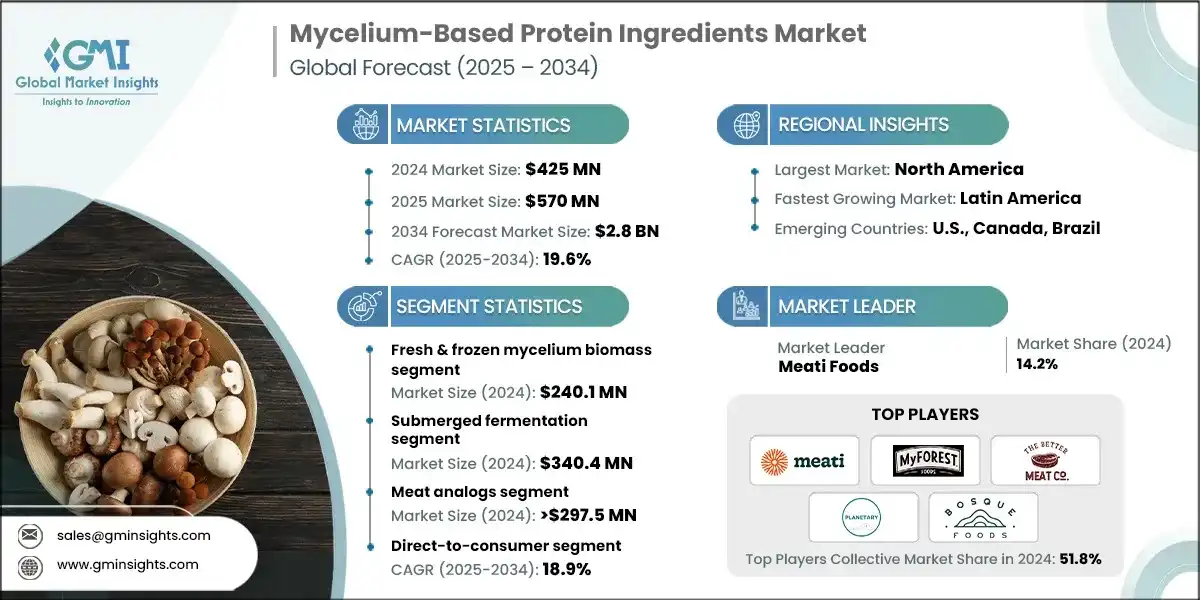
The global mycelium-based protein ingredients market was valued at USD 425 million in 2024. It is expected to grow from USD 570 million in 2025 to USD 2.8 billion by 2034, at a CAGR of 19.6%, according to latest report published by Global Market Insights Inc.
Mycelium-Based Protein Ingredients Market Key Takeaways
Market Size & Growth
- 2024 Market Size: USD 425 Million
- 2025 Market Size: USD 570 Million
- 2034 Forecast Market Size: USD 2.8 Billion
- CAGR (2025–2034): 19.6%
Regional Dominance
- Largest Market: North America
- Fastest Growing Region: Latin America
Key Market Drivers
- Rising consumer demand for sustainable protein sources.
- Environmental benefits over animal agriculture.
- Technological advancements in fermentation.
Challenges
- High production costs compared to plant proteins.
- Limited consumer awareness & acceptance.
Opportunity
- Development of clinical nutrition applications.
- Integration with food waste valorization.
Key Players
- Market Leader: Meati Foods led with over 14.2% market share in 2024.
- Leading Players: Top 5 players in this market include Meati Foods, MyForest Foods, Better Meat Co, Planetary, Bosque Foods, which collectively held a market share of 51.8% in 2024.
Get Market Insights & Growth Opportunities
- Growing consumer interest in sustainable sources of protein is one of the main market drivers: mainstream consumers are shifting towards high-protein, low-impact products, retailers and foodservice operators are stocking fungi-based products (such as a fungi-protein yogurt released nationwide by one of the large natural-food retailers). The change has been translated into faster product releases and increased capacity in production throughout the alternative-protein ecosystem.
- Technological improvement in the engineering of fermentation and bioprocess engineering is making commercial projects aim at many-thousand-ton-per-annum production, with industrial bioreactors with finer control of the process to increase yields and consistency. This shift of pilot- to industrial-scale is evidenced by the recent project funding and factory-building news, which directly increases the quantity of tons of ingredients available to formulators and food manufacturers.
- There is an accelerating capacity expansion and R&D both in investment flows (both the private VC rounds and government grants/loans) and in industry level reporting, and there have been announced multi-million-euro funding packages and factory investments (at individual companies) to ensure supply. This capital inflow makes the time to commercial scale much shorter, unit costs smaller due to economies of scale, and supports the expansion of the market-size which manufacturers and buyers’ document.
To get key market trends
Mycelium-Based Protein Ingredients Market Trends
- One of the trends is the shift towards whole-cut fungal products like steaks, cutlets and fillets, instead of ground and minced products. To provide more lifelike meat cuts, companies are investing in structural engineering and advanced fermentation to give fiber alignment. The change enhances consumer acceptance, enables premium pricing, and enables brands to compete with traditional animal products in the food service. The trend is also connected to the retail premiumization and chef product development as restaurants are increasingly testing whole-cut formats to vary menus.
- Mycelium-based companies are also entering into agreements with restaurant chains, workplace cafeterias, and meal-delivery companies as a method to enter the market more quickly. Such partnerships contribute to an increase in the rate of consumer trials, and consumer trials are frequently better with dine-out channels than with retail shelves. With the trend of menu diversification and sustainability differentiation, fungal protein is an ideal answer because it is scalable and has a clean-label ingredient.
- Fermentation processes are being digitized by the addition of automation and digital sensors as well as using AI-based control platforms to streamline yield, resource use, and energy consumption. Intelligent bioreactor control enables control changes in oxygenation, temperature, or nutrient delivery in real-time to enhance the consistency and lower the cost of production per kilogram. The trend directly facilitates the scale industrial roll out and enables firms to show better operational KPIs to the investors and industrial purchasers.
- Governments in Europe, Singapore, Israel, and North America are enhancing more grants, regulatory acceleration, pilot infrastructure, and innovation zones to encourage alternative protein production. The effect of this policy pull is faster factory building, investor confidence and institutional purchase commitment. Policy support also has an impact on the downstream market dynamics: schools, hospitals, and public food programs can be early adopters, which can help to normalize consumption outside of niche early adopters and is an indicator of systemic market maturity.
Mycelium-Based Protein Ingredients Market Analysis
Learn more about the key segments shaping this market
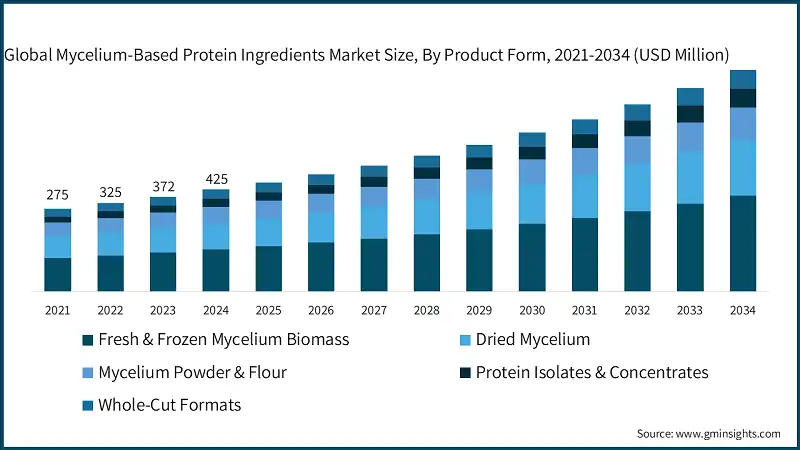
Based on product form, the market is segmented into fresh & frozen mycelium biomass dried mycelium, mycelium powder & flour, protein isolates & concentrates, and whole-cut formats. Fresh & frozen mycelium biomass segment was worth USD 240.1 million in 2024.
- Fresh and frozen mycelium biomass occupies the leading market share in the product form segmentation based on its applicability to least-processed, whole-food usage and means to meet clean-label and natural ingredient expectations. Its fiber content and meaty texture means that manufacturers can simply use it as a whole-cut product, as a patty or ready-made meal without subjecting it to heavy processing, which puts it at an advantage over powders and isolates. The format is also attractive to those who require shorter ingredient lists, lower downstream processing costs, greater scalability and accelerated commercialization in retail and foodservice markets.
- Functional food, nutrition bars, beverages, and hybrid plant-based formulations are all expanding steadily with other formats like powders, flours and protein concentrates under company focus. These processed versions have extended shelf life, increased use in dry-blend production, and can be used in cross-category development. Whole-cut formats are on the rise because new technologies can allow the creation of structured and meat-like textures that are more acceptable to consumers and help position it at a premium price.
Based on production technology, the mycelium-based protein ingredients market is segmented into submerged fermentation, solid-state fermentation, continuous aerobic fermentation, and batch & fed-batch fermentation. The submerged fermentation segment was valued at USD 340.4 million in 2024.
- Submerged fermentation is the most popular type of production technology with the highest percentage of production because it is scalable, gives specific control of the process, and works with big bioreactors in industry. With this approach, temperature, oxygen, pH and nutrient delivery can be continuously monitored, leading to a steady increase in biomass and improved productivity in such systems as opposed to conventional systems. Cost optimization can also be optimized through technology, and it can be applied in businesses that want to cater to many supplies to food manufacturers and QSR chains.
- Other technologies like the solid-state, batch, fed batch, and continuous aerobic fermentation are also becoming relevant as producers determine how texture, flavor development and functional attributes can be optimized towards end-use consumer requirements. Solid-state fermentation has benefits in the enhancement of sensory complexity and structural properties, but it is limited by automation and scale. Continuous and fed-batch systems are under investigation to enhance the yields and shorten the downtimes, as well as enhancing energy and input efficiency.
Based on application, the mycelium-based protein ingredients market is segmented into Meat Analogs, Dairy Analogs, Baked Goods, Beverages, Snacks & Processed Foods, Sports Nutrition & Supplements, Clinical Nutrition, Animal Feed. The meat analogs was worth over USD 297.5 million in 2024.
- Meat analogs occupy the biggest portion of the application space due to the growing need for sustainable and clean-labeled options that can be easily compared to meat in terms of its texture and nutritional value. The natural fibrous makeup of mycelium offers consumers a meaty bite with little processing resulting in the brand providing products that meet the expectations of consumers in terms of authenticity and ingredient disclosure. Categories’ domination is further accelerating with growing retail presence, restaurant chain relationships and more investments into whole-cut product formats.
- Other foods such as dairy analogs, baked goods, beverages, snacks, sports nutrition, and clinical nutrition are also growing in use slowly as manufacturers consider more applications to exploit the functional and nutritional properties of mycelium. The segments have a positive response to the neutrality of the ingredient, its digestibility, and micronutrient profile because it can be developed into fortified food solutions and performance-based formulations. Animal feed is a new direction as feed producers turn to low-resource protein substitutes such as livestock and aquaculture feeds, especially in areas with sustainability and food security issues.
Learn more about the key segments shaping this market
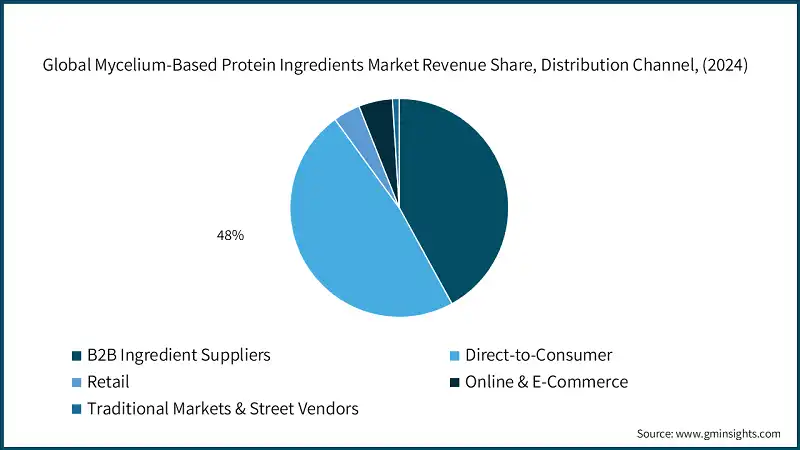
Based on distribution channel, the mycelium-based protein ingredients market is segmented into B2B ingredient suppliers, direct-to-consumer, retail, online & e-commerce, traditional markets & street vendors. The direct-to-consumer segment is estimated to grasp a value of USD 272 million in 2025 and is expected to grow at 18.9% of CAGR during 2025 to 2034.
- Direct-to-consumer has the biggest portion of the distribution environment, backed by the swift rise of digital-first food manufacturers and a high measure of fascination in new types of protein experiences in the doorstep of the consumers. Through this channel, companies can manage brand narratives, convey sustainability knowledge, gather immediate consumer responses, and quickly release product releases. The availability of subscription models, online store fronts and integrated logistics have enabled startups to grow rapidly without the need to rely on traditional retail listing charges and lengthy onboarding processes.
- Other distribution channels like B2B ingredient supply, retail and e-commerce marketplaces are also growing with firms moving away from niche discovery to mainstream distribution. B2B transactions are gaining momentum with food manufacturers and restaurant chains using mycelium-based products to build on product lines and distinguish themselves based on sustainability. The retail strength is enhanced by collaborating with natural food chains and high-end grocery stores, and e-commerce offers scale at reduced cost of operation. The conventional markets and street sellers are still restricted but have potential in the emerging markets as more people become aware of them and as they become available.
Looking for region specific data?
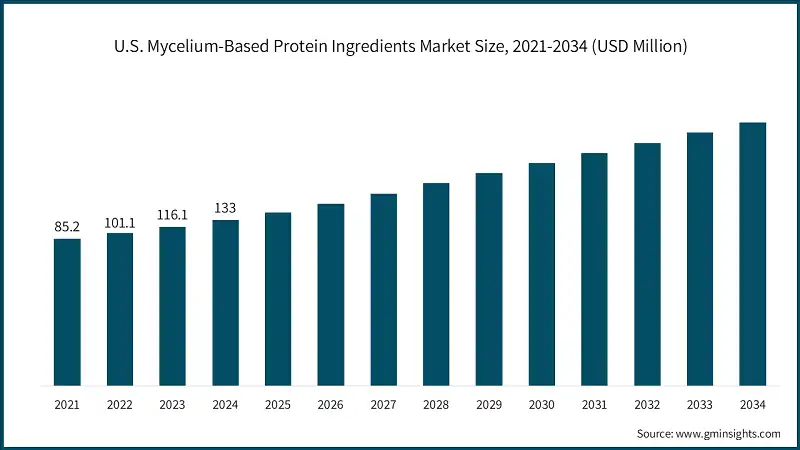
North America mycelium-based protein ingredients market accounted for USD 154.7 million in 2024 and is anticipated to show lucrative growth over the forecast period.
- North America has 36.4% market share in 2024 with the United States with the most dominant share because the region has a high number of commercial-scale fermentation plants, existing production infrastructure, and it was the first region to invest in fungal protein startups. Much venture funding is available to the region, which allows it to expand capacity very quickly, and go-to-market strategy even quicker, in retail and food service channels. The need for consumers to purchase clean-label, high-protein, and eco-friendly options is ever increasing, which is why retailers are eager to add new mycelium-based products to traditional categories.
- There are also regulatory transparency and dynamic research and development partnerships between industry and research institutions and government initiatives that contribute to expedited commercialization. U.S. also leads in scaling bioprocessing technologies that enable the manufactures to save on costs and gaining a better unit economics.
- Europe mycelium-based protein ingredients market accounted for USD 221.4 million in 2024 and is anticipated to show lucrative growth over the forecast period.
- Europe comprises 52.1% market share in 2024, which also focuses on the high demand for sustainable, low-impact protein sources and the initial regulatory approval of novel fermentation-based food ingredients. The highest share is held by such countries as Germany, the Netherlands, and the UK because of the presence of a developed alternative protein ecosystem, well-developed biotech research potential, and the favorable attitude of the government towards the development of food.
- Regional foods retailers and food producers are proactively using mycelium-based products in plant-based meat, prepared foods and functional products to address increasingly strict environmental and nutritional needs. The high climate goals and emphasis on the minimization of livestock emissions in the region increase the pace of adoption even further. There are also a well-established consumer awareness and readiness to pay a high price on eco-friendly sources of protein in Europe.
Asia Pacific mycelium-based protein ingredients market accounted for USD 26.4 million in 2024 and is anticipated to show lucrative growth over the forecast period.
- Asia-Pacific has a market share of 6.2% in 2024 and the market growth is driven by the growing urban populations, rising protein intake, and rising awareness of sustainable food substitutes. The governments are supporting food innovation initiatives and investing in precision fermentation and alternative protein startups, making countries like China, Singapore, and Japan some of the major adopters.
- The growing interest in mycelium-based ingredients is increasing rapidly due to the issue of food security that is becoming a major concern in the region, the insufficient land for agricultural production, and the necessity to diversify the sources of protein. The big manufacturers of food and the QSR chains are starting pilot projects to add fungi protein to meat alternatives, snacks, and fortified foods. The fact that Singapore is an early adopter of regulations in the alternative proteins field is a promising scale-up in the region, whereas Chinese industrial biotechnology offers effective economies of scale and production.
Latin America mycelium-based protein ingredients market accounted for 3.2% share in 2024 and is anticipated to show steady growth over the forecast period.
- Latin America is experiencing consistent and growth, as sustainability and affordability of alternative proteins gain momentum in major markets in Brazil, Mexico, and Argentina. The rising urbanization and the growing number of middle-income people is driving the demand of low-impact and plant-based protein ingredients, which provides mycelium-based products with an early opportunity to be adopted.
- The area remains limited with the lack of local production sites and increased dependency on imported products and technologies, which slows down commercialization. The region is slowly developing the background of the long-term development of demand as retail chains increase the number of plant-based products in their portfolio and food manufacturers seek to collaborate with foreign suppliers.
Middle East and Africa mycelium-based protein ingredients market accounted for 2.1% share in 2024 and is anticipated to show steady growth over the forecast period.
- The Middle East and Africa is growing at a slow and managed rate, which is guided by strategic national interests in the areas of food security, resilience to climate change, and less reliance on conventional livestock protein. Governments and food companies are searching to address water scarcity, small farming land, and heavy dependence on imports with low-resource protein technologies like precision fermentation, fungal-based solutions, and so forth.
- Early momentum is being generated by pilot projects, food innovation hubs, and regulatory interest in novel protein manufacturing, but penetration of the market is early. The region is slowly gaining strength in its adoption capacity due to the rising number of multinational ingredient suppliers, the development of modern retail, and the rapid investment in sustainable nutrition solutions.
Mycelium-Based Protein Ingredients Market Share
The protein ingredients market based on mycelium is highly concentrated with the top five competitors, Meati Foods, MyForest Foods, Better Meat Co., Planetary and Bosque Foods controlling about 51.8% of market share in 2024. They are the first movers in the development of fermentation infrastructure (scaling), proprietary fungal strains, and strategic partnerships across the supply chain. They have technological leadership as well as initial commercial traction which makes them able to invest heavily in R&D, capacity, and go-to-market strategies.
To stay competitive, businesses operating in this sector are actively streamlining their production models - e.g. using agricultural or food industry sidestreams such as feedstock, using vertical or modular fermentation systems to enhance yield, and simplifying to deliver a better cost-efficiency. They are also expanding their product pipelines by introducing a variety of formats (whole-cut meat analogues to much more neutral base ingredients) and catering to a variety of customer segments, including food service, branded food makers, and ingredient licenses. At the same time, they are trying to achieve regulatory clearances, sustainability certifications, and premium positioning through focusing on the reduction of the resource usage, clean-label formulations, and credentials of the circular economy.
Mycelium-Based Protein Ingredients Market Companies
Major players operating in mycelium-based protein ingredients industry are:
- Bosque Foods
- Maia Farms
- Planetary
- Meati Foods
- Cargill
- My Forest Foods
- Optimized Foods
- Esencia Foods
- Better Meat Co
Meati Foods prepares whole-cut alternative meat products with fast-growing mycelium as the foundation ingredient. The company specializes in low-process formulations with high nutrient contents that recreate the consistency and protein levels of traditional meat. Meati has large scale fermentation plants that can produce on a large commercial scale, making it a scalable supplier of alt-protein. It has a relatively low land and water resource production system and contributes to the sustainability objectives.
MyForest Foods is a manufacturer of meat substitutes made of mycelium through their own vertical farming. MyBacon, its flagship product, is developed with a short ingredient list which is aimed at the clean-label appeal of consumers. The company has increased the production scale to accommodate commercial distribution and has also come up with other forms of product like pulled meat alternatives. The production model will minimize the effects of the environment by effective utilization of space and water.
Mycelium-derived Rhiza protein, which is marketed by Better Meat Co. is a food processing ingredient available to businesses in business-to-business forms. Its fungal biomass fermentation platform was created to provide high-protein and is intended to increase the texture and nutrition of plant-based and hybrid meat products. The company does not deal with branded retail goods but with ingredient innovation, and so it forms a collaboration with mega manufacturers regarding formulations. The product line of the company is aimed at better sensory functionality compared to its traditional plant proteins.
Planetary is a biomanufacturing company, which is a fermentation-based company specialising in the large-scale production of mycoprotein in the food industry. It offers a fungal technology platform that is reconfigured to accommodate various fungal types to meet a variety of product applications. To meet the increasing demand for sustainable protein ingredients, the firm is increasing the production facilities. Its strategic expansion programs and collaborations enable it to be positioned in the industrial-scale fermentation markets.
Bosque Foods grows whole-cut meat alternatives with mycelium produced in a natural fermentation process. The company will find a way to compete with animal meat in structure, flavor, and mouthfeel, with clean-label and minimal-processing standards. Its production platform recycles agricultural by-products into high-protein fungal biomass to enhance efficiency of the entire resources. Bosque is positioned as a high-end supplier that looks at the use of texture in alternative protein through the application of texture.
Mycelium-Based Protein Ingredients Market Report Attributes
| Key Takeaway | Details |
|---|---|
| Market Size & Growth | |
| Base Year | 2024 |
| Market Size in 2024 | USD 425 Million |
| Market Size in 2025 | USD 570 Million |
| Forecast Period 2025 – 2034 CAGR | 19.6% |
| Market Size in 2034 | USD 2.8 Billion |
| Key Market Trends | |
| Drivers | Impact |
| Rising consumer demand for sustainable protein sources | Fuels adoption of mycelium proteins as eco-friendly alternatives to animal and soy proteins. |
| Environmental benefits over animal agriculture | Positions mycelium as a low-carbon, resource-efficient solution, attracting sustainability-focused brands. |
| Technological advancements in fermentation | Improves scalability and cost-efficiency, accelerating commercialization of mycelium-based ingredients. |
| Pitfalls & Challenges | Impact |
| High production costs compared to plant proteins | Restricts price competitiveness and slows penetration in mainstream food markets. |
| Limited consumer awareness & acceptance | Creates marketing challenges and requires strong education campaigns for adoption. |
| Opportunities: | Impact |
| Development of clinical nutrition applications | Opens premium segments with high-margin potential in medical and functional nutrition. |
| Integration with food waste valorization | Enhances sustainability credentials and reduces input costs through circular economic practices. |
| Market Leaders (2024) | |
| Market Leaders |
14.2% market share |
| Top Players |
Collective market share in 2024 is 51.8% |
| Competitive Edge |
|
| Regional Insights | |
| Largest Market | North America |
| Fastest growing market | Latin America |
| Emerging countries | U.S., Canada, Brazil |
| Future outlook |
|
What are the growth opportunities in this market?
Mycelium-Based Protein Ingredients Market News
- In March 2025, Millow began with a 2,500 m 2 plant in Gothenburg, Sweden, refurbishing it to a dry-state fermentation facility using oats and mycelium to make up to 500 kg /day of clean-label alternative protein to be used by European food processors.
- In November 2023, MyForest Foods expanded its New York mycelium-based meat manufacturing facility to over 180,000 sq. ft and got the capacity to produce about 20,000 pounds of weekly output to meet increasing demand of clean-label fungal protein products in the U.S. market.
- In July 2022, Nature’s Fynd sent a new bioreactor to the International Space Station through SpaceX-25, in partnership with NASA, Montana State University and BioServe Space Technologies to cultivate its fungi-based protein Fy 0 -in microgravity -and evaluate its feasibility in long-duration space missions.
The mycelium-based protein ingredients market research report includes in-depth coverage of the industry with estimates & forecast in terms of revenue (USD Million) & volume (Kilo Tons) from 2021 to 2034, for the following segments:
Market, By Product form
- Fresh & frozen mycelium biomass
- Dried mycelium
- Mycelium powder & flour
- Protein isolates & concentrates
- Whole-cut formats
Market, By Production Technology
- Submerged fermentation
- Solid-state fermentation
- Continuous aerobic fermentation
- Batch & fed-batch fermentation
Market, By Application
- Meat analogs
- Burgers & ground meat
- Whole-cut steaks & cutlets
- Bacon & sausages
- Nuggets & processed meats
- Dairy analogs
- Milk & cream alternatives
- Yogurt & fermented products
- Cheese alternatives
- Ice cream & frozen desserts
- Baked goods
- Beverages
- Snacks & processed foods
- Sports nutrition & supplements
- Clinical nutrition
- Animal feed
Market, By Distribution Channel
- B2B ingredient suppliers
- Direct-to-consumer
- Retail (modern trade)
- Supermarkets & hypermarkets
- Convenience stores
- Specialty health food stores
- Online & e-commerce
- Traditional markets & street vendors
The above information is provided for the following regions and countries:
- North America
- U.S.
- Canada
- Europe
- UK
- Germany
- France
- Italy
- Spain
- Rest of Europe
- Asia Pacific
- China
- India
- Japan
- South Korea
- Australia
- Rest of Asia Pacific
- Latin America
- Brazil
- Mexico
- Argentina
- Rest of Latin America
- MEA
- UAE
- Saudi Arabia
- South Africa
- Rest of Middle East and Africa
Frequently Asked Question(FAQ) :
What is the market size of the mycelium-based protein ingredients in 2024?
The market size was USD 425 million in 2024, with a CAGR of 19.6% expected through 2034 driven by rising consumer demand for sustainable, high-protein, low-impact foods and growing retail and foodservice adoption of fungi-based products.
What is the projected value of the mycelium-based protein ingredients market by 2034?
The mycelium-based protein ingredients market is expected to reach USD 2.8 billion by 2034, propelled by technological advancements in fermentation, capacity expansion, and increasing consumer acceptance of alternative proteins.
What is the current mycelium-based protein ingredients market size in 2025?
The market size is projected to reach USD 570 million in 2025.
How much revenue did the fresh & frozen mycelium biomass segment generate in 2024?
Fresh & frozen mycelium biomass held a significant share with a valuation of USD 240.1 million in 2024, supported by its applicability to whole-food usage and clean-label ingredient expectations.
What was the valuation of the submerged fermentation segment in 2024?
Submerged fermentation held the dominant position in production technology and was valued at USD 340.4 million in 2024, due to its scalability and precise process control capabilities.
What is the growth outlook for direct-to-consumer distribution from 2025 to 2034?
Direct-to-consumer segment is projected to reach USD 272 million in 2025 and grow at a CAGR of 18.9% till 2034, fueled by digital-first food manufacturers and subscription-based business models.
Which region leads the mycelium-based protein ingredients market?
North America held 36.4% of the market share in 2024, led by the U.S., which dominates due to its strong commercial fermentation capacity, established production infrastructure, and early investment in fungal-protein startups.
What are the upcoming trends in the mycelium-based protein ingredients market?
Key trends include shift towards whole-cut fungal products, AI-driven fermentation optimization, partnerships with restaurant chains and foodservice operators, and integration with food waste valorization for circular economy practices.
Who are the key players in the mycelium-based protein ingredients market?
Key players include Meati Foods, MyForest Foods, Better Meat Co, Planetary, Bosque Foods, Maia Farms, Cargill, Optimized Foods, and Esencia Foods.
Mycelium-Based Protein Ingredients Market Scope
Related Reports