Summary
Table of Content

Motor Driver IC Market
Get a free sample of this report
Form submitted successfully!
Error submitting form. Please try again.
Thank you!
Your inquiry has been received. Our team will reach out to you with the required details via email. To ensure that you don't miss their response, kindly remember to check your spam folder as well!
Request Sectional Data
Thank you!
Your inquiry has been received. Our team will reach out to you with the required details via email. To ensure that you don't miss their response, kindly remember to check your spam folder as well!
Form submitted successfully!
Error submitting form. Please try again.
Motor Driver IC Market Size
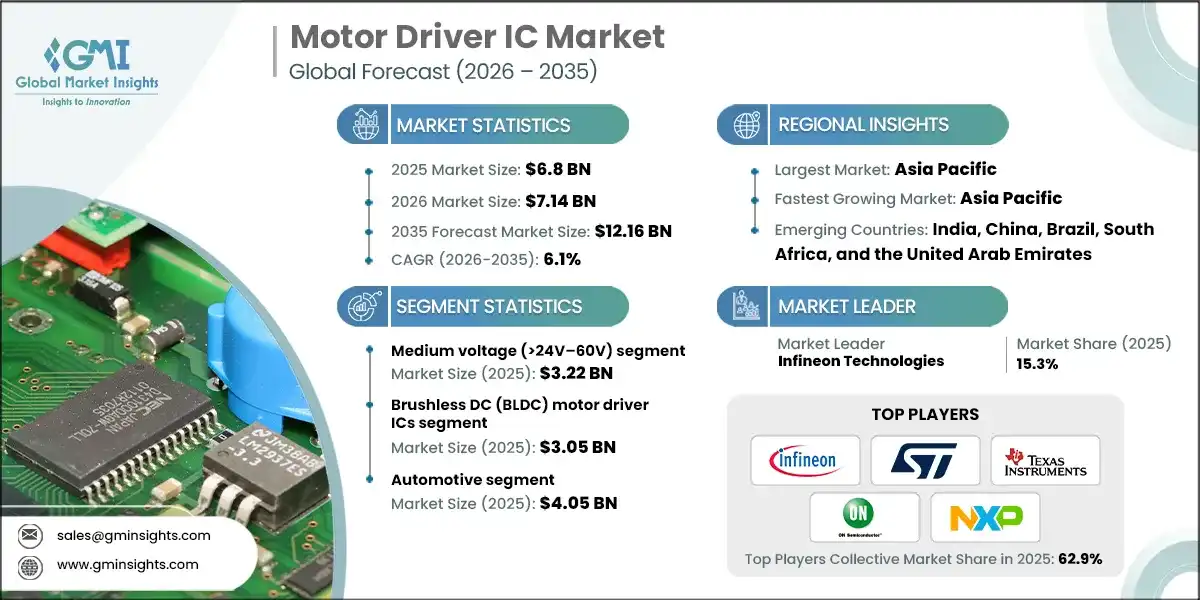
The global motor driver IC market size was valued at USD 6.8 billion and 1,011 million units in 2025. The market is expected to grow from USD 7.14 billion in 2026 to USD 9.36 billion in 2031 and USD 12.16 billion & 2,052 million units in 2035, at a value CAGR of 6.1% & volume CAGR of 8.1% during the forecast period, according to the latest report published by Global Market Insights Inc.
Motor Driver IC Market Key Takeaways
Market Size & Growth
- 2025 Market Size: USD 6.8 Billion
- 2026 Market Size: USD 7.14 Billion
- 2035 Forecast Market Size: USD 12.16 Billion
- CAGR (2026–2035): 6.1%
Regional Dominance
- Largest Market: Asia Pacific
- Fastest Growing Region: Asia Pacific
Key Market Drivers
- Electrification of vehicles increasing motor count.
- Energy efficiency regulations boosting motor upgrades.
- Growth in industrial automation and robotics.
- Shift toward BLDC and servo motors.
- Rising motor usage in smart appliances.
Challenges
- Automotive qualification complexity and long cycles.
- Thermal limits in high power applications.
Opportunity
- Expansion in electric vehicle market.
- Adoption of smart home and appliance automation.
Key Players
- Market Leader: Infineon Technologies led with over 15.3% market share in 2025.
- Leading Players: Top 5 players in this market include Infineon Technologies, STMicroelectronics (ST), Texas Instruments (TI), ON Semiconductor (onsemi), NXP Semiconductors, which collectively held a market share of 62.9% in 2025.
Get Market Insights & Growth Opportunities
The motor driver IC market is expanding, owing to electrification of vehicles increasing motor count, energy efficiency regulations boosting motor upgrades, growth in industrial automation and robotics, rising motor usage in smart appliances, and shift toward BLDC and servo motors.
The rising use of electrified vehicles is boosting the demand for Motor Driver ICs since many of these vehicles and hybrid variants use multiple electric motors for propulsion as well as other applications. For example, the French government made an announcement regarding the extended ecological bonus for the purchase of electric vehicles in October 2025, thus promoting the use of such vehicles and hence increasing the electrified motor base that requires sophisticated motor control.
Energy efficiency regulations force companies to increase motor and drive performance. As a result, a market emerges to support Motor Driver ICs. For example, in August 2025, the European Commission began a review of eco-design demands for electric motors and variable speed drives. The move is intended to keep up with technological advances and improve energy efficiency. The result is greater motor and drive efficiency and a push toward increased performance for related Motor Driver ICs.
The growing use of smart technology in washing machines, fridges, and air conditioners increases the demand for motor driver ICs, as these electronics help automate features such as variable motor speeds. In regard to energy conservation, the European Commission issued guidelines improving energy efficiency and consumer spending for household products starting April 2024. These guidelines help integrate sophisticated motor technologies into household appliances, as the EU spent USD 105.3 billion in 2022. With the global spread of smart appliances, there will be a greater need for motor control components that optimize performance, efficiency, and connectivity.
The market includes semiconductor components that connect the control electronics with the motors, allowing the motor to be controlled in terms of direction, speed, and torque. The market adds efficiency, reliability, and performance capabilities to the systems undergoing electrification and smart motion control using advanced motor technologies.
To get key market trends
Motor Driver IC Market Trends
- Motor Driver ICs are being developed with increasing use of intelligence such as current measurement, fault analysis, and protection mechanisms. This is achieved by embedding such mechanisms directly on-chip with their increasing use in sophisticated domains such as robotics, electric vehicles, and industrial automation. Smart Motor ICs can also monitor performance issues in real time due to their greater use.
- The development in motor driver ICs is witnessing smaller packages with increased functionality for accommodating size limitations in consumer, mobile, and automotive applications. Smaller packages also promote efficiency in terms of power consumption and thermal management for integrating them into compact systems. The applications are being extended to drones, smart appliances, and automotive modules because PCB size and weight reduction are essential in these segments.
- Motor Driver IC technology is undergoing a paradigm shift with the emergence of Gallium Nitride (GaN) and Silicon Carbide (SiC) material technologies, which make it possible to switch at a much faster rate with reduced energy losses in comparison to earlier silicon material technology. These technologies are highly beneficial in high-power motor driver ICs like electric vehicle traction drives.
- The use of brushless DC (BLDC) motor driver ICs continues to grow as different industries embed motor applications requiring precise control of speed and torque, for example, in the case of electric vehicles and in the heating, ventilation and air conditioning (HVAC) sector, as well as in robotics and drones. The need for two-axis control technology in sophisticated manufacturing processes stimulates the use of more complex control functions in BLDC and servo motor driver ICs.
Motor Driver IC Market Analysis
Learn more about the key segments shaping this market
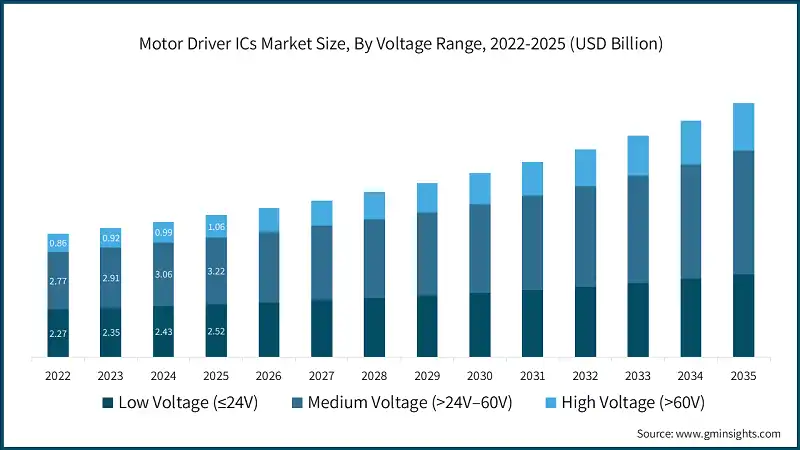
Based on voltage range, the market is divided into low voltage (≤24V), medium voltage (>24V–60V), and high voltage (>60V).
- The medium voltage (>24V–60V) segment accounted for the largest market and was valued at USD 3.22 billion in 2025. Medium voltage ICs are most suited for robotics, conveyors, HVAC systems, and electric mobility solutions due to their power handling, efficiency, and cost.
- Automated warehouse system builders demand medium voltage motor drivers because of their scalability, and fine granularity of motion control. This segment's demand is further reinforced by an increasing share of industrial automation and electrified transport solutions.
- Manufacturers are positioned to support in- demand, high-reliability mid-power motor driver integrated circuits (ICs) with built-in protection and diagnosis for industrial and automotive systems to enable widespread market adoption.
- The high voltage (>60V) segment was the fastest growing market during the forecast period, growing at a CAGR of 8.1% during the forecast period. The driving force behind the high market growth for this segment is applications in electric vehicles, industrial machinery, and large motor systems, all of which require robust power handling and efficient control.
- High voltage motor driver ICs improve torque, speed, and energy efficiency in EV traction systems, industrial pumps, and heavy duty automation.
- Manufacturers need to focus on high-voltage motor driver ICs with the ability to manage large amounts of current and thermal stress and integrated automation systems for industrial and EVs.
Learn more about the key segments shaping this market
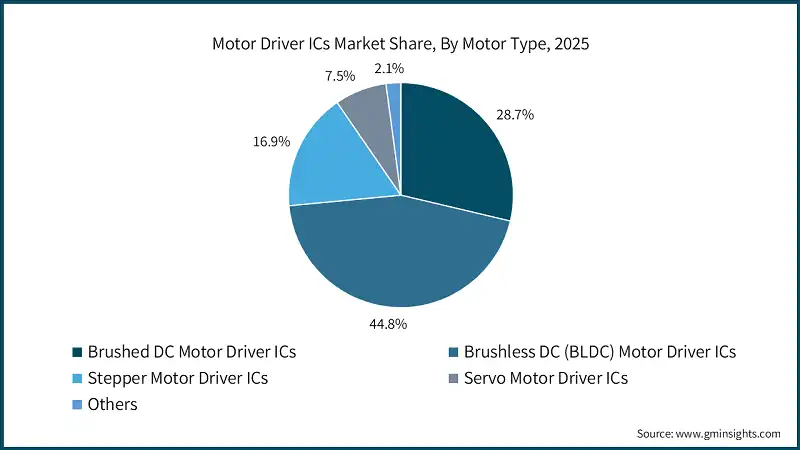
On the basis of motor type, the motor driver IC market is divided into brushed DC motor driver ICs, brushless DC (BLDC) motor driver ICs, stepper motor driver ICs, servo motor driver ICs, and others.
- The brushless DC (BLDC) motor driver ICs segment accounted for the largest market and was valued at USD 3.05 billion in 2025. Due to the wide application of BLDC motors in areas such as electric vehicles, industrial automation, HVAC (Heating, Ventilation, and Air Conditioning) systems, and consumer electronics, the demand for associated ICs is apparent.
- With the further adoption of electric vehicles, robotics, and smart appliances, the need is further strengthened for more sophisticated BLDC motor driver ICs, which incorporate advanced protection, diagnostic functions, and overall energy efficiency.
- The manufacturers should try to develop compact and energy-efficient BLDC motor drivers with advanced control functionality and adequate protection for the automotive, industrial, and consumer segments.
- The stepper motor driver ICs segment is projected to grow at a CAGR of 6.8% during the forecast period. Stepper motors are widely used in industrial automation and precision equipment due to their ability to control an axis position accurately without feedback systems.
- The automation of manufacturing, laboratory instruments, and medical devices drives the need for advanced stepper motor driver ICs for multi-axis control and high reliability.
- Manufacturers should focus on multi-axis, high-precision stepper motor driver ICs with integrated current control and protection features to address growing demand in industrial, medical, and automation applications.
Based on applications, the motor driver IC market is divided into automotive, consumer electronics, healthcare, chemical, military & defense, and others
- The automotive segment accounted for the largest market and was valued at USD 4.05 billion in 2025. Motor Driver ICs play a pivotal role in propulsion, steering, braking, HVAC, and in-vehicle automation functions.
- The policies that are encouraging the use of electric vehicles, such as subsidies, emission standards, and energy-efficient vehicles, act as an added stimulus for the demand side.
- Manufacturers need to develop automotive-grade, high-reliability, and energy-efficient motor driver ICs to meet the stringent safety requirements of EVs and other advanced/revolutionary vehicles.
- The military and defense segment is projected to grow at a CAGR of 6.4% during the forecast period. Motor driver ICs enable precision, energy efficiency, and durability in harsh conditions for mission-critical applications.
- In North America, Europe, and Asia, defense modernization initiatives and national government procurement policies are driving more advanced motor control solutions for this segment.
- Manufacturers need to build motor driver ICs that are rugged and high-performing, with the capability to operate in extreme conditions and meet defense standards and prolonged reset reliability for military use.
Looking for region specific data?
North America Motor Driver IC Market
North America motor driver ICs market held a market share of 21% in 2025 of the global Motor Driver ICs market.
- North America’s market continues steady growth, propelled by advanced manufacturing, automotive electrification, and automation adoption supported by regional industrial strength and strong technology sectors.
- The United States continues to top the demand for motor driver ICs owing to strong incorporation of these components in EVs, robotics, and smart systems in manufacturing and consumer products. Smart manufacturing initiatives in Canada and Mexico also further this demand.
- The ongoing digital transformation and investments in semiconductor technologies across industries strengthen the possibilities of long-term adoption of motor driver ICs, making North America a region of key growth potential with varied demand across industries.
- OEMs should aim to produce high-reliability and energy-saving motor drivers ICs that can be applied to electric vehicles, industrial automation, and robotics, which are consistent with digital-manufacturing strategies and related semiconductor investments.
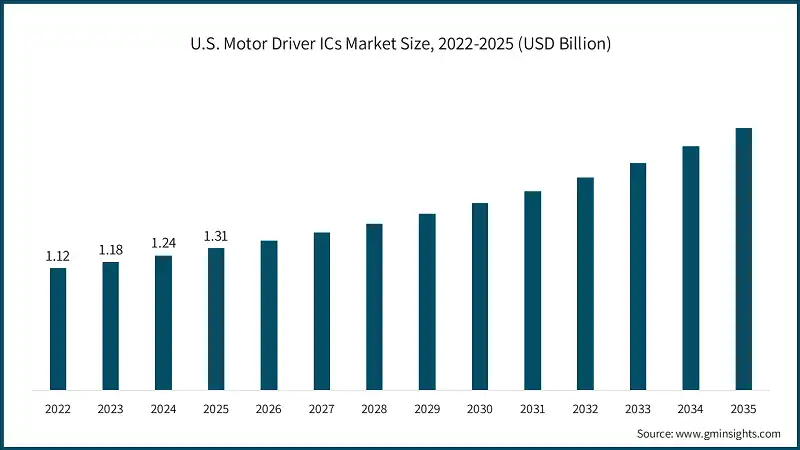
The U.S. motor driver IC market was valued at USD 1.13 billion and USD 1.18 billion in 2022 and 2023, respectively. The market size reached USD 1.31 billion in 2025, growing from USD 1.24 billion in 2024.
- In the United States, the need for motor driver ICs is increasing due to the continued implementation of automation, the adoption of electric vehicles, and the policies concerning the manufacturing of semiconductors.
- U.S. robotics companies requested the federal government implement a national robotics strategy in March 2025 to promote competitiveness and innovation in U.S. robotics and automation. This directly impacts the demand for motor control semiconductors in the advanced manufacturing sector.
- This demand indicates a need for sufficient development of the industrial automation and semiconductor ecosystems. This will enable the widespread adoption of motor driver ICs in automotive, industrial, and robotics systems.
- Manufacturers needs to focus on developing multi-axis motor driver ICs for robotics and automation applications and take advantage of the Federal Robotics Strategy to get long-term acceptance in the automotive industry.
Europe Motor Driver IC Market
Europe motor driver ICs market accounted for USD 1.09 billion in 2025 and is anticipated to show lucrative growth over the forecast period.
- Europe’s market is influenced by energy?efficiency regulations, industrial automation modernization, and stringent environmental policies that encourage use of advanced motion control technologies.
- Automotive electrification and factory automation are strong demand drivers from EU members. The sustained attention for sustainable manufacturing and energy reduction continues to support efficient motor driver solutions. Adoption continues as sustainable manufacturing and energy reduction policies are in place.
- The market is further strengthened by regional cooperation regarding standards and the integration of smart systems in the industrial sectors. European manufacturers are embedding more and more sophisticated control features to meet regulations and performance requirements.
- Manufacturers need to develop energy-efficient motor drivers to cater to eco-design requirements for automation, automotive electrification, and sustainable production settings.
Germany dominated the Europe motor driver IC market, showcasing strong growth potential.
- The demand for motor driver ICs and industrial automation in Germany is also influenced by the current developments in automation and robotics, as well as the competitiveness and investment pressure.
- For example, June 2025, VDMA noted a revenue decline of 10% in the German Robotics and Automation Industry. Such data illustrate the structural constraints in the industrial tech sectors, which impact the deployment of motor control components as companies modify investment in automation.
- Even so, ongoing electrification in sectors like automotive and manufacturing supports continued interest in advanced motor driver solutions.
- Manufacturers need to focus on more robust, high-performance motor driver ICs targeted at industrial automation and automotive electrification. It has to be a balance between the fluctuations in revenue and the need to capitalize on adoption initiatives around smart factories and robotics.
Asia Pacific Motor Driver IC Market
The Asia Pacific motor driver ICs market is the largest and fastest growing market and is anticipated to grow at the CAGR of 6.7% during the analysis timeframe.
- The Asia Pacific region is at the forefront of motor driver IC adaption due to the high levels of industrialization and rapid automation across the electronics, automotive, and consumer goods production sectors.
- This is particularly true for the rapid driver IC growth within the region and the supportive government initiatives aimed at local semiconductor acquisitions and R&D investments within China, Japan, South Korea, and Taiwan.
- In addition, the dominance of the region within the rapidly increasing robotics and EV production is further heightening the demand for motor driver ICs and solidifying Asia Pacific as a key and growing market.
- Manufacturers should target high-volume, integrated motor driver ICs for EVs, robotics, and electronics manufacturing, capitalizing on regional industrialization, automation growth, and government-backed semiconductor development programs.
China motor driver IC market is estimated to grow with a CAGR of 6.9% during the forecast period, in the Asia Pacific Motor Driver ICs market.
- There is strong growth in China’s market due to the rapid deployment of industrial automation, robust domestic manufacturing in electronics, and China’s leading position in EV (electric vehicles) production.
- China’s substantial investments in smart manufacturing and the robotics integrated systems help to further advance motor control solutions.
- There is a growth in the adoption of industrial robots and technological self-reliance policies. China’s industrial robots market remains the largest in the world and has resulted in a strong growth of the market.
Latin American Motor Driver IC Market
Brazil leads the Latin American motor driver ICs market, exhibiting remarkable growth during the analysis period.
- In Brazil, motor driver IC demand is emerging as industrial modernization and infrastructure projects progress alongside automation uptake.
- Growing focus on electrification of transport and increased adoption of automated systems in manufacturing and agriculture support incremental investment in motion control technologies.
- Expansion of digital manufacturing initiatives and integration of smart systems further encourage motor driver IC integration across regional sectors, contributing to gradual but sustained market growth.
- Manufacturers should offer reliable, mid-power motor driver ICs for manufacturing, agriculture, and logistics, supporting gradual automation adoption and infrastructure modernization across regional industrial sectors.
Middle East and Africa Motor Driver IC Market
South Africa motor driver ICs market to experience substantial growth in the Middle East and Africa Motor Driver ICs market in 2025.
- In South Africa, adoption of motor driver ICs is indicative of more automation and electrification as industries modernize and incorporate smart technologies.
- More investments in mining automation, logistics equipment, and energy-efficient solutions increase demand for motion control semiconductors.
- Government focus on industrialization and skills training creates a positive context for the use of emerging technologies, including motor driver ICs, to be more widely used across various industrial domains in the region.
- South African manufacturers are encouraged to take advantage of government initiatives focused on industrial development and training to build locally advanced technologies, especially more affordable and energy-efficient motor driver ICs for automation in mining, logistics, and industrials.
Motor Driver IC Market Share
The market scenario for Motor Driver ICs is shaped by rapid adoption of electric vehicles, industrial automation, robotics, and smart appliances. Together, key players in this market, including Infineon Technologies, STMicroelectronics (ST), Texas Instruments (TI), ON Semiconductor (onsemi), and NXP Semiconductors, account for around 62.9% of market share in 2025.
These companies focus on R&D to enhance motor control efficiency, integration with BLDC, stepper, and servo motors, and embedded protection and diagnostics. Notably, there are strategic partnerships, joint ventures, and acquisitions to accelerate innovation, improve automotive, industrial, and consumer electronics deployments, and expand geographical presence. Additionally, emerging start-ups and niche players are driving affordable motor driver IC solutions and AI-enabled platforms, further promoting innovation and adoption globally.
Motor Driver IC Market Companies
Prominent players operating in the market are as mentioned below:
- Texas Instruments (TI)
- Infineon Technologies
- STMicroelectronics (ST)
- ON Semiconductor (onsemi)
- NXP Semiconductors
- Analog Devices (ADI)
- Microchip Technology
- Toshiba Corporation
- ROHM Semiconductor
- Renesas Electronics
- Allegro MicroSystems
- Mitsubishi Electric
- Panasonic Corporation
- Monolithic Power Systems (MPS)
- Fuji Electric
- Infineon Technologies has 15.3% of the market in 2025, due to high performance motor driver ICs for automotive and industrial and consumer electronics applications. They also offer compact and energy efficient solutions for BLDC, stepper, and servo motors. Infineon has expanding partnerships with automotive OEMs, industrial automation repo, and research institutions to create solutions for electric vehicles, robotics, and smart appliances.
- As of 2025, STMicroelectronics (ST) had 14.3% of the market with integrated motor driver ICs for industrial automation, consumer electronics, and automotive systems. ST also creates high-efficiency automation solutions and has scalable design along with embedded protection. ST has integrated partnerships with smart factory programs and government-sponsored automation to create global market penetration.
- Texas Instruments (TI) had 12.2% of the market by offering precise motor driver ICs with advanced control and energy efficiency, along with wide cross segment application in automotive, industrial and consumer sectors. TI also has strong R&D and partnerships with robotics and industrial integrators.
- ON Semiconductor (onsemi) has 11.2% of the market. Offering high reliability and robust motor driver ICs for industrial machinery, automation, and EVs. ON has partnership with OEMs and system integrators along with energy efficient designs.
- NXP Semiconductors contributed to 9.9% of the market share by providing advanced motor driver ICs for the automotive, industrial, and consumer sectors. NXP provides integrated, miniaturized, and power-efficient solutions, working with automotive OEMs, automation vendors, and research institutes to promote global adoption.
Motor Driver IC Market Report Attributes
| Key Takeaway | Details |
|---|---|
| Market Size & Growth | |
| Base Year | 2025 |
| Market Size in 2025 | USD 6.8 Billion |
| Market Size in 2026 | USD 7.14 Billion |
| Forecast Period 2026 - 2035 CAGR | 6.1% |
| Market Size in 2035 | USD 12.16 Billion |
| Key Market Trends | |
| Drivers | Impact |
| Electrification of vehicles increasing motor count | Drives higher demand for motor driver ICs in EVs, contributing 24% market growth. |
| Energy efficiency regulations boosting motor upgrades | Encourages adoption of advanced ICs, improving performance and reducing energy consumption, 18% impact. |
| Growth in industrial automation and robotics | Expands motor driver IC deployment across manufacturing and robotics sectors, 21% market contribution. |
| Shift toward BLDC and servo motors | Increases demand for precision, high-efficiency motor driver ICs, influencing 15% of market growth. |
| Rising motor usage in smart appliances | Boosts small and medium motor driver IC adoption, contributing 12% to overall market expansion. |
| Pitfalls & Challenges | Impact |
| Automotive qualification complexity and long cycles | Slows IC adoption in automotive applications, affecting 8% of potential market growth. |
| Thermal limits in high power applications | Restricts IC performance and deployment in EVs and industrial motors, 7% impact. |
| Opportunities: | Impact |
| Expansion in electric vehicle market | Will drive 20% adoption of motor driver ICs, boosting automotive and industrial growth. |
| Adoption of smart home and appliance automation | Will increase 15% demand for compact, energy-efficient motor driver IC solutions. |
| Market Leaders (2025) | |
| Market Leaders |
15.3% market share |
| Top Players |
|
| Competitive Edge |
|
| Regional Insights | |
| Largest Market | Asia Pacific |
| Fastest Growing Market | Asia Pacific |
| Emerging Countries | India, China, Brazil, South Africa, and the United Arab Emirates |
| Future outlook |
|
What are the growth opportunities in this market?
Motor Driver IC Industry News
- In March 2024, Toshiba launched the SmartMCD Series gate driver ICs with the TB9M003FG model. This IC combines a microcontroller with sophisticated motor management capabilities, particularly sensorless control for three-phase brushless DC motors.
- In February 2024, Microchip introduced a new family of dsPIC33 DSC-based integrated motor drivers for the simplification of motor control system design. These drivers marry digital signal controllers and advanced motor control with the addition of sensorless field-oriented control and high-resolution pulse-width modulation (PWM) and include a supplementary development platform for the rapid design of motor drives.
- In January 2024, Infineon Technologies AG extended its portfolio for electric and hybrid vehicles with the addition of 650V and 100V automotive motor driver ICs.
- In February 2024, Infineon Technologies and Honda Motor Co. signed a Memorandum of Understanding (MoU). Infineon will be Honda's semiconductor partner to align roadmaps for products and technologies for the future.
The motor driver ICs market research report includes in-depth coverage of the industry with estimates & forecasts in terms of revenue (USD Million) and volume (Million Units) from 2022 to 2035, for the following segments:
Market, By Motor Type
- Brushed DC motor driver ICs
- Brushless DC (BLDC) motor driver ICs
- Stepper motor driver ICs
- Servo motor driver ICs
- Others
Market, By Voltage Range
- Low voltage (≤24V)
- Medium voltage (>24V–60V)
- High voltage (>60V)
Market, By Power Semiconductor Material
- Silicon (Si)
- Silicon Carbide (SiC)
- Gallium Nitride (GaN)
Market, By Level of Integration
- Gate driver ICs
- Integrated power drivers
- Fully integrated motor driver SoCs
Market, By Application
- Automotive
- Powertrain control
- Body electronics
- Infotainment
- Others
- Consumer electronics
- Home appliances
- Personal devices
- Healthcare
- Chemical
- Military and defense
- Others
The above information is provided for the following regions and countries:
- North America
- U.S.
- Canada
- Europe
- Germany
- UK
- France
- Spain
- Italy
- Netherlands
- Asia Pacific
- China
- India
- Japan
- Australia
- South Korea
- Latin America
- Brazil
- Mexico
- Argentina
- Middle East and Africa
- Saudi Arabia
- South Africa
- UAE
Frequently Asked Question(FAQ) :
What is the market size of the motor driver IC market in 2025?
The global market for motor driver IC was valued at USD 6.8 billion in 2025, supported by rising electrification of vehicles.
What is the projected value of the motor driver IC market by 2035?
The market is expected to reach USD 12.16 billion by 2035, growing at a CAGR of 6.1% from 2026 to 2035, driven by electric vehicle adoption.
What will be the market value of the motor driver IC industry in 2026?
The market is projected to reach USD 7.14 billion in 2026, reflecting early-stage growth fueled by vehicle electrification.
Which motor type segment generated the highest revenue in 2025?
Brushless DC (BLDC) motor driver ICs dominated the market, generating USD 3.05 billion in 2025 due to widespread use in electric vehicles, industrial automation, HVAC systems, and consumer electronics.
Which voltage range segment led the motor driver IC market in 2025?
The medium voltage (>24V–60V) segment led the market with USD 3.22 billion in 2025, supported by strong demand from robotics, conveyors, HVAC systems, and electric mobility applications.
Which application segment dominates the motor driver IC market?
The automotive segment dominated the market with USD 4.05 billion in 2025, driven by extensive use of motor driver ICs in EV propulsion, steering, braking, HVAC, and in-vehicle automation systems.
Who are the key players in the motor driver IC market?
Major players include Infineon Technologies, STMicroelectronics, Texas Instruments, ON Semiconductor, NXP Semiconductors, Analog Devices, Microchip Technology, Toshiba Corporation, ROHM Semiconductor, and Renesas Electronics.
Motor Driver IC Market Scope
Related Reports