Summary
Table of Content

Mobile Augmented Reality (AR) Market
Get a free sample of this report
Form submitted successfully!
Error submitting form. Please try again.
Thank you!
Your inquiry has been received. Our team will reach out to you with the required details via email. To ensure that you don't miss their response, kindly remember to check your spam folder as well!
Request Sectional Data
Thank you!
Your inquiry has been received. Our team will reach out to you with the required details via email. To ensure that you don't miss their response, kindly remember to check your spam folder as well!
Form submitted successfully!
Error submitting form. Please try again.
Mobile Augmented Reality Market Size
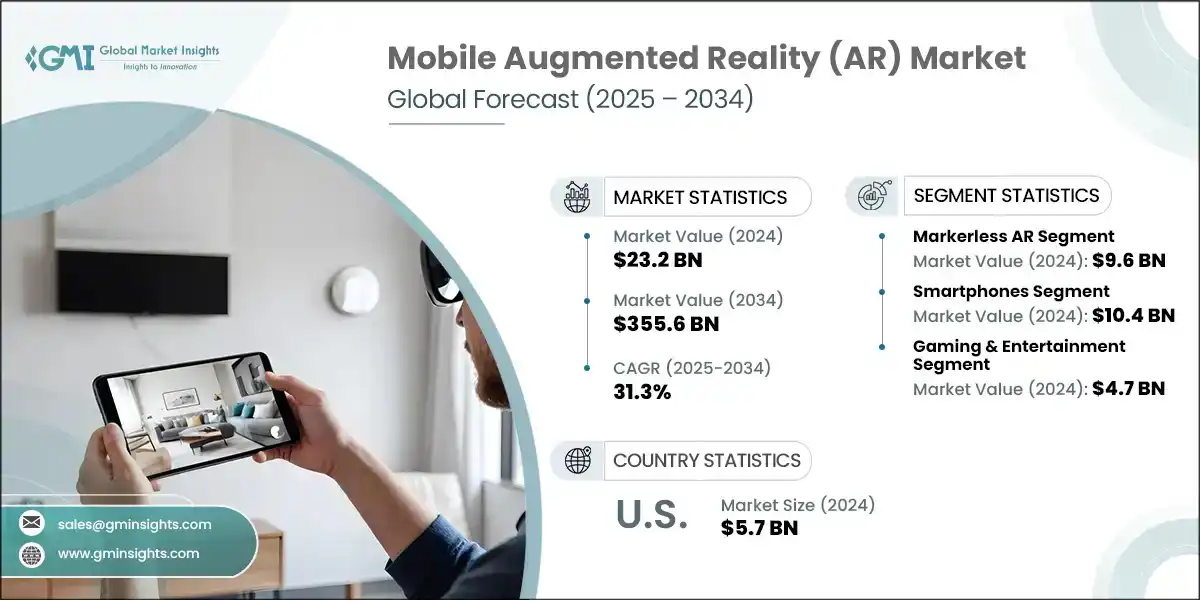
The global mobile augmented reality market was valued at USD 23.2 billion in 2024. The market is expected to grow from USD 30.6 billion in 2025 to USD 113.6 billion in 2030 and USD 355.6 billion by 2034, at CAGR of 31.3% during the forecasted period of 2025-2034.
Mobile Augmented Reality (AR) Market Key Takeaways
Market Size & Growth
- 2024 Market Size: USD 23.2 billion
- 2034 Forecast Market Size: USD 355.6 billion
- CAGR (2025–2034): 31.3%
Key Market Drivers
- Rising smartphone penetration with AR capabilities.
- Surging demand in retail and e-commerce.
- Expansion of 5g and edge computing.
- Increased adoption in mobile gaming and entertainment.
- Supportive ecosystem and developer tools.
Challenges
- Device Limitations and Fragmentation.
- Privacy and Security Concerns.
Opportunity
- Integration with ai for smart object recognition and personalization.
- Adoption in ar-powered virtual shopping and try-on experiences.
- Expansion into enterprise training, remote assistance, and field services.
- Development of webar for app-free experiences.
Get Market Insights & Growth Opportunities
- The growth of this market is attributed to the rising smartphone penetration with AR capabilities, surging demand in retail and e-commerce, expansion of 5g and edge computing, increased adoption in mobile gaming and entertainment, and supportive ecosystem and developer tools.
- Main force behind the growing mobile augmented reality market is the growing availability of AR-ready smartphones, made possible by multi-lens cameras, faster processors and built-in sensors that deliver smooth AR experiences and widen access in both emerging and mature economies. For instance, by the end of 2023, there were approximately 1.4 billion active mobile AR users worldwide, up from about 810 million in 2021, with projections reaching 1.73 billion by 2024, as stated in Statista.
- Augmented reality on mobile devices is providing initial training productivity benefits, with more than 90% gains in training efficiency reported by business customers. Real-world deployments yield sensational results - the U.S. Air Force's recruits executed all operations error-free with this augmented reality instructions, whereas traditional methods included several errors, and training took several days to approximately more than a hour.
- Retailers and online shopping sites are using mobile AR to create engaging trial experiences that improve how product perception, lower the number of returns, and boost shopper confidence. Sephora, IKEA and Amazon, for instance, now include Augmented reality tools that let customers see makeup, furniture and clothing in their own spaces using only a cell phone.
- The global launch of 5G networks, combined with improvements in edge computing, is speeding up mobile AR by delivering faster data processing, nearly zero latency, and smoother real-time graphics. As a result, industries such as retail, gaming, navigation, and industrial maintenance request high-performance AR solutions, because seamless, low-delay experiences are essential for keeping users engaged and boosting operational efficiency.
- On the basis of application, the global mobile augmented reality market is segmented into gaming & entertainment, retail & e-commerce, education & training, healthcare, military & defense, travel & tourism, real estate & architecture, and others. Under this segment, gaming & entertainment accounted for 20.5% of the market share in 2024. It is expanding quickly, driven by a growing appetite for immersive experiences and the popularity of AR games and social-media filters that pull users into interactive, real-world settings.
- In 2024, North America dominated the mobile AR market with a share of 34.3% and a value of USD 7.9 billion. The dominance stems from widespread smart-phone use, the heavy presence of firms such as Apple, Google, and Meta, the fast rollout of 5G networks, and rising adoption of augmented-reality tools in retail, gaming, and business settings.
To get key market trends
Mobile Augmented Reality Market Trends
- AR is fundamentally changing mobile retail and e-commerce by allowing shoppers to virtually try on clothes, preview merchandise in their own space, and see 3-D models from any angle. The trend took off after 2020, when record numbers of people moved online, and it already boosted customer engagement while cutting the number of returned items. Because of these benefits, brands are investing larger budgets into AR tools within their apps.
- Social media companies have integrated mobile AR features-such as face filters, branded lenses, and immersive effects-into their apps in order to deepen user engagement and encourage content creation. Although the push for AR began around 2018, adoption accelerated during 2021-2024, propelled by AR-focused influencer campaigns and interactive ads. With Gen Z users and brands embracing these tools, the trend is expected to expand through 2032 as platforms launch AR capabilities that foster creativity, self-expression, and heightened brand visibility.
- The widespread adoption of 5G networks, combined with edge computing, is giving mobile augmented reality the real-time, low-latency performance that gaming, navigation, and corporate training applications require. Although the shift first began around 2020, it gained momentum as carriers rolled out 5G worldwide and developers sought more responsive, immersive AR experiences. Industry observers now forecast that improving mobile infrastructure and rising user expectations will drive further AR innovation at least through the end of the decade.
- Web-based augmented reality, or WebAR, is challenging the app-centered approach by letting users open AR content in their mobile browsers. The concept first appeared around 2019 and quickly gained ground because brands wanted an easy, low-cost way to reach more customers. WebAR adoption is to keep rising through 2032, as its streamlined setup makes it the go-to choice for large-scale marketing, lifts access for new users and eases the lingering app fatigue many consumers feel.
Mobile Augmented Reality Market Analysis
Learn more about the key segments shaping this market
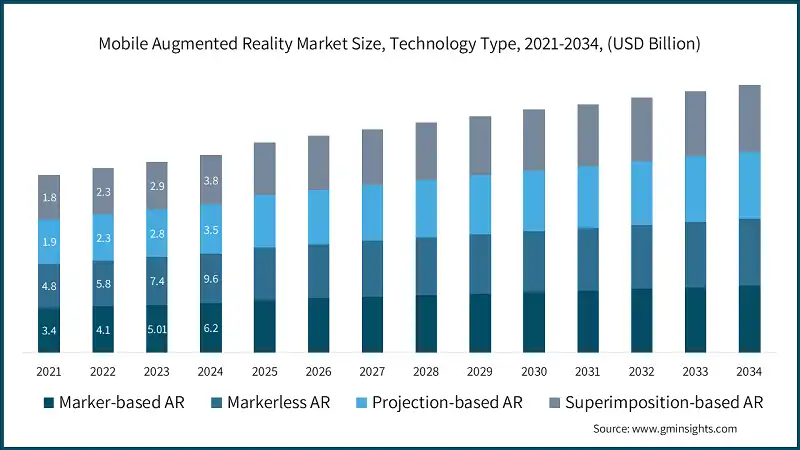
Based on technology type, the market is divided into marker-based AR, markerless AR, projection-based AR, and superimposition-based AR.
- The markerless AR market was the largest market and was valued at USD 9.6 billion in 2024. It is gaining traction because retail, gaming, and education expect smooth, interactive content that doesn’t rely on printed tags. By combining GPS, accelerometers, gyroscopes, and SLAM technology, this approach fixes digital objects to the real world and makes mobile AR flexible enough to scale. As a result, companies are using it for location-based games, navigation guides, virtual storefronts, and hands-on lessons.
- To meet this demand, developers should build markerless projects with ARKit, ARCore, and cross-platform SDKs that tap into spatial maps and onboard AI. When they partner with retailers, edtech firms, and tourist boards, they can deliver site-specific, personalized experiences that work anywhere, freeing brands from the cost and logistics of printing and installing physical markers.
- The superimposition-based AR market was the fastest growing segment and is anticipated to grow with a CAGR of 34% during the forecast period. An increasing number of AR developers and brands are using image superimposition to make real-time interactions feel more natural by placing digital content directly over users view of the physical world. This technique is quickly becoming standard in healthcare, automotive, and retail, where precise overlays-whether 3-D organs on a patient or step-by-step icons on a machine-can improve usability and speed up decision making. It is preferred because it offers clear, context-rich guidance that stays locked to the user’s vantage point.
- To advance the technology, developers must continue fine-tuning object-detection precision, lighting adjustment, and depth perception so that the digital elements blend seamlessly with moving scenes. Collaborating with sectors such as medical imaging, remote maintenance, and sales visualization will create high-impact applications where on-the-spot instructions cut mistakes, shorten training time, and boost overall productivity.
Learn more about the key segments shaping this market
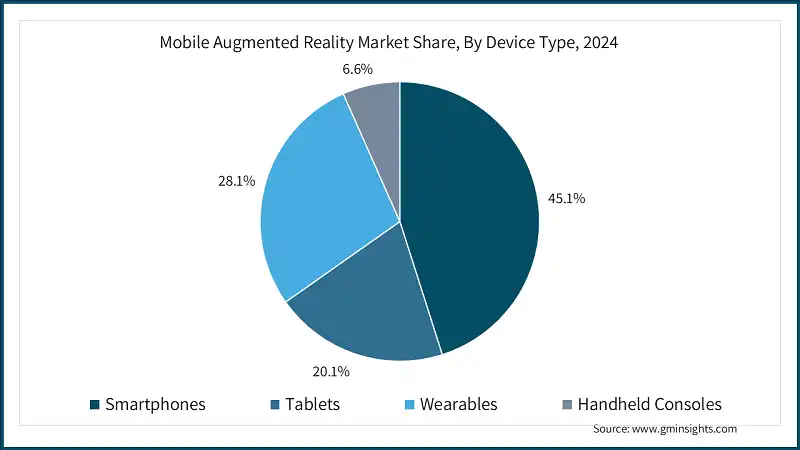
Based on device type, the mobile augmented reality market is divided into smartphones, tablets, wearables, and handheld consoles.
- The smartphones market was the largest market and was valued at USD 10.4 billion in 2024. The rise of mobile augmented reality is propelled by smartphones that sport high-quality cameras, precise sensors, and fast processors, all working together to deliver fluid AR experiences. Consumers can easily engage with interactive stories, enjoy AR-driven games, virtually try on clothes, or browse immersive stores-more quickly and broadly than with any other platform. Leading brands are adding multiple lenses, incorporating LiDAR scanners, and upgrading GPUs so that even mid-range devices now deliver solid AR performance alongside their premium cousins.
- To keep this momentum going, manufacturers must install AR-friendly features into every new design, especially camera alignment, steady thermal control, and smart battery drains that support longer sessions. Partnering closely with AR developers, social networks, and retailers can also spark exclusive, hardware-tailored experiences and bundled offerings that deepen customer loyalty, highlight each devices full capabilities, and spread AR use into consumer, education, and industrial settings.
- The wearables market was the fastest growing segment and is anticipated to grow with a CAGR of 34.7% during the forecast period. This is steadily expanding in enterprise, healthcare, and industrial environments that demand mobility, hands-free operation, and accurate data presentation. Devices such as smart glasses and headsets deliver real-time information as a visual overlay, improving workflow speed, workplace safety, and learning outcomes during on-the-job training. Leading companies including Magic Leap, Microsoft, and Snap are prioritizing lightweight ergonomics, high-resolution optics, advanced spatial-mapping sensors, and reliable voice control.
- To accelerate growth, manufacturers need to further refine headset optics so users can work comfortably over long shifts, embed low-latency edge processors that handle complex vision tasks locally, and tune power management so a single charge lasts all day. Collaborating with AR software developers, OEMs, and clinical networks to create tailored, application-specific hardware will prove essential in premium markets where precision, employee safety, and agile operations are significant.
Based on application, the mobile augmented reality market is divided into gaming & entertainment, retail & e-commerce, education & training, healthcare, military & defense, travel & tourism, real estate & architecture, and others.
- The gaming & entertainment market was the largest and was valued at USD 4.7 billion in 2024. It is climbing steadily, as AR games and interactive apps deliver immersive, location-centric, and social play that resonates with younger, screen-savvy users. Hit titles such as Pokémon GO, Snapchat Lenses, and TikToks AR filters have proven the engagement of AR-driven gameplay and content creation. In turn, entertainment brands are using the technology to amplify audience interaction, extend the life of IP, and stage out-of-the-screen moments that merge smoothly with digital storytelling.
- For developers, the immediate focus should be on real-time rendering, multiplayer sync, and precise geospatial tracking that deepen the gameplay experience. Partnerships with major franchises or trusted influencers also enable quick-turn, cross-promoted AR campaigns that sustain engagement and keep monetization channels flowing.
- The healthcare market was the fastest growing segment and is anticipated to grow with a CAGR of 35% during the forecast period. An increasing number of hospitals, medical-device companies, and training centers are using mobile AR tools for diagnosis, remote-surgery guidance, and hands-on education. By running on everyday smartphones and tablets, these apps let clinicians see complex anatomy in three dimensions, steer them through minimally invasive tasks, and let students rehearse rare scenarios through lifelike simulation. Their light weight and low setup cost make mobile AR ideal for ambulatory care, emergency rooms, and settings with few resources.
- System makers therefore must deliver AR solutions that are highly accurate, fully HIPAA compliant, and backed by secure cloud links and real-time sharing. To stay ahead, developers should tie their tech tightly to existing electronic-records systems, make it work smoothly across devices, and reduce latency. Early-stage pilots in partnership with medical schools and hospitals will build the trust needed for wide institutional roll-out.
Looking for region specific data?
The North America mobile augmented reality market held 34.3% market share in 2024 and is growing at a 30.1% CAGR, driven by high smartphone penetration, strong presence of AR-focused tech giants, widespread 5G rollout, and increasing adoption of immersive technologies across retail, gaming, healthcare, and enterprise training applications.
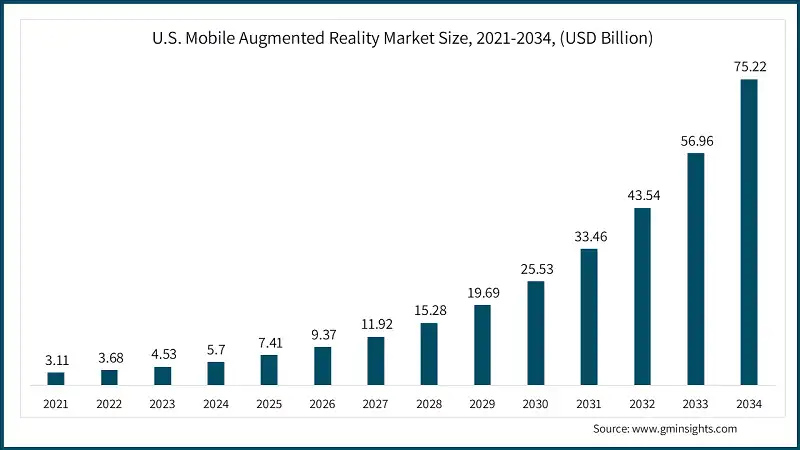
- The mobile AR market in the U.S. has been expanding steadily, achieving a CAGR of 29.4% and reaching a valuation of USD 5.7 billion in 2024. The U.S. market continues to grow because smartphones have AR built in, consumers are seeking more immersive shopping and gaming moments, and major American tech firms keep releasing user-friendly development kits. The CTA estimates that more than 100 million people in the U.S. used AR features within mobile apps in early 2024, with retail and gaming leading the way. That engagement is boosting the need for richer MAR solutions in e-commerce, entertainment, and healthcare, so brands are launching virtual try-ons, indoor navigation, and other interactive experiences.
- To stand out, developers and technology companies need to create lightweight, low-latency software-development-kits, fine-tune them for emerging 5-G networks, and build partnerships that link retailers, content creators, and health providers. Consumer trust will deepen if businesses prioritize privacy, design intuitive interfaces, and blend spatial-computing tools into every project.
- The Canada market is projected to grow significantly with a CAGR of 31.6% during the forecast period. In Canada, rising smartphone ownership, sustained government funding for digital innovation, and consumer enthusiasm for augmented-reality-enhanced retail, tourism, and learning are driving this market. The ICTC reports that more than 60 percent of Canadian firms test AR or VR tools to deepen user engagement, prompting wider use of mobile AR in health-training, property-showing, and bilingual-teaching apps. These trends create a steady need for scalable, localized content that works across devices.
- To gain an early edge, developers should use French-English interfaces, meet Canada’s strict privacy rules, and tap publicly funded grants to deliver hyper-local solutions. They should partner with national retailers, cultural organizations, and school boards so adoption spreads while experiences remain tuned to the nation’s diverse, tech-savvy public.
The Europe mobile augmented reality market held 25.7% market share and is growing at a 32.1% CAGR, driven by widespread smartphone adoption, increasing investment in 5G and edge computing infrastructure, and rising demand for immersive, AR-enhanced shopping and tourism experiences across countries like Germany, France, and the UK.
- The mobile AR market in Germany reached a valuation of USD 1.7 billion in 2024 and is anticipated to grow with a CAGR of 33.3% during the forecast period. Germany’s digitally literate consumer base, solid industrial infrastructure, and growing appetite for immersive technology in retail, manufacturing, and automotive settings continue to drive the mixed-reality-app market. Government initiatives support AR-enabled training, maintenance, and remote-support tools, further speeding acceptance of mobile augmented reality. Research from Bitkom shows that nearly 60 percent of Germans are willing to explore AR apps, especially for shopping and navigation, reinforcing a vibrant public-facing AR ecosystem.
- To compete in Germany’s MAR sector, developers and hardware makers should embed GDPR-compliant data practices, tailor content for German speakers, and collaborate with leading automotive and industrial firms on specialized tools. Creating 5G-ready AR platforms and tapping the nation’s robust R&D network will be crucial for delivering accurate, enterprise-grade AR experiences.
- The UK market is anticipated to reach USD 27.1 billion in 2034. Consumer dependence on smartphones, the surge in remote services such as telehealth and e-learning, and the U.K.s vibrant gaming and creative technology sectors-which first embraced immersive AR-continue to drive this market forward. Supportive government policies and a digitally fluent populace are further speeding up the uptake of mobile AR. According to Tech Nation, more than 3,000 immersive tech firms operate across the nation, cementing the U.K.s role as one of Europe's leading AR hubs.
- To stand out, developers and hardware makers should prioritize localizing AR content, fine-tuning AI-guided overlays, and forging solid partnerships with U.K. retailers, health providers, and entertainment groups. Aligning these efforts with strict data-privacy standards and crafting energy-efficient solutions will also meet U.K. regulations while contributing to broader sustainability goals.
The Asia-Pacific region is the fastest growing in the mobile AR market and is expected to grow at a CAGR of 34% during the forecasted period, driven by rapid smartphone adoption, widespread 5G deployment, and rising demand for immersive digital experiences across retail, education, and entertainment sectors.
- The China mobile AR market is projected to grow significantly, reaching USD 38.7 billion by 2034. China’s mobile augmented-reality industry is expanding quickly, fueled by the world’s largest smartphone population, government-supported plans for digital modernization, and accelerating public interest in immersive experiences from gaming to e-commerce to education. Major platforms such as Alibaba and Tencent are weaving AR features into shopping interfaces, and domestic phone makers are placing dedicated chips and sensors in new devices to create richer on-the-go interactions.
- Homegrown companies are boosting AR-content production through alliances with app developers, AI firms, and cloud services, while initiatives like Internet Plus and Made in China 2025 continue to underwrite the required network and hardware build-out. With its vast mobile ecosystem, rapid 5G deployment, and tech-savvy users, China aims to be both a leading consumer region and a key global source of cutting-edge mobile AR technology.
- India held a market size of USD 1.04 billion in 2024. This market is gaining traction as more consumers adopt smartphones, data costs stay low, and e-commerce and social-media channels multiply. Digital firms in retail, ed-tech, gaming, and real estate are wielding MAR to spice up customer engagement, enable virtual fittings, and offer immersive property tours. With a mobile-first public and a growing pool of developers, both tech startups and large conglomerates are embedding MAR features into everyday apps.
- Local creators prioritize thin, multilingual AR experiences that run well on entry-level and mid-tier devices, and alliances with telecoms are paving the way for early 5G use cases. Initiatives such as the Digital India push and the Startup India fund further fuel originality by supplying money, mentorship, and incubation. India is becoming a fertile ground for cost-effective, context-sensitive mobile AR solutions that can scale across diverse markets.
Latin America held 8.8% market share and is growing with a CAGR of 28.8%, driven by increasing smartphone adoption, improving internet infrastructure, and rising demand for immersive retail and entertainment experiences across cosmetics, fashion, and consumer electronics sector.
The Middle East & Africa mobile AR market was valued at USD 1.8 billion in 2024. The market growth is driven by expanding digital infrastructure, a growing young population, rising adoption of mobile-based retail and gaming, and increasing demand for premium, tech-integrated packaging in cosmetics, luxury goods, and consumer electronics sectors.
- The mobile AR market in UAE reached a valuation of USD 500 million in 2024 and is anticipated to grow with a CAGR of 27.4% during the forecast period. In the UAE, this market is surging, driven by sweeping digital transformation, near-universal smartphone use, and an energetic tourism and retail sector eager to adopt immersive technologies. Upscale stores and property developers now use AR for virtual try-ons, guided tours, and engaging shopping experiences, boosting brand prestige and drawing the attention of wealthy consumers and visitors.
- Local technology firms are partnering with global AR studios to develop customised apps, while initiatives under the UAE Innovation Strategy propel smart city solutions and digital commerce forward. The nation's robust infrastructure, dedicated tech zones such as Dubai Internet City, and widespread AR experiments in luxury retail and hospitality, all of which are cementing the UAE's role as the region's leading hub for mobile immersive experiences.
- The South Africa mobile AR market is anticipated to reach USD 4.9 billion in 2034. South Africa’s mobile augmented reality market is picking up speed, thanks to better network coverage, falling smartphone prices, and growing demand for digital engagement in education, retail, and tourism. Stores, museums, and cultural organizations now use mobile AR to enrich storytelling with virtual catalogs, interactive guides, and immersive brand experiences.
- Local startups and creative studios are releasing smartphone-friendly AR apps, often backed by government digital-skills and innovation schemes. A youthful, tech-savvy population and rising 4G-and-5G spend position South Africa as Africa’s leading test bed for mobile AR. Still, high data costs and patchy access limit some users, prompting firms to offer lighter features and team up with networks and schools.
Mobile Augmented Reality Market Share
- The top 5 companies Apple Inc., Google LLC, Samsung Electronics Co., Ltd., Niantic, Inc., and Magic Leap, Inc. collectively hold around 62.6% of the market, the industry is currently characterised by a moderately consolidated landscape. This concentration follows from well-developed ecosystems, proprietary frameworks like ARKit and ARCore, and large-scale investment in hardware-software integration. With extensive R&D pipelines, vertical control over devices and operating systems, and dedicated developer networks, these firms set high barriers for newcomers while further strengthening their competitive lead.
- Apple Inc. commands an estimated 17.7% of the mobile augmented reality market, driven by the widespread adoption of its ARKit platform, seamless integration across iOS devices, and consistent launch of AR features in iPhones and iPads. Apple’s strategic advantage lies in its closed hardware-software ecosystem, AR-focused hardware like LiDAR scanners, and developer support through its App Store. Its vision for spatial computing and the introduction of products like Vision Pro further reinforces its leadership in mobile AR.
- Google LLC holds roughly 15.3% of the global mobile augmented reality market, because ARCore reaches so many devices and Android still powers most smartphones, Google has been able to build AR tools into Maps, Lens, and Search. With its advanced AI and machine-learning work, plus close partnerships with hardware makers, the company supports mixed-reality features on a wide range of Android models, cementing its role as a major driver of AR on that platform.
- Samsung Electronics co. commands 13.6% of the market share, attributed to its flagship Galaxy smartphones that offer AR features like AR Emoji, Bixby Vision, and 3D scanning. Samsung leverages partnerships with both Google’s ARCore and its proprietary platforms, ensuring compatibility and performance. Its investment in hardware innovations like high-resolution displays, 5G, and depth-sensing cameras contributes to a competitive edge in the MAR space.
- Niantic, Inc. holds roughly 10.2% of the global mobile augmented reality market largely due to the enduring popularity of its AR-based games like Pokémon GO and Ingress. Niantic’s proprietary Lightship ARDK and real-world Platform provide developers tools for building geolocation-based AR experiences. With an active user base and real-world mapping data, Niantic maintains a unique position in the gaming-centric segment of mobile AR.
- Magic Leap Inc. currently commands roughly 5.7% of the global mobile augmented reality market. Though initially focused on enterprise-grade AR headsets, Magic Leap has expanded its ecosystem into mobile AR through SDK development and partnerships. The company’s emphasis on spatial computing, proprietary optics, and developer outreach through Magic Leap World places it as a niche but rising contender, especially in industrial and healthcare MAR applications.
Mobile Augmented Reality Market Companies
List of prominent players operating in the mobile AR market include:
- 8ninths Inc. (Valence)
- Appentus Technologies Private Limited
- Apple Inc.
- BidOn Games Studio, LLC
- Blippar.com Limited
- Google LLC
- Groove Jones, LLC
- Magic Leap, Inc.
- MAXST Co., Ltd.
- Niantic, Inc.
- PTC Inc. (formerly Parametric)
- Samsung Electronics Co., Ltd.
- Talespin Reality Labs, Inc.
- Wikitude GmbH
- Apple Inc., Google LLC, and Samsung Electronics Co., Ltd. currently lead the mobile augmented reality market, capturing large shares by tightly embedding AR features in smartphones, tablets, and wearables. Each company consistently pours resources into its own AR platform-Apple's ARKit, Google's ARCore, and Samsung's Galaxy AR-and draws on extensive developer communities to create engaging apps for gaming, navigation, retail, and productivity. Because they oversee both hardware and software, these firms can deliver smooth, unified AR experiences, and their strong brands and broad distribution keep them ahead as consumers embrace the technology.
- PTC Inc., Wikitude GmbH, and Blippar Ltd. currently occupy the challenger category in the mobile augmented-reality market, each working to solidify its standing by offering targeted development platforms, software-development kits (SDKs), and cutting-edge enterprise tools. Aimed at sectors such as manufacturing, retail, and education, these firms design scalable AR experiences that seamlessly link the physical and digital worlds. By prioritizing spatial computing, ensuring cross-platform support, and forging strategic partnerships, they seek to narrow the distance to market leaders while broadening their reach in specialized and enterprise applications worldwide.
- 8ninths Inc. (known as Valence), Appentus Technologies, and Groove Jones occupy a follower position in mobile augmented reality, sustaining visibility by offering project-based services, custom AR content, and apps aimed at specific markets. Operating mainly as service firms, they produce engaging experiences for marketing, training, and brand engagement, usually for regional and mid-sized customers. Although they add creative flair and solid technical work, their share of the market stays modest, held back by small-scale operations, few in-house platforms, and an emphasis on execution rather than pioneering innovation.
- BidOn Games Studio and Talespin Reality Labs occupy niche positions within the mobile augmented-reality landscape, each catering to narrow, well-defined sectors. BidOn centres on bespoke AR games and interactive marketing experiences, typically crafted for local audiences or for a single brand campaign. Talespin takes a different path, building AR-and-VR training modules that immerse employees during onboarding and ongoing development, with human-resources departments as its primary client. Both firms gain an advantage not from launching universal platforms, but from customizing projects, drawing on industry know-how, and working closely with customers at every stage.
Mobile Augmented Reality (AR) Market Report Attributes
| Key Takeaway | Details |
|---|---|
| Market Size & Growth | |
| Base Year | 2024 |
| Market Size in 2024 | USD 23.2 billion |
| Forecast Period 2025 - 2034 CAGR | 31.3% |
| Market Size in 2034 | USD 355.6 billion |
| Key Market Trends | |
| Drivers | Impact |
| Rising smartphone penetration with AR capabilities | Spurs nearly 35% increase in mobile AR app installations as AR-compatible smartphones become more affordable and globally accessible, expanding user base. |
| Surging demand in retail and e-commerce | Drives approximately 32% growth in AR-powered virtual try-on and in-store navigation applications as retailers adopt immersive tech. |
| Expansion of 5g and edge computing | Fuels nearly 30% surge in real-time, location-based AR experiences due to ultra-low latency and faster rendering speeds. |
| Increased adoption in mobile gaming and entertainment | Enables close to 37% rise in user retention and in-app monetization across AR-based mobile games and entertainment apps. |
| Supportive ecosystem and developer tools | Accelerates around 33% expansion in AR application development by lowering entry barriers for developers and startups through access to AR SDKs, etc. |
| Pitfalls & Challenges | Impact |
| Device Limitations and Fragmentation | Increases development complexity, inflates testing costs, and restricts seamless AR experiences across diverse smartphone models and OS platforms. |
| Privacy and Security Concerns | Slows enterprise adoption, triggers compliance hurdles, and limits data-intensive AR applications in sectors like healthcare, retail, and education. |
| Opportunities: | Impact |
| Integration with ai for smart object recognition and personalization | Will enhance real-time contextual experiences and boost user engagement through hyper-personalized content delivery. |
| Adoption in ar-powered virtual shopping and try-on experiences | Will elevate conversion rates and reduce return rates by enabling consumers to visualize products in real-world settings before purchase. |
| Expansion into enterprise training, remote assistance, and field services | Will improve operational efficiency, reduce training time, and minimize costly on-site visits across manufacturing, oil & gas, and healthcare sectors. |
| Development of webar for app-free experiences | Will broaden accessibility, reduce user friction, and accelerate brand campaign adoption by eliminating the need to download dedicated AR apps. |
| Market Leaders (2024) | |
| Market Leader |
|
| Top Players |
Collective market share in 2024 is 62.6% |
| Competitive Edge |
|
| Regional Insights | |
| Largest Market | North America |
| Fastest Growing Market | Asia Pacific |
| Emerging Country | China, India, Thailand |
| Future outlook |
|
What are the growth opportunities in this market?
Mobile Augmented Reality Industry News
- In July 2025, Niantic sold its game development studio, including the rights to some titles like Peridot and Marvel World of Heroes, to Scopely as part of a broader strategic refocus. While Niantic retains Pokémon Go, the company is streamlining operations to prioritize its core AR platform, Lightship, and doubling down on location-based experiences. Scopely plans to integrate the newly acquired games into its existing portfolio and enhance player engagement using its advanced publishing infrastructure.
- In June 2025, Snap Inc. announced it will release its first consumer-focused smart glasses, called Specs, in 2026, stepping directly into competition with Meta’s Ray-Ban smart glasses. The lightweight wearable is designed to overlay digital enhancements onto the real world and follows 11 years of Snap’s AR research with over $3 billion in investment. Specs will integrate advanced AR capabilities—including real-time machine learning and AI integrations—with Niantic Spatial to enhance its Lens Studio platform, allowing creators to publish immersive AR content for both Snapchat and Specs devices.
The mobile augmented reality market research report includes an in-depth coverage of the industry with estimates and forecast in terms of revenue (USD billion) from 2021 – 2034 for the following segments:
Market, By Technology Type
- Marker-based AR
- Markerless AR
- Projection-based AR
- Superimposition-based AR
Market, By Device Type
- Smartphones
- Tablets
- Wearables
- Handheld Consoles
Market, By Application
- Gaming & Entertainment
- Retail & E-commerce
- Education & Training
- Healthcare
- Military & Defense
- Travel & Tourism
- Real Estate & Architecture
- Others
The above information is provided for the following regions and countries:
- North America
- U.S.
- Canada
- Europe
- Germany
- UK
- France
- Italy
- Spain
- ROE
- Asia Pacific
- China
- India
- Japan
- South Korea
- Australia
- RoAPAC
- Latin America
- Middle East and Africa
- Saudi Arabia
- South Africa
- UAE
- RoMEA
Frequently Asked Question(FAQ) :
What is the market size of the mobile augmented reality in 2024?
The market size was USD 23.2 billion in 2024, with a CAGR of 31.3% expected through 2034 driven by rising smartphone penetration, 5G rollout, and demand in gaming and e-commerce.
What is the projected value of the mobile augmented reality market by 2034?
The market is expected to reach USD 355.6 billion by 2034, fueled by AR integration in retail, training, healthcare, and real-time applications.
How much revenue did the markerless AR segment generate in 2024?
The markerless AR segment generated USD 9.6 billion in 2024.
What is the growth outlook for the superimposition-based AR segment from 2025 to 2034?
Superimposition-based AR is projected to grow at a 34% CAGR, driven by its use in retail, healthcare, and step-by-step guidance applications.
How much revenue did the smartphone segment generate in 2024?
Smartphones segment led the market with USD 10.4 billion revenue in 2024.
What is the growth forecast for the wearables segment from 2025 to 2034?
Wearables are expected to grow at a CAGR of 34.7%, due to demand in hands-free industrial, medical, and enterprise AR use cases.
How much revenue did the gaming & entertainment segment generate in 2024?
Gaming & entertainment segment generated USD 4.7 billion in 2024.
Which region leads the mobile augmented reality market?
North America held a 34.3% share with USD 7.9 billion in 2024. Growth was driven by high AR adoption in retail, gaming, and enterprise applications.
What are the upcoming trends in the mobile augmented reality industry?
Key trends include WebAR adoption, AI-powered personalization, AR in virtual shopping and training, and privacy-focused AR architectures.
Who are the key players in the mobile augmented reality market?
Key players include Apple Inc., Google LLC, Samsung Electronics Co., Ltd., Niantic, Inc., and Magic Leap, Inc., collectively holding 62.6% of the market in 2024.
Mobile Augmented Reality (AR) Market Scope
Related Reports