Summary
Table of Content

Military Connectors Market
Get a free sample of this report
Form submitted successfully!
Error submitting form. Please try again.
Thank you!
Your inquiry has been received. Our team will reach out to you with the required details via email. To ensure that you don't miss their response, kindly remember to check your spam folder as well!
Request Sectional Data
Thank you!
Your inquiry has been received. Our team will reach out to you with the required details via email. To ensure that you don't miss their response, kindly remember to check your spam folder as well!
Form submitted successfully!
Error submitting form. Please try again.
Military Connectors Market Size
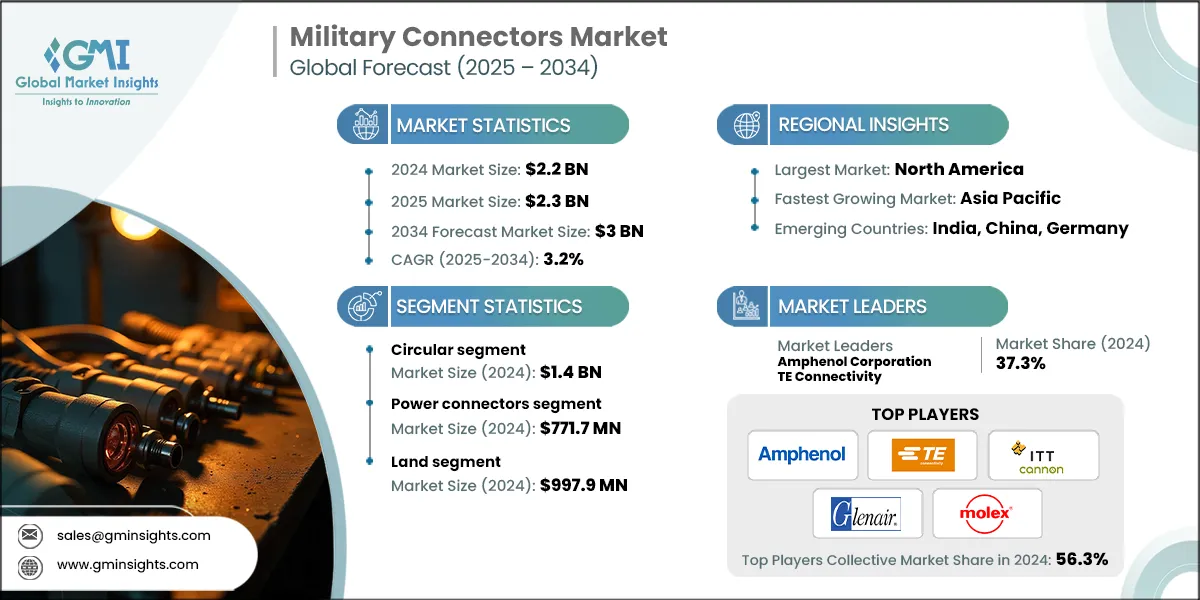
The global military connectors market was valued at USD 2.2 billion in 2024 with a volume of 20,042 thousand units. The market is expected to grow from USD 2.3 billion in 2025 to USD 2.6 billion by 2030 and USD 3 billion with a volume of 33,749 thousand units by 2034 growing at a value CAGR of 3.2% and a volume CAGR of 5.4% during the forecast period of 2025–2034, according to Global Market Insights Inc.
Military Connectors Market Key Takeaways
Market Size & Growth
- 2024 Market Size: USD 2.2 Billion
- 2025 Market Size: USD 2.3 Billion
- 2034 Forecast Market Size: USD 3 Billion
- CAGR (2025–2034): 3.2%
Key Market Drivers
- Increasing global defense expenditures.
- Modernization of military equipment.
- Increasing demand for secure communication systems.
- Expansion of UAVs and autonomous systems.
- Advancements in connector technology..
Challenges
- High manufacturing and material costs.
- Strict military standards and compliance.
Opportunity
- Growth in uncrewed and autonomous military systems.
- Retention of miniaturized and high-density connectors.
- Opportunities in emerging defense markets.
- Technological advancements in connector durability and performance.
Get Market Insights & Growth Opportunities
- The growth of the military connectors market is largely driven by increasing global defense expenditures, modernization of military equipment, increasing demand for secure communication systems, expansion of UAVs and autonomous systems, and advancements in connector technology.
- Increasing military budgets is driving military connector market growth due to demand for reliable, high-performance connectors necessary in the highly complex military communications, surveillance, and weapon systems. According to the International Peace Bureau (IPB), the estimate for global military spending in 2024 stands at USD 2.71 trillion, an outstanding increase from previous years. This rise in military spending around the globe is creating demand for high-tech, very high-quality connectors that last to connect communication and weapon systems for use in defense applications.
- The rapid growth of UAV and autonomous systems is a significant driver of the military connectors market. These connectors need to be lightweight, high-density, rugged and suitable for mission-critical capabilities including navigation, surveillance, secure communication and real-time data transfer. The DoD requested roughly USD 10.95 billion for uncrewed vehicle (UxV) acquisition and development in Fiscal year 2024, which is roughly USD 1 billion more than the previous year's request, and shows continued emphasis on autonomous technology. The DoD intends to continue to increase operational effectiveness of military forces, increase technology superiority of existing U.S. equipment, and further integrate uncrewed systems into U.S. defense strategy to address prevailing global, evolving security challenges.
- In 2024, North America dominated the global military connectors market with a share of 41.8%. The high defense spending, strong capabilities of military technologies, well-established military R&D, well-established military infrastructure, and high levels of manufacturing and export capabilities have all contributed to the region's dominance. For 2025, the DOD is requesting an acquisition budget of USD 311 billion which includes USD 168 billion for military equipment procurement and USD 143 billion for research, development, test and evaluation appropriations (RDT&E) and indicates an emphasis on modernization of capability overall.
To get key market trends
Military Connectors Market Trends
- The miniaturization and lightweight design are significant trend in market and began in the early 2000s, driven by the need for portable, space-efficient military systems. Lightweight and miniaturization of military connectors are accomplished through advanced materials, mostly composites or high-quality aluminium, that can reduce weight while maintaining strength. The peak growth of lightweight and miniaturization is occurring in the 2020s, with continued innovation fueling future expansion.
- The adoption of fiber optic connectors is a significant trend in the military connectors market, driven mainly by the growing need for high-speed, secure, and interference-resistant data transmission in advanced military systems such as UAVs, radar, and satellite communications. The trend began to take shape during the early 2010s as the defense technologies developed required a delivery (throughput) of data and reliable connectivity that traditional connectors could not support.
- A significant new development has been that the U.S. Air Force has added fiber optics connectors to their MIL-STD-1760 aircraft/store interface. The intent here is to improve throughput during military operations and increase flexibility when communicating with advanced weapons systems and sensors. Late 2020s fiber optic technology developments as mentioned before will establish fiber optics as the centerpiece of military communications providing better speed, uncompromised security, and more resilient data capacity.
- The integration of cybersecurity features in military connectors is a key trend that started in the early 2010s. It is driven by growing cyber threats and electronic warfare risks. Military connectors now include extra protection like strong shielding, encryption, authentication, and tamper-resistant designs to keep data safe and secure. As cyber-attacks become more common, the need to protect sensitive military communications is increasing. By the early to mid-2030s, advances in connectors will have evolved and maturely developed, thus the key component of future connectors must include cybersecurity.
- The DOD spent USD 13.5 billion on cyberspace activities in fiscal year 2024 up from the last year of drop of 6%. Funding will add to a few process and considerations as it evolves and supports the DoD's transition toward Zero Trust architecture, increase overall cyber resilience, and protect critical infrastructure.
Military Connectors Market Analysis
Learn more about the key segments shaping this market
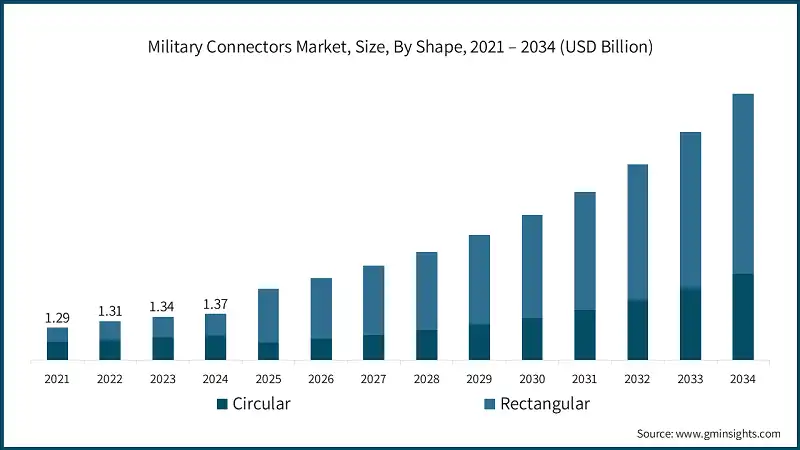
Based on shape, the market is segmented into circular and rectangular.
- The circular segment was the largest market and was valued at USD 1.4 billion in 2024. The expansion of this segment is attributed to the durable topology, ability to handle harsh conditions, and the extent of usage by customers building military equipment, where reliable and secure connections are essential.
- Manufacturers should focus on enhancing durability, improving corrosion resistance, ensuring secure locking mechanisms, optimizing for extreme conditions, integrating lightweight materials, and offering customizable solutions to meet diverse military application requirements and maintain competitive advantage in the circular connectors market.
- Rectangular military connectors segment is the fastest-growing segment with a CAGR of 3.8% during the forecast period of 2025-2034. The rectangular segment is on a fast growth trajectory, as evidenced by the demand drivers of dense configurations to support all needs, rapid integration of scalable, high performance military capability which utilize reliable, low profile, modular connectors.
- Companies should focus on improved miniaturization, rapid installation, more customizability, simplified ruggedness of extreme conditions, and imaginative new materials to address the changing demands of military devices.
Learn more about the key segments shaping this market
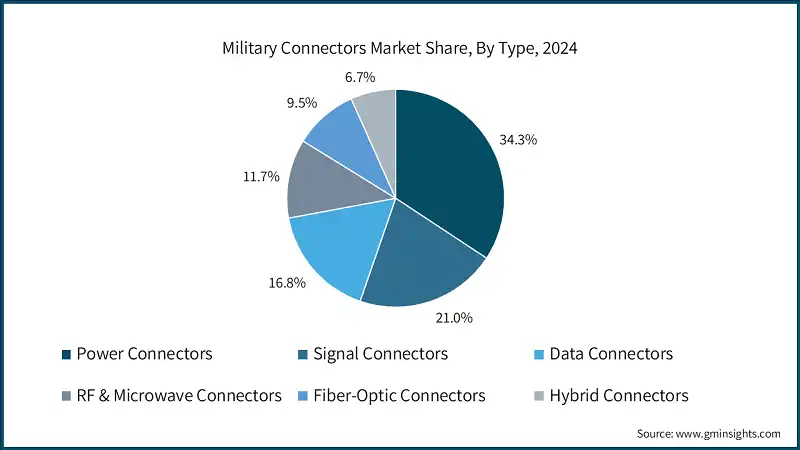
Based on type, the military connectors market is segmented into power connectors, signal connectors, data connectors, RF & microwave connectors, fiber-optic connector and hybrid connector.
- The power connectors was the largest segment and was valued at USD 771.7 million in 2024. This segment is primarily being driven by the demand for reliable power transmission by military systems, advancements by connector manufacturers, and an increased use of high-power application in military systems.
- Manufacturers should improve the current capacity of connectors, energy efficiency, thermal management, ruggedizing for extreme conditions, and smart monitoring in relation to the power applications of new age military systems.
- The hybrid connectors is the fastest-growing market and is anticipated to grow with a CAGR of 4.6% during the forecast period of 2025-2034. This growth is due to the increasing demand for connectors that combine power, signal and data with more efficiency, lower weight and simplified system integration in future military applications.
- Manufacturers should focus on reducing size and increasing applicability across different types of systems, increasing signal integrity, and improving durability and weight reduction using new advanced materials, as well as producing smarter multi-use “special mission” connectors to support military technology growth.
Based on the platform, the military connectors market is segmented into land, airborne, naval, and space satellites.
- The land segment was the largest market and was valued at USD 997.9 million in 2024. This growth is due to the increased presence of advanced military ground vehicles, a demand for reliable, high-quality and durable connectors, and the modernization of land-based defence technology.
- Manufacturers must prioritize the durability and vibration resistance of connectors, easy in-field maintenance, compatibility with systems employed on evolving vehicle systems, and weight savings to adapt to rugged conditions and technological advances in modern military ground applications.
- The space satellites segment is the fastest growing segment and is anticipated to grow with a CAGR of 4.1% during the forecast period of 2025-2034. This growth is due to the increase in satellite deployment for communication, navigation, and defense, with an emphasis on lightweight connectors that are radiation resistant and reliable in use.
- Manufacturers should be considering improved radiation shielding in connectors, weight reduction, thermal management, continued reliability in space environments, and help miniaturize high-performance connectors for next generation satellite technology.
Looking for region specific data?
North America military connectors market was valued at USD 941.8 million in 2024 and is anticipated to grow with a CAGR of 2.7% during the forecast period of 2025 – 2034. This market growth is due to increases in defense budgets and modernization of military systems, demand for new communication systems, and the movement to new connector technology in all sectors.
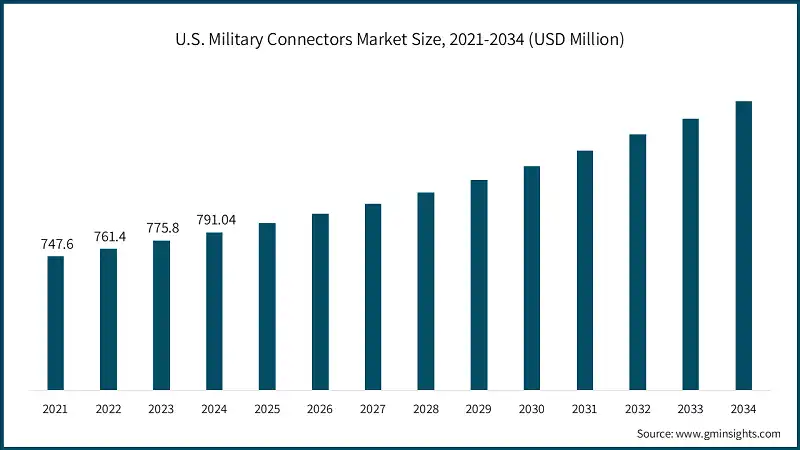
- The military connectors market in the U.S. was valued at USD 791.04 million in the year 2024. This market growth is driven by demand for unmanned systems and drones, expansion of aerospace and defense manufacturing, and demand for cybersecurity and secure communication.
- Companies should focus on obsolescence management of high-reliability connectors and new lightweight connectors for unmanned systems and drones, including better focus on cybersecurity, signal integrity for secure communication, and rugged and high-performance, to support everyone's expanding aerospace and defense manufacturing capabilities in the U.S.
- The Canada military connectors market is projected to grow significantly with a CAGR of 3.2% during the forecast period of 2025-2034. The market is being driven by increased funding and investment in next-generation fighter aircraft and naval vessels, growing reliance on connectors for missile defense systems, and growth in joint military operations creates demand for enhanced important issues, such as the need for connectors with interoperable technology.
- Companies should focus on high-reliability connectors that can resist the environmental extremes, this includes improving interoperability across military platforms due to important demand for growing interoperability, and restricted connector heights for next-generation aircraft and vessels, and modular design aspects to address changing technologies, particularly in Canada.
Europe military connectors market held a 16.5% share in 2024 and a 3.5% CAGR during the forecast period of 2025-2034. The expansion in the European market is being driven by greater modernization of defense systems, increasing demand for more advanced communication and electronic warfare systems, and increased collaborative military action on behalf of NATO member countries.
- The market in Germany was valued at USD 100.9 million in the year 2024. This market is fueled by increasing adoption of modular and scalable connector solutions allowing increased flexibility in deployment, increasing demand coming from the expansion of export-focused defense manufacturing, and increasing emphasis on the sustainability and energy efficiency of military technologies.
- Manufacturers should focus on developing modular, scalable connectors that allow for greater flexibility in deployment, improving sustainability and energy efficiency in design, improving durability for the export market, and including advanced technologies which would meet Germany's evolving defense scenarios.
- The UK military connectors market is anticipated to surpass USD 108.2 million by 2034. This growth is being driven by collaboration with NATO Allies on joint military projects, demand for connectors in the space and satellite defense systems more lightweight capabilities and ruggedized connector solutions especially for mobile forces.
- Manufacturers should focus on developing lightweight, ruggedized connectors for mobile forces, improving interoperability to support joint NATO operations, advancing high reliability solutions advantaging space and satellite defense applications to support growth in the UK market.
The Asia Pacific military connectors market held 28.2% market share in 2024 and is growing at a 4.1% CAGR during the forecast period of 2025-2034. The Asia Pacific market is driven by the national investments in domestic defense manufacturing capabilities, increasing emphasis on border security and surveillance technologies, and the increasing integration of AI and IoT-enabled military systems.
- The market in India was valued at USD 140.3 million in 2024. The growth is being driven by a strong emphasis on self-reliance in defense technology, increased demand for reliable, robust connectors for extreme environments, and government policy emphasis on research and development in defense electronics.
- Companies should focus on developing domestic high-quality connectors to meet requirements for extreme environments, investing time and capital in research and development to support innovation in defence for connectors, and supporting India's goals for self-reliance and winding requirements of changing military technology requirements.
- The China military connectors market is projected to grow significantly with a CAGR of 4% during the forecast period of 2025-2034. The growth is being driven by increased integration of AI and autonomous technologies into military platforms paced alongside the increased focus on high-speed data transport and power providing relatively efficient connectors.
- Manufacturers should focus on developing connectors that meet military specifications for all three attributes currently valued in connectors designed for military use such as AI-compatible, high-speed and power efficiencies, develop these attributes to improve reliable use and the use of autonomous military systems and anticipate incorporating new materials and product design forms that meet the performance characteristics of China's military technologies.
- The Japan military connectors market is projected to grow significantly with a CAGR of 3.6% during the forecast period of 2025-2034. This growth in the Japan market is due to integration of smart technologies into command-and-control systems, development of dual-use technologies with both civilian and military applications and adoption of modular open systems architecture in defense electronics.
- Companies must place emphasis on developing modular smart connector solutions that will be compatible with open systems architecture, to promote interoperability, assist with dual-use applications, and offer high reliability and adaptability to meet Japan's evolving defense technology and modernization requirements.
Latin America military connectors market held 4% market share in 2024 and is growing with a CAGR of 1.4% during the forecast period of 2025-2034. This growth is driven by rising adoption of unmanned aerial vehicles (UAVs) for surveillance and reconnaissance and development of regional defense industries aiming for self-reliance.
The Middle East & Africa market was valued at USD 212.1 million in 2024. The market is fueled because of increasing focus on electronic warfare capabilities, development of indigenous defense manufacturing and harsh environmental conditions driving rugged connector demand.
- The South Africa market is anticipated to grow with a CAGR of 1.3% during the forecast period of 2025-2034. The South Africa market is being driven by increase in focus on peacekeeping and regional security and demand for cost-effective and durable connector solutions.
- Manufacturers must focus on developing durable, cost-effective connectors for rugged environments, providing increased reliability for peace making missions and customizable solutions for regional security forces' operational needs in South Africa.
- The Saudi Arabia military connectors market is projected to grow with a CAGR of 2.3% during the forecast period of 2025-2034. The military connector market in Saudi Arabia is experiencing rapid growth because of increasing demand for lightweight and power efficient connector solutions, funding and modernization of land, air and naval forces, and growth of indigenous defense production under Saudi Arabia's vision 2030.
- Companies must prioritize development of power-efficient and lightweight connectors that meet high performance levels, offer modernization across several military domains, and support Saudi Arabia’s indigenous capability and technological self-sufficiency growth under Vision 2030.
- The UAE military connectors market was valued at USD 77.1 million in 2024. The growth is being pushed along by major investments into overall space defense programs, advanced smart battlefield communications technologies, and generally the rapid growth of AI integration into defense systems.
- Manufacturers must prioritize the development of advanced connectors for smart communications systems that support AI technology and high performance and durability levels for space defense applications and become accustomed to developing connectors tailored for rapidly establishment in active battlefield environments.
Military Connectors Market Share
- The top 5 companies are Amphenol Corporation, TE Connectivity, ITT Cannon, Glenair Inc., Molex and collectively hold around 56.3% of the market in 2024, indicating a consolidated market concentration driven by established supplier relationships and technological barriers to entry.
- Amphenol Corporation holds a major position in the market, accounting for 22.1% of the total market share in 2024. Amphenol Corporation has retained its position as the leading contender in the military connectors market by filling its role in the marketplace as an innovator. Amphenol Corporation manufactures and distributes high-quality products through global distribution channels, ensuring appropriate product for military and aerospace applications by adhering to their typical robust quality control standards. Amphenol Corporation invests in new technologies and customized connector solutions to ensure reliability and performance in rigorous environments that demand safe applications.
- TE Connectivity held 15.2% of the total market share in 2024, due to their knowledge of optical and imaging technologies. TE Connectivity has continued to have its position in the market based on its diversified product selection, research and development capacity, established supply chain globally, and focus on durable, high-performance connectors conforming to military and aerospace standards locally and globally.
- ITT Cannon is a key player in the military connectors market and holds 9.4% of the total market share in 2024, ITT Cannon maintains market share by ensuring its reputation as manufacturing rugged and reliable connectors for use in the most severe possible environments. ITT Cannon maintains robust relationships and shares solid communications with an established network of defense contractors, which is highly regarded and trusted in military aerospace and ground applications.
- Glenair, Inc. held 6.1% of the total market share in 2024, due to its dense product line of high-reliability rugged connectors, focus on innovation excellence, customization options, and reputation for meeting stringent military standards in diverse applications and harsh environments around the world.
- Molex held 3.5% of the total market share in 2024. Molex holds a major position in the market due to its extensive range of products that have highly advanced connector technologies, a strong global supply chain as well as a commitment to delivering proven and reliable, high-performance solutions for mission-critical military and defense applications.
Military Connectors Market Companies
Some of the prominent market participants operating in the market include:
- Amphenol Corporation
- TE Connectivity
- ITT Cannon (ITT Inc.)
- Glenair, Inc.
- Molex
- Smiths Interconnect
- Fischer Connectors SA
- Eaton Corporation
- Conesys
- ODU GmbH & Co. KG
- Weald Electronics Ltd.
- Omnetics Connector Corp.
- Winchester Interconnect
- Hans Turck GmbH
- Koehlke Components Inc.
- Ray Service a.s.
- Renhotec Group Ltd.
- Rojone Pty Ltd.
- ALFAR SL
- Allied Automation Inc.
- Amphenol Corporation, TE Connectivity, ITT Cannon (ITT Inc.), Glenair, Inc., Molex, Smiths Interconnect are considered leaders in the military connector market owing to their broad product portfolios, global presence, and strong brand reputation. They provide a wide range of high-reliability connectors for military aerospace, ground vehicles, and naval applications. Their continuous investment in miniaturization, ruggedization, and high-speed data transmission technologies, along with established partnerships with defense primes, provides them with a competitive advantage in scale, reliability, and innovation.
- Fischer Connectors SA, Eaton Corporation, Conesys, and ODU GmbH & Co. KG are challengers, focusing on rugged connector solutions and niche technologies. They have strong engineering resources and long-term supply programs with defense contractors. Though they are not as broad in global scale as the leaders, their expertise is in custom solutions, innovation on circular connectors, and penetration into regional market share, which allows them to grow their share steadily.
- Weald Electronics Ltd., Omnetics Connector Corp., Winchester Interconnect, Hans Turck GmbH are followers that offer reliable products, but their product portfolios are not as expansive as the leaders and challengers. Their competitive position is found in their representational sources with specialized military grade designs and significant presence in selective defense programs. They typically act as component suppliers or serve marginal defense markets, from which their growth is found through innovations in compact high-density connectors and relationships with OEM’s.
- Koehlke Components Inc., Ray Service a.s., Renhotec Group Ltd., Rojone Pty Ltd., ALFAR SL, and Allied Automation Inc. are niche players that focus on custom, application-specific or regional connector solutions. They sometimes offer cost-competitive solutions, require custom defense offerings, or service regional defense contracts. They have technology specialization and agility, but not global coverage or scale. Their growth is dependent on focused applications and collaborative partnerships.
Military Connectors Market Report Attributes
| Key Takeaway | Details |
|---|---|
| Market Size & Growth | |
| Base Year | 2024 |
| Market Size in 2024 | USD 2.2 Billion |
| Market Size in 2025 | USD 2.3 Billion |
| Forecast Period 2025-2034 CAGR | 3.2% |
| Market Size in 2034 | USD 3 Billion |
| Key Market Trends | |
| Drivers | Impact |
| Increasing global defense expenditures | The increasing focus on global defense spending leads to an increased spending on military budgets, creating a demand for sophisticated and reliable military connectors. |
| Modernization of military equipment | Military platforms are continuously updated and rely on rugged military connectors to ensure data and power transfer in environmental extremes. |
| Increasing demand for secure communication systems | Secure communications with encryption create a demand for connectors that will be interference and cybersecurity resistant in defense use. |
| Expansion of UAVs and autonomous systems | The increase in UAVs and autonomous systems will increase the demand for small and lightweight connectors that will provide reliable and connectivity. |
| Advancements in connector technology. | As connector technologies advance in terms of reduced size and EMI shielding, performance and the likelihood of reliable functioning continues to improve. |
| Pitfalls & Challenges | Impact |
| High manufacturing and material costs | Higher costs cause costs to rise above security and/or cause production costs to be above scaling, while also affecting cost for acceptance of products in military connector production. |
| Strict military standards and compliance | The strict military standards all increase the cycle and the cost to complete projects on time and deliver the compliant connector solutions on time. |
| Opportunities: | Impact |
| Growth in uncrewed and autonomous military systems | The profusion of UAV and autonomous platforms are likely to increase the demand for types of specialized connectors that are needed, providing considerable opportunity for market growth in military connectors. |
| Retention of miniaturized and high-density connectors | Miniaturization continues to foster the use of compact, high-density connectors which provide promise for a future class of compact devices in military electronics. |
| Opportunities in emerging defense markets | Increasing budgets for defense in emerging regions are creating new markets for military connectors manufacturers and supplying markets. |
| Technological advancements in connector durability and performance | Developing innovative technologies that improve connector resilience and efficiency levels are boosting reliability of connectors in significant hostile conditions and subsequently stimulating greater market growth. |
| Market Leaders (2024) | |
| Market Leader |
Top 2 companies hold 37.3% market share |
| Top Players |
Collective market share in 2024 is 56.3% |
| Competitive Edge |
|
| Regional Insights | |
| Largest Market | North America |
| Fastest growing market | Asia Pacific |
| Emerging countries | India, China, Germany |
| Future outlook | They are dedicated towards innovation through strategic developments; they will remain relevant to changing defense requirements. There has been increased investment in research and development to analyze improved connectivity and connector durability and performance., By investing in new component technologies such as fiber optics, 5G, and miniaturization they will deliver connectivity technologies that support military advancement. |
What are the growth opportunities in this market?
Military Connectors Industry News
- In 2023, ITT Cannon (ITT Inc.) formed a strategic collaboration with Littelfuse, Inc., a leader in circuit protection technology. This partnership aims to develop advanced, rugged connectors combining ITT Cannon’s expertise in harsh environment connectors.
- In 2023, Glenair, Inc. entered a collaboration agreement with Lockheed Martin to supply custom military connector solutions for unmanned aerial vehicles (UAVs). This partnership focuses on developing lightweight, high-performance connectors tailored for advanced aerospace applications.
The military connectors market research report includes in-depth coverage of the industry with estimates and forecasts in terms of revenue in (USD million) & volume in (Units) from 2021 – 2034 for the following segments:
Market, By Shape
- Circular
- MIL-DTL-38999
- MIL-DTL-26482
- MIL-DTL-5015
- Others
- Rectangular
- MIL-DTL-24308
- MIL-DTL-83513
- MIL-DTL-55302
- Others
Market, By Type
- Power connectors
- Signal connectors
- Data connectors
- RF & microwave connectors
- Fiber-optic connectors
- Hybrid connectors
Market, By Platform
- Land
- Command centers
- Soldier systems
- Armoured vehicles
- Combat vehicles
- Support vehicles
- UGVs
- Airborne
- Military aircraft
- Helicopters
- UAVs
- Naval
- Ships
- Aircraft carriers
- Destroyers
- Patrol vehicles
- Others
- Submarines
- Unmanned marine vehicles
- Ships
- Space satellites
The above information is provided for the following regions and countries:
- North America
- U.S.
- Canada
- Europe
- Germany
- UK
- France
- Spain
- Italy
- Netherlands
- Asia Pacific
- China
- India
- Japan
- Australia
- South Korea
- Latin America
- Brazil
- Mexico
- Argentina
- Middle East and Africa
- Saudi Arabia
- South Africa
- UAE
Frequently Asked Question(FAQ) :
What is the market size of the military connectors industry in 2024?
The market size was USD 2.2 billion in 2024, with a CAGR of 3.2% projected for 2025–2034, driven by growing global defense expenditures and modernization of equipment.
What is the current military connectors market size in 2025?
The market is projected to reach USD 2.3 billion in 2025.
What is the projected value of the military connectors market by 2034?
The market is expected to reach USD 3 billion by 2034, supported by rising adoption of UAVs, autonomous systems, and secure communication technologies.
How much revenue did the power connectors segment generate in 2024?
The power connectors segment generated USD 771.7 million in 2024.
What was the valuation of circular connectors in 2024?
The circular connectors segment was valued at USD 1.4 billion in 2024.
What is the growth outlook for hybrid connectors from 2025 to 2034?
Hybrid connectors are expected to grow at a 4.6% CAGR through 2034, owing to their ability to integrate power, signal, and data in compact and efficient solutions.
Which region leads the military connectors market?
The U.S. market was valued at USD 791 million in 2024. Growth is fueled by demand for unmanned systems, expansion of aerospace and defense manufacturing, and need for secure communications.
What are the upcoming trends in the military connectors industry?
Key trends include miniaturization and lightweight design, adoption of fiber optic connectors for secure high-speed data, and integration of cybersecurity features to counter electronic warfare threats.
Who are the key players in the military connectors market?
Leading players include Amphenol Corporation, TE Connectivity, ITT Cannon, Glenair, Inc., Molex, and Smiths Interconnect. Other significant participants are Fischer Connectors SA, Eaton Corporation, Conesys, ODU GmbH & Co. KG, and Omnetics Connector Corp.
Military Connectors Market Scope
Related Reports