Summary
Table of Content

Microgrid Market
Get a free sample of this report
Form submitted successfully!
Error submitting form. Please try again.
Thank you!
Your inquiry has been received. Our team will reach out to you with the required details via email. To ensure that you don't miss their response, kindly remember to check your spam folder as well!
Request Sectional Data
Thank you!
Your inquiry has been received. Our team will reach out to you with the required details via email. To ensure that you don't miss their response, kindly remember to check your spam folder as well!
Form submitted successfully!
Error submitting form. Please try again.
Microgrid Market Size
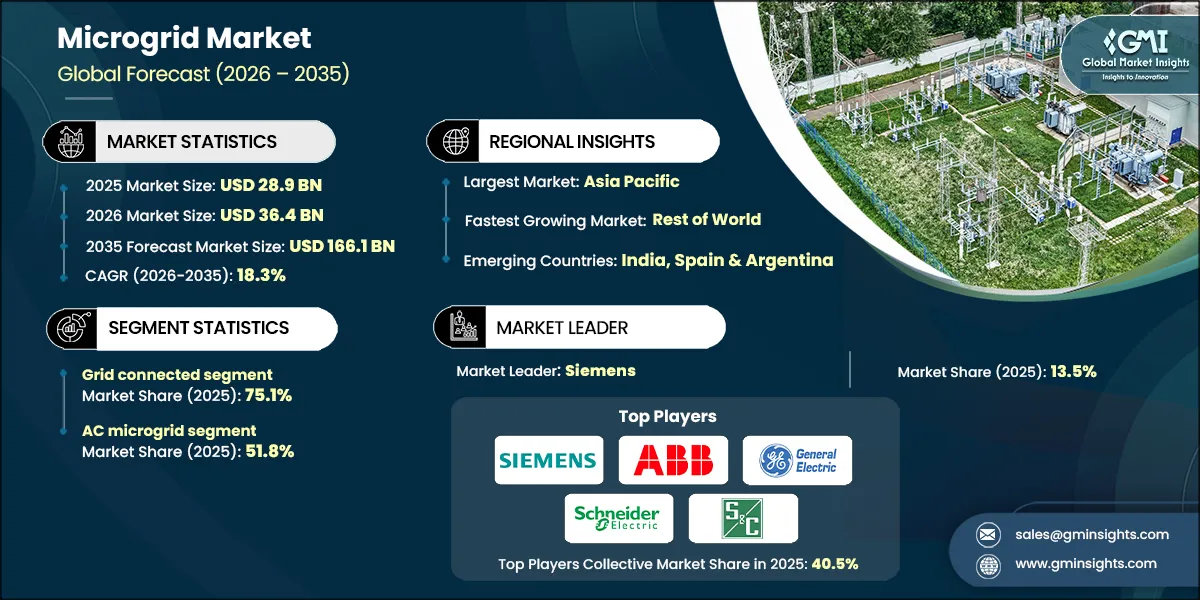
The global microgrid market was estimated at USD 28.9 billion in 2025. The market is expected to grow from USD 36.4 billion in 2026 to USD 166.1 billion in 2035, at a CAGR of 18.3% according to Global Market Insights Inc.
Microgrid Market Key Takeaways
Market Size & Growth
- 2025 Market Size: USD 28.9 Billion
- 2026 Market Size: USD 36.4 Billion
- 2035 Forecast Market Size: USD 166.1 Billion
- CAGR (2026–2035): 18.3%
Regional Dominance
- Largest Market: Asia Pacific
- Fastest Growing Region: Rest of World
Key Market Drivers
- Growing renewable integration.
- Rising energy resilience needs.
Challenges
- High initial costs.
- Complex regulatory frameworks.
Opportunity
- Government incentives.
- Technological advancements.
Key Players
- Market Leader: Siemens led with over 13.5% market share in 2025.
- Leading Players: Top 5 players in this market include Siemens, ABB, General Electric, Schneider Electric, S&C Electric Company, which collectively held a market share of 40.5% in 2025.
Get Market Insights & Growth Opportunities
- Increasing emphasis on energy reliability and resilience, combined with global renewable energy transition and stringent environmental norms, is accelerating microgrid adoption. Frequent power outages and risks from extreme weather or cyberattacks highlight the need for localized, independent systems capable of islanding from the main grid. These features ensure uninterrupted supply, making microgrids essential for critical facilities and communities seeking secure, sustainable energy solutions.
- A microgrid is a localized energy network with defined boundaries that operates both in grid-connected and islanded modes. It integrates distributed resources such as solar, wind, and battery storage with advanced control systems to optimize performance. Designed for campuses, industrial sites, or communities, microgrids enhance energy reliability, reduce dependency on centralized grids, and support sustainability goals through efficient renewable integration and intelligent energy management.
- Rising global investments in clean energy initiatives to curb carbon emissions and meet sustainability targets are creating favorable conditions for microgrid deployment. These programs reduce upfront capital costs, making projects more viable. For instance, the IEA reports that direct government spending on clean energy surpassed USD 2 trillion since 2020, significantly boosting opportunities for microgrid adoption across sectors seeking cost-effective, green energy solutions.
- Growing innovations in smart grid technologies, energy management platforms, and advanced storage systems are improving microgrid scalability and efficiency. Additionally, the rapid deployment of electric vehicle fleets is driving demand for resilient, localized power infrastructure. These advancements enable dynamic load balancing, seamless renewable integration, and enhanced operational flexibility, positioning microgrids as a critical component of modern energy ecosystems and sustainable transportation networks.
- Asia Pacific is among the dominant regions on account of growing adoption of renewable energy sources coupled with rising urbanization and industrial growth. Countries such as China, India, and Japan are investing heavily in solar and wind projects, requiring localized energy systems for stability and efficiency. Microgrids enable seamless renewable integration, reducing grid dependency and supporting regional sustainability goals.
- Moreover, companies ongoing investment in developing advanced microgrid solutions will propel the product growth. For instance, Delta unveiled its AI Data Center Microgrid Solution at Energy Taiwan 2025. The solution boasts a variety of on-site energy sources and solid-state transformers, achieving an impressive 98.5% efficiency. Tailored for swift load adjustments, it's engineered to bolster resilient, multi-source smart-grid applications, catering specifically to AI-driven facilities and industrial operations.
- Growing demand for reliable electricity in Latin America is accelerating microgrid adoption, particularly in rural regions where limited grid access hampers development and quality of life. Additionally, the region’s vulnerability to hurricanes, floods, and other extreme weather events often disrupt centralized grids, causing frequent outages. Microgrids provide resilient, localized power solutions, ensuring energy security and supporting economic growth while aligning with sustainability goals and reducing dependence on traditional infrastructure.
To get key market trends
Microgrid Market Trends
- Rising need for uninterrupted electricity in off-grid and remote regions is accelerating microgrid adoption. Companies are deploying advanced systems to improve reliability and visibility. For instance, in March 2021, ABB implemented Indonesia’s first microgrid at IMM mine, integrating solar PV, battery storage, and smart controls. This system generates 230 MWh annually and reduces 192 tons of CO? emissions, showcasing how microgrids enhance sustainability and energy security in areas where centralized grids are unreliable or unavailable.
- Growing renewable energy deployment, supported by declining solar PV costs and improved efficiency, is driving microgrid adoption globally. Microgrids enable seamless integration of solar and wind power, aligning with carbon reduction strategies and sustainability goals. This trend is reinforced by technological advancements that optimize energy storage and distribution, making microgrids a critical solution for industrial, commercial, and community applications seeking reliable, clean energy while reducing dependence on traditional centralized power systems.
- Increasing collaborations between governments and private firms are expanding microgrid reach in underserved regions with high renewable potential. For instance, in January 2024, Royal Johannesburg Golf Club, South Africa's largest solar microgrid, boasts 452 solar panels, FreedomWon battery stacks, Huawei inverters, and an ATESS PCS inverter. This initiative not only champions renewable energy adoption but also bolsters energy resilience. Furthermore, it sets a scalable model for sustainable power infrastructure, aligning with electrification goals in emerging markets.
- Growing investments in advanced technologies since 2019 have improved microgrid adaptability, resilience, and efficiency. Innovations in smart controls, energy storage, and automation make systems more attractive for diverse applications. Coupled with government incentives and rural electrification programs, these advancements will significantly boost adoption between 2028 and 2030, supporting global sustainability targets and cost-effective energy solutions for industries, communities, and critical infrastructure, while reducing reliance on aging centralized grids.
- Rising demand for durable power systems to minimize downtime and maintenance costs from industrial and remote applications escalate the business outlook. Microgrids offer extended operational life, ensuring consistent energy supply in areas where interruptions can be costly. For instance, on November 2025, India’s Defence Minister inaugurated NTPC’s 3.7 MW solar-hydrogen microgrid at Chushul, Ladakh. Commissioned in eight months, it replaces diesel generators at remote Army posts, cutting emissions, enhancing energy security, and eliminating fuel transport challenges in high-altitude terrain.
Microgrid Market Analysis
Learn more about the key segments shaping this market
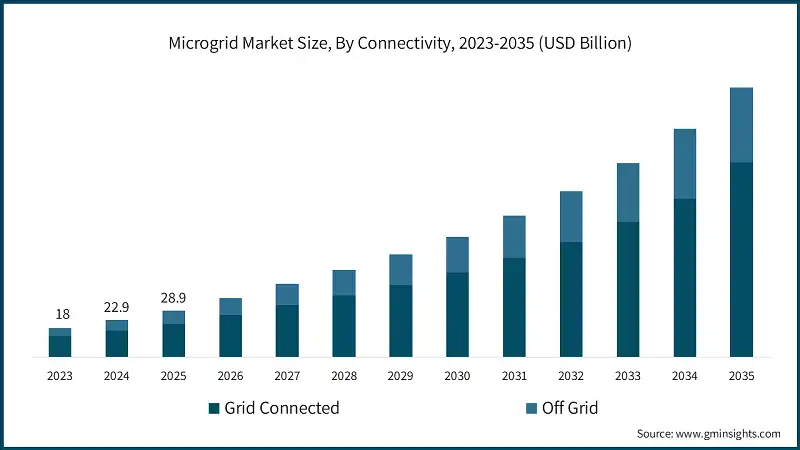
Based on connectivity, the industry is segmented into grid connected and off grid. Grid connected dominated the microgrid market, accounting for 75.1% in 2025 and is expected to grow at a CAGR of 18.9% through 2035.
- Increasing need for connectivity with advanced load management and peak shaving capabilities is driving grid tied microgrid adoption. These systems help reduce energy costs by minimizing reliance on expensive peak-time electricity. Rising investments by key players to develop connectivity in remote regions further strengthens this trend. For instance, Honeywell launched India’s first on-grid solar microgrid in Lakshadweep in September 2024, featuring 1.7 MWp solar capacity and 1.4 MWh battery storage for reliable, sustainable power.
- The off grid microgrid segment is projected to grow at a CAGR of 20.2% through 2035, fueled by rising energy needs in remote and underserved areas. These systems offer cost-effective, eco-friendly solutions for critical services including healthcare, education, and communication. Their ability to provide reliable power in isolated regions makes them essential for improving living standards and supporting economic development, particularly where centralized grids are impractical or unavailable.
- Additionally, rising government support through incentives, grants, and policies is accelerating microgrid adoption, especially in remote areas. For instance, in September 2024, the U.S. Department of Energy approved a USD 72.8 million loan guarantee for a tribal land microgrid project in California. The initiative includes a 15 MW solar installation and a 70 MWh long-duration battery system, highlighting how public funding drives large-scale renewable integration and energy resilience.
- Growing interest from companies in meeting off grid power needs and deploying advanced systems to ensure uninterrupted energy supply is fostering industry growth. The transition from centralized to decentralized energy systems reduces transmission losses, improves distribution efficiency, and enables local control over generation and consumption. This shift enhances energy security, supports sustainability goals, and positions microgrids as a critical solution for modern power infrastructure.
Learn more about the key segments shaping this market
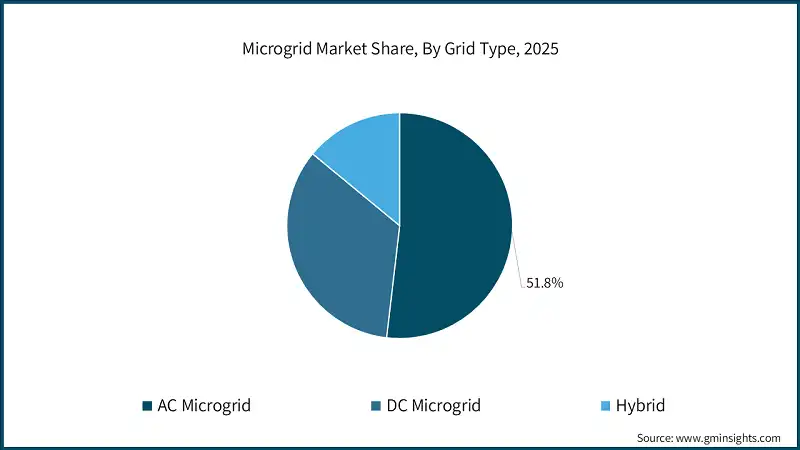
Based on grid type, the microgrid market is segmented into AC microgrid, DC microgrid and hybrid. AC microgrid dominates the market with a 51.8% share in 2025, and the segment is expected to grow at a CAGR of 18.3% from 2026 to 2035.
- The AC microgrid segment is gaining market share due to rising demand for reliable power solutions in regions prone to outages. Remote and underserved areas are driving innovation and investment, supported by government initiatives promoting clean energy adoption. For instance, in October 2021, Eaton built a solar-powered microgrid with battery storage at its circuit breaker facility in Rico. By 2022, the company targeted delivering 10 MW (AC) of solar PV and 2.23 MW of battery storage through two microgrids in Puerto Rico, enhancing energy resilience and sustainability.
- Advancements in energy storage, power electronics, and grid management systems, combined with supportive government policies, are accelerating AC microgrid investments. These innovations enhance efficiency and scalability, fostering decentralized energy adoption. For instance, in December 2024, Truist Bank invested USD 150 million in tax equity for Scale Microgrids, supporting projects including community solar and battery storage for commercial and industrial clients, highlighting growing financial backing for advanced microgrid solutions.
- The hybrid microgrid segment is projected to grow at a CAGR of 18.8% by 2035, driven by demand for cost-effective, energy-independent solutions in regions with unstable grids. These systems reduce energy costs and enhance resilience, making them ideal for remote areas where grid extension is unfeasible. For instance, in December 2024, CampusGrid, a hybrid microgrid featuring a 565 MW solar system and 1 MW battery storage for two hours of autonomy, was launched by the State University of Campinas at a cost of USD 7.7 million.
- The top two connectivity segments account for 85.9% of the market in 2025, with DC microgrids expected to exceed USD 47.4 billion by 2034. Growing adoption of renewable energy and demand for island-mode capable systems are driving this trend. Additionally, innovations in hydrogen-based microgrids, including advancements in electrolysis and fuel cell technologies, are improving efficiency and reliability, positioning DC microgrids as a critical solution for sustainable, decentralized energy systems globally.
Looking for region specific data?
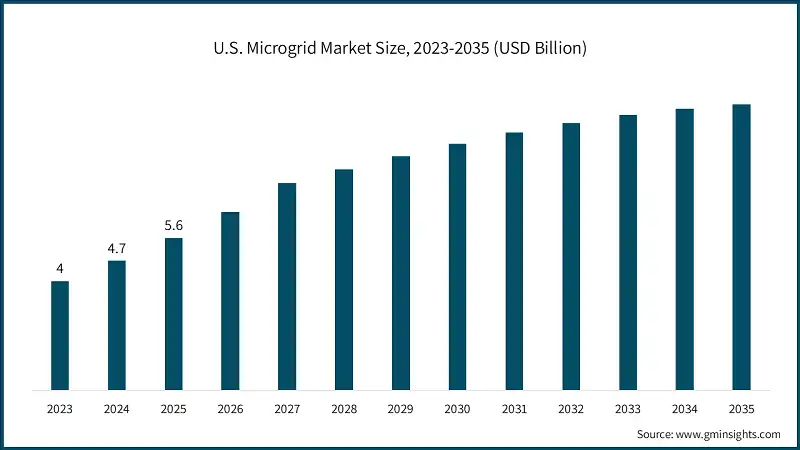
- The U.S. dominated the microgrid market in North America with around 81.6% share in 2025 and is expected to generate over USD 10.5 billion in revenue by 2035.
- Growing federal and state-level incentives are accelerating microgrid deployment across the country. Programs such as the U.S. DOE Microgrid Initiative provide funding and technical assistance, while states such as California and New York actively promote microgrid adoption to enhance energy resilience and sustainability. These initiatives create significant opportunities for businesses and communities seeking reliable, clean energy solutions, reducing dependence on centralized grids and supporting long-term carbon reduction goals.
- The North American microgrid market is expected to exceed USD 13.6 billion by 2035, driven by growing concerns over natural disasters and grid vulnerabilities. Increasing frequency and severity of extreme weather events expose weaknesses in centralized power systems, creating demand for resilient alternatives. According to NCEI, the U.S. recorded 403 climate-related disasters between 1980 and 2024, each causing losses above USD 1 billion. These challenges highlight the need for dependable, localized energy solutions, positioning microgrids as a critical component of future energy infrastructure.
- Asia Pacific microgrid market is anticipated to grow at a CAGR of 26.1% by 2035. Increasing earthquakes and typhoons in the region are disrupting centralized grids, creating strong demand for microgrids to enhance energy resilience. According to UN ESCAP, over 140 disasters in 2022 caused 7,500 deaths in the region. Growing vulnerability to extreme weather will accelerate microgrid adoption, ensuring reliable power for critical services and remote communities. These systems provide localized generation and storage, reducing outage risks and supporting sustainable energy access in disaster-prone areas.
- China dominates the regional microgrid market due to rapid industrialization, urbanization, and rising energy demand. Microgrids offer cost-effective, scalable solutions for expanding energy access across urban and remote areas. Western and mountainous regions lacking full grid coverage further drive adoption, enabling electrification of rural communities. Government initiatives promoting clean energy and infrastructure modernization strengthen this trend, positioning microgrids as a key component of China’s sustainable energy strategy.
- Europe’s microgrid market is projected to grow at a CAGR of 9.9%, fueled by aging infrastructure and the transition to decentralized energy systems. Investments in smart grid technologies and advanced microgrid controllers enable dynamic load balancing, fault detection, and seamless grid interaction. Their ability to operate in both grid-connected and islanded modes enhances resilience against outages and cyber threats, making microgrids essential for modernizing Europe’s energy networks and improving reliability.
- The Middle East & Africa microgrid market is expected to surpass USD 8.1 billion by 2035, driven by energy access challenges and rising electricity demand. Many remote communities lack reliable grid connections, making decentralized microgrids a practical solution. High solar potential and declining solar PV costs further support clean energy integration. These factors, combined with growing interest in renewable projects, position microgrids as a critical technology for improving energy reliability and sustainability in the region.
Microgrid Market Share
- The top 5 companies, including ABB, S&C Electric Company, General Electric, Schneider Electric, and Siemens, account for nearly 40.5% of the market share. Companies are developing modular and scalable microgrid solutions integrating solar, wind, battery storage, and advanced controllers. Offering both AC and DC architectures ensures flexibility for industrial, commercial, and remote applications, enabling faster deployment and meeting diverse customer requirements globally.
- Firms are adopting Energy-as-a-Service (EaaS) models, combining technology with financing options such as PPAs and leasing. This approach reduces upfront costs for customers, expands market reach, and creates recurring revenue streams through long-term maintenance, optimization, and performance guarantees.
- Moreover, key players are investing in AI-driven microgrid controllers and IoT-based monitoring systems enhances efficiency and resilience. These technologies enable predictive maintenance, dynamic load balancing, and real-time optimization, positioning companies as leaders in delivering intelligent, future-ready energy solutions.
- Companies are also collaborating with utilities, EPCs, and technology providers to deliver turnkey solutions. Active engagement with regulators helps streamline interconnection standards and secure incentives, while partnerships with governments and institutions accelerate adoption in underserved regions and large-scale projects.
Microgrid Market Companies
- ABB, delivers advanced microgrid solutions integrating renewable energy, storage, and intelligent controls for remote and industrial applications. Its focus on modular systems enhances scalability and resilience. Moreover, the company reported revenue of approximately USD 9 billion in Q3 2025, driven by electrification and automation segments.
- S&C Electric Company, specializes in resilient microgrid systems with switching, protection, and energy storage technologies. Its solutions ensure uninterrupted power for critical facilities and remote sites, emphasizing reliability and renewable integration.
- General Electric, offers comprehensive microgrid solutions combining distributed generation, advanced analytics, and grid optimization. Its portfolio supports renewable integration and energy resilience for industrial and utility-scale projects. Additionally, GE posted USD 68 billion in 2024 revenue, with strong performance in energy and grid modernization segments.
- Schneider Electric provides modular microgrid systems with smart controllers and IoT integration, enabling dynamic load management and renewable adoption. Its Villaya Flex solution targets community electrification. The company achieved USD 11.6 billion in Q3 2025 revenue, driven by energy management and automation businesses.
- Siemens, delivers advanced microgrid technologies with digitalization and automation capabilities, supporting both grid-connected and islanded operations. Its solutions enhance resilience and sustainability for industrial and commercial sectors. Siemens reported USD 92.1 billion in 2025 revenue, with strong growth in smart infrastructure and energy systems.
Eminent players operating in the microgrid industry are:
- ABB
- Advanced Microgrid Systems
- Ameresco
- Bloom Energy Corporation
- BoxPower
- Caterpillar
- Delta Electronics
- Eaton
- Exelon Corporation
- General Microgrids
- General Electric
- Heila Technologies
- Hitachi Energy
- Honeywell International
- Lockheed Martin Corporation
- Power Analytics Global Corporation
- PowerSecure
- Siemens
- Schneider Electric
- S&C Electric Company
- Toshiba Corporation
Microgrid Market Report Attributes
| Key Takeaway | Details |
|---|---|
| Market Size & Growth | |
| Base Year | 2025 |
| Market Size in 2025 | USD 28.9 Billion |
| Market Size in 2026 | USD 36.4 Billion |
| Forecast Period 2026 - 2035 CAGR | 18.3% |
| Market Size in 2035 | USD 166.1 Billion |
| Key Market Trends | |
| Drivers | Impact |
| Growing renewable integration | Growing renewable energy deployment in remote and urban areas drives microgrid adoption, enabling efficient solar and wind integration while reducing dependency on centralized grids. |
| Rising energy resilience needs | Rising concerns over outages and extreme weather events push demand for microgrids, offering localized, reliable power solutions for critical infrastructure and communities. |
| Pitfalls & Challenges | Impact |
| High initial costs | Significant upfront investment for equipment, storage, and control systems limits adoption, especially in developing regions with constrained budgets. |
| Complex regulatory frameworks | Fragmented policies and unclear grid interconnection standards create delays and increase compliance costs for microgrid projects. |
| Opportunities: | Impact |
| Government incentives | Expanding subsidies and clean energy programs reduce capital burden, making microgrid projects financially viable for businesses and communities. |
| Technological advancements | Innovations in energy storage, smart controls, and EV integration enhance microgrid efficiency, scalability, and long-term cost savings. |
| Market Leaders (2025) | |
| Market Leaders |
13.5% market share |
| Top Players |
|
| Competitive Edge |
|
| Regional Insights | |
| Largest Market | Asia Pacific |
| Fastest Growing Market | Rest of World |
| Emerging Countries | India, Spain & Argentina |
| Future outlook |
|
What are the growth opportunities in this market?
Microgrid Industry News:
- In September 2025, Eaton partnered with Xendee to enhance microgrid efficiency using AI-driven optimization tools. The collaboration focuses on improving energy savings, strengthening security, and advancing sustainability, enabling smarter, more resilient power systems for diverse applications and future-ready energy infrastructure.
- In February 2025, California-based BoxPower introduced solar-powered microgrid storage systems to improve energy access in remote areas. Combining advanced technology with intelligent software, the company accelerates installation and optimizes performance, supporting sustainable and reliable power for underserved communities.
- In May 2024, Schneider Electric presented Villaya Flex at the Alliance for Rural Electrification Energy Access Investment Forum in Lagos, Nigeria. The solution targets community electrification, addressing energy challenges and promoting a transition to clean, decentralized power across sub-Saharan Africa.
- In April 2024, Eaton partnered with Enel to implement Puerto Rico’s largest clean energy microgrid at its Arecibo circuit breaker plant. The system integrates 5 MW solar capacity, 1.1 MW battery storage, and existing generators, enhancing resilience, reducing emissions, and supporting local infrastructure.
The microgrid market research report includes an in-depth coverage of the industry with estimates & forecast in terms of revenue in “USD Billion & MW” from 2022 to 2035, for the following segments:
Market, By Grid Type
- AC microgrid
- DC microgrid
- Hybrid
Market, By Connectivity
- Grid connected
- Off grid
Market, By Power Source
- Diesel generators
- Natural gas
- Solar PV
- CHP
- Others
Market, By Storage Device
- Lithium-ion
- Lead acid
- Flow battery
- Flywheels
- Others
Market, By Application
- Healthcare
- Educational institutes
- Military
- Utility
- Industrial/ commercial
- Remote
- Others
The above information has been provided for the following regions and countries:
- North America
- U.S.
- Canada
- Mexico
- Europe
- Germany
- France
- UK
- Russia
- Spain
- Asia Pacific
- China
- Japan
- South Korea
- India
- Australia
- Middle East and Africa
- Saudi Arabia
- UAE
- South Africa
- Latin America
- Brazil
- Argentina
- Chile
Frequently Asked Question(FAQ) :
What is the market size of the microgrid market in 2025?
The market size was valued at USD 28.9 billion in 2025, with a CAGR of 18.3% expected through 2035, driven by rising demand for energy resilience, renewable integration, and decentralized power systems.
What is the projected value of the microgrid market by 2035?
The microgrid market is expected to reach USD 166.1 billion by 2035, due to growing investments in clean energy, smart grid technologies, and grid modernization.
What is the estimated microgrid market size in 2026?
The market size is projected to grow to USD 36.4 billion in 2026 as adoption accelerates across industrial, commercial, and community applications.
Which connectivity segment dominates the microgrid market?
Grid-connected microgrids dominated the market with a 75.1% share in 2025, supported by advanced load management, peak shaving capabilities, and improved grid interaction.
What is the growth outlook for off-grid microgrids through 2035?
Off-grid microgrids are expected to grow at a CAGR of 20.2% through 2035, driven by rising energy demand in remote and underserved regions and government electrification initiatives.
Which grid type holds the largest share in the microgrid market?
AC microgrids led the market with a 51.8% share in 2025, benefiting from compatibility with existing infrastructure and growing deployment in outage-prone regions.
What is the fastest-growing regional microgrid market?
The U.S. dominated the North America microgrid market with 81.6% share in 2025 and is expected to generate over USD 10.5 billion by 2035.
Who are the key players in the microgrid market?
Leading companies include Siemens, ABB, General Electric, Schneider Electric, and S&C Electric Company.
Microgrid Market Scope
Related Reports