Summary
Table of Content

Micro-Mobility Integration Systems Market
Get a free sample of this report
Form submitted successfully!
Error submitting form. Please try again.
Thank you!
Your inquiry has been received. Our team will reach out to you with the required details via email. To ensure that you don't miss their response, kindly remember to check your spam folder as well!
Request Sectional Data
Thank you!
Your inquiry has been received. Our team will reach out to you with the required details via email. To ensure that you don't miss their response, kindly remember to check your spam folder as well!
Form submitted successfully!
Error submitting form. Please try again.
Micro-Mobility Integration Systems Market Size
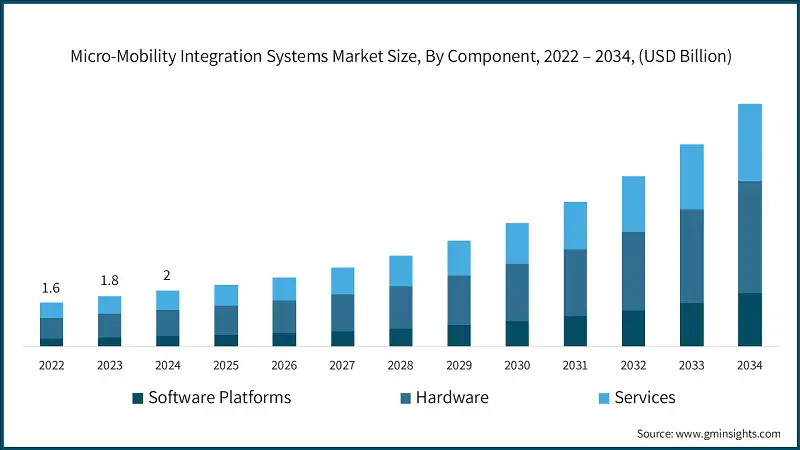
The global micro-mobility integration systems market was estimated at USD 2 billion in 2024. The market is expected to grow from USD 2.2 billion in 2025 to USD 8.7 billion in 2034, at a CAGR of 16.4% according to latest report published by Global Market Insights Inc.
Micro-Mobility Integration Systems Market Key Takeaways
Market Size & Growth
- 2024 Market Size: USD 2 Billion
- 2025 Market Size: USD 2.2 Billion
- 2034 Forecast Market Size: USD 8.7 Billion
- CAGR (2025–2034): 16.4%
Key Market Drivers
- Urbanization & Last-Mile Demand.
- Technology & Connectivity.
- Sustainability & Regulatory Support.
- Charging & Battery Infrastructure.
Challenges
- Regulatory Complexity.
- Safety & Liability Risks.
Opportunity
- Data Monetization & Analytics.
- Expansion to Emerging Cities.
Key Players
- Leading Players: Top 5 players in this market include Vulog, INVERS, Ridecell, Comodule, Wunder Mobility, which collectively held a market share of 7% in 2024.
Get Market Insights & Growth Opportunities
The micro-mobility integration systems market is experiencing transformative trends that are reshaping operational models, technology architecture, and business strategies across industry. As micro-mobility becomes part of multimodal transportation platforms, the market is experiencing a new model of urban mobility. This is evidenced by the current momentum created by established MaaS (Mobility as a Service) models.
The BVG's (Berliner Verkehrsbetriebe) Jelbi platform integrates public transport and multiple micro-mobility operators into a single platform, allowing users to plan and pay for their journeys with a single interface in Berlin. For example, Moovit is an example of a global MaaS platform that has served 1.7 billion riders in more than 3,500 cities in 112 countries and includes micro-mobility as an option within public transport routing.
The COVID-19 pandemic has had an extraordinary impact on the micro-mobility integration systems market. During the strict lockdowns, passenger-kilometers taken on the e-micromobility (e-scooters and e-bikes) dropped approximately 60 to 70% throughout Europe. However, in Italy, e-micromobility rebounded almost immediately, with total fleet e-kick scooter registrations rising from 4,650 in 2019 to 35,550 in 2020. The post-pandemic recovery also illustrates an overall resilience of the current market as it continues to experience its persistent growth and sustainable recovery path.
The micro-mobility integration systems market is projected to be primarily influenced by Europe with many European countries already investing heavily in shared mobility solutions, as evidenced by the extensive implementations within various European cities, such as those found in Germany. This commitment is evidenced by Germany's extensive network of greater than 360 dockless operations across a total of 139 cities throughout the country, which is an indication of a country's attempt to incorporate micro-mobility into its urban transport network.
The UK has also been a large market player in the micro-mobility space with over 18 live trials for e-scooters resulting in collectively a sizeable number of 52.6 million trips since beginning operation. The high number of trips provides evidence for strong adoption by riders and operational viability.
Asia-Pacific as the fastest-growing region in the Micro-Mobility Integration Systems Market due to large populations especially in China, rapid urbanization that is occurring in many countries and the diversity of regulations that exist throughout the region due to many B2B use cases for logistics companies. An example would be that China has over 420 million e-bikes operating throughout the country, with a city like Shanghai seeing approximately one e-bike for every two residents.
As of 2024, shared bike programs operate in over 300 cities equaling more than 15 million bikes. India has seen a majority of its B2C shared market evaporate, as many B2C operators began shifting their focus on the over 260 million motorcycles and scooters that are currently in lieu of B2C shared operations by shifting towards their focus on logistics in the form of B2B.

To get key market trends
Micro-Mobility Integration Systems Market Trends
Fleet management is being revolutionized using machine learning and artificial intelligence technologies by equipping fleet managers with predictive analytics, dynamic resource allocation capabilities, and automated decision-making processes. All this leads to significant increases in operational efficiency and profitability for fleet managers. The leading fleet management platform, Autofleet, has noticed that the use of AI-driven systems has minimize the amount of time that vehicles spend out of service by as much as 80% for those operators who are utilizing these systems.
The rate at which fleets are adopting these technologies is growing rapidly. By the year 2024, 93% of fleets with at least 50 vehicles will be using telematics systems to track their vehicles, and a growing number of these telematics systems will include AI-driven analytics and automation. In addition, a new operational tool that is being developed is a conversational AI interface that enables field personnel to ask questions and give commands to their fleet management systems using natural language. The use of this type of tool reduces the training requirements for personnel and greatly speeds up decision-making in time-critical situations.
There are several regulations that now require a structured approach to the management of parking on city streets. For example, in August 2021, Berlin amended its State Road Act to allow cities to charge fees on a per-vehicle basis, set fleet caps, and establish parking restrictions for e-scooters. From January 2024 to March 2025, Berlin will restrict the number of e-scooters within the light rail circle to as much as 19,000 e-scooters. Similarly, other major European cities such as Paris, Madrid, and Barcelona have passed laws requiring similar caps and fees on fleet operators as well as designated parking zones. Several cities in the United States, including San Francisco, Washington D.C., and Chicago — have also established designated parking zones for e-scooters.
Environmental sustainability is transitioning from marketing messaging to operational imperative, driven by regulatory requirements, corporate commitments, and user preferences. The European Union's Corporate Sustainability Reporting Directive (CSRD) reporting cycle begins in 2025, requiring fleet operators to demonstrate emissions reduction and supply-chain transparency. Vehicle design is evolving to prioritize longevity and recyclability. Comodule introduced a 90% recyclable e-scooter in May 2022 with a 5-year life expectancy, representing 2-20 times longer lifespan than conventional alternatives.
Additionally, Infrastructure innovation is advancing the hybrid model. Oonee, a provider of secured micro-mobility parking and charging hubs, received $3.77 million from the U.S. Communities Taking Charge Accelerator program to deploy it’s I-EMPOWER solution, which combines physical security, weather protection, and integrated charging in compact urban footprints. Portland's Electric Mobility Hubs project, funded with $1.71 million, integrates Lime e-scooters and Zipcar vehicles with public transit stations, demonstrating multi-modal infrastructure convergence.
Micro-Mobility Integration Systems Market Analysis
Learn more about the key segments shaping this market
Based on component, the micro-mobility integration systems market is divided into software platforms, hardware, and services. Hardware segment dominated the market accounting by 47% in 2024 and is expected to grow at a CAGR of 16.1% from 2025 to 2034.
- Hardware utilized by the ecosystem includes Internet of Things devices (IoT), telematics units, and charging infrastructures. There are numerous examples of hardware included as part of the ecosystem of smart mobility; some of these include wired charging stations, wireless charging systems, and “battery swap” charging stations. There are also smart locks, global positioning system (GPS) modules, and diagnostic sensors as well. Factory-installed IoT is the norm and it is expected that soon, seventy percent of the new production fleet will contain some form of connectivity.
- The software platform portion of the ecosystem thrives on recurring revenue streams, high margins, and network effects. In 2024, Wunder Mobility acquired GoUrban, creating the largest independent free-floating micro-mobility platform in the industry, supporting nearly fifty million trips annually and spread across two hundred cities. Platforms gather operational data and improve the predictive ability of micro-mobility systems. Some of the major companies in this sector include Vulog, INVERS, Ridecell, Comodule, Atom Mobility, Joyride, and Wunder Mobility.
- The software platforms are critical to the operation of micro-mobility fleets, as they facilitate fleet management, payment systems, data analytics, and customer-facing applications. Compliance is ensured by using geofencing technology and AI-driven features are becoming more commonplace. Most fleets that consist of over fifty vehicles utilize telematics systems equipped with sophisticated analytics capabilities.
Learn more about the key segments shaping this market
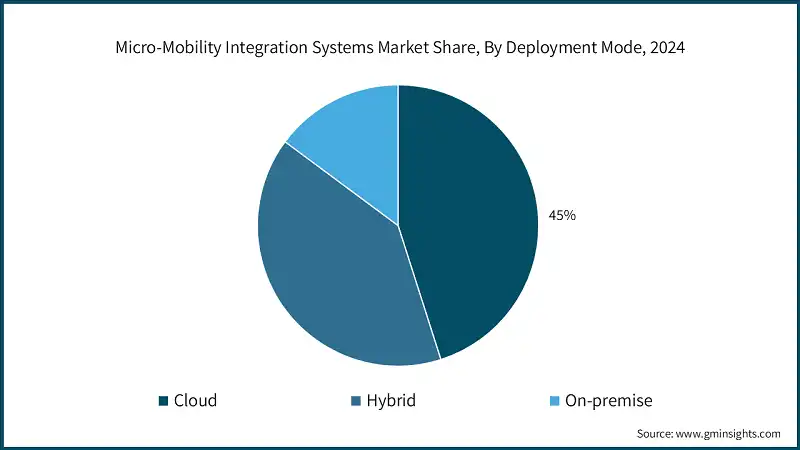
Based on deployment mode, the micro-mobility integration systems market is categorized into cloud, on-premises, and hybrid. Cloud segment dominated the market with 45% share in 2024, and the segment is expected to grow at a CAGR of 17% between 2025 and 2034.
- Cloud computing systems are built on third-party cloud providers such as AWS, Azure, and Google Cloud Platform. They host application software, databases, analytical engines, and operational tools. The advantages of the cloud include eliminating the need for an operator to manage physical servers, increasing scalability, decreasing implementation time, allowing for automatic updates, and enabling online and mobile access from anywhere.
- On February 2025, Bosch Global Software Technologies (BGSW) and EMotorad, along with their manufacturer Dynem, signed a Memorandum of Understanding (MoU), signaling a growing trend in cooperative relationships in the micro-mobility industry and the emergence of a new breed of strategies enabled by cloud-based Ecosystems. BGSW offers advanced software frameworks to support connected mobility, cloud computing and cybersecurity.
- On-premises deployments had the largest share of the market in 2024, accounting for 14.8% and exhibiting the largest projected growth rate of 18.0%. On-premises deployments has upfront investments of considerable capital into servers, networking devices, and data centers as well as ongoing operating costs associated with IT personnel, maintenance, and upgrades. However, they allow companies to have total control over data, systems, and customizations without relying on any third party.
Based on technology, the micro-mobility integration systems market is divided into fleet management & tracking systems, payment & billing integration, IoT connectivity & telematics, charging & battery management, data analytics & reporting, and geofencing & compliance tools. Fleet management and tracking systems is the largest segment in market and was valued at USD 629.2 million in 2024.
- The fleet management and tracking systems are shaped by well-established players such as Wunder Mobility, Vulog, INVERS, and Ridecell, and continue to expand its capabilities through the combination of their Platforms and Commonalities with users of higher volume fleets. The Launch of Urban Crew 2.0, Urban Sharing's New Operational Platform, in September 2024 is a Perfect Example of this trend. Urban Crew 2.0 utilizes the power of AI to improve the accuracy of Fleet Management by providing more effective means of automating vehicle rebalancing, optimizing battery swaps, and determining the creation of Job Orders related to Preventive Maintenance Services, based on the organization's Historical data and through the utilization of Live Data Feeds from Fleets in Service.
- Fleet management and tracking systems provide operational managers complete visibility into vehicle location for status and utilization of each vehicle monitored from one central location. Fleet managers can also monitor asset health, optimize fleet distribution, and plan for vehicle maintenance with even more accuracy than before. Operational managers have higher levels of visibility in vehicles and the ability to respond to operational changes in real-time, enabling operational managers to improve customer support and resolve customer issues significantly faster than before.
- Payment & billing integration held 18.9% of the market share in 2024. The segment is the fastest growth rate among technological segments, with a CAGR of 17.1% from 2025-2034. Payment systems need to support many payment methods such as credit/debit cards, mobile wallets, transit cards, and corporate accounts. Corporate billing capabilities support B2B applications, particularly in the rapidly growing last-mile delivery segment where companies like Yulu derive 85-90% of revenue from gig and delivery workers.
Based on vehicle, the micro-mobility integration systems market is divided into e-scooters, e-bikes, pedal bikes, e-mopeds, and others. E-Scooters dominates the market and was valued at USD 1.1 billion in 2024.
- E-scooters have emerged as popular for their small size, ease of use, and suitability for short urban trips. In the US micro-mobility saw 171 million trips in 2024 where most of the trips were done by e-scooters. Their growth is supported by improving regulations, with 28 U.S. states and Washington D.C. having formal e-scooter laws by September 2024. Growth for e-scooters has stabilized and continues to grow steadily, but at a slower rate than in established markets as they become widely used in new markets as well.
- E-bikes held 25% of the market in 2024 and grew quickly due to their longer range, higher load capacity, and greater comfort. More than one million e-bikes were sold in the United States in 2023. Similarly in China, operating over 420 million e-bikes and running shared e-bike programs in more than 300 cities with a fleet of over 15 million vehicles in 2024.
- Pedal bikes accounted for 10.8% of the market in 2024, making them the fastest growing micro-mobility option at an annual growth rate of 18.6%. Their rising popularity comes from low operating costs, simple maintenance, fewer regulatory hurdles, and strong appeal among users seeking healthy and convenient short-distance travel in dense urban areas.
Looking for region specific data?
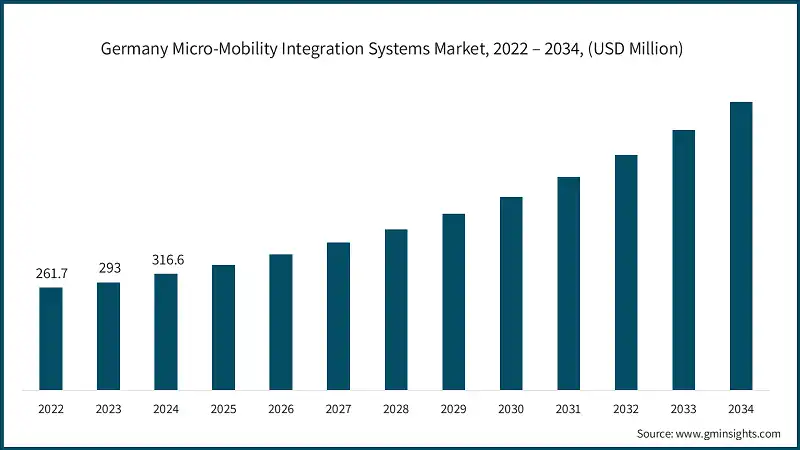
The Germany dominated Europe micro-mobility integration systems market with revenue of USD 316.6 million in 2024.
- Europe represents the largest regional market at 56.5% of market share in 2024, growing at a CAGR of 14.5% till 2034. The European market is a leader in micro cycling and micro-mobility due to established environmental regulations, broad cycling infrastructure and sustainable environmental policies. Since 2021, the European Union has invested $3.5 billion in cycling projects using structure finance through public funding, including USD 270 million to support Sustainable Urban Mobility projects for 2023.
- Germany represents 28% of the overall EU micro-mobility market and is the principal micro-mobility market in Europe. An example of this is that there are over 360 companies that operate dockless vehicles in 139 different cities across Germany, providing widespread access to both e-scooter and dockless bike share services. Furthermore, effective between January 2024 and March 2025, Berlin has implemented a fleet cap of 19000 e-scooters in accordance with its newly amended state road law which regulates micro-mobility use within urban areas.
- Major operators currently in these markets include Lime, available in 24 cities, Tier, which operates in 50-plus cities in the country. Similarly, companies such as Voi and Bird also offer services to German cities. Furthermore, the government has established the National Cycling Plan 3.0 to encourage expansion of bike infrastructure and encourage subsidies for e-bike purchases. This drives the usage of both shared micro-mobility and private micro-mobility.
- In the United Kingdom, there are currently 18 active trials of electric scooters and the number of miles travelled on scooters has grown by 57%, with 52.6 million total kilometers recorded via 24,102 e-scooters since September 2021. It is illegal to ride privately owned scooters on public roads. The Transport Bill planned for introduction in April 2022 will establish a new type of vehicle called a Low Speed-Zero Emission Vehicle (LSZEV) which will permit individuals to legally ride their own scooters on public roads.
China micro-mobility integration systems market will grow tremendously with CAGR of 20.2% between 2025 and 2034.
- Asia Pacific represents 17.8% of global market share in 2024, exhibiting the highest regional CAGR at 20.7%. China is leading the Asia-Pacific market, with over 420 million e-bikes in use across the country. In Shanghai, there is about one e-bike for every two people. Similarly, Beijing has taken more than 1 billion shared bike rides in 2023, which averages 3.1 million rides daily. This marks a 9% rise compared to 2022. Operators like Didi Bike, HelloBike, Meituan Bike, and Qingju Bike are major players in this market. The government has set rules for e-bikes, such as a weight limit of 55 kg, a speed cap of 25 km/h, motor power below 400W, and battery voltage not exceeding 48V.
- In Japan, the micro-mobility sector changed after the Road Traffic Act was amended in July 2023. The new category, "Specified Small Motorized Bicycles," lets people aged 16 and older ride electric bikes without needing a license. Helmet use is strongly encouraged. Lime and Hello Cycling partnered to deploy 50,000 electric-assist bikes at around 11,000 stations nationwide. Japan has about 72 million e-bikes in use. LUUP, as of January 2023, operates 6,000 ports in cities like Tokyo, Osaka, and Kyoto. These developments show growing adoption and supportive regulations in country.
The North America micro-mobility integration systems market in US will experience robust growth during 2025-2034.
- The US holds 88% share of the micro-mobility market in North America. In total, 133 million shared trips were taken in the US in 2023, and that number should grow to 171 million in 2024 by serving approximately 285,000 vehicles across 354 cities. The popularity of e-devices is apparent. 79% of systems have e-devices, and 66% of trips are made by e-bikes or e-scooters. More than 1 million e-bikes were sold in 2023. Among the 25 cities discussed in the report, there have been 39.7 million e-bike trips and 69.8 million e-scooter trips in the US during 2023.
- In Canada, the number of provinces with regulations for micro-mobility is larger than the federal government after the federal government removed e-bike definitions in 2020. Typical operating parameters generally require max speeds of 32 km/h and 500-Watt motors. Ontario has a pilot program for e-bikes and e-scooters ending in January 2025. Quebec legalized e-scooters this summer. These examples demonstrate increased micro-mobility usage across North America due to changing regulations and increased fleet size.
The Brazil will experience robust growth of 17.9% between 2025 and 2034.
- Brazil holds the majority market share in Latin America's micro-mobility integration systems at 68%. Over 600,000 units of electric bicycles and scooters were sold across Latin America in 2023, over 250 million bike trips were made by users of Tembici. Regulations set forth by the City of Rio de Janeiro require that riders be at least 18 years old, specify maximum speeds as 20 km/h on streets and 6 km/h in parks, and establish designated parking areas. Operators are required to relocate vehicles within three hours. Other proposed regulations include maximum speed limits, maximum fleet size, geographic restrictions, required insurance, and rapid relocations.
- Argentina represents substantial share in Latin America’s micro-mobility integration systems market. Buenos Aires has been driving electrification due to the Electromobility Law 27,520 which provides incentives via tax credits and subsidies for electric vehicles (EV), including removing tariffs on electric vehicles (EV) and hybrid vehicles (HV) with a value of $16,000 FOB as of February 2025. The 100% electric TramBUS transports approximately 50,000 commuters each day. Law 27,686 reduces the VAT, income tax, and export duties applicable to the automotive supply chain.
UAE micro-mobility integration systems market will grow tremendously with CAGR of 19.2% between 2025 and 2034.
- The UAE accounts for 67.4% of the MEA micro-mobility market and is at the forefront of e-scooter and e-bike usage, particularly in Dubai. The executive council of Dubai passed Resolution 13/2022 which formalizes the requirements for the use of e-scooters and e-bikes. All riders must be at least 16 years old, wear a helmet and obtain a permit from the RTA. The approval process is totally free and includes an online testing component. Micro-mobility operations are approved in 20 different locations including Sheikh Mohammed bin Rashid Boulevard, JLT - Dubai Internet City, City Walk and Palm Jumeirah.
- Saudi Arabia's regulations for micro-mobility have been established by the Ministry of Municipalities and Housing in October 2024 and include that a rider must be over 17 years old. E-scooters and e-bikes can only ride on existing cycle paths and cannot exceed a speed of 25 km/h comfortably and have a speed limit of 5 km/h while riding in public parks. The use of e-scooters or e-bikes on any public road, public street or path where they are not authorized for e-scooter and e-bike use is prohibited completely, the company and government of the KSA are proceeding cautiously to integrate micro-mobility in the country's urban infrastructure system.
Micro-Mobility Integration Systems Market Share
The top 7 companies in the market are Vulog, INVERS, Ridecell, Comodule, Wunder Mobility, Atom Mobility, and Joyride. These companies hold around 7% of the market share in 2024.
- Vulog provides technological solutions for over 60 fleet operators located in 20 different countries and is processing millions of transactions each year. The company has several competitive advantages: extensive knowledge of European regulations, an extensive range of features designed for different types of vehicles and types of operation, and close relationships with OEM manufacturers and public transport authorities.
- INVERS supports car-sharing, bike-sharing, and scooter-sharing programmes for over 150,000 vehicles around the world. INVERS has more than 1,000 clients operating in more than 50 countries. The company has expanded from its original business model of providing only hardware products to now offering a full suite of solutions encompassing all aspects of the car-sharing, bike-sharing, and scooter-sharing process. This expansion allows INVERS to compete directly with software companies while continuing to leverage its ability to create innovative and differentiated hardware products.
- Ridecell has created a cloud-based platform to automate the management of fleets of vehicles and support the operations of Shared Mobility companies. The company focuses primarily on car-sharing and scooter-sharing companies, with active deployments in North America, Europe, and Asia. Ridecell has positioned its product as being technology-driven, and stresses automation and artificial intelligence-based optimization, as crucial points of differentiation, in an increasingly competitive environment where success is based on optimizing both operational and financial performance.
- Comodule offers various competitive advantages with expertise in IoT connectivity and fleet management for light electric vehicles (LEVs), such as e-bikes, e-scooters, e-mopeds, and e-motorcycles. These include extensive knowledge of the LEV connectivity market, a broad-spectrum IoT platform allowing a range of vehicles to connect and function with multiple purposes, and a dual business model serving both fleet operators and OEMs (original equipment manufacturers).
- Wunder Mobility has an integrated software platform to assist the shared mobility industry, including car-sharing, bike-sharing, scooter-sharing, ride-hailing, and multimodal fleets across various kinds of vehicles. With its acquisition of GoUrban in September 2024, Wunder Mobility's competitive position has been greatly improved, now being the largest independent operator of free-floating micro-mobility in the world. It supports around 50 million trips per year across about 200 cities.
- Atom Mobility has more than 200 projects operating globally, with approximately 35,000 vehicles enabling just under 1 million rides a month. The company is the preferred platform choice for new entrants and for small operators looking for turnkey solutions when establishing their fleets.
- Joyride provides fleet management software and supportive operating services to operators in the micro-mobility space. The company has evolved from having in-house fleets to assisting third-party operators by providing them with the necessary technology and services. Joyride has created competitive advantages that add value to their operations by leveraging operational expertise, which they gained through direct fleet operations, and by combining technology and operational support to build a holistic solution set.
Micro-Mobility Integration Systems Market Companies
Major players operating in the micro-mobility integration systems industry include:
- Atom Mobility
- Comodule
- INVERS
- Joyride
- Ridecell
- Roam.ai
- Urban Sharing
- Vulog
- Wunder Mobility
- Splyt
- The micro-mobility integration systems market has very little competition between providers, it is highly fragmented and contains only 7 major platform and technology companies in total. The fragmentation within the market is evidence of its relative immaturity within the entire marketplace. It is also evidence of multiple operators' unique requirements of micro-mobility operations, regional differences in regulations and operational models, as well as the presence of multiple niche operators catering to a specific segment or geographical area.
- Vulog has extensive domain knowledge of European regulations, this domain knowledge allows Vulog to develop an extensive feature set that allows for various vehicle types and operational models. Vulog's competitive differentiators include the ability to leverage its vast network of relationships with automotive/mobility/transportation manufacturers (OEMs) and a strong relationship with transit agencies (public transportation). These relationships provide Vulog with the tools and resources required to protect the interests of operators, which helps to build a long-standing relationship with operators.
- INVERS focuses on hardware and software to provide comprehensive solutions to operators seeking integrated offerings. As such, INVERS has extensive experience in European markets with established regulations and provides extensive knowledge regarding compliance automation, data privacy, and interoperability. Ridecell has a diverse customer profile with multiple user segments, we serve operators of traditional car-sharing platforms, micro-mobility operators maintaining e-bikes and scooters, corporate fleet managers optimizing vehicle usage, and OEMs investigating new opportunities for mobility services.
- Comodule has taken a proactive approach to sustainability and the long-term usability of vehicles. Their Internet of Things modules are specifically designed for light electric vehicles and are available in a compact format that fits into e-scooters and e-bikes. Core functionalities include the use of a proprietary platform for tracking and managing fleets with live tracking capabilities, The development of a centralized payment and billing platform for accepting multiple methods of payment, offering customers the option of dynamic pricing.
- ATOM Mobility's platform has been built for the express purpose of allowing operators to launch their service quickly. Business operators using the white label model can maintain their own branding and gain access to tried and tested technology. Joyride is currently assisting a mix of business operators, some of whom are entering into new geographical markets, some are looking to maximize their efficiency, and others simply do not have the personnel or expertise to run effective fleet operations.
Micro-Mobility Integration Systems Market Report Attributes
| Key Takeaway | Details |
|---|---|
| Market Size & Growth | |
| Base Year | 2024 |
| Market Size in 2024 | USD 2 Billion |
| Market Size in 2025 | USD 2.2 Billion |
| Forecast Period 2025 - 2034 CAGR | 16.4% |
| Market Size in 2034 | USD 8.7 Billion |
| Key Market Trends | |
| Drivers | Impact |
| Urbanization & Last-Mile Demand | Increasing urban density drives demand for short-distance transport solutions like e-scooters and e-bikes. |
| Technology & Connectivity | IoT-enabled vehicles and fleet management software improve operational efficiency and user experience. |
| Sustainability & Regulatory Support | Policies promoting low-emission transport and investment in bike lanes / parking infrastructure increase adoption. |
| Charging & Battery Infrastructure | Investment in fast-charging stations or battery swap systems can enhance fleet uptime and expand service areas. |
| Pitfalls & Challenges | Impact |
| Regulatory Complexity | Different city regulations on safety, parking, and usage complicate scaling across regions. |
| Safety & Liability Risks | Injury and accident rates can impact public acceptance and increase insurance costs. |
| Opportunities: | Impact |
| Data Monetization & Analytics | Usage and mobility data can be monetized or used for city planning and partnerships. |
| Expansion to Emerging Cities | Rapid urbanization in developing markets presents a large untapped user base. |
| Market Leaders (2024) | |
| Market Leaders |
|
| Top Players |
Collective market share in 2024 is 7% |
| Competitive Edge |
|
| Regional Insights | |
| Largest Market | Europe |
| Fastest Growing Market | Asia-Pacific |
| Emerging Country | Brazil, South Africa, Australia, Italy, Sweden |
| Future Outlook |
|
What are the growth opportunities in this market?
Micro-Mobility Integration Systems Industry News
- In June 2025 ATOM Mobility announced it had acquired ScootAPI. The acquisition will create one large B2B SaaS solution in the micro-mobility software space. Additionally, ATOM has also launched OpenAPI v1 for MaaS integrations. This allows third-party platforms to connect to ATOM in real time to access vehicle availability, pricing, and booking capabilities.
- In April 2025, VisionEdgeOne and GCM Grosvenor reached an agreement to buy Inurba Mobility, showing continued interest in investment opportunities. Additionally, Seg Automotive and Octagon announced they will be working together to develop e-bike system solution products.
- In September 2024, Wunder Mobility acquired GoUrban, allowing it to operate as the largest independent free-floating micro-mobility supplier. Wunder Mobility now serves over 50 million clients yearly with services across nearly 200 different metropolitan regions and cities. This acquisition illustrates the growing trend of consolidating platform suppliers so that they can gain competitive edge through larger operations and to provide for greater financial success.
- In January 2024, Tier Mobility and NS (Dutch Railways) announced their alliance to support ecologically sustainable travel and mobility in the Netherlands. Tier will integrate its electric scooters and bikes with the NS public transit system, creating an integrated service point for people who desire to ride both forms of transportation. This partnership displays the continuing trend of MaaS (Mobility-as-a-Service) systems, allowing users to view and pay for their full multi-modal journey through one integrated service point.
The micro-mobility integration systems market research report includes in-depth coverage of the industry with estimates & revenue ($Bn) and volume (Units) from 2021 to 2034, for the following segments:
Market By Component
- Software Platforms
- Fleet management
- Booking systems
- Payment & billing systems
- Analytics & reporting
- Rider apps / user interface
- Operator dashboards
- Hardware
- IoT devices / sensors
- GPS trackers / navigation modules
- Smart locks
- Battery management systems
- Vehicle-mounted controllers
- Charging docks / stations
- Services
- Consulting & advisory
- System integration
- Installation & deployment
- Maintenance & repair
- Customer support / helpdesk
- Training & onboarding
Market By Technology
- Fleet management & tracking systems
- Payment & billing integration
- IoT connectivity & telematics
- Charging & battery management
- Data analytics & reporting
- Geofencing & compliance tools
Market By Deployment mode
- Cloud
- Hybrid
- On-premises
Market By Vehicle
- E-Scooters
- E-Bikes
- Pedal Bikes
- E-Mopeds
- Others
Market By End Use
- Fleet Operators
- Municipalities
- Universities & Corporate Campuses
- Delivery Companies
- Others
The above information is provided for the following regions and countries:
- North America
- US
- Canada
- Europe
- UK
- Germany
- France
- Italy
- Spain
- Belgium
- Netherlands
- Sweden
- Russia
- Asia Pacific
- China
- India
- Japan
- Australia
- Singapore
- South Korea
- Vietnam
- Indonesia
- Latin America
- Brazil
- Mexico
- Argentina
- MEA
- South Africa
- Saudi Arabia
- UAE
Frequently Asked Question(FAQ) :
What is the market size of the micro-mobility integration systems in 2024?
The market size was USD 2 billion in 2024, with a CAGR of 16.4% expected through 2034. The growth is driven by the integration of micro-mobility into multimodal transportation platforms and advancements in fleet management technologies.
What is the projected value of the micro-mobility integration systems market by 2034?
The market is poised to reach USD 8.7 billion by 2034, fueled by AI-driven fleet management systems, regulatory mandates, and infrastructure innovations.
What is the expected size of the micro-mobility integration systems industry in 2025?
The market size is projected to reach USD 2.2 billion in 2025.
How much revenue did the hardware segment generate in 2024?
The hardware segment accounted for 47% of the market in 2024 and is expected to grow at a CAGR of 16.1% till 2034.
What was the valuation of the cloud segment in 2024?
The cloud segment held a 45% market share in 2024 and is anticipated to expand at a CAGR of 17% between 2025 and 2034.
What is the growth outlook for fleet management and tracking systems from 2025 to 2034?
Fleet management and tracking systems, valued at USD 629.2 million in 2024, led by advancements in AI, telematics, and automation technologies.
Which region leads the micro-mobility integration systems sector?
Europe leads with a 56.5% market share in 2024, growing at a CAGR of 14.5% through 2034. The region's leadership is attributed to stringent environmental regulations, extensive cycling infrastructure, and sustainable policies.
What are the upcoming trends in the micro-mobility integration systems market?
Trends include AI-based fleet management, conversational interfaces, stricter parking regulations, recyclable vehicle designs, and hybrid infrastructure linking micro-mobility with public transit.
Who are the key players in the micro-mobility integration systems industry?
Key players include Atom Mobility, Comodule, INVERS, Joyride, Ridecell, Roam.ai, Urban Sharing, Vulog, Wunder Mobility, and Splyt.
Micro-Mobility Integration Systems Market Scope
Related Reports