Summary
Table of Content

Medical Pendant Market
Get a free sample of this report
Form submitted successfully!
Error submitting form. Please try again.
Thank you!
Your inquiry has been received. Our team will reach out to you with the required details via email. To ensure that you don't miss their response, kindly remember to check your spam folder as well!
Request Sectional Data
Thank you!
Your inquiry has been received. Our team will reach out to you with the required details via email. To ensure that you don't miss their response, kindly remember to check your spam folder as well!
Form submitted successfully!
Error submitting form. Please try again.
Medical Pendant Market Size
The market is driven by numerous factors such as the increasing number of hospital admissions & surgeries, technological advancements in medical pendants, the rise in the number of healthcare facilities, and the growing demand for clinical workflow efficiency, among other factors. Growth of ambulatory and decentralized care settings, expansion of minimally invasive and high‑tech surgical environments, and rising investments in smart hospitals are expected to fuel the industry's growth. Dräger, Mindray, STERIS, Ondal Medical Systems, and Heal Force are among the leading players operating in the market. These players mainly focus on product innovation, geographic expansion, integration of advanced technologies in equipment, strong R&D, and collaboration with local or regional healthcare providers, among other factors.
Medical Pendant Market Key Takeaways
Market Size & Growth
- 2025 Market Size: USD 616.7 Million
- 2026 Market Size: USD 648.2 Million
- 2035 Forecast Market Size: USD 1.1 Billion
- CAGR (2026–2035): 5.8%
Regional Dominance
- Largest Market: North America
- Fastest Growing Region: Asia Pacific
Key Market Drivers
- Rise in number of healthcare facilities.
- Increasing number of hospital admission & surgeries.
- Rising demand for clinical workflow efficiency.
- Technological advancements in medical pendant.
Challenges
- High cost of medical pendants.
- Lack of skilled healthcare workforce.
Opportunity
- Integration of IoT and automation technologies.
Key Players
- Market Leader: Drager led with over 32% market share in 2025.
- Leading Players: Top 5 players in this market include Drager, Mindray, STERIS, Ondal Medical Systems, Heal Force, which collectively held a market share of 60% in 2025.
Get Market Insights & Growth Opportunities
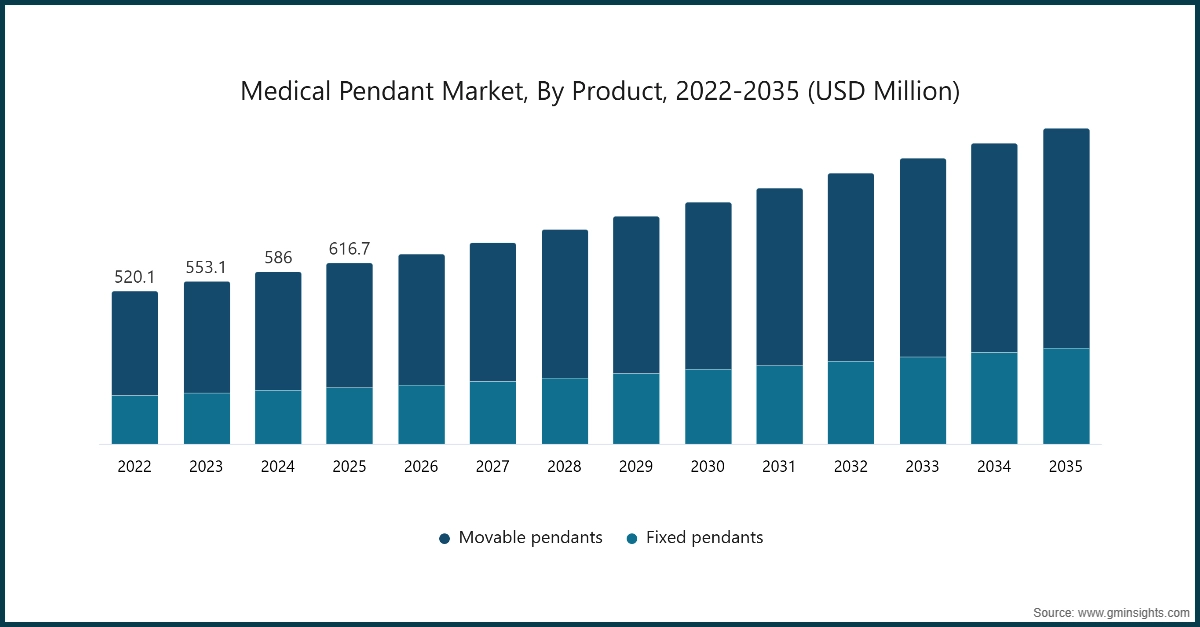
The market has increased from USD 520.1 million in 2022 and reached USD 586 million in 2024, with a historic growth rate of 6.1%. Governments and private organizations are making substantial investments in building new hospitals and upgrading existing ones. For example, emerging economies in the Asia Pacific and Africa regions are witnessing a surge in healthcare infrastructure due to population growth and improved access to healthcare. Additionally, with the rising prevalence of critical illnesses, hospitals are adding more ICU beds, each requiring advanced equipment such as medical pendants to manage medical gases, monitors, and other utilities.
Moreover, medical pendants are crucial in creating a clutter-free workspace by suspending devices and utilities, thereby freeing up floor space and enabling better movement of staff and equipment. Facilities with limited space, such as small operating rooms or ICUs, particularly benefit from the efficiency provided by pendants.
A medical pendant is a suspended system commonly used in healthcare facilities to organize and deliver medical equipment, utilities, and devices. It enhances workflow efficiency and ensures safety in surgical, critical care, and other clinical environments. Typically ceiling-mounted, these systems optimize space utilization while providing easy access to essential utilities such as medical gases, electrical outlets, and data connections.
The global medical pendant market was estimated at USD 616.7 million in 2025. The market is expected to grow from USD 648.2 million in 2026 to USD 1.1 billion in 2035, at a CAGR of 5.8% during the forecast period, according to the latest report published by Global Market Insights Inc.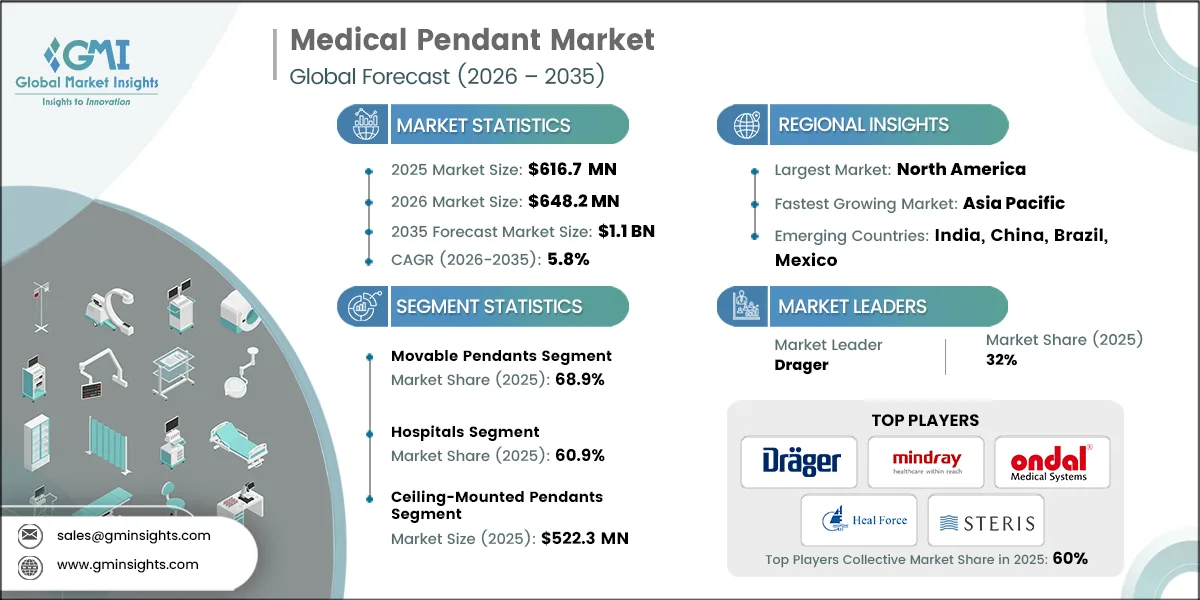
To get key market trends
Medical Pendant Market Trends
Integration of smart and connected technologies, a shift toward modular and customizable designs, and a rising focus on infection control and safety are among the key trends shaping the growth of the market.
- Modern pendants are designed with modular components, allowing facilities to customize configurations based on specific clinical needs (e.g., surgical, endoscopic, or ICU setups). Modular designs make it easier to upgrade or expand the system as hospital requirements evolve.
- Additionally, modern pendants are built to support heavier loads, accommodating multiple devices simultaneously, such as monitors, infusion pumps, ventilators, and anesthesia machines. The ongoing development and integration of advanced technologies in medical pendants are significantly enhancing their functionality, efficiency, and appeal in healthcare environments.
- Furthermore, advanced pendants are equipped with wireless connectivity options for seamless integration with other medical systems, such as electronic medical records (EMRs) and diagnostic tools. Automation in pendants enables smooth operation, including features such as auto-adjusting heights or angles based on preset configurations.
Medical Pendant Market Analysis
Learn more about the key segments shaping this market
Based on product, the global market is segmented into movable pendants and fixed pendants. The movable pendants segment accounted for a majority share of 68.9% in 2025. Growth of hybrid operating rooms is anticipated to fuel the segmental growth. The segment is expected to reach USD 753.3 million by 2035, growing at a CAGR of 6% during the forecast period.
- Movable pendants allow healthcare staff to adjust the positioning of medical equipment to suit different procedures and patient needs, making them highly versatile. They are increasingly used in hybrid operating rooms, intensive care units, and emergency departments, where versatility is crucial.
- Additionally, movable pendants eliminate the need for fixed equipment, freeing up floor space and facilitating better movement of personnel and devices. Designed with smooth gliding mechanisms, these pendants offer effortless mobility, reducing physical strain on healthcare workers.
- The fixed pendants segment is anticipated to reach over USD 324.4 million by 2035. Fixed pendants, also known as permanently attached or ceiling-mounted systems, are a primary product category due to their proven track record of stability, reliability, and ability to function in high-acuity clinical environments.
- These fixtures are mounted directly to the ceiling and are used to support critical utilities, including medical gas, electrical outlets, data connections, and equipment trays. The rigid design of these fixtures provides a stable surface for supporting devices that must not move during the delivery of care. This makes these fixtures particularly useful in intensive care units and surgical environments requiring high stability.
- In addition, hospitals appreciate the fact that fixed-mounted fixtures reduce floor clutter, provide better infection control, and offer more predictable workflow. The robust construction and long lifespan of these fixtures provide a solid foundation for the design of clinical infrastructure.
Based on installation, the medical pendant market is segmented into ceiling-mounted pendants, wall-mounted pendants, and other installation types. The ceiling-mounted pendants segment accounted for USD 522.3 million in market revenue in 2025.
- Ceiling-mounted pendants are favored for their durability and ability to support complex, permanent setups in high-demand environments. Despite their higher initial costs, their longevity and ability to enhance operational efficiency make them a preferred choice in advanced healthcare facilities.
- The demand for ceiling-mounted medical pendants is driven by their ability to optimize space, improve ergonomics, and support advanced medical technologies. As healthcare facilities focus on modernizing their infrastructure to accommodate sophisticated medical procedures and ensure patient safety, the market for ceiling-mounted pendants is expected to grow significantly.
- The wall-mounted pendants segment is witnessing significant growth with a revenue of USD 70.2 million in 2025. Professionals prefer wall-mounted pendants when there is limited ceiling support or for smaller room designs, as these systems can provide an organized way to deliver utilities and other device connections without taking up any floor space.
- Additionally, they are typically used in treatment rooms, emergency bays, and specialized procedure areas, where the use of available vertical wall space is possible. By using wall-mounted pendants, the management of cables can be significantly simplified, the mobility of clinicians can be improved, and a cleaner environment can be achieved.
- Further, the wall-mounted pendant has a compact design, allowing for easy integration into existing rooms during renovation projects. The use of wall-mount pendants is especially advantageous when clinical workflow requires easy access to equipment from the side, with no rotatable ceiling-mount range.
Based on application, the medical pendant market is segmented into intensive care unit (ICU), surgery, anesthesia, endoscopy, and other applications. The intensive care unit segment generated the highest revenue of USD 242.6 million in 2025.
- ICU pendants provide centralized access to life-support equipment, medical gases, and electrical outlets, enabling faster responses to emergencies. They can support multiple devices, such as monitors, ventilators, infusion pumps, and suction units, which are critical for patient care. These pendants are designed to handle significant weights, ensuring stability for connected devices.
- ICU pendants now feature touch-screen controls, IoT-enabled monitoring, and automated movement for ergonomic positioning.
- Additionally, new hospital projects and expansions of existing facilities often prioritize increasing ICU capacity, driving the demand for medical pendants.
- The surgery segment was valued at USD 194.5 million in 2025. In surgical environments, medical pendants play an important role in organizing complex sets of equipment while providing a sterile and efficient working environment. They supply utilities necessary for the operation of anesthesia machines, monitors, imaging devices, and surgical tools, all while keeping the floor free of cables and other obstacles.
- The multiple arm designs of pendants allow surgeons and their staff to place equipment in the precise location where it is needed, thereby enhancing ergonomics and reducing surgical procedure time.
- Further, the continued evolution of technology within operating rooms requires medical pendants to facilitate the integration of digital systems, imaging feeds, and communication systems.
- Furthermore, their adaptability, high load-bearing capacity, and ability to maintain a clutter-free environment make them vital tools in modern surgical workflows.
Learn more about the key segments shaping this market
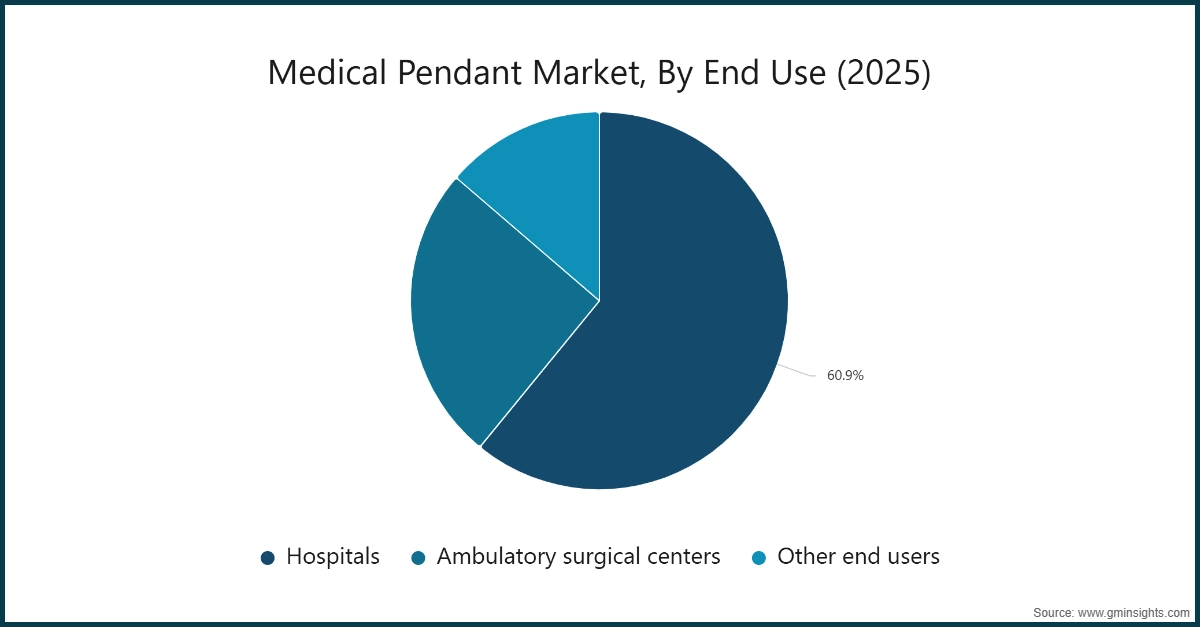
Based on end use, the medical pendant market is segmented into hospitals, ambulatory surgical centers, and other end-users. The hospitals segment accounted for the leading market share of 60.9% in 2025.
- Medical pendants are essential tools in modern hospitals, enabling efficient care delivery, optimizing workspace, and ensuring seamless access to medical utilities. The demand for these devices in hospitals is driven by hospital expansions, technological advancements, and the increasing need for specialized medical equipment.
- Furthermore, pendants provide immediate access to life-saving utilities in emergency situations, ensuring faster treatment delivery. Hospitals also rely on pendants to effectively organize equipment and utilities in high-pressure trauma care environments.
- The ambulatory surgical centers segment was valued at USD 156.6 million in 2025 and is expected to grow at a CAGR of 6.3% during the forecast period. The use of medical pendants is increasing in ambulatory surgical centers (ASCs), as they enable efficient, high-turnover procedures in compact operating rooms.
- Additionally, pendants help organize critical utilities while maintaining a sterile and efficient workflow for outpatient surgeries. Modular pendants allow rapid adjustment of mounted systems to accommodate evolving procedural workflows at ASCs without requiring significant structural modifications to the room.
- Furthermore, they make the environment safer by reducing trip hazards and simplifying infection control processes. As ASCs begin performing more complex surgeries, the use of pendant systems will support the delivery of modern, efficient patient care.
Looking for region specific data?
North America Medical Pendant Market
The North America market accounted for a majority share of 39.4% in 2025 and is anticipated to show notable growth over the forecast period.
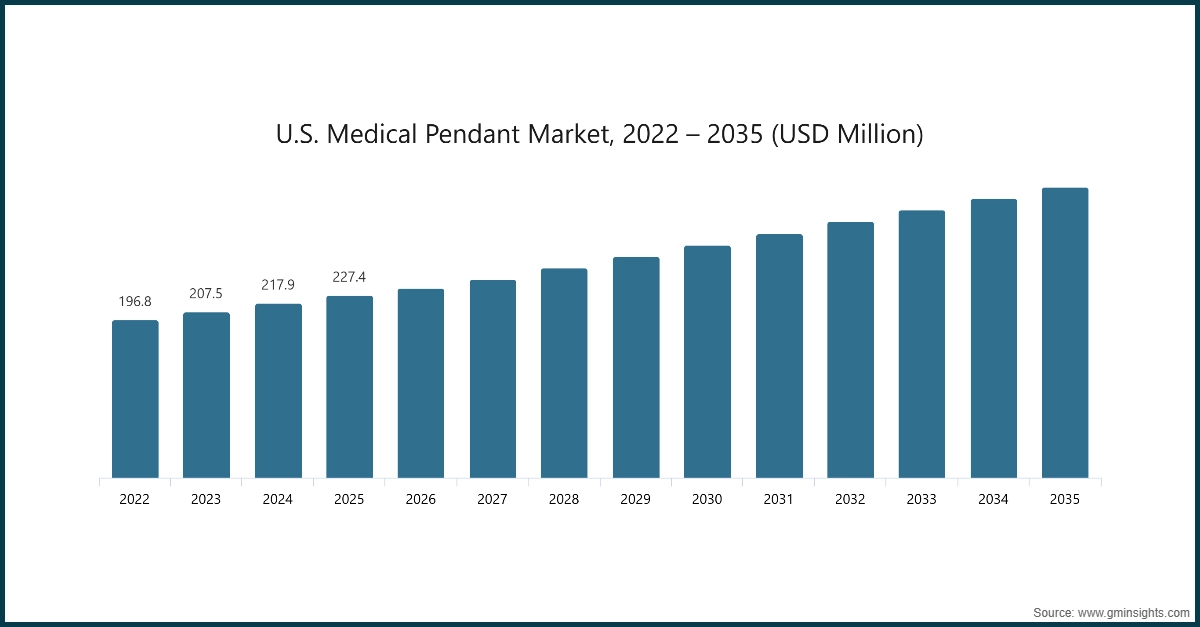
- The U.S. market was valued at USD 196.8 million and USD 207.5 million in 2022 and 2023, respectively. In 2025 the market size was valued at USD 227.4 million from USD 217.9 million in 2024.
- The increasing prevalence of diseases such as diabetes, cardiovascular conditions, and respiratory disorders requires long-term care, boosting the demand for ICUs and critical care units equipped with medical pendants. Additionally, with a rapidly aging population, the need for acute and critical care facilities is rising, driving the demand for medical pendants in the country.
- Additionally, the adoption of IoT-enabled medical pendants, which offer real-time monitoring and advanced controls, is gaining traction in technologically advanced healthcare settings. Moreover, hospitals and surgical centers in the U.S. increasingly demand pendants tailored for specific departments, such as operating rooms (ORs), ICUs, and neonatal units.
Europe Medical Pendant Market
Europe accounted for a significant share of the global market and was valued at USD 189 million in 2025.
- Hospitals throughout Europe are increasingly investing in modernizing their surgical environments. Countries are investing in ergonomics and infection-control improvements as well as standardizing equipment for better workflow efficiency in operating rooms and intensive care units. With Europe’s aging population, there is an increasing demand for advanced surgical and critical care capabilities.
- Further, hospitals prefer to use modular and multi-arm systems that are designed to integrate medical gases, data ports, and power outlets while ensuring safety. The growing emphasis on quality standards, compliance with safety requirements, digital healthcare transformation, and connectivity is driving the continued adoption of smarter pendant systems that support multiple connected devices.
- Overall, the European market for medical pendants is stable and consistently expanding due to technology replacement cycles and the continuous development of new facilities.
Asia Pacific Medical Pendant Market
The Asia Pacific market accounted for a substantial share of the market and was valued at USD 119.4 million in 2025.
- The market is experiencing significant growth across Asia-Pacific due to the expansion of the healthcare infrastructure, increasing volume of surgeries performed annually, and considerable capital investment into constructing new hospitals.
- The countries across the Asia-Pacific region have prioritized the modernization of operating rooms, intensive care units (ICUs), and emergency departments by purchasing large quantities of ceiling-mounted and modular pendant systems.
- Additionally, urbanization and increased investment in private healthcare are driving greater demand for pendant systems, as newly constructed hospitals are designed with more sophisticated layouts for the operating room (OR), which rely heavily on pendants for their overall function.
- Moreover, technological upgrades such as integrated data management, improved ergonomics, and customizable multi‑arm configurations are also widely embraced by hospitals.
Latin America Medical Pendant Market
The Latin American market is anticipated to exhibit remarkable growth during the analysis period.
- The development of the medical pendant industry in Latin America is primarily being driven by the continuously improving region's healthcare infrastructure, as well as an increased emphasis being placed on upgrading surgery and critical care facilities to more modern standards.
- Additionally, many hospitals in the region are upgrading or replacing older facilities with modern infrastructure improvements, including the implementation of pendant systems that allow for better usage of the available workspace, improved infection control, and mobility for the staff members working within that environment.
- Brazil, Mexico, and Argentina are leading the region in this shift, supported by the continued growth of an increasing number of private medical institutions with a focus on investing in new technology related to operating rooms.
- Furthermore, various hospitals are now transitioning from their traditional mounted systems to more organized pendant-based systems because of the increasing awareness of ergonomics in the workplace and concerns about safety within the hospital setting.
Middle East and Africa Medical Pendant Market
The Middle East and Africa market is expected to experience substantial growth over the analysis timeframe.
- There has been significant growth in the MEA region for the medical pendant business, primarily due to ongoing investments from governments into modernizing their healthcare systems and expanding their current hospital networks.
- Additionally, several countries in the Gulf region are building modernized medical facilities featuring fully equipped, technologically advanced operating rooms, where pendants are a key component in organizing clinical devices, medical gases, and power systems.
- Moreover, across MEA, hospitals increasingly seek modular, flexible pendant solutions that enhance workflow, support complex procedures, and align with the growing adoption of technologically advanced medical equipment.
Medical Pendant Market Share
The market is moderately concentrated, with competition driven by technology integration, ergonomic design, and compatibility with modern operating room and ICU workflows. The top five vendors collectively account for a significant share of the global market, reflecting the strong presence of established manufacturers with broad product portfolios and long‑standing hospital relationships. Key players include Dräger, Mindray, STERIS, Ondal Medical Systems, and Heal Force, each offering specialized pendant solutions tailored for surgical, critical‑care, and endoscopy settings.
Key players in the market focus on developing innovative and high-quality products that enhance hospital efficiency and patient safety. They prioritize integrating smart technologies, such as IoT and digital interfaces, into their pendant systems to optimize the management of medical equipment.
Additionally, these companies emphasize ergonomic, customizable designs and easy maintenance to meet the growing demands of critical care environments. Sustainability and adherence to strict hygiene standards are also key focal points, aligning with global healthcare trends and the increasing demand for reliable and durable medical solutions.
Further, an increasing number of vendors are competing with each other on advanced functionality, including integrated data modules, flexible multi-arm configurations, and controls to help streamline workflows. These features are now considered standard for more than half of the systems being deployed in the industry. Many hospitals are also looking at installing ceiling-mounted systems for patient safety as well as maximizing the amount of floor space available for the overall operating room.
Medical Pendant Market Companies
A few of the prominent players operating in the global medical pendant industry include:
- AEONMED
- Amico
- BeaconMedaes
- Brandon Medical
- COMEN
- Drager
- EMALED
- Heal Force
- Mindray
- NOVAIR MEDICAL
- Ondal Medical Systems
- pneumatik berlin medical systems
- Silbermann
- STERIS
- SURGIRIS
- TRIVITRON HEALTHCARE
- Drager
Focuses on advancing patient‑safety technologies, expanding integrated clinical‑care ecosystems, strengthening service‑based offerings, and growing presence in critical‑care, OR, and emergency environments through continuous innovation, training support, and hospital partnerships.
Emphasizes affordable innovation, expanding global reach in emerging markets, integrating smart monitoring and imaging solutions, strengthening R&D, and building ecosystem‑wide connectivity to compete with premium brands while maintaining cost‑effective clinical value.
Drives strategy through infection‑prevention leadership, surgical infrastructure expansion, acquisitions, and full‑suite sterile‑processing solutions, while enhancing OR efficiency, automation, and lifecycle services to deepen long‑term hospital relationships.
Medical Pendant Market Report Attributes
| Key Takeaway | Details |
|---|---|
| Market Size & Growth | |
| Base Year | 2025 |
| Market Size in 2025 | USD 616.7 Million |
| Market Size in 2026 | USD 648.2 Million |
| Forecast Period 2026-2035 CAGR | 5.8% |
| Market Size in 2035 | USD 1.1 Billion |
| Key Market Trends | |
| Drivers | Impact |
| Rise in number of healthcare facilities | Growing facility expansion is boosting demand for organized equipment‑management systems, making pendants essential for supporting modern treatment and surgical environments. |
| Increasing number of hospital admission & surgeries | Higher patient volumes intensify the need for efficient operating rooms and ICUs, driving greater adoption of pendants to streamline equipment access. |
| Rising demand for clinical workflow efficiency | Hospitals increasingly prioritize smoother workflows, leading to stronger uptake of pendants that reduce clutter, enhance ergonomics, and improve staff productivity. |
| Technological advancements in medical pendant | Smarter, more modular designs are accelerating adoption by offering better integration with monitoring, communication, and automated clinical systems. |
| Pitfalls & Challenges | Impact |
| High cost of medical pendants | Upfront capital expenses limit adoption in budget‑constrained facilities, slowing market growth and delaying modernization of older clinical spaces. |
| Lack of skilled healthcare workforce | Insufficient trained staff reduces effective use of pendant systems, discouraging investment and hindering seamless integration into clinical workflows. |
| Opportunities: | Impact |
| Integration of IoT and automation technologies | IoT‑enabled pendants will create highly connected, intelligent care environments, enhancing monitoring, predictive maintenance, and workflow automation, driving long‑term demand and transforming clinical efficiency. |
| Market Leaders (2025) | |
| Market Leader |
Around 32% market share |
| Top Players |
Collective market share of around 60% |
| Competitive Edge |
|
| Regional Insights | |
| Largest Market | North America |
| Fastest Growing Market | Asia Pacific |
| Emerging countries | India, China, Brazil, Mexico |
| Future outlook |
|
What are the growth opportunities in this market?
Medical Pendant Industry News
- In December 2024, the BeaconMedaes Patient Environment Team announced the successful completion of its second medical pendant project at a hospital in the north of England. This development covered the seamless integration of the hospital's existing GE vital signs monitoring system, improving the clinical environment for staff and patients.
The global medical pendant market research report includes an in-depth coverage of the industry with estimates and forecasts in terms of revenue in (USD Million) from 2022 - 2035 for the following segments:
Market, By Product
- Movable pendants
- Multi-arm movable pendants
- Single-arm movable pendants
- Fixed pendants
Market, By Installation
- Ceiling-mounted pendants
- Wall-mounted pendants
- Other installation types
Market, By Application
- Intensive Care Unit (ICU)
- Surgery
- Anesthesia
- Endoscopy
- Other applications
Market, By End Use
- Hospitals
- Ambulatory surgical centers
- Other end users
The above information is provided for the following regions and countries:
- North America
- U.S.
- Canada
- Europe
- Germany
- UK
- France
- Spain
- Italy
- Netherlands
- Asia Pacific
- China
- Japan
- India
- Australia
- South Korea
- Latin America
- Brazil
- Mexico
- Argentina
- MEA
- South Africa
- Saudi Arabia
- UAE
Frequently Asked Question(FAQ) :
What is the market size of the medical pendant market in 2025?
The global medical pendant market was valued at USD 616.7 million in 2025, driven by the rising number of hospital admissions and surgeries.
What is the market size of the medical pendant market in 2026?
The market is expected to reach USD 648.2 million in 2026, supported by the growing adoption of advanced hospital infrastructure.
What is the projected value of the medical pendant market by 2035?
The market is projected to reach USD 1.1 billion by 2035, growing at a CAGR of 5.8% during the forecast period due to increasing investments in smart hospitals and technological advancements in pendant systems.
What was the revenue of the ceiling-mounted pendants segment in 2025?
The ceiling-mounted pendants segment generated USD 522.3 million in revenue in 2025, as these systems offer durability, better space optimization, and the ability to support complex medical equipment setups in hospitals.
Which application segment generated the highest revenue in the medical pendant industry in 2025?
The intensive care unit (ICU) segment generated the highest revenue of USD 242.6 million in 2025, driven by the increasing number of critically ill patients and the need for centralized access to life-support equipment and medical utilities.
Which end-use segment held the largest share of the medical pendant market in 2025?
The hospitals segment accounted for the largest share of 60.9% in 2025, due to the high volume of surgical procedures and critical care treatments conducted in hospital environments.
Which region leads the medical pendant industry?
North America led the global market with a 39.4% share in 2025, supported by advanced healthcare infrastructure and high healthcare spending.
Who are the key players in the medical pendant market?
Leading companies operating in the market include Dräger, Mindray, STERIS, Ondal Medical Systems, and Heal Force.
Medical Pendant Market Scope
Related Reports