Summary
Table of Content

Mechanical Reciprocating Engine Market
Get a free sample of this report
Form submitted successfully!
Error submitting form. Please try again.
Thank you!
Your inquiry has been received. Our team will reach out to you with the required details via email. To ensure that you don't miss their response, kindly remember to check your spam folder as well!
Request Sectional Data
Thank you!
Your inquiry has been received. Our team will reach out to you with the required details via email. To ensure that you don't miss their response, kindly remember to check your spam folder as well!
Form submitted successfully!
Error submitting form. Please try again.
Mechanical Reciprocating Engine Market Size
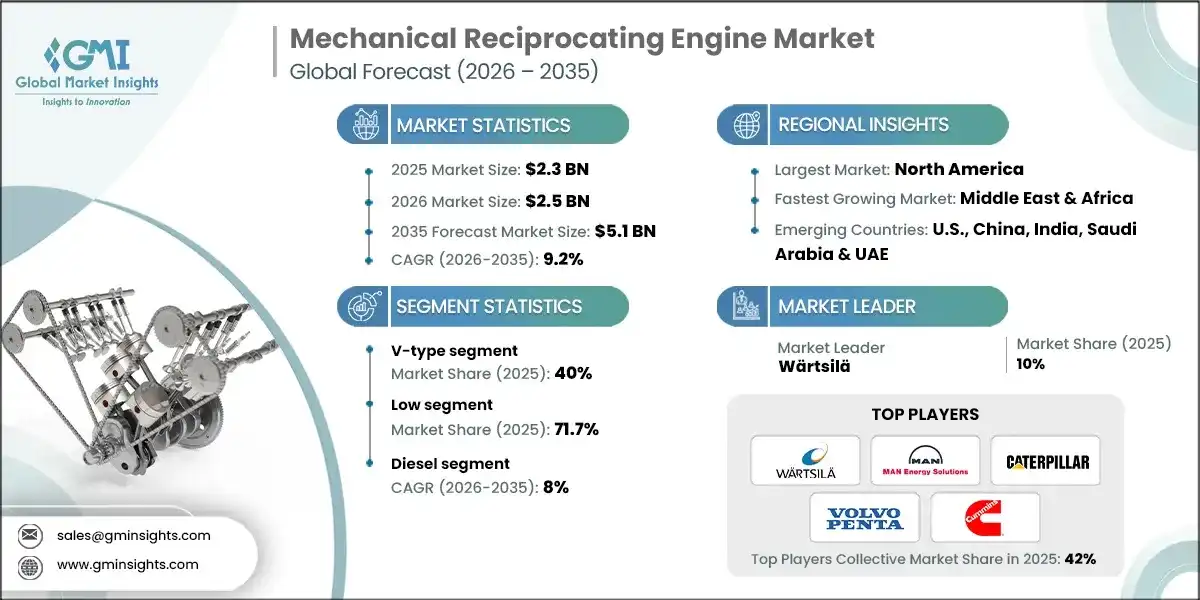
The mechanical reciprocating engine market was estimated at USD 2.3 billion in 2025. The market is expected to grow from USD 2.5 billion in 2026 to USD 5.1 billion by 2035, at a CAGR of 9.2%, according to a recent study by Global Market Insights Inc.
Mechanical Reciprocating Engine Market Key Takeaways
Market Size & Growth
- 2025 Market Size: USD 2.3 Billion
- 2026 Market Size: USD 2.5 Billion
- 2035 Forecast Market Size: USD 5.1 Billion
- CAGR (2026–2035): 9.2%
Regional Dominance
- Largest Market: North America
- Fastest Growing Region: Middle East & Africa
Key Market Drivers
- Growing demand for power generation.
- Large scale integration of renewable energy.
- Flourishing industrial sector.
Challenges
- Availability of alternative technologies.
Opportunity
- Hybrid power and microgrid deployment.
- Transition toward low-carbon and alternative fuels.
- Expansion of distributed and decentralized generation.
- Decarbonization-driven engine modernization.
Key Players
- Market Leader: Wärtsilä led with over 10% market share in 2025.
- Leading Players: Top 5 players in this market include Wärtsilä, MAN Energy Solutions, Caterpillar, AB Volvo Penta, Cummins, which collectively held a market share of 42% in 2025.
Get Market Insights & Growth Opportunities
- The ongoing expansion of industrial facilities, reinforced by rising capital inflows from both public authorities and private investors, is set to propel the industry growth. These investments are enhancing production capacity, modernizing infrastructure, and supporting industrial diversification, contributing to sustained expansion and long-term market development across multiple sectors.
- A reciprocating mechanical engine is a type of internal combustion engine that produces mechanical power by converting the back-and-forth motion of pistons inside cylinders into rotational motion. It functions by transforming the energy released during fuel combustion into useful work through four sequential strokes: intake, compression, power and exhaust.
- For instance, industrial output in China demonstrated strong momentum, recording a year-on-year growth exceeding 5% in June 2025. This increase reflects improved manufacturing activity, rising capacity utilization, and supportive economic policies, highlighting the country’s continued industrial resilience and its positive influence on broader market and supply-chain dynamics.
- The mechanical reciprocating engine market was valued at USD 1.8 billion in 2022 and grew at a CAGR of approximately 5% through 2025. Paradigm shift toward fuel-efficient & low-emission engines driven by strict environmental regulations and global sustainability goals will further support product adoption.
- The increasing emphasis on rural grid expansion, supported by favorable regulatory frameworks, along with greater awareness among end users about the need for reliable emergency power solutions, will strengthen the business growth. Additionally, expanding government-led electrification initiatives across regions are boosting demand.
- The industry represents a mature yet evolving segment of the global power and motion systems market. These engines remain widely used on account of their mechanical simplicity, high torque output, and adaptability across diverse operating conditions in industrial and stationary power applications.
- The growth is primarily driven by rising demand for reliable mechanical power in sectors requiring continuous or intermittent operation. Industrial expansion, infrastructure development, and increasing need for decentralized power generation are reinforcing the relevance of reciprocating engines, particularly in regions with limited grid stability.
- For instance, in March 2025, Cummins, alongside Johnson Matthey, PHINIA, and Zircotec in the UK’s Project Brunel, unveiled a new 6.7 L hydrogen internal combustion engine for trucks and buses. The H2-ICE prototype achieves over 99% tailpipe emission reduction compared to Euro VI diesel engines.
To get key market trends
Mechanical Reciprocating Engine Market Trends
- Mechanical reciprocating engines are valued for their robust construction, ease of maintenance, and ability to operate under variable loads. Continuous advancements in combustion efficiency, material durability, and thermal management are enhancing engine performance while extending operational lifespans in demanding environments.
- Fuel versatility is a key market strength, with engines capable of operating on diesel, gas, and blended fuels. Growing emphasis on fuel efficiency and emissions control is encouraging adoption of engines compatible with alternative and low-carbon fuels, supporting compliance with evolving environmental regulations.
- These mechanical engines are extensively deployed in industrial machinery, propulsion systems, agricultural equipment and backup power units. Their capability to deliver consistent mechanical output makes them suitable for both mobile and stationary applications where reliability and controllability are critical operational requirements.
- For instance, in May 2024, Renault and Geely established the Horse Powertrain JV in London, a 50 50 joint venture, later joined by Saudi Aramco, to co-develop combustion and hybrid powertrains, including internal combustion engines. The partnership aims for annual production of around 5 million units, targeting approximately USD 15 billion in revenue through innovative powertrain solutions.
- Emerging economies are experiencing rising demand driven by accelerating industrialization and infrastructure development, while developed regions emphasize efficiency improvements, modernization initiatives, and reductions in emissions. Policy frameworks, energy access programs, and industrial investment levels significantly influence adoption patterns and technology preferences.
- The market structure is influenced by high technical entry barriers, long product lifecycles, and strong aftermarket demand. Serviceability, spare part availability, and operational efficiency play crucial roles in buyer decision-making, contributing to stable replacement demand and long-term market continuity.
- The industry market is set to evolve gradually, balancing traditional strengths with emerging efficiency and sustainability requirements. Continued innovation in fuel adaptability, digital monitoring, and emissions performance will determine the long-term role of these engines within global energy and industrial systems.
- For citation, in February 2024, Wärtsilä won a contract to deliver two 34SG gas-fuelled reciprocating internal combustion engines, totalling 18 MW, for the Farmington power plant expansion. The engines are versatile, capable of operating on natural gas, biogas, synthetic methane, and hydrogen blends, enhancing flexibility, efficiency, and sustainability in the plant’s energy generation.
Mechanical Reciprocating Engine Market Analysis
 Learn more about the key segments shaping this market
Learn more about the key segments shaping this market
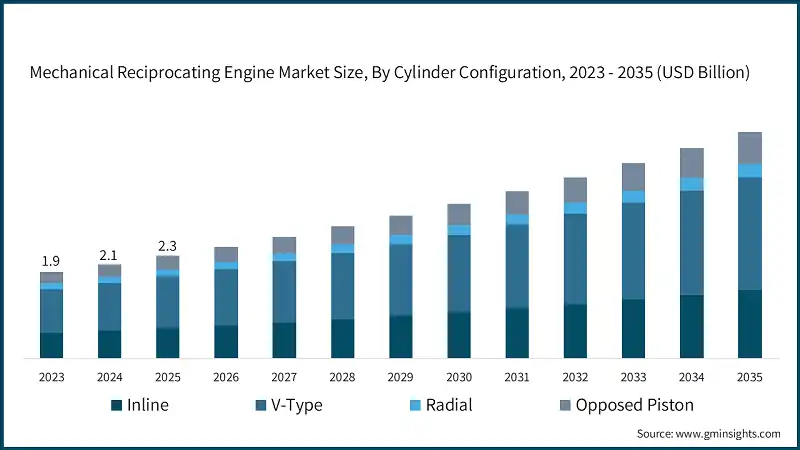
- Based on cylinder configuration, the industry is segmented into inline, v-type, radial and opposed piston. The v-type mechanical reciprocating engine industry holds a share of about 40% in 2025 and is projected to grow at a growth rate of over 8.5% through 2035.
- The industry is driven by demand for compact, high-power-density propulsion and power generation systems. Its configuration enables smoother operation, reduced engine length, and higher output, making it suitable for automotive, marine, and industrial applications requiring efficiency and balanced performance.
- For instance, in May 2025, KPUB, in partnership with Sky Global Partners, plans a 122 MW reciprocating engine plant in Colorado County, Texas. The facility will deploy six MAN RICE units, providing fast-start, dispatchable natural gas generation. This project replaces existing coal-fired capacity, supporting cleaner, flexible, and reliable power for the region’s energy needs.
- The inline segment is set to exceed USD 1.4 billion by 2035. The market is expanding owing to its straightforward design, efficient performance, and ease of maintenance. With cylinders arranged linearly, these engines deliver reliable power, fuel efficiency, and smooth operation. Their versatility makes them ideal for automotive, agricultural, and industrial applications, particularly where durability, cost-effectiveness, and long-term operational stability are critical for end users.
- The radial segment was valued at USD 153.4 million in 2025. Wide scale utilization across aviation, marine, and industrial applications, these engines offer high torque, reliability, and compact design. Their performance advantages make them ideal for sectors demanding lightweight, durable, and high-output power solutions.
- The opposed-piston mechanical reciprocating engine industry is witnessing growth due to its innovative dual-piston design, which eliminates the need for a cylinder head and enhances thermal efficiency. This configuration delivers higher power density, lower emissions, and improved fuel economy. Its adoption is increasing in automotive, marine, and industrial sectors that prioritize compact, efficient, and environmentally friendly engines.
Learn more about the key segments shaping this market
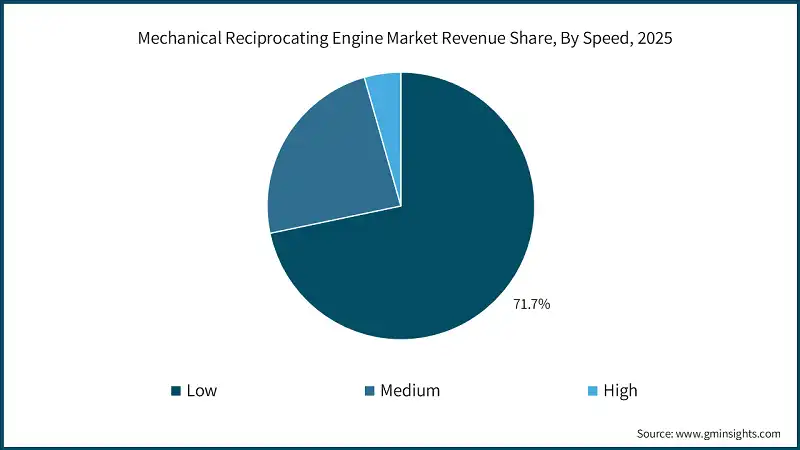
- Based on speed, the industry is divided into low, medium and high. The low mechanical reciprocating engine market holds a share of 71.7% in 2025 and is set to reach over USD 3.5 billion by 2035.
- Increasing reliance on robust power generation and marine propulsion systems is shaping industry growth. These engines combine high fuel efficiency with durability and reliable continuous operation, making them suitable for shipping, power plants, and industrial applications that require stable, long-duration energy output under heavy loads.
- Medium speed engines industry was estimated at USD 548.5 million in 2025. Increasing applicability across marine, power generation, and industrial applications, these engines provide reliable performance, moderate fuel consumption, and adaptability, making them suitable for projects requiring consistent energy supply with manageable maintenance demands.
- The high speed mechanical reciprocating engine market is set to grow at a rate of 6.5% from 2026 to 2035. These engines provide rapid acceleration, high power-to-weight ratios, and adaptability, making them ideal for automotive, marine, and aerospace applications where performance, responsiveness, and space optimization are critical.
- For instance, in August 2025, Black Hills Energy selected six Wärtsilä 50DF dual-fuel RICE units, totaling 99.6 MW, for a Rapid City, South Dakota plant. Capable of running natural gas and alternative fuels, these engines provide flexible grid support. The facility is scheduled to commence operations by Q4 2026, enhancing reliable and adaptable regional power generation.
- Based on fuel, the industry is bifurcated into diesel, gas and others. The diesel mechanical reciprocating engine industry will witness a CAGR of 8% by 2035. These engines are valued for their superior energy density, low fuel consumption, and robust performance under extreme conditions. Their widespread use spans construction, shipping, and generation sectors, driving steady product demand.
- The gas-powered engine market is expanding owing to rising demand for cleaner energy and flexible power generation. These engines efficiently run on natural gas, biogas, or other gaseous fuels, offering reduced emissions, high reliability, and low operating costs. Their versatility makes them ideal for industrial, commercial, and distributed energy applications.
Looking for region specific data?
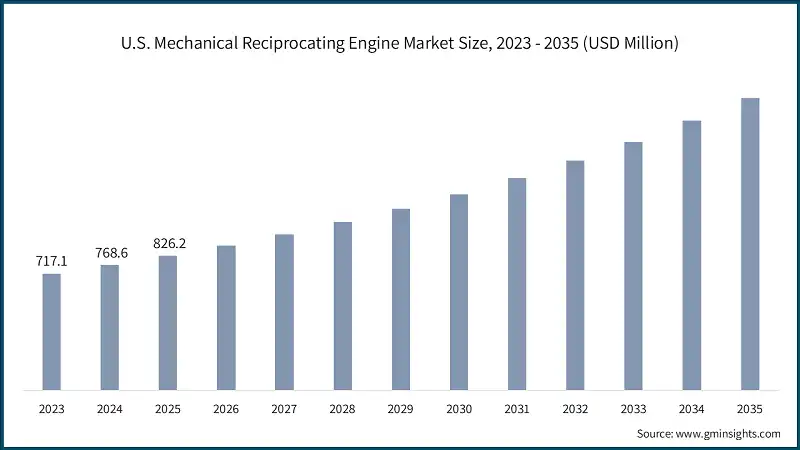
- The U.S. dominated the mechanical reciprocating engine market in North America with around 74% share in 2025 and generated USD 826.2 million in revenue. High demand for efficient, reliable engines in power generation, marine, and automotive applications fuels will positively sway the business growth. Advanced technologies, regulatory compliance, and a focus on emission reduction further support adoption and long-term industry scenario.
- For illustration, in May 2025, Wärtsilä secured a 507 MW gas engine order from a U.S. data center developer. The deal includes the delivery of 27 50SG flexible engines, scheduled from 2027, to provide reliable and distributed power for large-scale digital infrastructure. This installation enables uninterrupted operations, improves overall energy efficiency, and effectively addresses the increasing power requirements of modern industrial and commercial facilities.
- The North America mechanical reciprocating engine industry is projected to surge USD 2 billion by 2035. Rising demand in commercial and industrial sectors, combined with technological innovations and regulatory support for cleaner engines, is driving adoption. Growth is further fueled by modernization of energy infrastructure and distributed power generation projects.
- Europe accounts for about 25% of the mechanical reciprocating engine market in 2025. The industry is growing owing to stringent emission regulations, industrial modernization, and increasing demand for efficient power solutions. Engines are widely used in automotive and energy sectors. Technological innovations, focus on fuel efficiency, and adoption of alternative fuels are driving business dynamics.
- The Asia Pacific industry is set to grow at a rate of over 9.5% by 2035. The market is witnessing significant growth due to rapid industrialization, urbanization, and expanding power generation needs. High demand from automotive and manufacturing sectors, coupled with government incentives for energy-efficient and low-emission technologies, is driving the product adoption.
- For illustration, in October 2025, Wärtsilä established a new manufacturing facility to strengthen reciprocating engine production across Asia. This expansion enhances regional manufacturing capacity, supports rising demand for engines, & improves localized supply chains, enabling faster deliveries and greater efficiency for power generation and industrial applications.
- The Middle East & Africa mechanical reciprocating engine market is expanding as industrialization, energy infrastructure projects, and marine development accelerate. High demand for reliable, fuel-efficient engines in oil, gas, and power generation sectors drives growth. Adoption is further supported by investments in modern technology and low-emission, high-performance engine solutions.
- The Latin America mechanical reciprocating engine industry is expanding on account of growing industrial activities, energy infrastructure development, and rising demand for reliable power solutions. Technological advancements, focus on fuel efficiency, and government initiatives supporting energy modernization will foster the business landscape.
Mechanical Reciprocating Engine Market Share
- The top 5 players in mechanical reciprocating engine industry are Wärtsilä, MAN Energy Solutions, Caterpillar, AB Volvo Penta and Cummins contribute around 42% of the market share in 2025.
- The industry is characterized by steady demand across diverse sectors, including automotive, marine, power generation, and industrial applications. It is highly competitive, driven by technological innovation, efficiency improvements, and emission compliance. The growth is influenced by energy infrastructure development, rising industrialization, and the global shift toward sustainable and reliable power solutions.
- Wärtsilä’s portfolio includes medium-speed diesel, gas and dual/multi-fuel engines for industrial mechanical drives, power generation, and hybrid systems. Engines are designed for high efficiency, flexible operation, and low emissions across applications such as distributed power, backup generation, and heavy industry.
- MAN Energy Solutions offers large-bore mechanical reciprocating engines, including gas, diesel and dual-fuel platforms tailored for power generation, CHP, and industrial drives. Their engines prioritize high reliability, fuel flexibility, modular installation, and future-ready decarbonization options across sectors requiring robust mechanical power solutions.
- Caterpillar delivers spans high-speed and medium-speed diesel and gas engines used in prime & standby power generation, mechanical drives, and industrial applications. Its engines deliver dependable torque, efficiency, and emissions compliance for diverse sectors, supported by a broad global service network.
- AB Volvo Penta offers reciprocating diesel and gas engines for industrial and marine auxiliary applications. Its engines are engineered for reliable mechanical power delivery, generator set drives, and hybrid solutions, serving construction, agriculture, power generation, and industrial equipment markets with scalable, durable reciprocating platforms.
- Cummins includes a wide array of diesel, natural gas, and alternative-fuel engines for industrial, power generation, and off-highway applications. Known for dependable performance and global support, its engines power mechanical drives, generator sets, and heavy industrial equipment with an emphasis on emissions reduction and fuel flexibility.
Mechanical Reciprocating Engine Market Companies
- Wärtsilä recorded net sales of USD 5.7 billion, while its energy segment order intake rose by 29% through the third quarter of 2025. This performance reflects strong capability to respond to rising energy demand, supported by efficient operations and a sustained focus on maintaining long-term profitability and financial stability.
- Caterpillar reported second-quarter 2025 sales and revenues totaling USD 16.6 billion. This represented a modest 1% decline compared with the same period in the second quarter of 2024, reflecting softer demand in certain end markets while the company continued to focus on cost discipline and operational efficiency.
- In 2025, Kawasaki Heavy Industries reported robust financial performance, achieving net sales of USD 13.4 billion. Building on this momentum, the company plans to reinforce its market position through continued investment in advanced technologies, expansion of its global footprint, and ongoing improvements across its key industrial and engineering business segments.
Major players operating in the mechanical reciprocating engine industry are:
- AB Volvo Penta
- Caterpillar
- Cummins
- Deutz AG
- Doosan Corporation
- Escorts Kubota
- Fairbanks Morse Defense
- GE Vernova
- JC Bamford Excavators
- Kawasaki Heavy Industries
- KUBOTA Corporation
- Lister Petter
- MAN Energy Solutions
- Mitsubishi Heavy Industries
- Motorenfabrik Hatz
- Perkins Engines Company
- Rehlko
- Rolls-Royce
- Siemens Energy
- Wärtsilä
Mechanical Reciprocating Engine Market Report Attributes
| Key Takeaway | Details |
|---|---|
| Market Size & Growth | |
| Base Year | 2025 |
| Market Size in 2025 | USD 2.3 Billion |
| Market Size in 2026 | USD 2.5 Billion |
| Forecast Period 2026 to 2035 CAGR | 9.2% |
| Market Size in 2035 | USD 5.1 Billion |
| Key Market Trends | |
| Drivers | Impact |
| Growing demand for power generation | Rising electricity consumption across industries, commercial facilities, and remote locations is driving adoption of engines for dependable power generation. Their fast start-up, high efficiency at part loads, fuel flexibility, and suitability for decentralized and backup applications support growth. |
| Large scale integration of renewable energy | Large-scale renewable integration increases grid variability, creating demand for flexible, dispatchable generation. These engines provide rapid ramping, grid balancing, black-start capability, and hybrid operation with solar and wind assets, ensuring stability while accommodating intermittent renewable output at microgrid levels. |
| Flourishing industrial sector | Expanding manufacturing, mining, oil & gas, and construction activities are boosting demand for reliable mechanical power. These systems support prime, standby, and continuous operations, offering durability, easy maintenance, and compatibility with diverse fuels across varied industrial operating conditions globally. |
| Pitfalls & Challenges | Impact |
| Availability of alternative technologies | The availability of alternative technologies such as gas turbines, fuel cells, and battery energy storage systems restrains the mechanical reciprocating engines market. These alternatives offer lower emissions, reduced noise, and improved efficiency in certain applications, limiting engine adoption in some regions. |
| Opportunities: | Impact |
| Hybrid power and microgrid deployment | Rising adoption of hybrid power systems and microgrids creates opportunities for mechanical reciprocating engines, supporting renewable integration, load balancing, and reliable backup power in remote and off-grid regions. |
| Transition toward low-carbon and alternative fuels | Growing use of low-carbon fuels such as natural gas, biogas, hydrogen blends, and synthetic fuels expands opportunities by enhancing engine sustainability and compliance with tightening emission regulations. |
| Expansion of distributed and decentralized generation | Increasing preference for decentralized power generation in industrial and commercial facilities drives demand for mechanical reciprocating engines due to fast response, scalability, and dependable onsite power supply. |
| Decarbonization-driven engine modernization | Global decarbonization efforts are creating opportunities for upgrading mechanical reciprocating engines with advanced controls, efficiency improvements, and compatibility with low-carbon fuels to meet stricter emission norms and sustainability targets. |
| Market Leaders (2025) | |
| Market Leaders |
10% market share |
| Top Players |
|
| Competitive Edge |
|
| Regional Insights | |
| Largest Market | North America |
| Fastest Growing Market | Middle East & Africa |
| Emerging Country | U.S., China, India, Saudi Arabia & UAE |
| Future outlook |
|
What are the growth opportunities in this market?
Mechanical Reciprocating Engine Industry News
- In July 2025, Wärtsilä has been chosen to provide 282 MW of flexible reciprocating engines for a significant U.S. data center project. The contract includes its fifteen 18V50SG natural-gas engines, ensuring dependable onsite power in Ohio and facilitating the facility’s swift construction and efficient operational performance.
- In June 2025, MAN Energy Solutions has been selected to supply engines for a 122 MW fast-start natural gas peaker plant in Texas. The project includes six MAN reciprocating internal combustion engines with rapid start-up capability, awarded under a USD 105 million performance-based grant to strengthen grid flexibility and expand responsive power generation capacity.
- In February 2025, Cummins has partnered with a leading shipping company to jointly develop dual-fuel reciprocating engines capable of running on both LNG and traditional fuels. These engines aim to reduce emissions and lower operating costs for commercial fleets, supporting sustainable maritime operations while enhancing efficiency & flexibility in fuel usage across diverse routes and conditions.
- In January 2025, GE Vernova announced an investment of nearly USD 600 million to enhance domestic manufacturing facilities across its U.S. plants. Over the next two years, this expansion will increase production capacity for gas fueled reciprocating and related engines, enabling the company to address rising global energy demand, strengthen supply chains, and support the growing requirements of the energy and industrial sectors.
The mechanical reciprocating engine market research report includes in-depth coverage of the industry with estimates & forecast in terms of revenue (USD Million) & volume (MW) from 2022 to 2035, for the following segments:
Market, By Fuel
- Gas
- Diesel
- Others
Market, By Rated Power
- 0.5 MW - 1 MW
- > 1 MW - 2 MW
- > 2 MW - 3.5 MW
- > 3.5 MW - 5 MW
Market, By Speed
- Low
- Medium
- High
Inline
- V-type
- Radial
- Opposed piston
The above information has been provided for the following regions and country:
- North America
- U.S.
- Canada
- Mexico
- Europe
- UK
- France
- Germany
- Russia
- Italy
- Spain
- Netherlands
- Denmark
- Asia Pacific
- China
- India
- Japan
- South Korea
- Australia
- Thailand
- Singapore
- Middle East & Africa
- UAE
- Saudi Arabia
- Qatar
- Oman
- Kuwait
- Egypt
- Turkey
- South Africa
- Latin America
- Brazil
- Argentina
- Chile
Frequently Asked Question(FAQ) :
What is the market size of the mechanical reciprocating engine industry in 2025?
The market size for mechanical reciprocating engine exceeded USD 2.3 billion in 2025 and is expected to grow at a CAGR of 9.2% from 2026 to 2035, driven by rising demand for reliable power generation and industrial energy systems.
What is the current mechanical reciprocating engine market size in 2026?
The mechanical reciprocating engine industry is projected to reach USD 2.5 billion in 2026 as investments in industrial infrastructure and decentralized power generation continue to rise.
What is the projected value of the mechanical reciprocating engine market by 2035?
The mechanical reciprocating engine market is expected to reach USD 5.1 billion by 2035, due to increasing adoption in power generation, marine propulsion, and industrial mechanical drive applications.
How much revenue did the low-speed mechanical reciprocating engine segment generate in 2025?
The low-speed mechanical reciprocating engine segment dominated the industry with a 71.7% share in 2025 and is projected to exceed USD 3.5 billion by 2035, supported by demand from marine and continuous power generation applications.
What was the market share of the V-type cylinder configuration segment in 2025?
The V-type mechanical reciprocating engine segment held around 40% market share in 2025, driven by its compact design, high power density, and suitability for automotive, marine, and industrial applications.
What is the growth outlook for high-speed mechanical reciprocating engines from 2026 to 2035?
High-speed mechanical reciprocating engines are expected to grow at a CAGR of 6.5% from 2026 to 2035, supported by rising demand in automotive, aerospace, and applications requiring high power-to-weight ratios.
Which country leads the mechanical reciprocating engine industry in North America?
The U.S. dominated the North America market with around 74% share and generated USD 826.2 million in revenue in 2025. Growth is driven by strong demand from power generation, marine, and industrial sectors along with a focus on efficient and low-emission engine technologies.
What are the key trends in the mechanical reciprocating engine industry?
Key trends include increasing adoption of dual-fuel and low-emission engines, integration with digital monitoring systems, and growing use in hybrid power and microgrid applications to support renewable energy integration.
Who are the major players in the mechanical reciprocating engine market?
Leading companies in the mechanical reciprocating engine industry include Wärtsilä, MAN Energy Solutions, Caterpillar, AB Volvo Penta, Cummins, Mitsubishi Heavy Industries, Rolls-Royce, Siemens Energy, and Kawasaki Heavy Industries.
Mechanical Reciprocating Engine Market Scope
Related Reports