Summary
Table of Content

Meat Grinder Market
Get a free sample of this report
Form submitted successfully!
Error submitting form. Please try again.
Thank you!
Your inquiry has been received. Our team will reach out to you with the required details via email. To ensure that you don't miss their response, kindly remember to check your spam folder as well!
Request Sectional Data
Thank you!
Your inquiry has been received. Our team will reach out to you with the required details via email. To ensure that you don't miss their response, kindly remember to check your spam folder as well!
Form submitted successfully!
Error submitting form. Please try again.
Meat Grinder Market Size
The market has shown rapid growth over the past few years. The market has grown consistently due to the rising demand for cost-effective and high-grade meat products. In addition, the market has witnessed a surge in demand for meat grinding products due to the popularity of home-based food preparation. The demand for meat grinding products is expected to grow significantly in the coming years as meat grinding has become a viable solution for quality control and customization of meat products to meet the rising demand for meat products globally.
Meat Grinder Market Key Takeaways
Market Size & Growth
- 2025 Market Size: USD 1.22 Billion
- 2026 Market Size: USD 1.31 Billion
- 2035 Forecast Market Size: USD 3 Billion
- CAGR (2026–2035): 9.6%
Regional Dominance
- Largest Market: North America
- Fastest Growing Region: Asia Pacific
Key Market Drivers
- Rising adoption of high-capacity industrial systems.
- Demand for "Clean-Label" and Freshly Processed Meat.
- Technological pivot to electric and "Smart" grinders.
Challenges
- Strict hygiene and food safety regulations (USDA/EFSA).
- High initial investment for commercial-grade units.
Opportunity
- Integration of AI-powered quality & contamination detection.
- Expansion of E-commerce and D2C sales channels.
Key Players
- Market Leader: Hobart led with over 8% market share in 2025.
- Leading Players: Top 5 players in this market include Hobart, Bizerba, Weston Brands, Fimar S.p.a., Roser Group, which collectively held a market share of 42% in 2025.
Get Market Insights & Growth Opportunities
Advanced meat processing practices are now common in the meat grinding industry. These practices include industrial-grade electric mincers, automated meat portions, floor-standing meat grinders, as well as variable-speed grinding platforms. However, the cost factor has been a major challenge for meat processors and consumers to directly use meat grinding machines. The capital cost of installing heavy-duty stainless steel meat grinding machines, bone separators, as well as cooling machines for industrial meat grinding is extremely high.
The various grinding technologies that are developed to perform different functions, like coarse grinding, fine mincing, and sausage stuffing, are also contributing to the market's growth. The solution providers of today's market are utilizing a broad range of tools that are best for beef meat, pork meat, poultry meat, and even plant-based meat products. The meat processors can use specialized grinding machines for different texture requirements; hence, they are getting closer to achieving the highest output volume while minimizing wastage at the same time.
Furthermore, the use of digital technology like smart torque sensors, automated reverse gear function, and AI-based blade sharpness monitoring has also helped increase productivity. In a nutshell, it is safe to say that these developments are helping meat processors attain higher volume output while minimizing downtime and enhancing hygiene cycles. In addition, the advent of e-commerce sites, digital user manuals, and maintenance services has helped change the meat grinder market into a data-driven market that is accessible to meat producers from anywhere in the world.
Another significant aspect that is encouraging the growth of the market for advanced grinding equipment is the reduction of financial risk. There is a lot of uncertainty associated with meat processing, as the cost of livestock is constantly changing, and the government is enforcing stringent food safety regulations. Moreover, the cost of labor is continuously increasing. High-end equipment requires a lot of investments, and small businesses are exposed to a lot of financial risks, especially in developing nations where access to credit is very low. Therefore, small meat processors are opting for cost-effective equipment, such as hand-cranked grinding equipment, modular kits for multi-purpose kitchen devices, and shared processing centers.
This is helping them manage risks and invest in essential products like premium-grade meat and food-grade lubricants. Various initiatives taken by the government of different nations are encouraging the growth of the food processing industry, as they are providing subsidies for food safety and training for enhancing production levels and earnings for local butchers.
Moreover, the need for efficient protein processing across the world is a factor that plays a very significant role in the acceleration of the market. The need for protein and the general rise in the population means that the consumption of meat is on the rise at a very high rate. Meat grinders are able to provide for the efficient use of the resource as opposed to the manual chopping of the meat, whereby the overall yield is much higher when the meat is minced using the machines. Through technology, it is possible to attain better consistency and lower energy consumption, along with a better biosecurity and hygiene standard. This not only provides for the efficient processing of the meat but also meets the demand for protein across the world, thereby transforming the meat grinding technology into a significant aspect of the food security landscape.
The global meat grinder market was estimated at USD 1.22 billion in 2025. The market is expected to grow from USD 1.31 billion in 2026 to USD 3 billion in 2035, at a CAGR of 9.6% according to latest report published by Global Market Insights Inc.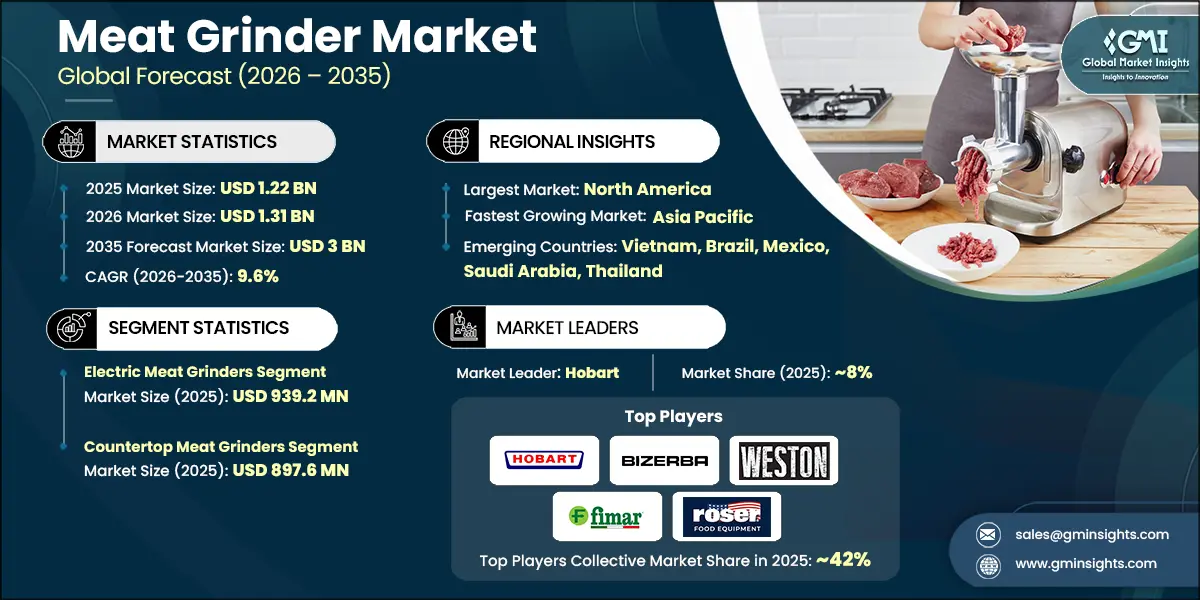
To get key market trends
Meat Grinder Market Trends
The market is undergoing a major overhaul at a global level owing to technological advancements and a shift towards more versatile and user-friendly products. One of the most prominent features of the meat grinder industry is that manufacturers are incorporating more advanced features into their electrical meat grinders. These features include digital controls, variable speeds, auto-reverse features, thermal overload protection, and sound-reducing technology. These are highly advanced features that allow users to attain industrial-grade results without requiring technical expertise or industrial investments.
- The fact that manufacturers are incorporating more advanced features into their electrical meat grinders is a major overhaul of the meat grinder market at a global level.
- The market is witnessing an increased and significant move towards multi-attachment meat grinders that offer more than just the basic meat grinding function. Modern electric meat grinders now come with sausage stuffing attachments, kibbe meat grinder attachments, vegetable slicing sets, and pasta-making sets that offer more than just the basic meat grinding function.
- The multi-functionality of meat grinders will be seen as an added advantage by consumers to use the kitchens more efficiently and to minimize the number of appliances that they use in their kitchens. Moreover, the growing importance of green living and the use of home meat processing equipment will also contribute to the meat grinder market. The fact that meat grinders will allow them to grind meat more economically will be seen as an advantage by consumers.
- Meat grinders with automated control and smart sensors and even IoT systems are becoming the norm. Such features minimize manual input and increase precision, efficiency, and safety in a business setting. Some industrial meat grinders, for example, feature automatic shut-off functions during excessive grinding speeds.
- Today's consumers prefer electric grinders because they are efficient, quick, and versatile in nature, but this was not the case previously. People around the world tended to use manual grinders, especially in the developed regions of North America and Europe; however, we are witnessing a shift now. People are actively looking for productivity as well as efficiency, which is driving the electric grinder's demand in the market.
- With the environmental impact growing awareness, manufacturers are now directed towards producing energy-efficient meat grinders for the target consumers. The trend is now shifting towards designing grinders that use recyclable materials while also incorporating features like low-noise motors as well as focused energy consumption.
Meat Grinder Market Analysis
Learn more about the key segments shaping this market
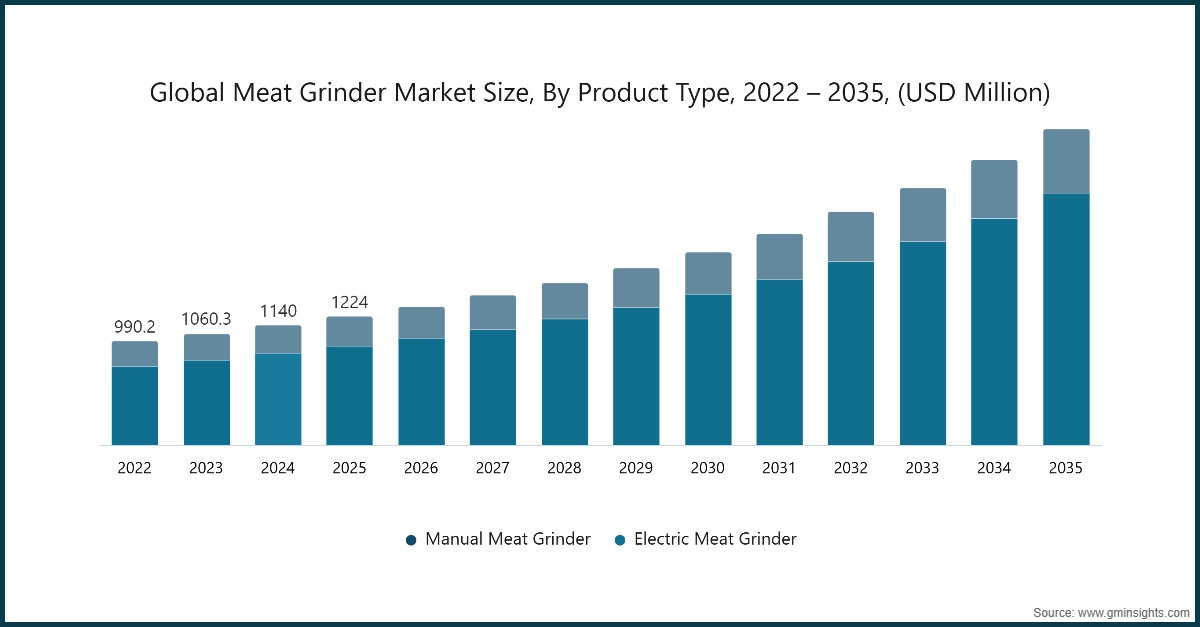
Based on product type, the meat grinder market is segmented into manual meat grinders and electric meat grinders. Electric meat grinders dominated the market, generating USD 939.2 million in 2025, and are projected to grow at a CAGR of 10% from 2026 to 2035.
- Electric meat grinders represent the fastest growing and most commercially significant segment due to their superior processing speed, consistent grinding quality, and reduced physical effort requirements compared to manual alternatives.
- These powered units benefit from continuous technological improvements, including more powerful motors, enhanced gear systems, improved cooling mechanisms, and sophisticated safety features—driving widespread adoption across residential and commercial applications.
- The increasing availability of affordable electric models at various price points has significantly expanded market accessibility, enabling budget-conscious consumers to transition from manual to electric grinding solutions.
- Rising consumer preference for convenience, time-saving appliances, and professional-quality results strongly favors electric grinders, which are viewed as essential equipment for serious home cooks, small butcher shops, and food service establishments.
Learn more about the key segments shaping this market
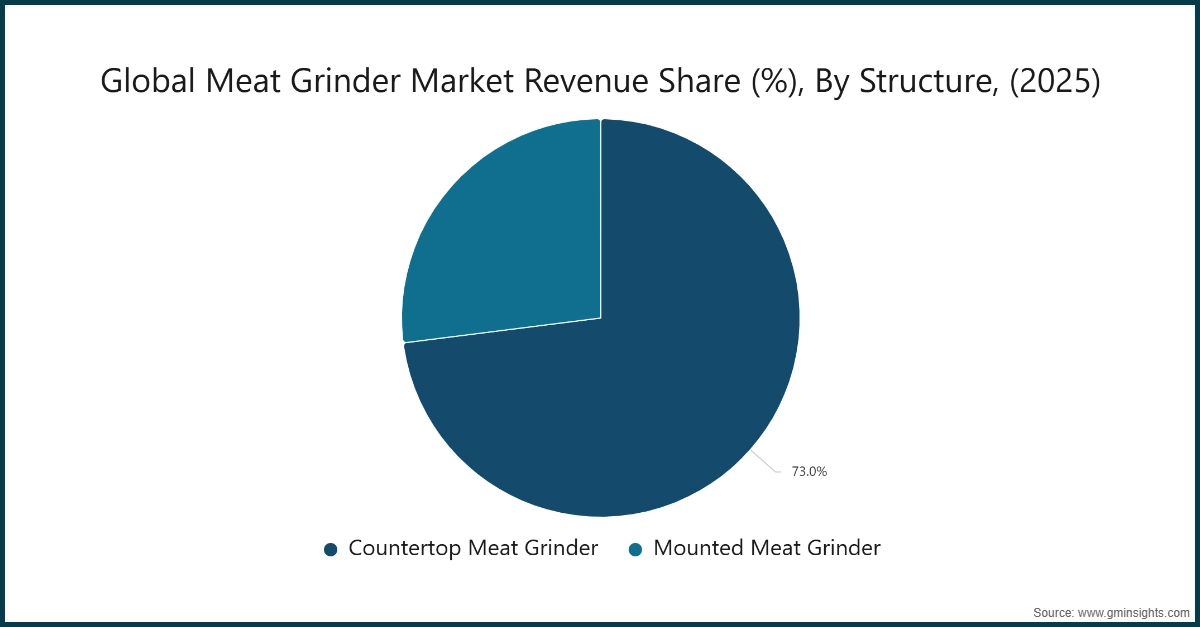
Based on structure, the meat grinder market is divided into countertop meat grinders and mounted meat grinders. Countertop meat grinders emerged as the largest segment with a market share of 73%, valued at USD 897.6 million in 2025, and are expected to grow at a CAGR of 10% from 2026 to 2035.
- Countertop models dominate the market due to their portability, ease of storage, and suitability for modern kitchen environments where permanent fixture installation is impractical or undesirable.
- These freestanding units require minimal setup, offer greater flexibility in kitchen placement, and can be easily stored when not in use—appealing to space-conscious urban consumers and occasional users.
- The proliferation of compact, aesthetically designed countertop grinders with stable suction bases and anti-slip feet has significantly enhanced usability and safety, expanding adoption among residential users who prioritize convenience and versatility.
North America Meat Grinder Market
Looking for region specific data?
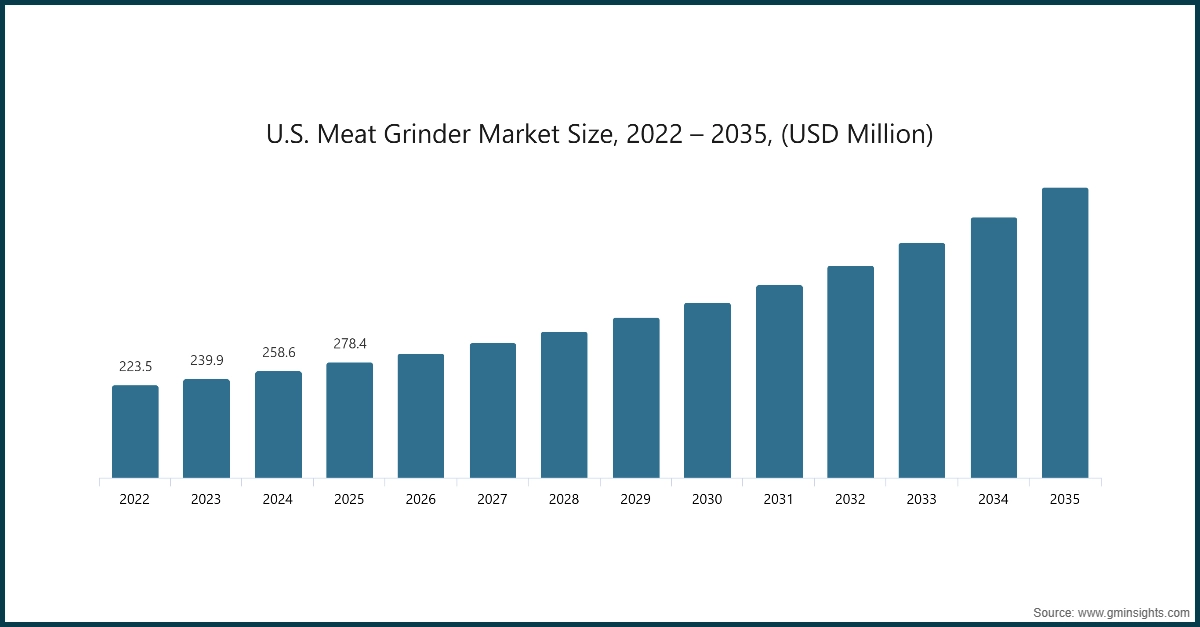
The U.S. dominates the overall North America meat grinder market, valued at USD 278.4 million in 2025, and is projected to expand at a CAGR of 9.9% from 2026 to 2035.
- The U.S. meat grinder industry is experiencing steady growth as domestic interest in home cooking, artisanal food preparation, and dietary customization continues to rise. Consumers across the country increasingly invest in quality kitchen appliances—particularly electric meat grinders with stainless steel construction, multiple grinding plates, and sausage-making attachments—to enhance food quality and preparation capabilities.
- However, premium commercial-grade equipment requires substantial investment and storage space. As a result, many consumers, particularly apartment dwellers and occasional users, prefer mid-range electric models or compact countertop units that balance performance with affordability and space efficiency.
- Rising meat prices, growing awareness of ground meat quality variations, and increasing interest in game processing and specialty sausage making are further accelerating home meat grinder adoption. The popularity of hunting, farm-to-table movements, and whole-animal purchasing from local farms creates sustained demand for reliable grinding equipment.
- Digital recipe platforms, YouTube cooking channels, and social media food communities provide extensive grinding tutorials and recipe inspiration, reducing intimidation factors and encouraging equipment purchases. The combination of culinary enthusiasm, quality consciousness, and technological accessibility is expected to sustain the region's long-term market expansion.
Europe Meat Grinder Market
In the European market, Germany is expected to register significant growth from 2026 to 2035, supported by strong culinary traditions and rising investments in premium kitchen equipment.
- Germany's meat processing culture, including traditional sausage making (wurst production) and home butchery practices, creates robust demand for both residential and small commercial grinding equipment. German consumers particularly value engineering quality, durability, and precision—driving preference for well-constructed electric grinders with powerful motors and stainless steel components.
- The country's emphasis on food quality, traceability, and artisanal preparation methods encourages investment in personal meat processing equipment. Growing concerns about industrial meat processing standards and additive content in commercial ground meat products are pushing health-conscious consumers toward home grinding solutions.
- Moreover, Germany's strong small butcher shop tradition and specialty meat retailer network creates sustained demand for commercial-grade countertop and mounted grinders. These establishments require reliable, high-capacity equipment capable of processing significant volumes while maintaining consistent quality standards.
- Seasonal game processing traditions, particularly during hunting seasons, generate periodic demand spikes for robust grinding equipment capable of handling wild game and tougher meat cuts, highlighting the market's diverse application base and growth potential.
Asia Pacific Meat Grinder Market
In the Asia Pacific market, China held the largest share 32% in 2025, and is projected to grow at a CAGR of 11.2% from 2026 to 2035.
- China leads regional meat grinder adoption due to expanding middle-class populations, rising disposable incomes, and increasing westernization of dietary habits. Growing interest in home-prepared dumplings, meatballs, and ground meat dishes drives residential equipment demand.
- Rapid urbanization and the proliferation of modern retail channels, including e-commerce platforms, have significantly improved product accessibility and consumer awareness. Online marketplaces offer extensive product selections at competitive prices, enabling comparison shopping and informed purchasing decisions.
- China's expanding food service sector, including restaurants, hotels, and catering operations, creates substantial commercial equipment demand. Small and medium-sized food businesses increasingly adopt electric grinders to ensure ingredient quality, reduce costs, and maintain operational flexibility.
- Government food safety initiatives and consumer concerns about meat quality and adulteration are encouraging home meat processing adoption. The ability to select and grind fresh meat provides quality assurance that pre-ground commercial products cannot guarantee, particularly in markets where food safety incidents have heightened consumer vigilance
Middle East and Africa Meat Grinder Market
In the Middle East & Africa market, Saudi Arabia held a substantial 23% share in 2025, with growth expected to accelerate through 2035 as the country experiences rising consumer affluence and evolving food preparation preferences.
- Saudi Arabia's growing expatriate population and increasing exposure to international cuisines are driving demand for diverse food preparation equipment, including meat grinders for burger preparation, kebab making, and sausage production.
- The country's hot climate and concerns about meat freshness during transportation and storage encourage consumers to purchase whole cuts and grind meat immediately before cooking, ensuring maximum freshness and quality.
- Rising disposable incomes and the expansion of modern retail infrastructure, including hypermarkets and specialty kitchen equipment stores, have improved access to quality grinding equipment across urban centers.
- Cultural preferences for fresh, home-prepared foods and traditional meat-based dishes align well with meat grinder utility. The ability to control meat quality, fat content, and ingredient purity resonates strongly with health-conscious consumers and families prioritizing dietary quality
Meat Grinder Market Share
Hobart holds the largest market share with 8% in the market. In 2025, the prominent manufacturers in the meat grinder industry are Hobart, Bizerba, Weston Brands, Fimar S.p.a., and Roser Group collectively held the market share of 42%.
- Bizerba maintains its competitive advantage by consistently investing in advanced meat processing technologies and integrated commercial grinding solutions. The company emphasizes innovations in motor efficiency, blade technology, and safety management systems, ensuring strong performance across commercial and industrial operations. Bizerba continues to enhance its digital equipment platforms, incorporating real-time performance monitoring, predictive maintenance alerts, and energy consumption tracking systems, keeping its production equipment technologically advanced and highly efficient.
Meat Grinder Market Companies
Major players operating in the meat grinder industry include:
- Hobart
- Bizerba
- Weston Brands
- Fimar S.p.a.
- Roser Group
- ADE Germany
- Dito Sama
- Fatosa, S.A.
- Dadaux SAS
- Ari Makina
- Amisy
- Nikai Group
- ASGO
- C.R.M. s.r.l.
- Clearline
- ABM Company
- AlexanderSolia GmbH
Hobart strengthens its leadership in the global meat grinder industry by focusing on heavy-duty commercial grinding systems, including high-capacity floor models, countertop units, and specialized processing equipment. The company's expanding portfolio spans compact grinders for small butcher shops, medium-capacity restaurant equipment, and industrial-scale processing systems tailored to meat processing facilities and large-scale food service operations. Hobart's strategic emphasis on durability, food safety compliance, sanitation-friendly design, and operator safety ensures long-term competitiveness in high-volume commercial and industrial segments.
Weston Brands enhances its market standing through continuous development of versatile meat processing solutions, particularly for home users, hunters, and small commercial operations. The company prioritizes investments in stainless steel construction, powerful motor systems, and comprehensive accessory packages to meet rising standards for food quality and processing versatility. Weston's integrated product line—from manual grinders to electric models with sausage stuffing capabilities—allows the company to maintain product quality and rapidly adopt new technologies across its North American operations.
Fimar S.p.a. reinforces its competitive position by delivering Italian-engineered precision grinding equipment designed for professional kitchens, butcher shops, and food processing facilities. The company focuses on combining traditional craftsmanship with modern manufacturing techniques, producing grinders with hardened steel components, efficient gear systems, and ergonomic designs. Fimar's commitment to European quality standards and CE compliance ensures strong market presence across European Union countries and international markets demanding premium commercial equipment.
Meat Grinder Market Report Attributes
| Key Takeaway | Details |
|---|---|
| Market Size & Growth | |
| Base Year | 2025 |
| Market Size in 2025 | USD 1.22 Billion |
| Market Size in 2026 | USD 1.31 Billion |
| Forecast Period 2026-2035 CAGR | 9.6% |
| Market Size in 2035 | USD 3 Billion |
| Key Market Trends | |
| Drivers | Impact |
| Rising adoption of high-capacity industrial systems | The shift toward high-throughput floor-standing grinders is driven by global meat consumption spikes, forcing processors toward automated, high-torque systems to maintain supply chain efficiency. |
| Demand for "Clean-Label" and Freshly Processed Meat | Consumers are increasingly prioritizing hygiene and quality control, leading to a surge in home meat grinding and specialty butcher shop "grind-to-order" services. |
| Technological pivot to electric and "Smart" grinders | The transition from manual to electric grinders with IoT-enabled sensors (overheat protection, speed adjustment) is reducing labor costs and enhancing safety in commercial kitchens. |
| Pitfalls & Challenges | Impact |
| Strict hygiene and food safety regulations (USDA/EFSA) | Frequent updates to sanitary standards for stainless steel grades and "easy-clean" designs increase R&D costs and manufacturing complexities for equipment providers. |
| High initial investment for commercial-grade units | The cost of high-output, precision-engineered industrial mincers remains a barrier for small-scale local butchers in developing markets. |
| Opportunities: | Impact |
| Integration of AI-powered quality & contamination detection | Real-time visual AI integration can detect foreign materials (bone fragments, plastic) during the grinding process, significantly reducing recall risks. |
| Expansion of E-commerce and D2C sales channels | Online marketplaces are providing domestic brands with direct access to global consumers, specifically for versatile, multi-attachment countertop models. |
| Market Leaders (2025) | |
| Market Leader |
Market share of ~8% |
| Top Players |
Collective market share of ~42% |
| Competitive Edge |
|
| Regional Insights | |
| Largest Market | North America |
| Fastest growing market | Asia Pacific |
| Emerging countries | Vietnam, Brazil, Mexico, Saudi Arabia, Thailand |
| Future outlook |
|
What are the growth opportunities in this market?
Meat Grinder Industry News
- In January 2025, Hobart introduced its next-generation commercial meat grinder series featuring advanced motor cooling technology and enhanced safety systems. The new platform incorporates thermal protection sensors, automatic overload shutdown mechanisms, and improved grinding plate designs that increase processing speed by 30% while reducing energy consumption. Hobart reported that the system extends motor lifespan significantly and improves grinding consistency through precision-engineered cutting components, enhancing both operational efficiency and product quality across commercial food service facilities.
- In March 2025, Bizerba announced a major upgrade to its industrial meat processing equipment line for the 2026 production cycle. The upgrade includes the rollout of Bizerba's Smart Grinder 3.0 system featuring real-time performance analytics, predictive maintenance algorithms, and automated cleaning cycle reminders designed to optimize operational uptime. The new system improves processing efficiency by using sensor technology to detect blade wear, motor temperature fluctuations, and grinding chamber conditions before they affect meat quality or equipment performance.
- In October 2025, Weston Brands disclosed plans to launch its advanced residential meat grinder series for the 2026 market season. The suite integrates enhanced motor power (up to 1.5 HP for residential models), stainless steel grinding components, and improved reverse function mechanisms. Weston's product development division also confirmed enhancements to its sausage stuffing attachments, including larger capacity tubes and quick-release systems. These updates are designed to strengthen Weston's position in the premium home processing market and reduce user frustration during extended grinding sessions.
- In August 2025, Fimar S.p.a. revealed its roadmap for a fully modernized commercial grinder infrastructure rollout for the 2026 equipment season. This includes a new generation of energy-efficient motors, enhanced stainless steel housing with improved sanitation access, and expanded use of food-grade materials throughout all product contact surfaces. Fimar also announced a transition to modular grinding head designs, enabling integrated maintenance scheduling, simplified parts replacement, and reduced equipment downtime across all commercial installations.
The meat grinder market research report includes in-depth coverage of the industry, with estimates & forecast in terms of revenue (USD Million) and volume(Million Unit) from 2022 to 2035, for the following segments:
Market, By Product Type
- Manual Meat Grinder
- Electric Meat Grinder
Market, By Feed Type
- Tray Feed Grinder
- Vertical Feed
- Auger Feed
- Manual Push Feed
- Others (Vacuum Feed, etc.)
Market, By Material
- Aluminum
- Cast Iron
- Stainless Steel
- Others (Carbon Steel, etc.)
Market, By Structure
- Countertop Meat Grinder
- Mounted Meat Grinder
- Floor Mounted
- Table Mounted
Market, By Capacity
- Small (Up to 150 lbs/hour)
- Medium (150-500 lbs/hour)
- Large (Above 500 lbs/hour)
Market, By Operation
- Light-duty
- Medium-duty
- Heavy-duty
Market, By Price Range
- Low (Under USD 500)
- Medium (USD 500 - USD 1000)
- High (Above USD 1000)
Market, By End User
- Residential
- Commercial
- Hotels and Restaurants
- Catering Services
- Butcher Shops
- Others
- Industrial
- Meat Processing Plants
- Food Manufacturing Facilities
Market, By Distribution Channel
- Online
- E-commerce Website
- Company Website
- Offline
- Hypermarkets and Supermarkets
- Specialty Stores
- Others (Department Stores, Individual Stores, etc.)
The above information is provided for the following regions and countries:
- North America
- U.S.
- Canada
- Europe
- UK
- Germany
- France
- Italy
- Spain
- Asia Pacific
- China
- Japan
- India
- South Korea
- Australia
- Latin America
- Brazil
- Mexico
- Argentina
- MEA
- Saudi Arabia
- UAE
- South Africa
Frequently Asked Question(FAQ) :
What was the market size of the meat grinder industry in 2025?
The market was valued at USD 1.22 billion in 2025, supported by rising demand for cost-effective and high-quality meat processing solutions.
What is the projected size of the meat grinder market in 2026?
The market is expected to reach USD 1.31 billion in 2026, driven by growing adoption of electric grinders and increasing home-based food preparation.
What is the forecasted value of the meat grinder market by 2035 and its CAGR?
The market is projected to reach USD 3 billion by 2035, expanding at a CAGR of 9.6% during 2026–2035. Growth will be fueled by rising global meat consumption, demand for freshly processed meat, and technological advancements such as smart sensors and AI-powered grinders.
Which product type dominates the meat grinder industry?
Electric meat grinders dominated the market in 2025, generating USD 939.2 million, and are projected to grow at a 10.0% CAGR, favored for speed, consistency, and convenience.
Which structure type holds the largest share in the meat grinder industry?
Countertop meat grinders led with a 73% share (USD 897.6 million) in 2025, popular for portability, ease of storage, and suitability for modern kitchens.
What was the value of the U.S. meat grinder market in 2025?
The U.S. market was valued at USD 278.4 million in 2025, and is projected to grow at a 9.9% CAGR through 2035, driven by rising interest in home cooking and artisanal food preparation.
Who are the key players in the meat grinder market?
Leading companies include Hobart, Bizerba, Weston Brands, Fimar S.p.a., and Roser Group, collectively holding 42% of the market share in 2025. Other notable players are ADE Germany, Dito Sama, Fatosa S.A., Dadaux SAS, and AlexanderSolia GmbH.
Meat Grinder Market Scope
Related Reports