Summary
Table of Content

Meat and Poultry Processing Equipment Market
Get a free sample of this report
Form submitted successfully!
Error submitting form. Please try again.
Thank you!
Your inquiry has been received. Our team will reach out to you with the required details via email. To ensure that you don't miss their response, kindly remember to check your spam folder as well!
Request Sectional Data
Thank you!
Your inquiry has been received. Our team will reach out to you with the required details via email. To ensure that you don't miss their response, kindly remember to check your spam folder as well!
Form submitted successfully!
Error submitting form. Please try again.
Meat and Poultry Processing Equipment Market Size
Meat processing equipment includes all the machinery and systems that are involved in slaughtering, processing, packaging, and preserving meat and poultry products, ensuring maximum efficiency, the safety of the products, and compliance with the standards established in the regulations.
Meat and Poultry Processing Equipment Market Key Takeaways
Market Size & Growth
- 2025 Market Size: USD 15.5 Billion
- 2026 Market Size: USD 16.6 Billion
- 2035 Forecast Market Size: USD 30.5 Billion
- CAGR (2026–2035): 7%
Regional Dominance
- Largest Market: Asia Pacific
- Fastest Growing Region: North America
Key Market Drivers
- Rising global meat consumption & production expansion.
- Labor shortage & automation imperative.
- Food safety & quality regulations stringency.
Challenges
- High capital investment requirements.
- Maintenance & service cost concerns.
Opportunity
- Retrofit & upgrade market.
- Emerging species & product categories.
Key Players
- Market Leader: JBT Corporation led with over 25.3% market share in 2025.
- Leading Players: Top 5 players in this market include JBT Corporation, GEA Group, Middleby Corporation, Meyn, Provisur Technologies, which collectively held a market share of 36.1% in 2025.
Get Market Insights & Growth Opportunities
As global meat consumption rises, demand for the modernizing advance equipment for processing slaughtered meats has significantly increased, as it is fundamental to increased production capacity. Asia-Pacific currently has the largest market for meat processing equipment in the world. This is due to the growing middle-class populace in the region, rising disposable incomes, and culture shifts toward meat-based diets.
Such speed in the economy has raised the demand for meat, thus usually befalling modernization of processing facilities, installation of novel machinery, improving productivity, and most importantly safety standards. In the same light, North America is the fastest-growing market due to continuing technological developments and an increased focus on automation of processes to mitigate labor shortages.
Investments have been substantial into automation technology to enhance operation efficiency while satisfying stringent food safety regulations. Labor shortages, aggravated in the last years due to demographic problems and the continuous rise in labor costs, have pushed up the adoption of automation robots and other automated appliances in the world.
Government regulatory requirement changes emphasizing safety of food, hygiene, and safe processing of foodstuffs compel processors to upgrade their machines to current standards, thereby further driving demand. These factors work in concert to establish an environment susceptible to changes brought about by technological innovation and regulatory compliance.
The global meat and poultry processing equipment market was valued at USD 15.5 billion in 2025. The market is expected to grow from USD 16.6 billion in 2026 to USD 30.5 billion in 2035, at a CAGR of 7% according to latest report published by Global Market Insights Inc.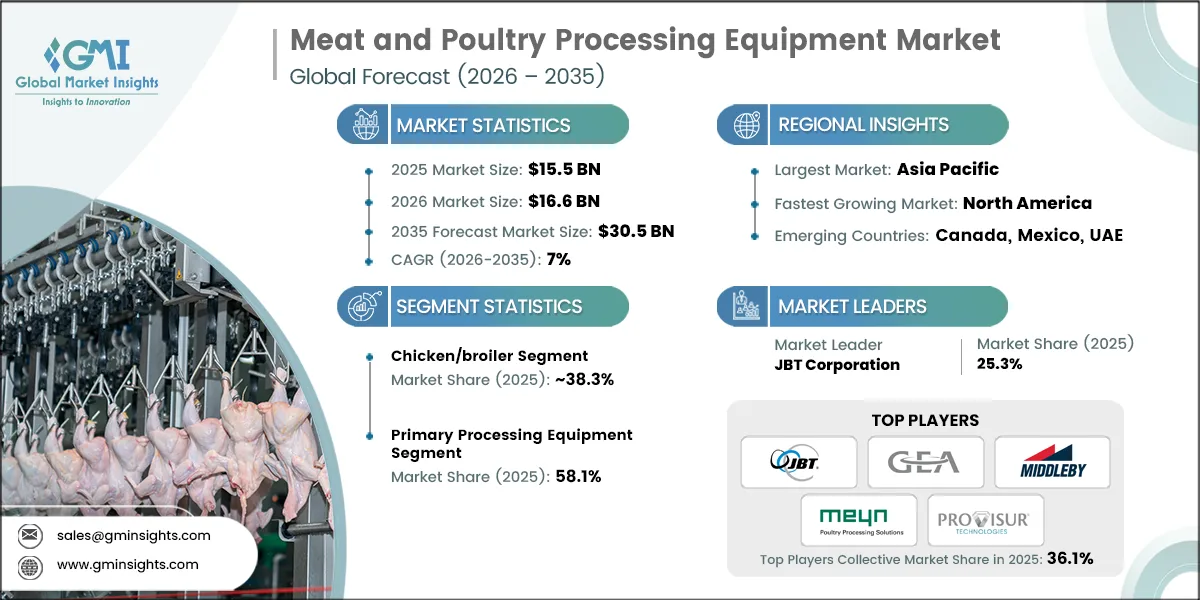
To get key market trends
Meat and Poultry Processing Equipment Market Trends
The meat and poultry processing industry is undertaken to adopt advanced automation and robotics, all for the improving of overall efficiency, precision, and safety. Complex tasks such as deboning, portioning, and packaging can be automated with little or no human intervention and significantly reduced labor costs while providing better consistency of product. The growing shortage of workers and the need to comply with increasingly severe hygiene standards are motivating the trend, particularly in high-volume processing plants. The intelligent, sensor-based machinery further enables real-time monitoring and quality control and thus streamlines operations and reduces the waste.
With environmental problems, the trend for much more sustainable processing equipment arises among manufacturers. Examples of advancement would be machine energy savings or those machines water-recycling-use-wise, and environmentally friendly packaging integrated with processing lines installed. These innovations facilitate a processor in lowering its carbon footprints and meeting the tightening environmental standards.
Continuous innovation is the name of the game in food processing equipment manufacture since changing regulatory standards all over the globe increasingly direct their attention toward the same. Enhanced food safety protocols require stricter hygiene control and traceability. These requirements create a demand for more advanced processing equipment with basic intelligent features, e.g., easy-clean surfaces and antimicrobial coatings, and integrated monitoring systems, thereby ensuring compliance and low contamination risks.
Equipment design is also being determined by changing consumer tastes such as the demand for minimally processed, free-preservative products. Even so, equipment are being manufactured with the possible processing solutions i.e gentle handling, minimal processing times, and natural preservation-through high-pressure processing (HPP) technologies in mind.
Meat and Poultry Processing Equipment Market Analysis
Learn more about the key segments shaping this market
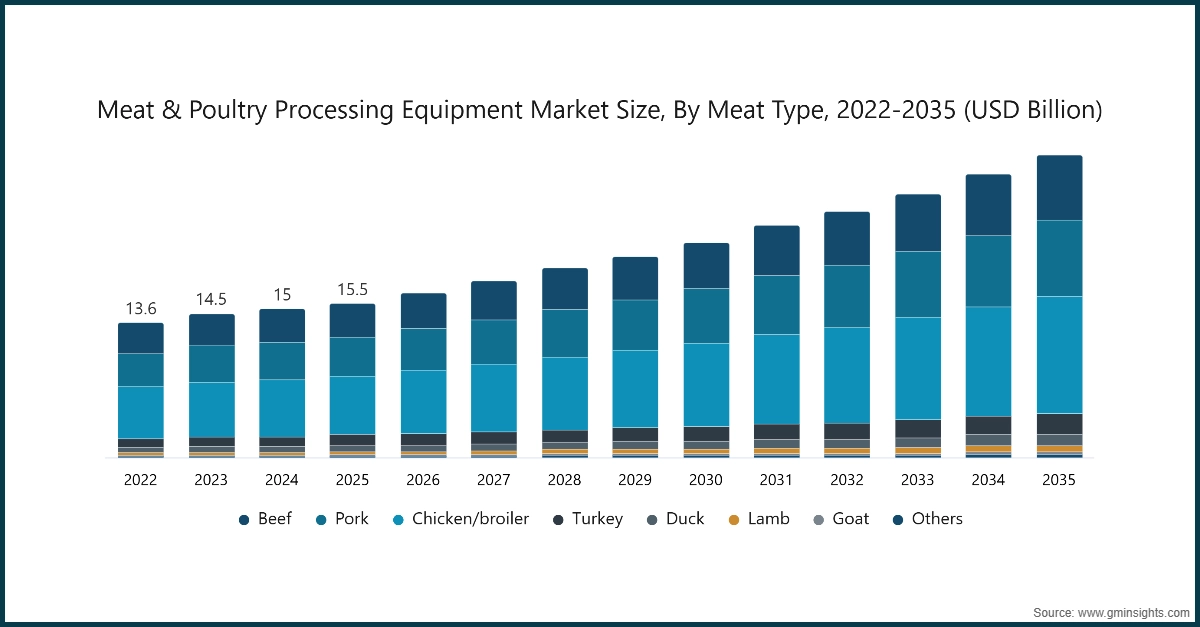
Based on meat type, the market is segmented into beef, pork, chicken/broiler, turkey, duck, lamb, goat and others. Chicken/broiler dominated the market with an approximate market share of 38.3% in 2025 and is expected to grow with a CAGR of 7.1% by 2035.
Due to the vast consumption of chicken globally and the shorter production cycles, the chicken/broiler segment effectively accounts for most of the meat and poultry processing equipment market. Chicken can be seen as a rather cheap and versatile source of protein, gaining a preference in a host of markets, particularly in developing areas where the demand for cheap protein sources is rising.
Automation and improved processing technologies of processing equipment exclusively designed for chicken, such as deboning, portioning, and packaging equipment, bring efficiency and safety. With an increase in processed chicken products like ready-to-eat and convenience foods, there is a pressure on innovation and investment in high-capacity, automated processing lines for quick and efficient consumer satisfaction.
Whereas cattle and pork together cater to premium and traditional markets. The increasing consumer preference for assorted premium cuts has caused their beef processing equipment to progress, if steadily, particularly in North America and Europe. The pork processing segment is fueled by the meat's ubiquitous consumption in processed products like sausages and ham, and innovations in automation are providing these lines with more safety and throughput.
Learn more about the key segments shaping this market
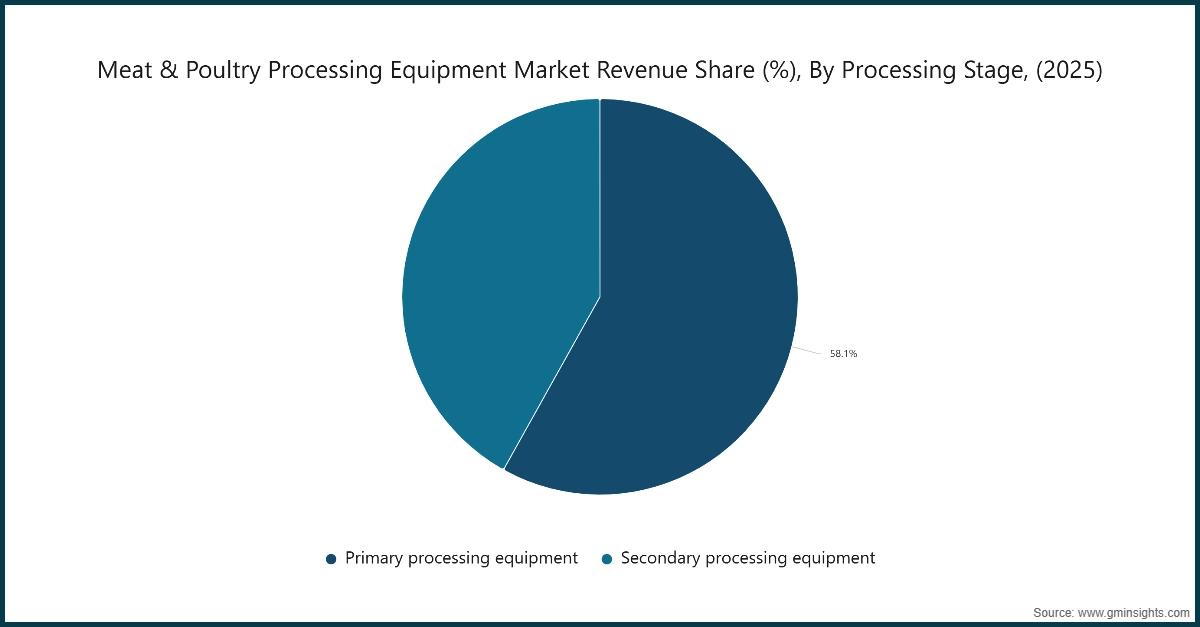
Based on processing stage, the meat and poultry processing equipment market is segmented into primary processing equipment and secondary processing equipment. Primary processing equipment held the largest market share of 58.1% in 2025.
Primary processing equipment dominates because it has important role in preliminary meat and poultry processing areas-such as slaughtering, evisceration, carcass splitting, etc. All these processes require efficient machines capable of high volumes in quick time and hence are critical to ensure the required throughput and hygiene. The increasing consumption of meat and strict safety regulations have made automation imperative in these stages, making primary processing equipment practically a must to work on a large scale.
Secondary processing equipment addresses further processing like cutting, deboning, marinating, and packaging. The segment is steadily gaining ground due to an increasing consumer preference for value-added products and convenience food. Innovations like robotic deboning technology and portioning technology do increase efficiency and product consistency; however, it remains secondary to primary processing owing to being process-specific.
Based on automation level, the market is segmented into manual equipment, semi-automated equipment, fully automated equipment and intelligent/AI-enabled systems.
Semi-automated equipment provides a level of automation and flexibility to handle a variety of processing tasks, thus enabling it to fit a multitude of products and production volumes. This flexibility supports its application in many processing plants, especially in areas with moderate automation budgets, and also supports incremental upgrades from manual systems.
Manual equipment continues to be the preferred option for small-scale or traditional processing, especially where investment in automation is limited. Though good initial cost and ease of use are the driving factors, decreasing popularity is driven by industries striving to obtain better safety, hygiene, and productivity.
Fully automated equipment is beneficial in large-scale, high-volume processing plants with a view toward maximum efficiency and consistency. Widespread adoption is being limited, however, in emerging markets due to high capital costs coupled with maintenance complexities.
Looking for region specific data?
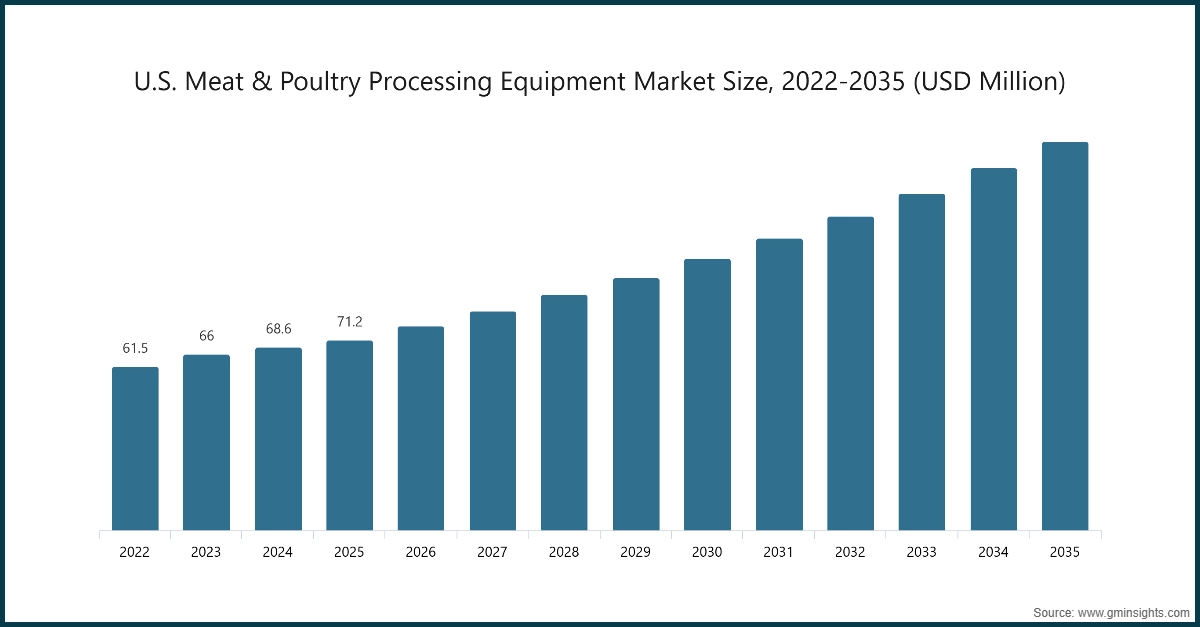
The meat and poultry processing equipment market in North America will grow at a CAGR from approximately 7.4% between 2026 and 2035.
- Innovations in waste management, which include recycling wastewater and industrial effluents, support the adoption of meat and poultry processing equipment in sustainable processing practices according to the principles of the circular economy.
- Increased focus and consumer awareness about the environmental concerns associated with meat and poultry, combined with the rising interest for naturally produced meat and poultry products, will thus be factors encouraging brands to invest in such environmental standards processing equipment, further driving market growth.
The meat and poultry processing equipment markets in Europe, especially in a few countries like Germany, are expected to grow with a rapid pace in the coming years.
- Continuous research and development drives adopted with eco-friendly manufacturing processes for reduced environmental impact and maximized purity of the products are pushed into applications related to organic farming, natural-extracts, and pharmaceutical-grade processing.
- The increased consumer preference for clean-label, plant-based, and allergen-free products motivates investment in environmentally sustainable processing equipment, reinforcing trends toward health and sustainability in the food and personal care sectors.
The meat and poultry processing equipment market in China and India is expected to have lucrative growth between 2026 and 2035, with CAGR 7.5% in the Asia Pacific region.
- Rapid urbanization and improving disposable incomes are driving the demand for high-performance processing equipment in the food, packaging, and healthcare sectors, thereby promoting the move to natural and organic meat and poultry products.
- Increasing the attention paid to natural, organic, and functional food formulations is boosting demand for bio-based and pharmaceutical-grade processing equipment, promoting sustainable, healthy manufacturing practices.
Between 2026 and 2035, the market for meat and poultry processing equipment in the Middle East is projected to grow significantly during this period.
- Growing initiatives are encouraging adoption of improved processing equipment in food, cosmetics, and dietary supplement industries.
- Operational costs have declined due to the present advancement of bio- and thermal treatment technologies, which have facilitated acceptance of progressive systems like UV-based processing and waste management in different sectors.
Between 2025 and 2035, a promising expansion of the meat and poultry processing equipment sector is foreseen in the Latin America.
- Increased environmental awareness along with pressure to recycle waste in a more sustainable way are stimulating the uptake of eco-processing technologies in the meat and poultry industries, as well as in cosmetics and functional foods.
- Rising disposable incomes and increased scientific research into natural extracts and bio-based ingredients are fueling demand for sustainable, bio-based processing equipment in food, pharmaceutical, and cosmetic sectors.
Meat and Poultry Processing Equipment Market Share
Meat and poultry processing equipment industry is moderately consolidated with players like JBT Corporation, GEA Group, Middleby Corporation, Meyn and Provisur Technologies which accounts for 36.1% market share in 2025.
The meat and poultry processing equipment industry consists of such leading companies operating mostly in their regional areas. Their long years of experience with meat and poultry processing equipment have allowed these companies to maintain a strong market position worldwide. Their product offerings are diverse and majorly supported by production capacities and distribution networks, which can serve the increasing demand for meat and poultry processing equipment in various regions.
Meat and Poultry Processing Equipment Market Companies
Major players operating in the meat and poultry processing equipment industry includes:
- Alberk Poultry Erocessing Equipment
- BAADER
- Bayle SA
- Cantrell Gainco
- Frontmatec
- GEA Group
- Jarvis Canada
- JBT Corporation
- Mayekawa
- Meyn
- Middleby Corporation
- Provisur Technologies
- Tomra Food
JBT Corporation's meat and poultry processing equipment covers an entire gamut such as deboning, cutting, and portioning systems, all designed for high efficiency and hygiene so as to support processors in optimizing product quality and throughput at various processing stages.
GEA Group's automation and sustainability features state-of-the-art slaughtering, deboning and packaging equipment, such that meat processing is further toward its goal of making operations safer all the while increasing efficiency in operations.
Provisur Technologies specializes maybe in innovative food processing equipment, for example, grinding machines and form and portion machinery, and it was engineered to increase productivity consistency in meat and poultry operations, together with achieving quality, and hygiene standards.
Middleby Corporation further provides a comprehensive line of poultry processing systems-from evisceration to cutting to packaging. Its particular focus is found in the automation and energy efficiency of its equipment to optimize operations while complying with strict sanitation requirements in the industry.
Meyn assures end users of high quality, even meat processors, under the highest safety and hygiene standards by providing high-capacity and precision slaughtering, defeathering and evisceration equipment.
Meat and Poultry Processing Equipment Market Report Attributes
| Key Takeaway | Details |
|---|---|
| Market Size & Growth | |
| Base Year | 2025 |
| Market Size in 2025 | USD 15.5 Billion |
| Market Size in 2026 | USD 16.6 Billion |
| Forecast Period 2026-2035 CAGR | 7% |
| Market Size in 2035 | USD 30.5 Billion |
| Key Market Trends | |
| Drivers | Impact |
| Rising global meat consumption & production expansion | Increased meat demand propels the need for advanced processing equipment, driving market growth and innovation to meet higher production volumes efficiently. |
| Labor shortage & automation imperative | Labor shortages accelerate adoption of automated processing solutions, reducing reliance on manual labor and enhancing operational efficiency in meat and poultry processing plants. |
| Food safety & quality regulations stringency | Stringent regulations compel manufacturers to invest in sophisticated processing equipment that ensures compliance, safety, and high-quality standards, thereby shaping product development and technology adoption. |
| Pitfalls & Challenges | Impact |
| High capital investment requirements | Substantial upfront costs hinder smaller players from upgrading to advanced processing systems, potentially restricting market growth and technological diffusion. |
| Maintenance & service cost concerns | Ongoing maintenance and service expenses can deter adoption of high-end equipment, impacting overall market expansion and profitability for manufacturers. |
| Opportunities: | Impact |
| Retrofit & upgrade market | Growing demand for modernization offers lucrative opportunities for equipment suppliers to retrofit existing systems, extending machinery lifespan and enhancing efficiency. |
| Emerging species & product categories | Introduction of new meat sources and innovative product lines opens avenues for specialized processing equipment, diversifying market offerings and expanding customer base. |
| Market Leaders (2025) | |
| Market Leader |
25.3% market share |
| Top Players |
Collective Market Share of 36.1% in 2025 |
| Competitive Edge |
|
| Regional Insights | |
| Largest Market | Asia Pacific |
| Fastest growing market | North America |
| Emerging countries | Canada, Mexico, UAE |
| Future outlook |
|
What are the growth opportunities in this market?
Meat and Poultry Processing Equipment Industry News
- In December 2024, JBT had its amalgamation with Marel, thus being called JBT Marel Corporation-the new company. The new entity starts to trade under the ticker symbol ''JBTM'' and aims at revolutionizing food processing technology while at the same time adding higher value to global customers and stakeholders.
- In August 2023, JBT introduced groundbreaking poultry processing innovations, including the Innospexion bone-detection system, precision waterjet portioning, flavor injection solutions, and energy-efficient spiral ovens, all of which revolutionized operational efficiency, product quality, and sustainability in poultry processing industries worldwide.
This meat and poultry processing equipment market research report includes in-depth coverage of the industry, with estimates & forecasts in terms of revenue (USD Billion) and volume (Kilo Tons) from 2022 to 2035, for the following segments:
Market, by Meat Type
- Beef
- Pork
- Chicken/broiler
- Turkey
- Duck
- Lamb
- Goat
- Others
Market, by Processing Stage
- Primary processing equipment
- Slaughter & evisceration
- Chilling & carcass handling
- Secondary processing equipment
- Cutting, deboning & trimming
- Portioning & fabrication
Market, by Automation Level
- Manual equipment
- Semi-automated equipment
- Fully automated equipment
- Intelligent/AI-enabled systems
The above information is provided for the following regions and countries:
- North America
- U.S.
- Canada
- Europe
- Germany
- UK
- France
- Spain
- Italy
- Rest of Europe
- Asia Pacific
- China
- India
- Japan
- Australia
- South Korea
- Rest of Asia Pacific
- Latin America
- Brazil
- Mexico
- Argentina
- Rest of Latin America
- Middle East and Africa
- Saudi Arabia
- South Africa
- UAE
- Rest of Middle East and Africa
Frequently Asked Question(FAQ) :
What was the market size of the meat and poultry processing equipment in 2025?
The market size was valued at USD 15.5 billion in 2025, at a CAGR of 7% till 2035. The market is driven by increasing demand for automation, efficiency, and compliance with stringent hygiene and safety regulations.
What is the projected value of the meat and poultry processing equipment market by 2035?
The market is poised to reach USD 30.5 billion by 2035, supported by advancements in automation, sustainable processing technologies, and evolving consumer preferences.
What is the expected size of the meat and poultry processing equipment industry in 2026?
The market size is expected to reach USD 16.6 billion in 2026.
What was the market share of the chicken/broiler segment in 2025?
The chicken/broiler segment held a market share of approximately 38.3% in 2025 and is expected to grow at a CAGR of 7.1% through 2035.
What was the market share of the primary processing equipment segment in 2025?
The primary processing equipment segment accounted for 58.1% of the market share in 2025, owing to its critical role in initial processing stages such as slaughtering and evisceration.
What is the growth outlook for the North American meat and poultry processing equipment sector?
The North American market is expected to grow at a CAGR of approximately 7.4% from 2026 to 2035, driven by innovations in waste management and sustainable processing practices.
What are the upcoming trends in the meat and poultry processing equipment market?
Key trends include the adoption of advanced automation and robotics, sustainable processing equipment, intelligent sensor-based machinery, and equipment designed for minimally processed and preservative-free products.
Who are the key players in the meat and poultry processing equipment industry?
Key players include Alberk Poultry Processing Equipment, BAADER, Bayle SA, Cantrell Gainco, Frontmatec, GEA Group, Jarvis Canada, JBT Corporation, Mayekawa, and Meyn.
Meat and Poultry Processing Equipment Market Scope
Related Reports