Summary
Table of Content

Masonry Tools and Equipment Market
Get a free sample of this report
Form submitted successfully!
Error submitting form. Please try again.
Thank you!
Your inquiry has been received. Our team will reach out to you with the required details via email. To ensure that you don't miss their response, kindly remember to check your spam folder as well!
Request Sectional Data
Thank you!
Your inquiry has been received. Our team will reach out to you with the required details via email. To ensure that you don't miss their response, kindly remember to check your spam folder as well!
Form submitted successfully!
Error submitting form. Please try again.
Masonry Tools and Equipment Market Size
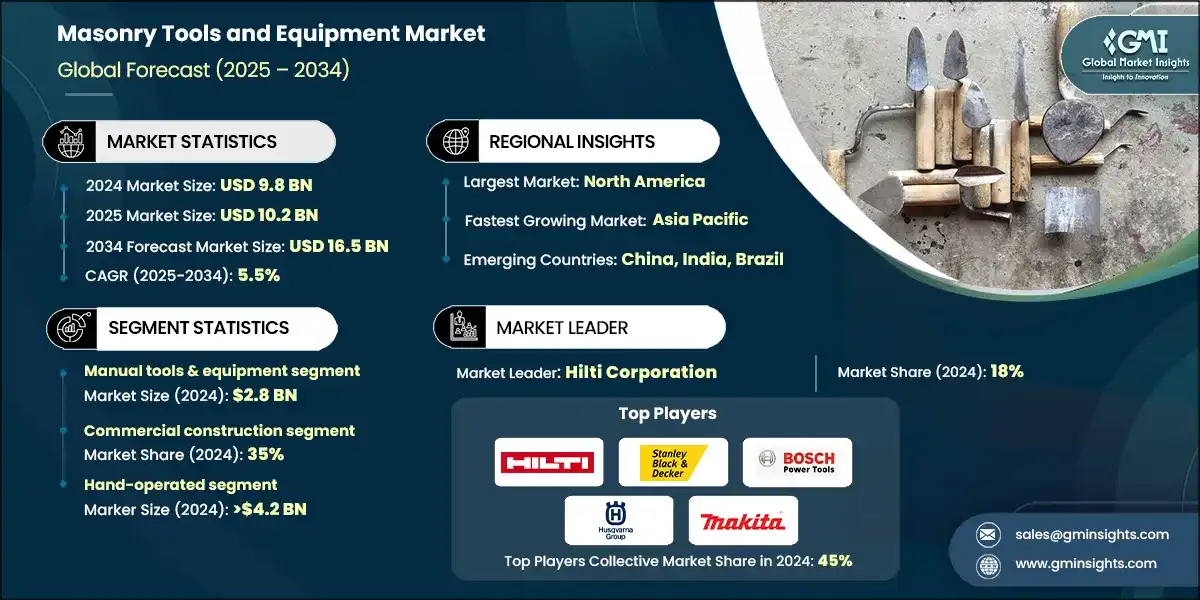
The masonry tools and equipment market was estimated at USD 9.8 billion in 2024. The market is expected to grow from USD 10.2 billion in 2025 to USD 16.5 billion in 2034, at a CAGR of 5.5% according to latest report published by Global Market Insights Inc.
Masonry Tools and Equipment Market Key Takeaways
Market Size & Growth
- 2024 Market Size: USD 9.8 Billion
- 2025 Market Size: USD 10.2 Billion
- 2034 Forecast Market Size: USD 16.5 Billion
- CAGR (2025–2034): 5.5%
Regional Dominance
- Largest Market: North America
- Fastest Growing Region: Asia Pacific
Key Market Drivers
- Expansion of Commercial Construction Activities.
- Shifts Toward Electrification and Automation.
- Rising Safety Standards in Construction.
Challenges
- High Cost of Advanced Equipment.
- Shortage of Skilled Labor for Advanced Tools.
Opportunity
- High Cost of Advanced Equipment.
- Shortage of Skilled Labor for Advanced Tools.
Key Players
- Market Leader: Hilti Corporation led with over 18% market share in 2024.
- Leading Players: Top 5 players in this market include Hilti Corporation, Stanley Black & Decker, Bosch Power Tools, Husqvarna Group, Makita Corporation, which collectively held a market share of 45% in 2024.
Get Market Insights & Growth Opportunities
The masonry tools and equipment market is currently going through a period of transition. The construction industry’s push to be efficient and develop long-lasting infrastructure is largely responsible for this change. The masonry market includes a diversity of hand tools, like trowels, hammers and chisels, as well as power tools and machinery like mixers, cutters and grinders. These hand tools and power tools are the necessary components, for example, most jobs that require laying bricks, cutting stones, mixing mortar and applying the finishing touches to surfaces.
As construction projects become more sophisticated and time sensitive, there is a marked shift towards hand tools and power tools that are easier to use, more precise and safer. This shift towards methodologies that minimize fatigue and improve construction efficiency is gaining traction amongst contractors and masons. Additionally, market change is driven by residential and commercial construction, especially in emerging economies because of population growth and infrastructure development. Sustainability is burgeoning in masonry, as manufacturers are specifically looking for sustainable materials and energy efficient machines.
Innovation and the introduction of new tools is ongoing, with manufacturers focusing on battery-powered tools and dust control techniques and systems to satisfy restrictions placed on safety and the environment. Changes in distribution methods are emerging as well, with non-traditional channels (e.g., e-commerce) and small contractors and DIY users increasingly seeking masonry tools and masonry equipment, which is allowing both small contractors and DIY users a better opportunity to find tools specifically for their needs.
To get key market trends
Masonry Tools and Equipment Market Trends
The masonry tools and equipment industry is in constant evolution, and they are mainly driven by new technologies and evolving user needs.
- Improved Design and Durability: The market for tools is looking for tools that can help shape user comfort and reduce fatigue through lightweight materials and ergonomic handle designs; users are looking for a durable tool made from high carbon steel for a longer lifespan.
- Technology and Automation: The industry incorporates smart sensors in high-end tools to measure performance; further, robotic bricklaying systems and semi-automated equipment provide value in productivity and accuracy while lowering labor costs on construction job sites.
- Sustainability: The way we create masonry tools has been influenced by sustainable construction practices. Many companies have already started to utilize ethical materials and sustainable "production" processes, mostly in Europe/North America, to manufacture masonry tools that support sustainability energy-efficient buildings.
- E-Commerce - The terribly underserved marketplace for masonry tools is shifting aggressively toward an online platform to purchase tools. The sales of tools through the e-commerce channel now comprise most of the Tools sold to professional contractors and DIY consumers in providing more access to products.
- Digital Transformation - Building Information Modeling (BIM) intends to transform masonry construction companies through CAD/Computer-aided manufacturing and assembly. The development of AR applications, the use of 3D printing methods to visualize design in construction, and train workers will further support the transition to computerized technologies relative to construction.
Masonry Tools and Equipment Market Analysis
Learn more about the key segments shaping this market
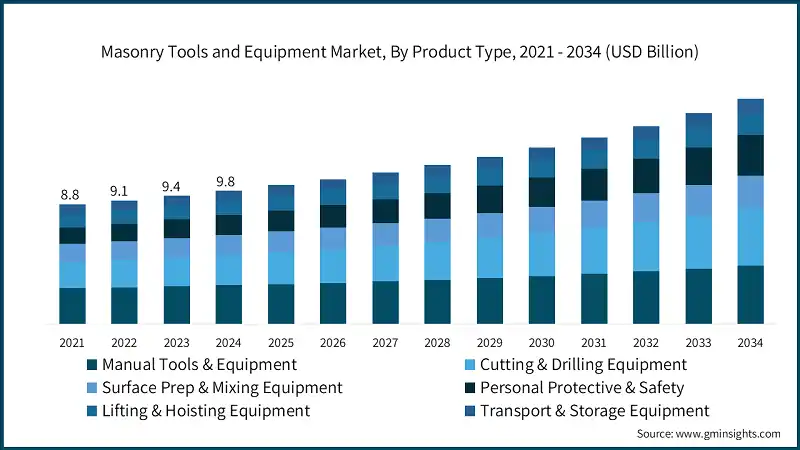
Based on product type, the market is divided into manual tools & equipment, cutting & drilling equipment, surface prep & mixing equipment, personal protective & safety, lifting & hoisting equipment, and transport & storage equipment. The manual tools & equipment generated a revenue of USD 2.8 billion in 2024.
- Manual tools and equipment constitute the largest category in the masonry tool industry. This category consists of the trowels, levels, squares, hammers, chisels, and other hand-operated tools that remain essential to masonry work. Although the adoption of powered equipment has expanded, manual tools continue to be essential for precision work and finishing processes as well as in situations where power tools cannot be used.
- Sales growth in the segment can be attributed to increased construction activity in developing markets where manual tools have price advantages. Manufacturers now define premium tools using carbon fiber and lightweight alloy constructions that improve performance.
- The cutting and drilling equipment segment is a fast-growing category in the masonry tool market. This segment will include diamond blade saws, core drilling machines, specialty cutting systems, or angle grinders for cutting concrete, stone, brick, and blocks. Infrastructure improvements, decorative stone applications, and dust regulations will build sales in cutting and drilling equipment. Improved manufacturing processes in the production of diamond tools and laser-guided cutting will broaden the applications for cutting and drilling equipment.
Learn more about the key segments shaping this market
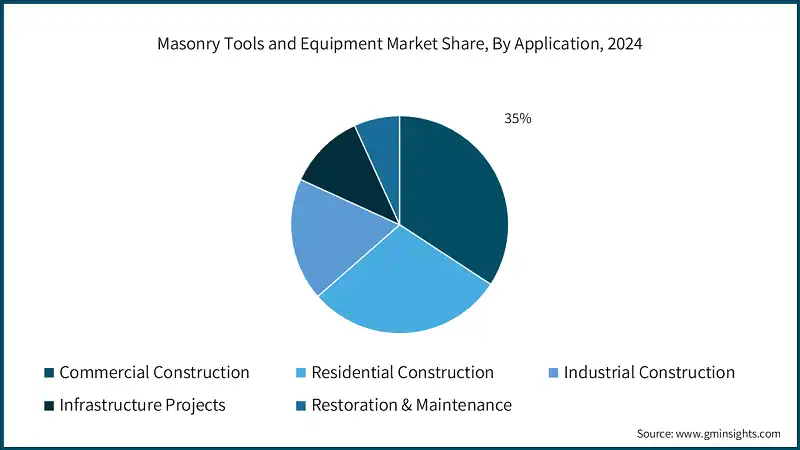
Based on application, the masonry tools and equipment market is segmented into commercial construction, residential construction, industrial construction, infrastructure projects, and restoration & maintenance. The commercial construction segment held around 35% of the global masonry tools and equipment market share in 2024.
- Commercial construction constitutes a large percentage of the masonry tools and equipment sector. This sector includes office construction, retail developments, hospitality projects, and institutional construction. The demand is driven by the need for better productivity and more sophisticated equipment to meet tight project timelines and quality standards and has been boosted along with the increase in commercial real estate developments and heavy retail & hospitality infrastructure expansion across new markets.
- Commercial contractors have shown a readiness to invest in advanced equipment to improve the productivity and outcomes of the project at hand. Large commercial projects mean that specialized equipment, robotic systems, and material handling systems can be utilized. As the complexity of some commercial masonry applications increases, there is a growing need for equipment and tools, including architectural stonework, decorative facades, and fire-rated masonry systems. This complexity also provides a push further to grow the overall equipment and tool sector.
- The residential construction sector does represent a significant portion of the masonry tools and equipment industry. Residential construction would encompass single-family, multi-family, and renovation projects as they relate to brick, stone and block masonry systems. Demand in housing markets overall, increased renovation activity, and reliance on masonry materials in a lot of these scenarios are pushing the market forward in this sector. Demographic factors regarding housing will also create growth in the residential market (household formation, continued urbanization, and overall aging housing stock renovation).
Based on technology, the masonry tools and equipment market is segmented into hand-operated, basic power tools, automated/CNC equipment, and smart/connected tools. The hand-operated segment exceeded USD 4.2 billion in 2024.
- The masonry tools sector consists of three key technology segments: hand-operated tools, basic power tools and smart/connected tools. Hand-operated tools make up the largest segment in the masonry tools sector, including long-standing tools that are dependent on human power. These tools still serve an important function for precision work and finishing work, especially in instances where power tools are not feasible. The stability of this segment is based on the costs associated with these tools in price-conscious markets and the great amount of control they provide for precise work.
- Basic power tools are a large segment of the masonry tools industry and include electric and pneumatic powered tools, which improve productivity compared to manual tools. This segment continues to evolve with more assertive advances in battery systems and durability features. One major trend is the move from corded power to cordless power source.
- Smart/connected tools represent the smallest segment of all three technologies, but with the greatest growth potential. Smart/connected tools are IoT-enabled (internet-of-things) or utilize data analytics and have features such as GPS tracking, predictive maintenance, etc. Growth in this segment is driven by the focus on the optimization of equipment and the integration with a construction technology system.
Looking for region specific data?
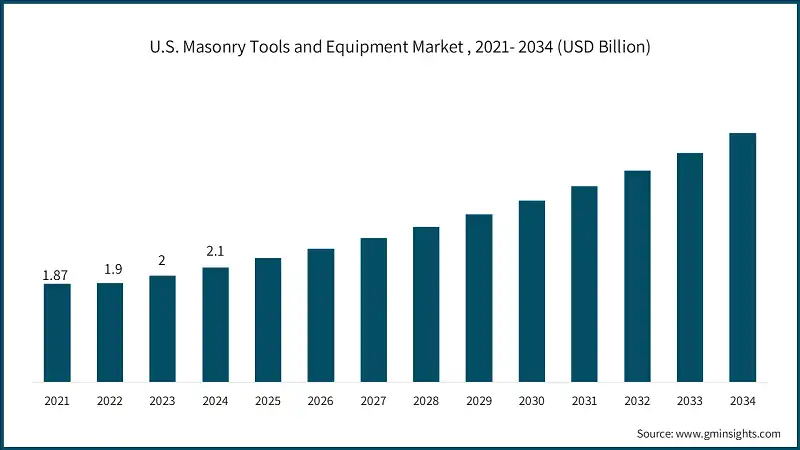
The U.S. masonry tools and equipment market dominated around 80.4% of the market share in 2024, with generating around USD 2.1 billion revenue.
- North America has a sizeable stake in the global market, with the U.S. being the primary source of demand in the region because of infrastructure modernization and commercial construction activities.
- The Bipartisan Infrastructure Law is a significant funding source for construction equipment demand, especially for transportation, utilities, and public infrastructure projects.
- The expansion of data center construction due to growth from AI and cloud computing will also drive additional equipment demand throughout the region.
Europe masonry tools and equipment market, Germany leads the 27.2% share in 2024 and is expected to grow at 5.8% CAGR during the forecast period.
- Europe maintains a significant market share globally, driven by demand for renewable energy infrastructure development, building renovation programs, and infrastructure modernization.
- The region's awareness of energy efficiency and sustainability increases demand for equipment that meets environmental and performance specifications.
- Grid investment programs and renewable energy infrastructure projects will also continue to drive construction equipment demand across utility-scale and distributed energy infrastructure installations.
The Asia Pacific leads the masonry tools and equipment market. China holds a share of around 42.9% in 2024 and is anticipated to grow with a CAGR of 6% from 2025 to 2034.
- The Asia Pacific region is the market leader for masonry tools and equipment globally because of large infrastructure development programs and growing urbanization of the region.
- China constitutes a dominant portion of the Asia Pacific market, further developed through government infrastructure programs and the country's largest construction industry globally.
- The large investments planned in clean energy in China will generate enormous demand for construction equipment in renewable energy developments, grid development, and industrial development.
- As the region of the world with the largest concentration of manufacturing, the area offers cost benefits and improved supply chain efficiencies for local markets.
Masonry Tools and Equipment Market Share
Hilti Corporation is leading with 18% market share. Hilti Corporation, Stanley Black & Decker, Bosch Power Tools, Husqvarna Group, and Makita Corporation collectively hold around 45%, indicating moderately fragmented market concentration. These prominent players are proactively involved in strategic endeavors, such as mergers & acquisitions, facility expansions & collaborations, to expand their product portfolios, extend their reach to a broad customer base, and strengthen their market position.
- Hilti Corporation develops and makes tools, technologies, software, and services for the construction market and remains a solid market presence based on drilling, breaking, and cutting tools, a direct-selling business model, and professional tools and services in masonry.
- Stanley Black & Decker develops hand tools, power tools, and accessories for the global market, and uses brand recognition through Stanley, DeWalt, and Black+Decker, related to a large distribution network, to offer total reinforced masonry solutions.
- Bosch Power Tools supplies construction and industrial power tools for the global market that include rotary hammers, grinders, and demolition hammers that are recognized for precision and toughness in masonry applications and is backed by technical capabilities and invention.
Masonry Tools and Equipment Market Companies
Major players operating in the masonry tools and equipment industry are:
- MARSHALLTOWN Company
- Hilti
- DEWALT (Stanley Black & Decker)
- Makita
- Husqvarna
- Graco
- RUBI
- Bahco
- Bon Tool Company
- Kraft Tool Company
- Trow & Holden Company
- EZG Manufacturing
- Collomix
- Arbortech
- LEVEL5 Tools LLC
Husqvarna Group’s Construction division develops cutting, demolition, and surface prep equipment for heavy-duty projects, including brick and block apt for these major masonry, concrete, and demolition projects to meet performance criteria while ensuring quality in the operation.
Makita Corporation develops, makes, and sells professional power tools, such as rotary hammers, angle grinders, and demolition hammers, with an emphasis on battery technology, as well as cordless tools, for enhanced efficiency and mobility for masonry usage.
Masonry Tools and Equipment Market Report Attributes
| Key Takeaway | Details |
|---|---|
| Market Size & Growth | |
| Base Year | 2024 |
| Market Size in 2024 | USD 9.8 Billion |
| Market Size in 2025 | USD 10.2 Billion |
| Forecast Period 2025 - 2034 CAGR | 5.5% |
| Market Size in 2034 | USD 16.5 Billion |
| Key Market Trends | |
| Drivers | Impact |
| Expansion of Commercial Construction Activities | The global recovery in commercial construction is stimulating demand for masonry tools and equipment. This change can be attributed to urbanization and real estate project development. |
| Shifts Toward Electrification and Automation | The industry is amid a transition from manual tools to electric power and automatic tools. These tools are faster, more accurate and integrate better into a digital workflow in construction. |
| Rising Safety Standards in Construction | Regulations governing site safety are tightening and there is an increased understanding of the risks associated with certain work activities. Consequently, the demand for onsite safe equipment as well as masonry tools that invoke safety is increasing. |
| Pitfalls & Challenges | Impact |
| High Cost of Advanced Equipment | The cost of smart and automated tools continues to be an impediment, particularly for small to medium sized contractors that work in cost-sensitive environments. |
| Shortage of Skilled Labor for Advanced Tools | There needs to be specialized skills developed to effectively employ technologically advanced equipment. The lack of skilled trained personnel is a limiting factor in adoption in many areas. |
| Opportunities: | Impact |
| High Cost of Advanced Equipment | Aging infrastructure in developed economies will generate new demand for more repair and renovation focused tools and generate niche opportunities for tool manufacturers. |
| Shortage of Skilled Labor for Advanced Tools | The effective use of technologically advanced equipment demands specialized skills, and the lack of trained personnel is limiting adoption in several regions. |
| Market Leaders (2024) | |
| Market Leaders |
18% market share |
| Top Players |
Collective market share in 2024 is 45% |
| Competitive Edge |
|
| Regional Insights | |
| Largest market | North America |
| Fastest growing market | Asia Pacific |
| Emerging countries | China, India, Brazil |
| Future outlook |
|
What are the growth opportunities in this market?
Masonry Tools and Equipment Market News
- In September 2024, Quikrete completed its $11.5 billion acquisition of Summit Materials, extending the company's influence in the aggregates and ready-mix concrete industries. This acquisition secures Quikrete's status within the supply chain of construction materials and creates additional relationships with upcoming integrated solutions.
- In August 2024, DeWalt introduced its PowerShift modular battery system for masonry tools, enabling a variety of combinations of the 20V batteries. This new battery system will assist in addressing the runtime limitations of cordless masonry tools for heavy-use applications and supports DeWalt's place in the professional construction equipment market.
- In July 2024, Doosan Bobcat publicly announced a merger with Doosan Robotics to jointly develop integrated construction automation solutions for masonry applications. This latest merger would position Doosan Bobcat well with emerging trends toward automating construction operations in masonry and construction.
- In June 2024, Hilti developed advanced dust management systems for new masonry tools as part of its expanding Nuron cordless platform. This advancement put Hilti in a position to satisfy OSHA standards while addressing construction industry's worker safety compliance.
- In May 2024, EZG Manufacturing opened a new 50,000 square foot facility in Ohio for manufacturing masonry saws. This factory will allow the company to meet the growing demand in North America while increasing the company's capacities.
The masonry tools and equipment market research report includes in-depth coverage of the industry with estimates & forecasts in terms of revenue (USD Billion) and volume (Thousand Units) from 2021 to 2034, for the following segments:
Market, By Product Type
- Manual tools & equipment
- Cutting & drilling equipment
- Surface prep & mixing equipment
- Personal protective & safety
- Lifting & hoisting equipment
- Transport & storage equipment
Market, By Application
- Commercial construction
- Residential construction
- Industrial construction
- Infrastructure projects
- Restoration & maintenance
Market, By End Use
- Masonry contractors
- General contractors
- Specialty trade contractors
- Equipment rental companies
- Educational institutions
- Government agencies
Market, By Technology
- Hand-operated
- Basic power tools
- Automated/CNC equipment
- Smart/connected tools
Market, By Distribution Channel
- Direct sales
- Indirect sales
The above information is provided for the following regions and countries:
- North America
- U.S.
- Canada
- Europe
- Germany
- UK
- France
- Italy
- Spain
- Asia Pacific
- China
- India
- Japan
- Australia
- South Korea
- Latin America
- Brazil
- Mexico
- Argentina
- Middle East and Africa
- South Africa
- Saudi Arabia
- UAE
Frequently Asked Question(FAQ) :
What is the market size of the masonry tools and equipment market in 2024?
The market size was USD 9.8 billion in 2024, with a CAGR of 5.5% expected through 2034 driven by the construction industry's focus on efficiency and durable infrastructure development.
What is the projected value of the masonry tools and equipment market by 2034?
The masonry tools and equipment market is expected to reach USD 16.5 billion by 2034, propelled by expansion of commercial construction activities, shifts toward electrification and automation, and rising safety standards in construction.
What is the current masonry tools and equipment market size in 2025?
The market size is projected to reach USD 10.2 billion in 2025.
How much revenue did the manual tools & equipment segment generate in 2024?
Manual tools & equipment generated USD 2.8 billion in 2024, representing the largest category in the masonry tool industry.
What was the market share of the commercial construction segment in 2024?
Commercial construction held around 35% of the global masonry tools and equipment market share in 2024, driven by office construction, retail developments, hospitality projects, and institutional construction.
What is the valuation of the hand-operated technology segment in 2024?
Hand-operated tools exceeded USD 4.2 billion in 2024, making up the largest segment in the masonry tools sector.
Which region leads the masonry tools and equipment market?
The U.S. masonry tools and equipment market held about 80.4% share in 2024, generating nearly USD 2.1 billion, driven by infrastructure upgrades and commercial construction across North America.
What are the upcoming trends in the masonry tools and equipment market?
Key trends include greater use of IoT-connected tools for efficiency and data-driven decision-making, investment in electric or low emissions equipment, adoption of robotic bricklaying systems, integration of Building Information Modeling (BIM), and expansion of e-commerce distribution channels.
Who are the key players in the masonry tools and equipment market?
Key players include Hilti Corporation, DEWALT (Stanley Black & Decker), Makita, Husqvarna, Graco, RUBI, Bahco, MARSHALLTOWN Company, Bon Tool Company, Kraft Tool Company, Trow & Holden Company, EZG Manufacturing, Collomix, Arbortech, and LEVEL5 Tools LLC.
Masonry Tools and Equipment Market Scope
Related Reports