Summary
Table of Content

Maltodextrin Market
Get a free sample of this report
Form submitted successfully!
Error submitting form. Please try again.
Thank you!
Your inquiry has been received. Our team will reach out to you with the required details via email. To ensure that you don't miss their response, kindly remember to check your spam folder as well!
Request Sectional Data
Thank you!
Your inquiry has been received. Our team will reach out to you with the required details via email. To ensure that you don't miss their response, kindly remember to check your spam folder as well!
Form submitted successfully!
Error submitting form. Please try again.
Maltodextrin Market Size
- The maltodextrin market continues to expand steadily as demand rises across food, beverage, and industrial applications. Its functional versatility including bulking, thickening, texturizing, and acting as a carrier for flavors and nutrients keeps it integral to product formulation. Manufacturers rely on maltodextrin for its neutral taste, ease of digestibility, and ability to enhance mouthfeel, which supports its use in snacks, bakery items, beverages, confectionery, and nutritional products. Growing interest in processed and convenience foods further strengthens its adoption across mainstream and specialty product lines.
- Beyond food applications, maltodextrin’s role is increasing in pharmaceuticals, personal care, and industrial sectors due to its binding, film‑forming, and stabilizing properties. Its compatibility with other ingredients and cost‑effective production makes it a preferred choice for companies optimizing formulation performance. At the same time, the market is experiencing gradual shifts toward cleaner labels and alternative carbohydrate sources, prompting producers to innovate with variants derived from different raw materials and enhanced processing methods.
- Overall, the market remains characterized by consistent demand, ongoing product innovation, and a broadening application base. Manufacturers are balancing functionality, cost efficiency, and evolving consumer expectations, which continues to shape investment, product development, and competitive dynamics within the maltodextrin ecosystem.
The global maltodextrin market was valued at USD 4.1 billion in 2025. It is projected to grow from USD 4.2 billion in 2026 to USD 6.1 billion by 2035, representing 4.3% CAGR from 2026 to 2035, according to latest report published by Global Market Insights Inc.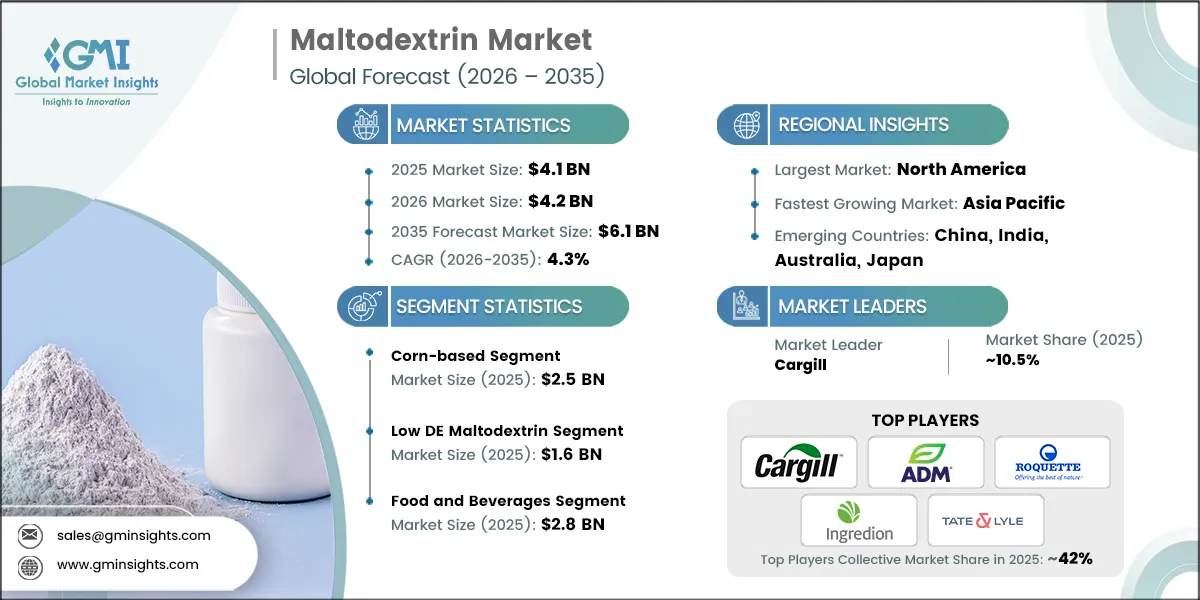
Maltodextrin Market Key Takeaways
Market Size & Growth
- 2025 Market Size: USD 4.1 Billion
- 2026 Market Size: USD 4.2 Billion
- 2035 Forecast Market Size: USD 6.1 Billion
- CAGR (2026–2035): 4.3%
Regional Dominance
- Largest Market: North America
- Fastest Growing Region: Asia Pacific
Key Market Drivers
- Rising demand for processed and convenience foods.
- Expanding applications in nutrition and sports products.
- Versatility in texture, stability, and carrier functions.
Challenges
- Raw material price fluctuations.
- Regulatory scrutiny on additives and processing.
Opportunity
- Development of cleaner‑label and specialty variants.
- Growing demand for value‑added encapsulation and carrier systems.
Key Players
- Market Leader: Cargill led with over 10.5% market share in 2025.
- Leading Players: Top 5 players in this market include Cargill, Ingredion, ADM, Roquette, Tate & Lyle, which collectively held a market share of 42% in 2025.
Get Market Insights & Growth Opportunities
To get key market trends
Maltodextrin Market Trends
- The maltodextrin industry is experiencing steady functional‑driven growth as manufacturers increasingly prioritize ingredients that offer versatility across both food and industrial formulations. A prominent trend is the expanding role of maltodextrin as a clean‑tasting bulking and carrying agent, especially as companies develop products requiring stable texture, improved solubility, and controlled sweetness levels. Its compatibility with a wide range of ingredients keeps it central to reformulation efforts across beverages, snacks, nutritional powders, and confectionery products.
- Another key trend is the shift toward cleaner ingredient labels and more transparent processing methods. While maltodextrin traditionally aligns with mainstream processed formulations, manufacturers are working on variants produced through refined enzymatic hydrolysis and alternative carbohydrate sources to appeal to cleaner‑label product developers. This includes efforts to offer organic, non‑GMO, and allergen‑friendly options that maintain performance while supporting evolving consumer expectations around ingredient origin and processing.
- The market is also witnessing increased innovation focused on improving functionality for specialized applications. Companies are developing tailored maltodextrin grades with optimized dextrose equivalent (DE) values for controlled viscosity, enhanced spray‑drying performance, and better stability in challenging formulations such as high‑protein beverages or nutraceutical powders. This trend reflects rising demand for consistent texture and flow behavior in both food and non‑food applications.
- In addition, the use of maltodextrin is expanding across pharmaceutical, personal care, and industrial segments due to its binding, film‑forming, and moisture‑control properties. As these sectors seek cost‑efficient and multifunctional excipients, maltodextrin is increasingly leveraged for tablet formulation, cosmetic stabilization, and coating applications. This cross‑industry adoption continues to shape the product development strategies of suppliers, driving innovation in production efficiency and ingredient customization.
Maltodextrin Market Analysis
Learn more about the key segments shaping this market
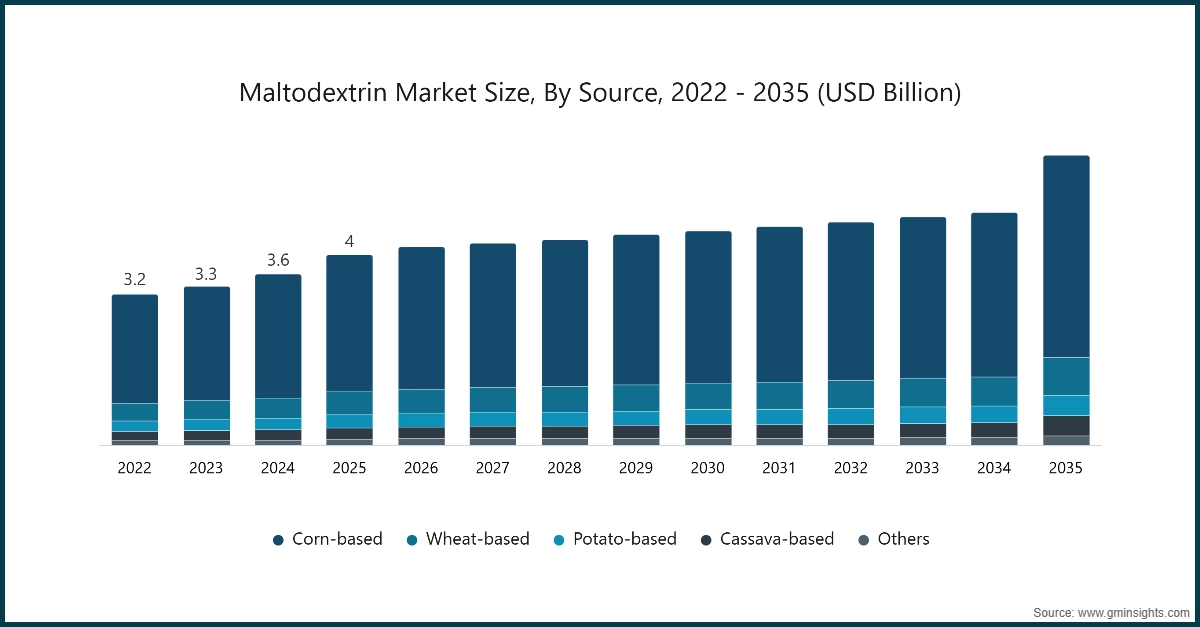
Based on source, the market is segmented into corn-based, wheat-based, potato-based, cassava-based, and others. The corn-based segment was valued at USD 2.5 billion in 2025 and is anticipated to expand to 4% of CAGR during 2026-2035.
- Across source categories, corn-based maltodextrin maintains a strong position due to its reliable functional profile, stable processing behavior, and broad compatibility with diverse formulation needs. It is widely preferred by manufacturers for its consistent texture enhancement, neutral sensory impact, and dependable performance across varying DE levels. Its production framework is mature and efficient, supporting a steady supply flow and predictable quality, which keeps it central to applications in food, beverages, pharmaceuticals, and personal care products. This consistency allows product developers to achieve uniformity in viscosity, solubility, and bulk characteristics across both dry and liquid formulations.
- Meanwhile, wheat-, potato-, cassava-, and other alternative sources continue to serve as complementary options that cater to specific formulation requirements or ingredient philosophies. These variants often attract interest in applications where unique functional attributes, allergen considerations, or processing preferences guide ingredient selection. However, their use generally remains narrower as they tend to offer more specialized benefits rather than broad, cost‑effective versatility. As industries focus on performance reliability and formulation efficiency, corn-based maltodextrin is expected to retain its central role, with other sources contributing targeted benefits that support niche or differentiated product development.
Maltodextrin market based on grade is segmented into food grade, pharmaceutical grade, industrial grade, and others. The food grade segment was valued at USD 2.7 billion in 2025 and is anticipated to expand to 3.8% of CAGR during 2026-2035.
- Across grades, food-grade maltodextrin holds a central role due to its clean taste, reliable functionality, and compliance with stringent food-safety standards. Product developers value its consistent behavior across DE ranges for fine-tuning texture, mouthfeel, solubility, and sweetness modulation in snacks, bakery, beverages, confectionery, and nutritional powders. Its ease of processing and compatibility with flavors, colors, sweeteners, and proteins supports stable formulations and predictable sensory outcomes. The extensive use of food-grade maltodextrin as a bulking agent, carrier, and texturizer reinforces its position in reformulation projects and line extensions targeting performance, cost efficiency, and label clarity.
- Pharmaceutical-grade, industrial-grade, and other specialized grades address distinct needs around purity, performance thresholds, and process robustness. Pharmaceutical-grade maltodextrin is utilized for its excipient qualities including binding, film-forming, and flow improvement supporting solid dosage consistency and stability in nutraceuticals. Industrial-grade variants support applications that prioritize viscosity control, spray-drying performance, adhesion, and moisture management for coatings, personal care, and select technical uses. Together, these grades reflect a market that values tailored functionality, with food grade driving broad adoption while higher-spec and process-focused grades deliver targeted benefits in regulated and performance-critical applications.
Maltodextrin market based on application is segmented into food and beverages, pharmaceuticals, cosmetics and personal care, industrial applications, and others. The food and beverages segment was valued at USD 2.8 billion in 2025 and is anticipated to expand to 3.8% of CAGR during 2026-2035.
- In application terms, the food and beverages segment remains the dominant user of maltodextrin due to its multifunctional role across a wide range of formulations. It is valued for its ability to enhance texture, improve mouthfeel, stabilize ingredients, and act as a reliable carrier for flavors, colors, and sweeteners. Its neutral taste and predictable behavior across different DE levels make it essential in snacks, bakery items, nutritional powders, confectionery, and beverage mixes. As the food industry continues to prioritize formulation efficiency, cost management, and product consistency, maltodextrin remains integral to processes where texture, solubility, and stability directly influence consumer experience.
- Beyond food and beverages, maltodextrin’s adoption in pharmaceuticals, cosmetics, personal care, and industrial applications reflects its versatility in non-food sectors. In pharmaceuticals, it serves as a dependable excipient, supporting tablet binding, controlled disintegration, and flow improvement. Cosmetics and personal care formulations leverage its film-forming, moisture‑control, and smoothening properties, enabling stable creams, powders, and lotions. Industrial applications utilize maltodextrin for its spray‑drying performance, adhesion, and viscosity control, especially in coatings and chemical processes. Together, these segments illustrate a market where food and beverages anchor demand, while specialized technical and functional attributes fuel expanding opportunities across regulated and performance-driven industries.
Learn more about the key segments shaping this market
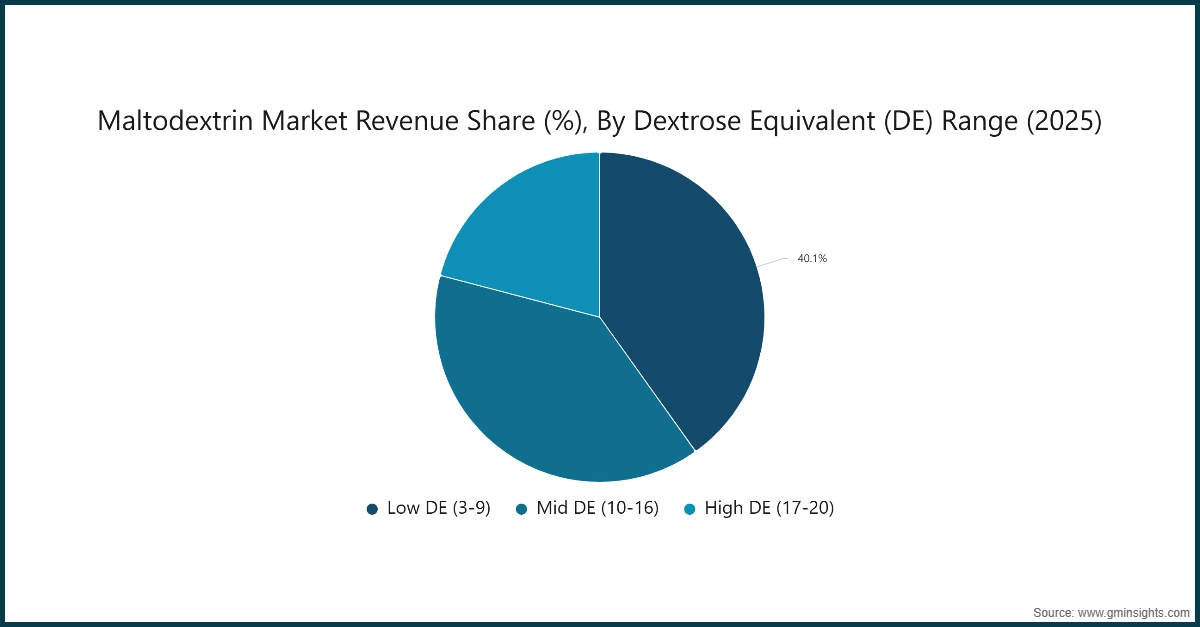
Maltodextrin market based on dextrose equivalent (DE) range is segmented into low DE maltodextrin, mid DE maltodextrin, and high DE maltodextrin. The low DE maltodextrin segment was valued at USD 1.6 billion in 2025 and is anticipated to expand to 3.7% of CAGR during 2026-2035.
- Low DE maltodextrin continues to hold a central role in the DE‑based landscape due to its strong bulk‑forming ability, minimal sweetness, and superior thickening properties. Its stable behavior in both dry and liquid systems makes it a preferred choice for applications that demand controlled viscosity, mild flavor impact, and reliable binding characteristics. Manufacturers rely on low DE grades for their excellent compatibility with proteins, flavors, and sensitive ingredients, supporting wide adoption across nutritional powders, baked goods, and processed food formulations.
- Mid and high DE maltodextrin segments complement this by offering tailored sweetness, solubility, and energy‑release profiles suited for beverages, confectionery, instant mixes, and sports nutrition products. These grades cater to applications requiring faster dissolution, enhanced mouthfeel, or specific carbohydrate functionality. Together, all DE ranges create a balanced portfolio that enables formulators to fine‑tune texture, stability, sensory attributes, and product performance, with low DE varieties forming the backbone of the segment due to their versatile and formulation‑friendly nature.
Looking for region specific data?
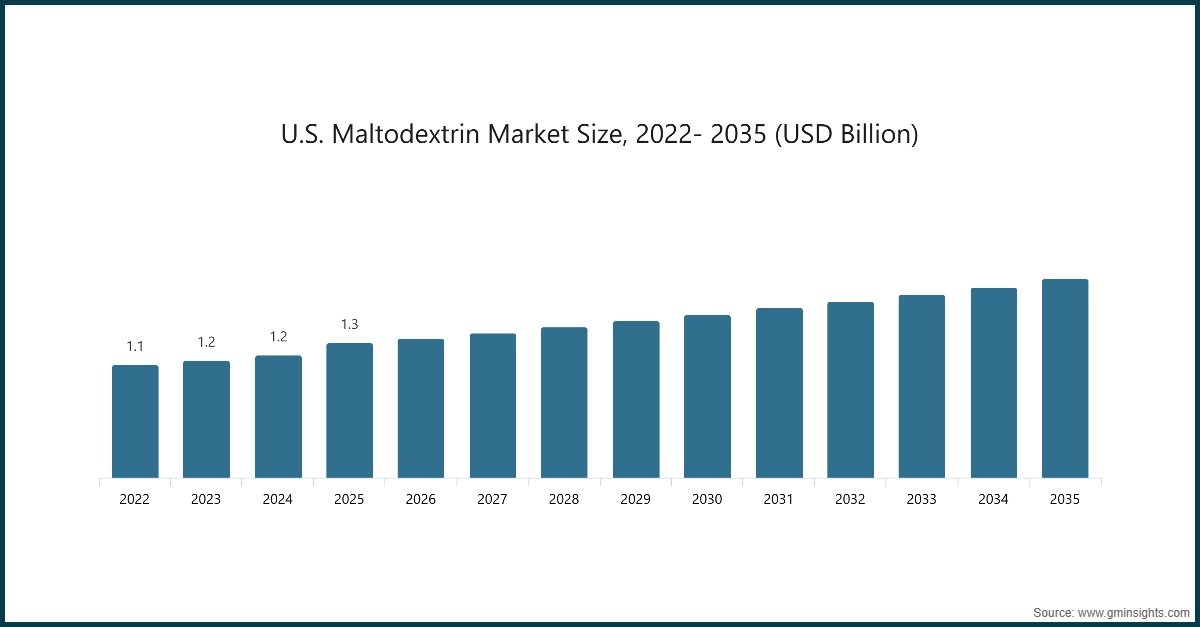
The North America maltodextrin market accounted for USD 1.5 billion in 2025 and is anticipated to show lucrative growth over the forecast period.
North America shows steady demand for maltodextrin driven by strong consumption of processed foods, sports nutrition products, and pharmaceutical formulations. The U.S. in particular is highlighted for its growing use in clean‑label and non‑GMO product development, with manufacturers responding to evolving customer expectations related to ingredient transparency. This region benefits from a mature food processing ecosystem and sustained interest in fast‑digesting carbohydrates for functional foods and performance nutrition, making the U.S. and Canada key contributors to regional adoption.
The Europe market accounted for USD 1.1 billion in 2025 and is anticipated to show lucrative growth over the forecast period.
Europe represents a regulated but stable maltodextrin market, shaped by stringent ingredient standards and strong demand for processed and convenience foods. Countries such as Germany, France, the U.K., Italy, and Spain maintain steady utilization in food, beverage, and nutraceutical applications. Ingredient innovation is influenced by clean‑label trends and the region’s cautious approach to additives, yet its developed consumer market and established food industries continue to support consistent usage across major EU economies.
Asia Pacific maltodextrin market accounted for 27.3% market share in 2025 and is anticipated to show lucrative growth over the forecast period.
Asia Pacific stands out as the highest‑growth regional market supported by expanding food processing industries, rising disposable incomes, and strong demand from pharmaceutical and personal care sectors. China, India, Japan, South Korea, and ASEAN countries are key drivers, with broad adoption fueled by urbanization and preference for packaged, functional, and nutrition‑focused products. The region’s manufacturing expansion, sports nutrition growth, and broader ingredient versatility further amplify its leadership in overall demand growth.
Latin America maltodextrin market is anticipated to grow at a CAGR of 4.3% during the analysis timeframe.
Latin America shows growing interest in maltodextrin as food processing and packaged goods markets expand across countries like Brazil, Argentina, and Mexico (often overlapping with NA in trade influence). Rising consumption of convenience foods and increasing activity in bakery, confectionery, and beverage industries contribute to steady adoption. Industrial and nutraceutical uses are also gaining traction as regional manufacturers enhance formulation efficiency and cost‑effective ingredient sourcing.
Middle East & Africa maltodextrin market is expected to grow at a CAGR of 1.7% during the analysis timeframe.
The MEA region presents a developing yet gradually expanding maltodextrin landscape, supported by a combination of food industry modernization and increased demand for shelf‑stable and processed products. Key markets such as the GCC, Turkey, Israel, South Africa, and North Africa drive uptake, particularly in confectionery, beverages, infant nutrition, and personal care applications. Although growth is slower compared to APAC, the region benefits from rising consumer interest in packaged foods and expanding industrial applications.
Maltodextrin Market Share
- Cargill, Ingredion, ADM, Roquette, and Tate & Lyle are a significant part of the global maltodextrin industry and with further standing of being highly consolidated with the top five players steadily holding 42% market share in the year 2025.
- Competition is driven by the push to enhance processing efficiency, with producers focusing on improving starch hydrolysis, energy use, and yield optimization to strengthen margins in a high‑volume ingredient environment.
- Firms differentiate themselves through diversified sourcing strategies, securing multiple starch origins such as corn, tapioca, wheat, and potato to ensure supply stability and meet varied customer preferences amid raw‑material volatility.
- A key competitive focus is on developing functional variants with specific DE levels, solubility profiles, and stability behaviors, enabling suppliers to target specialized uses in nutrition powders, clinical formulations, and personal care products.
- Clean‑label and specialty variants are becoming important differentiators, as producers invest in non‑GMO, organic, and minimally processed maltodextrin options to align with evolving expectations around ingredient transparency.
- Competition increasingly revolves around value‑added services such as spray‑drying support, encapsulation systems, and customized carrier solutions, which help suppliers secure premium positions beyond commodity offerings.
- Companies with robust, multi‑region manufacturing footprints and flexible logistics networks gain a competitive edge, as buyers prioritize supply assurance and resilience in addition to pricing.
- Many players expand into adjacent starch-derivative portfolios including glucose syrups, dextrins, and polyols to offer bundled solutions that strengthen customer loyalty and reduce switching likelihood.
- Strong regulatory compliance capabilities provide an advantage, as participants must meet diverse global standards across food, pharmaceutical, and personal care applications, making quality systems a core competitive lever.
- Sustainability commitments now influence long‑term competitiveness, with firms differentiating through reductions in water use, energy consumption, and waste, alongside responsible sourcing initiatives that appeal to environmentally conscious buyers.
Maltodextrin Market Companies
The major players operating in maltodextrin industry include:
- Cargill
- Ingredion
- ADM
- Roquette
- Tate & Lyle
- Others
- Cargill plays a major role in shaping the maltodextrin market through its expansive global starch-processing capabilities and strong integration across corn and other carbohydrate supply chains. Its scale allows consistent quality, high‑volume output, and broad application support, making it a key supplier to food, beverage, pharmaceutical, and personal care industries. The company also drives innovation in cleaner‑label and specialty maltodextrin solutions.
- Ingredion contributes significantly to the market by offering a wide portfolio of functional maltodextrin grades tailored for texture enhancement, stability, and carrier applications. Its focus on formulation support, customer collaboration, and alternative starch sources strengthens its position among manufacturers seeking performance optimization and reliable supply across diverse end‑use sectors.
- ADM’s role is anchored in its vertically integrated grain and ingredient operations, enabling steady production and supply of maltodextrin with strong consistency. Its capabilities in starch processing, product customization, and global distribution make it an essential partner for companies needing scalable ingredient solutions with dependable functional performance.
- Roquette is influential in the maltodextrin ecosystem through its deep expertise in plant‑based ingredients and advanced starch technologies. It offers a range of maltodextrin products designed for specialized applications in nutrition, pharmaceuticals, and personal care, with a strong emphasis on quality systems, regulatory compliance, and innovation in functional carbohydrate solutions.
- Tate & Lyle strengthens the market through its focus on functional ingredient innovation and high‑performance carbohydrate solutions. Its maltodextrin offerings support texture, stability, and solubility needs across food and beverage formulations, while its commitment to clean‑label development and technical support positions it as a strategic partner for manufacturers pursuing formulation efficiency and product differentiation.
Maltodextrin Market Report Attributes
| Key Takeaway | Details |
|---|---|
| Market Size & Growth | |
| Base Year | 2025 |
| Market Size in 2025 | USD 4.1 Billion |
| Market Size in 2026 | USD 4.2 Billion |
| Forecast Period 2026-2035 CAGR | 4.3% |
| Market Size in 2035 | USD 6.1 Billion |
| Key Market Trends | |
| Drivers | Impact |
| Rising demand for processed and convenience foods | Boosts consistent, high‑volume usage across mainstream formulations |
| Expanding applications in nutrition and sports products | Strengthens demand for functional carbohydrate solutions |
| Versatility in texture, stability, and carrier functions | Enhances its adoption across diverse product categories |
| Pitfalls & Challenges | Impact |
| Raw material price fluctuations | Creates cost instability for manufacturers and buyers |
| Regulatory scrutiny on additives and processing | Requires continuous compliance and quality upgrades |
| Opportunities: | Impact |
| Development of cleaner‑label and specialty variants | Enables access to premium and health‑focused product segments |
| Growing demand for value‑added encapsulation and carrier systems | Opens pathways for higher‑margin functional applications |
| Market Leaders (2025) | |
| Market Leader |
Market Share Approximately 10.5% |
| Top Players |
Collective Market Share Approximately 42% |
| Competitive Edge |
|
| Regional Insights | |
| Largest Market | North America |
| Fastest growing market | Asia Pacific |
| Emerging countries | China, India, Australia, Japan |
| Future outlook |
|
What are the growth opportunities in this market?
Maltodextrin Industry News
In September 2022, Cargill introduced a soluble corn fiber ingredient commercially next year, and Kemin Industries has introduced Shield Pure, a mold inhibitor that offers bakers a one-to-one replacement for synthetic mold inhibitors. Soluble corn fiber (SCF) is a type of fiber that's made from partially hydrolyzed corn starch.
The maltodextrin market research report includes in-depth coverage of the industry with estimates & forecasts in terms of revenue (USD Billion) & (Kilo Tons) from 2022 to 2035, for the following segments:
Market, By Source
- Corn-based
- Wheat-based
- Potato-based
- Cassava-based
- Others
Market, By Grade
- Food grade
- Pharmaceutical grade
- Industrial grade
Market, By Application
- Food and beverages
- Baked goods
- Confectionery
- Dairy products
- Beverages
- Convenience foods
- Others
- Pharmaceuticals
- Excipient in drug formulations
- Nutritional supplements
- Cosmetics and personal care
- Skincare products
- Haircare products
- Industrial applications
- Adhesives
- Binders
- Coating and encapsulation
- Others
- Animal feed
- Fermentation processes
Market, By Dextrose Equivalent (DE) Range
- Low DE maltodextrin
- Mid DE maltodextrin
- High DE maltodextrin
The above information is provided for the following regions and countries:
- North America
- U.S.
- Canada
- Europe
- UK
- Germany
- France
- Italy
- Spain
- Rest of Europe
- Asia Pacific
- China
- India
- Japan
- South Korea
- Australia
- Rest of Asia Pacific
- Latin America
- Brazil
- Mexico
- Argentina
- Rest of Latin America
- MEA
- UAE
- Saudi Arabia
- South Africa
- Rest of Middle East and Africa
Frequently Asked Question(FAQ) :
What is the market size of the maltodextrin in 2025?
The market size was USD 4.1 billion in 2025, with a CAGR of 4.3% expected through 2035, driven by rising demand for processed and convenience foods.
What is the projected value of the maltodextrin industry by 2035?
The maltodextrin market is expected to reach USD 6.1 billion by 2035, propelled by increasing pharmaceutical and personal care adoption, and ongoing innovation in clean-label.
What is the current maltodextrin industry size in 2026?
The maltodextrin market size is projected to reach USD 4.2 billion in 2026, supported by sustained food processing industry growth.
How much revenue did the corn-based maltodextrin segment generate in 2025?
The corn-based maltodextrin segment was valued at USD 2.5 billion in 2025, growing at a CAGR of 4% through 2035, driven by its reliable functional profile, consistent texture enhancement, neutral sensory impact, and broad compatibility.
What was the valuation of the food grade maltodextrin segment in 2025?
The food grade maltodextrin segment was valued at USD 2.7 billion in 2025, growing at a CAGR of 3.8% through 2035, owing to its consistent performance as a bulking agent, texturizer, and carrier in snacks.
What is the growth outlook for the food and beverages application segment?
The food and beverages segment was valued at USD 2.8 billion in 2025 and is expected to grow at a CAGR of 3.8% through 2035.
Which region leads the maltodextrin market?
North America leads the maltodextrin market with USD 1.5 billion in 2025, driven by strong consumption of processed foods, sports nutrition products, and pharmaceutical formulations.
What are the key trends shaping the maltodextrin market?
Key trends include evelopment of tailored DE-value grades for specialized formulations, expanding use as a pharmaceutical excipient and cosmetic stabilizer, and growing innovation in encapsulation and spray-drying carrier systems across high-margin applications.
Who are the key players in the maltodextrin market?
Key players include Cargill, Ingredion, ADM, Roquette, and Tate & Lyle, which collectively hold approximately 42% of the global maltodextrin market in 2025, competing through processing efficiency, diversified starch sourcing, functional grade innovation, and clean-label product development.
Maltodextrin Market Scope
Related Reports