Summary
Table of Content

Machine Tool Spindle Units Market
Get a free sample of this report
Thank you!
Your inquiry has been received. Our team will reach out to you with the required details via email. To ensure that you don't miss their response, kindly remember to check your spam folder as well!
Form submitted successfully!
Error submitting form. Please try again.
Request Sectional Data
Thank you!
Your inquiry has been received. Our team will reach out to you with the required details via email. To ensure that you don't miss their response, kindly remember to check your spam folder as well!
Form submitted successfully!
Error submitting form. Please try again.
Machine Tool Spindle Units Market Size
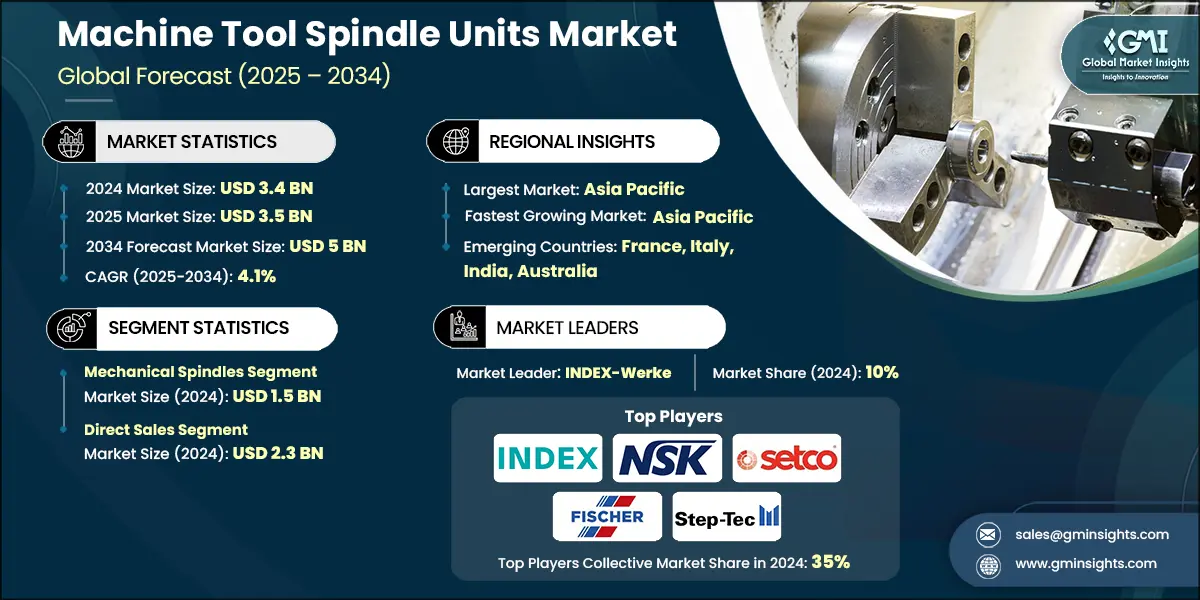
The machine tool spindle units market was estimated at USD 3.4 billion in 2024. The market is expected to grow from USD 3.5 billion in 2025 to USD 5 billion in 2034, at a CAGR of 4.1% according to latest report published by Global Market Insights Inc.
To get key market trends
The rising demand for high-precision machining in industries such as aerospace, automotive, electronics and medical devices is a primary driver of the machine tool spindle market. These industries require parts that are extremely tight tolerances, complex geometries and high-quality surface finish, and as a result of this, manufacturers are developing and investing in advanced spindle technologies that will provide high speeds, low vibration and repeatable torque. Demand is particularly high in applications such as turbine blade manufacturing, EV drivetrain components and microelectronics because production tolerances must be tight such that any deviation at all will jeopardize performance and/or safety.
Machine Tool Spindle Units Market Report Attributes
| Key Takeaway | Details |
|---|---|
| Market Size & Growth | |
| Base Year | 2024 |
| Market Size in 2024 | USD 3.4 Billion |
| Market Size in 2025 | USD 3.5 Billion |
| Forecast Period 2025 - 2034 CAGR | 4.1% |
| Market Size in 2034 | USD 5 Billion |
| Key Market Trends | |
| Drivers | Impact |
| Rising demand for high-precision machining | As the demand for components with very tight tolerances and complex geometries in industries like aerospace, automotive and electronics increases, manufacturers are being forced to consider newer spindle technologies. |
| Technological advancements in spindle design | Development of new spindle technology, such as direct-drive spindles, integrated sensors, and enhanced cooling systems, are changing the game in terms of machining capability. The application of these technologies provides improved thermal stability and efficiency, overall, and supports predictive maintenance strategies that reduce down-time, as well. |
| Demand for energy-efficient and compact solutions | The ongoing emphasis on sustainability and in some cases potential cost containment is influencing spindle development to require less power and footprint while not sacrificing performance. Green, or eco-focused spindle development will help manufacturers comply with worldwide environmental standards while at the same time optimizing costs. |
| Pitfalls & Challenges | Impact |
| High R&D and production costs | The development of advanced spindle systems does require an investment in R&D prototyping and precision engineering which can burden financial resources. |
| Fluctuating raw material costs | Fluctuations in essential materials costs, like steel, aluminum, and ceramic, add ambiguity to cost planning and long-term contracts. Such uncertainty creates margin erosion and triggers frequent pricing changes that impact global competitiveness. |
| Opportunities: | Impact |
| Smart manufacturing & industry 4.0 | Implementing IoT-enabled spindles and real-time monitoring systems in smart factories provide new realms of efficiency and automation. These plans enable predictive maintenance, and significantly reduce downtime, thus enhancing productivity, making these features particularly appealing to manufacturers looking to modernize manufacturing operations. |
| Customization & modular spindle systems | Modular spindle systems, and customization capabilities drastically improve flexibility in manufacturing by allowing end-users to design spindle configurations to meet the distinctive needs of specific machining processes and materials. Flexibility decreases changeover time, maximizes performance, and supports quick changeover plans in a high-mix manufacturing environment. |
| Market Leaders (2024) | |
| Market Leaders |
10% market share |
| Top Players |
Collective market share in 2024 is 35% |
| Competitive Edge |
|
| Regional Insights | |
| Largest market | Asia Pacific |
| Fastest growing market | Asia Pacific |
| Emerging countries | France, Italy, India, Australia |
| Future outlook |
|
What are the growth opportunities in this market?
Furthermore, the tendency for smaller and lighter materials increases the demand for precision. High-precision spindles support multi-axis machining and advanced CNC systems, which are necessary for efficient production of complex parts. The growth of additive-subtractive hybrid manufacturing (where spindles are used to post-process 3D-printed part is also driving this change. The increasing global quality standards from governments and regulatory industries will accelerate the adoption, and subsequent growth, of precision spindles for manufacturers around the world.
Many spindles are designed with technology such as direct drive motors, ceramic bearings, and advanced cooling systems to provide improved performance and reliability. These innovations provide less heat generation, improved energy efficiency, and increased spindle life all important requirements in high-duty cycle operation. Furthermore, spindles can now offer sensor integration and smart diagnostics to offer real-time monitoring of spindle health, predictive maintenance, and reduced unplanned downtime.
Another important progress is the advent of modular and customizable spindle systems. These provide flexibility for manufacturers to custom-configure spindles for specific machine operations and offer shorter setup times. Innovations in materials, for example lightweight alloys and composites also present enhanced thermal stability and reduced inertia, when high speeds are important. As manufacturing continues to become automated and digitized, spindle technologies that support seamless integration with CNC controllers and robotic systems are increasing in value, as spindle innovation will be fundamental to competitive advantage.
Machine Tool Spindle Units Market Trends
The market for machine tools spindle units is evolving with the confluence of automation, precision engineering and digital manufacturing technologies. With the manufacturing industry evolving to require quicker, more accurate, energy efficient machining processes, spindle manufacturers are developing smart, high speed and modular designs. The push toward Industry 4.0, electric vehicles, advancements in aerospace, and miniaturization of electronics are changing what spindles need to be in terms of technology, driving the market towards smart, integrated, and application driven spindle systems.
- Modern spindles are now being outfitted with sensors and other functions which can analyze data in real-time and provide connectivity consistent with Industry 4.0. This will allow for predictive maintenance, remote diagnostics, and performance optimization to reduce downtime and increase productivity and cost efficiency. Manufacturers understand that if they don't adapt, they will be less competitive in production facilities focused on high volume and precision-driven environments.
- Specifically, the machining of complex geometries and advanced materials e.g., composites, titanium, in industries like aerospace, automotive, and electronics has created an increasing demand for spindles that have high rotation speeds and torque stability while also being capable of multi-axis machining. Spindles that support faster cycle times and higher throughput will be essential for machining on next-generation CNC machines and in hybrid manufacturing systems.
- With increasing government regulations and cost constraints, there is more focus on energy-efficient spindle systems in manufacturing. New technologies—such as liquid-cooled spindles, low-friction bearings, and lightweight materials—are increasingly allowing for lower power use and heat generation. These more sustainable designs not only reduce power and costs, but they also align with the numbers of manufacturers around the world looking to meet global ESG (Environmental, Social and Governance) goals.
- The emerging trend toward environmentally responsible design, as well as cost factors, is encouraging suppliers to design and offer spindle systems that are more energy efficient. Innovative efforts related to spindle design include developing liquid-cooled spindles, low-friction bearings, and lightweight materials to reduce power consumption and heat. Sustainable design practices not only lead to reduced operational costs, but they can also support global ESG initiatives, rendering them a strategic priority for manufacturers worldwide.
Machine Tool Spindle Units Market Analysis

Learn more about the key segments shaping this market
Based on product/technology type, the machine tool spindle units market is divided into mechanical spindles, electric/motorized spindles, air-driven spindles, and specialized/hybrid spindles. In 2024, mechanical spindles held the major market share, generating a revenue of USD 1.5 billion.
- Mechanical spindles are popular with shops due to their simplicity and durability with high up-time. Because of the lack of a motor in the spindle itself, mechanical spindles utilize an external drive system which simplifies spindle design. Thus, it is easier and less costly to own than the alternative spindle options, especially for small to mid-sized manufacturers. Their robust construction also lends itself to greater utilization in heavy duty applications, where the demands for torque/rigidity are guaranteed.
- Though mechanical spindles have been dependable, they typically provide lower rotational speeds and accuracy than motorized spindles. The dependence on drives externally to the spindle means that the spindle is not really the mechanism that is controlling the speed, and by having a speed controller, there is some variability in speed. Additionally, there is greater vibration that results in a greater need for maintenance/replacement over time. Thus, mechanical spindles are less suited to high-speed or ultra-precision machining, like in aerospace or electronics. As industries move toward tighter tolerances and fast cycle times, common mechanical spindles may not keep up to standard.
- Mechanical spindles remain an important part of traditional machining environments, especially in lathe machines, milling machines, and manual or semi-automated environments where high-speed performance is less essential. For example, they can be used on various machines and can often be easily retrofitted. They are a popular choice in workshops doing general-purpose machining, repairs, or low production volumes. The long service life and straightforward troubleshooting also are factors that contribute to their enduring presence in the marketplace.
Learn more about the key segments shaping this market
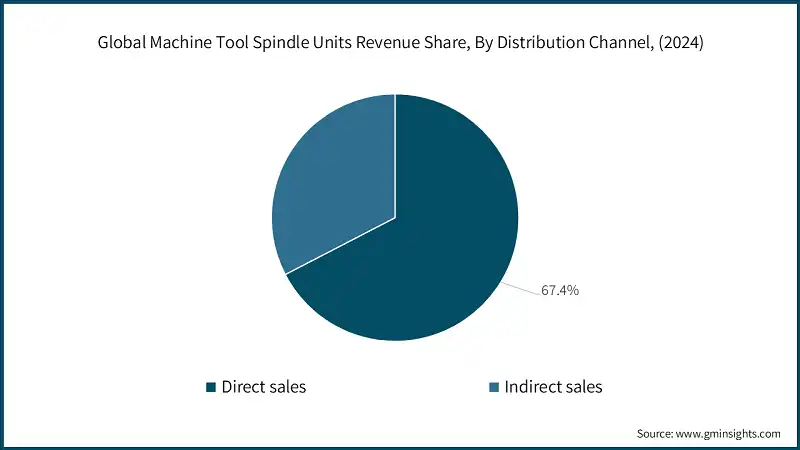
Based on the distribution channel, the machine tool spindle units market is segmented into direct sales and indirect sales. In 2024, direct sales distribution channel held a major market share, generating a revenue of USD 2.3 billion.
- Having a direct sales strategy enables spindle-makers to develop a closer relationship with their customer/end-user and allow for a better understanding of their machining process. This direct relationship also allows for each specific spindle to be customizable, as well as the potential for technical assistance should an issue arise. Direct purchaser engagement allows business owners to also incorporate enhanced feedback loops a necessary part of the customer experience, current generation of spindle users can expect a customized service for each.
- Value-added services allow manufacturers to provide installation assistance, training, and during-and-post sales services, all contribute to customer loyalty and satisfaction post purchase. In these high precision industries, when you are usually dependent upon the distributor sales to develop a mutually agreed relationship, is often desired than a distributorship sales response.
Based on the end use industry, the machine tool spindle units market is segmented into automotive industry, aerospace, medical technology, energy sector, defense industry and general manufacturing.
- High-precision machining is becoming more important in the automotive industry for producing components for electric vehicles (EVs), hybrid systems, lightweight structures, and so forth. Along with expected growth in demand for machine tools spindles recurring factors in the demand of producing battery housing, motor shafts, transmission gears, aluminum body panels, etc. In recent years with the transition toward electrification, and fuel efficiency, spindles producing parts at higher speeds, multi-axis capabilities, with minimized cross talk due to vibration, increased.
- Automotive manufacturing is known for high volume, repetitive production and spindle systems need to provide durability, and compatibility features for automotive automated machining lines. By using the integration of spindle systems with factory smart technologies such as smart tooling and factory automation engineering allows for the ability to monitor wirelessly in real-time, use predictive maintenance techniques, long cycle production timeframes, even enabling spindle changes with little to no down time, to maintain throughput, and quality in automotive plants.
Looking for region specific data?
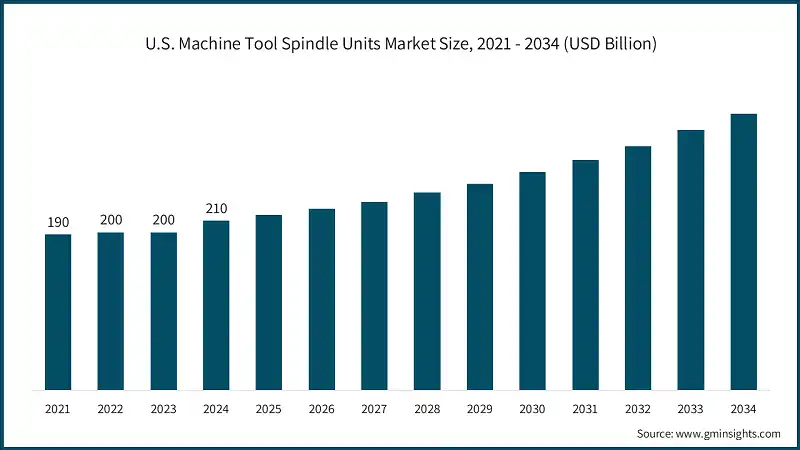
In 2024, the U.S. dominated the North America machine tool spindle units market, accounting for around 78.2% share and generating around USD 210 million revenue in the same year.
- There is growth in the U.S. market, stimulated by revitalized domestic manufacturing and federal initiatives such as the CHIPS Act and the Inflation Reduction Act. These incentives are shifting investments towards semiconductors, electric vehicles, and defense areas that necessitate high-precision machining capabilities. This creates an increased demand for advanced spindles, and especially multi-axis and AI-induced models compatible with CNC. In addition to creating demand for advanced spindles, U.S. manufacturers are implementing hybrid additive-subtractive machining systems manufacturing systems that are significantly reliant on high-performance spindles to enhance productivity and maintain accuracy across a range of complex operations.
- North America is considered an important region, in the global machine tool spindle market, as it is a stable industrial region with technological know-how and established infrastructure. Analysis suggests that the North American market benefits from an established ecosystem of OEMS, automated integration, and precision engineering companies. High-speed spindles and modular spindle systems that support flexible manufacturing are becoming more common. The emergence of smart factories and digital twins also support investments in spindles equipped with integrated sensors for real-time information and measurements.
Europe machine tool spindle units market, UK leads with 12.7% share in 2024 and is expected to grow at 11.3% CAGR during the forecast period.
- A trend towards smart manufacturing and sustainability in Europe is influencing the way spindle technology is adopted. Manufacturers are increasingly integrating energy-efficient spindles with features such as liquid cooling, low-friction bearings, and real-time performance monitoring. These features are in line with EU regulations encouraging green industrial practices and carbon reductions.
- In addition, there is an expanding adoption of modular and customizable spindle systems, allowing OEMs to optimize machining setups for various production applications. The European machine tool spindle market is largely driven by countries such as Germany and Switzerland that lead the world in precision engineering and advanced manufacturing. These nations have a tradition of producing high-quality CNC machines and spindle systems built to the exacting standards of the automotive, aerospace, and medical device industries.
The Asia Pacific leads the machine tool spindle units market; China leads with share of around 22.5% in 2024 and is anticipated to grow with a CAGR of around 8.3% from 2025 to 2034.
- Asia-Pacific's dominance in the machine tool spindle space is primarily due to its rapid manufacturing growth and modernization. Countries like China, India, Japan, and South Korea are investing significant resources to modernize their industrial base, especially in automotive, electronics, and heavy engineering. This growth is fostering a demand for spindles that can hold up to the expectations of high-volume, precision machining. Locally, manufacturers are increasingly embracing CNC technologies and automated production lines which also demand reliable and high-performance spindle systems, thus contributing to demand.
- The region is also quickly adopting new smart manufacturing technologies, such as IoT-enabled spindle technologies, predictive maintenance, and, certainly, multi-axis machining capabilities. This embraces the potential for enhanced operational efficiency, and product quality, and overall improvements with practice for products sent to export markets.
Middle East and Africa machine tool spindle units market is growing steadily during the forecast period.
- Demand for machine tool spindles in the Middle East & Africa region is on the rise, due to development of large-scale infrastructure projects and plans to broaden industrial capabilities beyond oil and gas. Saudi Arabia, the UAE, and South Africa are investing in automotive assembly, aerospace components, and general engineering - industries that utilize precision machining tools. This provides an opportunity for spindle manufacturers to provide strong, low-cost spindle solutions to meet the needs of the growing industries.
- The MEA region is still in relative infancy in terms of automation, than in Asia or Europe. However, there is more interest in technologies that advance "smart manufacturing" with IoT-enabled spindles. Multi-axis machining systems are garnering interest as well. Additive manufacturing, especially in aerospace and medical applications - continues to grow, and in turn generates a demand for spindles for post-processing. Manufacturing firms in the region are starting to develop advanced spindle offerings that enhance uptime, reduce costs per part, and explore technology associated with integration into digitally controlled systems.
Machine Tool Spindle Units Market Share
INDEX-Werke are leading with 10% market share. INDEX-Werke, NSK Nakanishi, Setco Spindle, FISCHER Spindle Technology and Step-Tec collectively hold around 35%, indicating moderately fragmented market concentration. These prominent players are proactively involved in strategic endeavors, such as mergers & acquisitions, facility expansions & collaborations, to expand their product portfolios, extend their reach to a broad customer base, and strengthen their market position.
INDEX-Werke GmbH & Co. KG is a well-known German company focused on manufacturing high-precision turning machines and spindle systems. Notably, they manufacture multi-spindle CNC machines and provide solutions for the automotive, aerospace, and general engineering industries. INDEX aims to stand out in terms of innovation in spindle technology by developing features such as high-speed functionality, thermal stability, adaptability to automated production lines, and more. Their productivity and accuracy-based solutions make them a popular choice among manufacturers seeking reliable and efficient machining systems.
NSK Nakanishi Corporation, which is based in Japan, is known for its ultra-precision spindle systems, especially in dental, medical, and industrial fields. The focus of NSK is within compact, high-speed spindles, which maintain precision for micro-machining and fine finishing. NSK's spindles have many designs which feature advanced bearing technologies and materials to reduce weight, creating a smooth operation with reduced vibration. NSK emphasizes quality, innovation and develops products for industries and applications where precise dependable quality is paramount, namely, in automotive and medical device industries.
Machine Tool Spindle Units Market Companies
Major players operating in the machine tool spindle units industry are:
- Buffoli Industries Group
- Changzhou Hanqi Spindle
- Colombo Filippetti
- EMCO Group
- FISCHER Spindle Technology
- GMN Paul Müller Industrie
- IBAG Spindle Technology
- INDEX-Werke
- Kessler Spindle Systems
- NSK Nakanishi
- Professional Instruments
- Setco Spindle
- Step-Tec
- Takisawa Machine Tools
- Westwind Air Bearings
Kessler Spindle Systems, is a global leader for the design and manufacture of motor spindles for milling, turning, and grinding applications. They have recognized high-performing spindles continuing demanding machining conditions in aerospace, automotive and other markets. Kessler's spindles feature high-performance direct drive, integrated cooling, and sensor-based monitoring for a predictive-maintenance approach in spindle use.
Westwind Air Bearings, part of Novanta, has a long history of developing air-bearing spindle technology, broadly applied to PCB drilling, semiconductor manufacturing, and ultra-precision applications. Air-bearing spindles eliminate any mechanical contact allowing for nearly zero vibration providing exceptional rotational accuracy. The designs offered by Westwind are ideally suited to high-speed applications where surface finish and dimensional accuracy are critical. The company’s focus on innovation and reliability is a testament to the industry’s demanded cutting-edge spindle solutions for micro-machining activities and electronic production.
Machine Tool Spindle Units Market News
- In July 2025, Miele debuted their MasterCool Series III Machine Tool Spindles at IFA. Their top-of-line features include Masterfresh Pro technology, FoodView internal cameras, and a Freeze&Cool drawer adaptable between full freezer use to optional cooling levels. The smart features are app-controlled and offer customers superior flexibility and food preservation.
- In January 2025, Hisense Group revealed its ultra-modern Smart Hub Refrigerator at CES. This unit has AI-powered food tracking capabilities, an associated ConnectLife app, and a unique VersaTemp Zone drawer to create a versatile, smart appliance for today’s kitchen environment.
- In January 2025 at CES, LG Electronics presented its Smart InstaView French Door Refrigerator. This model has a transparent T-OLED screen, an AI-powered internal camera, and support for the ThinQ Food management system. The Smart InstaView model also has support for voice control, personalized meal planning, and remote monitoring capabilities, making this one of the showcase innovations in LG’s range of smart kitchen products.
- In January 2025, GE Appliances released the Profile Smart French Door Refrigerator. It comes with climate-controlled drawers, voice assistant support, and a SmartHQ app for remote temperature monitoring and energy savings.
- In January of 2025, Samsung unveiled the 2025 Family Hub+ 4-Door Flex Refrigerator at CES. It's an impressive offering, which includes several smart features including AI Vision Inside which recognizes foods, larger touchscreen for usability, integration with SmartThings for the smart home infused with convenience, and a FlexZone that can switch refrigerator to freezer based on needs.
- In January of 2025, GE Appliances launched its Profile Smart French Door Refrigerator. It features climate-controlled drawers, so foods are stored at their freshest and, it has voice assistant capabilities and a SmartHQ app to monitor and manage settings remotely, which supports usability and enhances energy efficiencies.
The machine tool spindle units market research report includes in-depth coverage of the industry with estimates & forecasts in terms of revenue (USD Billion) and volume (Thousand Units) from 2021 to 2034, for the following segments:
Market, By Product/Technology Type
- Mechanical spindles
- Electric/motorized spindles
- Air-driven spindles
- Specialized/hybrid spindles
Market, By Technology Performance
- Standard speed spindles (0-8,000 rpm)
- High-speed spindles (8,000-25,000 rpm)
- Ultra-high-speed spindles (25,000-60,000+ rpm)
Market, By Application
- Machining centers (vertical/horizontal)
- Turning machines/lathes
- Grinding machines
- Milling machines
- Gear cutting/finishing machines
Market, By End Use
- Automotive industry
- Aerospace
- Medical technology
- Energy sector
- Defense industry
- General manufacturing
Market, By Distribution Channel
- Direct sales
- Indirect sales
The above information is provided for the following regions and countries:
- North America
- U.S.
- Canada
- Europe
- Germany
- UK
- France
- Italy
- Spain
- Asia Pacific
- China
- India
- Japan
- Australia
- South Korea
- Latin America
- Brazil
- Mexico
- Argentina
- Middle East and Africa
- South Africa
- Saudi Arabia
- UAE
Frequently Asked Question(FAQ) :
What are the upcoming trends in the machine tool spindle units market?
Key trends include integration of IoT-enabled spindles with real-time monitoring and predictive maintenance, adoption of multi-axis CNC machines with high-speed spindles, development of energy-efficient spindle systems with liquid cooling and low-friction bearings, and implementation of modular and customizable spindle systems for flexible manufacturing.
Who are the key players in the machine tool spindle units market?
Key players include INDEX-Werke, NSK Nakanishi, Setco Spindle, FISCHER Spindle Technology, Step-Tec, Buffoli Industries Group, Changzhou Hanqi Spindle, Colombo Filippetti, EMCO Group, GMN Paul Müller Industrie, IBAG Spindle Technology, Kessler Spindle Systems, Professional Instruments, Takisawa Machine Tools, and Westwind Air Bearings.
How much revenue did the mechanical spindles segment generate in 2024?
Mechanical spindles generated USD 1.5 billion in 2024, holding the major market share due to their simplicity, durability, and cost-effectiveness for small to mid-sized manufacturers.
What was the valuation of the direct sales distribution channel in 2024?
Direct sales held the major market share and generated USD 2.3 billion in 2024, enabling closer customer relationships and customization capabilities.
Which region leads the machine tool spindle units market?
The U.S. dominated the North America machine tool spindle units market, accounting for around 78.2% share and generating around USD 210 million revenue in 2024.
What is the current machine tool spindle units market size in 2025?
The market size is projected to reach USD 3.5 billion in 2025.
What is the market size of the machine tool spindle units in 2024?
The market size was USD 3.4 billion in 2024, with a CAGR of 4.1% expected through 2034 driven by rising demand for high-precision machining across aerospace, automotive, electronics, and medical sectors.
What is the projected value of the machine tool spindle units market by 2034?
The machine tool spindle units market is expected to reach USD 5 billion by 2034, propelled by technological advancements in spindle design, demand for energy-efficient solutions, and adoption of smart manufacturing technologies.
Machine Tool Spindle Units Market Scope
Related Reports