Summary
Table of Content

Machine Learning in Logistics Market
Get a free sample of this report
Form submitted successfully!
Error submitting form. Please try again.
Thank you!
Your inquiry has been received. Our team will reach out to you with the required details via email. To ensure that you don't miss their response, kindly remember to check your spam folder as well!
Request Sectional Data
Thank you!
Your inquiry has been received. Our team will reach out to you with the required details via email. To ensure that you don't miss their response, kindly remember to check your spam folder as well!
Form submitted successfully!
Error submitting form. Please try again.
Machine Learning in Logistics Market Size
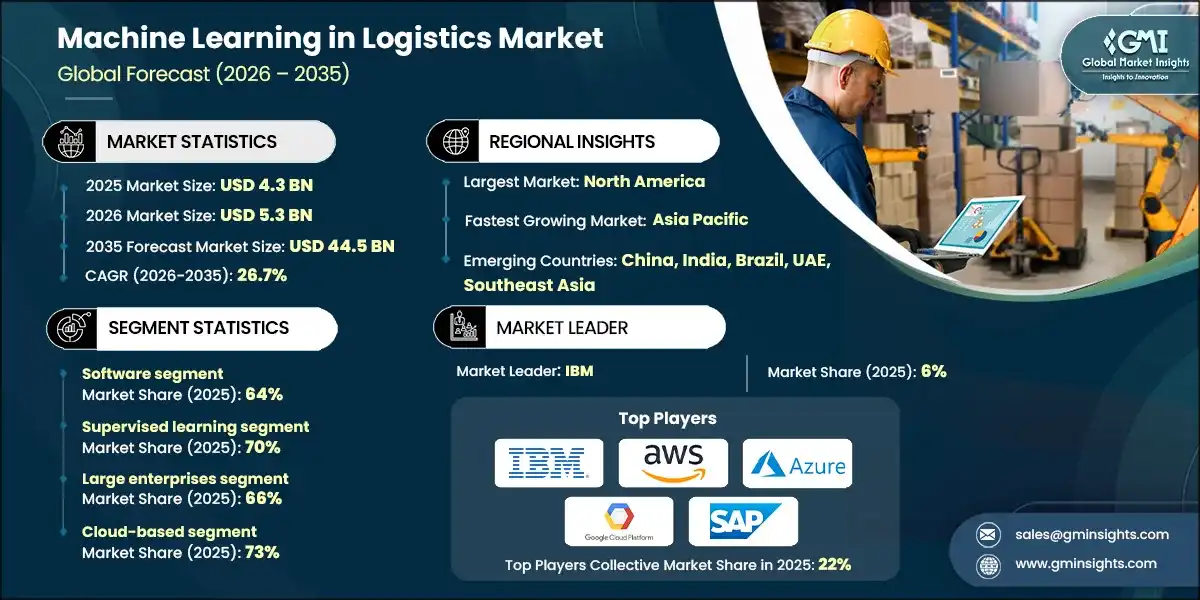
The global machine learning in logistics market size was estimated at USD 4.3 billion in 2025. The market is expected to grow from USD 5.3 billion in 2026 to USD 44.5 billion in 2035, at a CAGR of 26.7% according to latest report published by Global Market Insights Inc.
To get key market trends
Machine learning is reshaping logistics, driving data-centric decisions, predictive insights, and automation throughout the supply chain. E-commerce's meteoric rise, a pressing demand for supply chain efficiency, and swift strides in AI and IoT are propelling this market's remarkable growth.
The total addressable market encompasses multiple dimensions of ML applications in logistics, including demand forecasting, route optimization, warehouse management, inventory optimization, fleet management, and predictive maintenance.
Modern AI algorithms and machine learning boost the adaptability of autonomous mobile robots (AMRs), enabling them to learn from their environments and enhance their performance over time. More than 80% of retailers intend to ramp up AI integration in their operations, aiming to increase their workforce and elevate employee satisfaction.
Modern logistics operations increasingly rely on machine learning-based predictive analytics. Companies that have integrated AI into their supply chain management report cost reductions of 15% and inventory savings reaching as high as 35%.
In 2021, global e-commerce sales peaked at USD 5.2 trillion, with projections set to surpass USD 6.3 trillion by 2024, representing nearly 20% of the total global retail sales. This rapid expansion fuels a heightened demand for quicker, more dependable deliveries and precise estimated time arrivals (ETAs). Furthermore, e-commerce transactions are anticipated to reach over USD 4.3 trillion globally by 2025.
With consumer expectations now set on next-day and same-day deliveries, businesses are turning to ML-powered automation to streamline order processing, picking, and packing. Those who embraced warehouse automation early on boast fulfillment accuracy rates surpassing 99.5%. This technology adeptly manages a surge in smaller, frequent orders, all within tighter delivery windows, something traditional manual processes struggle to achieve efficiently
Machine Learning in Logistics Market Report Attributes
| Key Takeaway | Details |
|---|---|
| Market Size & Growth | |
| Base Year | 2025 |
| Market Size in 2025 | USD 4.3 Billion |
| Market Size in 2026 | USD 5.3 Billion |
| Forecast Period 2026 - 2035 CAGR | 26.7% |
| Market Size in 2035 | USD 44.5 Billion |
| Key Market Trends | |
| Drivers | Impact |
| Increased optimization of supply chain operations | Enables faster, data-driven decisions, reducing operational costs, delays, and inefficiencies across the supply chain. |
| Automation of warehousing operations | Improves picking, packing, and inventory accuracy while reducing labor dependency and processing time. |
| Growth of e-commerce sector | Increase demand for ML-powered route optimization, order forecasting, and real-time delivery management. |
| Rising need for enhanced customer experience | Drives adoption of predictive delivery times, smart tracking, and personalized logistics services. |
| Integration with IoT, real-time tracking, and advanced logistics infrastructure | Enables real-time visibility, predictive analytics, and proactive issue resolution across logistics networks. |
| Pitfalls & Challenges | Impact |
| Data quality and integration concerns | Leads to inaccurate model predictions and unreliable decision-making due to inconsistent, incomplete, or fragmented data sources. |
| Integration with legacy systems | Rising complexities, costs, and timelines hinder seamless ML adoption in logistics IT infrastructure. |
| Opportunities: | Impact |
| Real-time supply-chain visibility & dynamic optimization | Improves decision-making by enabling instant adjustments to routes, inventory, and operations, reducing delays and costs. |
| Predictive analytics & demand forecasting for inventory and supply-chain planning | Enhances inventory accuracy, reduces stockouts and overstocking, and improves overall supply-chain efficiency. |
| Warehouse automation, smart warehousing & robotics integration | Increase operational speed, accuracy, and throughput while lowering labor costs and error rates. |
| Fleet management & predictive maintenance for transport assets | Reduces vehicle downtime, extends asset lifespan, and lowers maintenance and operating costs. |
| Market Leaders (2025) | |
| Market Leaders |
6% Market Share |
| Top Players |
|
| Competitive Edge |
|
| Regional Insights | |
| Largest Market | North America |
| Fastest growing market | Asia Pacific |
| Emerging countries | China, India, Brazil, UAE, Southeast Asia |
| Future outlook |
|
What are the growth opportunities in this market?
Machine Learning in Logistics Market Trends
Machine learning algorithms are spearheading a transformative wave in the logistics industry, particularly in autonomous warehouse systems. Today's warehouse automation is evolving from traditional, capital-heavy setups to adaptable, scalable solutions, prominently featuring Autonomous Mobile Robots (AMRs) and AI-driven orchestration software.
Within months of deploying AMR technology, early adopters have witnessed a 2-3x increase in units picked per hour, halved walking times, and a 50% cut in order cycle times. These systems not only blend effortlessly with current operations but also enhance both tote-to-person and person-to-goods workflows. Furthermore, they offer real-time insights into picking rates and robot utilization.
Amazon's Vulcan robot, a testament to advanced robotics, employs AI-driven tactile sensors to discern and grasp items. This innovation not only boosts adaptability but also facilitates collaboration with humans, significantly minimizing repetitive tasks. Between 2018 and 2022, third-party logistics providers witnessed a surge of over 30% in their adoption of robotics, year-over-year.
ML algorithms boost robot adaptability, enabling them to learn from their environment and enhance their performance over time, thus managing a broader range of tasks. This technology empowers systems to make decisions influenced by environmental conditions, marking a shift from mere automation to true autonomy, driven by the convergence of cloud, 5G, and AI.
Logistics operations are undergoing a transformation, thanks to generative AI. This technology not only offers predictive insights and refines demand forecasting but also optimizes operations. By analyzing vast datasets, generative AI delivers real-time insights, bolstering decision-making, refining route optimization, and boosting supply chain efficiency.
For instance, in February 2024, Maersk teamed up with Microsoft, harnessing generative AI for route optimization and demand forecasting. This partnership led to a 30% reduction in shipping delays and significant fuel efficiency improvements.
Since 2016, the transportation industry has poured around USD 78 billion into IoT, catalyzing the adoption of machine learning-driven tracking and analytics. This fusion of IoT sensors and machine learning is ushering in unparalleled real-time visibility throughout the supply chain.
Edge computing processes IoT data close to its source, ensuring low latency. This capability is vital for real-time decisions in autonomous vehicles and warehouse robotics. A powerful combination of cloud technology, 5G, and AI is driving the transition from mere automation to true autonomy.
Machine Learning in Logistics Market Analysis
Learn more about the key segments shaping this market
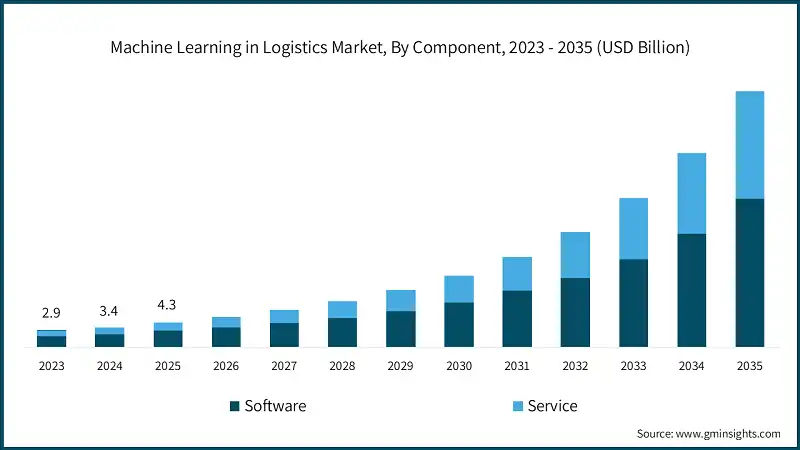
Based on component, the machine learning in logistics market is segmented into software and services. The software segment dominates the market with 64% share in 2025, and the segment is expected to grow at a CAGR of 25.1% from 2026 to 2035.
- Software solutions, including ML algorithms, analytics tools, and integrated platforms, drive demand forecasting, route optimization, inventory management, and predictive maintenance.
- The software segment leads due to ML platforms enabling intelligent logistics by integrating with ERP and WMS systems, ensuring supply chain scalability.
- Microsoft Azure, Amazon Web Services, and Google Cloud Platform, leading cloud providers, have tailored machine learning services specifically for logistics. Notably, Azure Government is spotlighting threat detection as a key focus of its machine learning initiatives.
- The services segment is projected to grow at a 29.3% CAGR, reaching USD 18.8 billion by 2035, driven by the increasing complexity of ML implementations and demand for specialized expertise.
- Services comprise professional services including consulting, system integration, and training, as well as managed services covering ongoing support, monitoring, and optimization.
- Professional services dominate the service segment, projected to grow at a 28.4% CAGR and reach USD 10.4 billion by 2035, driven by demand for consulting on ML use cases and implementation strategies.
- System integration services address the challenge of connecting ML solutions with legacy logistics systems, a critical hurdle given that data is often siloed across multiple platforms requiring 3-6 months of data preparation.
- The managed services segment enables organizations to leverage AI capabilities by providing continuous monitoring, optimization, and maintenance of ML systems.
- Less than 10% of distributors have crafted an AI roadmap and identified key use cases for deployment. In response, companies are turning to managed services, ensuring their models are continuously retrained with fresh data and can swiftly adapt to evolving patterns and trends.
Learn more about the key segments shaping this market
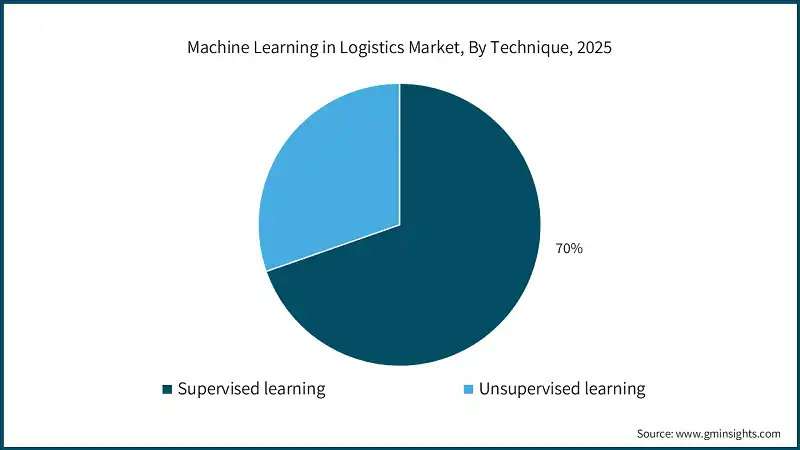
Based on technique, machine learning in logistics market is divided into supervised learning and unsupervised learning. The supervised learning segment dominates with 70% market share in 2025 and is growing at the fastest rate of 25.6% CAGR till 2035.
- Supervised learning algorithms excel at demand forecasting, route optimization, and predictive maintenance applications where historical labeled data is available for training.
- These techniques include regression analysis, decision trees, neural networks, and ensemble methods that identify patterns in historical data to predict future outcomes.
- Supervised learning drives logistics use cases by leveraging historical data. Demand forecasting systems improve accuracy by 8-10% over traditional methods through advanced analysis of sales, trends, and real-time factors.
- Gradient boosting techniques excel at demand forecasting, handling messy data while requiring 50-70% less data preparation than deep learning approaches.
- Hybrid ensemble methods, which combine multiple algorithms, can reduce errors by as much as 18%. Meanwhile, LSTM (Long Short-Term Memory) networks excel at capturing seasonal patterns and long-term dependencies in demand data.
- The unsupervised learning segment is experiencing accelerated growth at 29.1% CAGR, projected to reach USD 16 billion by 2035.
- Unsupervised learning techniques, such as clustering, anomaly detection, and association rule learning, tackle applications where acquiring labeled training data is either unfeasible or impractical.
- In various logistics domains, unsupervised learning is gaining traction. By employing clustering algorithms, businesses can segment customers, products, and locations, paving the way for more precise forecasting strategies.
- Anomaly detection systems identify supply chain disruptions and security threats in real-time. Association rule learning uncovers product relationships, aiding warehouse optimization and cross-selling.
- Unsupervised learning is gaining traction for applications like fraud detection, real-time risk assessment, and automated quality control. Companies use it to analyze transaction data and detect anomalies to prevent chargebacks.
- Unsupervised learning in computer vision achieves 99% defect detection accuracy in production line inspections. Emerging trends include semi-supervised and reinforcement learning for autonomous vehicles and warehouse robots.
Based on organization size, the machine learning in logistics market market is segmented into large enterprises and small and medium-sized enterprises (SMEs). The large enterprises segment dominates with 66% market share in 2025.
- Organization size segmentation reveals distinct adoption patterns, with large enterprises dominating current market value while small and medium-sized enterprises demonstrate accelerated growth potential.
- Large organizations possess the financial resources, technical expertise, and data infrastructure necessary for comprehensive ML implementations across global logistics operations.
- Advanced analytics and machine learning empower large enterprises to forecast demand, streamline routes, and pinpoint potential supply chain challenges, resulting in enhanced decision-making and operational efficiency.
- Leveraging ML capabilities, they optimize inventory across multiple echelons, balancing stock throughout distribution networks. This enables real-time stock level analysis and automatic transfers, culminating in a 35% reduction in inventory.
- Major logistics providers are leveraging digital twin technology, boosting their warehouse capacity by 10% and reaping the benefits of economies of scale in ML deployment.
- The SME segment is projected to grow at a 29.5% CAGR, reaching USD 18.1 billion by 2035, driven by cloud-based AI platforms that reduce upfront capital requirements.
- SMEs are increasingly adopting ML solutions to remain competitive, with over 95% of distributors exploring AI use cases.
- Cloud-based deployment models particularly benefit SMEs, offering pay-as-you-go pricing that makes ML accessible without massive infrastructure investments.
- Managed services models help SMEs utilize AI capabilities without requiring in-house expertise, addressing the fact that only 30% of organizations can scale AI efforts effectively.
- SMEs gain significantly from ML applications, with a 30% boost in demand forecasting reducing stockouts and excess inventory, while route optimization lowers transportation costs by 10-25% and fuel usage.
- Predictive maintenance reduces vehicle downtime by up to 50%, helping SMEs optimize asset use. Advancements in cloud-based ML platforms are expected to drive SME adoption, nearing parity with large enterprises by the early 2030s.
Based on deployment model, the machine learning in logistics market is divided into cloud-based and on-premises. The cloud-based dominate with 73% market share in 2025, and with a CAGR of 27.4% during forecast period.
- Cloud-based deployments are expected to reach USD 33.9 billion by 2035, driven by scalability, flexibility, reduced costs, and access to advanced ML capabilities without infrastructure maintenance.
- Cloud platforms allow businesses to roll out machine learning solutions in just weeks, a stark contrast to the six-month timelines typical of traditional fixed automation.
- Major cloud providers have developed specialized ML services for logistics. Microsoft Azure offers AI-driven logistics platforms with enhanced threat detection through machine learning.
- Amazon Web Services utilizes its logistics expertise to deliver ML tools for supply chain applications, while Google Cloud Platform simplifies model development with ML APIs and AutoML features.
- On-premises solutions remain relevant for organizations with stringent data, sovereignty requirements, regulatory constraints, or existing substantial IT infrastructure investments.
- Industries including defense, government, and certain healthcare segments prefer on-premises deployment to maintain complete control over sensitive operational and customer data.
- On-premises ML deployments require higher upfront costs and longer implementation but provide full data control, customization, and offline functionality.
- Organizations are adopting hybrid models, keeping sensitive data on-premises while using cloud platforms for scalable computing and advanced analytics. The integration of edge computing enables low-latency processing locally, synchronized with cloud systems.
Looking for region specific data?
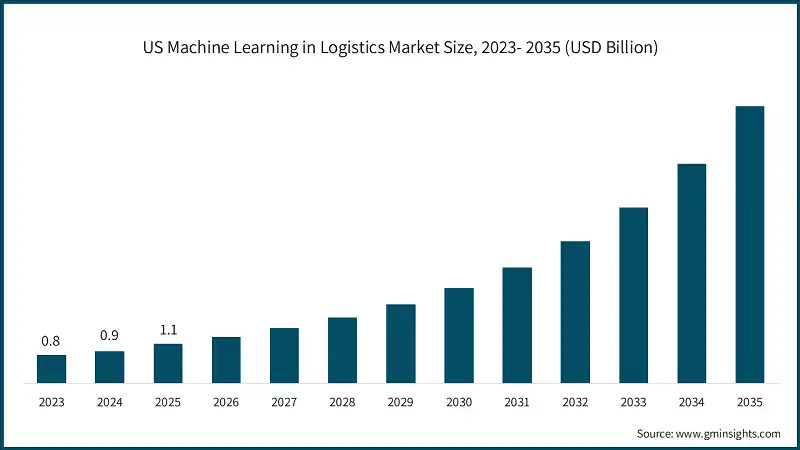
North America region dominated the machine learning in logistics market with a market share of 32%, which is anticipated to grow at a CAGR of 22.4% through 2035. North America's leadership stems from widespread acceptance of AI-driven logistics solutions, advanced technology infrastructure, and concentration of leading technology companies.
- North America dominates the machine learning in logistics market, driven by e-commerce growth, advanced digital infrastructure, and strong supply chain investments.
- Global tech giants like Amazon, Microsoft, Google, and IBM underscore the market's maturity, establishing significant operations in the region. These leaders are at the forefront, consistently innovating and rolling out cutting-edge ML platforms tailored for logistics, warehousing, and transportation enhancements.
- Amazon is leading the charge in logistics by embedding machine learning into warehouse robotics, inventory forecasting, and optimizing last-mile deliveries. This move not only speeds up automation but also enhances real-time decision-making throughout its supply chain.
- In 2024, North America claimed a significant 39% share of global AI in supply chain market, underscoring its leadership in adopting and commercially deploying machine learning in logistics.
- Enterprises are accelerating ML adoption, focusing on predictive analytics, digital twins, and automation to enhance resilience and meet customer demands.
- Bolstered by robust digital infrastructure and active cross-border trade, Canada is steadily increasing its stake in North America's market, which is set to expand at a 24.5% CAGR from 2026 to 2035.
The machine learning in logistics market in US is expected to experience significant and promising growth from 2026 to 2035.
- The US leads the North American Machine Learning in Logistics market due to its advanced digital infrastructure and early adoption of AI-driven supply chain technologies.
- Backed by a robust ecosystem of cloud service providers, AI startups, and system integrators, technology leaders and logistics giants are harnessing ML for warehousing, transportation, and last-mile delivery.
- Federal and industry regulations on data security, cybersecurity, and AI governance are steering the logistics sector towards a responsible embrace of machine learning (ML). This push is catalyzing investments in platforms that prioritize security, compliance, and scalability.
- Federal and industry regulations on data security, cybersecurity, and AI governance are steering the logistics sector towards responsible machine learning adoption, spurring investments in secure, compliant, and scalable platforms.
- In the US, robust R&D capabilities, venture funding, and collaborations among tech providers, logistics firms, and academic institutions drive the swift commercialization of ML solutions, fostering ongoing innovation and widespread enterprise adoption.
- Enterprises are leveraging intelligent automation to boost service reliability, while e-commerce operators, 3PLs, and fleet providers adopt ML-powered platforms to meet rising demands for speed and accuracy.
Asia Pacific is the fastest growing machine learning in logistics market, which is anticipated to grow at a CAGR of 31.3% during the analysis timeframe.
- Rapid e-commerce growth, significant investments in digital infrastructure, and swift modernization of manufacturing and logistics are propelling Asia Pacific to the forefront as the fastest-growing regional market for machine learning in logistics.
- China dominates the Asia-Pacific market, supported by strong government backing for AI and digital technologies under initiatives such as Made in China 2025.
- Chinese logistics giants are rapidly embracing machine learning. For instance, Alibaba Cloud's EasyDispatch harnesses AI to enhance routing, fulfillment, and last-mile delivery. Moreover, these platforms are broadening their reach into Southeast Asian logistics corridors.
- India is emerging as a high-growth market, driven by rising e-commerce penetration, Digital India initiatives, and increased adoption of affordable cloud-based ML tools for forecasting, routing, and warehouse automation.
- Japan and South Korea lead in AI adoption, leveraging automated manufacturing, strong automotive and electronics industries, and advanced supply-chain technologies.
- Southeast Asia, led by countries like Singapore, Malaysia, and Vietnam, is witnessing rapid growth driven by digital infrastructure upgrades, foreign logistics investments, and expanding e-commerce networks.
The China is fastest growing country in Asia Pacific machine learning in logistics market growing with a CAGR of 29.7% from 2026 to 2035.
- China's Machine Learning (ML) in Logistics market is rapidly growing, driven by rising e-commerce volumes, advanced digital infrastructure, and demand for intelligent supply-chain solutions.
- Through initiatives like "Made in China 2025" and the "New Generation Artificial Intelligence Development Plan," government policies are driving the adoption of AI and digital technologies, bolstering enterprise AI integration and modernizing logistics.
- China's advanced logistics and digital infrastructure include smart warehouses, automated ports, high-speed rail freight, and urban delivery systems, enabling real-time data collection and machine learning.
- Major players in e-commerce and logistics, including Alibaba, JD.com, Cainiao, and SF Express, are scaling up their use of machine learning for tasks like route optimization, warehouse robotics, demand forecasting, and automating last-mile deliveries.
- Backed by robust government support and a thriving tech ecosystem, China is at the forefront of the Asia-Pacific market, driven by a surging demand for smart, automated, and resilient logistics solutions.
Europe machine learning in logistics market accounted for USD 1.2 billion in 2025 and is anticipated to show growth of 24.4% CAGR over the forecast period.
- The machine learning in logistics market in Europe is growing steadily, driven by industrial output, cross-border trade, and digital supply chain transformation. Key markets include Germany, the Netherlands, France, and the UK.
- Germany leads the European market, driven by its strong industrial base, automated warehouses, and early adoption of AI in supply-chain optimization.
- Southern Europe is witnessing increased adoption of machine learning in logistics, driven by e-commerce growth, port modernization, and urban delivery challenges.
- The UK is swiftly adopting AI and analytics in logistics, driven by strong data governance, high cloud adoption, and government-backed digital innovation programs.
- European regulations, such as GDPR and AI governance frameworks, are fostering responsible AI adoption, bolstering enterprise confidence in secure and compliant machine learning deployments.
- Collaborations among technology providers, logistics operators, and e-commerce companies are driving ML-powered platform adoption, strengthening connectivity and supply-chain resilience in hubs like the Netherlands and Scandinavia.
Germany dominates the Europe machine learning in logistics market, showcasing strong growth potential, with a CAGR of 21.1% from 2026 to 2035.
- Technology providers and logistics firms in Germany, specializing in AI algorithms, predictive analytics, and cloud platforms, are driving innovation in the country's logistics market through machine learning.
- Government initiatives, such as Industry 4.0 programs and digital transformation incentives, are driving the adoption of ML solutions in manufacturing, warehousing, and transportation.
- German technology and logistics firms are leveraging ML models, IoT, and automation to enable predictive maintenance, dynamic routing, and smart inventory management.
- Leading providers are developing scalable, modular, and highly interoperable ML platforms, reinforcing Germany’s position as a key hub for AI-driven logistics innovation in Europe.
- For instance, in October 2025, DHL unveiled its new Europe Innovation Center, covering 5,360 m², dedicated to pioneering AI, robotics, IoT, and sustainable logistics solutions.
Brazil leads the Latin American machine learning in logistics market, exhibiting remarkable growth of 26.3% during the forecast period of 2026 to 2035.
- Major Brazilian cities like São Paulo, Rio de Janeiro, and Brasília are rapidly adopting Machine Learning in logistics, driven by growing e-commerce and demand for efficient supply chain operations.
- Government initiatives are driving adoption through investments in digital infrastructure, AI programs, and innovation-focused policies.
- In Brazil, logistics firms, tech providers, and e-commerce players are teaming up with global leaders in machine learning and cloud platforms. Their goal To roll out customized solutions spanning predictive analytics, warehouse automation, route optimization, and last-mile delivery.
- With the expansion of digital infrastructure, IoT networks, and cloud-based platforms, logistics systems powered by machine learning are gaining traction and scalability in supply-chain operations nationwide, spanning retail, industrial, and institutional sectors.
UAE to experience substantial growth in the Middle East and Africa machine learning in logistics market in 2025.
- Government initiatives in Dubai, Abu Dhabi, and Sharjah are accelerating the UAE's market, focusing on smart supply chains, digital transformation, and operational efficiency.
- With government funding and smart city initiatives leading the charge, investments in logistics infrastructure are increasingly favoring ML-driven platforms. These platforms are being harnessed for predictive analytics, route optimization, warehouse automation, and real-time fleet management.
- In UAE, cloud and AI firms, along with global and regional technology providers, are introducing scalable, data-driven ML logistics solutions. These solutions are specifically designed for e-commerce, industrial, and urban distribution networks.
- The UAE leverages modular ML platforms, IoT, and automation tools to enhance supply chain efficiency and resilience, solidifying its role as a regional hub for intelligent logistics.
- GCC nations are witnessing a surge in the adoption of ML-powered logistics solutions, thanks to supportive regulations, government incentives, and initiatives aimed at bolstering digital infrastructure. These advancements are steering supply-chain operations towards greater cost-efficiency, sustainability, and agility.
Machine Learning in Logistics Market Share
The top 7 companies in the machine learning in logistics industry are IBM, Amazon Web Services (AWS), Microsoft Azure, Google Cloud Platform (GCP), SAP SE, Manhattan Associates, and Blue Yonder contributed around 27% of the market in 2025.
- IBM Corporation, harnessing its Watson AI platform and a vast array of enterprise software, takes the lead in the market. With a focus on logistics, IBM's solutions employ machine learning to enhance supply chain optimization, forecast demand, and enable predictive maintenance.
- Amazon Web Services (AWS), leveraging Amazon's logistics expertise and scalable cloud platform, ranks second in the market. It offers machine learning tools like Amazon Forecast for demand prediction and Amazon SageMaker for custom model development.
- Microsoft Corporation (Azure) is competing aggressively through Azure Machine Learning services and strategic enterprise relationships. Microsoft's collaboration with Maersk in February 2024 to adopt generative AI for route optimization and demand forecasting resulted in a 30% decrease in shipping delays and considerable fuel efficiency gains.
- Google Cloud Platform (GCP) stands out with its advanced AI/ML capabilities and intuitive AutoML tools, streamlining model development. GCP's TensorFlow framework, a popular choice for ML research and development, lays the groundwork for logistics applications.
- SAP SE leverages its ERP software expertise to integrate machine learning (ML) into logistics systems, using its S/4HANA platform and Intelligent Technologies group for seamless adoption.
- Manhattan Associates, a leader in warehouse management and supply chain execution software, integrates machine learning into its offerings. The company is dedicated to delivering AI-driven solutions that enhance warehouse optimization, streamline order management, and refine transportation execution.
- Blue Yonder, formerly JDA Software, provides end-to-end supply chain solutions using advanced machine learning for demand forecasting and inventory optimization. Its Luminate platform integrates AI technologies to deliver prescriptive analytics for optimal decision-making.
Machine Learning in Logistics Market Companies
Major players operating in the machine learning in logistics industry are:
- Amazon Web Services (AWS)
- Blue Yonder
- DHL Supply Chain
- FedEx Corporation
- Google Cloud Platform (GCP)
- IBM
- Manhattan Associates
- Microsoft Azure
- Oracle
- SAP SE
- IBM, Amazon Web Services, and Microsoft Corporation hold over 15% of the ML in Logistics market. These companies focus on advanced technologies, strategic partnerships, and digital solutions to enhance supply chain visibility, data analytics, and automation. They aim to deliver efficient end-to-end supply chain management while expanding globally through acquisitions and partnerships to offer comprehensive logistics solutions across regions and industries.
- Key players are focusing on sustainability and resilience to stay competitive. They are adopting green logistics practices, such as optimizing transportation routes and using energy-efficient warehousing, to meet regulations and attract eco-conscious customers. Additionally, agile and flexible supply chain strategies are being developed to mitigate risks and ensure reliability amidst disruptions.
Machine Learning in Logistics Industry News
- In May 2024, Oracle and Kuehne+Nagel announced a strategic partnership aimed at leveraging AI technologies to innovate and optimize supply chain and logistics management processes. The collaboration focuses on integrating Oracle’s advanced AI capabilities with Kuehne + Nagel’s extensive logistics expertise to enhance operational efficiency and deliver value-added solutions to their customers.
- In April 2024, Flexport unveiled an AI-driven logistics platform that optimizes shipment routes and anticipates supply chain disruptions. This move underscores the growing trend of leveraging predictive analytics for proactive logistics oversight. By harnessing real-time data from diverse sources, the platform delivers actionable insights.
- In September 2024, Amazon unveiled a substantial investment of around USD 10.7 billion, aimed at bolstering its cloud and logistics operations in Germany. This move not only underscores Amazon's dedication to machine learning-driven logistics automation but also sees the company integrating cutting-edge robotics and AI systems to streamline and enhance warehouse tasks.
- In October 2025, Element Logic's analysis on warehouse automation trends highlights a pivotal shift. The integration of AI, robotics, IoT, and data analytics is steering the industry away from traditional fixed automation, ushering in a new era of adaptable, ML-driven systems.
The machine learning in logistics market research report includes in-depth coverage of the industry with estimates & forecasts in terms of revenue (USD Bn) from 2022 to 2035, for the following segments:
Market, By Component
- Software
- Services
- Managed
- Professional
Market, By Technique
- Supervised learning
- Unsupervised learning
Market, By Organization Size
- Large enterprises
- Small and medium-sized enterprises (SMEs)
Market, By Deployment Model
- Cloud-based
- On-premises
Market, By Application
- Inventory management
- Supply chain planning
- Transportation management
- Warehouse management
- Fleet management
- Risk management and security
- Others
Market, By End Use
- Retail and e-commerce
- Manufacturing
- Healthcare
- Automotive
- Food & beverage
- Consumer goods
- Others
The above information is provided for the following regions and countries:
- North America
- US
- Canada
- Europe
- Germany
- UK
- France
- Italy
- Spain
- Russia
- Nordics
- Benelux
- Asia Pacific
- China
- India
- Japan
- Australia
- South Korea
- Singapore
- Thailand
- Indonesia
- Vietnam
- Latin America
- Brazil
- Mexico
- Argentina
- Colombia
- MEA
- South Africa
- Saudi Arabia
- UAE
Frequently Asked Question(FAQ) :
Who are the key players in the machine learning in logistics industry?
Key players include Amazon Web Services (AWS), Blue Yonder, DHL Supply Chain, FedEx Corporation, Google Cloud Platform (GCP), IBM, Manhattan Associates, Microsoft Azure, Oracle, and SAP SE.
Which region leads the machine learning in logistics sector?
North America leads the market with a 32% share in 2025 and is anticipated to observe around 22.4% CAGR through 2035.
What are the upcoming trends in the machine learning in logistics market?
Key trends include the adoption of AMRs, AI-driven orchestration, generative AI for predictive insights, IoT-based real-time tracking, edge computing for low-latency decisions, and the convergence of cloud, 5G, and AI to enable full autonomy.
What was the valuation of the cloud-based deployment segment in 2025?
The cloud-based deployment segment accounted for 73% of the market share in 2025, with a CAGR of 27.4% projected during the forecast period.
What is the growth outlook for the supervised learning segment from 2026 to 2035?
The supervised learning segment, which held a 70% market share in 2025, is set to expand at the fastest rate of 25.6% CAGR through 2035.
How much revenue did the software segment generate in 2025?
The software segment generated approximately 64% of the market share in 2025 and is expected to grow at a CAGR of 25.1% till 2035.
What is the projected value of the machine learning in logistics market by 2035?
The market is poised to reach USD 44.5 billion by 2035, fueled by the adoption of AI-driven solutions, e-commerce growth, and automation across the supply chain.
What is the expected size of the machine learning in logistics industry in 2026?
The market size is projected to reach USD 5.3 billion in 2026.
What is the market size of machine learning in logistics in 2025?
The market size was USD 4.3 billion in 2025, with a CAGR of 26.7% expected through 2035. The growth is driven by advancements in AI, IoT, and the rising demand for supply chain efficiency.
Machine Learning in Logistics Market Scope
Related Reports