Summary
Table of Content

LTE & 5G NR-based CBRS Networks Market
Get a free sample of this report
Form submitted successfully!
Error submitting form. Please try again.
Thank you!
Your inquiry has been received. Our team will reach out to you with the required details via email. To ensure that you don't miss their response, kindly remember to check your spam folder as well!
Request Sectional Data
Thank you!
Your inquiry has been received. Our team will reach out to you with the required details via email. To ensure that you don't miss their response, kindly remember to check your spam folder as well!
Form submitted successfully!
Error submitting form. Please try again.
LTE & 5G NR-based CBRS Networks Market Size
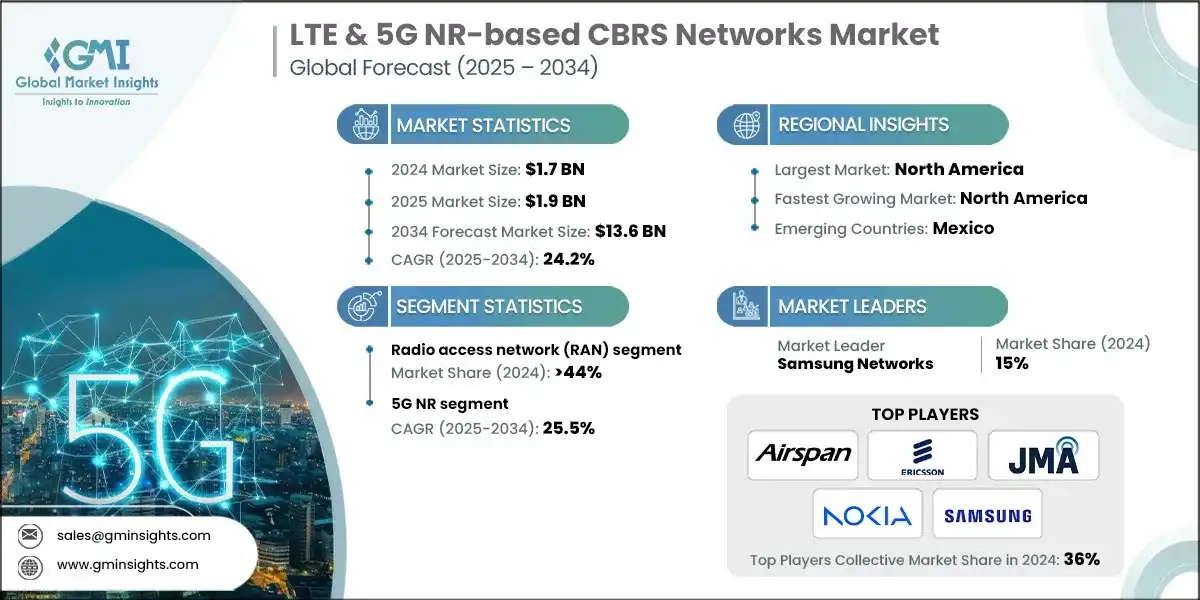
The global LTE & 5G NR-based CBRS networks market was estimated at USD 1.7 billion in 2024. The market is expected to grow from USD 1.9 billion in 2025 to USD 13.6 billion in 2034, at a CAGR of 24.2%, according to latest report published by Global Market Insights Inc.
LTE & 5G NR-based CBRS Networks Market Key Takeaways
Market Size & Growth
- 2024 Market Size: USD 1.7 Billion
- 2025 Market Size: USD 1.9 Billion
- 2034 Forecast Market Size: USD 13.6 Billion
- CAGR (2025–2034): 24.2%
Key Market Drivers
- Rising adoption of private LTE and 5G NR networks.
- Increasing CBRS small cell deployments by cable operators.
- Investment in portable private 5G solutions.
- Advancements in SAS and CBRS 2.0.
- Growing enterprise interest in private wireless networks.
Challenges
- Interference near federal incumbents.
- Coordination complexity and operational costs.
Opportunity
- Growing industrial IoT and enterprise campus networks.
- MVNO offload and secondary carrier aggregation.
- Integration with private 5G solutions.
Key Players
- Market Leader: Samsung Networks led with over 15% market share in 2024.
- Leading Players: Top 5 players in this market include Airspan, Ericsson, JMA Wireless, Nokia, Samsung Networks, which collectively held a market share of 36% in 2024.
Get Market Insights & Growth Opportunities
- LTE & 5G NR-based CBRS Networks are growing because many companies need private LTE and 5G NR for campuses, factories, ports. CBRS gives them spectrum 3.5 GHz, 3550 to 3700 MHz, without spending lots of money. Some other countries use mid-band too but call it different ways. For instance, The CBRS framework in the U.S. has enabled installation of over 400,000 CBRS base stations as of July 2024, with usage across 83% of all counties, supporting critical sectors such as public safety, rural broadband, and industrial IoT.
- Private LTE and 5G adoption are going up fast. Ericsson makes NetCloud, Nokia has CBRS solution also. Many enterprises are testing, some already live. Logistics, factory automation, and campus networks get value clear. Rollouts and trials show real growth across sectors.
- Cable and telecoms try CBRS indoor coverage. Comcast, for example, put private CBRS network at University of Virginia May 2025. They said campus coverage improved. Not every cable company has done this yet. Expansion and trials continue slowly. Neutral-host and in-building networks become more usual.
- SAS vendors allow CBRS sharing. Federated Wireless runs big SAS platforms, sometimes announce uptime hits. Google Cloud CBRS 2.0 updates improve coastal coverage. Fixed wireless, IoT, enterprise networks scale better now. Companies deploy networks faster, easier than before.
- Problems still there. Interference near federal users, coordination tricky, cost matters. FCC and industry roadmap try to fix slowly. CBRS LTE and 5G NR expected boost campus mobility, industrial automation, fixed wireless access. Market growth continues steady next years, more adoption coming.
To get key market trends
LTE & 5G NR-based CBRS Networks Market Trends
- Market is growing fast because more companies want private LTE and 5G NR using CBRS spectrum. Comcast Business, for example, set up a network at University of Virginia in 2025. Campus coverage got better, and staff could communicate easier.
- Federated Wireless reported full uptime in 2024 and 2025, no interference at all. Shared spectrum now works for enterprises. CBRS seems like real telco-grade network. Fixed wireless, IoT, private networks all supported. Companies start using LTE and 5G NR for important operations.
- Google Cloud launched CBRS 2.0 mid-2024. Spectrum Heatmaps improved for coastal areas. Help plan networks better and optimize performance. Factories, logistics, and campuses using it. Enterprise networks get dependable private connectivity. Operators are happy, deployments are faster, easier to manage.
- Spending momentum strong, CBRS networks expected $1.3 billion by 2027. Charter report 2024 showed mobile growth. Verizon introduced portable private 5G for enterprises. Investment covers MVNO offload, IoT, private campuses. Businesses and operators show big interest. Adoption is growing across sectors.
- Still challenges exist. Interference near federal users, coordination hard, costs high sometimes. FCC watching, industry roadmap helps address. CBRS LTE and 5G NR expected to boost fixed wireless, campus mobility, factories. Growth steady, driven by adoption, tech updates, and supportive rules.
- Technology plans focus on 5G NR in n48 with SA options. Some companies are asking for higher power limits to get better coverage and more capacity in CBRS networks. Regulators keep tiered access and SAS for incumbents, PALs, and GAA. They try balance interference protection with flexible enterprise use under 3550–3700 MHz rules.
- Cable operators scaling CBRS small cells to offload MVNO traffic and save roaming costs. Charter working on shared spectrum builds across 2025, news says. Crowdsourced data show MVNOs from Charter and Comcast putting many 5G cells in PAL areas. It works with Verizon’s secondary carriers through aggregation.
LTE & 5G NR-based CBRS Networks Market Analysis
Learn more about the key segments shaping this market
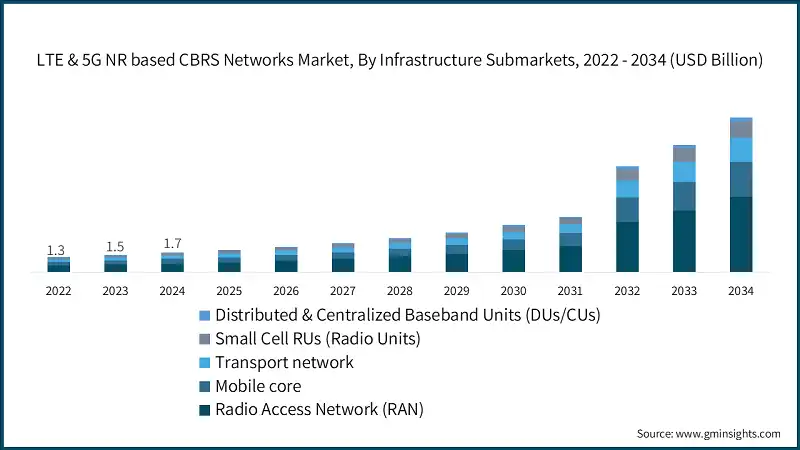
Based on infrastructure submarkets, the LTE & 5G NR-based CBRS networks market is divided into radio access network (RAN), mobile core, transport network, small cell RUs (Radio Units), and distributed & centralized baseband units (DUs/CUs). The radio access network (RAN) segment dominated the market in 2024, accounting for over 44% of total revenue.
- The radio access network or RAN segment of CBRS macro and small cell radios that link user devices to core networks. Enterprises use them for better indoor and outdoor coverage and to cut latency. Some vendors like Ericsson, Nokia, Samsung provide RAN hardware with beamforming and spectrum tools.
- Mobile core handles subscriber stuff, session control, network functions for LTE and 5G NR on CBRS. Virtualized and cloud-native cores let operators’ setup private networks fast. Ericsson, Nokia, and Airspan solutions help scale services while keeping latency low and reliability high for campuses or industrial sites.
- Transport networks join RAN with core networks. Fiber or microwave usually connects CBRS deployments in campuses, factories, and enterprises. These links are important for high capacity, low latency, and backup. Critical for factories, ports, and dense city areas where downtime is not allowed.
- Small cell RUs manage local coverage and capacity. Gaining use in campuses, factories, cities. Companies like JMA Wireless, Airspan, Samsung make small, low-power, easy to deploy RU. They help use spectrum efficiently and let networks expand flexible for private LTE or 5G NR.
- Distributed and centralized baseband units, DUs and CUs, handle signal processing and link RAN to core. Centralized units coordinate multiple sites; distributed units reduce local delay. CBRS networks use them for performance tuning, virtualization, and enterprise-specific setups for private LTE or 5G NR deployments.
Learn more about the key segments shaping this market
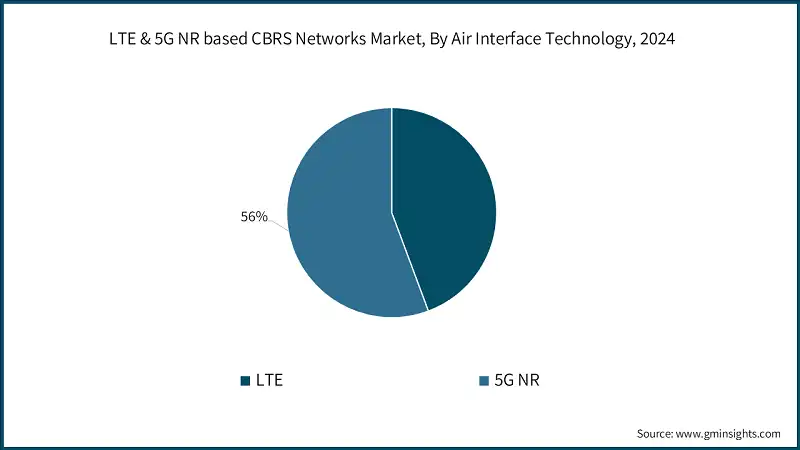
Based on air interface technology, the LTE & 5G NR-based CBRS networks market is segmented into LTE and 5G NR. The 5G NR segment led the Market in 2024 and is expected to grow at a CAGR of 25.5% from 2025 to 2034.
- LTE part of CBRS still matters for many enterprises and factory networks cause it stable and works with many devices. LTE in campuses, ports, factories giving reliable coverage and low delay for IoT sensors, legacy gear. Companies like LTE because it proven and easy to use.
- LTE also benefits from small cell deployments and flexible spectrum. Vendors like Ericsson, Nokia, Airspan sell LTE radios ready for CBRS. Companies can deploy private networks fast and simple. Mostly these networks are used for monitoring, basic operations, and remote connectivity where high data speed is not needed much.
- 5G NR now dominates CBRS market, mostly because of high throughput, very low latency, network slicing. Factories, campuses, and industrial sites prefer 5G NR for advanced stuff like AR, autonomous logistics, robots, and smart automation. Vendors including Ericsson, Nokia, Samsung, and JMA Wireless lead with enterprise-ready 5G NR solutions.
- 5G NR networks on CBRS also use cloud-native management and scalable architecture. Multi-site coordination possible, spectrum used efficiently, networks can grow easy. Enterprises want high performance and next-gen applications. 5G NR expected to take most private CBRS deployments, slowly LTE adoption smaller for mission-critical work.
Based on cells, the LTE & 5G NR-based CBRS networks market is segmented into indoor small cells and outdoor small cells. The indoor small cells segment is expected to dominate the Market, as the growing demand for seamless, high-capacity connectivity within enterprise buildings, commercial complexes, hospitals, shopping malls, airports, and educational institutions is driving significant adoption.
- Many enterprises now put indoor small cells to fix bad coverage and network crowding, mainly in busy places with many users. Growth of cloud apps, digital systems, and IoT devices push even more deployment. Goal is stable low delay and better network experience inside buildings and campuses.
- Cost low and install easy so companies pick indoor small cells instead of older DAS systems. These small cells give control of network local and better spectrum use. They support private LTE and 5G NR for key uses like real-time monitoring, automation, AR or VR training for workers.
- Indoor small cells also give strong targeted coverage with high data speed. This matches the growing need for strong indoor networks. That is why this segment stays ahead and lead market. Companies like this solution for enterprise and factory network upgrades.
- Outdoor small cells are also slowly increasing use, mostly for city streets, transport hubs, big factories, and smart city projects. They help fill coverage gaps and take load from main networks at busy hours. But outside deployment is harder because of site permit, complex installation and cost more.
- Even with slow growth outdoors, investments in 5G rollout and smart city plan will make adoption go up in coming years. Outdoor cells will support large areas while indoor small cells handle inside needs. Together they build complete CBRS network coverage.
Based on application, the LTE & 5G NR-based CBRS networks market is segmented into mobile network densification, fixed wireless access (FWA), cable operators & new entrants, neutral hosts, private cellular networks. The mobile network densification segment is expected to dominate the Market, high-speed data and seamless coverage pushes operators to deploy more small cells in dense urban areas.
- The mobile network densification part in the CBRS market keeps growing as operators try fixing coverage holes and pushing more capacity into busy city areas. They place small cells close together, so they don’t need big new towers that cost much more. This way they can move more traffic without breaking the network when everyone is online at once. It also helps them roll out upgrades faster and reuse spectrum better, which is why many see it as the first clear use for CBRS bands.
- Fixed Wireless Access takes CBRS and gives internet where cables don’t reach them well or costs too much to build. Smaller ISPs and regional providers set up CBRS links to bring broadband to rural and outer suburb homes. They get performance like licensed spectrum without paying the heavy auction prices, so it keeps costs down. Governments pushing internet gaps to close internet gaps make this grow faster, and more programs keep backing it, turning FWA into one of the quicker growing segments of the market.
- Cable companies and new entrants go for CBRS, so they don’t depend fully on big mobile operators anymore. Cable groups push their own mobile traffic through CBRS to save on roaming bills and mix mobile with home internet packages. At the same time, tech firms and small ISPs build smaller local networks just for certain users. This shift pulls in new competition and lets outsiders join the market without massive upfront spending.
- Neutral hosts use CBRS to build one shared network that many operators can run on inside big places like airports, arenas, and malls. Landowners or system firms often set these up so users get strong signal without every carrier building their own gear.
- Private cellular networks maybe biggest shift later, as factories, campuses, and energy sites build own LTE or 5G NR systems with CBRS. Companies want control, keep data local, and get very low lag for machines, robots, and sensors. These networks run training apps, automate work, and connect IoT stuff safely. More digital industry means private CBRS will grow and push most future demand.

Looking for region specific data?
The US dominates the North American LTE & 5G NR-based CBRS networks market, generating USD 725.5 million revenue in 2024.
- The FCC set up rules for CBRS that make spectrum sharing possible in three levels: incumbents, PALs, and GAA. This system helps companies use spectrum better and encourages new wireless tech, without interfering with existing users.
- Charter Communications keep adding mobile lines, over 2 million Spectrum Mobile lines in 2024 alone. They keep evolving networks, densifying coverage and offloading traffic where PALs and GAA are open. This makes service better and network more flexible in busy areas.
- Neutral host setups getting more common in US, firms like Crown Castle and American Tower build shared networks for several operators at once. Will find these mostly in stadiums, airports, and big commercial buildings where many people need strong signal at same time.
- Private LTE and 5G networks grow fast with companies that want secure, high-speed wireless for their own sites. Networks handle automation, IoT, and real-time monitoring. Vendors like Federated Wireless and JMA Wireless provide solutions for these enterprise needs, tailored for industry specifics.
- Fixed Wireless Access is also expanding, especially in rural or underserved zones. Providers use CBRS to deliver high-speed internet without needing wires everywhere. It reduces cost, speeds rollout, and brings broadband to homes and businesses that wired networks don’t reach yet.
The LTE & 5G NR-based CBRS Networks Market in Germany is expected to experience significant and promising growth from 2025 to 2034.
- Germany set up rules that help private LTE and 5G networks grow. The Federal Network Agency (Bundesnetzagentur) gives local spectrum in 3.7–3.8 GHz for businesses. Companies can run their own networks without waiting on public carriers. This push supports Industry 4.0 and stronger connectivity in industrial areas.
- Enterprises in Germany use private 5G more now for automation and digital operations. Hamburger Containerboard for example, built a private 5G network at its Spremberg paper mill with over 120 antennas covering 350,000 square meters. The network helps monitor production in real-time and makes processes run smoother.
- Panasonic also runs a private 5G test setup at its Customer Experience Center in Munich. This place is for testing new connectivity solutions and checking industrial applications. It helps companies understand how to use private networks for factories and operations.
- Neutral host networks are picking up in Germany, especially in cities and big venues. These allow many operators to share the same infrastructure. It lowers costs and improves coverage. Shared spectrum bands, like 3.7–3.8 GHz, are being tested to make these deployments easier.
- Wireless internet is becoming more common in the countryside and areas of Germany that don't have great internet access. Companies are using airwaves in these areas to beam fast internet to homes without having to dig up roads and install new cables. This means more houses and businesses can get online even if they're in places where regular wired internet isn't available. Basically, wireless internet is helping to solve the problem of slow or nonexistent broadband in these underserved locations.
The LTE & 5G NR-based CBRS Networks Market in China is expected to experience significant and promising growth from 2025 to 2034.
- China is a fastest growing country in the Asia pacific, mostly in factories and big enterprises. The government give local spectrum in 3.3–3.6 GHz and 4.8–5.0 GHz, so companies can run networks without messing with public carriers. This rule help Industry 4.0 and better connectivity in industrial areas.
- Enterprises in China adopt private 5G more, mostly to automate and digitalize operations. CATL for instance deployed a private 5G network over 5 million square meters across six provinces. The network handle centralized process control, AI video inspections, big real-time data checks, and smart logistics, making operations faster and safer.
- China Telecom reported more than 16,000 private 5G networks deployed, with over 40,000 applications launched. They serve manufacturing, logistics, and healthcare. Enterprises use these networks for real-time monitoring, IoT-based automation, and keeping sensitive data in-house for security.
- Neutral host approaches growing in cities and big venues, letting multiple operators share infrastructure. It cuts costs and extends coverage. China Mobile, China Unicom, and China Telecom lease infrastructure from third-party providers to deploy 5G, improving investment efficiency and network reach.
- Fixed Wireless Access expanding in rural or underserved regions. Providers use local spectrum to deliver broadband fast, without laying wires everywhere. This approach brings connectivity to areas that lack reliable internet before.
- The government pushed for domestic equipment and tech to improve security and lower foreign dependency. These policies plus enterprise adoption and infrastructure growth make China a leader in private LTE and 5G NR networks, supporting industrial and enterprise connectivity and building a strong ecosystem.
The LTE & 5G NR-based CBRS networks market in UAE is expected to experience significant and promising growth from 2025 to 2034.
- The UAE has become an important country in private LTE and 5G NR networks, led by partnerships, supportive regulations, and focus on industrial digitization. TDRA push forward policies that let companies adopt private networks, seeing the value for sector-specific connectivity and innovation across industries.
- ADNOC with e& build what is called the largest private 5G network for energy sector. Covering 11,000 square kilometers, this network mix AI and automation for both onshore and offshore operations, expecting $1.5 billion in value by 2030 through better production and lower emissions.
- ZTE and e& UAE run PoC trials for private 5G networks showing high uplink and edge computing power. Trial prove quick deployment works and can adapt to bands like 26GHz, 4.9GHz, 700MHz, fitting different industrial needs without much delay.
- Neutral host setups grow too, especially indoor and large venue coverage. Companies like TAWAL build shared infrastructure for 4G and 5G, helping IoT apps and other ICT services run smoothly without each operator building everything separately.
- du and Nokia partnership shows UAE push for advanced private 5G. Their work combines private networks with generative AI to digitize industries, improve operations, and support sector-wide efficiency, helping companies adopt next-gen connectivity faster.
The LTE & 5G NR-based CBRS networks market in Brazil is expected to experience significant and promising growth from 2025 to 2034.
- Brazil has been growing in private LTE and 5G NR networks, led by industrial sector demand and regulatory support. Anatel issue licenses and allocate spectrum, helping companies adopt private networks to improve automation, efficiency, and connectivity across multiple industries.
- The National Telecommunications Agency has given 66 licenses for enterprise-owned private 5G networks across 2.39–2.4 GHz, 3.7–3.8 GHz, and 27.5–27.9 GHz bands. These policies support factories, energy plants, and agricultural sites, allowing businesses to run private networks without interfering with public carriers.
- Shared network setups are becoming more popular in Brazil, particularly in cities. Think of it like this: Oi Brazil is building the basic structure for phone networks, and then different phone companies can all use it. This means they can share cell towers and the radio waves they use. This is good because it costs less to get things up and running, it makes sure more areas have good signal, and it helps different phone companies offer great 5G service without having to build their own brand-new network everywhere.
- Also, the government's agency, Anatel, is really important. They're making a great effort to figure out who gets to use which radio waves. They're also letting businesses have their own private networks, which encourages them to use the latest 4G and 5G technology. At the same time, they're making sure everything works well with the existing phone companies. Basically, Brazil is finding a way to update its industries, keep costs down, and improve city phone coverage all at the same time.
LTE & 5G NR-based CBRS Networks Market Share
- The top 7 companies in the market are Airspan, Commscope, Ericsson, JMA Wireless, Nokia, Radisys, and Samsung, contributing around 60% of the market in 2024.
- Airspan continues to expand its footprint with small cell and RAN solutions, mostly in private LTE and 5G deployments. Their products help industrial sites, factories, and logistics centers scale networks efficiently while keeping latency low.
- Commscope focuses on in-building coverage, DAS, and indoor small cells for dense urban and enterprise sites. They help operators and enterprises offload mobile traffic and optimize wireless capacity. Its share grows as more stadiums, airports, and campuses adopt shared CBRS infrastructure for reliable connectivity.
- Ericsson remains a global leader with end-to-end RAN, core, and private network solutions. Large-scale industrial, campus, and logistics deployments rely on their spectrum-ready radios. Their market share benefits from global operator contracts and enterprise adoption in mission-critical environments requiring high throughput and low-latency connectivity.
- JMA Wireless specializes in compact small cell RUs and indoor network solutions. Its flexible deployments make it suitable for healthcare, education, and enterprise campuses. Rapid adoption occurs where localized coverage and spectrum efficiency matter, helping the company steadily gain share in specialized CBRS applications.
- Nokia commands a strong position with integrated RAN, core, and private 5G networks. Enterprises in industrial automation and IoT-heavy environments prefer its solutions for scalable and secure private networks. Large commercial and government projects reinforce its market presence in CBRS enterprise networks.
- Radisys emphasizes cloud-native and virtualized network functions. Its RAN software and open network solutions allow operators and enterprises to scale private LTE and 5G services efficiently. Companies needing flexible, mission-critical networks find Radisys solutions particularly useful.
- Samsung grows share with private LTE and 5G deployments targeting smart factories, logistics, and campuses. Its low-latency small cells and RAN solutions integrate seamlessly into enterprise networks, giving it competitive advantage in industrial and high-density private CBRS networks.
LTE & 5G NR-based CBRS Networks Market Companies
Major players operating in the market are:
- Airspan
- Amazon Web Services
- Cisco
- Comcast
- Commscope
- Ericsson
- JMA Wireless
- Nokia
- Radisys
- Samsung
- The LTE & 5G NR-based CBRS networks market is shaped by a mix of global veterans, regional leaders and emerging resolution, each driving company and industrial adoption. Ericsson, Nokia, Samsung Networks, Cisco and AT&T participated with end-to-end solution, which part, core, small cells and private networks, scale utilization and global access. Their solutions support enterprise complexes, factories and logistics networks, and often integrate cloud-can-do, network discs and IoT connection for complex distribution.
- Regional companies such as ZTE, Fujitsu and Baicells focus on specific geography, which meet the needs of local spectrum rules and cost-sensitive companies. They provide quick deployment to industrial parks, smart cities and campus networks. Their local expertise and flexibility allow them to compete with global suppliers by effectively addressing the requirements for regulatory and infrastructure.
- Emerging solutions including open RAN, SAS platforms and software-defined private networks, including Federated Wireless, Radisys, Mavenir and Altiostar drive innovation. They focus on cloud and virtualized architecture that enables fast and more flexible distribution of LTE and 5G NR networks for companies. The common appearance of large sitting and flexible innovators promotes a competitive landscape, which accelerates CBRS private networks and network modernization in many industries.
LTE & 5G NR-based CBRS Networks Market Report Attributes
| Key Takeaway | Details |
|---|---|
| Market Size & Growth | |
| Base Year | 2024 |
| Market Size in 2024 | USD 1.7 Billion |
| Market Size in 2025 | USD 1.9 Billion |
| Forecast Period 2025 - 2034 CAGR | 24.2% |
| Market Size in 2034 | USD 13.6 Billion |
| Key Market Trends | |
| Drivers | Impact |
| Rising adoption of private LTE and 5G NR networks | Improves campus, industrial, and port connectivity for enterprises |
| Increasing CBRS small cell deployments by cable operators | Reduces MVNO offload and roaming costs, enhancing network efficiency |
| Investment in portable private 5G solutions | Supports enterprise deployments, industrial IoT, and mobile workforce solutions |
| Advancements in SAS and CBRS 2.0 | Enhances spectrum management, reliability, and coastal coverage for private networks |
| Growing enterprise interest in private wireless networks | Accelerates trials, deployments, and adoption across manufacturing, logistics, and campuses |
| Pitfalls & Challenges | Impact |
| Interference near federal incumbents | Requires strict SAS management and careful deployment planning to avoid disruptions |
| Coordination complexity and operational costs | High planning and integration costs for private LTE/5G NR networks can slow adoption |
| Opportunities: | Impact |
| Growing industrial IoT and enterprise campus networks | CBRS adoption expands for automation, logistics, and smart building applications |
| MVNO offload and secondary carrier aggregation | Enables cost-efficient expansion of private networks without additional spectrum licenses |
| Integration with private 5G solutions | Supports hybrid LTE/5G NR deployments for future-proof enterprise connectivity |
| Market Leaders (2024) | |
| Market Leaders |
15% market share |
| Top Players |
Collective market share in 2024 is 36% |
| Competitive Edge |
|
| Regional Insights | |
| Largest Market | North America |
| Fastest Growing Market | North America |
| Emerging Country | Mexico |
| Future Outlook |
|
What are the growth opportunities in this market?
LTE & 5G NR-based CBRS Networks Industry News
- In June 2025, ZTE and e& UAE successfully completed a private 5G network Proof-of-Concept (PoC) trial in the UAE. The trial demonstrated scalable, secure, and high-performance connectivity solutions for enterprises, enabling smart industries and supporting sustainable growth. This milestone reinforces the partners’ commitment to advancing digital transformation and private network adoption in the region.
- In May 2025, Comcast Business launched a private CBRS network at the University of Virginia, improving campus coverage and connectivity. The deployment demonstrates enterprise adoption of CBRS for indoor and neutral-host networks, facilitating high-density user support and operational efficiency for educational institutions.
- In May 2025, Federated Wireless announced that its Spectrum Access System (SAS) for the Citizens Broadband Radio Service (CBRS) achieved 100% uptime throughout 2024 and the first quarter of 2025. This included 100% spectrum availability and zero interference-related outages.
- In February 2025, ADNOC and e& announced the deployment of the energy sector’s largest private 5G network across 11,000 square kilometers in the UAE. The network will integrate AI and automation across ADNOC’s onshore and offshore operations, transmitting real-time data from over 12,000 sensors, enabling predictive analytics, operational safety, and efficiency improvements, with expected value generation of $1.5 billion over five years.
The LTE & 5G NR-based CBRS networks market research report includes in-depth coverage of the industry with estimates & forecasts in terms of revenue ($ Mn/Bn) from 2021 to 2034, for the following segments:
Market, By Infrastructure Submarkets
- Radio Access Network (RAN)
- Mobile core
- Transport network
- Small Cell RUs (Radio Units)
- Distributed & Centralized Baseband Units (DUs/CUs)
Market, By Air Interface Technology
- LTE
- 5G NR
Market, By Cells
- Indoor small cells
- Outdoor small cells
Market, By Application
- Mobile network densification
- Fixed Wireless Access (FWA)
- Cable operators & new entrants
- Neutral hosts
- Private cellular networks
- Education
- Governments & municipalities
- Healthcare
- Manufacturing
- Military
- Mining
- Oil & gas
- Retail & hospitality
- Others
Market, By Frequency Band
- Below 2.3 GHz
- 2.3-2.6 GHz
- 3.3-3.6 GHz
- 3.55-3.7 GHz
- 3.7-3.8 GHz
- 3.8-4.2 GHz
- 4.6-4.9 GHz
- Above 20 GHz
The above information is provided for the following regions and countries:
- North America
- U.S.
- Canada
- Europe
- Germany
- UK
- France
- Italy
- Spain
- Russia
- Nordics
- Asia Pacific
- China
- India
- Japan
- Australia
- South Korea
- Southeast Asia
- Latin America
- Brazil
- Mexico
- Argentina
- MEA
- South Africa
- Saudi Arabia
- UAE
Frequently Asked Question(FAQ) :
What is the market size of the LTE & 5G NR-based CBRS networks in 2024?
The market size was USD 1.7 billion in 2024, with a CAGR of 24.2% expected through 2034 driven by private LTE/5G adoption across enterprises and industrial sites.
What is the current LTE & 5G NR-based CBRS networks market size in 2025?
The market size is projected to reach USD 1.9 billion in 2025.
What is the projected value of the LTE & 5G NR-based CBRS networks market by 2034?
The LTE & 5G NR-based CBRS networks market is expected to reach USD 13.6 billion by 2034, fueled by enterprise IoT deployments, small cell densification, and advanced SAS/CBRS 2.0 rollouts.
How much revenue did the Radio Access Network (RAN) segment generate in 2024?
The RAN segment generated over 44% of total revenue in 2024, making it the leading infrastructure submarket. Its dominance is driven by enterprise demand for improved indoor/outdoor coverage and low-latency connectivity.
What was the valuation of the 5G NR segment in 2024?
The 5G NR segment led the market in 2024 and is projected to grow at a CAGR of 25.5% through 2034.
What is the growth outlook for indoor small cells from 2025 to 2034?
Indoor small cells are expected to dominate due to high demand for seamless enterprise building connectivity. Growth will be driven by IoT integration, AR/VR workforce training, and cost-efficient alternatives to DAS systems.
Which region leads the LTE & 5G NR-based CBRS networks market?
The U.S. dominated the North America market, generating USD 725.5 million in 2024. Growth is driven by FCC spectrum-sharing rules, private enterprise network adoption, and expanding fixed wireless access in underserved areas.
What are the upcoming trends in the LTE & 5G NR-based CBRS networks industry?
Key trends include increasing private LTE/5G deployments in enterprises, CBRS small cell densification by cable operators, MVNO offload with secondary carrier aggregation, and SAS 2.0 advancements for better spectrum management.
Who are the key players in the LTE & 5G NR-based CBRS networks market?
Key players include Airspan, Commscope, Ericsson, JMA Wireless, Nokia, Radisys, Samsung, Cisco, Comcast, AT&T, Verizon, and emerging innovators like Federated Wireless, Mavenir, and Altiostar.
LTE & 5G NR-based CBRS Networks Market Scope
Related Reports