Summary
Table of Content

Low Speed Vehicle Market
Get a free sample of this report
Form submitted successfully!
Error submitting form. Please try again.
Thank you!
Your inquiry has been received. Our team will reach out to you with the required details via email. To ensure that you don't miss their response, kindly remember to check your spam folder as well!
Request Sectional Data
Thank you!
Your inquiry has been received. Our team will reach out to you with the required details via email. To ensure that you don't miss their response, kindly remember to check your spam folder as well!
Form submitted successfully!
Error submitting form. Please try again.
Low Speed Vehicle Market Size
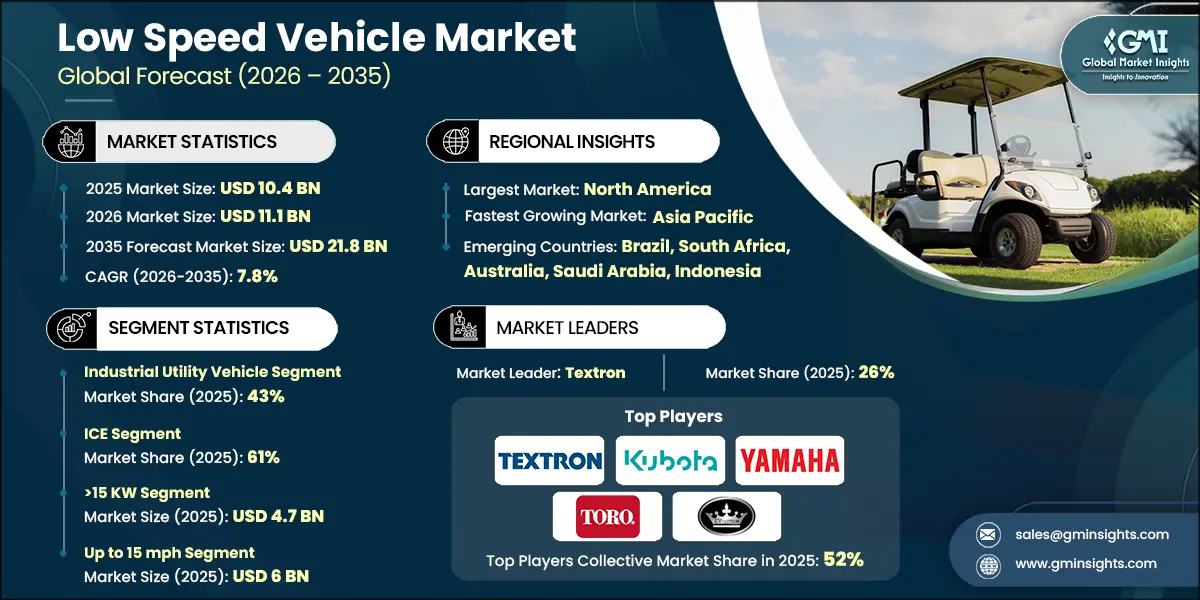
The global low speed vehicle market size was estimated at USD 10.4 billion in 2025. The market is expected to grow from USD 11.1 billion in 2026 to USD 21.8 billion in 2035, at a CAGR of 7.8% according to latest report published by Global Market Insights Inc.
Low Speed Vehicle Market Key Takeaways
Market Size & Growth
- 2025 Market Size: USD 10.4 Billion
- 2026 Market Size: USD 11.1 Billion
- 2035 Forecast Market Size: USD 21.8 Billion
- CAGR (2026–2035): 7.8%
Regional Dominance
- Largest Market: North America
- Fastest Growing Region: Asia-Pacific
Key Market Drivers
- Urban mobility inside gated/controlled areas.
- Tourism, hospitality & leisure expansion.
- Electrification push & sustainability mandates.
- Operational cost savings in conventional vehicles.
Challenges
- Limited road access & regulatory inconsistencies.
- Range & performance limitations.
Opportunity
- Customization & modular utility bodies.
- Premium & lifestyle LSVs for residential use.
Key Players
- Market Leader: Textron led with over 26% market share in 2025.
- Leading Players: Top 5 players in this market include Textron, KUBOTA, Yamaha Motor, The Toro Company, EVolution Electric Vehicles, which collectively held a market share of 52% in 2025.
Get Market Insights & Growth Opportunities
Rapid urbanization across the globe has intensified challenges such as traffic congestion, air pollution, and noise, creating a pressing need for eco-friendly and efficient transportation solutions. Low-Speed Vehicles (LSVs) have emerged as a sustainable alternative for short-distance travel, particularly in densely populated urban centers, gated communities, and recreational spaces such as resorts and campuses.
Powered by electricity or alternative fuels, LSVs produce minimal emissions, contributing to cleaner air and reduced environmental impact. Their compact design makes them easy to maneuver in crowded areas, while their speed limitations ensure safety in shared spaces. LSVs align with green mobility initiatives, offering a practical solution for cities striving to achieve sustainable urban development and improve quality of life.
Technological advancements in EV batteries, such as improved energy density, reduced charging time, and extended life cycles, have significantly boosted the efficiency and appeal of LSVs. These innovations reduce operational costs and enhance performance, making LSVs attractive for both personal and commercial uses, including delivery services and industrial applications.
The ramifications of the COVID-19 pandemic on the Low-Speed Vehicle industry are “mixed” in nature. Disruptions in production, logistical problems because of supply chain issues, and the impact of halting production related to COVID led to a temporary decrease in production and deliveries from 2020–2021. Most of the OEMs operating in the LSV space are small and regional dealers, with the majority located in China, India, and areas within Southeast Asia. Due to the high demand for batteries, motors, and electronic components in particular, many OEMs in these locations struggled with the shortage of components and had to slow down production.
North America is driving low speed vehicle market due to its advanced infrastructure, widespread adoption of sustainable mobility solutions, and strong demand in residential, recreational, and industrial applications. The country’s well-established golf culture significantly boosts the demand for golf carts, a key segment of LSVs. Moreover, favorable government policies, tax incentives for electric vehicles, and increasing emphasis on green mobility drive the adoption of electric LSVs. Large-scale industrial facilities and gated communities in the U.S. further contribute to the growing usage of utility-focused LSVs, cementing the country’s dominance.
In Asia-Pacific the low-speed vehicle market continues to grow exponentially. Countries like China, Japan, and India are key players, with China being a major manufacturer and exporter of LSVs. Affordable production costs, coupled with growing adoption in sectors like agriculture, logistics, and industrial facilities, boost the region’s market share. The rising popularity of electric LSVs in smart city projects and last-mile delivery in urban areas further strengthens APAC’s position in the market. Moreover, government subsidies and initiatives in emerging economies drive affordability and accessibility, fueling growth.
To get key market trends
Low Speed Vehicle Market Trends
The increasing pace of Connected Data-Solution for Low-Speed Vehicles (LSV) aligns with the trends seen in the overall digital transformation of mobility. The ability to integrate IoT and telematics will enable fleet operators to closely monitor their vehicles, track the vehicle's location, understand how the vehicle is being used, schedule preventative maintenance based upon real-time data received from the vehicle, and ultimately reduce vehicle downtime and operating expenses.
The utilization of this type of technology will enable shared mobility operators to improve the utilization of their fleets by providing greater safety and better user experience through real-time availability and diagnostics. For example, in October 2023, GEM, a leader in street legal LSVs, partnered with Joyride, a software platform for micromobility, to introduce the utilization of IoT connected LSVs for shared use. This type of partnership illustrates how technology can be leveraged to create intelligent fleet models that focus on the end-user experience.
As the adoption of electric LSVs continues to grow, the market is expected to develop new innovative charging systems and energy management systems to support electric Low-Speed Vehicles. Charging via traditional plugin connectors typically require charging systems that are lengthy, cumbersome, and limit the capacity of fleet deployments. To streamline the operation of electric low-speed vehicles and reduce vehicle downtime and to achieve maximum efficiency with their fleets, new advanced systems such as wireless charging and rapid charging technology are currently being developed.
In January 2024, WiTricity and ICON EV unveiled the 2024 ICON Low-Speed Vehicles. It will feature the wireless charging option that is the first wireless charging solution for vehicles and will provide charging speeds comparable to traditional plug-in methods, while eliminating the need to connect with wires when charging the vehicle to provide seamless charging for the user and operators of the vehicles. Wireless vehicle charging allows for a reduction in operational friction associated with maintaining electric LSVs, especially in high-use environments, such as campuses and resorts, and urban shared mobility systems.
The Low-Speed Vehicle market is transforming from an exclusively functional utility-oriented product to one that combines comfort, style, and compatibility with lifestyle preferences. Manufacturers are beginning to recognize that LSVs are more than simply functional mobility products, they also can impact user satisfaction and increase customer acceptance and use of electric LSVs within residential communities, the hospitality sector, and recreational sectors.
By launching a new Liberty low-speed electric vehicle, which is street-legal, along with an updated Freedom RXV low-speed electric vehicle, E-Z-GO, a Textron Specialized Vehicles entity, demonstrated that consumer expectations for LSVs are expanding beyond simply utility-oriented products to include comfortable and stylish LSVs that allow for user customization through personalization. The alignment of product offerings to fit the preferences of consumer lifestyles is enabling manufacturers to expand their overall market appeal of LSVs, thereby increasing their use and acceptance within urban areas, resorts, and specialized fleet applications.
Low Speed Vehicle Market Analysis
Learn more about the key segments shaping this market
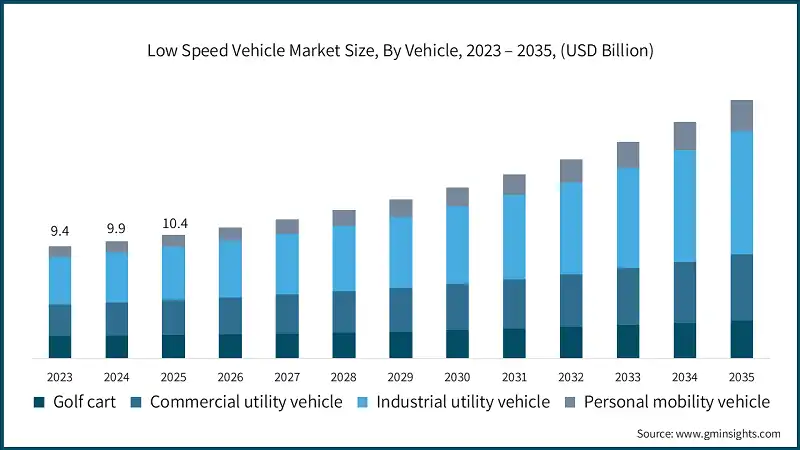
Based on vehicle, the low speed vehicle market is divided into golf cart, commercial utility vehicles, industrial utility vehicles, and personal mobility vehicles. Industrial utility vehicle segment dominated the market accounting by 43% in 2025 and is expected to grow at a CAGR of 8.9% from 2026 to 2035.
- The industrial utility vehicles is the largest and fastest growing segment in terms of vehicle category. Industrial LSV's play an important role in the demanding environments of manufacturing facilities, logistics centers, construction sites, and many other commercial uses, by providing the required payload capacity (1,500-2,500 lbs), rugged construction and extended duty cycles.
- In response to the increasing demand for industrial utility vehicles, leading manufacturers such as KUBOTA, Textron and Yamaha, have developed purpose-built products specifically designed for this segment, offering high durability and high payload capacity to fleet operators, as well as low total cost of ownership (TCO). Fleet managers recognise that the operational savings and the potential TCO savings of 25-30% within five years make this category of electric vehicles attractive for this segment.
- The commercial utility vehicle segment includes a range of versatile mid-duty vehicles which are used by hotels, golf course maintenance operators, facility managers, governmental agencies and various general applications. Commercial LSV's combine a good balance of payload capacity (800-1,500 lbs) with the ability to move quickly and efficiently and versatility of usage using modular bed systems that can be configured for carrying cargo, transporting passengers, and/or mounting equipment for special purposes.
- Leading brands such as Club Car, E-Z-GO, and Star EV are competing aggressively for market share in the commercial segment based on features such as payload capacity, customisation options and dealer network support.
Learn more about the key segments shaping this market
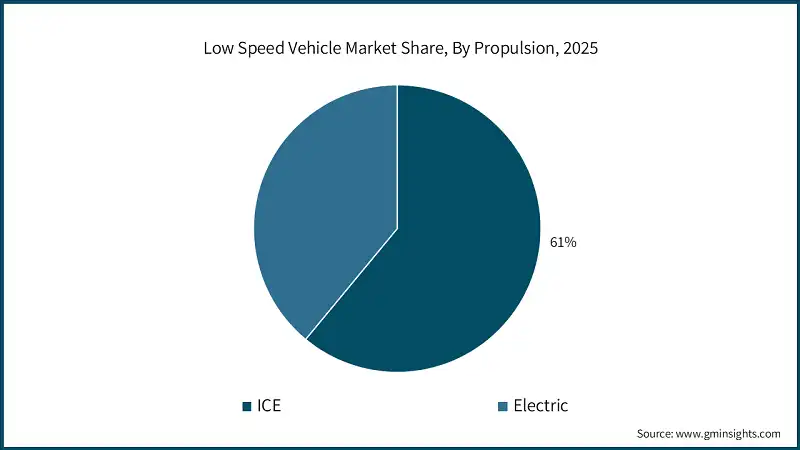
Based on propulsion, the low speed vehicle market is categorized as ICE and electric. ICE segment dominated the market with 61% share in 2025, and the segment is expected to grow at a CAGR of 7.1% between 2026 to 2035.
- Internal Combustion Engine (ICE) LSVs maintain majority market share, reflecting installed base inertia and specific application advantages. Most of the internal combustion engine-powered LSVs use gas engines in the range of three to ten horsepower with either continuously variable transmission or automated transmission. This provides an unlimited operational range when operating the vehicle as well as the ability to quickly refuel it.
- Golf courses have one of the largest user populations of gasoline-powered LSVs, and as of 2025, gasoline-powered golf carts remain the largest portion of the total number of LSVs used on golf courses. The primary reasons for continuing to purchase gasoline-powered LSVs for use on golf courses include the long-term use of gasoline-powered LSVs by the operators, the lower cost of capital associated with purchasing the LSV and the perception that their performance has been more than adequate for traditional golf course uses.
- Electric LSVs provide significant benefits to fleet and industrial operators, as these operators have less than 10% of their fleet operating time using electric-powered LSVs. The most significant benefits to electric-powered LSVs include having near-zero maintenance costs, quiet operation, zero direct emissions, and reduced operating costs and effective means of accelerating the use of LSVs over time. The lifecycle cost savings for most electric-powered LSVs are approximately 25-35% over five to eight years for most fleets and industrial operators who have conducted lifecycle cost analysis.
Based on power output, the low speed vehicle market is divided into >15 KW, 6-15KW, and <15KW. >15 KW segment dominate the market and was valued at USD 4.7 billion in 2025.
- Class 15 KW Power can meet the market needs of larger, more demanding uses in commercial and industrial environments requiring high capacity and continued operation with exceptional performance. These uses include industrial manufacturing sites, large warehouse locations, construction sites, commercial-type heavy-duty operations as well as agriculture utility requirements.
- Due to the segment's relatively slow growth rate of 6.4%, lower than the overall market growth rate, it indicates maturity of traditional industrial applications. The majority of future growth is likely to be driven by an expansion in the number of fleets used for manufacturing in Asia and by the replacement of existing Internal Combustion Engine (ICE) based utility vehicles with Electric Utility Vehicles (EUV) in these segments.
- The mid-power class of 6-15 KW Power is the fastest growing segment of the utility vehicle market with a forecasted CAGR of 9.1% since it is in the ideal power range for both Commercial Utility Vehicles as well as Premium Personal Mobility Vehicles. The mid-power Category also provides users with a good balance between performance, efficiency, and cost. Utility Vehicles in this category have payload capacities of between 800-1500 lbs, can travel at speeds ranging from 20-30 mph, and provide range optimization through lower power consumption.
Based on speed class, the low speed vehicle market is divided into Up to 15 mph, 15–25 mph, and Above 25 mph. Up to 15 mph is the largest segment in market and was valued at USD 6 billion in 2025.
- The 15 mph Speed Class is the most dominant, which includes vehicles that are intended to operate in a more controlled manner on private property, such as golf courses, resort campuses, retirement communities, and industrial sites. This speed category aligns with the initial specifications of golf carts, as well as with low-speed transport applications on facilities. The primary purpose of this speed classification is to ensure the safety of pedestrians in mixed-use environments.
- This segment is growing at a CAGR of 6.7%, which is below the market average, indicating that traditional golf and resort markets are increasingly maturing, and their growth potential is limited by the lack of broader addressable verticals to apply that success to. The cost-conscious nature of many golf courses, as well as those looking for more economic options within the developing world, continues to support the demand for basic 15 mph vehicles. In developing markets, price sensitivity will often outweigh concerns for performance.
- The segment with the greatest growth potential is represented by the 15-25 mph Speed Class with CAGR of 8.8%. This reflects a growing consumer demand for a more versatile vehicle that is suitable for operation in both controlled environments and limited street use. Therefore, the speeds represented in this speed range align with the definition of Low-Speed Vehicles (LSVs), which is a federal classification through the NHTSA that describes a four-wheeled vehicle that is defined by a maximum speed of between 20-25 mph.
Looking for region specific data?
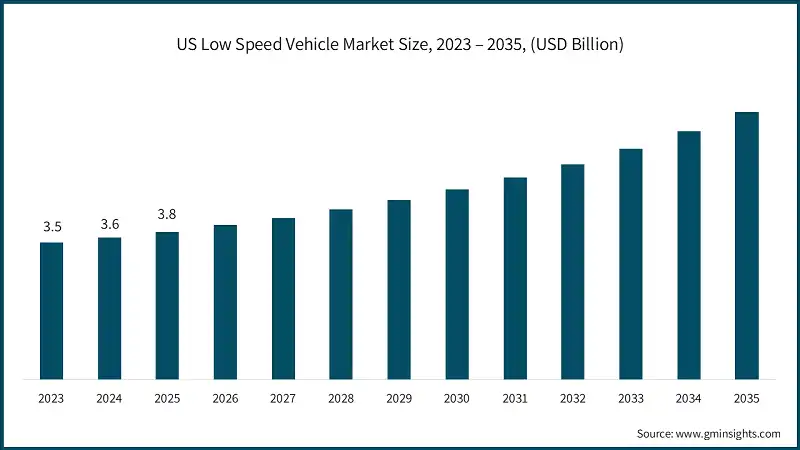
The US dominated North America low speed vehicle market with revenue of USD 3.8 billion in 2025.
- The United States is leading the regional market, with an estimated 40,000+ gated communities, more than 15,000 golf courses, and a growing number of university and corporate campuses, as well as state laws allowing the operation of LSVs on public roads. One of the primary drivers of demand is the electrification of industrial and logistics facilities. Warehouses are owned by large companies such as Amazon, FedEx, UPS, and third-party logistics companies. These companies deploy heavily electric LSVs for their intra-campus materials movement and use electric LSVs in place of diesel forklifts and ICE utility vehicles.
- Canada holds 11.8% share of the North American market. Government incentives for electrification and increased tourism infrastructure underpin Canada's growth. Although this technology increases the cost of electric LSVs by $1,500 to $2,000, it is essential to operate all year long in Canada. The Federal Investing in Canada Infrastructure Program has allocated C$15 million annually toward indigenous mobility projects.
China low speed vehicle market will grow tremendously with CAGR of 11% between 2026 and 2035.
- China is dominating the Asia Pacific market, driven largely by the deployment of large institutional campuses and the construction of tourism infrastructure under government mandates. Domestic manufacturers like Jiangsu Baodiao, Suzhou Eagle, and Zhongyi Electric offer products at competitive prices, which provides a cost-effective solution for mass deployment. Zhejiang and Jiangsu provinces house more than 80% of China's LSV production capacity, creating regional industrial clusters with a complete supply chain, from components to final assembly, for electric LSVs.
- India has the greatest growth opportunity as the country is rapidly expanding its hotel industry, developing factories, and creating gated communities’ infrastructure. The expansion of India's tourism sector and the addition of over 300 hotels before 2030 is driving the demand for golf carts and shuttles for guests as well as golf courses, which have been a factor in increased demand for golf carts. The addition of a new golf course creates a heavy demand for equipment which will continue to be in demand for a long time.
The Europe low speed vehicle market in Germany will experience robust growth between 2026 and 2035.
- Germany is the market leader in Europe and is growing at a CAGR of 7.2% because of applications in industrial manufacturing campuses, the electrification of municipal fleets, and rising demand for premium hospitality. German automotive manufacturers, such as Volkswagen, BMW, and Mercedes-Benz, along with tier-1 suppliers, are using fleets of more than 1,000 electric low-speed vehicles (LSVs) for their logistics operations inside their plants. The vehicles support their initiatives to utilize Industry 4.0 digitalization by having automated guided vehicles (AGVs) integrated with electric LSV fleets.
- The United Kingdom has a strong golf market and currently has an opportunity to replace their existing fleet of lead-acid golf carts at the end of their useful lives. The deployment of LSVs in ultra-low emission zones in urban last-mile delivery operations drives the adoption rate of electric golf carts, with Royal Mail and DPD receiving exemption from the London Congestion Charge, saving approximately £15 per vehicle. The electrification of sites of historical significance is a high visibility niche. For example, the National Trust, English Heritage, and Royal Estates have converted their transportation fleets to LSVs to protect their delicate historic landscapes.
Brazil will experience robust growth of 3.6% between 2026 and 2035.
- Brazil continues to be the largest market for LSVs having a 44.4% share of total LSV market in Latin America. LSVs are seen as an important opportunity within Brazil's agricultural sector particularly for the crop and livestock management of sugarcane, soybeans, and coffee.
- Argentina's restrictive and prohibitive import quotas on LSVs create price distortions due to artificial scarcity. Retail pricing (MSRP) and import tariffs imposed by the Argentinian Customs Service (AFIP) restrict access to the LSV market in Argentina, as well as the time it takes to get approved by AFIP prior to importing non-essential vehicles.
UAE low speed vehicle market will grow tremendously with CAGR of 11.1% between 2026 and 2035.
- The UAE is also emerging as the second largest LSV market, holding 32.8% of the total LSV market share in MEA region. The two largest regional markets, Dubai and Abu Dhabi, are deploying fleets of autonomous LSVs to support their smart city initiatives and NEOM project by 2030. Therefore, there will be a tremendous opportunity for LSVs in MEA due to the large demand by luxury hotels and leisure industry for LSVs that are air conditioned, have high-end interiors, and operate quietly.
- LSVs demand in Saudi Arabia will be primarily driven by the Vision 2030 gigaprojects, including NEOM, the Arabian Red Sea Project, and Qiddiya. All these projects will require large LSVs for construction, operations, and transport of guests. Additionally, Hajj and Umrah create significant demand for the deployment of heavy-duty electric (HDE) LSVs to transport the elderly and disabled pilgrims
Low Speed Vehicle Market Share
- The top 7 companies in the market are Textron, KUBOTA, Yamaha Motor, The Toro Company, Columbia Vehicle, EVolution Electric Vehicles, and Star EV. These companies hold around 52% of the market share in 2025.
- Textron has a leading presence in the electric vehicle industry with an extensive brand portfolio that includes E-Z-GO, Cushman and Arctic Cat. Therefore, it is no surprise that they are the largest producer and seller of golf carts and the largest golf car manufacturer, and their extensive dealer network allows them to provide full sales and service coverage.
- KUBOTA focuses on the industrial and agricultural utility vehicle segment, where they achieve success due to their agricultural equipment heritage. The company's RTV range is located between traditional LSVs and Utility Terrain Vehicles and is constructed for tough use with diesel and electric drivetrains.
- Yamaha Motor competes in both the golf car and utility vehicle market segments via its Golf-Car Division and strong brand equity as a Powersports Manufacturer. Yamaha has a competitive advantage through its global distribution network and is especially strong in the Asia Pacific region.
- The Toro Company offers a competitive advantage through its Workman Utility Vehicle line that specifically targets grounds maintenance and golf course operators. The Toro Company's competitive positioning is the result of their established relationships with golf course superintendents and grounds maintenance professionals through their commercial mowers and other products. This provides multiple opportunities to sell their Utility Vehicles to these customers.
- Columbia Vehicle Company represents a new breed of electric vehicle manufacturers with minimal current market share, but they are strategically positioned in the premium and technology-forward segments of the market. They will focus on differentiated niches such as custom luxury LSVs, connected fleets and specialized vehicles for specific applications.
Low Speed Vehicle Market Companies
Major players operating in the low-speed vehicle industry include:
- Bradshaw EV
- Columbia Vehicle
- Deere & Company
- EVolution Electric Vehicles
- KUBOTA
- Polaris GEM
- Star EV
- Textron
- The Toro Company
- Yamaha Motor
- Textron and KUBOTA collectively held a substantial market share in the low-speed vehicle industry, due to their strong brand reputation, diversified product offerings, and robust global presence. Textron Inc. has established itself as a market leader with its wide range of LSVs catering to industrial, recreational, and commercial needs.
- Its renowned brands, such as E-Z-GO and Cushman, are highly popular in the golf cart and utility vehicle segments. Textron’s consistent focus on innovation, including electric and hybrid LSVs, along with its extensive distribution network and after-sales service, has strengthened its foothold across North America and beyond.
- KUBOTA, a leader in agricultural and industrial machinery, has leveraged its expertise to dominate the industrial utility vehicle segment. Its LSVs are known for their durability, advanced engineering, and suitability for heavy-duty applications in farming, construction, and industrial operations. KUBOTA’s strong presence in the Asia-Pacific region, coupled with its growing market share in North America and Europe, has contributed to its substantial influence in the LSV market.
Low Speed Vehicle Market Report Attributes
| Key Takeaway | Details |
|---|---|
| Market Size & Growth | |
| Base Year | 2025 |
| Market Size in 2025 | USD 10.4 Billion |
| Market Size in 2026 | USD 11.1 Billion |
| Forecast Period 2026 - 2035 CAGR | 7.8% |
| Market Size in 2035 | USD 21.8 Billion |
| Key Market Trends | |
| Drivers | Impact |
| Urban mobility inside gated/controlled areas | Growth of gated communities, campuses, resorts, and planned townships increases demand for quiet, short-range transport. |
| Tourism, hospitality & leisure expansion | Resorts, hotels, theme parks, and golf facilities continue adopting LSV fleets for guest movement. |
| Electrification push & sustainability mandates | Cities, universities, and corporates replace gas carts with electric LSVs for ESG goals and emission reporting. |
| Operational cost savings in conventional vehicles | Lower fuel, maintenance, and insurance make LSVs cheaper to own for fleets. |
| Pitfalls & Challenges | Impact |
| Limited road access & regulatory inconsistencies | LSVs are often banned from highways/arterials; differing local rules restrict adoption. |
| Range & performance limitations | Short range, slower speeds, and low towing capability cap usable applications. |
| Opportunities: | Impact |
| Customization & modular utility bodies | Swappable cargo beds, people-mover modules, and commercial add-ons widen addressable markets. |
| Premium & lifestyle LSVs for residential use | Higher-end consumer LSVs (design + infotainment) create margin-rich segments. |
| Market Leaders (2025) | |
| Market Leaders |
26% market share |
| Top Players |
|
| Competitive Edge |
|
| Regional Insights | |
| Largest Market | North America |
| Fastest growing market | Asia-Pacific |
| Emerging countries | Brazil, South Africa, Australia, Saudi Arabia, Indonesia |
| Future outlook |
|
What are the growth opportunities in this market?
Low Speed Vehicle Industry News
- On January 2025, Yamaha Golf-Car Company (YGC) announced a deal that will enable them to be the only distributor for Pilotcar electric low-speed vehicles (LSVs) in North America. They will utilize their extensive dealer network across North America to sell Pilotcar's street-legal versions such as the PC2 and PC4.
- In June 2024, Motovolt Mobility, India's leading e-mobility company, joined forces with Zevo, an innovative logistics services company that uses advanced technology to provide efficient and environmentally sustainable solutions to their customers, to introduce 5,000 M7 electric scooters designed to facilitate urban mobility and last-mile delivery.
- On August 2023, GEM released the GEM Go app, which is a free mobile app that consists of interactive maps and allows users to locate streets where they are permitted to drive low-speed vehicles (LSVs). The app primarily identifies streets with speed limits of 35 mph or less, which represent over half of America's highways and streets.
- On January 2023, E-Z-GO announced they have revamped their RXV golf car and have redesigned it with many new specifications and refinements to enhance golfers' on-course experience. According to E-Z-GO, the RXV now features a new, streamlined design from the front end to create a contemporary and sophisticated golf vehicle suitable for any golf facility.
The low-speed vehicle market research report includes in-depth coverage of the industry with estimates & revenue ($Bn) and volume (Units) from 2022 to 2035, for the following segments:
Market By Vehicle
- Golf Cart
- Commercial utility vehicle
- Industrial utility vehicle
- Personal mobility vehicle
Market By Propulsion
- ICE
- Electric
Market By Power Output
- >15 KW
- 6-15KW
- <15KW
Market By Speed Class
- Up to 15 mph
- 15–25 mph
- Above 25 mph
Market By Application
- Golf courses
- Hotels & resorts
- Airports
- Industrial facilities
- Others
The above information is provided for the following regions and countries:
- North America
- US
- Canada
- Europe
- UK
- Germany
- France
- Italy
- Spain
- Belgium
- Netherlands
- Sweden
- Russia
- Asia Pacific
- China
- India
- Japan
- Australia
- Singapore
- South Korea
- Vietnam
- Indonesia
- Latin America
- Brazil
- Mexico
- Argentina
- MEA
- South Africa
- Saudi Arabia
- UAE
Frequently Asked Question(FAQ) :
What was the market size of the low-speed vehicle in 2025?
The market size was USD 10.4 billion in 2025, with a CAGR of 7.8% expected through 2035. The growth is driven by increasing urbanization, demand for eco-friendly transportation, and advancements in electric vehicle technologies.
What is the projected value of the low-speed vehicle market by 2035?
The market is poised to reach USD 21.8 billion by 2035, fueled by the adoption of electric LSVs, innovative charging solutions, and rising demand in urban and recreational sectors.
What is the expected size of the low-speed vehicle industry in 2026?
The market size is projected to reach USD 11.1 billion in 2026.
What was the market share of the industrial utility vehicle segment in 2025?
The industrial utility vehicle segment accounted for 43% of the market in 2025 and is expected to grow at a CAGR of 8.9% till 2035.
What was the market share of the ICE segment in 2025?
The ICE segment dominated the market with a 61% share in 2025 and is set to expand at a CAGR of 7.1% up to 2035.
What was the valuation of the up to 15 mph speed class segment in 2025?
The up to 15 mph speed class segment was valued at USD 6 billion in 2025. The market is led by its use in controlled environments such as golf courses, resort campuses, and industrial sites.
Which region dominated the low-speed vehicle sector in 2025?
The United States dominated the North American market, generating USD 3.8 billion in revenue in 2025.
What are the upcoming trends in the low speed vehicle market?
Integration of IoT and telematics in fleet management, advances in wireless and fast charging, and growing demand for stylish, customizable LSVs.
Who are the key players in the low speed vehicle industry?
Major players include Bradshaw EV, Columbia Vehicle, Deere & Company, EVolution Electric Vehicles, KUBOTA, Polaris GEM, Star EV, Textron, The Toro Company, and Yamaha Motor.
Low Speed Vehicle Market Scope
Related Reports