Summary
Table of Content

Long Duration Energy Storage Market
Get a free sample of this report
Form submitted successfully!
Error submitting form. Please try again.
Thank you!
Your inquiry has been received. Our team will reach out to you with the required details via email. To ensure that you don't miss their response, kindly remember to check your spam folder as well!
Request Sectional Data
Thank you!
Your inquiry has been received. Our team will reach out to you with the required details via email. To ensure that you don't miss their response, kindly remember to check your spam folder as well!
Form submitted successfully!
Error submitting form. Please try again.
Long Duration Energy Storage Market Size
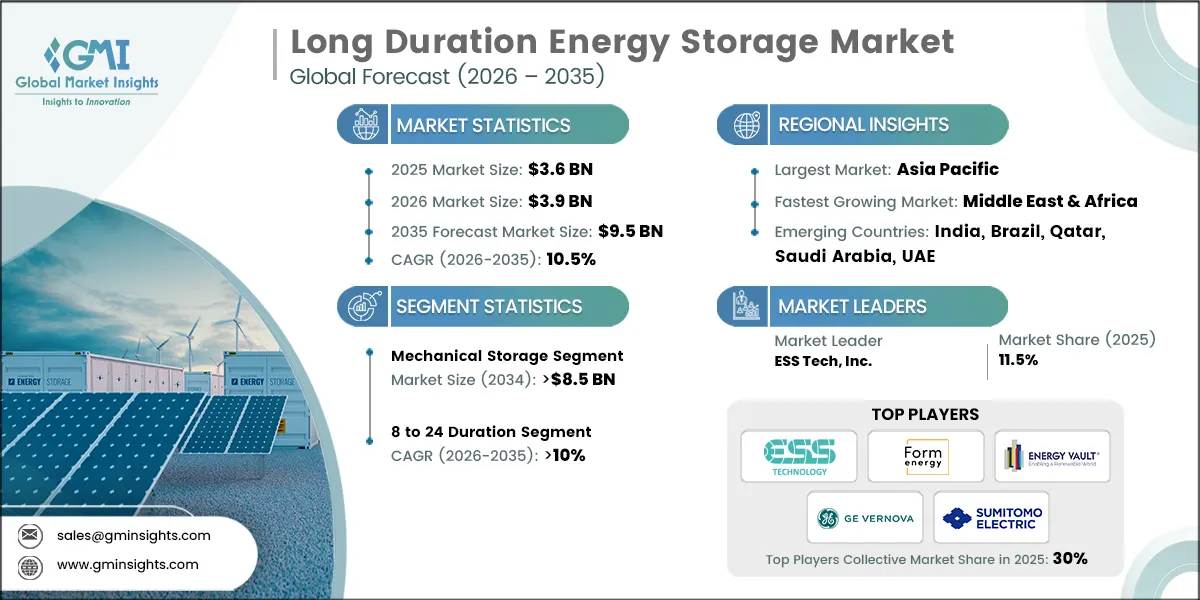
The global long duration energy storage market size was valued at USD 3.6 billion in 2025. The market is expected to grow from USD 3.9 billion in 2026 to USD 9.5 billion in 2035, at a CAGR of 10.5%, according to Global Market Insights Inc.
Long Duration Energy Storage Market Key Takeaways
Market Size & Growth
- 2025 Market Size: USD 3.6 Billion
- 2026 Market Size: USD 3.9 Billion
- 2035 Forecast Market Size: USD 9.5 Billion
- CAGR (2026–2035): 10.5%
Regional Dominance
- Largest Market: Asia Pacific
- Fastest Growing Region: Middle East & Africa
Key Market Drivers
- Favorable regulatory framework.
- Growth in the renewable energy sector.
Challenges
- High capital cost.
Opportunity
- Increasing concerns toward security of supply.
Key Players
- Market Leader: ESS Tech, Inc. led with over 11.5% market share in 2025.
- Leading Players: Top 5 players in this market include Sumitomo Electric, ESS Tech, Form Energy, Energy Vault, Inc., GE Vernova, which collectively held a market share of 30% in 2025.
Get Market Insights & Growth Opportunities
- As renewable energy sources like solar and wind become more prevalent, the need for long-duration energy storage has intensified. Unlike short-duration batteries, LDES systems can store energy for 10 hours or more, making them essential for balancing intermittent generation and ensuring grid reliability. This shift is driven by the growing urgency to decarbonize power systems while maintaining stable electricity supply, especially during multi-day weather events or seasonal fluctuations.
- The U.S. Department of Energy (DOE) has significantly ramped up support for LDES. In 2024, USD 100 million was committed to pilot diverse LDES technologies. These investments are part of broader initiatives like the Energy Storage Grand Challenge and the Long Duration Storage Shot, which aim to reduce costs and accelerate deployment of storage systems that go beyond conventional lithium-ion batteries.
- The long duration energy storage (LDES) market is experiencing rapid growth driven by the global shift toward renewable energy, the need for grid stability, and advancements in storage technologies. As the world strives to reduce carbon emissions and combat climate change, integrating intermittent renewable sources like solar and wind into the energy grid has become paramount. However, these sources are variable and require reliable storage solutions to ensure a continuous power supply, especially during periods of low generation.
- U.S. has emerged as a leader in LDES deployment through its Long Duration Energy Storage Program with multiple investments. For instance, the California Energy Commission allocated over USD 270 million to support non-lithium-ion technologies. Notable projects include a 33 MWh flow battery microgrid at Valley Children’s Hospital, funded with USD 28 million, and a 32 MWh zinc hybrid battery system at a Mojave steel mill, backed by USD 14 million. These projects demonstrate how state-level funding is translating into tangible infrastructure.
- Federal and state programs support a wide range of solutions, including flow batteries, zinc-based systems, thermal storage, and mechanical energy storage. The DOE’s definition of LDES includes systems capable of delivering firm power for 10+ hours, and its funding reflects a commitment to exploring multiple pathways. Reports from national labs like NREL emphasize the importance of moving beyond 4-hour lithium-ion batteries to meet future grid needs.
- Technological advances are also propelling the market forward. Innovations in thermal storage, pumped hydro, compressed air energy storage (CAES), and flow batteries have improved efficiency, lifespan, and cost-effectiveness of long-duration storage systems. For example, flow batteries like vanadium or zinc-based systems offer scalable, durable solutions suitable for grid-scale applications.
- The widespread adoption of smart grids is a major contributor, with over 58% of smart grid investments now incorporating LDES technologies. Additionally, the integration of renewable energy sources like solar and wind into the grid has created a need for advanced systems that can handle distributed energy resources (DERs), manage bi-directional power flows, and maintain grid stability.
To get key market trends
Long Duration Energy Storage Market Trends
- One prominent trend is the diversification of storage technologies. Traditionally dominated by pumped hydro and thermal storage, the market now sees significant growth in battery technologies like flow batteries such as vanadium and zinc-based systems that offer scalability, durability, and cost-effectiveness for multi-day storage. Additionally, emerging technologies like liquid air energy storage (LAES), cryogenic storage, and compressed air energy storage (CAES) are gaining momentum due to their ability to store large amounts of energy.
- In 2024, 12.3 GW (37,143 MWh) of new capacity was installed across the U.S., marking a 33% increase over 2023. California and Texas dominated the rollout, but expansion is underway in states like New Mexico, Oregon, and Arizona, accounting for 30% of Q4 2024 additions. This trend illustrates the broadening adoption of storage infrastructure beyond traditional hubs, signifying rising confidence in LDES as a foundational grid asset.
- The DOE continues to pioneer LDES innovation through its Long Duration Storage Shot, set on slashing costs by 90% for systems delivering electricity for 10+ hours. Via regime-scale funding USD 349 million toward demonstrations and USD 100 million toward pilots the department is encouraging diversified technology adoption, including hydrogen, thermal, flow battery, and mechanical storage. Similarly, NREL’s Storage Futures Study underscores the strategic evolution needed as systems transition from 4-hour to multi-day storage.
- Another key trend is the declining cost of both renewable generation and storage solutions. Technological innovations, economies of scale, and increased competition are driving down costs, making long-duration storage economically viable for utilities and independent power producers. This cost reduction is crucial for widespread adoption, enabling storage to complement renewable projects and facilitate grid balancing without significant subsidies.
- In 2024, the LDES sector attracted USD 2.1 billion in venture capital, USD 1.8 billion in corporate funding, and USD 1.2 billion in government support. This blend demonstrates a robust financing ecosystem where innovative startups and established energy players are jointly funded through public-private partnerships. Substantial federal backing complemented by targeted grant programs has become a critical enabler for large-scale R&D and pilot projects.
- Policy and regulatory support continue to accelerate market growth. Governments worldwide are implementing favorable policies, incentives, and funding programs aimed at promoting long-duration storage deployments. For instance, some regions are establishing integrated resource plans prioritizing storage solutions to achieve renewable energy targets and grid modernization goals. Such policies are fostering a conducive environment for investment and innovation in LDES.
- The market is witnessing a growing emphasis on distributed energy storage systems, including battery storage and microgrids. LDES platforms are evolving to manage these decentralized assets efficiently, ensuring grid stability and resilience. The integration of solar, wind, and other renewables requires sophisticated control systems, and LDES is central to balancing supply and demand in real time. This trend aligns with global decarbonization goals and supports the transition to cleaner energy sources.
Long Duration Energy Storage Market Analysis
Learn more about the key segments shaping this market
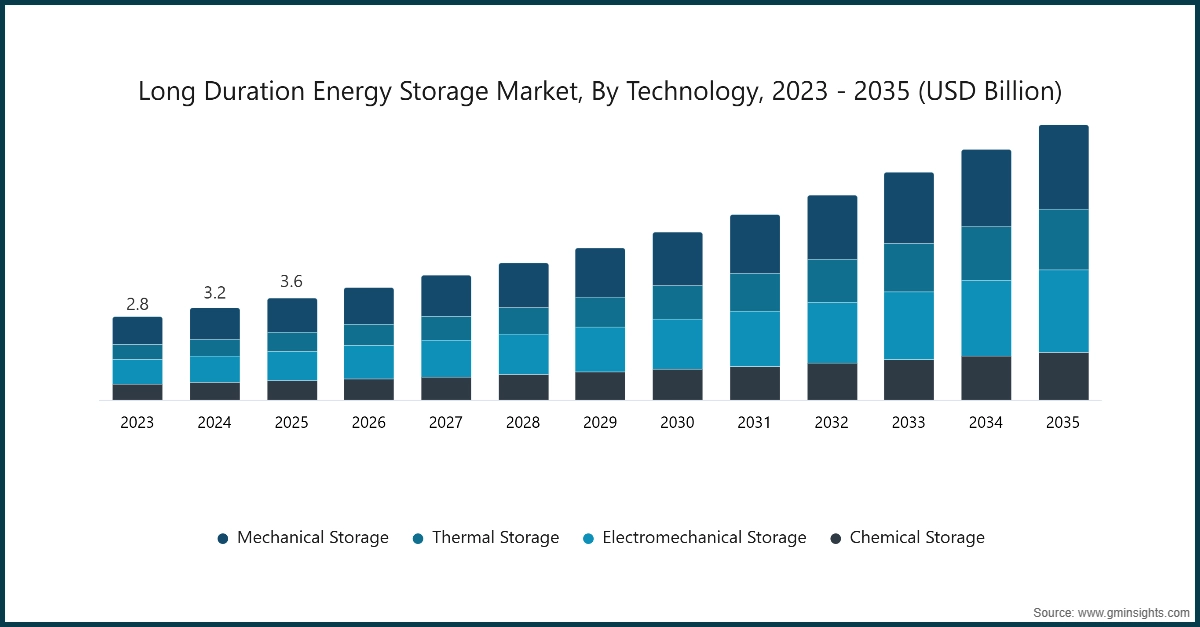
- The long duration energy storage market was valued at USD 2.8 billion, USD 3.2 billion and USD 3.6 billion in 2023, 2024 and 2025 respectively. Mechanical storage encompassing pumped hydro, compressed air (CAES), gravity-based systems, and flywheels forms a robust backbone for grid-level LDES. The mechanical storage segment is anticipated to cross USD 8.5 billion by 2035, underscoring its significance in the broader LDES landscape.
- Thermal energy storage (TES) holds a unique place in long-duration strategies by capturing heat in mediums like molten salts or hot rock to later generate electricity. Within the DOE’s Long-Duration Storage Shot initiative, thermal storage is highlighted as a key R&D pathway to attain cost-effective, firm 10+ hour storage by 2030.
- NREL and ARPA-E support projects like ENDURING, which explore low-cost TES with efficient power cycles demonstrating TES’s potential to deliver affordable, long-duration capacity without relying on conventional chemical batteries. These systems offer exceptional lifespans and lower operational costs, rendering them ideal for extensive applications such as renewable smoothing and industrial resiliency.
- Electromechanical storage majorly represented by flywheels but also including motor-pump/motor-compressor systems leverages kinetic or potential energy. The Brattle report identifies these systems as important for inter-day (10–36 hours) and multi-day (36+ hours) scenarios, particularly as grids integrate deeper renewables. These technologies excel in rapid-response grid services and typically use proven industrial components, enabling faster commercialization and cost efficiencies compared to nascent chemical or thermal options.
- While mechanical systems like pumped hydro and CAES boast cycle efficiencies of 79–98% and massive scale potential, they require specific locations (e.g., caverns or reservoirs). TES systems, conversely, offer flexible modular thermal storage units and tap into abundant thermal resources, benefiting from ongoing R&D support. Electromechanical options provide unmatched responsiveness and modularity, offering grid operators reliable scalability without highly specialized infrastructure.
- Each segment aligns with distinct value propositions in advancing LDES. Mechanical storage serves as a foundation for large-scale, multi-day storage reliably managing variable renewables. Thermal storage offers cost-effective dispatchable power with fewer supply chain vulnerabilities tied to batteries.
- Electromechanical systems bridge current short-duration solutions and future multi-day needs, bringing agility thanks to industrialized, modular platforms. Together, they reflect strategic diversification that supports deep decarbonization, enhances grid resilience, and ensures flexibility for future clean energy systems.
Learn more about the key segments shaping this market
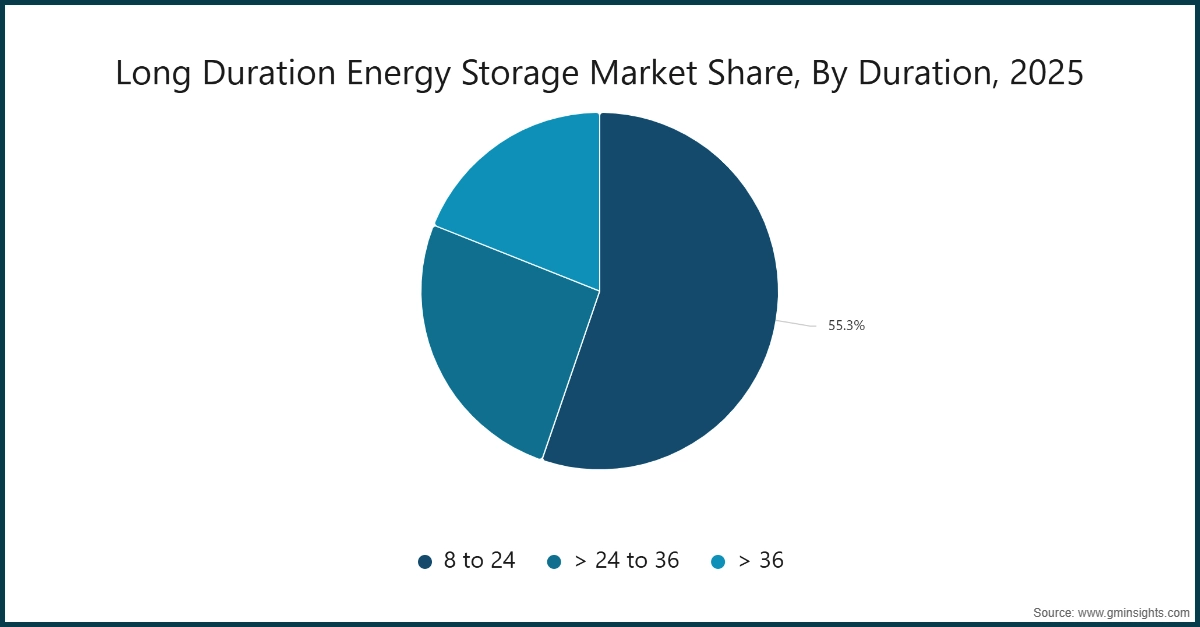
- Based on duration, the 8 to 24 duration segment is expected to grow more than 10% CAGR by 2035. Energy storage systems capable of delivering power for 8–24 hours and >24–36 hours are critical for bridging gaps caused by renewable intermittency. While short-duration batteries handle hourly fluctuations, these segments address daily and multi-day imbalances such as prolonged cloudy or windless periods. This capability ensures uninterrupted power supply and reduces reliance on fossil-fuel peaker plants, aligning with decarbonization goals.
- The U.S. Department of Energy (DOE) explicitly targets these segments through its Long Duration Storage Shot, aiming for cost reductions of 90% by 2030 for systems delivering 10+ hours of firm power. DOE allocated USD 349 million for demonstration-scale projects and USD 100 million for pilots, prioritizing technologies that can sustain power beyond 24 hours. These investments underscore the strategic importance of multi-day storage for future grid resilience.
- The 8–24 hour segment is dominated by advanced flow batteries, thermal storage, and compressed air systems. For instance, California’s Long Duration Energy Storage Program funded a 33 MWh flow battery microgrid at Valley Children’s Hospital with USD 28 million, designed to provide extended backup during outages. Such projects highlight how this segment supports critical infrastructure and renewable integration at scale.
- Storage systems exceeding 24 hours including iron-air batteries, hydrogen-based solutions, and gravity storage are emerging as game-changers. Companies are piloting iron-air batteries capable of 100-hour discharge, directly addressing multi-day reliability needs. DOE and ARPA-E have backed similar projects under programs like ENDURING, which combine thermal storage with efficient power cycles to deliver affordable multi-day energy.
- Together, these segments form the backbone of a decarbonized grid. The 8–24 hour range ensures daily balancing, while >24–36 hour systems provide resilience during extreme weather or seasonal variability. With hundreds of millions in federal and state funding and growing private investment, these technologies are moving from concept to commercialization, making them indispensable for achieving 100% clean energy targets.
 Looking for region specific data?
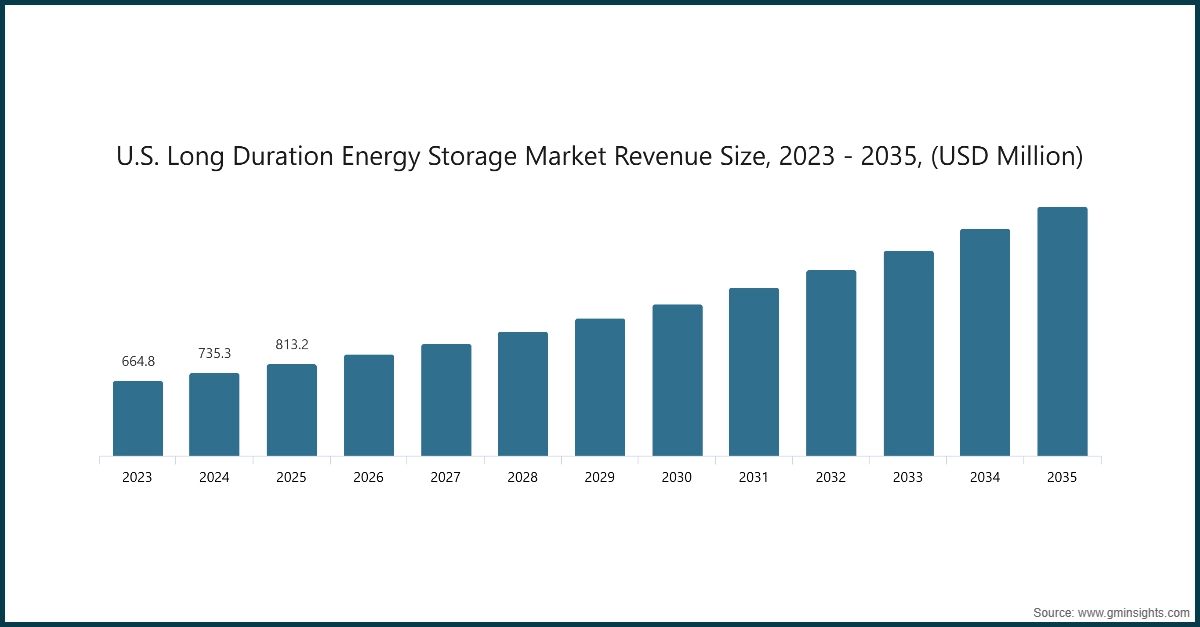
 - The U.S. long duration energy storage market in 2023, 2024 and 2025 was valued at USD 664.8 million, USD 735.3 million and USD 813.2 million respectively. This consistent upward trend reflects increasing confidence in LDES technologies as essential components of grid modernization. The growth demonstrates a clear trajectory toward scaling solutions that can handle renewable intermittency and enhance grid reliability.
- By the end of 2024, China had amassed around 73.76 GW (168 GWh) of cumulative new energy storage capacity, a staggering more than 40% of the global total reflecting over 130% year-over-year growth. This makes China the world’s leader in both total capacity and deployment rate, driven by the urgent need to manage its rapidly expanding solar and wind resources.
- China has embedded new-type energy storage defined as systems beyond pumped hydro into strategic national policy. In March 2022, the National Development and Reform Commission (NDRC) and National Energy Administration (NEA) set a target for 30 GW of new storage capacity by 2025 via the “New Energy Storage Development Implementation Plan.” By 2024, this target had already been surpassed, prompting the launch of a three-year action plan (2025–27) aiming for 180 GW of new-type storage and USD 35 billion in investment.
- Europe is a global leader in renewable energy adoption, with countries like Germany, Spain, and Denmark achieving high penetration of wind and solar. This creates a pressing need for LDES to manage variability and ensure grid stability. The European Union’s commitment to achieving net-zero emissions by 2050 and its interim target of 55% emissions reduction by 2030 makes LDES indispensable for balancing intermittent renewables and reducing reliance on fossil backup systems.
- The EU has embedded energy storage into its Fit for 55 and REPowerEU strategies, allocating billions of euros for innovation and deployment. Programs like Horizon Europe and the Innovation Fund have funded large-scale LDES projects, including thermal and mechanical storage pilots. For instance, the EU Innovation Fund awarded USD 118 million to Highview Power for a liquid air energy storage facility in Spain, capable of delivering multi-hour to multi-day storage.
- Similarly, The Middle East region is deploying innovative LDES technologies such as molten salt thermal storage and pumped hydro. Oman’s Green Hydrogen Hub and Saudi Arabia’s NEOM project incorporate multi-day storage solutions to stabilize renewable generation and support green hydrogen production. These projects highlight the Middle East’s role as a testing ground for advanced storage technologies.
Long Duration Energy Storage Market Share
Top 5 companies including Sumitomo Electric, ESS Tech, Form Energy, Energy Vault, Inc., and GE Vernova hold more than 30% market around the world. The major companies consistently work on new products and solutions which makes them a crucial part of the industry globally. These companies place a high focus on investment, especially on research and development. Besides, these companies apply different methods of market development in order to obtain considerable shares in the industry.
Long Duration Energy Storage Market Companies
- Sumitomo Electric is a pioneer in vanadium redox flow battery technology for long-duration energy storage. Its systems deliver unlimited cycling, high safety, and scalability for grid applications. By enabling renewable integration and peak-shaving, Sumitomo positions LDES as a critical enabler of Japan’s carbon neutrality goals and global decarbonization strategies.
- MAN Energy Solutions drives LDES through its Electro-Thermal Energy Storage (ETES) technology, converting electricity into heat and cold for later reconversion. ETES enables multi-hour storage, industrial decarbonization, and district heating. Integrated with digital controls, MAN’s approach enhances grid stability and supports Europe’s transition to low-carbon energy systems.
Major players operating in the long duration energy storage industry are:
- Sumitomo Electric: Sumitomo offers vanadium redox flow battery systems designed for grid-scale applications. Their technology provides unlimited cycling, high safety, and long-duration energy storage, supporting renewable integration and peak-shaving with proven deployments in Japan and globally.
- ESS Tech, Inc.: ESS specializes in iron-flow battery solutions delivering up to 12+ hours of storage. Their systems use earth-abundant materials, offering long life, non-flammable chemistry, and low-cost scalability for utility and industrial applications.
- EOS Energy Enterprise: EOS develops zinc hybrid cathode batteries optimized for 3–12-hour durations. Their technology is robust in extreme temperatures, requires minimal maintenance, and is suited for renewable integration and microgrid reliability.
- Invinity Energy Systems: Invinity provides modular vanadium flow batteries for 8–24-hour storage. Their systems enable high cycling, long life, and safe operation, ideal for commercial, industrial, and grid-scale renewable projects.
- Energy Vault, Inc.: Energy Vault delivers gravity-based energy storage systems using heavy composite blocks and cranes. Their technology offers multi-hour to multi-day storage, low degradation, and sustainable materials for large-scale grid applications.
- MAN, Energy Solutions: MAN offers Electro-Thermal Energy Storage (ETES) systems that convert electricity into heat and cold for later reconversion. These systems provide long-duration storage and support industrial decarbonization and district heating.
- Highview Power: Highview Power develops liquid air energy storage (LAES) plants capable of delivering multi-day storage. Their technology uses cryogenic processes, offering large-scale, zero-emission solutions for grid balancing and renewable integration.
- Primus Power: Primus Power manufactures zinc-bromide flow batteries with 20-year lifespans. Their systems provide long-duration storage with high efficiency and minimal maintenance, targeting utility and microgrid applications.
- CMBlu Energy AG: CMBlu offers Organic SolidFlow batteries based on renewable materials. Their technology provides safe, scalable, and sustainable long-duration storage for grid and industrial use.
- Malta Inc.: Malta develops pumped-heat energy storage systems using molten salts and chilled liquids. Their technology delivers 10+ hours of storage, enabling flexible, cost-effective solutions for renewable-heavy grids.
- RheEnergise Limited: RheEnergise focuses on high-density pumped hydro systems using “High-Density Fluid” for gravity storage. Their approach enables deployment in hilly terrains, offering long-duration storage without large reservoirs.
- QuantumScape Battery, Inc.: QuantumScape is advancing solid-state battery technology for extended duration and high energy density. Their systems aim to deliver safer, faster-charging solutions for grid and mobility applications.
- Form Energy: Form Energy develops iron-air batteries capable of 100-hour discharge. Their technology provides ultra-low-cost, multi-day storage, addressing seasonal and extreme weather reliability challenges for renewable grids.
- Alsym Energy, Inc.: Alsym develops non-lithium aqueous battery systems designed for grid-scale and industrial applications. Their technology emphasizes safety, cost-effectiveness, and sustainability, offering multi-hour storage without reliance on scarce or flammable materials.
- Ambri Incorporated: Ambri provides liquid metal battery solutions for long-duration storage. Their systems deliver high cycle life, low degradation, and cost efficiency, targeting renewable integration and large-scale grid reliability.
- VFlowTech Pte. Ltd. VFlowTech specializes in vanadium redox flow batteries for 8–24-hour storage. Their modular systems offer scalability, long life, and safe operation, supporting commercial and utility-scale renewable projects.
- VoltStorage: VoltStorage manufactures iron flow batteries for stationary energy storage. Their technology delivers sustainable, long-duration storage with high safety and minimal maintenance, ideal for residential and industrial applications.
- MGA Thermal Pty. Ltd.: MGA Thermal focuses on thermal energy storage using modular blocks that store heat for later conversion to electricity. Their solution supports long-duration storage for renewable-heavy grids and industrial decarbonization.
- Rondo Energy, Inc.: Rondo Energy offers thermal storage systems that capture renewable electricity as heat for industrial processes. Their technology provides zero-emission, cost-effective solutions for sectors requiring high-temperature energy.
- Lina Energy Ltd.: Lina Energy develops sodium-based battery systems for long-duration storage. Their technology emphasizes affordability, safety, and scalability, targeting grid and renewable integration applications.
- e-Zinc Inc.: e-Zinc delivers zinc-based electrochemical storage systems capable of multi-day discharge. Their technology is designed for resilience, low cost, and long life, supporting remote and renewable-powered grids.
- GE Vernova: GE Vernova offers comprehensive energy storage solutions, including long-duration thermal and chemical storage technologies. Their systems aim to deliver reliable, scalable energy storage for grid resilience, renewable integration, and decarbonization efforts, emphasizing operational efficiency and grid modernization.
- Enersys: Enersys provides long-duration energy storage solutions primarily through advanced flow and lithium-ion battery systems. Their products are designed for grid stabilization, renewable energy support, and backup power, emphasizing durability, scalability, and optimized performance for utility-scale.
- LG Energy Solutions: LG Energy Solutions offers advanced long-duration energy storage systems featuring high-capacity lithium-ion batteries. These solutions focus on scalable, reliable energy storage for grid stabilization, renewable integration, and energy security, emphasizing innovation, safety, and sustainability in supporting a cleaner energy future.
- Storelectric Ltd.: Storelectric specializes in compressed air energy storage (CAES) solutions for large-scale, long-duration applications. Their systems offer grid balancing, seasonal storage, and high efficiency for renewable integration.
Long Duration Energy Storage Market Report Attributes
| Key Takeaway | Details |
|---|---|
| Market Size & Growth | |
| Base Year | 2025 |
| Market Size in 2025 | USD 3.6 Billion |
| Market Size in 2026 | USD 3.9 Billion |
| Forecast Period 2026-2035 CAGR | 10.5% |
| Market Size in 2035 | USD 9.5 Billion |
| Key Market Trends | |
| Drivers | Impact |
| Favorable regulatory framework | Supportive policies like tax incentives, renewable portfolio standards, and storage mandates accelerate LDES adoption. Governments in regions such as the U.S., EU, and China fund pilot projects and set targets for multi-hour storage, creating a stable environment for investment and commercialization of advanced storage technologies. |
| Growth in the renewable energy sector | Rapid expansion of solar and wind power drives demand for LDES to manage intermittency and ensure grid reliability. As renewable penetration rises globally, multi-hour and multi-day storage becomes essential for balancing supply and demand, reducing curtailment, and supporting decarbonization goals across diverse energy markets. |
| Pitfalls & Challenges | Impact |
| High capital cost | LDES technologies often require significant upfront investment for infrastructure, materials, and installation. Systems like flow batteries, thermal storage, and compressed air demand specialized components and large-scale facilities, making initial costs high. This creates barriers for widespread adoption, especially in emerging markets without strong subsidies or financing support. |
| Opportunities: | Impact |
| Increasing concerns toward security of supply | Growing risks of energy shortages and geopolitical disruptions are driving utilities and governments to prioritize reliable power. LDES offers multi-hour and multi-day storage, ensuring continuous electricity during extreme weather or supply interruptions. This positions LDES as a strategic solution for energy security and resilience in global markets. |
| Market Leaders (2025) | |
| Market Leader |
11.5% market share |
| Top Players |
Collective market share of 30% |
| Competitive Edge |
|
| Regional Insights | |
| Largest Market | Asia Pacific |
| Fastest growing market | Middle East & Africa |
| Emerging countries | India, Brazil, Qatar, Saudi Arabia, UAE |
| Future outlook |
|
What are the growth opportunities in this market?
Long Duration Energy Storage Industry News
- In September 2025, ESS Tech commissioned a 10 MW / 100 MWh iron-flow battery system at a renewable energy hub in California. The installation supports 12-hour discharge, enabling grid operators to balance solar variability and enhance resilience during peak demand. The project is part of a state-backed initiative to scale non-lithium LDES technologies.
- In July 2025, Sumitomo Electric announced the completion of a 60 MWh vanadium redox flow battery system integrated with a wind farm in Hokkaido. The system provides long-duration storage for up to 24 hours, improving renewable utilization and grid stability. This milestone aligns with Japan’s national strategy to achieve carbon neutrality by 2050.
- In August 2025, Form Energy broke ground on its first commercial-scale iron-air battery manufacturing facility in West Virginia. The plant will produce multi-day storage systems capable of 100-hour discharge, supporting utilities in managing seasonal variability and extreme weather resilience.
This long duration energy storage market research report includes in-depth coverage of the industry with estimates & forecast in terms of “USD Million” from 2022 to 2035, for the following segments:
Market, By Technology
- Mechanical Storage
- Thermal Storage
- Electromechanical Storage
- Chemical Storage
Market, By Duration
- 8 to 24
- > 24 to 36
- > 36
Market, By Capacity
- Up to 50 MW
- 50-100 MW
- More than 100 MW
Market, By Application
- Grid Management
- Power Backup
- Renewable Energy Integration
- Off Grid & Microgrid Systems
The above information has been provided for the following regions and countries:
- North America
- U.S.
- Canada
- Mexico
- Europe
- UK
- France
- Germany
- Italy
- Russia
- Spain
- Asia Pacific
- China
- Australia
- India
- Japan
- South Korea
- Middle East & Africa
- Saudi Arabia
- UAE
- Turkey
- South Africa
- Egypt
- Latin America
- Brazil
- Argentina
Frequently Asked Question(FAQ) :
What is the market size of the long duration energy storage in 2025?
The market size was USD 3.6 billion in 2025, with a CAGR of 10.5% expected through 2035, driven by renewable energy integration, favorable regulatory frameworks, and increasing demand for grid stability solutions beyond conventional lithium-ion batteries.
What is the projected value of the long duration energy storage market by 2035?
The long duration energy storage market is expected to reach USD 9.5 billion by 2035, propelled by declining costs of storage technologies, and growing energy security concerns driving multi-hour and multi-day storage adoption globally.
What is the current long duration energy storage market size in 2026?
The market size is projected to reach USD 3.9 billion in 2026.
What is the projected value of the mechanical storage segment by 2035?
The mechanical storage segment is anticipated to cross USD 8.5 billion by 2035, supported by its proven reliability, high cycle efficiencies of 79–98%, and suitability for large-scale multi-day grid storage applications.
What was the valuation of the U.S. long duration energy storage market in 2025?
The U.S. long duration energy storage market was valued at USD 813.2 million in 2025, supported by federal DOE investments, state-level funding programs, and increasing deployment of non-lithium LDES technologies across key states.
What is the growth outlook for the 8 to 24 hour duration segment from 2026 to 2035?
The 8 to 24 hour duration segment is expected to grow at more than 10% CAGR through 2035, driven by growing deployment of advanced flow batteries, thermal storage, and compressed air systems for daily grid balancing.
Which region leads the long duration energy storage market?
Asia Pacific leads as the largest market, with China alone accounting for around 73.76 GW of cumulative new energy storage capacity by end of 2024, representing over 40% of global total, driven by rapid solar and wind expansion and ambitious national storage deployment targets.
What are the upcoming trends in the long duration energy storage market?
Key trends include diversification of storage technologies beyond pumped hydro into flow batteries, liquid air, and gravity storage systems, growing emphasis on distributed energy storage and microgrids, increasing public-private investment partnerships, and advancing iron-air battery technology capable of 100-hour discharge for multi-day resilience.
Who are the key players in the long duration energy storage market?
Key players include Sumitomo Electric, ESS Tech, EOS Energy Enterprise, Invinity Energy Systems, Energy Vault, MAN Energy Solutions, Highview Power, Primus Power, CMBlu Energy, Malta Inc., RheEnergise, QuantumScape, Form Energy, Alsym Energy, Ambri, VFlowTech, VoltStorage, MGA Thermal, Rondo Energy, Lina Energy, e-Zinc, GE Vernova, Enersys, LG Energy Solutions, and Storelectric.
Long Duration Energy Storage Market Scope
Related Reports