Summary
Table of Content

Logic IC Market
Get a free sample of this report
Form submitted successfully!
Error submitting form. Please try again.
Thank you!
Your inquiry has been received. Our team will reach out to you with the required details via email. To ensure that you don't miss their response, kindly remember to check your spam folder as well!
Request Sectional Data
Thank you!
Your inquiry has been received. Our team will reach out to you with the required details via email. To ensure that you don't miss their response, kindly remember to check your spam folder as well!
Form submitted successfully!
Error submitting form. Please try again.
Logic IC Market Size
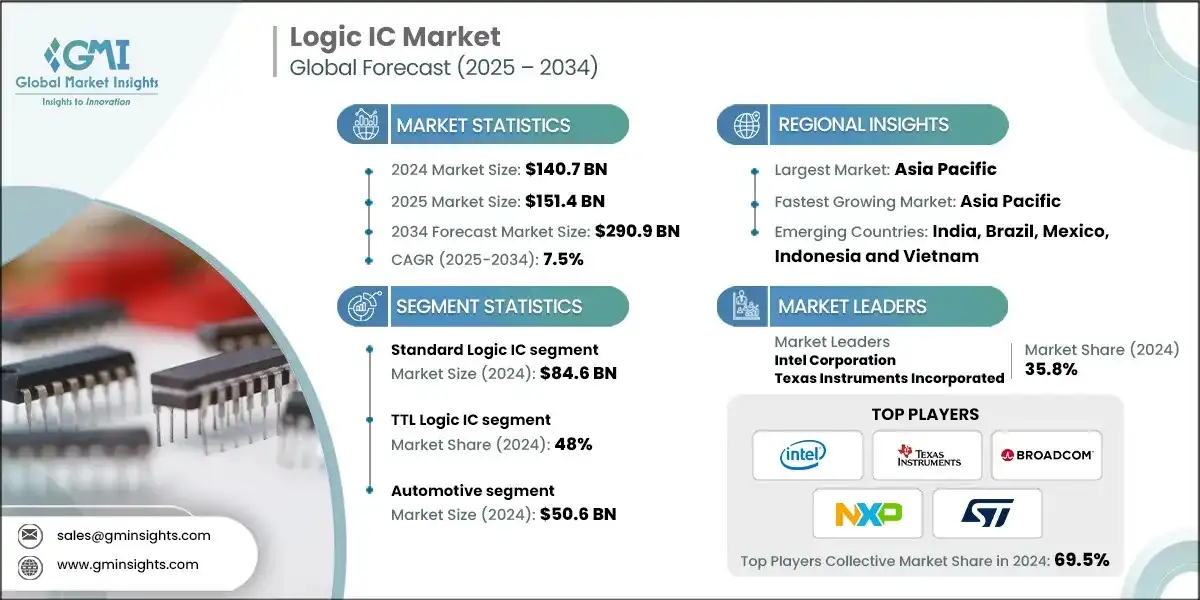
The global logic IC market was valued at USD 140.7 billion in 2024 with a volume of 1,45,28,055 units. The market is expected to grow from USD 151.4 billion in 2025 to USD 210.5 billion in 2030 and USD 290.9 billion in 2034, growing at a CAGR of 7.5% during the forecast period of 2025-2034, according to Global Market Insights Inc.
Logic IC Market Key Takeaways
Market Size & Growth
- 2024 Market Size: USD 140.7 billion
- 2034 Forecast Market Size: USD 290.9 billion
- CAGR (2025–2034): 7.5%
Key Market Drivers
- Growing demand from industrial automation and smart manufacturing.
- Advancements in 16-bit and BiCMOS logic IC technologies.
- Integration of logic ICs in automotive electronics and ADAS.
- Use of logic ICs in consumer electronics and edge computing devices.
- Expansion of logic IC deployment in telecommunications and data center infrastructure.
Challenges
- High implementation and upgrade costs.
- Competition from alternative processing and integration technologies.
Opportunity
- Increasing adoption of logic ICs in emerging computing applications.
- Advancements in logic IC design and optimization technologies.
Key Players
- Market Leader: Intel Corporation led with over 35.8% market share in 2024.
- Leading Players: Top 5 players in this market include Intel Corporation, Texas Instruments Incorporated, Broadcom Inc., NXP Semiconductors N.V., STMicroelectronics N.V., which collectively held a market share of 69.5% in 2024.
Get Market Insights & Growth Opportunities
- The growing demand for high-speed data processing and complex computational capabilities in cloud computing and AI-driven environments is a key driver of the Logic IC market. Also, enterprises and cloud service providers are increasingly integrating advanced logic ICs such as programmable logic devices and custom ASICs to support faster processing, improved energy efficiency, and enhanced workload management. This high demand is further expected to support the growth to the global market.
- The shift towards next-generation logic IC technologies, including advanced CMOS nodes and low-power designs, is significantly accelerating market growth. Emerging logic ICs provide higher transistor densities, improved processing speeds, and lower power consumption, which are critical for handling complex applications.
- Moreover, logic ICs are increasingly used in edge AI devices, high-performance gaming systems, industrial automation, and automotive electronics including advanced driver-assistance systems (ADAS) and autonomous driving controllers which is another factor expected to positively impact the market growth.
- In 2024, North America held a 26.1% share of the global logic IC market, driven by rapid expansion of hyperscale data centers across the United States and Canada. The region’s strong position is further reinforced by significant investments in AI, cloud computing, and edge computing technologies from major tech companies such as Google, Amazon, and Microsoft. Additionally, growing demand for high-performance logic ICs in enterprise servers, industrial automation, and next-generation consumer electronics continues to bolster North America’s leadership in this market.
To get key market trends
Logic IC Market Trends
- Recent trend observed in the market is advancement in semiconductor nodes and packaging technologies. The transition to sub-5nm process nodes in logic ICs is accelerating globally, with FinFET and Gate-All-Around (GAA) technologies enabling enhanced performance and energy efficiency. Since 2021, the industrial logic IC sector has seen significant adoption of nodes smaller than 10 nm, driving growth at a projected 18.2% CAGR. This trend is expected to continue through 2030 as demand for high-performance, low-power logic solutions in edge-AI, HPC, and automotive applications intensifies.
- Intelligent industrial systems, autonomous mobility solutions, and edge computing devices are increasingly leveraging sophisticated Logic ICs for real-time signal processing, decision-making, and hardware-level control. These systems are rapidly evolving beyond conventional architectures, driving demand for programmable logic devices, embedded processors, and application-optimized logic ICs in fields such as robotics, ADAS, and factory automation. Since 2020, adoption has surged and is expected to accelerate further by 2030, spurred by the need for precision, performance, and reliability in connected ecosystems.
- Enterprise-grade system-on-chip (SoC) platforms and logic-based orchestration frameworks are enhancing the deployment, diagnostics, and lifecycle management of Logic ICs across data-centric industries. These solutions are gaining traction in sectors like telecommunications, finance, and high-performance computing due to their ability to deliver real-time system control, remote configurability, and enhanced computational throughput. Since 2020, infrastructure operators have significantly increased investments in intelligent logic solutions to meet escalating requirements for performance, uptime, and security that will define the next decade.
Logic IC Market Analysis
Learn more about the key segments shaping this market
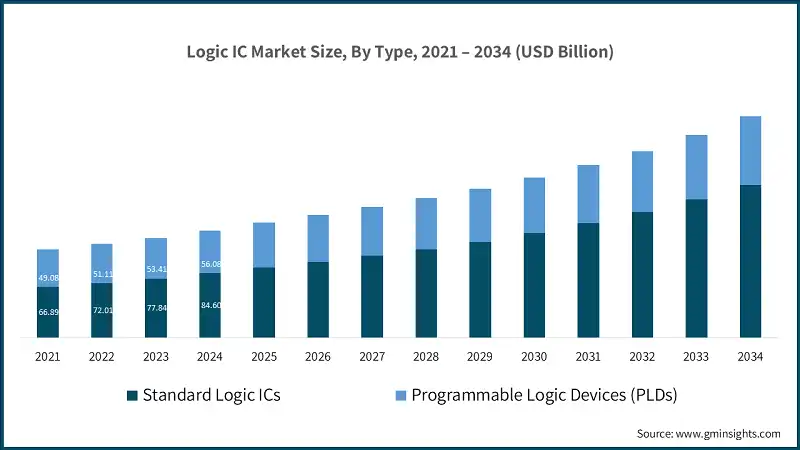
Based on the type, the market is segmented into standard logic ICs, programmable logic devices (PLDs).
- In 2024, the Standard Logic IC segment was valued at USD 84.6 billion. This segment’s dominance is due to its extensive application across consumer electronics, computing devices, and general-purpose industrial equipment. The increasing demand for affordable, reliable, and high-performance logic ICs in smartphones, PCs, IoT devices, and embedded systems continues to fuel market growth. The surge in smart home technology, digital transformation, and widespread adoption of connected devices has further strengthened the role of standard logic ICs.
- To address evolving consumer and small office/home office (SOHO) needs, manufacturers are investing heavily in R&D to develop high-speed, low-power, and highly integrated logic ICs compatible with the latest semiconductor technologies. Innovations focus on reducing power consumption, improving processing speeds, and enhancing integration density to support more complex functions in smaller footprints.
- The standard logic IC segment is projected to grow at a robust CAGR of 9% between 2025 and 2034. This growth is fueled by the ongoing demand for cost-effective, high-performance logic ICs across consumer electronics, home-office equipment, and small to medium business applications. The transition to more advanced, power-efficient semiconductor technologies is accelerating the adoption of next-generation standard logic ICs, which deliver enhanced speed and integration capabilities.
- To leverage this opportunity, manufacturers should focus on developing high-speed, thermally efficient logic ICs that meet the evolving requirements of modern chipsets and system architectures. Prioritizing energy efficiency, broad compatibility, and cost competitiveness will be essential for capturing market share among OEMs and end-users.
Learn more about the key segments shaping this market
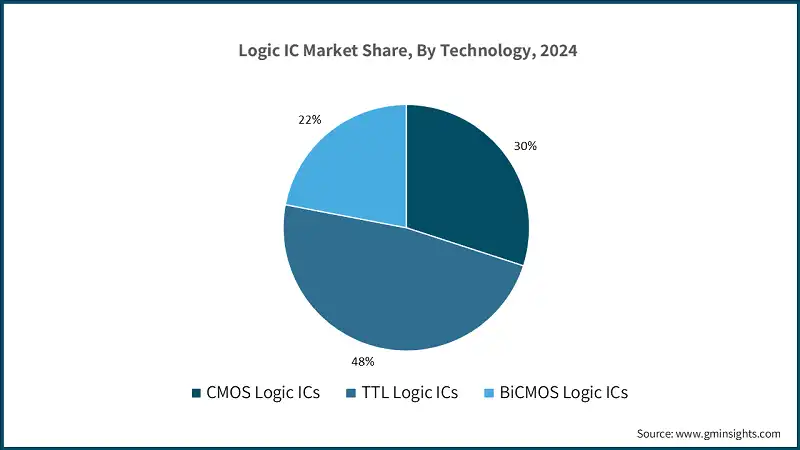
On the basis of technology, the logic IC market is divided into CMOS Logic ICs, TTL Logic ICs, BiCMOS Logic ICs
- The TTL Logic IC segment held a significant market share of 48% in 2024, driven by its widespread use in industrial applications, legacy systems, and specialized computing environments. TTL logic ICs are valued for their robust performance, reliability, and compatibility with established electronic systems, making them crucial in sectors such as automotive electronics, telecommunications, and embedded control systems.
- The continued demand for TTL logic ICs is supported by industries requiring low-latency logic components, especially in applications where stability and proven technology take precedence over the latest innovations.
- The BiCMOS logic IC segment is expected to grow at a robust CAGR of 11.2% from 2025 to 2034, driven by increasing adoption in high-performance computing, AI accelerators, and next-generation communication platforms. BiCMOS technology offers superior speed, power efficiency, and analog-digital integration capabilities compared to traditional logic ICs, making it essential for complex and mixed-signal applications across data centers, telecom infrastructure, and advanced industrial systems.
- To capitalize on this growth, manufacturers should focus on developing scalable, high-density BiCMOS logic ICs with enhanced thermal management, integrated power management circuits, and improved error correction features. Strategic partnerships with OEMs, cloud service providers, and chipset designers will be critical to broaden adoption across multiple industries. Additionally, aligning product development with emerging standards like CXL and PCIe Gen6 will ensure long-term competitiveness and seamless integration into future computing architectures.
Based on end use industry, the market is segmented into automotive, consumer electronics, industrial, healthcare, aerospace & defense
- The automotive segment dominated the automotive logic IC market in 2024, generating USD 50.6 billion in revenue. This high market value is by extensive use of IC’s in automotive electronics, including advanced driver-assistance systems (ADAS), infotainment, powertrain control, and safety modules. The rising complexity of vehicle systems, electrification, and connected car technologies is fueling demand for these ICs.
- Manufacturers should focus on improving 16-bit logic ICs with enhanced processing speeds, reduced power consumption, and higher thermal resilience tailored for automotive environments. Incorporating features such as integrated diagnostics, and compliance with automotive safety standards (like ISO 26262) can offer significant product differentiation. Strategic partnerships with automotive OEMs, Tier 1 suppliers, and autonomous vehicle technology providers will be critical to expanding market reach and driving sustained growth in this sector.
- The industrial segment is projected to register the highest CAGR of 8.8% from 2025 to 2034, driven by the increasing adoption of logic ICs in advanced automation, robotics, and smart manufacturing systems. Logic ICs play a vital role in enhancing processing speed, energy efficiency, and reliability in complex industrial environments, supporting real-time control, predictive maintenance, and IoT-enabled equipment.
- To capitalize on this growth, manufacturers should focus on developing robust, high-performance logic ICs tailored for industrial applications with enhanced thermal stability, low power consumption, and superior noise immunity. Incorporating features such as integrated diagnostics, fault tolerance, and compatibility with emerging industrial communication standards will be key differentiators. Building strategic partnerships with industrial OEMs, system integrators, and IoT solution providers will help expand market reach and drive innovation in smart factory ecosystems.
Looking for region specific data?
The North America held a market share of 26.15% in the logic IC market in 2024, driven by the strong presence of data centers, early adoption of advanced logic IC technologies, and widespread use of high-performance computing systems across sectors such as IT & telecom, gaming, and enterprise infrastructure. The region’s leadership is further supported by significant investments in AI, cloud services, and digital transformation initiatives, which continue to drive demand for cutting-edge logic ICs.
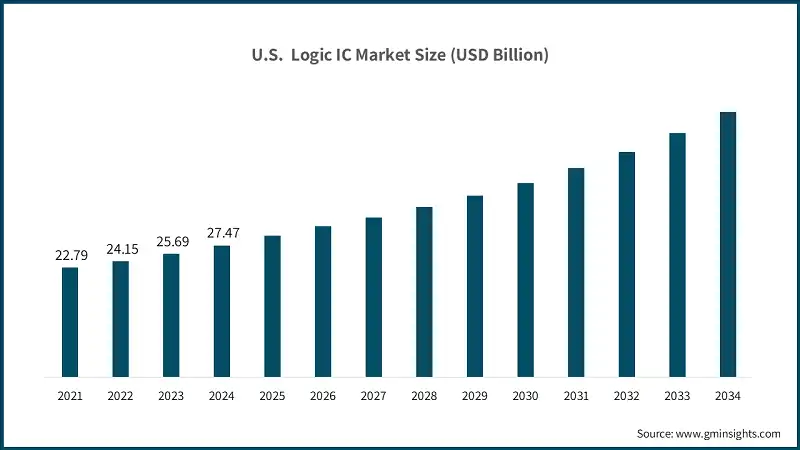
- In 2024, the U.S. logic IC market accounted for USD 27.47 billion, driven by strong adoption of high-performance computing solutions across cloud service providers, government agencies, and enterprises. The rising demand for advanced logic ICs in AI training, data analytics, and server virtualization is significantly contributing to this growth. Additionally, the U.S. continues to lead in gaming hardware sales and professional content creation, further boosting demand for high-speed and high-efficiency logic ICs.
- To strengthen their foothold in the U.S. market, manufacturers should focus on developing cutting-edge logic IC solutions tailored for next-generation data centers, enterprise workstations, and gaming platforms. Strategic collaborations with major cloud infrastructure providers, system integrators, and workstation OEMs will be crucial to capitalize on this growing demand.
- Canada logic IC market is projected to grow at a CAGR of 4.9% during the forecast period, supported by steady modernization of IT infrastructure, increasing adoption of cloud computing, and growing investments in digital transformation initiatives across sectors such as education, government, and healthcare. While growth is moderate, the shift toward advanced logic IC technologies for enterprise and public sector applications is expected to create new opportunities for semiconductor manufacturers.
- To capitalize on the Canada market, logic IC vendors should focus on building strong partnerships with local system integrators, government procurement agencies, and managed service providers that will be critical to expanding market penetration.
Europe logic IC market is projected to grow at a CAGR of 7.1% during 2025–2034. This growth is driven by ongoing investments in expanding data center capacities, the increasing adoption of cloud-based enterprise solutions, and rising demand for advanced logic ICs in automotive electronics and industrial automation sectors. Europe’s focus on digital sovereignty, AI integration, and smart manufacturing through initiatives such as “Digital Europe” and “Industry 5.0” is further accelerating the deployment of cutting-edge semiconductor technologies across multiple industries.
- Germany logic IC market is projected to reach USD 10.7 billion by 2034, fueled by the country’s strong industrial foundation, growth in data-intensive sectors, and increasing adoption of advanced computing solutions across automotive, manufacturing, and research domains. Germany’s focus on Industry 4.0, AI integration, and automation is driving demand for high-performance logic ICs used in industrial control systems, robotics, and embedded applications. Government initiatives supporting digitization in SMEs and public infrastructure further enhance the uptake of scalable and reliable logic IC technologies.
- Logic IC manufacturers aiming to expand in the German market should prioritize the development of energy-efficient, durable chips optimized for long lifecycle industrial use, high-precision engineering, and enterprise IT infrastructure. Adherence to European data security and environmental standards is essential. Strategic partnerships with German automotive OEMs, industrial automation companies, and research institutions will be key to capturing growth opportunities in this innovation-driven economy.
- UK logic IC market accounted for USD 8.6 billion in 2024, driven by the country’s advanced IT infrastructure, early adoption of cloud computing, and strong demand for high-performance logic ICs across financial services, media, and academic research sectors. The accelerating focus on AI, data analytics, and digital transformation across industries is fueling the need for reliable, low-latency, and high-speed logic integrated circuits. Furthermore, government initiatives promoting smart manufacturing and data center modernization are boosting the adoption of advanced logic IC solutions.
- To capitalize on the UK market, logic IC manufacturers should prioritize enterprise-grade chips optimized for latency-sensitive workloads and hybrid cloud environments. Forming strategic partnerships with fintech firms, public sector bodies, and local system integrators. Leveraging the UK’s leadership in financial innovation and AI research can provide a significant competitive advantage, driving broader adoption of next-generation logic IC technologies in mission-critical applications.
Asia Pacific accounted for 32.8% of the logic IC market in 2024, propelled by rapid expansion in electronics manufacturing, growing cloud infrastructure, and increasing adoption of AI, edge computing, and IoT technologies across key economies such as China, India, Japan, and South Korea. Government initiatives focused on digitization, rising consumer demand for high-performance devices, and the flourishing gaming and e-commerce sectors are driving strong growth in advanced logic IC adoption throughout the region.
- China logic IC market is projected to grow at a CAGR of 7% during the forecast period 2025–2034, driven by the country’s rapid advancements in AI development, expanding cloud infrastructure, and robust electronics manufacturing sector. The surge in data center construction, increasing demand from hyperscale server operators, and growth of smart industrial zones are fueling the need for high-performance logic ICs. China’s strategic role as a global semiconductor hub and innovation center further amplifies domestic demand for advanced logic IC technologies.
- To capitalize on China’s dynamic computing and industrial ecosystem, logic IC manufacturers should focus on localized product innovation and forge partnerships with leading Chinese OEMs, cloud service providers, and AI enterprises.
- Japan Logic IC market is expected to reach USD 18.4 billion by 2034, driven by the country’s advanced electronics industry, growing demand for high-performance logic ICs in industrial automation, and widespread adoption of AI-driven applications. Japan’s leadership in robotics, automotive innovation, and semiconductor manufacturing is fueling continuous investments in computing infrastructure that relies on scalable, energy-efficient logic IC solutions.
- To capture growth opportunities in Japan, logic IC manufacturers should prioritize high-reliability products tailored for industrial IoT, automotive-grade systems, and advanced robotics applications. Collaborations with local OEMs and component suppliers will be crucial for deeper market penetration. Emphasizing compliance with Japan’s stringent quality standards and supporting edge computing deployments will further enhance competitiveness in this precision-driven market.
- India Logic IC market is expected to grow at a robust CAGR of 11.3% during the forecast period from 2025 to 2034, driven by rapid digital transformation, expansion of data centers, and government initiatives such as Make-in-India and Digital India. The increasing adoption of cloud computing, AI/ML applications, and enterprise digitization across BFSI, healthcare, and education sectors is fueling demand for high-performance, cost-effective logic ICs. Additionally, the country’s growing base of tech-savvy consumers and startups is boosting the need for powerful logic ICs in desktops, gaming systems, and workstations.
- To leverage India’s strong growth potential, logic IC manufacturers should focus on delivering affordable, scalable solutions tailored for SMBs and hyperscalers. Strategic partnerships with domestic system integrators, cloud providers, and electronics OEMs will be critical for expanding distribution and adoption. Localization of manufacturing and alignment with India’s policy priorities will further enhance competitiveness and enable sustained long-term market presence in this rapidly evolving economy.
Latin America Logic IC market was valued at USD 16.2 billion in 2024, supported by increasing investments in digital infrastructure, expanding data center capacity, and ongoing modernization of enterprise IT systems. Key countries such as Brazil, Mexico, and Chile are experiencing growing adoption of cloud services, AI workloads, and advanced computing across banking, telecommunications, and education sectors, which is driving demand for reliable, high-performance logic ICs.
Middle East & Africa (MEA) Logic IC market is projected to reach USD 20.9 billion by 2034, fueled by increasing investments in digital infrastructure, increasing investment in government datacenter , and rising demand for high-performance computing in educational institutes, industrial spaces. Regional programs such as Saudi Arabia’s Vision 2030 and the UAE’s Smart Dubai are driving the adoption of cloud computing, AI, and smart governance, which rely heavily on advanced logic ICs for servers, data centers, and connected devices. To capitalize on this expanding market, logic IC manufacturers should focus on developing high-efficiency, scalable solutions optimized for the MEA region’s unique requirements. Collaborations with local governments, system integrators, and cloud service providers will be key to broadening market penetration.
- The UAE logic IC market is projected to grow at a CAGR of 7.5% during the forecast period 2025–2034, supported by ongoing digital transformation initiatives, steady expansion of cloud services, and increased investments in AI-driven government and enterprise projects. While growth is moderate compared to global markets, rising demand for high-reliability and energy-efficient logic ICs in smart infrastructure, education, and e-governance continues to drive adoption across the country.
- To strengthen their foothold in the UAE, logic IC manufacturers should prioritize developing enterprise-grade, scalable solutions optimized for smart city deployments, government data centers, and hybrid cloud environments. Strategic collaborations with public sector technology providers, system integrators, and local IT service companies will be crucial to achieving national digitalization objectives and capturing emerging opportunities in the modernizing IT landscape.
- Saudi Arabia logic IC market was valued at USD 3 billion in 2024, driven by the country Vision 2030 initiatives that prioritize digital transformation, smart infrastructure, and technological self-reliance. Growth is fueled by the expansion of data centers, increasing enterprise IT modernization, and heightened focus on AI and cloud computing within public services and education sectors.
- To capitalize on the Saudi Arabia market, logic IC manufacturers should tailor their solutions to align with Vision 2030 objectives, emphasizing secure, high-performance logic ICs optimized for smart government applications, healthcare digitalization, and cloud-driven education systems. Forming strategic partnerships with government agencies, telecom operators, and public sector IT integrators will be critical to broadening market penetration and sustaining long-term growth in this rapidly evolving digital landscape.
- The South Africa logic IC market is projected to grow at a CAGR of 6.6% during the forecast period 2025–2034, driven by gradual improvements in digital infrastructure, rising adoption of automation and smart technologies across sectors such as education, public services, and banking. Increasing investments in local data centers and expanding demand for energy-efficient and cost-effective logic ICs in industrial and enterprise applications are key growth drivers.
- To capitalize on this market potential, logic IC manufacturers should focus on developing affordable, low-power, and thermally resilient products suited for the region’s developing IT and industrial ecosystems. Collaborations with local distributors, government agencies, and educational institutions will be critical for broadening adoption, while addressing challenges such as power efficiency, cost sensitivity, and infrastructure readiness will ensure long-term success.
Logic IC Market Share
- The Logic IC industry is characterized by strong competition among leading global semiconductor companies, with the top five players—Intel Corporation, Texas Instruments Incorporated, Broadcom Inc., NXP Semiconductors N.V., and STMicroelectronics N.V.—holding a combined market share of 69.5% in 2024. This highlights a moderately consolidated market where a few key firms exert significant influence across multiple application segments.
- Intel Corporation led the Logic IC market with a 20.6% share in 2024. Intel's extensive portfolio of high-performance logic ICs, including processors, controllers, and custom silicon solutions, alongside its ongoing investments in advanced process technologies, supports its dominant position across data centers, PCs, and emerging AI workloads.
- Texas Instruments Incorporated followed with a 15.2% market share. TI’s broad offering of analog and embedded processing logic ICs, known for reliability and scalability, positions it strongly in industrial, automotive, and consumer electronics sectors. Its focus on power efficiency and integrated solutions continues to drive adoption in diverse end markets.
- Broadcom Inc. held a 12.1% market share in 2024, supported by its leadership in networking, broadband, and wireless communication logic ICs. The company’s emphasis on high-speed connectivity and integrated system-on-chip (SoC) designs has cemented its role in telecom infrastructure, data centers, and enterprise networking equipment.
- NXP Semiconductors N.V. accounted for 11.4% of the Logic IC market. NXP’s strong expertise in automotive and secure connectivity logic ICs, combined with its focus on edge computing and IoT applications, drives its significant presence in smart vehicle electronics, industrial automation, and mobile platforms.
- STMicroelectronics N.V. captured 10.2% of the market, leveraging its diversified product portfolio in automotive, industrial, and consumer logic IC segments. The company’s innovation in power management, sensor integration, and microcontroller-based logic solutions enables sustained growth, especially in automotive safety systems and smart industrial applications.
Logic IC Market Companies
The major companies operating in the Logic IC industry are:
- Intel Corporation
- Texas Instruments Incorporated
- Broadcom Inc.
- NXP Semiconductors N.V.
- ON Semiconductor Corporation
- STMicroelectronics N.V.
- Microchip Technology Inc.
- Analog Devices, Inc.
- Infineon Technologies AG
- Renesas Electronics Corporation
- Xilinx, Inc. (AMD)
- Lattice Semiconductor Corporation
- Marvell Technology, Inc.
- Qualcomm Incorporated
- Semtech Corporation
- GlobalFoundries Inc.
- Samsung Electronics Co., Ltd.
- Some of the key players in the logic IC market include Intel Corporation, Texas Instruments Incorporated, Broadcom Inc., NXP Semiconductors N.V., and STMicroelectronics N.V. These companies dominate the global logic IC landscape due to their comprehensive semiconductor portfolios, leadership in advanced process technologies, and strong presence across diverse end markets such as automotive, industrial, communications, and consumer electronics. Their market leadership is bolstered by significant investments in R&D, vertically integrated manufacturing capabilities, and strategic collaborations with OEMs and system integrators, ensuring cutting-edge product innovation, scalability, and cost efficiency.
- Companies like microchip technology, analog devices, ON semiconductor, and infineon technologies are recognized as strong challengers. These firms focus on specialized logic IC segments including power management, mixed-signal integration, and industrial automation. They drive adoption across niche and mid-scale applications, offering innovative solutions tailored for energy efficiency, enhanced reliability, and system integration. However, their market reach and scale remain narrower compared to the top-tier players.
- Market followers such as Renesas Electronics, ROHM Semiconductor, Vishay Intertechnology, and Cirrus Logic concentrate on niche applications such as automotive safety, sensor interfacing, and consumer audio logic ICs. These companies serve specific verticals with specialized product lines but have limited global presence and comparatively lower R&D investments, restricting their competitiveness in high-growth and high-volume segments.
- Emerging and niche players including Ambarella, Marvell Technology Group, Silicon Labs, and Xilinx (now part of AMD) specialize in programmable logic, AI accelerators, and edge computing logic ICs. Their focus on advanced architectures, flexible integration, and tailored solutions addresses growing demands in AI, IoT, and 5G connectivity. While these firms offer high innovation potential, their narrower product scope and market penetration limit broader scalability in the overall logic IC market.
Logic IC Market Report Attributes
| Key Takeaway | Details |
|---|---|
| Market Size & Growth | |
| Base Year | 2024 |
| Market Size in 2024 | USD 140.7 billion |
| Forecast Period 2025 - 2034 CAGR | 7.5% |
| Market Size in 2034 | USD 290.9 billion |
| Key Market Trends | |
| Drivers | Impact |
| Growing demand from industrial automation and smart manufacturing | Drives significant logic IC deployment, accounting for approximately 30% of market demand, fueled by increasing adoption of IoT-enabled equipment, robotics, and real-time control systems. |
| Advancements in 16-bit and BiCMOS logic IC technologies | Accelerate processing efficiency and power savings, projected to contribute around 25% of market growth by enabling higher performance in mixed-signal and embedded applications. |
| Integration of logic ICs in automotive electronics and ADAS | Estimated to add 18% to market growth, supported by the rise of autonomous driving, infotainment systems, and in-vehicle networking technologies. |
| Use of logic ICs in consumer electronics and edge computing devices | Expected to account for 12% of growth, driven by demand for energy-efficient, compact solutions in smart home devices, wearables, and AI edge applications. |
| Expansion of logic IC deployment in telecommunications and data center infrastructure | Forecasted to contribute about 15%, backed by the need for high-speed, reliable logic components in 5G networks, cloud servers, and AI accelerator platforms. |
| Pitfalls & Challenges | Impact |
| High implementation and upgrade costs | Elevated expenses related to adopting advanced logic IC technologies, such as 16-bit and BiCMOS upgrades, slow down integration especially among small and mid-sized enterprises, limiting widespread deployment in cost-sensitive industrial and automotive applications. |
| Competition from alternative processing and integration technologies | Emerging alternatives like FPGA-based solutions, ASIC accelerators, and advanced system-on-chip (SoC) designs pose competitive challenges to traditional logic ICs, potentially impacting market share and innovation timelines. |
| Opportunities: | Impact |
| Increasing adoption of logic ICs in emerging computing applications | The growing use of logic ICs in AI, automotive electronics, and industrial automation is driving demand for specialized, high-performance solutions, especially in autonomous systems, edge AI devices, and smart manufacturing environments. |
| Advancements in logic IC design and optimization technologies | Innovations in circuit design, power management, error correction, and integration techniques are improving the processing efficiency, reliability, and scalability of logic ICs across both industrial and automotive applications. |
| Market Leaders (2024) | |
| Market Leaders |
Top two companies hold 35.8% market share |
| Top Players |
Collective market share in 2024 is 69.5% |
| Competitive Edge |
|
| Regional Insights | |
| Largest Market | Asia Pacific |
| Fastest Growing Market | Asia Pacific |
| Emerging Country | India, Brazil, Mexico, Indonesia and Vietnam |
| Future Outlook |
|
What are the growth opportunities in this market?
Logic IC Industry News
- In April 2025, Intel Corporation launched its latest high-performance 16-bit logic ICs optimized for automotive and industrial automation applications. These chips feature enhanced processing speed, low power consumption, and integrated safety protocols to support advanced driver-assistance systems (ADAS) and smart manufacturing solutions. This release reinforces Intel’s position as a leader in next-generation logic IC technologies.
- In February 2025, Texas Instruments introduced a new series of logic ICs with improved thermal resilience and noise immunity, designed specifically for IoT and edge computing devices. These ICs offer scalable architectures and seamless integration with emerging industrial communication standards, targeting OEMs and system integrators in the automation and consumer electronics sectors.
- In October 2024, Broadcom Inc. unveiled its latest logic IC portfolio featuring enhanced power efficiency and embedded diagnostics capabilities for 5G infrastructure and data center networking equipment. The new solutions aim to provide high reliability and performance for mission-critical telecommunications and cloud computing applications.
- In August 2024, NXP Semiconductors began mass production of advanced logic ICs tailored for automotive safety and infotainment systems. Built on a 16nm process technology, these ICs deliver superior processing power while maintaining stringent automotive-grade reliability and compliance with global safety standards.
- In May 2024, STMicroelectronics introduced specialized logic ICs with integrated error correction and robust thermal management designed for industrial robotics and AI-enabled manufacturing systems. These ICs support real-time data processing and predictive maintenance functionalities essential for smart factory deployments.
This logic IC market research report includes in-depth coverage of the industry with estimates & forecasts in terms of revenue (USD Billion) and units from 2021 to 2034, for the following segments:
Market, By Type
- Standard Logic ICs
- CMOS Logic ICs
- TTL Logic ICs
- BiCMOS Logic ICs
- Programmable Logic Devices (PLDs)
- Programmable Logic Arrays (PLAs)
- Programmable Array Logic (PAL)
- Complex Programmable Logic Devices (CPLDs)
- Field Programmable Gate Arrays (FPGAs)
Market, By Technology
- CMOS Logic ICs
- TTL Logic ICs
- BiCMOS Logic ICs
Market, By End Use Industry
- Automotive
- Consumer Electronics
- Industrial
- Healthcare
- Aerospace & Defense
The above information is provided for the following regions and countries:
- North America
- U.S.
- Canada
- Europe
- UK
- Germany
- France
- Italy
- Spain
- Netherlands
- Asia Pacific
- China
- India
- Japan
- South Korea
- ANZ
- Latin America
- Brazil
- Mexico
- Argentina
- MEA
- UAE
- Saudi Arabia
- South Africa
Frequently Asked Question(FAQ) :
What is the market size of the logic IC industry in 2024?
The global market size for logic IC was valued at USD 140.7 billion in 2024, with demand fueled by industrial automation and smart manufacturing adoption.
What is the current logic IC market size in 2025?
The market size is projected to reach USD 151.4 billion in 2025.
What is the projected value of the logic IC market by 2034?
The logic IC market is expected to reach USD 290.9 billion by 2034, growing at a 7.5% CAGR driven by demand for high-performance computing, AI, and automotive electronics.
How much revenue did the standard logic IC segment generate in 2024?
The standard logic IC segment generated USD 84.6 billion in 2024.
What was the valuation of the automotive end-use industry in 2024?
The automotive segment generated USD 50.6 billion in 2024.
What is the growth outlook for the industrial segment from 2025 to 2034?
The industrial segment is projected to grow at the highest CAGR of 8.8% till 2034.
What was the U.S. logic IC market size in 2024?
The U.S. market accounted for USD 27.47 billion in 2024. Growth is driven by strong adoption in cloud data centers, AI training, and high-performance computing systems.
What are the upcoming trends in the logic IC industry?
Key trends include adoption of sub-5nm semiconductor nodes, expansion of BiCMOS logic ICs for high-performance computing, integration in edge AI devices, and increased demand from smart factories and autonomous vehicles.
Who are the key players in the logic IC market?
Leading companies include Intel Corporation, Texas Instruments Incorporated, Broadcom Inc., NXP Semiconductors N.V., and STMicroelectronics N.V., together holding nearly 70% market share in 2024
Logic IC Market Scope
Related Reports