Summary
Table of Content

Lodging Construction & Renovation Market
Get a free sample of this report
Form submitted successfully!
Error submitting form. Please try again.
Thank you!
Your inquiry has been received. Our team will reach out to you with the required details via email. To ensure that you don't miss their response, kindly remember to check your spam folder as well!
Request Sectional Data
Thank you!
Your inquiry has been received. Our team will reach out to you with the required details via email. To ensure that you don't miss their response, kindly remember to check your spam folder as well!
Form submitted successfully!
Error submitting form. Please try again.
Lodging Construction & Renovation Market Size
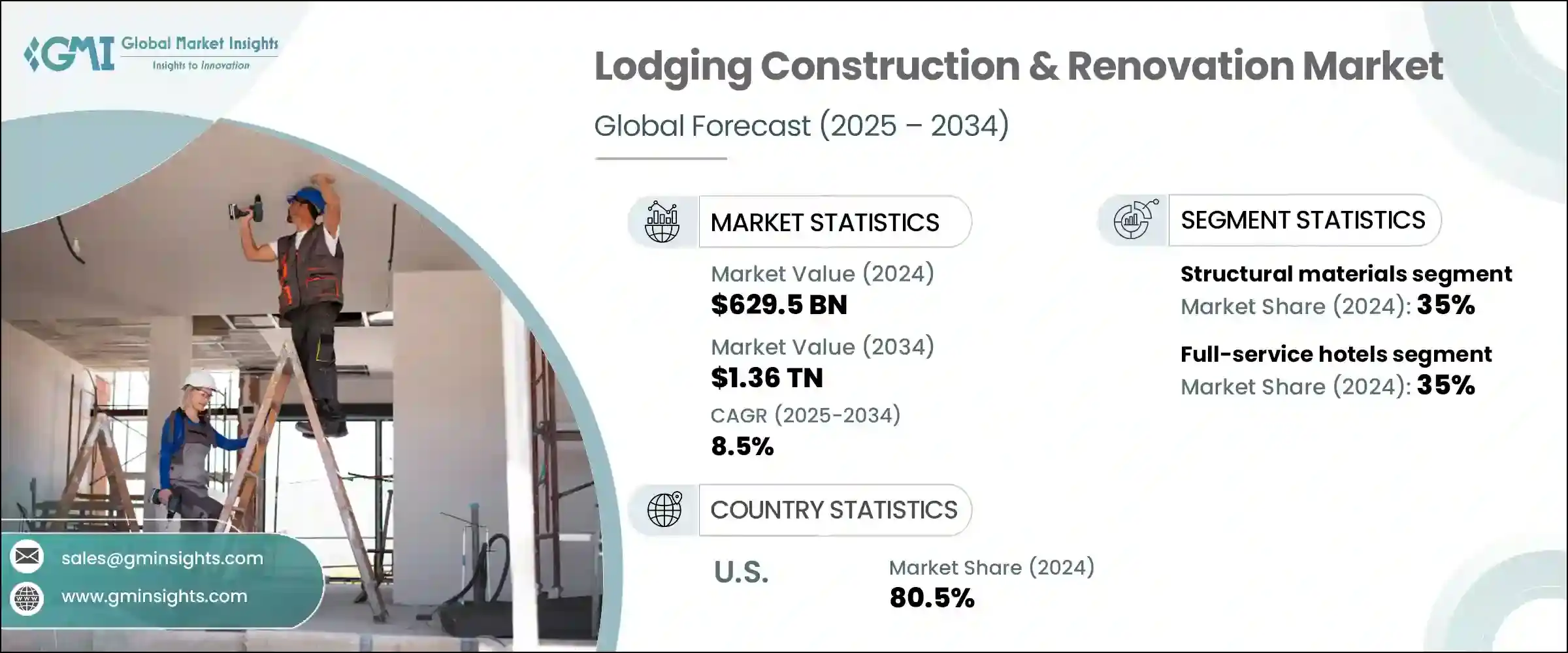
The global lodging construction & renovation market size was estimated at USD 629.5 billion in 2024. The market is expected to grow from USD 659.7 billion in 2025 to USD 1.36 trillion in 2034, at a CAGR of 8.5%.
To get key market trends
- The rapid evolution of sustainable building technologies and modular construction is transforming the market from traditional infrastructure projects into strategic enablers of operational efficiency and guest-centric innovation.
- With increasing integration of smart building systems, green materials, and digital twin frameworks, professionals now require multi-disciplinary expertise across construction, energy efficiency, and hospitality design. This shift is making continuous upskilling and green construction certifications critical to delivering scalable, cost-effective, and regulation-compliant hospitality infrastructure.
- Public-private partnerships and brand-driven standardization efforts are accelerating modernization across the lodging sector. In March 2024, the World Tourism Organization (UNWTO) and IHG, Marriott, and Accor jointly announced the “sustainable stays initiative,” aimed at retrofitting over 10,000 legacy hotels globally with energy-efficient systems by 2030. Concurrently, hotel chains are working closely with general contractors and design-build firms to establish template-based renovation programs that streamline upgrades while preserving brand identity and reducing downtime.
- This reflects a broader market transition from isolated renovation cycles to end-to-end lifecycle planning, including asset valuation, environmental impact assessment, adaptive reuse feasibility, and smart guest room technology integration. New builds are increasingly designed with embedded IoT, modular mechanical systems, and predictive maintenance infrastructure especially in luxury and urban business-class segments.
- The pandemic accelerated the demand for health-conscious retrofits and contactless guest experiences, driving large-scale upgrades in air handling systems, room automation, antimicrobial surfaces, and UV-C sanitization technologies. As of 2024, a majority of leading hotel chains have integrated hybrid renovation strategies, blending energy retrofits with experience-driven design enhancements to improve both sustainability metrics and occupancy rates.
- Green certification frameworks now dominate project specifications, with LEED, WELL, and EDGE emerging as standard benchmarks across regions. Owners and developers increasingly demand certified expertise in sustainable design and retrofitting. Firms with credentials in LEED AP, Fitwel Ambassador, and WELL AP are being prioritized in bidding processes to ensure both ESG compliance and competitive differentiation.
- Cross-functional project delivery models are becoming the norm, with increased collaboration between architects, data engineers, sustainability officers, and brand managers. In January 2024, Hilton Worldwide launched the “Smart Build Partner Network,” a cross-disciplinary vendor ecosystem that includes digital construction firms, building analytics providers, and circular economy consultants to accelerate standardized, tech-enabled hotel developments.
- North America leads the lodging construction & renovation market in absolute spending, driven by large-scale pipeline investments, franchise-driven renovation programs, and rising ESG regulations at the state level. In August 2023, Marriott committed USD 2.3 billion to hotel refreshes across the U.S. and Canada, emphasizing smart energy systems and accessible design.
- Asia-Pacific is the fastest-growing region, fueled by rapid urbanization, domestic tourism surges, and aggressive national tourism infrastructure targets. Countries like India, Vietnam, and Thailand are prioritizing smart hotel corridors, public-private financing schemes, and green building codes bolstered by international investments and technology transfers from global hotel brands.
Lodging Construction & Renovation Market Report Attributes
| Key Takeaway | Details |
|---|---|
| Market Size & Growth | |
| Base Year | 2024 |
| Market Size in 2024 | USD 629.5 Billion |
| Forecast Period 2025 – 2034 CAGR | 8.5% |
| Market Size in 2034 | USD 1.36 Trillion |
| Key Market Trends | |
| Drivers | Impact |
| Surge in Tourism & Business Travel Post-COVID | Global travel demand is rebounding strongly, prompting hotel operators to invest in new properties and refurbish existing ones to meet rising guest expectations. |
| Sustainability & Green Building Mandates | Regulatory pressure (LEED, EDGE, WELL) and ESG priorities are pushing hotels to integrate energy-efficient HVAC systems, solar panels, low-carbon materials, and water-saving fixtures. |
| Digital Guest Experience Integration | Demand for smart room controls, contactless check-in, mobile keys, and IoT-based building management systems is driving both renovation and new build initiatives. |
| Franchise Expansion and Brand Standardization | Global chains like Marriott, Hilton, and Accor are expanding aggressively in emerging markets and enforcing brand renovation cycles every 5–7 years. |
| Pitfalls & Challenges | Impact |
| Over-reliance on High-Cost Urban Projects | Heavy focus on flagship urban hotel developments can leave portfolios vulnerable during demand slumps or localized downturns. |
| Underestimating Renovation Complexity | Many hotel operators miscalculate the downtime, cost overruns, or regulatory hurdles involved in phased renovations—especially in older or mixed-use buildings. |
| Opportunities: | Impact |
| Labor & Skilled Workforce Shortages | There's a global shortage of skilled construction labor, especially those trained in green building and hotel-specific design standards. |
| Volatile Material Prices & Supply Chain Disruptions | Key construction materials like steel, HVAC equipment, and smart tech components remain exposed to global supply chain uncertainties. |
| Market Leaders (2024) | Market Leaders |
|
| Top Players |
Collective market share is 40% |
| Competitive Edge |
|
| Regional Insights | |
| Largest Market | North America |
| Fastest Growing Market | Asia Pacific |
| Emerging Countries | India, UAE, Brazil, Southeast Asia |
| Future outlook |
|
What are the growth opportunities in this market?
Lodging Construction & Renovation Market Trends
- The convergence of smart building systems and AI-enabled facility management is redefining hotel construction strategies, with firms increasingly demanding contractors skilled in IoT, energy analytics, and predictive maintenance. This trend accelerated in 2023 with the adoption of digital twin technologies and AI-based guest behavior modeling. It is driven by the need for intelligent infrastructure that enhances operational efficiency, personalizes guest experience, and ensures asset longevity.
- Modular and prefabricated construction models are becoming standard for hotel development, allowing faster, scalable, and cost-efficient delivery. This trend gained momentum in 2022 with major hotel groups like Marriott and citizenM adopting modular strategies for consistent quality and reduced downtime. It is fueled by rising labor costs, supply chain volatility, and the demand for rapid deployment in high-growth regions.
- Green certification and ESG-aligned renovation are emerging as critical differentiators for investor confidence and guest loyalty. Gaining traction post-2021, certifications like LEED, WELL, and EDGE have become default requirements in many new hotel developments and refurbishments. This demand is driven by decarbonization goals, operational cost savings, and consumer preference for sustainable stays. The trend is expected to intensify through 2028, aligning hospitality design with global climate and social governance benchmarks.
- The rise of low-disruption renovation methods and offsite prefabrication is transforming the execution model of lodging refurbishment. Since 2022, hotel owners have accelerated adoption of phasing strategies, plug-and-play room modules, and offsite MEP assembly to reduce guest disturbance and property downtime. This trend is fueled by revenue continuity and enhanced renovation cycles dictated by global hotel brands. It is expected to grow through 2027, particularly in high-occupancy metro properties.
- Government-led tourism infrastructure programs are accelerating hotel construction activity in emerging economies. Since 2023, nations like Saudi Arabia, Vietnam, and Egypt have launched large-scale tourism development plans including public-private investment in hospitality assets. Supported by tax incentives and regulatory easing, these initiatives are boosting hotel construction pipelines in Tier-2 and Tier-3 cities.
Lodging Construction & Renovation Market Analysis
Learn more about the key segments shaping this market
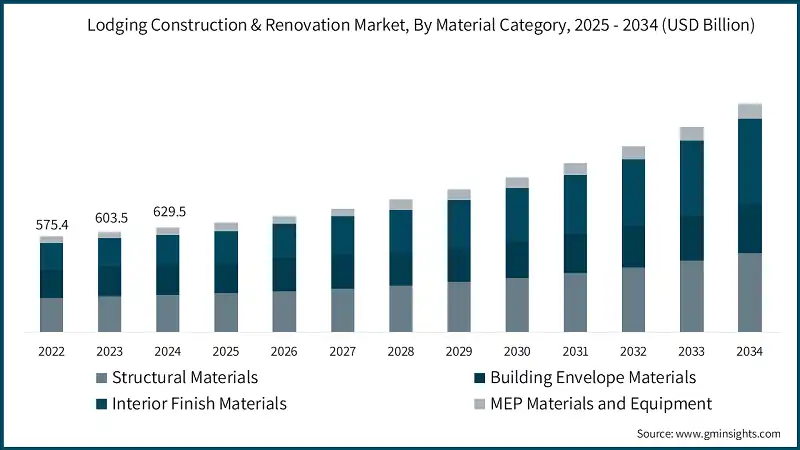
Based on material category, the lodging construction & renovation market is divided into structural materials, building envelope materials, interior finish materials, and MEP materials and equipment. The structural materials segment dominated the lodging construction & renovation market accounting for around 35% in 2024 and is expected to grow at a CAGR of over 8% through 2034.
- Structural materials continue to dominate the market, serving as the foundational element for both new developments and large-scale renovations across hotel chains, resorts, and luxury properties. Materials such as reinforced concrete, structural steel, engineered timber, and composite systems provide the core framework that supports vertical expansion, seismic retrofitting, and adaptive reuse projects across various geographies.
- For instance, in February 2024, turner construction utilized a hybrid concrete-steel structural system during the repositioning of a historic hotel in San Francisco. The solution enabled vertical expansion by three floors while preserving the building’s heritage facade. The structural upgrade supported LEED Gold certification, improved seismic performance, and extended the property’s asset life cycle.
- Building envelope materials play a critical role in thermal, acoustic, and moisture control, directly impacting energy efficiency and guest comfort. This category includes curtain walls, high-performance glazing systems, insulation, and waterproofing components that improve building performance and contribute to certification efforts such as LEED and WELL. Rising demand for sustainability and weather resilience continues to drive material innovation and adoption in this space.
- Interior finish materials are essential to creating brand-consistent guest experiences through aesthetic enhancements and functional upgrades. These materials include flooring, wall coverings, ceilings, and decorative fixtures that define the character of lobbies, guestrooms, and common areas. Increasing focus on sustainable design, luxury finishes, and experiential interiors continue to influence material selection during renovation cycles.
- MEP (Mechanical, Electrical, and Plumbing) materials and equipment support the operational backbone of hotel facilities, enabling climate control, lighting, fire safety, and water management systems. This category includes HVAC units, electrical panels, smart thermostats, low flow plumbing fixtures, and energy management controls. Integration of smart building technologies and energy-efficient systems is becoming a key priority in both new construction and retrofit projects.
- For instance, in April 2024, Marriott international initiated a multi-property MEP upgrade to integrate smart building systems across its U.S. portfolio, reducing energy costs and aligning with the company’s 2050 net-zero targets.
Learn more about the key segments shaping this market
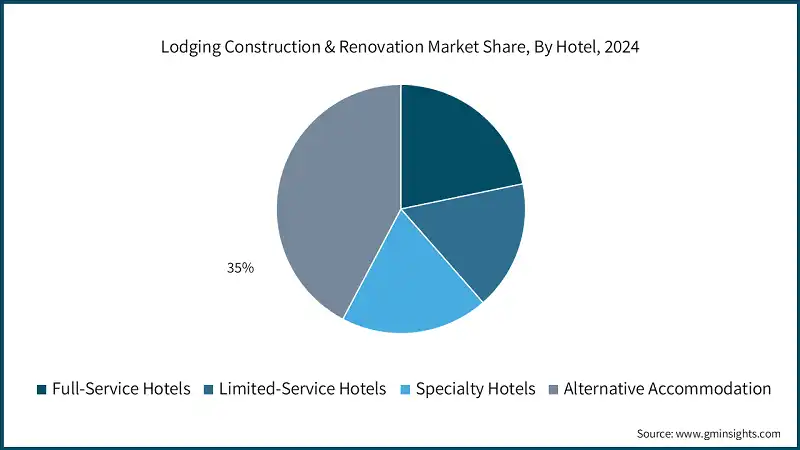
Based on hotels, the lodging construction & renovation market is segmented into full-service hotels, limited-service hotels, specialty hotels and alternative accommodation. The full-service hotels segment dominates the market with 35% share in 2024, and the segment is expected to grow at a CAGR of over 8% from 2025 to 2034.
- Full-service hotels continue to dominate the lodging construction & renovation market, serving as the primary focus for large-scale redevelopment, brand repositioning, and amenity upgrades across urban, resort, and convention destinations. These properties typically feature extensive guest services such as restaurants, spas, meeting facilities, and recreational areas which drive higher renovation frequency and complexity to maintain brand standards and competitive positioning.
- Full-service hotels require specialized construction capabilities, including phasing plans that allow operations to continue during renovation, and integrated upgrades across structural, MEP, and interior finish systems. Renovation efforts often focus on enhancing guest experience, increasing revenue-generating areas, and aligning with evolving brand design guidelines.
- Limited-service hotels prioritize cost-effective renovations aimed at improving guest comfort and operational efficiency. Renovation projects typically emphasize upgrades to guestrooms, lobbies, and energy systems, with a focus on minimizing downtime and ensuring a quick return on investment. These properties often adopt modular renovation methods to streamline execution and control costs.
- Specialty Hotels including boutique, heritage, and lifestyle properties focus on highly customized renovations that preserve architectural uniqueness while integrating modern amenities. These projects often involve adaptive reuse of historic buildings or conversion of non-traditional structures into hospitality spaces, requiring precision planning and specialized materials to balance preservation with performance.
- Alternative accommodation including serviced apartments, vacation rentals, and branded residences is an emerging segment within the renovation market. Projects in this category typically emphasize flexible design, smart home integration, and extended-stay functionality. As traveler demand shifts toward personalized and tech-enabled stays, renovation priorities are increasingly centered on multi-functional layouts and digitally connected environments.
- For instance, in March 2024, Hilton began a USD 200 million phased renovation program across several of its full-service brands, including Hilton Hotels & Resorts and DoubleTree. The program focused on revamping meeting spaces, upgrading wellness amenities, and implementing new interior design standards. The effort enhanced brand consistency, improved ADR, and extended asset lifecycle across its North American portfolio.
Based on project, the lodging construction & renovation market is segmented into new hotel construction, hotel renovation and refurbishment, hotel expansions and additions, conversion and adaptive reuse projects, and carbon fiber applications. The new hotel construction segment is expected to dominate the market, driven by the increasing demand for ground-up hospitality developments that incorporate smart infrastructure, energy efficiency, and brand-specific design standards.
- New Hotel construction continues to dominate the lodging construction & renovation market, serving as the primary driver of capital investment and innovation across global hospitality portfolios. This segment encompasses ground-up developments that integrate the latest design trends, sustainability standards, and smart building technologies to meet evolving guest expectations and regulatory requirements.
- Hotel renovation and refurbishment represent a significant segment focused on upgrading existing properties to extend asset life, improve guest experiences, and maintain brand competitiveness. This segment often involves phased construction to minimize operational disruptions, targeted interior finish upgrades, and systems modernization to meet evolving code and sustainability goals.
- Hotel expansions and additions involve increasing the capacity or functionality of existing hotels through the addition of new guest rooms, meeting spaces, restaurants, or recreational amenities. These projects require careful structural and MEP integration to preserve operational continuity and maximize return on incremental investment.
- Conversion and adaptive reuse projects focus on transforming non-hospitality buildings such as office towers, historic landmarks, or industrial facilities—into hotel properties. These projects demand innovative design and construction approaches to balance preservation, compliance, and modern guest expectations.
- Carbon fiber applications are an emerging niche within the lodging construction & renovation market, used primarily for structural strengthening and seismic retrofitting. offering high strength-to-weight ratios and rapid installation, carbon fiber materials help extend building lifespan and improve resilience, particularly in retrofit and expansion projects.
- For instance, in January 2024, a leading hotel developer completed a new luxury resort in Florida incorporating state-of-the-art energy management and structural innovations. The project set new benchmarks for construction efficiency, guest comfort, and sustainability performance, reinforcing the prominence of new construction in the lodging market.
Based on the construction method, the lodging construction & renovation market is segmented into traditional construction methods, modular and prefabricated construction, advanced construction technologies, and sustainable construction methods. The traditional construction methods segment is expected to dominate the market, driven by its widespread familiarity, adaptability across diverse project scales, and alignment with region-specific regulatory and labor dynamics.
- Traditional construction methods continue to dominate the lodging construction & renovation market, serving as the established approach for delivering hotel projects ranging from luxury resorts to urban full-service properties. These methods offer proven reliability, design flexibility, and extensive contractor expertise, supporting complex site conditions and bespoke architectural requirements.
- Traditional construction methods provide comprehensive on-site building processes, including cast-in-place concrete, steel framing, masonry, and conventional mep installations. This hands-on approach enables detailed customization, phased renovation scheduling, and direct quality control that align with hospitality brands’ stringent standards.
- Modular and prefabricated construction is gaining traction as a faster, cost-efficient alternative, particularly for limited-service hotels and repeatable room modules. Off-site fabrication reduces site disruption and construction timelines, allowing quicker market entry. However, adoption is tempered by design limitations and logistical challenges in complex urban environments.
- Advanced construction technologies, including 3d printing, robotics, and building information modeling (BIM) are increasingly integrated to enhance accuracy, collaboration, and waste reduction. These technologies support precision in renovations and new builds, improving schedule adherence and cost predictability.
- Sustainable construction methods focus on minimizing environmental impact through energy-efficient materials, low-carbon concrete, waste recycling, and green certifications such as LEED and well. adoption is driven by rising regulatory requirements and brand commitments to sustainability and corporate social responsibility.
- For example, in March 2024, a major renovation at a Hyatt Regency property in Chicago utilized traditional construction methods to execute a phased upgrade of guest rooms and public spaces while keeping the hotel operational. The approach ensured quality craftsmanship, maintained brand standards, and minimized guest disruption throughout the year-long project.
Looking for region specific data?
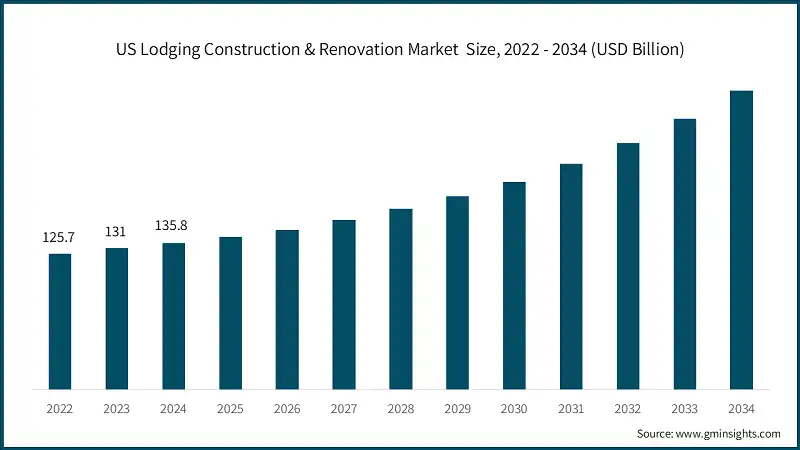
US dominated the lodging construction & renovation market in North America with around 80.5% share and generated USD 135.8 billion in revenue in 2024.
- The US dominates the lodging construction & renovation market in North America, driven by a robust tourism industry, expansive hotel brand presence, and strong investments in urban infrastructure and hospitality modernization. As a global leader in large-scale hospitality development, the U.S. market is shaped by steady capital inflows from hotel REITs, institutional investors, and franchise-driven expansion by major players such as Marriott, Hilton, and Hyatt.
- U.S. based hotel chains are at the forefront of deploying smart building technologies, modular construction methods, and ESG-aligned renovation strategies. Construction and renovation engagements increasingly focus on sustainability compliance, ADA and LEED certification, and integration of digital guest experiences through IoT, access control, and energy-efficient systems.
- For instance, in September 2023, Marriott International announced a USD 2.3 billion reinvestment initiative across its U.S. portfolio to support brand refreshes, green retrofits, and guest-facing technology upgrades illustrating the country’s emphasis on asset repositioning and future-ready hospitality infrastructure.
- The U.S. also benefits from a mature ecosystem of general contractors, design-build firms, and material suppliers, supported by well-established building codes, skilled labor availability, and advanced project delivery technologies like BIM and digital twin modeling. This enhances execution efficiency and ensures consistent quality across projects.
The lodging construction & renovation market in UK is expected to experience significant and promising growth from 2025 to 2034.
- The lodging construction & renovation market in the UK is expected to experience steady growth, driven by a rebound in tourism, increased investments in boutique and lifestyle hotels, and government-backed urban regeneration initiatives. As major cities like London, Manchester, and Edinburgh prepare for rising travel volumes and sustainability mandates, hotel operators are prioritizing refurbishment of aging assets and the construction of energy-efficient, tech-integrated properties.
- This growth is further supported by evolving consumer preferences for unique, design-focused accommodations and the accelerated adoption of green building standards such as BREEAM. Additionally, adaptive reuse of heritage buildings into high-end hotels is gaining traction, especially in historic urban cores—aligning with the UK's focus on preservation and sustainability.
- With the return of international events, tightening ESG regulations, and increased capital inflow from institutional investors and hotel REITs, the UK market is positioned to remain a key contributor to the European lodging construction and renovation landscape through 2028.
The lodging construction & renovation market in China is expected to experience significant and promising growth from 2025 to 2034.
- The lodging construction & renovation market in China is expected to experience significant and promising growth from 2025 to 2034, fueled by rapid urbanization, expanding domestic tourism, and government-led infrastructure and hospitality development initiatives. As travel demand rebounds and new cultural and economic zones emerge, both international and local hotel brands are accelerating new builds and large-scale renovations particularly in Tier 2 and Tier 3 cities.
- This growth is further supported by China’s strategic focus on smart city development, energy-efficient construction, and green building certifications such as China’s Three-Star Green Building Rating and LEED. Additionally, aging hotel stock in major metropolitan areas is undergoing modernization to align with evolving guest expectations, digitalization standards, and ESG compliance.
- With robust public-private partnerships, growing consumer demand for experiential and upscale accommodations, and increasing adoption of modular and sustainable construction techniques, China is poised to become one of the leading markets globally for lodging construction and renovation over the next decade.
The lodging construction & renovation market in UAE is expected to experience significant and promising growth from 2025 to 2034.
- The UAE continues to dominate the lodging construction & renovation market in the Middle East, driven by large-scale hospitality investments, visionary urban planning, and national tourism initiatives such as UAE Vision 2031 and the Dubai Tourism Strategy 2030. The country is positioning itself as a global luxury and lifestyle destination, supported by mega-projects like NEOM (UAE-linked investments), Expo City Dubai expansion, and the growing demand for high-end resorts, serviced apartments, and branded residences.
- Leading hotel chains and regional developers are actively engaging design-build firms, consultants, and modular construction specialists to accelerate delivery and ensure ESG compliance across hospitality portfolios. The demand spans ultra-luxury hotels, boutique properties, mixed-use developments, and the adaptive reuse of cultural landmarks into heritage hotels.
- For instance, in March 2025, Emaar Hospitality Group announced a multibillion-dirham hospitality development program that includes new resort builds across Dubai and Abu Dhabi and full-scale renovations of existing properties to meet LEED Gold and Estidama standards. This reflects the UAE’s commitment to sustainability and premium guest experiences as pillars of future lodging growth.
- The UAE lodging construction & renovation market also benefits from a maturing ecosystem of global contractors, regional developers, and international design firms such as Foster Partners and Gensler, enabling seamless delivery of large, complex, and high-specification hotel projects. Strategic partnerships between public agencies and hospitality investors continue to shape a resilient, innovation-led construction pipeline.
The lodging construction & renovation market in Brazil is expected to experience significant and promising growth from 2025 to 2034.
- Brazil’s diverse tourism assets—from the Amazon rainforest and Pantanal wetlands to iconic urban centers like Rio de Janeiro and São Paulo are fueling demand for new hotel constructions and extensive renovations, particularly in eco-friendly and boutique segments. National initiatives such as the Brazilian Tourism Strategic Plan emphasize sustainable growth and regional development, supporting construction activities beyond traditional hubs.
- For instance, in January 2025, the Brazilian Development Bank (BNDES) announced a substantial funding program targeting sustainable tourism infrastructure, aimed at accelerating hotel refurbishments and new builds in key states like Bahia, Minas Gerais, and Paraná. This initiative reflects a growing focus on improving quality standards and boosting visitor experiences.
- The Brazilian lodging construction & renovation market also benefits from a vibrant ecosystem of local contractors, international hotel operators, and architectural firms specializing in tropical design and energy-efficient construction methods. Partnerships with global brands continue to expand, driving modernization and digitalization of hotel assets.
- With favorable government policies, growing middle-class travel, and a surge in event-driven tourism, Brazil is positioned to witness robust and sustained growth in its market through 2034, strengthening its status as a leading hospitality destination in Latin America.
Lodging Construction & Renovation Market Share
- The top 7 companies in the lodging construction & renovation industry are AccorHotels
Barton Malow Company, Balfour Beatty US, Clark Construction Group, DPR Construction, Gilbane Building Company, and Hensel Phelps Construction Co contribute around 40% of the market in 2024.
- AccorHotels is a global leader in lodging construction and renovation, leveraging its extensive hospitality portfolio and deep industry expertise to drive large-scale hotel development and refurbishment projects worldwide. Accor’s competitive advantage lies in its integrated approach, combining brand management with design innovation and sustainability standards. The company focuses on adaptive reuse, smart building technologies, and modular construction to enhance operational efficiency and guest experience across diverse markets.
- Barton Malow Company holds a strong position in the U.S. construction sector, specializing in large hospitality projects that require complex engineering and precise execution. Barton Malow’s edge comes from its vertically integrated services, including preconstruction planning, self-performing capabilities, and advanced safety programs. The company’s emphasis on collaborative delivery methods and Lean construction techniques enables efficient project timelines and cost control in hotel construction and renovation.
- Balfour Beatty US ranks among the top general contractors in lodging construction, known for its robust project management and sustainable building practices. Balfour Beatty’s competitive strength stems from its extensive experience in mixed-use developments and public-private partnerships, which enhances its ability to navigate complex regulatory environments. Its investment in technology-driven construction tools, such as BIM and virtual design coordination, supports high-quality outcomes on hospitality projects.
- Clark Construction Group is recognized for its comprehensive construction services tailored to luxury hotels, resorts, and urban hospitality developments. Clark’s advantage lies in its proven track record of delivering landmark projects through integrated design-build and construction management approaches. The company prioritizes innovation in material sourcing, energy efficiency, and community engagement, strengthening its position in markets demanding sustainable and experiential lodging environments.
- DPR Construction excels in technically challenging and mission-critical lodging projects, with a focus on high-performance building systems and integrated project delivery. DPR’s competitive edge is its collaborative culture, advanced data-driven construction methodologies, and commitment to LEED and WELL certifications. Its expertise in healthcare and education sectors complements its hospitality portfolio, enabling cross-industry innovation and quality assurance.
- Gilbane Building Company is a trusted name in hospitality construction and renovation, offering end-to-end services that encompass preconstruction consulting, construction, and facilities management. Gilbane’s strength lies in its client-focused approach, leveraging digital project controls and workforce development initiatives to enhance project outcomes. Its commitment to safety, diversity, and sustainability aligns with evolving industry standards and customer expectations.
- Hensel Phelps Construction distinguishes itself through a nationwide presence and strong expertise in complex lodging projects, including large-scale hotels and resort developments. Hensel Phelps’s competitive advantage is its integrated project delivery model, combining preconstruction, construction, and post-construction services for seamless execution. The company’s investments in technology, sustainability, and workforce training drive consistent quality and innovation across diverse hospitality markets.
Lodging Construction & Renovation Market Companies
Major players operating in the lodging construction & renovation industry are:
- AccorHotels
- Barton Malow
- Balfour Beatty US
- Clark Construction
- DPR Construction
- Gilbane Building
- Hensel Phelps Construction
- Hilton Worldwide
- Hyatt Hotels
- InterContinental Hotels (IHG)
- AccorHotels, Barton Malow Company, and Balfour Beatty US focus on comprehensive lodging construction and renovation services, combining project management, sustainable building practices, and innovative design solutions.
- AccorHotels leverages its global hospitality expertise for integrated hotel development, Barton Malow emphasizes self-perform construction and safety-driven project delivery, while Balfour Beatty US excels in large-scale mixed-use developments with advanced technology integration.
- Clark Construction Group, DPR Construction, and Gilbane Building Company cater to luxury and complex hospitality projects with a focus on design-build and integrated project delivery. Clark Construction prioritizes sustainability and community engagement, DPR Construction drives innovation through data-driven methodologies and LEED-certified buildings, and Gilbane Building Company specializes in client-focused solutions supported by digital project controls and workforce development initiatives.
- Hensel Phelps Construction distinguishes itself through its nationwide presence and integrated project delivery model, combining preconstruction, construction, and post-construction services for seamless execution of hotel and resort developments. The company invests heavily in technology, sustainability, and workforce training to ensure consistent quality and innovation across projects.
- These companies differentiate through strong partnerships with hotel brands, extensive expertise in regulatory compliance and sustainability standards, adoption of modular and prefabricated construction methods, and focus on delivering high-quality, timely projects. Their commitment to innovation, safety, and client collaboration supports the evolving needs of the market.
Lodging Construction & Renovation Industry News
- In June 2024, AccorHotels announced a USD 1.5 billion investment plan to accelerate sustainable hotel renovations across Europe and the Middle East, focusing on energy-efficient retrofits, smart building technologies, and experience enhancements aligned with ESG goals.
- In April 2024, Barton Malow Company secured a major contract for the construction of a luxury resort in the Caribbean, incorporating modular construction techniques and advanced project management software to shorten delivery timelines and reduce costs.
- In February 2024, Balfour Beatty US unveiled a digital twin pilot project for a flagship hotel renovation in New York City, integrating BIM, IoT sensors, and AI-driven predictive maintenance to optimize operational efficiency and reduce downtime during refurbishment.
- In January 2024, Clark Construction Group partnered with a leading sustainable materials supplier to implement low-carbon concrete and recycled steel in multiple hotel expansion projects across California, reinforcing its commitment to green building practices.
- In December 2023, DPR Construction launched an innovation hub focused on integrating renewable energy systems and smart HVAC controls in hospitality construction projects, aiming to deliver net-zero energy hotels in collaboration with major hotel chains.
The lodging construction & renovation market research report includes in-depth coverage of the industry with estimates & forecasts in terms of revenue ($ Bn) from 2021 to 2034, for the following segments:
Market, By Hotel
- Full-service hotels
- Limited-service hotels
- Specialty hotels
- Alternative accommodation
Market, By Project
- New hotel construction
- Hotel renovation and refurbishment
- Hotel expansions and additions
- Conversion and adaptive reuse project
- Carbon fiber
Market, By Material Category
- Structural materials
- Building envelope materials
- Interior finish materials
- MEP materials and equipment
Market, By Construction Method
- Traditional construction methods
- Modular and prefabricated construction
- Advanced construction technologies
- Sustainable construction methods
The above information is provided for the following regions and countries:
- North America
- U.S.
- Canada
- Europe
- UK
- Germany
- France
- Italy
- Spain
- Russia
- Nordics
- Asia Pacific
- China
- India
- Japan
- Australia
- South Korea
- Singapore
- Vietnam
- Thailand
- Philippines
- Latin America
- Brazil
- Mexico
- Argentina
- MEA
- South Africa
- Saudi Arabia
- UAE
Frequently Asked Question(FAQ) :
Who are the key players in the lodging construction & renovation industry?
Key players include AccorHotels, Barton Malow, Balfour Beatty US, Clark Construction, DPR Construction, Gilbane Building, Hensel Phelps Construction, Hilton Worldwide, Hyatt Hotels, and InterContinental Hotels (IHG).
What is the market size of the traditional construction methods segment in 2024?
The traditional construction methods segment is expected to dominate the market in 2024, propelled by its widespread familiarity, adaptability across diverse project scales and alignment.
Which region leads the lodging construction & renovation sector?
The United States leads the market in North America, accounting for 80.5% of the regional revenue and generating USD 135.8 billion in 2024. This dominance is attributed to a robust tourism industry, extensive hotel brand presence, and significant investments in urban infrastructure.
What is the market size of the lodging construction & renovation in 2024?
The market size was USD 629.5 billion in 2024, with a CAGR of 8.5% expected through 2034. The market growth is driven by advancements in sustainable building technologies, modular construction, and increasing demand for smart infrastructure.
What are the upcoming trends in the lodging construction & renovation market?
Key trends include the adoption of smart building systems, AI-enabled facility management, modular construction, ESG-aligned renovations, low-disruption refurbishment methods, and government-led tourism infrastructure programs in emerging economies.
Which segment dominated the lodging construction & renovation market in 2024?
The full-service hotels segment dominated the market with a 35% share in 2024 and is expected to witness 8% CAGR up to 2034.
What was the share of the structural materials segment in 2024?
The structural materials segment accounted for approximately 35% of the market in 2024 and is set to expand at a CAGR of over 8% till 2034.
What is the projected value of the lodging construction & renovation market by 2034?
The market is poised to reach USD 1.36 trillion by 2034, fueled by rising investments in tourism infrastructure, ESG-aligned renovations, and adoption of modular construction techniques.
Lodging Construction & Renovation Market Scope
Related Reports