Summary
Table of Content

Liquid Hydrogen Market
Get a free sample of this report
Form submitted successfully!
Error submitting form. Please try again.
Thank you!
Your inquiry has been received. Our team will reach out to you with the required details via email. To ensure that you don't miss their response, kindly remember to check your spam folder as well!
Request Sectional Data
Thank you!
Your inquiry has been received. Our team will reach out to you with the required details via email. To ensure that you don't miss their response, kindly remember to check your spam folder as well!
Form submitted successfully!
Error submitting form. Please try again.
Liquid Hydrogen Market Size
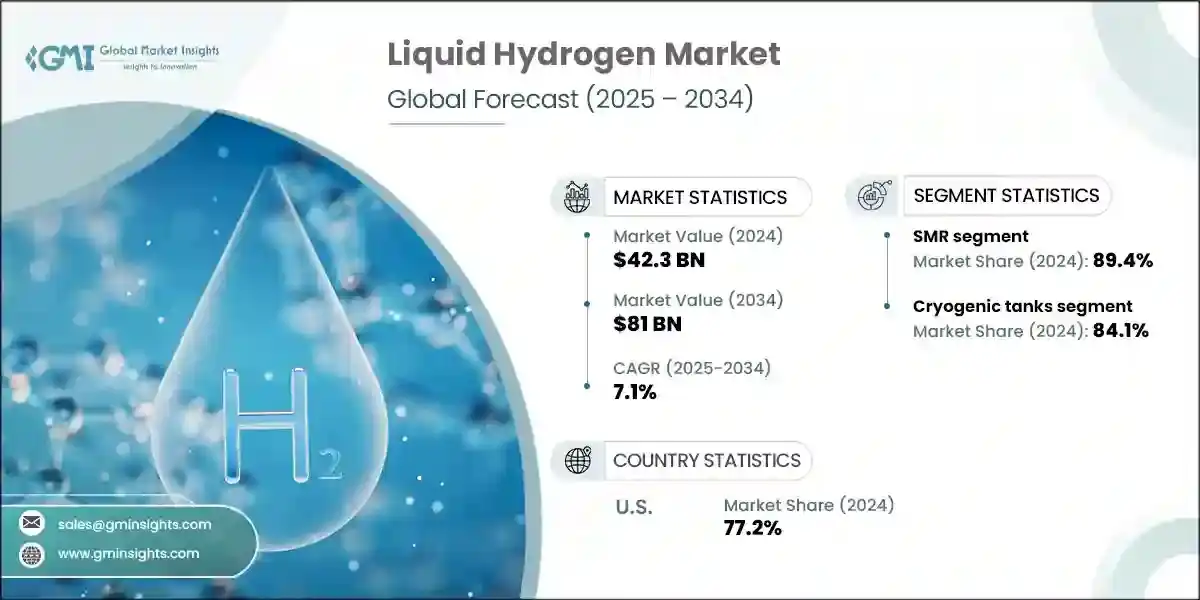
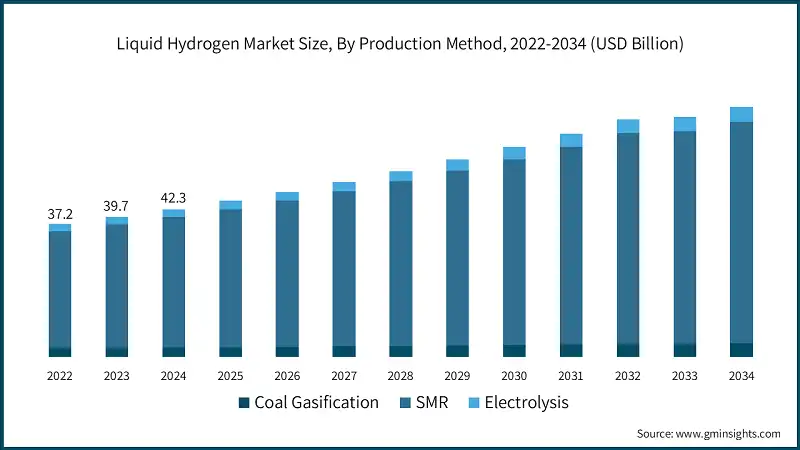
The global liquid hydrogen market size registered a valuation of USD 42.3 billion in 2024 and is projected to escalate to USD 81 billion by 2034, reflecting a CAGR of 7.1% over the forecast period. The emergence of hydrogen hubs is set to fuel the industry growth, as these strategic zones facilitate concentrated product deployment, storage, and distribution, thereby stimulating the overall business dynamics.
To get key market trends
- Growing focus on decarbonization goals, coupled with increasing adoption of hydrogen targets across key economies, will drive the market growth. Industry stakeholders are deploying diversified hydrogen solutions across transportation, industrial, and energy sectors, while expanding hydrogen infrastructure and investing strategically to unlock long term business potential.
- Liquid hydrogen is a cryogenic fuel used in transportation, chemical, and metal industries. It is typically produced via coal gasification, electrolysis and steam methane reforming, its carbon footprint depends on integration with carbon capture technologies. Further, it can be paired with CCUS to support low-emission hydrogen deployment, fueling clean energy innovation and enabling the transition to a sustainable industrial ecosystem.
- Technology providers and energy service firms are advancing hydrogen technologies and forging strategic collaborations to strengthen the business landscape. Simultaneously, nations and corporations are forming international alliances to foster innovation, integrate global supply chains, and accelerate the development of hydrogen infrastructure worldwide.
- For instance, in 2025, under the Hydrogen Breakthrough Priority International Actions initiative, countries including the U.S., U.K., and India committed to accelerating the deployment of clean hydrogen technologies. Additionally, organizations including the Clean Energy Ministerial and the International Partnership for Hydrogen and Fuel Cells in the Economy, pledged to build globally integrated hydrogen supply chains.
- Inorganic strategic ventures along with rising public-private partnerships are actively fueling business growth. Clean energy goals coupled with increasing investment in liquefaction and cryogenic technologies are facilitating widespread product deployment. For example, in August 2022, Egypt signed an MoU to advance green hydrogen development, underscoring the increasing momentum toward global hydrogen integration and renewable energy expansion.
- Evolving production technologies including SMR, coal gasification and electrolysis are actively enhancing the potential of liquid hydrogen. It is further strengthened by regulatory incentives and cost-efficiency strategies, enabling scalable product deployment. Industry players are integrating cleaner feedstocks and carbon capture solutions to achieve low emission outputs, thereby stimulating the business landscape
- Favorable government policies and incentives to support the hydrogen economy, including financial support for research and development, tax incentives, and regulatory frameworks that promote the use of liquid hydrogen in various sectors, will propel the business outlook. For instance, in January 2025, Turbotech, Safran, and Air Liquide completed ground testing of the world’s first liquid hydrogen-fueled gas turbine engine for light aviation, as part of the BeautHyFuel project in France.
- The governments and private enterprises are also exploring ways to produce, transport, and utilize liquid hydrogen, with a focus on green hydrogen produced using renewable energy sources. For instance, in December 2024, the South Korean government started developing a plan to design, construct, and demonstrate the nation's first liquid-hydrogen (LH2) carrier vessel.
Liquid Hydrogen Market Report Attributes
| Key Takeaway | Details |
|---|---|
| Market Size & Growth | |
| Base Year | 2024 |
| Market Size in 2024 | USD 42.3 Billion |
| Forecast Period 2025 - 2034 CAGR | 7.1% |
| Market Size in 2034 | USD 81 Billion |
| Key Market Trends | |
| Drivers | Impact |
| Shifting trends toward decarbonization | Accelerates low carbon fuel adoption across industrial and mobility sectors, redefining energy pathways and supporting sustainable production frameworks globally. |
| Growing focus on clean energy directives | Strengthens regulatory push for hydrogen infrastructure and fuels demand for clean alternatives across, chemical units, refineries, and transportation. |
| Rising investments, new policy development & innovations | Fuels commercial scale deployment, enhances technology maturity, and supports new project pipelines across production, storage, and downstream value chain. |
| Pitfalls & Challenges | Impact |
| High cost associated to transportation | Limits wide scale adoption due to expensive liquefaction, storage, and distribution, especially in markets lacking advanced cryogenic infrastructure. |
| Opportunities: | Impact |
| Deployment of mobile cryogenic tankers | Enables flexible distribution of liquid hydrogen across transportation and industrial sites, supporting last-mile delivery and expanding market accessibility in regions lacking fixed infrastructure. |
| Development of hydrogen corridors | Accelerates transportation sector growth by supporting refueling networks and cryogenic tank logistics across strategic routes. |
| Global strategic partnerships for hydrogen trade | Enables global business growth through strategic hydrogen trade alliances, driving cryogenic tank deployment and supporting international energy diversification efforts. |
| Integration with renewable powered SMR | Enhances production potential by aligning SMR based liquid hydrogen with clean energy sources, boosting ESG compliance and investor interest. |
| Market Leaders (2024) | |
| Market Leaders |
11% Market share in 2024 |
| Top Players |
Collective market share in 2024 is 36.5% |
| Competitive Edge |
|
| Regional Insights | |
| Largest Market | North America |
| Fastest Growing Market | Asia Pacific |
| Emerging Countries | China, Japan |
| Future outlook |
|
What are the growth opportunities in this market?
Liquid Hydrogen Market Trends
- Growing hydrogen infrastructure is driving focused product deployment through strategic zoning of corridors and industrial clusters. These zones support cryogenic tank logistics and pipeline integration to enable efficient distribution across transportation, chemical, and metal sectors, thereby reinforcing long-term business dynamics and accelerating product penetration across key applications.
- Ongoing government-funded research & pilot projects have created opportunities for various investors and key industry players to shift their focus toward clean energy technology. For instance, in July 2024, in partnership with fellow Spanish business Ariema Enerxia, Matteco has been awarded USD 1.2 million by the Spanish government to develop a "new generation" of alkaline electrolyzers, which will lower the levelized cost of hydrogen by up to 20%.
- Institutional investors and private equity firms are actively funding next-generation hydrogen infrastructure, focusing on liquid hydrogen logistics and digitalized supply chains. Their investments enhance operational resilience, foster innovation in cryogenic systems, and support automated distribution platforms. These actions reinforce long-term commercial viability and drive technology led scalability across the hydrogen value chain.
- Cross-border collaborations, co-development of liquefaction technologies by the companies, harmonization of safety standards, and scaling hydrogen infrastructure across regions will influence the business statistics. Growing operational synergy will further accelerate international deployment, thereby strengthening the hydrogen ecosystem.
- Enhancing liquefaction efficiency, improving storage stability, and ensuring transport safety are the key drivers influencing the adoption of advanced hydrogen technologies. Moreover, industry players are innovating in cryogenic engineering and deploying digital monitoring systems to streamline product deployment, thereby reducing operational risks, and enabling cost-effective scaling across hydrogen production and distribution networks, stimulating the business landscape.
- Policymakers and regulators are energizing the liquid hydrogen market by driving infrastructure development and accelerating clean hydrogen adoption. Rising interest and investment in green hydrogen to meet decarbonization goals is anticipated to drive the product adoption. For instance, in August 2022, Actis signed a Memorandum of Understanding with the Egyptian government for the development of green hydrogen.
- Ongoing construction of large-scale electrolyzers for commercial hydrogen production, along with declining equipment costs propelled by technological advancements, economies of scale, and intensifying market competition is set to positively influence the business scenario.
Liquid Hydrogen Market Analysis
Learn more about the key segments shaping this market
- Based on production methods, the market is segmented into coal gasification, electrolysis, and SMR. The SMR segment dominated the liquid hydrogen market accounting for 89.4% in 2024 and is expected to grow at a CAGR of over 11% through 2034.
- Shifting focus toward the construction and scale-up of SMR facilities for hydrogen production will sway the business statistics. The ongoing development of larger-scale SMR plants to meet the increasing demand for hydrogen across various industries, along with integration of Carbon Capture and Storage (CCS) technologies with SMR facilities, is anticipated to drive the demand in the coming times.
- Growing recognition of hydrogen as a versatile energy carrier has led to a trend in using SMR for hydrogen production as part of broader strategies for energy transition and the decarbonization of various sectors. Increased investments in SMR projects across various countries and regions and expansion and modernization of the existing SMR facilities will stimulate the business landscape.
- The coal gasification liquid hydrogen market will project at a CAGR of over 7.5% by 2034. It is a viable hydrogen production method, strengthened by ongoing research in advanced gasification technologies. Its ability to utilize abundant coal reserves makes it strategically important for energy-secure regions.
- Ongoing efforts to develop cleaner and more efficient coal gasification technologies, along with integration with Carbon Capture and Storage (CCS) technologies to capture and store carbon dioxide emissions, will address the environmental concerns associated with the traditional production method, thereby boosting the method adoption.
- In December 2024, Air Liquide received USD 118.8 million from the European Innovation Fund to support its ENHANCE project at the Port of Antwerp-Bruges, Belgium. This will be Europe’s first industrial-scale facility to produce, liquefy, and distribute low-carbon and renewable hydrogen from ammonia.
- Electrolysis liquid hydrogen market will grow at rate of over 11.2% by 2034. Advancements in large-scale electrolyzer systems, coupled with declining equipment costs, are accelerating the product deployment. These developments will further enhance the commercial viability and supporting scalable growth across global production and distribution networks.
- For instance, in 2023, Air Liquide became a partner in six out of seven Clean Hydrogen Hubs announced by the U.S. DOE. These hubs aim to accelerate low carbon hydrogen development, including liquefaction, distribution, and storage.
Learn more about the key segments shaping this market
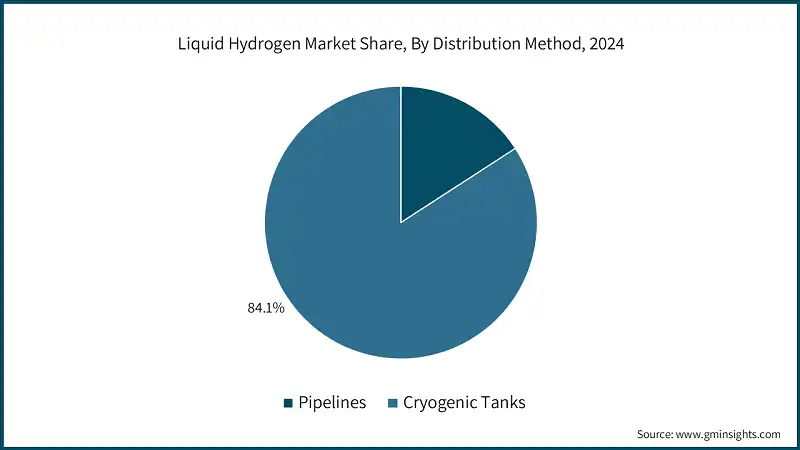
- Based on distribution method, the liquid hydrogen market is segmented into pipelines and cryogenic tanks. Cryogenic tanks dominated the industry scenario with 84.1% share in 2024, and the segment is projected to surge at a CAGR exceeding 7.5% through 2034, driven by infrastructure expansion and operational efficiency gains.
- Key factors including their ability to store and transport hydrogen at ultra-low temperatures along with expanding applications in mobility, aerospace, and industrial sectors are driving product adoption. Moreover, ongoing advancements in the tank design and materials will improve the efficiency, safety, and cost-effectiveness of the storage solutions.
- For instance, INOXCVA, a manufacturer of cryogenic solutions with its headquarters in Vadodara, created, developed, and produced the biggest liquid hydrogen tank ever manufactured in India. The tank will be used to feed hydrogen charging stations for trucks, buses, and trams at South Korea's first hydrogen liquefaction factory, which has a daily capacity of five tons.
- The pipeline liquid hydrogen market will grow more than CAGR 6.5% by 2034. Development of hydrogen hubs with multiple end-users and industrial facilities are connected by a network of pipelines, which will support gain momentum in the coming years. These hubs can facilitate the efficient distribution of liquid hydrogen among different users within a specific region.
- Growing emphasis on developing and implementing the safety standards and regulations specific to hydrogen transportation, coupled with ongoing technological advancements to improve the efficiency and safety of hydrogen pipelines, will augment the product adoption. Safety considerations are crucial due to the unique characteristics of hydrogen, including its flammability and the need to manage it at cryogenic temperatures.
- For instance, in March 2024, Exolum initiated the world’s first commercial-scale project to transport and store hydrogen using LOHC containing about 20 tonnes of hydrogen through a 1.5 km pipeline between storage tanks, with lab tests verifying LOHC quality.
Looking for region specific data?
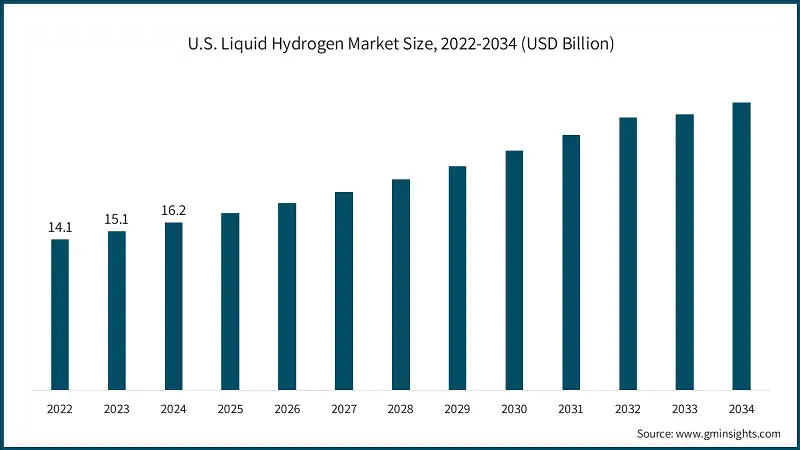
- The U.S. holds a reasonable share in the liquid hydrogen market in North America with around 77.2% share in 2024 and generated USD 16.2 billion in revenue. The growing transportation sector along with shifting consumer preferences toward the adoption of hydrogen fuel cell vehicles (FCVs) to reduce dependence on traditional fossil fuels, is set to augment the industry landscape.
- Ongoing federal initiatives including the Hydrogen Energy Earthshot and tax incentives under the Inflation Reduction Act will drive the market growth. The Department of Energy supports large-scale clean hydrogen hubs, including liquid hydrogen for heavy-duty transportation and aerospace.
- North America is projected to surge over USD 38 billion by 2034. The growing transportation sector along with shifting consumer preferences toward the adoption of hydrogen fuel cell vehicles (FCVs) to reduce dependence on traditional fossil fuels, is set to augment the industry landscape. Further, initiatives and incentives at various levels of government to promote the development and use of hydrogen as an alternative fuel will augment the product penetration across the region.
- The Europe liquid hydrogen market was evaluated at USD 6.9 billion in 2024. Ongoing development and implementation of hydrogen policies and strategies to support the growth of the hydrogen economy, along with the introduction of targets, incentives, and regulations to encourage the production and use of liquid hydrogen, will drive the industry scenario.
- In addition, international collaborations across the region to share knowledge, expertise, and resources for advancing hydrogen technologies will contribute to the business momentum. For instance, in February 2025, a new project to create methods for storing and using liquid hydrogen as an energy carrier for maritime transport was initiated by the consortium headed by ArianeGroup, an industrial organization that oversees LH2 for space purposes.
- The Asia Pacific liquid hydrogen market hold a market share of 31.4% in 2024. Large-scale adoption of liquid hydrogen across economies, including Japan and South Korea, primarily for the transportation sector in the production of fuel cell vehicles, will augment the product penetration. Ongoing investments to develop hydrogen production, storage, and distribution infrastructure will drive the business statistics.
- The China liquid hydrogen market holds the largest market share in the region owing to heavy investment in developing the infrastructure to support this technology. For instance, in March 2024, China introduced a 100 kg liquid-hydrogen fuel system that might enable a truck to go 1,300 kilometers without refueling.
- The rest of world liquid hydrogen market is set to reach over USD 2.1 billion by 2034. Increasing the potential of hydrogen to diversify the economies across the regions, primarily in the Gulf countries, along with large-scale availability of unutilized renewable sources across the region, is set to boost the hydrogen adoption.
- Further, some Middle Eastern countries are exploring the production and export of liquid hydrogen to meet the global demand for clean energy. The development of hydrogen strategies across countries to outline the plans for the production and use of hydrogen will augment the market growth.
Liquid Hydrogen Market Share
- The top five companies leading the liquid hydrogen industry are Shell, Air Products, Air Liquide, Linde, and Kawasaki Heavy Industries possess a distinct competitive edge owing to their robust infrastructure, advanced technological capabilities, and expansive global operations. Surging clean energy demand, continuous innovation in liquefaction and storage technologies, and supportive regulatory frameworks will drive a notable rise in strategic partnerships and joint ventures, enabling these players to expand their market footprint and accelerate technology deployment across key regions.
- Kawasaki Heavy Industries maintains a strategic position in the liquid hydrogen market through its pioneering role in hydrogen liquefaction, storage, and transport technologies. The company leverages decades of cryogenic engineering expertise and has led key initiatives such as the development of the world’s first liquefied hydrogen carrier Suiso Frontier. Its integrated value chain approach spanning production, marine transport, and onshore regasification infrastructure strengthens its global competitiveness.
- Mergers and acquisitions aimed at diversifying technological portfolios along with strategic alliances, have emerged as key factors driving the industry scenario. Moreover, the enhancement of research & development capabilities along with ongoing advancement of hydrogen infrastructure continue to play a pivotal role in accelerating the product adoption.
- Linde through its integrated capabilities across production, liquefaction, storage, and distribution maintains a notable market share in the industry. The company leverages proprietary cryogenic technologies and decades of industrial gas expertise to deliver large-scale liquid hydrogen solutions for mobility, aerospace, and industrial sectors. Strategic partnerships, including joint ventures and long-term supply agreements, bolster their presence in key global markets.
Liquid Hydrogen Market Companies
Eminent players operating in the liquid hydrogen industry are:
- Air Liquide
- Air Products and Chemicals, Inc.
- Chart Industries
- Engie
- GE Appliances
- GENH2
- INOXCVA
- Iwatani Corporation
- Kawasaki Heavy Industries
- Linde
- Messer
- Plug Power
- Praxair Technology, Inc.
- Salzburger Aluminium Group
- Shell
- Wuxi Yuantong Gas
- Air Products and Chemicals, with a revenue of USD 12.1 billion in 2024, supported by its clean energy initiatives. The company announced its major infrastructure plans to construct hydrogen refueling stations across Canada, California, and Europe. These developments are underpinned by its integrated global hydrogen supply chain, enabling scalable deployment and cross-regional connectivity.
- Shell advanced its hydrogen strategy with strong focus on scaling the liquid hydrogen infrastructure to support transport decarbonization. The company, in 2024, invested approximately USD 497 million in R&D projects along with joint initiatives with key mobility and logistics partners aimed at decarbonization. These efforts were further reinforced by the commissioning of large-scale electrolyzer projects to ensure long-term supply resilience.
- Air Liquide strengthened its presence in the liquid hydrogen market through a series of strategic deployments and production expansions. The company reported progress on large-scale liquid hydrogen production units in the U.S. and South Korea, while also expanding the refueling infrastructure for mobility and industrial applications. Air Liquide secured long-term supply agreements and reinforced its role in enabling the hydrogen ecosystem.
Liquid Hydrogen Industry News
- In May 2025, Air Products announced its successful supply of liquid hydrogen for the world’s first hydrogen-powered superyacht, Breakthrough, built by Dutch shipyard Feadship. The vessel features a 3.2 MW hydrogen fuel cell system that generates electricity emission-free. The project included safe bunkering and cryogenic storage integration with MAN Cryo, marking a breakthrough in sustainable marine fuel solutions. This milestone highlights hydrogen’s potential to decarbonize maritime transport and supports the transition to cleaner global shipping.
- In July 2024, Air Products announced the launch of its first trials using the liquid hydrogen-fueled Mercedes-Benz GenH2 trucks, in collaboration with Daimler Truck. The pilot is part of a broader initiative to build a commercial-scale hydrogen refueling station (HRS) network across key TransEuropean corridors. The Duisburg station, now active, supports customer trials with five GenH2 trucks and includes liquid hydrogen refueling, aiming to replicate heavy-duty operating conditions. This partnership not only supports Air Products' goal to convert its fleet to hydrogen but also advances Europe’s hydrogen ecosystem with high-capacity refueling infrastructure, backed by EU and German state funding
- In March 2024, Chart Industries entered in an agreement with Element Resources to supply hydrogen liquefaction systems, cryogenic storage tanks, trailer loadout bays, ISO containers, and compression units. The Lancaster Clean Energy Center facility will produce over 20,000 tons of green hydrogen annually in California, with Chart’s integrated solution streamlining construction and deployment.
The liquid hydrogen market research report includes in-depth coverage of the industry with estimates & forecast in terms of revenue and volume (USD Billion & MT) from 2021 to 2034, for the following segments:
Market, By Production Method
- Coal Gasification
- SMR
- Electrolysis
Market, By Distribution Method
- Pipelines
- Cryogenic Tanks
Market, By End Use
- Transportation
- Light Duty Vehicles (LDV)
- Heavy Duty Vehicles (HDV)
- Hydrogen Ship
- Rail
- Port Machinery
- Construction Machinery
- Chemical
- Others
The above information has been provided for the following regions and countries:
- North America
- U.S.
- Canada
- Europe
- Germany
- UK
- France
- Italy
- Asia Pacific
- China
- India
- Japan
- South Korea
- Australia
- Rest of World
Frequently Asked Question(FAQ) :
What was the market share of the SMR segment in 2024?
The SMR segment dominated 89.4% share in 2024 and is set to expand at a CAGR of over 11% through 2034.
Who are the key players in the liquid hydrogen industry?
Key players include Air Liquide, Air Products and Chemicals, Inc., Chart Industries, Engie, GE Appliances, GENH2, INOXCVA, Iwatani Corporation, Kawasaki Heavy Industries, Linde, Messer, Plug Power, Praxair Technology, Inc.
What are the upcoming trends in the liquid hydrogen market?
Trends include hydrogen hubs, cryogenic tech advances, digital monitoring, cross-border collaboration, and rising green hydrogen investments for decarbonization.
Which region leads the liquid hydrogen sector?
The U.S. market holding a 77.2% share in 2024 and generating USD 16.2 billion in revenue. The market growth is led by the expanding transportation sector and increasing adoption of hydrogen fuel cell vehicles.
What is the growth outlook for the electrolysis segment?
The electrolysis segment is anticipated to witness over 11.2% CAGR up to 2034.
What was the valuation of the cryogenic tanks segment in 2024?
The cryogenic tanks segment accounted for 84.1% of the market in 2024 and is likely to showcase around 7.5% CAGR till 2034.
What is the market size of the liquid hydrogen in 2024?
The market size was USD 42.3 billion in 2024, with a CAGR of 7.1% expected through 2034. The emergence of hydrogen hubs and advancements in hydrogen infrastructure are driving market growth.
What is the projected value of the liquid hydrogen market by 2034?
The market for liquid hydrogen is poised to reach USD 81 billion by 2034, driven by infrastructure expansion, technological advancements, and increasing adoption of clean energy solutions.
Liquid Hydrogen Market Scope
Related Reports