Summary
Table of Content

Liquid Crystal Elastomers for Soft Robotics Market
Get a free sample of this report
Form submitted successfully!
Error submitting form. Please try again.
Thank you!
Your inquiry has been received. Our team will reach out to you with the required details via email. To ensure that you don't miss their response, kindly remember to check your spam folder as well!
Request Sectional Data
Thank you!
Your inquiry has been received. Our team will reach out to you with the required details via email. To ensure that you don't miss their response, kindly remember to check your spam folder as well!
Form submitted successfully!
Error submitting form. Please try again.
Liquid Crystal Elastomers for Soft Robotics Market Size
The global liquid crystal elastomers for soft robotics market was estimated at USD 260 million in 2024, reflecting early-stage commercialization underpinned by two decades of materials science progress. It is expected to grow from USD 332.8 million in 2025 to USD 3.07 billion by 2034, at a CAGR of 28%, according to latest report published by Global Market Insights Inc.
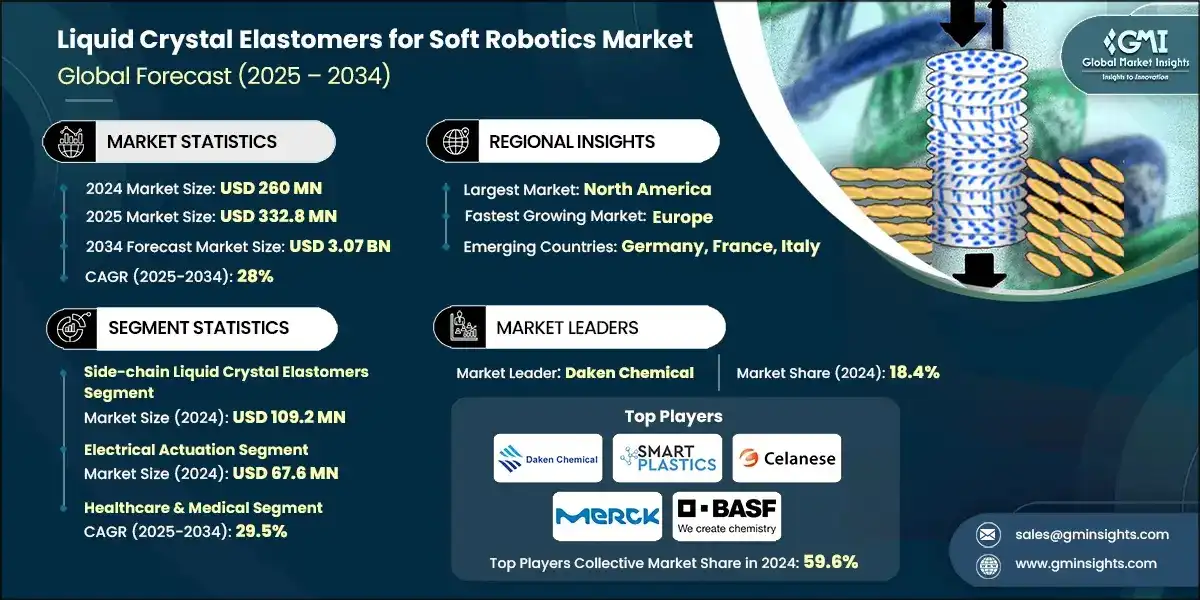
To get key market trends
- Market aligns with improvements in performance, manufacturability, and systems integration across healthcare, automation, and consumer sectors. The numbers are consistent with rapid early adoption patterns seen in novel actuator classes once reliability crosses clinical and industrial thresholds, a path that’s clearer as LCE fibers demonstrate human-muscle-beating work capacity of 650 J/kg and power density of 293 W/kg and as woven architectures show repeatable multifunctional motion under quantified loads.
- Raw materials still command a 35–40% cost share due to specialized mesogens, crosslinkers, and alignment substrates, while processing/fabrication consumes roughly 25–30% as alignment, crosslink kinetics, and precision machining set quality limits. The shifts as additive manufacturing spreads: direct ink writing and fiber production support complex geometries and localized alignment without bespoke tooling, reducing capex and unit cost while enabling product variety. Expect system integration and software-defined actuation to scale fastest as end users buy performance rather than materials.
- The manufacturing and processing services constitute 25% of market value, which represents the advanced fabrication processes involved in making LCEs such as molecular alignment, controlled crosslinking, and precision machining. The adoption of additive manufacturing technologies, especially direct ink writing and 3D printing, has been lowering the costs of processing, but also allows customization, which helps gain access to the market and market expansion.
- The most rapidly expanding value segment of 30-35% of the total is system-level applications, which include complete devices of soft robots, actuator assemblies, and complete control systems. This segment has the advantage of growing demand for autonomous robotics in both healthcare and manufacturing and consumer applications where it has shown performance measures to be superior in some applications compared to traditional actuator technologies.
Liquid Crystal Elastomers for Soft Robotics Market Report Attributes
| Key Takeaway | Details |
|---|---|
| Market Size & Growth | |
| Base Year | 2024 |
| Market Size in 2024 | USD 260 Million |
| Market Size in 2025 | USD 332.8 Million |
| Forecast Period 2025 - 2034 CAGR | 28% |
| Market Size in 2034 | USD 3.07 Billion |
| Key Market Trends | |
| Drivers | Impact |
| Stimuli-responsive actuation capabilities | Stimuli-responsive actuation enables high-strain, programmable motion (30–50% strain; sub-0.5 s response) |
| Advancements in additive manufacturing | 4D/AM methods cut costs and enable complex, aligned geometries |
| Demand for autonomous and self-sustained robotics | Defense- and health-backed integration of electronics on LCE films |
| Pitfalls & Challenges | Impact |
| Slow actuation speed | Thermal diffusion slows bulk actuation; fiber/electro-photothermal cues mitigate |
| Complex fabrication techniques | Alignment/crosslinking complexity raises cost; AM is reducing barriers |
| Opportunities: | Impact |
| Enables development of next-gen biomedical devices with enhanced flexibility and precision | Biomedical devices and wearables with programmable compression/actuation (20–60 mmHg; 1,000+ cycles) |
| Facilitates innovation in smart wearables and responsive textiles | Woven fiber actuators for multifunctional soft robots with quantified performance |
| Market Leaders (2024) | |
| Market Leaders |
18.4% |
| Top Players |
Collective market share in 2024 is 59.6% |
| Competitive Edge |
|
| Regional Insights | |
| Largest Market | North America |
| Fastest Growing Market | Europe |
| Emerging Country | Germany, France, Italy |
| Future Outlook |
|
What are the growth opportunities in this market?
Liquid Crystal Elastomers for Soft Robotics Market Trends
- Programs across top labs show LCEs with multiple responsive domains to thermal, optical, electrical, and magnetic inputs, enabling layered control and complex gaits in soft robots. The numbers tell us that electrically driven fibers can achieve up to 43% strain and multi-second cycles while supporting woven assemblies that actuate as unified fabrics. Here’s what’s interesting: the same architecture can be tuned for sterile or hazardous settings via magnetic or optical triggers, removing tethers and avoiding conductive leads. Over the next 2–4 years, multi-modal actuation is poised to grow at about 30%+ as developers target complex, autonomous behaviors.
- Artificial Muscle Development and Performance Enhancement. LCE fibers have posted headline performance work capacity up to 650 J/kg and power density up to 293 W/kg outperforming human skeletal muscle by ~17× and ~6× respectively, while maintaining reversible operation and textile compatibility. Fish-like swimmers at ~15 mm/s and pumps hitting 7.06 kJ/m³ work density illustrate both speed and force delivery in realistic environments. Because of this, expect niche commercialization in 2025–2030 across prosthetics, surgical tools, and haptics, with wider diffusion into general robotics through 2030–2034 as durability improves.
- Quantitatively, actuation strains in the 30–45% range and response times reaching sub-second regimes are now common in fiber and thin-film formats, which together expand utility in wearable and mobile platforms. Expect this trend to underpin a wave of semi-autonomous devices where geometry, not just electronics, encodes behavior.
- Clinical-grade compression devices powered by LCEs now deliver 20–60 mmHg with controllable profiles and acceptable skin-interface temperatures, and they retain performance over repeated cycles. Compare this to pneumatic sleeves or rigid exos, and the comfort and portability advantages are clear. By 2027–2029, expect first FDA-cleared LCE wearables in niche indications, then broader wellness and performance products as cost curves improve
Liquid Crystal Elastomers for Soft Robotics Market Analysis
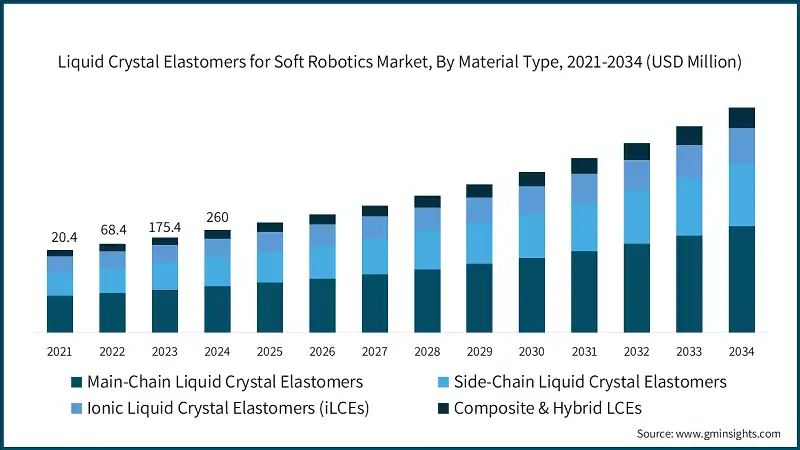
Learn more about the key segments shaping this market
Based on material type, the market is segmented into main-chain liquid crystal elastomers, side-chain liquid crystal elastomers, ionic liquid crystal elastomers (iLCEs), and composite & hybrid LCEs. Side-chain liquid crystal elastomers hold a significant share at a valuation of USD 109.2 million in 2024.
- Side-chain liquid crystal elastomers hold 42% share in 2024, running at a 26.7% CAGR thanks to easier synthesis, broad shape-programming, and good processability for films, fibers, and printed parts. Main-chain LCEs claim 28% with a faster 28.9% CAGR because of higher actuation forces and dimensional stability in demanding aerospace and industrial uses, including fiber muscles that reach 650 J/kg work capacity under thermal or photothermal drive. Ionic LCEs represent 10% at 28% CAGR, adding electrical responsiveness and sensing for soft skins and integrated control. Composite and hybrid systems occupy 20% with the fastest 29.2% CAGR, leveraging carbon fillers, metals, or magnetic particles to couple actuation with conductivity or magnetothermal triggers for multifunctional parts.
- These shares reflect where performance meets manufacturability. Side-chain formats win on versatility and cost, main-chain on strength and stability, and composite on integration. The real driver here is application fit: textiles and wearables favor sidechain and composite fibers; aerospace and automation lean toward main-chain and magnetically responsive hybrids. As 4D printing expands, expect side-chain dominance to narrow as main-chain and hybrid materials exploit precision alignment and multi-material builds.
Based on actuation mode, the liquid crystal elastomers for soft robotics market is segmented into thermal actuation, optical actuation, electrical actuation, magnetic field actuation, and multi-modal actuation. Electrical actuation segment was valued at USD 67.6 million in 2024, and it is anticipated to expand 30.7% of CAGR during 2025-2034.
- Thermal actuation accounts for 38% in 2024 at a 25% CAGR, valued for reliability and force where speed isn’t critical, supported by well-understood nematic–isotropic transitions and simple control. Electrical actuation takes 26% with the highest 30.7% CAGR, delivering millisecond-to-second response, precise positioning, and straightforward digital control, aided by ionic formulations and thin-film metallization that survives 1,000 cycles. Multi-modal approaches thermal-optical, electrothermal, and magnetothermal represent 18% growing at 30.4% as developers stack stimuli to achieve complex, reprogrammable motion with lower system complexity.
- Pricing and integration follow performance envelopes. Thermal remains cost-effective and robust, electrical accelerates autonomy and wearables, while multi-modal actuators anchor high-end robotics that need remote, contactless, or sterile operation. Expect electrical and multi-modal shares to rise as conductive and magnetically responsive composites mature and embedded electronics on LCEs become common.
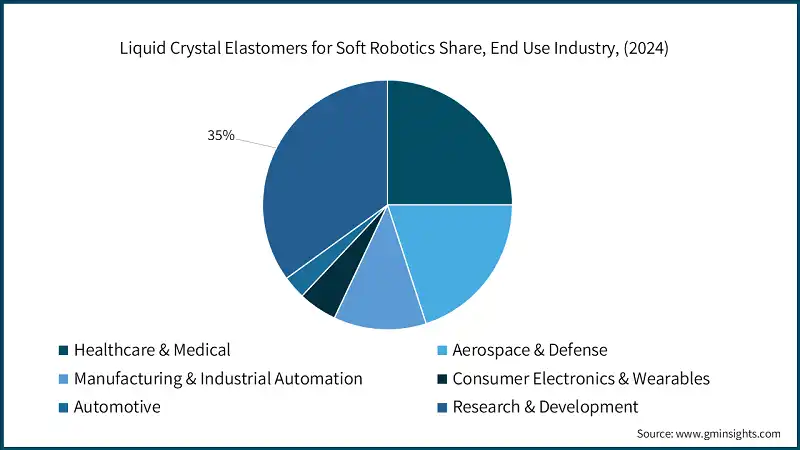
Learn more about the key segments shaping this market
Based on end use industry, the liquid crystal elastomers for soft robotics market is segmented into healthcare & medical, aerospace & defense, manufacturing & industrial automation, consumer electronics & wearables, automotive, and research & development. Healthcare & medical is estimated to grasp a value of USD 65 million in 2025 and is expected to grow at 29.5% of CAGR during the forecast period.
- In 2024, the healthcare and medical applications will occupy 25% of the market share and will record the highest growth rate of 29.5% up to the year 2034. This encompasses prosthetic actuators, rehabilitation equipment, surgical equipment and therapeutic equipment. The biocompatibility of the LCE materials is excellent and the materials can work down to physiological temperature, so that medical applications require an accurate and controlled actuation.
- LCE-based compression therapy devices have been demonstrated to produce a highly accurate pressure span of 20-60mmHg which is adequate to meet the clinical needs of a number of therapeutic uses. The business case of strategic merger of LCEs with FDA-regulated medical devices offers colossal potential in the market and clinical trials are bearing good news on both prosthetic actuators and rehabilitation equipment. The medical care sector targets the rising trend in the demand for custom-made medical equipment and the rising number of elderly individuals in pursuit of complex, therapeutic services.
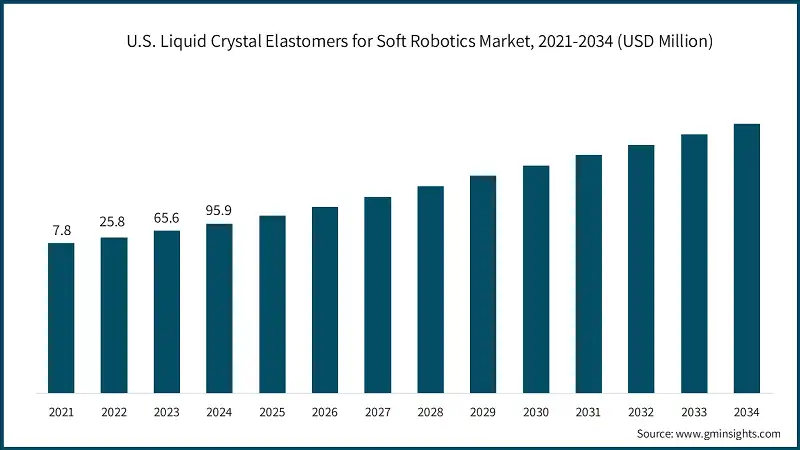
Looking for region specific data?
North America Liquid Crystal Elastomers for Soft Robotics Market Europe market accounted for USD 65 million in 2024 and is anticipated to show lucrative growth over the forecast period. The Asia Pacific market is anticipated to grow at the highest CAGR during the analysis timeframe. Daken Chemical leads with 18.4% market share in 2024, anchoring a top five concentration of 59.6% that signals meaningful, but not prohibitive, barriers to entry. The data confirms that performance differentiation of 650 J/kg work capacity, 293 W/kg power density in fiber muscles has become a central battleground as suppliers prove quantified gains in actuators and textiles. Here’s the thing: players with alignment control, fiber processing, and additive tool chains can now deliver application-specific parts faster, which tightens customer lock-in while raising the bar for newcomers. Smart-Plastics Ltd’s application-first model brings rapid prototyping and collaborative design to healthcare and aerospace programs, shortening development cycles via tailored chemistries and weaving/printing know-how. Celanese scales production by embedding LCE lines into global polymer operations, leveraging automation and QC to stabilize cost and quality at volume. Merck KGaA repurposes decades of liquid crystal IP from displays to elastomeric systems, prioritizing high-performance niches where premium specs pay. Synthon Chemicals and niche firms like Beam Co and Wilshire Technologies pursue novel formulations and sustainable processes to stand out, aided by academia and public grants. M&A and partnerships are active as incumbents seek fast tracks to weaving, metallization, and hybrid composites. Government-backed projects, notably NSF/DOE/AFRL awards, influence procurement and de-risk pilots in defense and healthcare, indirectly shaping share trajectories. Bottom line: market concentration remains moderate as IP moats form around process windows and application data, while collaboration-centric strategies unlock new verticals. The market leadership of Daken Chemical is founded on the extensive research in LCE, the new and modern manufacturing plant and the strategic alliances with the major manufacturers of robotics. The proprietary synthesis process allows the company to produce high-performance LCE materials repeatedly with better actuation properties and with work densities that match the 650 J/kg standards which have been set in literature studies. Its competitive strategy is built on vertical integration whereby the company synthesizes raw materials to the production of the final components such as finished products offering cost benefits and quality control in its entire chain of value. Recent investments in additive manufacturing compatibility have made Daken the company, which is in a position to address the expanding market of our personalized LCE components and our quick prototyping services. Smart-Plastics Ltd has already gained a good position in the market due to its concentration on application specific LCE formulations and customer-oriented developmental strategies. The vision of the company focuses on working closely with the end-users in healthcare and aerospace industries and creating solutions that meet the specific performance needs and regulatory provisions. The high prototyping speeds and flexible production processes that allow the company to respond quickly to the changing customer demands are the competitive advantage. The technical services organization of Smart-Plastics offers diverse services such as selection of materials, design optimization, and performance validation to enable the firm to build robust customer relationships and deter entry of competitors. Celanese Corporation has the benefit of being able to compete in the LCE market due to its vast polymer chemistry expertise and worldwide manufacturing capacity. The strategy of the company is aimed at the realization of cost competitiveness by means of production scale and preservation of standards of performance needed in the sphere of robotics usage. The advantage that Celanese has is that it merges LCE production with the already established polymer manufacturing activities thus saving on the capital needs and speeding up the business venture into the market. The international supply chain and distribution channels of the company offer great benefits to cater to the international markets and cater to the multinational robotics manufacturers. Merck KGaA leverages centuries of knowledge of the liquid crystal displayed technologies in the leadership role in the display technologies and applies it to elastomeric applications. The competitive advantages of the company include its strong knowledge of the chemistry of liquid crystal, the well-established supplier connections of the specialty chemicals, and the well-developed intellectual property base of the liquid crystal material. The strategy of Merck is focused on high-performance applications in which higher material properties incur high prices. The research and development capabilities of the company are high-level characterization methods and the ability of molecular modeling which hastens the development of new materials. The BASF Corporation joining the LCE market is a sign of the company focusing on sustainable materials and advanced technologies in manufacturing. The company strategy focuses on its own growth and development of bio-based LCE materials and environmentally friendly manufacturing processes in response to the increased market demand for sustainable technologies. The established relationships with customers in the automotive market and the industrial market are global, which offers LCE a lot of competitive power towards market penetration. The large scale and speed of technological development and scale-up capability of the company is possible through its big R&D resources and technical capabilities. Europe Liquid Crystal Elastomers for Soft Robotics Market
Asia Pacific Liquid Crystal Elastomers for Soft Robotics Market
Latin American Liquid Crystal Elastomers for Soft Robotics Market
Middle East and Africa Liquid Crystal Elastomers for Soft Robotics Market
Liquid Crystal Elastomers for Soft Robotics Market Share
Liquid Crystal Elastomers for Soft Robotics Market Companies
Liquid Crystal Elastomers for Soft Robotics Industry News
The liquid crystal elastomers for soft robotics market research report includes in-depth coverage of the industry with estimates & forecast in terms of revenue (USD Million) & volume (Tons) from 2021 to 2034, for the following segments:
Market, By Material Type
- Main-chain liquid crystal elastomers
- Polysiloxane-based LCEs
- Polyacrylate-based LCEs
- Polyester-based LCEs
- Polyurethane-based LCEs
- Side-chain liquid crystal elastomers
- End-on Sidechain LCEs
- Side-on Sidechain LCEs
- Laterally Attached LCEs
- Ionic liquid crystal elastomers (iLCEs)
- Cationic iLCEs
- Anionic iLCEs
- Zwitterionic iLCEs
- Composite & hybrid LCEs
- Carbon-based Composites (CNT, Graphene, GO)
- Metal Nanoparticle Composites (Au, Ag, Fe3O4)
- Liquid Metal Embedded LCEs
- Ceramic-filled LCEs
Market, By Actuation Mode
- Thermal actuation
- Direct thermal heating
- Joule heating (electrothermal)
- Induction heating
- Optical actuation
- Photochemical (azobenzene-based)
- Photothermal (CNT, gold nanoparticles)
- Near-infrared responsive
- Visible light responsive
- Electrical actuation
- Dielectric actuation
- Electrostatic actuation
- Ionic actuation
- Magnetic field actuation
- Magnetothermal
- Direct magnetic torque
- Multi-modal actuation
- Thermal-optical combined
- Electrical-thermal combined
- Rf-controlled systems
Market, By End Use Industry
- Healthcare & Medical
- Medical devices & implants
- Prosthetics & orthotics
- Drug delivery systems
- Surgical robotics
- Rehabilitation equipment
- Biomedical research tools
- Aerospace & Defense
- Morphing aircraft structures
- Adaptive camouflage systems
- Deployable space structures
- Autonomous military robots
- Surveillance & reconnaissance
- Missile & rocket components
- Manufacturing & Industrial Automation
- Soft robotic grippers
- Assembly line automation
- Material handling systems
- Quality control & inspection
- Packaging & processing
- Maintenance & repair robots
- Consumer Electronics & Wearables
- Smart textiles & clothing
- Wearable health monitors
- Haptic feedback devices
- Flexible displays
- Personal assistive devices
- Gaming & entertainment
- Automotive
- Adaptive seating systems
- Active aerodynamics
- Vibration damping
- Interior comfort systems
- Safety & protection systems
- Research & Development
- Academic research institutions
- Government research labs
- Material testing & characterization
The above information is provided for the following regions and countries:
- North America
- U.S.
- Canada
- Europe
- UK
- Germany
- France
- Italy
- Spain
- Rest of Europe
- Asia Pacific
- China
- India
- Japan
- South Korea
- Australia
- Rest of Asia Pacific
- Latin America
- Brazil
- Mexico
- Argentina
- Rest of Latin America
- MEA
- UAE
- Saudi Arabia
- South Africa
- Rest of Middle East and Africa
Frequently Asked Question(FAQ) :
Who are the key players in the liquid crystal elastomers for soft robotics market?
Key players include Daken Chemical, Smart-Plastics Ltd, Celanese Corporation, Merck KGaA, BASF SE, Synthon Chemicals, Beam Co, Wilshire Technologies, and TCI America.
Which region leads the liquid crystal elastomers for soft robotics market?
The U.S. market led North America’s 45% regional share in 2024. Growth is driven by strong aerospace, defense, and healthcare R&D backed by programs from AFWERX and NSF.
What are the upcoming trends in the liquid crystal elastomers for soft robotics industry?
Key trends include 4D printing integration, multi-modal actuation systems, and development of artificial muscles surpassing human work capacity, enabling next-gen wearable and autonomous robotic systems.
What is the growth outlook for the healthcare & medical segment from 2025 to 2034?
The healthcare and medical segment is projected to grow at 29.5% CAGR through 2034.
What was the valuation of the electrical actuation segment in 2024?
Electrical actuation was valued at USD 67.6 million in 2024, holding a 26% share. It leads growth with a 30.7% CAGR due to precise digital control, fast response, and improved ionic formulations.
How much revenue did the side-chain liquid crystal elastomers segment generate in 2024?
Side-chain liquid crystal elastomers generated USD 109.2 million in 2024, accounting for 42% of the market.
What is the current liquid crystal elastomers for soft robotics market size in 2025?
The market size is projected to reach USD 332.8 million in 2025.
What is the projected value of the liquid crystal elastomers for soft robotics market by 2034?
The market is expected to reach USD 3.07 billion by 2034, supported by advancements in additive manufacturing and the commercialization of soft robotic actuators across healthcare and industrial automation.
What is the market size of the liquid crystal elastomers for soft robotics industry in 2024?
The market size was USD 260 million in 2024, with a CAGR of 28% expected through 2034, driven by growing demand for autonomous and self-sustained robotics.
Liquid Crystal Elastomers for Soft Robotics Market Scope
Related Reports