Summary
Table of Content

Liquid Air Energy Storage Market
Get a free sample of this report
Form submitted successfully!
Error submitting form. Please try again.
Thank you!
Your inquiry has been received. Our team will reach out to you with the required details via email. To ensure that you don't miss their response, kindly remember to check your spam folder as well!
Request Sectional Data
Thank you!
Your inquiry has been received. Our team will reach out to you with the required details via email. To ensure that you don't miss their response, kindly remember to check your spam folder as well!
Form submitted successfully!
Error submitting form. Please try again.
Liquid Air Energy Storage Market Size
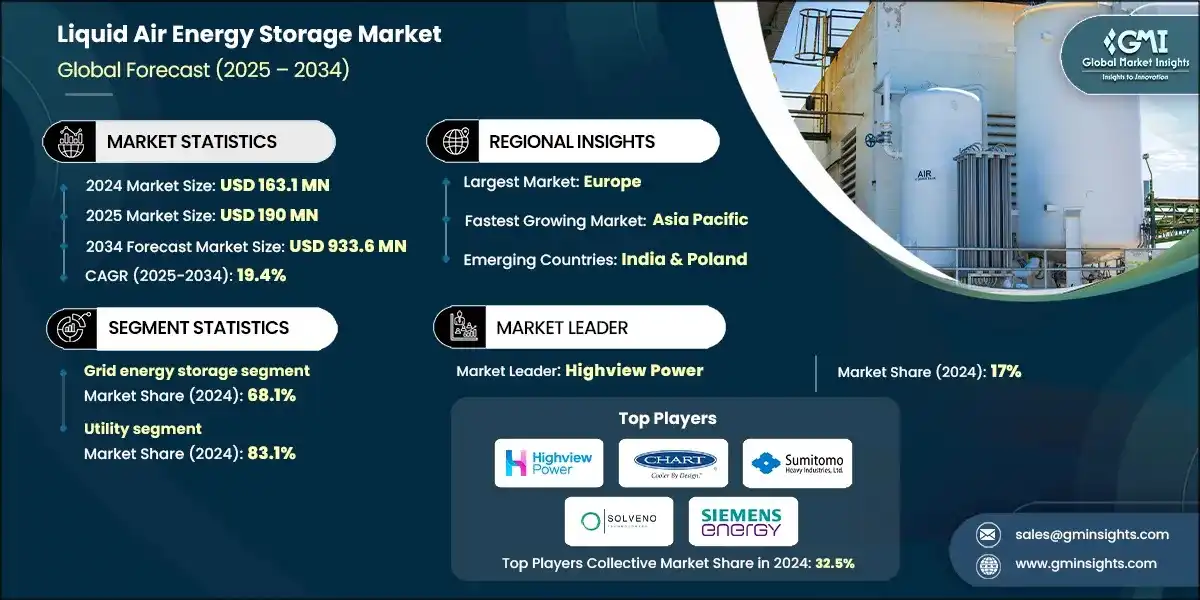
The global liquid air energy storage market was estimated at USD 163.1 million in 2024. The market is expected to grow from USD 190 million in 2025 to USD 933.6 million in 2034, at a CAGR of 19.4% according to Global Market Insights Inc.
Liquid Air Energy Storage Market Key Takeaways
Market Size & Growth
- 2024 Market Size: USD 163.1 Million
- 2025 Market Size: USD 190 Million
- 2034 Forecast Market Size: USD 933.6 Million
- CAGR (2025–2034): 19.4%
Key Market Drivers
- Renewable energy integration.
- Environmental sustainability.
Challenges
- High initial capital costs.
- Lower round-trip efficiency.
Opportunity
- Integration with industrial waste heat.
- Support for renewable-powered microgrids.
Key Players
- Market Leader: Highview Power led with over 17% market share in 2024.
- Leading Players: Top 5 players in this market include Highview Power, Chart Industries, Sumitomo Heavy Industries, Ltd, Solveno Technologies, Siemens Energy, which collectively held a market share of 32.5% in 2024.
Get Market Insights & Growth Opportunities
- Growing countries' transition to low-carbon energy systems necessitates demand for flexible, large-scale energy storage systems. LAES supports this by storing excess electricity generated from intermittent renewable sources, including wind and solar. It helps balance supply and demand, ensuring grid stability even when renewable output fluctuates. Unlike batteries, LAES can also store energy for long durations (hours to days), making it ideal for seasonal or weekly balancing.
- Liquid air energy storage (LAES) is a large-scale energy storage technology that stores electricity by cooling ambient air to cryogenic temperatures (around -196°C), turning it into liquid. When energy is needed, the liquid air is heated, expanding rapidly to drive turbines and generate electricity. LAES is scalable, long-lasting, and uses non-toxic, abundant materials, making it a promising solution for integrating renewable energy and enhancing grid flexibility.
- Key players are forming partnerships to exchange their technology, customer base and expand the product growth. For instance, in April 2021, Highview Power, a prominent provider of long-duration energy storage systems, partnered with MAN Energy Solutions to deliver turbomachinery for its CRYOBattery project. This 50 MW liquid-air energy storage facility, with a minimum capacity of 250MWh, is located in Carrington Village, UK.
- Additionally, LAES systems use abundant, non-toxic materials, mainly air and steel, making them environmentally friendly and easier to recycle than lithium-ion batteries, leading to escalate their adoption. They also have a long operational life (20–30 years) with minimal degradation over time. This durability reduces lifecycle costs and environmental concerns associated with battery disposal or rare earth mining.
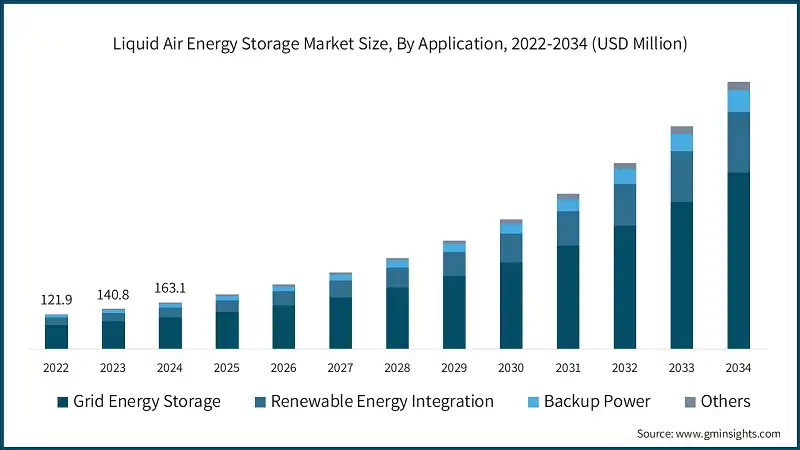
- The liquid air energy storage market was valued at USD 105.8 million in 2021 and grew at a CAGR of 15.5% through 2024 on account of its suitability for both medium and large-scale applications. Moreover, it can be deployed in urban, rural, or industrial settings and doesn’t require specific geological conditions, such as those required for pumped hydro or compressed air energy storage. This flexibility makes it attractive for utilities, data centers, and industrial users seeking reliable backup power.
- Europe is among the dominant regions driven by a powerful combination of climate policy, renewable energy expansion, and technological innovation. Rising regions' environmental targets, such as the European Union’s ambitious climate targets, which include reducing greenhouse gas emissions by 55% by 2030 and achieving net-zero emissions by 2050, will uplift the business scenario. To meet these goals, the EU aims to increase the share of renewables in its energy mix to 42.5% by 2030, which necessitates large-scale, long-duration energy storage solutions, including LAES, to manage the intermittency of wind and solar power
- Asia Pacific is the fastest-growing region in the liquid air energy storage market, accelerating due to a combination of renewable energy expansion, energy security concerns, supportive government policies, and technological innovation. Governments across the region are actively promoting energy storage through policy incentives, pilot projects, and strategic investments. For instance, China’s 14th Five-Year Plan emphasizes the development of innovative storage technologies, including LAES, while Japan is investing in smart grid and storage infrastructure as part of its energy transition strategy.
To get key market trends
Liquid Air Energy Storage Market Trends
- Growing popularity of renewable energy sources such as wind and solar necessitates the demand for long-duration energy storage, including LAES as a scalable solution capable of storing energy for hours to days, unlike lithium-ion batteries, which are better suited for short-term storage. This makes LAES ideal for balancing grid supply and demand over extended periods, driving the product growth. Additionally, its ability to decouple power and energy capacity also allows for flexible system design, making it attractive for utilities seeking reliable backup during prolonged renewable intermittency or peak demand periods.
- Increasing companies' efforts in bolstering product adoption by introducing new projects in developing regions will augment the industry landscape. For instance, in December 2022, Huge Energy Ltd, a London-based LAES technology firm, is set to build Poland’s first liquid air energy storage plant. The company has signed a letter of intent and agreement with Promet Plast SC, a renewable energy player in the Gaj Olawski energy cluster near Wroclaw. The initial phase includes a 25 MW / 125 MWh facility, with plans to expand by adding six more units of similar capacity.
- Furthermore, ongoing technological innovation aiming to improve the efficiency and cost-effectiveness of LAES escalates the product adoption. Advances in cryogenic engineering, thermal energy recovery, and system integration are pushing round-trip efficiencies closer to 70%. These improvements make LAES more competitive with other storage technologies. Modular and scalable designs are also reducing installation time and costs. Continuous evolution of R&D focused towards improving the performance and commercial viability of LAES is attracting interest from utilities, industries, and investors looking for robust energy storage options, leading to bolster the business growth.
- Rising companies' collaborations will uplift the technology growth. For instance, in January 2023, Sumitomo Heavy Industries and Hiroshima Gas are building a 4.99 MW, 4-hour Liquid Air Energy Storage plant near Hatsukaichi LNG Terminal, enhancing grid efficiency using cryogenic technology and cold energy reuse. Additionally, growing governments' introduction of supportive policies and incentives to accelerate energy storage deployment will foster the industry growth.
- Growing industries' pressure to decarbonize will improve LAES adoption, offering dual benefit: energy storage and waste heat utilization. By integrating LAES with industrial processes, companies can capture waste heat to enhance system efficiency while storing excess energy for later use. This is particularly valuable in sectors including steel, cement, and chemicals. The ability to reduce emissions and energy costs simultaneously is driving increased adoption of LAES in industrial settings, where sustainability and operational efficiency are becoming strategic priorities.
Liquid Air Energy Storage Market Analysis
Learn more about the key segments shaping this market
Based on the application, the industry is segmented into grid energy storage, renewable energy integration, backup power and others. The grid energy storage application dominated about 68.1% market share in 2024 and is expected to grow at a CAGR of 19% through 2034.
- The increasing penetration of renewable energy sources is driving demand for flexible, long-duration storage solutions such as LAES. Improving solar and wind deployment also increases the challenges of managing their variability, necessitating LAES adoption, which offers a scalable, zero-emission method to store excess energy and release it when needed, helping stabilize the grid. Its use of ambient air and avoidance of rare materials make it environmentally and economically attractive.
- The renewable energy integration market will grow at a CAGR of 20% by 2034. The growing share of intermittent renewable energy sources such as wind and solar is creating an urgent need for reliable grid balancing solutions. LAES is increasingly recognized for its ability to store surplus energy and release it during low-generation periods, ensuring a stable power supply. Moreover, LAES offers a clean, non-toxic alternative that supports grid flexibility without relying on rare materials. Its ability to decouple generation from consumption makes it a vital tool in managing the increasing variability of renewable energy and maintaining grid reliability.
- The backup power market is expected to cross USD 73 million by 2034. Rising frequency of power outages due to extreme weather and grid instability increases the need for reliable backup energy, making LAES a preferred choice as a clean alternative to diesel generators and chemical batteries. It stores energy using ambient air, producing zero emissions during operation. Furthermore, with rising environmental regulations and public pressure to reduce carbon footprints, industries and utilities are turning to LAES for sustainable backup solutions.
Learn more about the key segments shaping this market
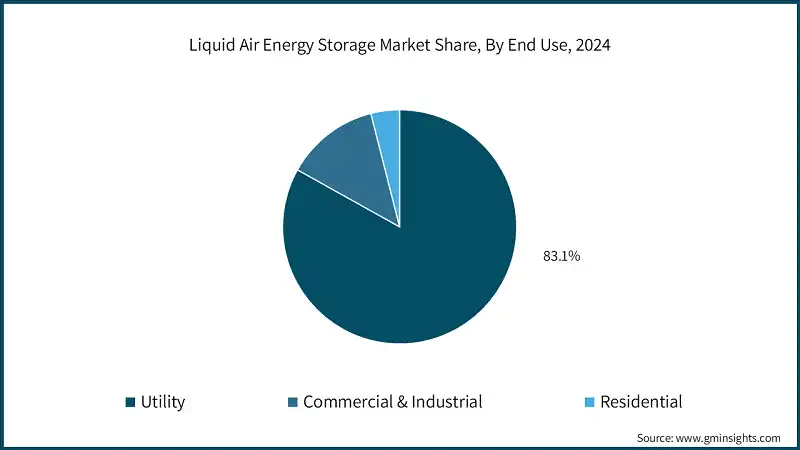
Based on end use, the industry is segmented into residential, commercial & industrial, and utility. Utility application dominates the market with an 83.1% share in 2024 and is expected to grow at a CAGR of 19.2% from 2025 to 2034.
- Growing pressure on utilities to manage fluctuating energy supply and demand, especially with the increasing integration of renewables, propels LAES adoption as a preferred solution due to its ability to deliver long-duration energy storage at scale. Ongoing countries' efforts to deploy technology in the coming years will complement the industry scenario. For instance, in December 2022, Huge Energy Ltd, a UK-based LAES developer, plans to build Poland’s first liquid air energy storage plant—starting with a 25 MW/125 MWh unit and aiming to expand with six more installations of a similar scale.
- The commercial & industrial is set to grow at a CAGR of 20.1% through 2034. Growing energy reliability challenges due to rising grid instability and peak demand charges faced by the C&I sector are propelling LAES adoption as a solution to ensure uninterrupted operations and reduce energy costs. Its ability to store energy during off-peak hours and discharge during peak times helps businesses manage tariffs and avoid downtime. Moreover, with increasing pressure to maintain operational continuity and reduce energy expenses, LAES offers a scalable, long-duration storage option. The rising need for resilient energy systems is prompting industries to invest in LAES for backup power, load shifting, and enhanced energy management.
- The residential is set to grow at a CAGR of 19.8% by 2034, due to increasing concerns over grid outages and energy reliability, encouraging homeowners to seek backup power solutions that are both clean and dependable. LAES offers a non-toxic, emission-free alternative to diesel generators and lithium-ion batteries. Additionally, the increasing frequency of extreme weather events and grid instability is driving interest in resilient energy systems. LAES is emerging as a viable option for households aiming to secure energy independence while aligning with growing environmental awareness and sustainability goals.
Looking for region specific data?
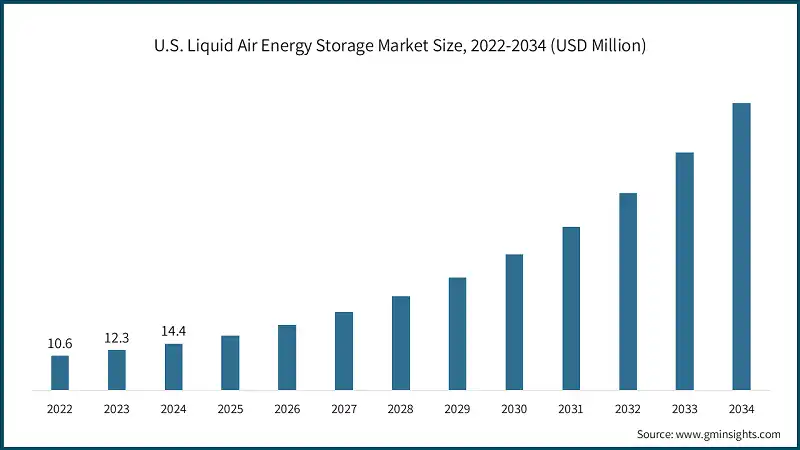
- The U.S. dominated the liquid air energy storage market in North America with around 96.7% share in 2024 and is expected to generate over USD 88 million by 2034. Increasing investments in solar and wind power across the U.S., bolster the need for long-duration energy storage, making LAES a preferred choice for supporting grid stability by storing excess renewable energy and releasing it during demand peaks, helping utilities manage variability and enhance reliability.
- Moreover, ongoing tightening of environmental regulations and public awareness raise the popularity of LAES for its zero-emission profile and use of non-toxic materials. Its safety advantages over chemical batteries and compatibility with existing infrastructure make it an attractive option for sustainable energy strategies.
- The North America liquid air energy storage market size exceeded USD 14.9 million in 2024. Rising concerns over cyber threats, natural disasters, and aging grid infrastructure are gaining attention for LAES is gaining attention as a tool for enhancing energy security. Its ability to provide long-duration backup power and operate independently of fuel supply chains makes it attractive for critical infrastructure and remote communities, which improves its adoption.
- Europe liquid air energy storage market is anticipated to reach over USD 622 million by 2034. Europe’s increasing commitment to climate neutrality and expanding renewable energy capacity is driving demand for long-duration storage. LAES supports grid flexibility by storing surplus wind and solar energy and releasing it during demand peaks, helping meet rising decarbonization goals.
- Increasing companies' investments for introducing LAES in the region will complement the industry growth. For instance, in May 2021, Highview Power, a global leader in long-duration energy storage, is developing seven liquid air projects in Spain totaling 350MW/2.1GWh. This USD 1 billion expansion boosts its global pipeline to over 5GWh.
- Asia Pacific liquid air energy storage market is anticipated to grow at a CAGR of 19.8% by 2034. Increasing frequency of natural disasters such as typhoons, floods, and heatwaves, which threaten energy infrastructure, increases demand for advanced solutions that can provide long-duration backup operating independently of fuel supply chains. Governments across the region are boosting support for domestic clean energy technologies through funding, pilot programs, and strategic partnerships. LAES is benefiting from this growing momentum, especially as countries seek scalable, locally adaptable solutions that reduce reliance on imported energy storage systems and support green industrial growth.
Liquid Air Energy Storage Market Share
- The top 5 companies, including Highview Power, Chart Industries, Sumitomo Heavy Industries, Ltd, Solveno Technologies and Siemens Energy, account for around 32.5% market share. Companies are collaborating with utilities, industrial players, and infrastructure owners to enable faster deployment. Integrating LAES with existing facilities such as LNG terminals or air separation units reduces capital costs and accelerates scalability. These partnerships also help navigate regulatory landscapes and unlock new markets across energy-intensive sectors.
- Additionally, key players are investing in R&D to enhance round-trip efficiency and reduce energy losses. By developing second-generation LAES systems with improved thermodynamic cycles and integration with waste heat sources, companies can offer more competitive, high-performance solutions that meet the growing demand for long-duration and cost-effective energy storage.
- Companies are expanding into regions with rising renewable adoption and grid reliability challenges, such as Asia Pacific, Eastern Europe, and Latin America, which can drive growth. Furthermore, tailoring LAES solutions to local energy needs and leveraging government incentives helps companies establish a strong foothold in underserved or fast-developing energy markets.
Liquid Air Energy Storage Market Companies
- Highview Power, a UK-based pioneer in LAES, Highview Power offers modular, grid-scale cryogenic storage systems with up to 40-year lifespans. Its patented technology captures excess renewable energy and delivers clean power on demand. Backed by major investors, it’s developing large-scale projects globally, including a 300 MWh plant in the UK.
- Chart Industries, a U.S. public company, designs cryogenic systems central to LAES, including heat exchangers and storage tanks. Its proprietary SuperGap vaporizers and modular construction enhance efficiency and scalability. With USD 4.2 billion in revenue, Chart supports zero-emission energy storage for peak shaving and renewable integration.
- Sumitomo Heavy Industries, a Japanese industrial giant, provides turnkey LAES solutions through its SHI FW division. It offers scalable systems with ancillary grid services such as inertia and reactive power. Its Hiroshima plant is the world’s first commercial LAES facility. Sumitomo reported USD 6.9 billion in revenue in 2025.
- Solveno Technologies, a Belgian startup, specializes in sustainable energy systems, including LAES. It offers compact, scalable cryogenic storage as an alternative to batteries, targeting industrial parks and commercial users. Though privately held and recently founded, it’s gaining traction for its engineering-driven, low-emission solutions.
- Siemens Energy supports LAES through its expertise in turbines, compressors, and plant engineering. While primarily focused on Compressed Air Energy Storage (CAES), it collaborates with Sumitomo on LAES development. Siemens Energy posted USD 42.4 billion in revenue and is advancing long-duration storage for grid stability and renewable integration.
Eminent players operating in the liquid air energy storage market are:
- Chart Industries
- ENERGY DOME
- Everllence
- Highview Power
- Huge Energy
- Innovatium
- Phelas
- Siemens Energy
- Solveno Technologies
- Sumitomo Heavy Industries, Ltd
Liquid Air Energy Storage Market Report Attributes
| Key Takeaway | Details |
|---|---|
| Market Size & Growth | |
| Base Year | 2024 |
| Market Size in 2024 | USD 163.1 Million |
| Market Size in 2025 | USD 190 Million |
| Forecast Period 2025 - 2034 CAGR | 19.4% |
| Market Size in 2034 | USD 933.6 Million |
| Key Market Trends | |
| Drivers | Impact |
| Renewable energy integration | Enables long-duration storage to balance intermittent solar and wind power, ensuring grid stability and renewable energy reliability. |
| Environmental sustainability | Uses non-toxic, abundant air and steel, offering a clean, recyclable alternative to lithium-ion batteries with minimal ecological impact. |
| Pitfalls & Challenges | Impact |
| High initial capital costs | Large-scale LAES plants require significant upfront investment, which can deter adoption without strong policy or financial support. |
| Lower round-trip efficiency | LAES systems typically have 50–70% efficiency, lower than lithium-ion batteries, affecting competitiveness in short-duration applications. |
| Opportunities: | Impact |
| Integration with industrial waste heat | LAES can utilize waste heat from factories to boost efficiency, creating synergies between energy storage and industrial decarbonization. |
| Support for renewable-powered microgrids | LAES enables stable, long-duration storage for remote or island microgrids, enhancing energy access and resilience using local renewable sources. |
| Market Leaders (2024) | |
| Market Leaders |
17% market share |
| Top Players |
Collective market share in 2024 is 32.5% |
| Competitive Edge |
|
| Regional Insights | |
| Largest Market | Europe |
| Fastest Growing Market | Asia Pacific |
| Emerging Country | India & Poland |
| Future Outlook |
|
What are the growth opportunities in this market?
Liquid Air Energy Storage Industry News:
- In March 2024, Zhonglv Zhongke Energy Storage installed a 60MW LAES unit in Golmud, Qinghai, China, in 2024 last quarter. It’s the first industrial-scale LAES project globally, aiming to support regional energy needs and expand internationally with backing from Fives.
- In June 2021, Highview Enlasa, a joint venture between Highview Power and Enlasa, is set to develop Chile’s first liquid air energy storage project. This initiative marks a major step in introducing long-duration, zero-emission storage technology to Latin America.
The liquid air energy storage market research report includes an in-depth coverage of the industry with estimates & forecast in terms of revenue in “USD Million” from 2021 to 2034, for the following segments:
Market, By Application
- Grid energy storage
- Renewable energy integration
- Backup power
- Others
Market, By End Use
- Utility
- Commercial & industrial
- Residential
The above information has been provided for the following regions and countries:
- North America
- U.S.
- Canada
- Europe
- UK
- Germany
- Poland
- Spain
- Asia Pacific
- China
- Japan
- India
- Rest of World
Frequently Asked Question(FAQ) :
What is the market size of the liquid air energy storage in 2024?
The market size was USD 163.1 million in 2024, with a CAGR of 19.4% expected through 2034 driven by the growing transition to low-carbon energy systems and rising demand for flexible, large-scale energy storage solutions.
What is the projected value of the liquid air energy storage market by 2034?
The liquid air energy storage market is expected to reach USD 933.6 million by 2034, propelled by renewable energy integration, environmental sustainability, and technological innovation.
What is the current liquid air energy storage market size in 2025?
The market size is projected to reach USD 190 million in 2025.
What was the market share of the grid energy storage application hold in 2024?
Grid energy storage dominated with about 68.1% market share in 2024.
What was the market share of the utility segment in 2024?
Utility application held 83.1% market share in 2024, led by pressure to manage fluctuating energy supply and demand with increasing renewable integration.
What is the growth outlook for the commercial & industrial segment from 2025 to 2034? The
commercial & industrial segment is set to grow at a CAGR of 20.1% through 2034, due to energy reliability challenges and rising grid instability.
Which region leads the liquid air energy storage market?
The U.S. dominated the North American liquid air energy storage market with about 96.7% share in 2024 and is projected to exceed USD 88 million by 2034.
What are the upcoming trends in the liquid air energy storage market?
Key trends include integration with industrial waste heat, support for renewable-powered microgrids, improved round-trip efficiency through cryogenic engineering advances, and LAES role in decarbonizing power grids.
Who are the key players in the liquid air energy storage market?
Key players include Highview Power, Chart Industries, Sumitomo Heavy Industries, Ltd, Solveno Technologies, Siemens Energy, ENERGY DOME, Everllence, Huge Energy, Innovatium, and Phelas.