Summary
Table of Content

Light-Protective Packaging Materials Market
Get a free sample of this report
Form submitted successfully!
Error submitting form. Please try again.
Thank you!
Your inquiry has been received. Our team will reach out to you with the required details via email. To ensure that you don't miss their response, kindly remember to check your spam folder as well!
Request Sectional Data
Thank you!
Your inquiry has been received. Our team will reach out to you with the required details via email. To ensure that you don't miss their response, kindly remember to check your spam folder as well!
Form submitted successfully!
Error submitting form. Please try again.
Light-Protective Packaging Materials Market Size
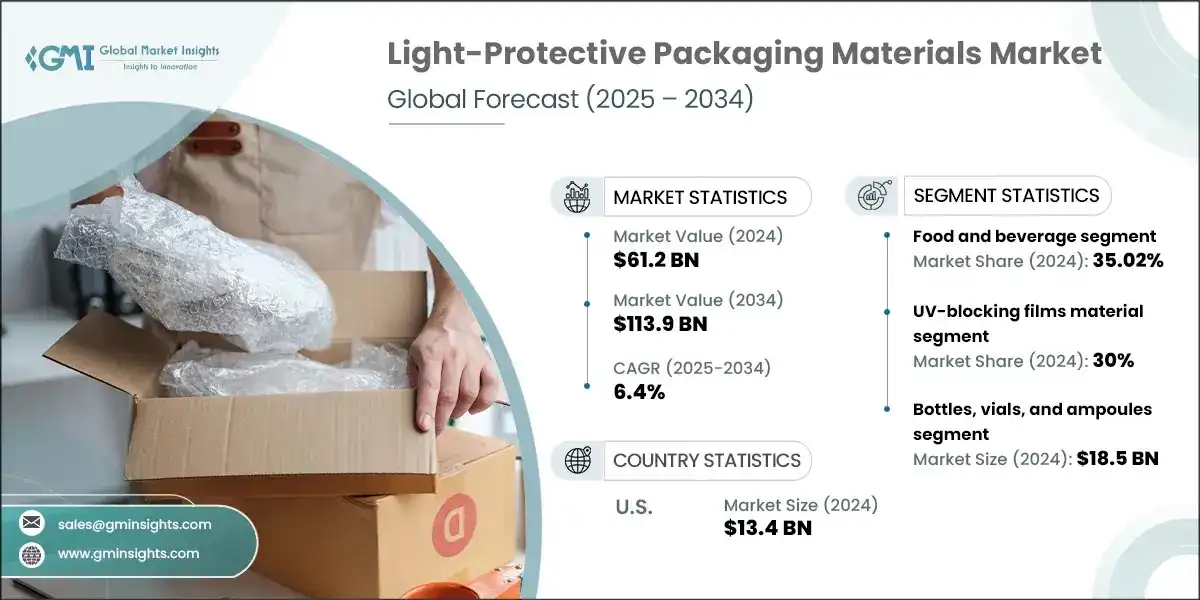
The global light-protective packaging materials market size was valued at USD 61.2 billion in 2024. The market is expected to grow from USD 64.9 billion in 2025 to USD 113.9 billion in 2034, growing at a CAGR of 6.4%.
Light-Protective Packaging Materials Market Key Takeaways
Market Size & Growth
- 2024 Market Size: USD 61.2 Billion
- 2034 Forecast Market Size: USD 113.9 Billion
- CAGR (2025–2034): 6.4%
Key Market Drivers
- Increasing demand for light-sensitive pharmaceuticals.
- Shelf-life extension for food & beverage.
- Regulatory compliance and safety standards.
- Cosmetic and chemical product stability.
Challenges
- High cost of advanced barrier materials.
- Supply chain complexity.
Opportunity
- High cost of advanced barrier materials.
- Supply chain complexity.
- Development of smart and multi-layer barrier solutions.
- Expansion in emerging markets.
- Sustainable and recyclable material innovations.
- Integration with smart packaging technologies.
Key Players
- Market Leader: Berry Global Inc. led with over 11% market share in 2024.
- Leading Players: Top 5 players in this market include Berry Global Inc., Sealed Air Corporation, Schott AG, Amcor PLC, Gerresheimer AG, which collectively held a market share of 34% in 2024.
Get Market Insights & Growth Opportunities
- Light protective packaging materials are specially fabricated to shield products mainly light-sensitive foodstuffs, beverages, pharmaceuticals, and cosmetics from the dander of light stages including ultraviolet (UV), visible, and fluorescent light.
- The increasing demand for packing shields for light-sensitive pharmaceuticals is the principal growth driver behind market expansion. Several advanced drugs such as biologics, vaccines, and special injectables require high-tech packaging such as amber glass vials, UV-blocking films and coated containers to avoid rapid degradation through exposure to light, for instance, UV-resistant glass vials and tubes manufactured by Schott and used by pharmaceutical companies for the stability of drugs.
- Food and beverage manufacturers are increasingly adopting light-protective packaging, especially for the shelf life of their products. For example, milk, juices, dairy and other such products are quite sensitive to light, which is detrimental to their nutrient forms, besides spoiling them.
- Another significant driver cosmetics and personal care industry is another significant driver of the market, as many active ingredients like retinol and vitamins are highly sensitive to light. Thus, brands are shifting to UV-blocking containers and high-barrier laminates in a bid to maintain efficacy at shelf and product efficacy.
- Asia Pacific leads the global light-protective packaging materials market with e-commerce continuously expanding and lightweight packaging demand driving this region's growth. The major population in Asia, increasing disposable incomes and very stringent regulatory systems further leads to dominance of the market.
- Europe is the fastest-growing region in the global market for light-protective packaging materials market. Raising health awareness, inclination towards plant-based products, and rising disposable incomes leading to demand for premium, organic, and natural oils and cosmetics drive growth in the region.
To get key market trends
Light-Protective Packaging Materials Market Trends
- Technological advancement in the market includes the use of fully recyclable and bio-based laminates & the adoption of smart packaging features like QR codes, RFID tracking and tamper-evident seals for improved visibility and traceability.
- Innovations in packaging materials such as multi-layer barrier films, specialty coatings and nano-enabled UV blockers is increasing the protective capabilities of packaging. For instance, companies such as Sealed Air have come up solutions that present light protection in combination with moisture and oxygen barriers to ensure the best preservation of sensitive products.
- The surge in e-commerce has rapidly increased the volume of products requiring protective packaging, including during transit as well as under the light. Lightweight, strong and UV-protecting films and containers are more often preferred for less damage to products and maintenance of quality.
- The pharmaceutical sector's need to protect light-sensitive drugs and biologics, has embraced UV-blocking glasses and films that can easily be adopted. Companies like Berry Global Inc. lead in the manufacture of UV-protective films and plastics in response to strict regulatory requirements and the need for product stability.
- The administering stricter regulations on the safety and labeling of products as well as packaging materials, result in a rise in the adoption of light-protective packaging solutions. Also, the applicants for license are required to comply with the requirements of the US FDA or the European Medicines Agency (EMA), which require that certain pharmaceuticals and food products be packed in light-hindering materials.
- Environmental issues have accelerated the adoption of biodegradable and recyclable, bio-based light-protective packaging. Innovations, such as thinner multi-layer films with UV blockers and plant-derived resins, are fast cashing in on the market of such leaders as Berry Global. This backs the worldwide efforts to reduce plastic waste and cut carbon footprints, while maintaining quality packaging.
Light-Protective Packaging Materials Market Analysis
Learn more about the key segments shaping this market
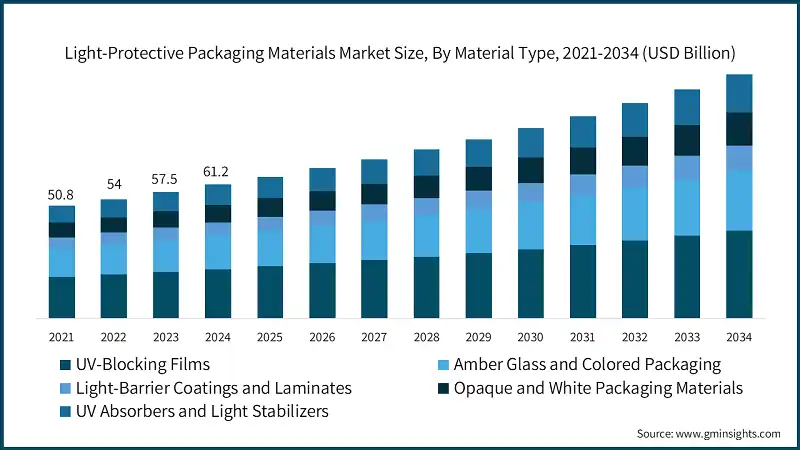
Based on material type, the light-protective packaging materials market is divided into UV-blocking films, amber glass and colored packaging, light-barrier coatings and laminates, opaque and white packaging materials and UV absorbers and light stabilizers. The UV-blocking films material dominated the market, accounting for around 30% share in 2024, and is expected to grow at a CAGR of 6.7% during 2025-2034.
- UV-blocking films constitute a vital category since they are used in packaging to protect products from damaging UV rays, thus preventing photodegradation and extending shelf life. UV-blocking films are used for all kinds of food, pharmaceuticals, agricultural chemical substances and consumer goods due to their high strength and protection.
- For instance, Berry Global has a NorDiVent film line with advanced UV blockers that can effectively shield sensitive products from ultraviolet light, thereby greatly enhancing the shelf life of pharmaceuticals and perishable food.
- Amber glass and colored packaging materials are commonly used in pharmaceutical and cosmetic packaging to protect light-sensitive products from ultraviolet and visible light. Amber glass serves well as a natural UV barrier for preserving the stability of drugs and cosmetics without requiring any further coatings.
- Light-barrier coatings and laminates are materials that have specialized applications on flexible films, paperboard and rigid packaging items to increase UV and light protection.
Learn more about the key segments shaping this market
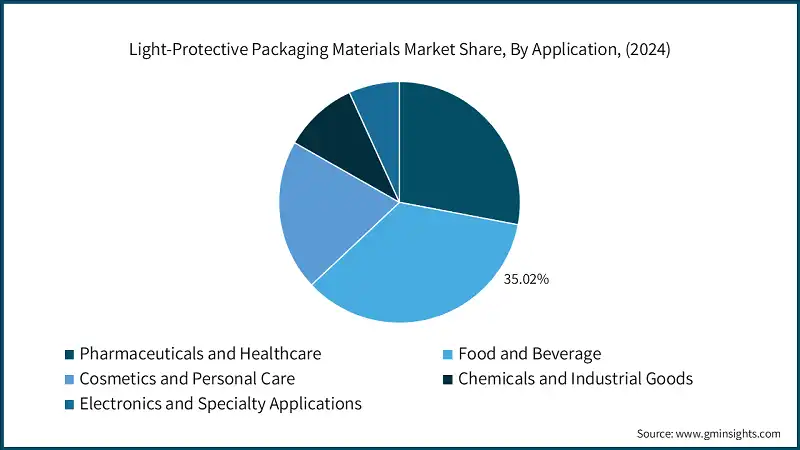
Based on application, the light-protective packaging materials market is divided into pharmaceuticals and healthcare, food and beverage, cosmetics and personal care, chemicals and industrial goods, and electronics and specialty applications. The food and beverage segment dominated the light-protective packaging materials market with a market share of around 35.02% in 2024, and it is anticipated to grow at a CAGR of 6.5%.
- The food and beverage industry has been booming lately. People are becoming more aware of what they’re eating, things like quality, safety, and how long food lasts on the shelf are top of mind. Because of this, there’s a growing need for better packaging solutions that protect food from light.
- The Food and Agriculture Organization (FAO) has pointed out that when milk is exposed to UV and visible light, it can lose a lot of its vitamins, like riboflavin and vitamin A. That’s a big deal because it means the nutritional quality drops, and so does the shelf life.
- On another note, the pharmaceuticals and healthcare sector is also on the rise. There’s a growing global demand for biologics, vaccines, and treatments for chronic diseases like cancer, diabetes, and various infections. It’s clear that vials are still a go-to option for delivering drugs in a sterile way.
Based on product type, the light-protective packaging materials market is divided into bottles, vials, and ampoules, films, wraps and pouches, boxes, cartons and rigid container, coatings, laminates and additives, and smart packaging solutions. The bottles, vials, and ampoules segment dominated the market, valued at USD 18.5 billion in 2024, and it is anticipated to grow with a CAGR of 6.7%.
- The light-protective packaging materials market's main product category comprises bottles, vials, and ampoules, which had over 30% overall market penetration in 2024 hitting the pharmaceutical glass packaging good share. These are mainly used for vaccines, biologics, antibiotics and injectable drugs. The containers provide exact dosage, sterility, and high barrier properties against moisture, oxygen and light.
- Injectable drugs are one of the fastest-growing segments of the pharmaceutical industry, requiring highly specialized packaging solutions such as glass vials and ampoules with superior protection from light to ensure the stability and efficacy of the drug, According to World Health Organization (WHO).
- Films, wraps and pouches are expected to constitute the fastest-growing segment in light-protective packaging. These formats of flexible packaging are mostly valued as lightweight, cost-effective ones that can be applied across food, pharmaceutical, and personal care applications.
Looking for region specific data?
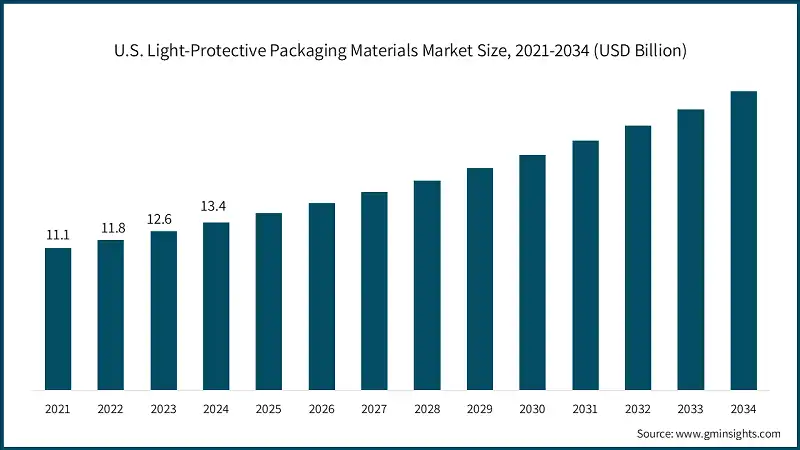
In the light-protective packaging materials market, U.S. accounts the major share in North America by accounting USD 13.4 billion in 2024 and is expected to grow at a CAGR of 5.3% in 2034.
- Ease of online shopping in U.S. has flooded the demand for light and sturdy packages that protect products-including foodstuffs, pharmaceuticals, and consumer goods-from degradation due to light during transit. The trend also benefits with the U.S. government's focus on waste reduction like the United States 2030 food loss and waste reduction goal.
- Establishing firms and startups innovate towards biodegradable and UV-blocking packaging to interpret growing consumer attention to sustainability and product safety driving demand.
- The Canadian market is similarly propelled by the rapid growth of e-commerce, with consumer inclination towards sustainable packaging. The trend of organic, bio-based, and recyclable light-protective packaging in Canada is growing for clean label and functional foods.
The light-protective packaging materials market in Germany is expected to experience significant and promising growth from 2025 to 2034.
- Europe accounts for around 20% market share in light-protective packaging materials market. Europe is benefitting from stringent environmental regulations, one of which includes the European Union's Packaging that calls for increased recyclability and lessening of packaging waste. Such regulatory environment promotes the adoption of sustainable light-protective packaging materials like amber glass, UV-blocking films, and multilayer laminates that prolong shelf life while conserving the environment.
- Germany leads with advanced glass and film technologies, supported by companies investing in recyclable and biodegradable materials.
- Plant-based, natural products have become the favor of consumers, with more realization of quality and sustainability issues associated with packaging- all driving continuous growth.
The light-protective packaging materials market in India is expected to experience significant and promising growth from 2025 to 2034.
- The light-protective packaging materials market accounts for the largest share in the Asia-Pacific region and is steadily growing at a CAGR of 6.5%. Rapid industrialization of the region, growth of pharmaceutical manufacturing and increased health awareness among consumers are pushing this growth.
- The huge demand for lightweight, protective, and sustainable packaging solutions has increased due to a surge in e-commerce in countries like India. E-commerce in India is expected to be the fastest retail e-commerce industry-growth globally with a CAGR of 14.1% from 2023 to 2027.
- Governments across Asia Pacific are strengthening regulations on packaging waste and promoting the use of recyclable and biodegradable materials, therefore fast-tracking developments in UV-blocking films, coated glass and multilayer laminates.
The light-protective packaging materials market in Brazil is expected to experience significant and promising growth from 2025 to 2034.
- With increase in health awareness, demand for organic and plant-based foods as well as expanding pharmaceutical packaging needs, the light-protective packaging materials market is growing with a CAGR of 5.4%. The paramount markets are Brazil and Argentina.
- Governments and businesses in Brazil emphasize sustainable arena and methods of packaging, especially for UV-blocking films and amber glass for food and cosmetic applications.
The light-protective packaging materials market in UAE is expected to experience significant and promising growth from 2025 to 2034.
- Light-protective packaging materials observe gradual growth in Middle East and Africa markets with CAGR of 4.8% due to increased disposable income directed toward state-of-the-art forms of UV-protective packaging for wellness, cosmetics and specialty foods.
- South Africa is rapidly moving towards increased UV protection for locally grown, organic agricultural products and the packaging thereof, augmenting the country's food and cosmetic exports.
- There is emerging regulatory shift encouraging eco-friendly packaging, and improving consumer preference for plant-based products are further contributors to this ongoing development.
Light-Protective Packaging Materials Market Share
The light-protective packaging materials industry is moderately consolidated; the top 7 manufacturers account for about 44% of the total market share in 2024. Berry Global Inc., Sealed Air Corporation, Schott AG, Amcor Plc, Gerresheimer AG, Owens-Illinois Inc. and Bormioli Pharma are leading companies. These companies have a strong international presence due to the extensive expertise they have acquired in regards to light-protective packaging materials. Their multifaceted products are supported by a strong production capability and distribution network that can respond to the increasing demand from various regions.
- Berry Global Inc. is the industry's leading company that globally provides environment-friendly packaging solutions with an intense focus on recyclable, lightweight, and highly innovative plastic packaging for the pharmaceutical, personal care, food, and beverage sectors. The company promotes circular economy principles and designs products with an aim to minimize environmental footprint. For instance, Berry Global has enhanced the production of its Magic SL Light piston-follower airless system in North America, a completely recyclable solution for dispensing that is lighter by 26% compared to metal alternatives and designed for premium skincare products.
- Sealed Air develops multi-layer barrier films and advanced packaging containing physical barriers for UV, moisture and oxygen, which are critical to keeping light-sensitive pharmaceuticals and food products. Sealed Air's innovations include recyclable flexible films and smart packaging technologies which can extend the shelf life of products and enhance consumer convenience.
- Schott AG specializes in specialty glass packaging for pharmaceuticals: UV-grade Type I borosilicate glass is the core product offering. The phytochemical uses of this glass include filling vials and ampoules, while its purity ensures protection of biologics and injectable drugs against degradation from light.
- Amcor is a global player with its wide array of plastic and flexible packaging solutions and a vigorous commitment to sustainability and innovation. Among its UV-blocking films and laminated media types are those made for food, beverage, and healthcare applications. A case is its AmFiber, a paper-based sustainable packaging line developed by Amcor, offering an eco-friendly alternative requirement without compromising the product's integrity.
- Gerresheimer AG is a supplier of pharma packaging through glass and polymer solutions. It offers the complete range, from Type I glass vials to ready-to-use (RTU) polymer containers. An example of this would be the RTU containers, based on polymer technology, that offer user-friendly solutions.
- Owens-Illinois (O-I), one of the biggest producers of amber and colored glass bottles, provides natural protection against UV and visible light, especially for beverages, food, and pharma products.
- Bormioli Pharma manufactures pharma glass packs that protect against light, producing amber and coated vials and ampoules for the protection of biologics against degradation due to exposure to light.
Light-Protective Packaging Materials Market Companies
Major players operating in the light-protective packaging materials industry are:
- Amcor Plc
- AptarGroup Inc.
- Ardagh Group
- Berry Global Inc.
- Bormioli Pharma
- Gerresheimer AG
- Huhtamaki Oyj
- Klockner Pentaplast
- Mondi Group
- Nipro Corporation
- Owens-Illinois Inc.
- RPC Group (Berry Global)
- Schott AG
- Sealed Air Corporation
- SGD Pharma
- Stevanato Group
Light-Protective Packaging Materials Market Report Attributes
| Key Takeaway | Details |
|---|---|
| Market Size & Growth | |
| Base Year | 2024 |
| Market Size in 2024 | USD 61.2 Billion |
| Forecast Period 2025 - 2034 CAGR | 6.4% |
| Market Size in 2034 | USD 113.9 Billion |
| Key Market Trends | |
| Drivers | Impact |
| Increasing demand for light-sensitive pharmaceuticals | Increases the need for advanced protective packaging to maintain drug efficacy. |
| Shelf-life extension for food & beverage | Growth in adoption of the light-protective packaging materials to preserve freshness and nutrients. |
| Regulatory compliance and safety standards | Compels manufacturers to use light-protective packaging. |
| Cosmetic and chemical product stability | Increase in demand for UV-protective packaging to maintain formulation integrity. |
| Pitfalls & Challenges | Impact |
| High cost of advanced barrier materials | Limits the widespread adoption, especially in markets which are price-sensitive. |
| Supply chain complexity | Causes complications in sourcing and distribution and brings an impact on timely availability and demand. |
| Opportunities: | Impact |
| High cost of advanced barrier materials | Limits the widespread adoption, especially in markets which are price-sensitive. |
| Supply chain complexity | Causes complications in sourcing and distribution and brings an impact on timely availability and demand. |
| Development of smart and multi-layer barrier solutions | Will improve Smart and Multilayer Functions in safeguarding product against light entering, oxygen, and moisture, making the product better protected from spoilage and elongated shelf life. |
| Expansion in emerging markets | Will drive rapid market expansion, creating better access to novel packaging, and satisfying growing consumers demand. |
| Sustainable and recyclable material innovations | Reduce environmental impacts, are in view of regulations and consumer expectations, and align with the changes toward eco-friendly types of packaging. |
| Integration with smart packaging technologies | Will provide real-time tracking and efficiency in the supply chain while assuring the safety of the products and bringing more interactive features to engage consumers. |
| Market Leaders (2024) | |
| Market Leaders |
11% Market share |
| Top Players |
Collective market share 34% in 2024 |
| Competitive Edge |
|
| Regional Insights | |
| Largest Market | Asia Pacific |
| Fastest Growing Market | Europe |
| Emerging Country | Germany, UK, France, Italy, and UAE |
| Future Outlook |
|
What are the growth opportunities in this market?
Light-Protective Packaging Materials Industry News
- Amcor PLC concluded its all-share takeover of Berry Global in April 2025, forging a packing behemoth having combined sales nearing USD 24 billion annually. The deal with a consideration of USD 16.9 billion adds significantly to the glory of Amcor in the area of consumer and healthcare packaging, light-protective materials included.
- In Jan 2025, International Paper finalized its acquisition of DS Smith for more than USD 7 billion to extend its reach in sustainable packaging solutions, particularly in protective and specialty packaging.
- Berry Global and Nestlé Purina PetCare will Launch 100% Recycled Content Treat Canisters in Jan 2025.
The light-protective packaging materials market research report includes an in-depth coverage of the industry with estimates and forecast in terms of revenue (USD Million) and volume (Kilo Tons) from 2021-2034 for the following segments:
Market, By Material Type
- UV-blocking films
- Polyethylene terephthalate (PET) films
- Polyvinyl chloride (PVC) films
- Polypropylene (PP) films
- Multi-layer barrier films
- Amber glass and colored packaging
- Amber glass vials and bottles
- Green and blue glass
- Opaque glass containers
- Light-barrier coatings and laminates
- Functional coatings
- Nanotechnology-enhanced barriers
- Hybrid and composite materials
- Opaque and white packaging materials
- Opaque plastics
- White polyethylene and polypropylene
- Paper-based light-barrier materials
- UV absorbers and light stabilizers
- Organic UV absorbers
- Inorganic UV absorbers
- Light stabilizer additives
Market, By Product Type
- Bottles, vials, and ampoules
- Pharmaceutical glass bottles
- Amber and colored glass vials
- Opaque plastic containers
- Films, wraps, and pouches
- UV-blocking flexible films
- Multi-layer barrier wraps
- Light-protective pouches
- Boxes, cartons, and rigid containers
- Opaque and laminated cartons
- Composite and hybrid boxes
- Coatings, laminates, and additives
- UV-blocking coatings
- Light-stabilizer laminates
- Performance enhancing additives
- Smart packaging solutions
- Light-activated indicators
- Sensor-integrated packaging
- IOT-enabled light monitoring
Market, By Application
- Pharmaceuticals and healthcare
- Light-sensitive drug packaging
- Biologics and specialty medicines
- Diagnostic and clinical sample protection
- Food and beverage
- Dairy and juice packaging
- Oils, sauces, and condiments
- Confectionery and baked goods
- Ready-to-eat and perishable foods
- Cosmetics and personal care
- Skin care and sun protection products
- Hair care and colorants
- Fragrances and essential oils
- Specialty cosmetic products
- Chemicals and industrial goods
- Light-sensitive chemicals
- Agrochemicals and fertilizers
- Laboratory reagents
- Electronics and specialty applications
- Photographic films and media
- Light-sensitive components
- Specialty packaging for electronics
The above information is provided for the following regions and countries:
- North America
- U.S.
- Canada
- Europe
- Germany
- UK
- France
- Spain
- Italy
- Rest of Europe
- Asia Pacific
- China
- India
- Japan
- Australia
- South Korea
- Rest of Asia Pacific
- Latin America
- Brazil
- Mexico
- Argentina
- Rest of Latin America
- Middle East and Africa
- Saudi Arabia
- South Africa
- UAE
- Rest of Middle East & Africa
Frequently Asked Question(FAQ) :
What is the market size of the light-protective packaging materials in 2024?
The market size was valued at USD 61.2 billion in 2024, with a CAGR of 6.4% expected through 2034. The increasing demand for light-sensitive pharmaceutical packaging is driving market growth.
What is the projected value of the light-protective packaging materials market by 2034?
The market is poised to reach USD 113.9 billion by 2034, driven by advancements in recyclable materials, smart packaging features, and regulatory compliance requirements.
What was the market share of UV-blocking films in 2024?
UV-blocking films accounted for approximately 30% of the market share in 2024 and is set to expand at a CAGR of 6.7% from 2025 to 2034.
How much revenue did the food and beverage segment generate in 2024?
The food and beverage segment dominated the market with a 35.02% share in 2024 and is anticipated to witness over 6.5% CAGR during the forecast period.
What was the valuation of the bottles, vials, and ampoules segment in 2024?
The bottles, vials, and ampoules segment was valued at USD 18.5 billion in 2024 and is projected to grow at a CAGR of 6.7% through 2034.
Which region leads the light-protective packaging materials sector?
The United States market accounting for USD 13.4 billion in 2024. The market growth is driven by the rise in e-commerce and government initiatives.
What are the upcoming trends in the light-protective packaging materials market?
Trends include bio-based and recyclable materials, multi-layer barrier films, nano UV blockers, smart packaging, and stricter regulatory compliance.
Who are the key players in the light-protective packaging materials industry?
Key players include Amcor Plc, AptarGroup Inc., Ardagh Group, Berry Global Inc., Bormioli Pharma, Gerresheimer AG, Huhtamaki Oyj, Klockner Pentaplast, and Mondi Group.
Light-Protective Packaging Materials Market Scope
Related Reports