Summary
Table of Content

LEO PNT Market
Get a free sample of this report
Form submitted successfully!
Error submitting form. Please try again.
Thank you!
Your inquiry has been received. Our team will reach out to you with the required details via email. To ensure that you don't miss their response, kindly remember to check your spam folder as well!
Request Sectional Data
Thank you!
Your inquiry has been received. Our team will reach out to you with the required details via email. To ensure that you don't miss their response, kindly remember to check your spam folder as well!
Form submitted successfully!
Error submitting form. Please try again.
LEO PNT Market Size
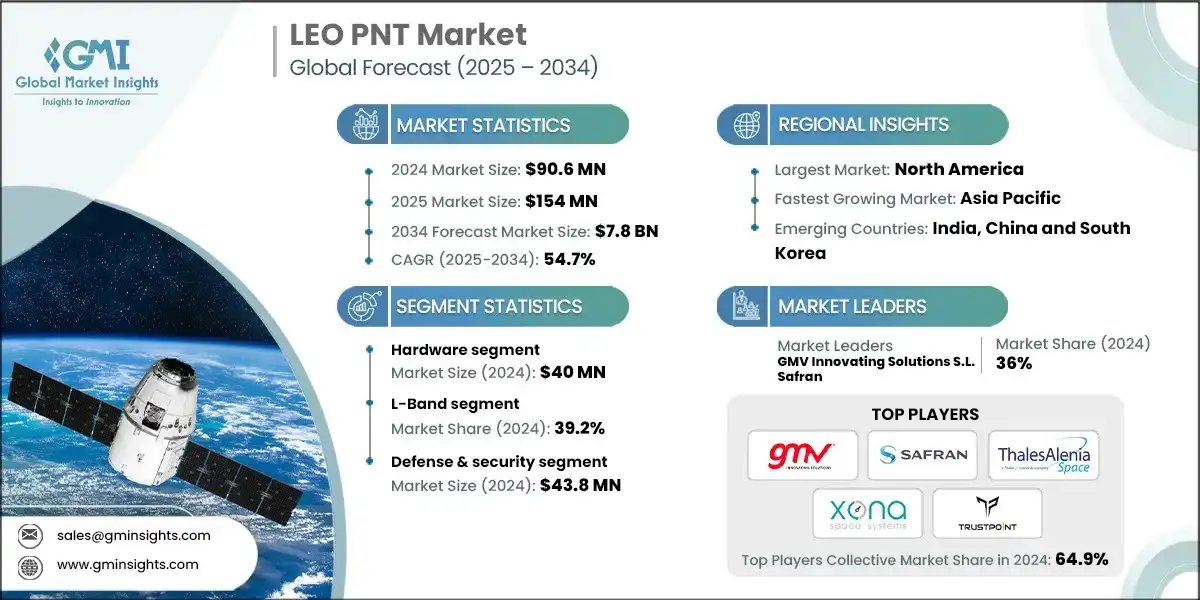
The global LEO PNT market was valued at USD 90.6 million in 2024. The market is expected to grow from USD 154 million in 2025 to USD 1.6 billion by 2030 and USD 7.8 billion by 2034, growing at a value CAGR of 54.7% during the forecast period of 2025–2034, according to Global Market Insights Inc.
To get key market trends
- The growth of the LEO PNT market is attributed to factors such as expansion of satellite navigation applications across commercial and defense sectors, increasing demand for resilient and secure navigation solutions, growth in autonomous vehicles, UAVs, and connected IOT devices, and expansion of 5G and future network infrastructure.
- The rapid growth of autonomous vehicles, UAVs, and connected IoT devices is a key driver of the LEO PNT market, as these technologies require highly accurate, low-latency positioning, navigation, and timing services. Ericsson reports that the number of cellular IoT connections nearly hit 4 billion by the end of 2024 and is expected to exceed 7 billion by 2030, translating to a steady 11% compound annual growth rate. As such, through connected devices and autonomous systems, demand for LEO-based PNT will increase worldwide.
- The expansion of 5G and future network infrastructure drives the LEO PNT market with the expectation of achieving ultra-precise timing and synchronization as it will be critical to maintaining seamless connectivity during significant stress. According to GSMA Intelligence, the total number of global 5G connections reached 1.6 billion at the end of 2023 and expected to jump to 5.5 billion in 2030. 5G connections will take up more than 51% of all mobile connections globally by 2029. 5G’s rapid growth will revolutionize global connectivity and technology.
- In 2024, North America dominated the global LEO PNT market with a share of 44.5%, due to increased defense spending and modernization initiatives. According to Stockholm International Peace Research Institute (SIPRI), US military expenditure in 2024 was USD 997 billion, 5.7% higher than in 2023. This is indicative of investment in advanced navigation, positioning, and timing systems to enhance combat capability, missile guidance, and secure communications. This budgetary outlay propels LEO PNT adoption for military applications across the region.
LEO PNT Market Report Attributes
| Key Takeaway | Details |
|---|---|
| Market Size & Growth | |
| Base Year | 2024 |
| Market Size in 2024 | USD 90.6 million |
| Market Size in 2025 | USD 154 million |
| Forecast Period 2025 - 2034 CAGR | 54.7% |
| Market Size in 2034 | USD 7.8 billion |
| Key Market Trends | |
| Drivers | Impact |
| Expansion of satellite navigation applications across commercial and defense sectors | Supports 30% growth in adoption of LEO PNT solutions for aviation, maritime, logistics, and defense applications. |
| Increasing demand for resilient and secure navigation solutions | Drives 25% improvement in service reliability and anti-jamming capabilities for critical operations. |
| Growth in autonomous vehicles, UAVs, and connected IoT devices | Boosts 38% surge in requirement for precise and low-latency LEO PNT services. |
| Expansion of 5G and Future Network Infrastructure | Precise timing is critical for 5G network synchronization. LEO PNT supports ultra-accurate timing services, aiding in faster, more reliable deployment of telecom infrastructure, especially in remote and underserved areas. |
| Rising global infrastructure and industrial digitization | Stimulates 28% increase in demand for accurate timing and positioning for smart grids, telecom, and transportation networks. |
| Pitfalls & Challenges | Impact |
| High initial investment and deployment costs | Deploying and maintaining large-scale LEO satellite constellations requires substantial capital expenditure, making it challenging for new entrants and slowing widespread adoption. |
| Regulatory and spectrum allocation challenges | Securing regulatory approvals and dedicated frequency bands for PNT services can be complex and time-consuming, limiting the pace of market expansion and global interoperability. |
| Opportunities: | Impact |
| Integration with autonomous systems and smart mobility | LEO PNT enhances real-time, high-precision navigation for autonomous vehicles and drones, opening new revenue streams and driving demand in transportation, logistics, and urban mobility sectors. |
| Demand for GPS alternatives in national security | Governments seek resilient navigation solutions to ensure operational continuity in contested environments, fueling investments in sovereign LEO PNT systems and boosting market credibility and growth. |
| Expansion in emerging markets and remote regions | LEO satellites offer affordable, high-accuracy PNT services in underserved regions, accelerating market penetration and supporting infrastructure development in areas with limited traditional GNSS coverage. |
| Commercial use in finance, energy, and telecom sectors | Critical sectors require precise timing and location data. LEO PNT enables secure, low-latency services, creating opportunities for tailored commercial applications and partnerships beyond traditional navigation use cases. |
| Market Leaders (2024) | |
| Market Leaders |
Top 2 companies hold 36% market share in 2024 |
| Top Players |
Collective market share in 2024 is 64.9% |
| Competitive Edge |
|
| Regional Insights | |
| Largest Market | North America |
| Fastest Growing Market | Asia Pacific |
| Emerging Country | India, China and South Korea |
| Future Outlook |
|
What are the growth opportunities in this market?
LEO PNT Market Trends
- The rapid expansion of satellite constellations is a significant trend in the LEO PNT industry since the early 2020s, fuelled by advances in miniaturization and reduced costs. These smaller spacecraft factors into improvements with respect to addressing global positioning and timing and certainly brings better coverage, latency, and resiliency to GPS. According to 2022 U.S. GAO report issued in 2022, approximately 5,500 satellites were active as of the spring of 2022, and this will ultimately grow, with approximately 58,000 more satellites expected to launch by 2030, driven primarily the launch of integrated large LEO constellations.
- The integration of LEO PNT with 5G and emerging 6G networks is a major market trend, allowing for low-latency, high-precision positioning for IoT and autonomous systems. The integration peaked roughly by the end of the 2020s- where the global industry matured collectively on 6G. The UK government invested over USD 100 million in developing 5G and 6G research as a response to urgent connectivity and positioning demands. This included approximately USD 25 million for projects at universities and USD 70 million to develop a state-of-the-art Telecoms Lab in the West Midlands. Comprehensive investment indicates a clear commitment to accelerating advanced 5G and 6G development.
LEO PNT Market Analysis
Learn more about the key segments shaping this market
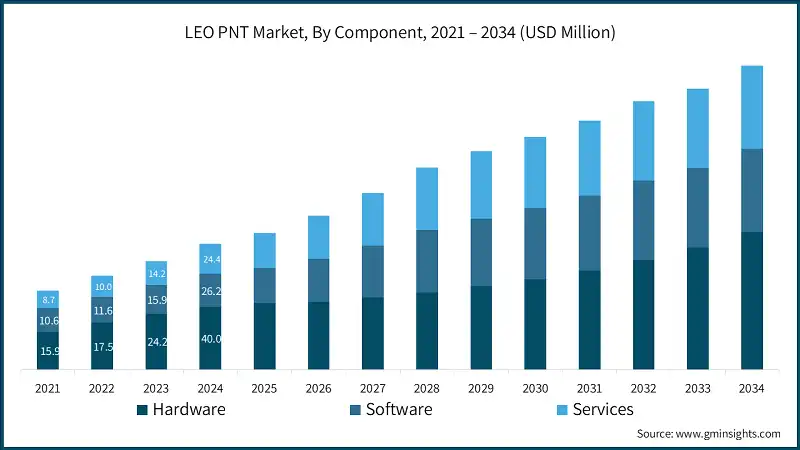
Based on components, the market is segmented into hardware, software and services.
- The hardware segment was valued at USD 40 million in 2024. This segment's growth can be attributed to the trends of increasing demand for sophisticated satellite components, the advances of miniaturization technologies, and increasing investments in LEO satellites and the need for reliable high-performance hardware solutions.
- Manufacturers should focus on this sector by focusing on component energy efficiency, improved radiation resistance, reduction in size and weight, the development of modular or scalable hardware that can be quickly deployed and is compatible with next-generation satellite technologies.
- The services segment is the fastest growing segment and is anticipated to grow with a CAGR of 58.5% during the forecast period of 2025 – 2034. This segment has continued to grow from an increasing demand for satellite-based positioning, navigation, and timing services. These services are used in, IoT, autonomous vehicles, new telecommunication designs, among other rapidly growing applications. The increasing adoption of LEO constellations and their associated reliability and low-latency connectivity is also driving this growth.
- Manufacturers should focus on developing flexible or modular service platforms and ground infrastructure that takes advantage of the improvements to stakeholders. Cloud integration, real time data analysis, interoperability, and cybersecurity will be particularly critical areas to support growing applications in telecommunication, IoT, and autonomous systems.
Learn more about the key segments shaping this market
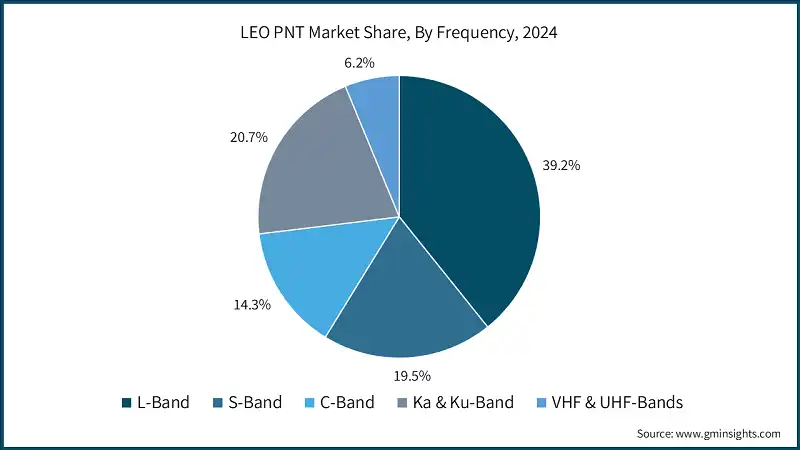
Based on frequency, the LEO PNT market is segmented into L-Band, S-Band, C-Band, Ka & Ku-Band and VHF & UHF-Bands.
- The L-Band segment dominated the market with a market share of 39.2% in 2024. This market segment is primarily driven by significant and steady use of the L-Band frequency range in trusted satellite communications and navigation services, strong resistance to signal interference and adverse weather conditions, and critical applications, such as aviation, maritime, and mobile communications, requiring steady and accurate positioning, timing, and navigation data output.
- Manufacturers should focus on improving receiver sensitivity, antenna miniaturization, lower power consumption, and ensure integration with new LEO constellations and evolving regulatory policies, while capturing market opportunity.
- Ka & Ku-Band segment is the fastest growing segment and is anticipated to grow with a CAGR of 59.4% during the forecast period of 2025 – 2034, driven by the increased demand for high speed data transfer and improved broadband services, and increased satellite communications use cases.
- Companies should focus on new technology adoption, scalability of networks, partner program development, and customized solutions to respond to rising demand and maintain their lead in the market.
Based on the application, the LEO PNT market is segmented into defense & security, commercial applications, and government & civil.
- The defense & security segment was the largest market and was valued at USD 43.8 million in 2024, propelled by an increase in resilient, jam-resistant navigation systems demand, strategic modernization in the military, and government interest and investment in GNSS-independent and secure positioning systems.
- Companies need to develop secure and resilient LEO PNT systems specifically meant to serve the defense ecosystem, improve anti-jam capabilities, ensure seamless interoperability with existing platforms, and follow government procurement trajectories to capture an increasing amount of military demand.
- The commercial applications segment is the fastest growing segment and is anticipated to grow with a CAGR of 58.2% during the forecast period of 2025-2034. This expansion come from increasing demand for precise and resilient navigation in autonomous vehicles, drones, logistics, and smart infrastructure, coupled with increased VC backing, innovation, and rapid integration of LEO PNT capabilities in commercial IoT ecosystems.
- Manufacturers should develop scalable, commercially friendly LEO PNT solutions, integrate with autonomous systems, IoT, and logistics, with an eye on high-accuracy and low-latency solutions that can plug-and-play with existing infrastructure.
Looking for region specific data?
North America LEO PNT market was valued at USD 40.3 million in 2024 and is growing at a 54% CAGR during the forecast period of 2025 – 2034, driven by substantial investments in space technology, government activities and the presence of major industry players.
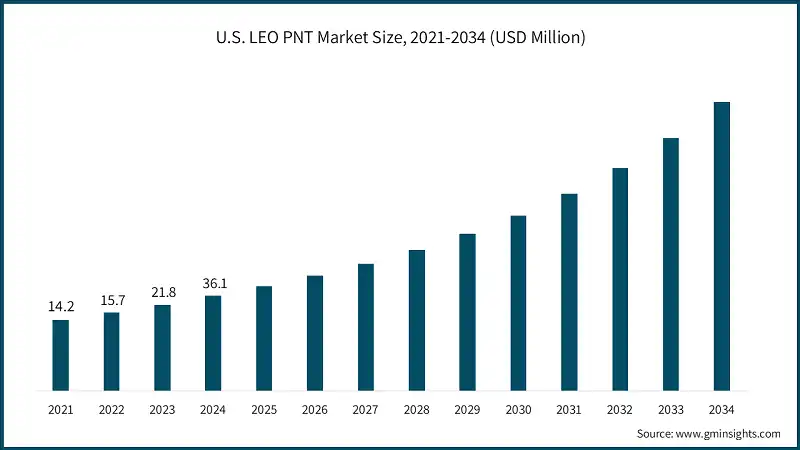
- U.S. market was valued at USD 36.1 million in 2024. This growth in the U.S. market is being driven by increased government investments in defense, commercialization, improvements in satellites allowed expansion of technology for LEO PNT, and thin-edge, ubiquitous 5G/6G networks increasing demand for precise navigation with resilience.
- US manufacturers must focus on developing resilient PNT technologies, scaling production of cost-effective LEO satellites, integration of 5G/6G and autonomous systems, and strengthening partnerships with government and commercial buyers to address increasing demand.
- Canada LEO PNT market is projected to grow significantly with a CAGR of 51.5% during the forecast period of 2025-2034. Canada's market is driven by precision agriculture technology adoption, expansion of remote mining exploration, increase in arctic surveillance, security and international space collaboration.
- Companies in Canada must focus on developing resilient navigation technologies, augmentation of satellite infrastructure, arctic applications, and fostering collaborative partnerships with government and international representatives.
The LEO PNT market in Europe is anticipated to grow with a CAGR of 53% during the forecast period of 2025 – 2034, driven by increased investments into satellite navigation systems like Galileo, increased growth in smart transportation and logistics solutions, and development of public-private space partnerships and collaborations.
- The market in Germany was valued at USD 6.2 million in 2024, driven by expansion of industry 4.0 and smart manufacturing, concentrates on secure and resilient defense navigation systems and increased R&D of space technology-based innovations.
- Manufacturers should focus on Germany by developing advanced autonomous vehicle navigation, supporting Industry 4.0 and smart city issues, enhancing secure defense PNT technologies and investing in R&D partnerships to create further innovations and meet increasing demand in precision positioning solutions.
- UK market is anticipated to surpass USD 493.5 million by 2034. The UK market sees significant growth on the back of more widespread use of autonomous drone operations, the establishment of numerous space innovation centers, and growing investment in national cyber security frameworks.
- Businesses must make the UK market a priority by engaging with developments surrounding autonomous drone technologies in the UK, introducing collaborative initiatives with space innovation centers, addressing cybersecurity enhancements to PNT systems, and developing smart urban infrastructure to take advantage of the increasing levels of demand and regulation which support it.
The LEO PNT market in Asia Pacific market was valued at 16.9 million in 2024. The market is continuing to evolve with increasing demand for disaster management and monitoring systems, the expansion and deployment of satellites, and increasing expenditures by government in respect of space infrastructure.
- The market in the India was valued at USD 2.6 million in 2024. Indian market is evolving continuously in relation to an expanding use of precision agriculture technologies, and rural digital infrastructure projects, as well as growing investments in respect of security and defense applications.
- Businesses must prioritize the development of rural connectivity and precision agriculture, and integration of autonomous systems designed for consumers to fulfill the growing requirements from the expanding Indian market.
- China LEO PNT market is projected to reach USD 899.5 million by the year 2034, driven by national strategic focus on space dominance and outcomes plus large-scale deployment of smart urban infrastructure coupled with the expansion of the electric and autonomous vehicle market.
- Businesses in China must prioritize developments that align with the national space strategy, support big smart infrastructure projects, design new navigation systems for electric and autonomous vehicles, increase investment in more advanced satellite systems and develop partnerships with government and industry stakeholders.
- Japan LEO PNT market is projected to grow significantly with a CAGR of 57.8% during the forecast period of 2025-2034, propelled by growth in advanced robotics and manufacturing sectors, the rapid adoption of autonomous vehicles and drones, and increasing attention to disaster management and emergency response systems.
- Manufacturers must need to concentrate on building precision navigation solutions for robotics and manufacturing, developing autonomous vehicle and drone technologies, and developing reliable PNT solutions for disaster response systems, toward facilitating the demand for Japan's growing LEO PNT sector.
The LEO PNT market in Latin America was valued at USD 4 million in 2024. The market is propelled by growing investments in satellite communications, growing precision agriculture demand, growth in transportation and logistics sectors, and development of rural connectivity and digital infrastructure.
MEA market is projected to surpass USD 181.3 million by 2034. The market is fuelled by growing demand from the oil & gas sector needing precision navigation, a growing demand for border security and surveillance, and the increasing use of autonomous drones for agriculture and inspection work.
- South Africa LEO PNT market is projected to reach USD 23.9 million by the year 2034, driven by developing mining automation, growing demand for precision agriculture, government support for space initiatives, a growing use of autonomous vehicles, and projects for smart city infrastructure.
- Companies should focus on implementing advanced navigation options for the mining and agriculture industries, working with government-based space programs, and helping assist in smart city infrastructures to satisfy South Africa's changing market.
- Saudi Arabia LEO PNT market is projected to grow with a CAGR of 50.6% during the forecast period of 2025-2034. The market growth is due to result of the strategic programs under Vision 2030 for digital transformation, and demand for precision navigation services as the oil & gas sectors continue to grow, and the increasing adoption of autonomous systems resulting in advancements in technology and infrastructure.
- Companies should focus on training and developing advanced PNT solutions in line with Vision 2030, developing technology for the oil & gas sector, enhancing autonomous systems, and working with the government to spur investment and adoption.
- UAE market is projected to grow with a CAGR of 49.7% during the forecast period of 2025-2034. The market is growing because of government-led space exploration and satellite programs, growth of advanced telecommunications technology 5G/6G and interest in renewable energy projects that need precise monitoring.
- Manufacturers should focus on committing to advanced satellite technology, integrating PNT solutions with the 5G/6G network, developing the performance of renewable energy monitoring systems, and partnering with government space initiatives to take advantage of the growth in the UAE market.
LEO PNT Market Share
- The top 5 companies GMV Innovating Solutions S.L., Safran, Thales Alenia Space, Xona Space Systems, Inc. and TrustPoint, Inc. collectively held 64.9% of the market share in 2024.
- GMV Innovating Solutions S.L. held 20.4% of the total market share in 2024, due to cutting-edge technology, strategic partnerships with various defense agencies, a global footprint of operations, and a series of successful secure and high-precision navigation solutions for both commercial and military needs.
- Safran held a 15.6% of the total market share in 2024, by advancing the delivery of high-performance navigation and timing solutions tailored for the aerospace and defense markets, and its R&D base and integration of advanced technologies, together with strong partnerships allowing Osisko to deliver secure, reliable and high-performance systems responding to the growing global PNT needs.
- In 2024, Thales Alenia Space accounted for 14.7% of the total market share, gaining market traction using its legacy expertise in satellite manufacturing, presence in an increasingly important European space program, and ability to deliver secure, advanced navigation solutions for both commercial and defense markets.
- Xona Space Systems, Inc. held a 7.8% of the total market share in 2024, benefitting from the company's role in establishing commercial LEO-based navigation services as a leader in high-performance, secure, and resilient PNT services built from its Pulsar constellation and its ability to provide these capabilities across autonomous systems, smart infrastructure and defense applications, establishing itself as a leader in next-generation satellite navigation.
- TrustPoint, Inc. held a 6.4% of the total market share in 2024, attributed to its innovative program to develop secure, scalable satellite navigation solutions. The company's focus on commercial and defense-grade PNT services, quick technology development, and alliances with appropriate companies positioned it as an emerging industry leader in robust performance, high reliability, and dependable alternatives to traditional GNSS capabilities.
LEO PNT Market Companies
Some of the prominent market participants operating in the LEO PNT industry include:
- Airbus
- CACI International Inc.
- Celestia Technologies
- Fugro
- General Dynamics Corporation
- GMV Innovating Solutions S.L
- Hexagon AB
- Honeywell International Inc.
- L3Harris Technologies, Inc
- Microchip Technology Inc
- OneWeb Technologies Inc.
- Rakon Limited
- Safran
- Satelles, Inc.
- SYNTONY
- Thales Alenia Space
- TrustPoint, Inc.
- VIAVI Solutions Inc.
- Xona Space Systems, Inc
- Airbus, General Dynamics Corporation, Honeywell International Inc., L3Harris Technologies, Inc, Thales Alenia Space are the clear leaders in the market. These companies are leaders in the LEO PNT market due to their broad product portfolios, extensive global presence, and established relationships with government and defense agencies. Their solutions cover satellites, ground control, and integrated PNT services. Continuous innovation, reliability, and the ability to serve commercial, defense, and aerospace applications at scale provide them a significant competitive advantage.
- Hexagon AB, Safran, CACI International Inc., GMV Innovating Solutions S.L, VIAVI Solutions Inc. are notable challengers in the LEO PNT industry. These challengers emphasize specialized, or advanced PNT technologies to include satellite navigation payloads, innovations in signal integrity, and high precision positioning for military and commercial applications. Their growth is driven more through technology differentiation, niche capabilities, and partnerships to expand their reach in particular regions and/or specific applications.
- Microchip Technology Inc, Satelles, Inc., Rakon Limited, TrustPoint, Inc., SYNTONY are positioned as followers in the LEO PNT market. These players provide reliable components, subsystems, or niche services but have limited market influence compared to leaders and challengers. These companies generally have limited scope, usually providing directly to a narrow customer sector, a narrower geography, or as a supplier of a LEO PNT component to a larger integrator. There base business growth depends on forming partnerships, leveraging new sensor and timing technologies, and on targeted blending of disruptive integration into specialized applications.
- Celestia Technologies, OneWeb Technologies Inc., Xona Space Systems, Inc. are positioned as niche players in the market. These are niche players, focused on emerging or highly specialized LEO PNT solutions, such as small satellite constellations, experimental GNSS augmentation, or regional positioning services. Their strengths lie in technological innovation, agility, and specialized applications, but they lack the global coverage, scale, and broad adoption of larger competitors.
LEO PNT Industry News
- In 2024, OneWeb Technologies Inc. launched the Astra APNT solution, a LEO-based PNT receiver ensuring navigation resilience for military and critical infrastructure when GNSS is unavailable.
- In 2024, Thales Alenia Space signed a ESA contract to develop an end-to-end LEO PNT orbit demonstrator, including five satellites, ground, and user segments. The project aims to deliver centimeter-level accuracy, anti-jamming resilience, and low latency, marking a significant step forward in Europe’s LEO-based navigation capabilities.
The LEO PNT market research report includes in-depth coverage of the industry with estimates and forecasts in terms of revenue in (USD million) from 2021 – 2034 for the following segments:
Market, By Component
- Hardware
- Atomic clocks
- Transponders
- Antenna
- Sensors
- Power amplifiers
- Receivers
- Others
- Software
- Signal processing & control
- Security / encryption
- Services
Market, By Satellite Type
- Smallsat
- CubeSat
Market, By Frequency
- L-Band
- S-Band
- C-Band
- Ka & Ku-Band
- VHF & UHF-Bands
Market, By Application
- Defense & security
- Land systems
- Airborne systems
- Naval systems
- Commercial applications
- Transport & logistics
- Aviation
- Agriculture
- Marine
- Surveying & mobile mapping
- Others
- Government & civil
- Critical government infrastructure
- Traffic management
- Rail control & management
- Disaster & emergency management
- Others
The above information is provided for the following regions and countries:
- North America
- U.S.
- Canada
- Europe
- Germany
- UK
- France
- Spain
- Italy
- Netherlands
- Asia Pacific
- China
- India
- Japan
- Australia
- South Korea
- Latin America
- Brazil
- Mexico
- Argentina
- Middle East and Africa
- Saudi Arabia
- South Africa
- UAE
Frequently Asked Question(FAQ) :
Who are the key players in the LEO PNT market?
Key players include GMV Innovating Solutions S.L., Safran, Thales Alenia Space, Xona Space Systems, Inc., TrustPoint, Inc., Airbus, Honeywell International Inc., L3Harris Technologies, General Dynamics Corporation, and Hexagon AB.
What are the upcoming trends in the LEO PNT industry?
Key trends include integration of LEO PNT with 5G/6G networks, deployment of large satellite constellations, advancements in anti-jamming and anti-spoofing technologies, and adoption for autonomous mobility and smart city infrastructure.
Which region leads the LEO PNT market?
The U.S. market was valued at USD 36.1 million in 2024. Growth is driven by strong defense investments, commercialization of satellite constellations, and integration with 5G/6G networks enhancing navigation resilience.
What is the growth outlook for services in the LEO PNT market from 2025 to 2034?
The services segment is projected to grow at a CAGR of 58.5% through 2034.
What was the valuation of the defense & security application segment in 2024?
The defense & security segment was valued at USD 43.8 million in 2024.
How much revenue did the hardware component segment generate in 2024?
The hardware segment generated USD 40 million in 2024, led by demand for advanced satellite components and miniaturized, high-performance navigation hardware.
What is the projected value of the LEO PNT market by 2034?
The market size for LEO PNT is expected to reach USD 7.8 billion by 2034, supported by global deployment of satellite constellations, defense modernization, and IoT integration.
What is the market size of the LEO PNT industry in 2024?
The market size was USD 90.6 million in 2024, with a CAGR of 54.7% expected through 2034 driven by expansion of 5G networks, autonomous systems, and secure navigation demand.
What is the current LEO PNT market size in 2025?
The market size is projected to reach USD 154 million in 2025.
LEO PNT Market Scope
Related Reports