Summary
Table of Content

LCR Meters Market
Get a free sample of this report
Form submitted successfully!
Error submitting form. Please try again.
Thank you!
Your inquiry has been received. Our team will reach out to you with the required details via email. To ensure that you don't miss their response, kindly remember to check your spam folder as well!
Request Sectional Data
Thank you!
Your inquiry has been received. Our team will reach out to you with the required details via email. To ensure that you don't miss their response, kindly remember to check your spam folder as well!
Form submitted successfully!
Error submitting form. Please try again.
LCR Meters Market Size
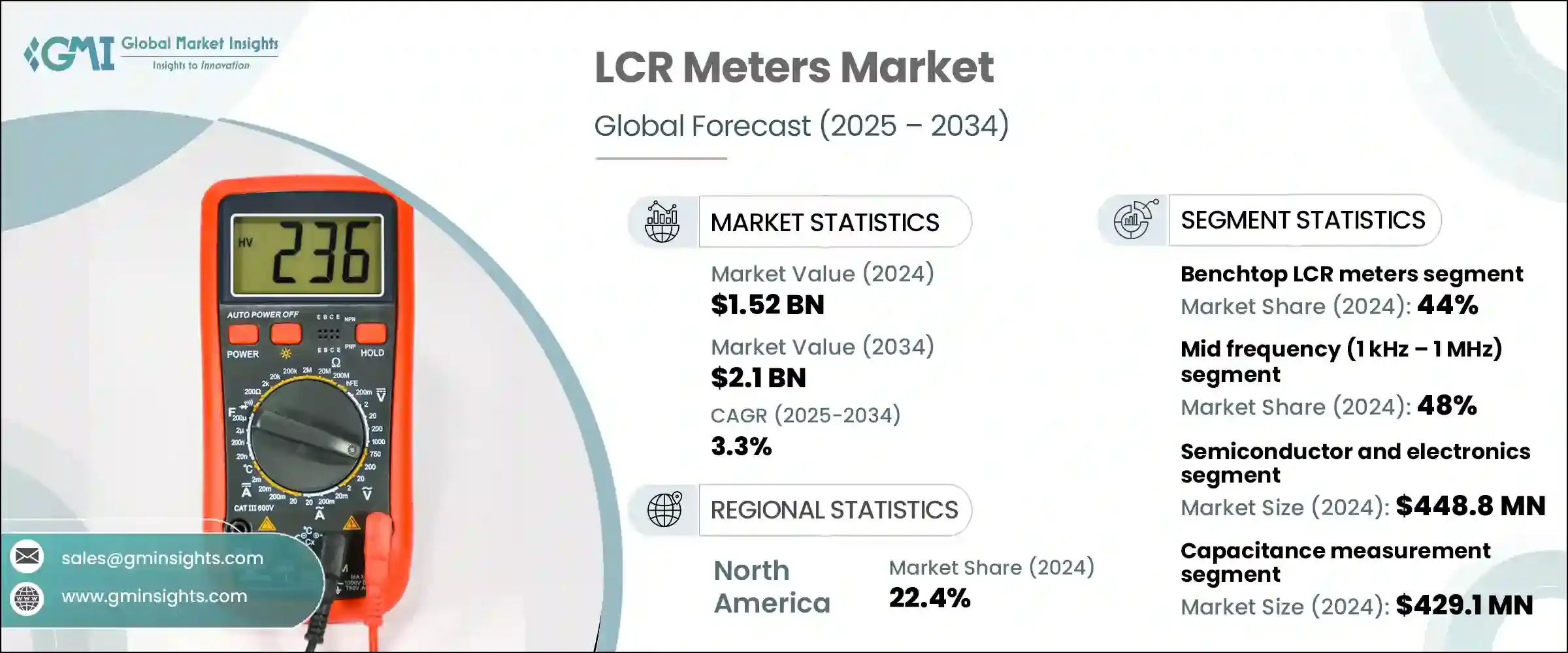
The global LCR meters market was estimated at USD 1.52 billion in 2024. The market is expected to grow from USD 1.56 billion in 2025 to USD 1.81 billion in 2030 and USD 2.1 billion by 2034, at a CAGR of 3.3% during the forecast period of 2025–2034.
LCR Meters Market Key Takeaways
Market Size & Growth
- 2024 Market Size: USD 1.52 Billion
- 2034 Forecast Market Size: USD 2.1 Billion
- CAGR (2025–2034): 3.3%
Key Market Drivers
- Rising demand for advanced electronics (EVs, 5G, IoT).
- Advancements in measurement and automation technologies.
- Growing focus on product reliability and quality control.
- Increasing R&D in semiconductors and aerospace sectors.
- Expansion of smart manufacturing and Industry 4.0.
Challenges
- High cost of high-frequency precision components.
- Lack of skilled personnel for advanced testing.
Opportunity
- Customization of LCR meter functionalities and form factors.
- Integration of smart testing features and IoT connectivity.
Key Players
- Market Leader: Hioki E.E. Corporation led with over 8.9% market share in 2024.
- Leading Players: Top 5 players in this market include Keysight Technologies, Hioki E.E. Corporation, Chroma ATE Inc., GW Instek (Good Will Instrument Co., Ltd.), B&K Precision Corporation, which collectively held a market share of 47.8% in 2024.
Get Market Insights & Growth Opportunities
- The growth of the LCR market is driven by several factors including the rising demand for compact and high-performance electronic devices, increasing adoption of advanced consumer electronics, growing emphasis on energy-efficient solutions, rapid technological advancements, and the expansion of e-commerce and smart manufacturing industries.
- One of the key driver for LCR market is the rising demand for miniaturized, high-frequency components to support the growth of portable electronics and IoT-enabled devices. This trend is driven by the need for compact, reliable, and efficient LCR components that enhance performance and durability. For example, the global market for IoT devices, which extensively uses LCR components, is projected to grow significantly, reaching over USD 1.6 trillion by 2029, according to industry reports.
- Advancements in material science and component design are driving the development of LCR components with superior temperature stability, reduced power consumption, and enhanced performance. Additionally, manufacturers are prioritizing the production of RoHS-compliant and lead-free components to align with global sustainability standards.
- The accelerating growth of e-commerce, automotive electronics, and industrial automation is fueling demand for high-precision, reliable, and customized LCR solutions. This demand is further supported by the need for advanced packaging and integration methods that maintain component performance throughout transport, storage, and deployment in diverse electronic systems.
- In 2024, Asia Pacific region leads the global LCR meters market accounting for the largest share of 42% and reaching a market value of USD 638.4 million. This regional dominance is primarily driven by the presence of major electronics manufacturing hubs, rising investments in semiconductor fabrication, strong demand for consumer electronics, and the growing adoption of advanced technologies such as 5G, IoT, and AI across countries like China, Japan, South Korea, and India. Additionally, favorable government initiatives and increasing R&D activities continue to boost the market growth in the region.
To get key market trends
LCR Meters Market Trends
- A recent market trend is the integration of machine learning (ML) algorithms within LCR platforms, aimed at enabling real-time component identification, deviation detection, and predictive failure modeling. This ML integration offers significant advantages for closed-loop quality control.
- The market is gradually shifting from standalone LDR meters to integrated sensor modules that combine light detection with temperature, motion, or proximity sensing. This trend is particularly pronounced in smart lighting systems, home automation, and consumer electronics, where compact multi-sensor platforms are increasingly replacing single-function devices. The rising demand for space-efficient and multifunctional systems is transforming the deployment of LDR measurement technologies.
- There is an increasing focus on improving the spectral sensitivity and dynamic range of LDR meters, driven by emerging applications in astronomy, biomedical diagnostics, and plant growth research. Vendors are launching LDR meters capable of detecting a wider range of wavelengths—including infrared and near-ultraviolet—broadening their use in specialized fields that require advanced and precise light measurement.
LCR Meters Market Analysis
Learn more about the key segments shaping this market
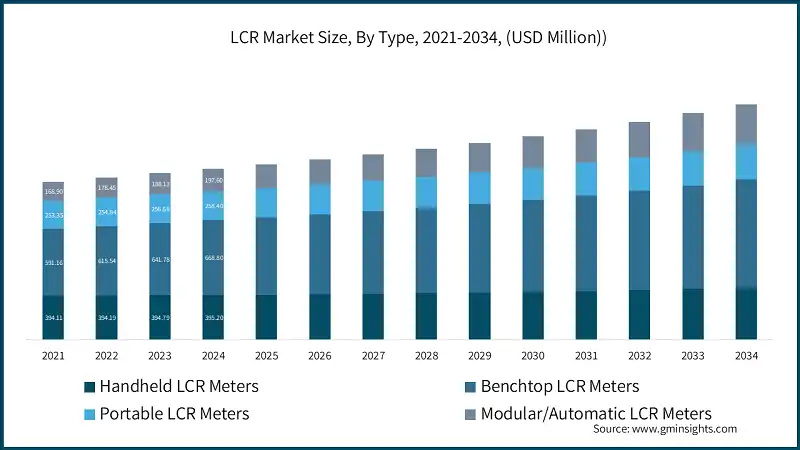
On the basis of types, the market is segmented into Handheld LCR Meters, Benchtop LCR Meters, Portable LCR Meters, Modular/Automatic LCR Meters. The benchtop LCR meters segment accounts for the highest market share of 44% and the modular/automatic LCR meters segment is the fastest-growing segment with a CAGR of 6.1% during the forecast period.
- In 2024, the benchtop segment led the LCR meters market with an estimated value of USD 668.8 million. Benchtop LCR meters are highly regarded for their exceptional measurement accuracy, broad frequency range, and advanced impedance analysis features, making them essential for precision testing in semiconductor, automotive electronics, and telecommunications sectors. Industry benchmarks show that benchtop LCR meters maintain measurement accuracy within ±0.05% across an extensive test frequency range, significantly outperforming handheld models typically used for basic diagnostics.
- Moreover, with the growing demand for highly accurate component characterization in R&D and production environments, benchtop LCR meters align with the stringent testing requirements in sectors like aerospace, 5G, and EV battery development. Their compatibility with automation systems and compliance with global testing standards (such as IEC and JEITA) support efficient quality control, accelerate innovation, and reduce design failures—making them essential for high-reliability product development.
- The modular/automatic LCR meters segment is one of the fastest-growing categories in the market and is projected to expand at a CAGR of 6.1% during the forecast period. These systems are designed for high-volume testing environments and offer unmatched scalability, speed, and integration flexibility—making them ideal for automated production lines, semiconductor fabs, and advanced component validation setups. Their modular architecture allows for parallel testing channels, significantly increasing throughput in mass manufacturing.
- Structurally, automated LCR systems can reduce overall test cycle time by up to 40% compared to manual benchtop instruments, while minimizing operator error and improving consistency in data collection. This makes them highly suitable for quality control processes in industries such as automotive electronics, 5G RF components, and multilayer ceramic capacitors (MLCCs).
Learn more about the key segments shaping this market
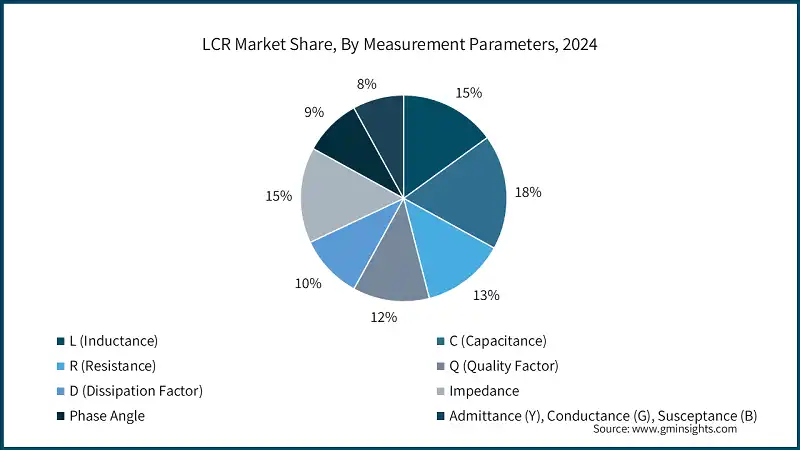
Based on measurement parameters, the market is segmented into L (Inductance),C (Capacitance),R (Resistance),Q (Quality Factor),D (Dissipation Factor),Impedance, Phase Angle, Admittance (Y), Conductance (G), Susceptance (B). The C (Capacitance) segment accounts for the highest market share of 28.23%.
- The capacitance measurement segment accounted for a significant portion of the LCR meters market and was valued at USD 429.1 million in 2024. Capacitance testing plays a crucial role in quality control, design validation, and failure analysis across a wide range of industries including consumer electronics, automotive, telecommunications, and medical devices. The rising complexity of multilayer ceramic capacitors (MLCCs), which are extensively used in compact electronic devices, is fueling the demand for high-accuracy capacitance measurement tools.
- Capacitance-focused LCR meters are increasingly preferred for their ability to detect minute variations in dielectric properties, especially in miniaturized, high-density circuits. These meters support high-frequency measurements and automated test functions, ensuring consistency and speed in mass-production environments. Manufacturers offering fast-settling, high-resolution capacitance meters—along with features like multi-channel support and PC interfacing—are well-positioned to capture demand from high-growth sectors such as EV powertrains, IoT sensors, and advanced memory systems.
- The impedance measurement segment is the fastest growing segment and is anticipated to expand at a CAGR of 5.1% during the forecast period. Impedance analysis is vital for characterizing complex electronic components and materials, particularly in sectors such as telecommunications, power electronics, biomedical devices, and high-frequency circuit design. With the rising adoption of high-speed digital systems, 5G infrastructure, and EV power systems, the need for accurate impedance profiling across a broad frequency spectrum has become increasingly critical.
- Impedance-capable LCR meters are valued for their ability to provide detailed insights into circuit behaviour, component losses, and material properties under varying conditions. These instruments support high-resolution sweeps and phase angle analysis, which are essential in assessing quality, reliability, and performance in R&D and production settings. Manufacturers focusing on developing meters with advanced vector impedance analysis, wide bandwidth support, and automation-ready interfaces are expected to benefit from the growing demand for high-precision testing in next-gen electronic ecosystems.
On the basis of frequency range, the market is segmented into Low Frequency (< 1 kHz),Mid Frequency (1 kHz – 1 MHz),High Frequency (> 1 MHz). The mid frequency (1 kHz – 1 MHz) segment accounts for the highest market share of 48% and is projected to grow with a CAGR of 2.7% during the forecast period.
- The Mid Frequency (1 kHz – 1 MHz) segment dominated the LCR meters market in 2024, reaching a valuation of USD 729.6 million. This frequency range represents the ideal balance for most standard electronic testing applications, making it highly popular among R&D laboratories, academic institutions, and industrial electronics manufacturers. LCR meters operating within this band are particularly well-suited for evaluating capacitors, inductors, resistors, and printed circuit board (PCB) traces, where precision is essential but ultra-high-frequency testing is not required. Their widespread utility has positioned them as the default choice for general-purpose impedance analysis, component sorting, and circuit prototyping.
- The segment is projected to grow at a CAGR of 2.67% through the forecast period, underpinned by the steady expansion of the global electronics and semiconductor industries. As passive component miniaturization and density continue to increase in consumer electronics, automotive systems, and IoT devices, mid-frequency testing remains a cost-effective and technically sufficient solution for validating performance and quality. Additionally, their integration with automation systems and digital interfaces is helping manufacturers streamline quality control in electronic manufacturing services (EMS) and reduce time-to-market. Equipment providers focusing on enhancing UI/UX, improving test speed, and adding PC-based analysis features within this frequency band are expected to maintain strong market relevance in the coming years.
- The High Frequency (>1 MHz) segment is emerging as one of the fastest-growing areas within the LCR meters market and is projected to expand at a CAGR of 6.8% during the forecast period. These advanced instruments are designed to meet the stringent testing demands of high-speed, high-frequency applications such as 5G communication systems, radio frequency (RF) modules, power semiconductors, and advanced automotive electronics. With frequencies extending beyond 1 MHz—often reaching up to 100 MHz or more—these meters allow engineers to perform precise impedance analysis of components under real-world operating conditions, especially where signal integrity and electromagnetic compatibility (EMC) are critical.
- The growth of this segment is largely driven by rapid technological advancements in wireless communication, aerospace and defense electronics, and high-performance computing (HPC), where components must operate flawlessly at high frequencies. Manufacturers are increasingly integrating high-frequency LCR meters into automated test systems (ATEs) for real-time diagnostics, failure prediction, and process optimization. Moreover, their role in the characterization of dielectric materials, RF coils, multilayer ceramic capacitors (MLCCs), and filters is becoming essential for product innovation and reliability assurance. Continued investment in wideband impedance analysers, AI-assisted test algorithms, and high-speed digital interfaces will further accelerate adoption of high-frequency LCR meters across cutting-edge electronic development and manufacturing ecosystems.
On the basis of end use industry, the market is segmented into Manufacturing, Automotive, Healthcare, Semiconductors & Electronics, Aerospace & Defense, Academic & Research Institutions, Utilities, Others (e.g., Renewable Energy, IoT device manufacturers). The semiconductors and electronics segment accounts for the highest market share of 29.53%
- The semiconductor and electronics segment was a major contributor to the LCR meters market in 2024, with a valuation of USD 448.8 million. As miniaturization, higher integration, and frequency optimization continue to define the next wave of semiconductor and electronic device innovation, the need for precise electrical component characterization is paramount. LCR meters are critical for testing passive components like capacitors, inductors, and resistors, as well as for advanced impedance profiling of semiconductor wafers, IC packages, and printed circuit boards (PCBs). These meters are extensively used across R&D labs, foundries, and fabrication facilities to ensure that components meet performance, tolerance, and reliability standards.
- The demand in this segment is driven by growing adoption of advanced technologies such as 5G, IoT, AI hardware, and EV power electronics, which require high-frequency, low-noise, and compact electronic architectures. The continued expansion of wafer-level packaging, chiplet integration, and heterogeneous computing platforms has also elevated the requirement for high-resolution, multi-frequency testing tools. Semiconductor companies are leveraging high-precision LCR meters to enhance quality control, optimize material properties, and reduce time-to-market for next-generation chips. As the semiconductor industry shifts toward smaller process nodes and advanced substrate materials, LCR meter manufacturers offering high-frequency accuracy, automation-ready platforms, and AI-based analytics will have a competitive edge in this high-growth vertical.
- The automotive segment is witnessing steady growth in the LCR meters market and is expected to expand at a CAGR of 6% during the forecast period. With the rapid electrification of vehicles and the proliferation of advanced driver-assistance systems (ADAS), onboard sensors, infotainment units, and power electronics, automotive manufacturers are placing greater emphasis on component reliability and electromagnetic performance. LCR meters are crucial in testing capacitors, inductors, and sensors used in electric drive systems, battery management units (BMUs), and vehicle control modules, where high-accuracy impedance and dielectric property measurements are essential.
- As electric vehicles (EVs) and plug-in hybrid electric vehicles (PHEVs) become mainstream, automotive OEMs and tier-1 suppliers are increasing their use of high-frequency and high-temperature-stable components, which demand rigorous testing. LCR meters with thermal chambers and frequency sweep capabilities are increasingly used to simulate real-world conditions and ensure compliance with stringent safety and durability standards. Additionally, the integration of advanced electronic systems for energy efficiency and emission reduction is pushing demand for in-line quality control and R&D-grade measurement equipment. Manufacturers of LCR meters offering automotive-grade calibration, AI-assisted fault detection, and integration with automated production lines will benefit significantly from this evolving automotive electronics landscape.
Looking for region specific data?
North America accounted for a 22.4% share of the global LCR meters market in 2024, valued at USD 350 million, and is expected to grow steadily, supported by the region’s strong electronics manufacturing base, widespread adoption of automated test equipment, and rising investments in R&D. Growth is further fueled by demand for high-precision testing in EVs, aerospace systems, and telecom infrastructure, as well as rising use of LCR meters in quality assurance and reliability labs.
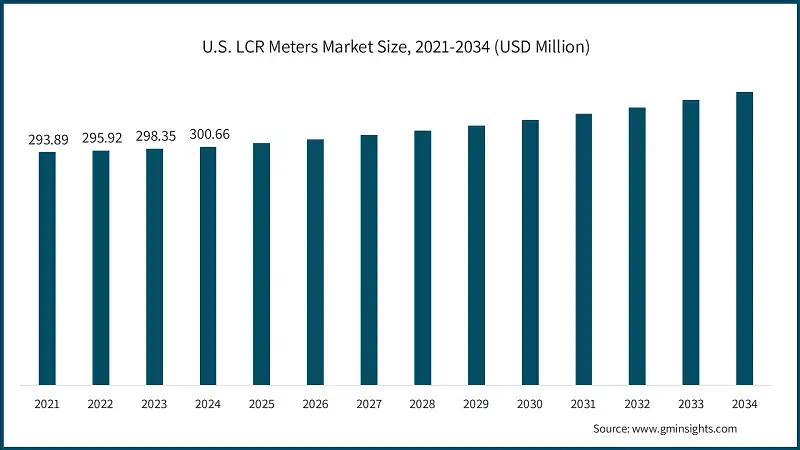
- The U.S. LCR meters market was valued at USD 300.66 million in 2024 and is expected to experience steady growth throughout the forecast period. As a global leader in automotive, aerospace, electronics, and construction industries, the U.S. market is propelled by increasing demand for high-performance adhesive solutions that enable lightweight designs, miniaturization, and enhanced energy efficiency.
- The U.S. presents a significant growth opportunity for the LCR meter market due to its robust R&D infrastructure, leading position in semiconductor innovation, and growing adoption of electric vehicles (EVs) and advanced medical electronics. The expansion of 5G networks and aerospace technology also requires high-precision testing equipment, boosting demand for high-frequency and automated LCR meters. Government initiatives such as the CHIPS Act are expected to stimulate domestic semiconductor manufacturing, further driving LCR meter usage in design, prototyping, and quality control. Additionally, the shift toward Industry 4.0 and smart manufacturing creates opportunities for LCR meter integration with automated test systems. Vendors offering customizable, high-speed, and AI-enabled LCR meters stand to benefit by addressing the increasing need for precision and data-driven diagnostics in U.S. industrial and R&D sectors.
- The Canada LCR meters market reached a valuation of USD 48.94 million in 2024 and is projected to grow steadily over the forecast period. This growth is supported by a strong construction sector, expanding renewable energy projects, and rising demand for efficient, low-maintenance adhesive technologies within automotive and aerospace manufacturing. With Canada’s increasing focus on sustainable infrastructure, energy-efficient retrofits, and eco-certified building materials, LCR meters are gaining prominence by providing clean bonding solutions that minimize material waste and accelerate installation processes.
- Canada offers promising opportunities for the LCR meter market, fuelled by its expanding electronics manufacturing base, growing investments in clean energy technologies, and rising demand for advanced testing equipment in EV battery research and telecommunication sectors. The country’s emphasis on sustainable development and electrification of transport systems aligns with the increasing need for precise measurement tools like LCR meters to test components in power electronics and renewable energy systems. Additionally, government-backed R&D initiatives and funding programs for innovation in universities and tech hubs further support the adoption of benchtop and modular LCR meters. As Canada pushes for advanced diagnostics and quality assurance in smart grid infrastructure and medical electronics, manufacturers offering high-frequency, automated, and compact LCR solutions can gain a competitive edge in this high-potential market.
Europe held a 19% share of the global LCR Meters Market in 2024 and is growing at a CAGR of 2.49%, driven by the region’s strong industrial base, increasing investments in electric mobility and semiconductor manufacturing, and rising demand for high-precision testing equipment in automotive, aerospace, and electronics sectors.
- The Germany LCR meters market reached a valuation of USD 72.2 million in 2024 and is anticipated to grow with a CAGR of 5.8% during the forecast period. As Europe’s leading industrial economy, Germany’s demand for high-precision testing instruments is driven by advancements in automotive electronics, industrial automation, and semiconductor manufacturing. The country’s strong focus on R&D, quality assurance, and Industry 4.0 adoption is fueling the need for accurate component measurement solutions such as LCR meters. Moreover, the transition toward electric mobility and renewable energy is further accelerating demand for LCR meters capable of handling high-frequency and high-voltage applications, making Germany a key market for innovation-driven testing technologies.
- Germany presents a significant opportunity for the LCR meters market due to its status as Europe’s industrial and automotive hub, with strong demand for high-precision electronic testing in sectors like EV manufacturing, industrial automation, and renewable energy. The country's transition toward e-mobility and its leadership in automotive electronics create substantial demand for component validation and circuit diagnostics, where LCR meters play a crucial role. Additionally, the robust growth of Germany’s semiconductor and PCB industries—fueled by government-backed investments under the EU Chips Act—supports increased adoption of advanced benchtop and modular LCR meters. Opportunities also lie in collaborating with academic and industrial research institutions that focus on high-frequency testing, energy-efficient systems, and miniaturized electronics.
- The UK LCR meters market was valued at USD 49.1 million in 2024 and is projected to grow steadily during the forecast period. The country's strong industrial base—particularly in aerospace, automotive, electronics, and defense—continues to fuel demand for advanced testing and measurement equipment like LCR meters. As the U.K. emphasizes reshoring of manufacturing capabilities post-Brexit, there is an increasing focus on quality assurance, high-frequency component testing, and automation in production environments. LCR meters are becoming essential in supporting innovations in EVs, renewable energy systems, and telecommunications infrastructure. Additionally, government support for R&D and digital manufacturing through initiatives like “Made Smarter” is expected to drive the integration of smart, high-precision instrumentation across U.K.’s evolving industrial sectors.
- To compete effectively in the U.K. market, manufacturers should focus on producing REACH- and RoHS-compliant, low-VOC, and recyclable LCR meters market that align with the country’s net-zero emission targets and green building standards. Opportunities are emerging in applications like EV battery bonding, aircraft interiors, modular construction, and smart electronics, where durable, thermally resistant, and weatherproof adhesive solutions are in demand. Customization, just-in-time supply, and support for regional certifications (such as BREEAM and CE marking) will further strengthen supplier positioning in this increasingly sustainability-conscious market.
- The U.K. presents significant opportunities in the LCR meters market, driven by its robust electronics, aerospace, and EV manufacturing sectors. As British industries adopt smarter manufacturing practices and digitization, the demand for high-precision testing equipment such as LCR meters is rising. The country’s focus on electrification, particularly in transportation and energy systems, increases the need for accurate testing of inductive, capacitive, and resistive components.
The Asia-Pacific region dominated the LCR Meters Market in 2024, accounting for a market value of USD 638.4 million and the largest regional share. This dominance is driven by the region’s expansive electronics manufacturing base, rapid industrialization, strong presence of semiconductor and consumer electronics industries, and increasing investments in R&D and test automation across countries like China, Japan, South Korea, and India.
- The China LCR meters market reached a valuation of USD 226 million in 2024 and is poised for robust growth in the coming years. China’s rapid industrialization and leadership in global electronics, electric vehicles (EVs), and semiconductor manufacturing are driving significant demand for precision electronic testing equipment, including LCR meters. The booming 5G infrastructure, growth in consumer electronics, and the rise of domestic R&D initiatives have intensified the need for high-frequency, automated, and modular LCR measurement systems. Moreover, national strategies like “Made in China 2025” are accelerating the localization of test equipment technologies, pushing manufacturers to invest in advanced metrology solutions to ensure quality, reliability, and competitiveness in high-tech exports.
- China presents a significant opportunity for the LCR meters market due to its rapidly expanding electronics and semiconductor manufacturing base, which demands advanced and high-precision testing instruments. With the country at the forefront of 5G deployment, electric vehicle (EV) adoption, and renewable energy systems, the need for accurate measurement of inductance, capacitance, and resistance is accelerating. Government initiatives like Made in China 2025 and increased investments in R&D and automation are pushing local industries to enhance quality control and design capabilities. There is strong potential for manufacturers offering modular, high-frequency, and automated LCR meters with real-time data analytics and integration into smart factory systems. Additionally, localization of production and after-sales service support will help international players tap into this high-growth market while aligning with China’s push for technological self-reliance.
- The Japan LCR meters market reached a valuation of USD 114.3 million in 2024 and is projected to grow steadily, supported by the country’s highly advanced manufacturing ecosystem across automotive, electronics, robotics, and precision instruments. Japan’s strong emphasis on miniaturization, component reliability, and cleanroom production environments fuels demand for high-precision LCR meters capable of accurate measurement across broad frequency ranges. Moreover, the country’s leadership in semiconductor innovation and electric vehicle development creates sustained requirements for high-frequency, automated, and AI-integrated testing instruments. Japan’s regulatory emphasis on product safety, calibration accuracy, and environmental compliance is also driving adoption of digitally enhanced, energy-efficient LCR meters aligned with global quality standards.
- Japan presents a high-value opportunity for LCR meter manufacturers, driven by its leadership in semiconductor innovation, EV manufacturing, and miniaturized electronics. The country’s advanced R&D infrastructure and high demand for precision testing in robotics, medical devices, and consumer electronics make it a strategic market for high-frequency and AI-integrated LCR meters. Additionally, Japan's aging infrastructure and growing investments in renewable energy systems such as solar and wind power are creating new demand for component-level diagnostics and condition monitoring—areas where advanced LCR meters excel. Manufacturers that offer cleanroom-compatible, compact, and ultra-precise instruments with automation support can gain significant traction, especially by aligning with Japan's quality-centric and environmentally conscious industrial policies.
- The India LCR meters market was valued at USD 91.4 million in 2024 and is poised for substantial growth, supported by the rapid expansion of domestic electronics manufacturing, defence modernization, and the increasing adoption of electric vehicles and renewable energy systems. India’s “Make in India” and “PLI (Production Linked Incentive)” schemes have catalyzed semiconductor and component-level production, increasing demand for precise electronic testing tools like LCR meters.
- The Indian market is also benefiting from large-scale deployment of solar and wind energy infrastructure, as well as ongoing development in battery storage technologies, all of which rely on precise inductance, capacitance, and resistance measurements. Furthermore, initiatives like “Digital India” and “Smart Cities Mission” are accelerating the need for high-performance LCR meters in infrastructure monitoring, telecom, and embedded systems.
- As India moves toward becoming a global electronics and EV manufacturing hub, the demand for automated, high-frequency, and multifunctional LCR meters—especially those integrated with digital platforms and remote monitoring capabilities—is expected to rise. Companies offering localized support, affordable pricing models, and compliance with BIS and Indian Standards will have a strong competitive advantage in this evolving market.
Latin America held an 8.5% share of the global LCR Meters Market in 2024 and is growing at a CAGR of 2.05%, driven by a rising middle-class population, expanding electronics manufacturing, and increasing investments in technical education and industrial automation. This makes the region a promising market for LCR meter suppliers seeking growth in cost-sensitive but evolving sectors like automotive, telecom, and energy.
The Middle East & Africa LCR Meters Market was valued at USD 114 million in 2024. Growth in the region is driven by the increasing demand for advanced testing instruments in sectors such as energy, automotive, and aerospace, as well as rising investments in R&D and education. Countries in the Gulf region are expanding their capabilities in electronics assembly, industrial automation, and renewable energy projects, which is further boosting the need for precise impedance measurement solutions such as LCR meters.
- In 2024, the South Africa LCR meters market reached a value of USD 25.08 million, driven by ongoing infrastructure upgrades in the telecom and renewable energy sectors. The country has been investing steadily in solar and wind energy projects, which require precision testing of power electronics, inverters, and passive components. According to the South African Renewable Energy Council, over 58% of energy project developers identified advanced test instruments as essential for improving system efficiency and reducing downtime, pointing to increasing demand for versatile, rugged LCR meters suited for both lab and field applications.
- South Africa presents an emerging opportunity for LCR meter manufacturers, supported by the country’s ongoing efforts to strengthen its industrial base, particularly in sectors such as automotive assembly, mining automation, renewable energy, and telecommunications. The expansion of solar power installations and the integration of off-grid energy systems is creating demand for precise electronic component testing, where LCR meters play a vital role in ensuring performance and safety. Additionally, local universities and technical institutes are investing in electronics R&D and education, driving the need for advanced yet cost-effective test and measurement tools. Manufacturers offering rugged, affordable, and portable LCR meters with multi-frequency capabilities can find strong traction, especially by partnering with vocational training programs, local distributors, and energy developers focused on infrastructure resilience and energy efficiency.
- The UAE LCR meters market was valued at USD 25.25 million in 2024, bolstered by national strategies promoting technological innovation, smart manufacturing, and aerospace development. The country’s focus on becoming a hub for industrial R&D and electronics design is creating a favorable environment for the deployment of advanced test and measurement equipment. As per the UAE Industrial Strategy 2031, more than 65% of tech-focused enterprises in free zones prioritize investment in high-performance instrumentation, reflecting a growing role for feature-rich LCR meters in supporting innovation, precision, and global competitiveness.
- The UAE offers a promising opportunity for LCR meter manufacturers, driven by its strong focus on becoming a regional technology and manufacturing hub through initiatives such as “Operation 300bn” and the “Make it in the Emirates” strategy. As the country accelerates investment in advanced electronics, aerospace, EV infrastructure, and renewable energy projects—including solar PV, hydrogen, and grid modernization—there is a growing need for high-precision testing equipment like LCR meters. Additionally, the UAE’s push toward smart cities and digital industrialization creates demand for reliable component testing in automation, IoT devices, and power electronics. Manufacturers that can provide compact, multi-frequency, and automation-compatible LCR meters—along with regional calibration and support services—can gain strong traction by aligning with the UAE’s technology-driven, quality-conscious industrial ecosystem.
- In 2024, the LCR meters market in the Rest of MEA (excluding South Africa, Saudi Arabia, and UAE) reached USD 26.05 million, reflecting gradual adoption of testing equipment across emerging electronics, energy, and industrial sectors. Countries such as Egypt, Nigeria, and Morocco are witnessing increased interest in electronics assembly, telecom infrastructure development, and vocational training programs. According to African Union industry reports, over 50% of new technical training institutes launched since 2020 are equipped with electronic testing labs, presenting strong growth potential for affordable and educational-grade LCR meters in the broader MEA region.
- The Rest of Middle East and Africa (MEA) presents an emerging opportunity for LCR meter manufacturers, supported by growing industrialization, digital transformation, and the expansion of electronics assembly, automotive, and renewable energy sectors in countries such as Egypt, Nigeria, Kenya, and Morocco. Governments across these regions are investing in infrastructure modernization, vocational technical education, and localized manufacturing under national development programs, creating demand for affordable, reliable, and easy-to-operate testing equipment. As the electronics and power sectors mature, especially with the rise of solar and off-grid energy systems, the need for accurate component-level diagnostics and maintenance tools like LCR meters will grow.
LCR Meters Market Share
- The Hioki E.E. Corporation holds a significant position in the LCR meters industry, accounting for approximately 8.9% of the total market share. The company is known for its high-performance handheld and benchtop LCR meters, widely used in automotive electronics and power electronics testing. Hioki’s continued innovation in moisture- and heat-resistant enclosures, user-friendly interfaces, and localized calibration services positions it strongly in regional markets. Key competitive factors include sustainability, precision, regional customization, and a robust localized supply chain.
- B&K Precision Corporation commands around 6.5% of the total market share, thanks to its cost-effective, compact, and eco-efficient LCR meters. Its focus on durability, component preservation accuracy, and portable testing solutions makes it ideal for education, telecom, and field testing environments. The company’s emphasis on quality design, intuitive interfaces, and commitment to sustainable production continues to strengthen its global positioning.
- Chroma ATE Inc. holds about 3.3% market share, leveraging its expertise in automated testing platforms and high-precision metrology solutions. Known for offering high-frequency and programmable LCR meters, Chroma supports advanced applications in semiconductor, EV battery testing, and aerospace sectors. The company’s consistent focus on modular innovation and reliability ensures it meets the stringent requirements of modern electronic design and testing environments.
LCR Meters Market Companies
Some of the prominent market participants operating in the LCR meters industry include:
- Keysight Technologies
- Hioki E.E. Corporation
- Chroma ATE Inc.
- IET Labs, Inc.
- GW Instek (Good Will Instrument Co., Ltd.)
- B&K Precision Corporation
- Yokogawa Electric Corporation
- Fluke Corporation
- Agilent Technologies
- Extech Instruments
- Scientific Mes-Technik Pvt. Ltd.
- Newton4th Ltd (N4L)
- Kikusui Electronics Corporation
- Preen AC Power Corp.
- Applent Instruments Inc.
- DER EE Electrical Instrument Corp.
- TECPEL Co., Ltd.
- Victor Instruments (Shenzhen Victor Hi-Tech Co. Ltd.)
- Tonghui Electronics Co., Ltd.
- Aplab Limited
- Keysight Technologies is considered a market leader, with a dominant global presence and a comprehensive portfolio of high-frequency, precision LCR meters that cater to mission-critical applications in aerospace, automotive, telecommunications, and semiconductor testing. The company’s USP lies in its cutting-edge measurement accuracy, modular platform integration, and software-defined instrumentation, allowing engineers to test complex components with speed and reliability. Keysight’s strength in R&D, automation, and real-time analytics reinforces its value proposition to high-end customers demanding next-gen testing capabilities.
- GW Instek (Good Will Instrument Co., Ltd.) is recognized as a strong challenger, particularly in the mid-range and educational LCR meter market segment. The company differentiates itself with affordable, robust, and easy-to-use LCR meters that are widely adopted in academic institutions, small labs, and developing markets. Its USP lies in delivering feature-rich testing equipment at competitive pricing, backed by solid build quality, localized service support, and a wide global distribution network. GW Instek continues to close the gap with leaders through frequent product upgrades and strategic channel partnerships.
LCR Meters Market Report Attributes
| Key Takeaway | Details |
|---|---|
| Market Size & Growth | |
| Base Year | 2024 |
| Market Size in 2024 | USD 1.52 Billion |
| Forecast Period 2025 – 2034 CAGR | 3.3% |
| Market Size in 2034 | USD 2.1 Billion |
| Key Market Trends | |
| Drivers | Impact |
| Rising demand for advanced electronics (EVs, 5G, IoT) | Boosts LCR meter unit sales by 25%, driven by expanded component testing requirements. |
| Advancements in measurement and automation technologies | Enables 30% increase in adoption of high-frequency, automated, and modular LCR meters. |
| Growing focus on product reliability and quality control | Accelerates 40% growth in demand for precision testing equipment across key industries. |
| Increasing R&D in semiconductors and aerospace sectors | Spurs 35% rise in demand for high-accuracy and programmable LCR meters. |
| Expansion of smart manufacturing and Industry 4.0 | Drives approximately 28% growth in demand for networked and automated test systems. |
| Pitfalls & Challenges | Impact |
| High cost of high-frequency precision components | Limits adoption in cost-sensitive markets and increases overall device pricing |
| Lack of skilled personnel for advanced testing | Hinders optimal usage of LCR meters, especially in developing regions |
| Opportunities: | Impact |
| Customization of LCR meter functionalities and form factors | Enables expansion into niche applications while reinforcing brand loyalty with OEM |
| Integration of smart testing features and IoT connectivity | Creates an opportunity for real-time diagnostics, data logging, and predictive maintenance. |
| Market Leaders (2024) | |
| Market Leaders |
8.9% Market Share |
| Top Players |
Collective market share in 2024 47.8% |
| Competitive Edge |
|
| Regional Insights | |
| Largest Market | Asia Pacific |
| Fastest growing market | Asia Pacific |
| Emerging countries | India, Brazil, Mexico |
| Future outlook |
|
What are the growth opportunities in this market?
LCR Meters Industry News
- In March 2025, Keysight Technologies launched its next-generation high-frequency LCR Meter— the E4983A series, designed for applications in advanced semiconductor testing and EV battery development. The meter supports up to 100 MHz test frequency, improved impedance accuracy, and AI-enabled analytics, enabling more precise material and component characterization in high-speed digital and automotive systems.
- In February 2025, Hioki E.E. Corporation unveiled its new portable LCR Meter (IM7581-01) during the Embedded World 2025 event in Nuremberg, Germany. The new model supports automated impedance analysis, USB-C integration, and lightweight ruggedized housing—ideal for in-field testing across automotive service centers, renewable energy projects, and academic labs. The company emphasized its commitment to usability, accuracy, and compact test solutions.
- In August 2024, Chroma ATE Inc. announced a strategic partnership with Foxlink Group to co-develop automated LCR meter testing systems aimed at EV battery modules and power electronics. This partnership integrates Chroma’s programmable impedance meters with Foxlink’s smart factory automation systems, enhancing testing efficiency while meeting growing demand for real-time, AI-driven diagnostics in Asia-Pacific manufacturing hubs.
The LCR meters market research report includes in-depth coverage of the industry with estimates and forecasts in terms of revenue in (USD billion & Volume (Units) from 2021 – 2034 for the following segments:
Market, By Type
- Handheld LCR meters
- Benchtop LCR meters
- Portable LCR meters
- Modular/automatic LCR meters
Market, By Measurement Parameters Type
- L (Inductance)
- C (Capacitance)
- R (Resistance)
- Q (Quality Factor)
- D (Dissipation Factor)
- Impedance
- Phase Angle
- Admittance (Y), Conductance (G), Susceptance (B)
Market, By Frequency Range Type
- Low Frequency (< 1 kHz)
- Mid Frequency (1 kHz – 1 MHz)
- High Frequency (> 1 MHz)
Market, By End Use Industry Type
- Manufacturing
- Handheld LCR meters
- Benchtop LCR meters
- Portable LCR meters
- Modular/automatic LCR meters
- Automotive
- Handheld LCR meters
- Benchtop LCR meters
- Portable LCR meters
- Modular/automatic LCR meters
- Healthcare
- Handheld LCR meters
- Benchtop LCR meters
- Portable LCR meters
- Modular/automatic LCR meters
- Semiconductors & electronics
- Handheld LCR meters
- Benchtop LCR meters
- Portable LCR meters
- Modular/automatic LCR meters
- Aerospace & Defense
- Handheld LCR meters
- Benchtop LCR meters
- Portable LCR meters
- Modular/automatic LCR meters
- Academic & research institutions
- Handheld LCR meters
- Benchtop LCR meters
- Portable LCR meters
- Modular/automatic LCR meters
- Utilities
- Handheld LCR meters
- Benchtop LCR meters
- Portable LCR meters
- Modular/automatic LCR meters
- Others (e.g., Renewable Energy, IoT device manufacturers)
The above information is provided for the following regions and countries:
- North America
- U.S.
- Canada
- Europe
- Germany
- UK
- France
- Spain
- Italy
- Netherlands
- Asia Pacific
- China
- India
- Japan
- Australia
- South Korea
- Latin America
- Brazil
- Mexico
- Argentina
- Middle East and Africa
- Saudi Arabia
- South Africa
- UAE
Frequently Asked Question(FAQ) :
What is the market size of the LCR meters in 2024?
The market size was USD 1.52 billion in 2024, with a CAGR of 3.3% expected through 2034 driven by advancements in measurement and automation technologies.
What is the projected value of the LCR meters market by 2034?
The market size for LCR meters is expected to reach USD 2.1 billion by 2034, fueled by growth in electronics, smart manufacturing, and high-frequency component testing.
How much revenue did the benchtop LCR meters segment generate in 2024?
Benchtop LCR meters segment generated USD 668.8 million in 2024.
What was the valuation of modular/automatic LCR meters in 2024?
Modular/automatic LCR meters are projected to grow at a 6.1% CAGR, driven by demand in automated test environments and mass manufacturing setups.
What is the growth outlook for impedance measurement from 2025 to 2034?
Impedance measurement is projected to grow at a 5.1% CAGR, supported by demand in 5G, EV systems, and complex circuit diagnostics.
Which region leads the LCR meters market?
Asia Pacific led with 42% share and USD 638.4 million in 2024. Regional dominance is driven by semiconductor hubs, electronics production, and IoT adoption.
What are the upcoming trends in the LCR meters industry?
Key trends include AI-integrated diagnostics, modular platforms, high-frequency testing, and predictive maintenance for Industry 4.0 environments.
Who are the key players in the LCR meters market?
Key players include Keysight Technologies, Hioki E.E. Corporation, Chroma ATE Inc., GW Instek, and B&K Precision Corporation.
LCR Meters Market Scope
Related Reports