Summary
Table of Content

Law Enforcement Software Market
Get a free sample of this report
Form submitted successfully!
Error submitting form. Please try again.
Thank you!
Your inquiry has been received. Our team will reach out to you with the required details via email. To ensure that you don't miss their response, kindly remember to check your spam folder as well!
Request Sectional Data
Thank you!
Your inquiry has been received. Our team will reach out to you with the required details via email. To ensure that you don't miss their response, kindly remember to check your spam folder as well!
Form submitted successfully!
Error submitting form. Please try again.
Law Enforcement Software Market Size
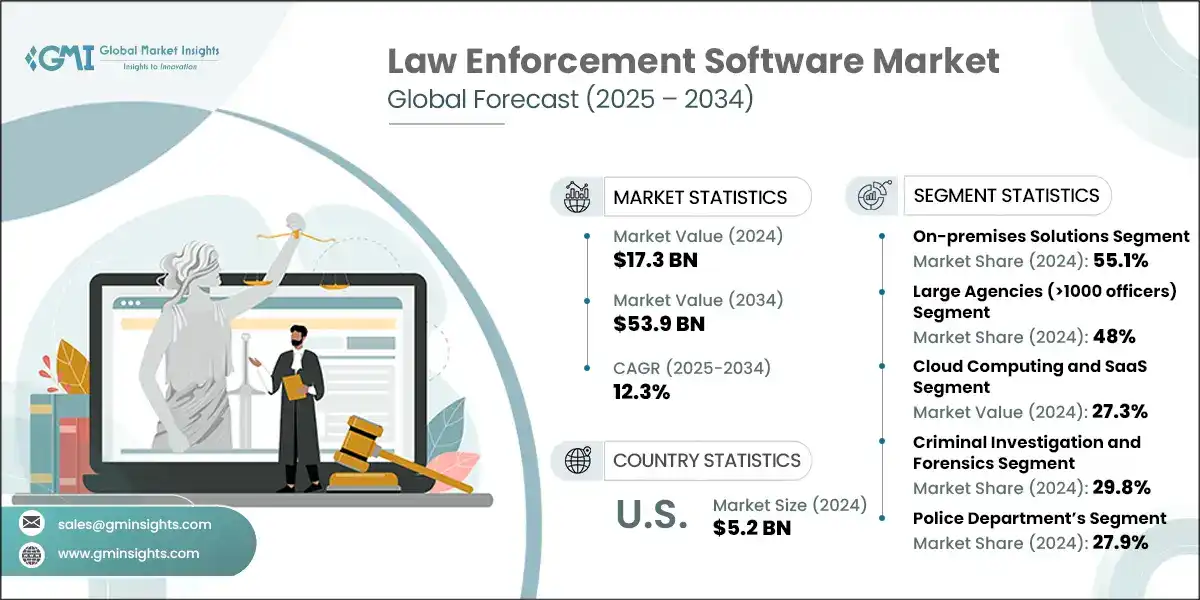
The global law enforcement software market size was estimated at USD 17.3 billion in 2024. The market is expected to grow from USD 18.9 billion in 2025 to USD 53.9 billion in 2034, at a CAGR of 12.3%, as per the latest report published by global market insights, Inc.
To get key market trends
- The law enforcement software market is experiencing robust growth, driven by the rapid adoption of digital policing technologies, AI-powered analytics, cloud computing, and big data solutions. Increasingly sophisticated crime patterns, the need for real-time intelligence, and enhanced public safety demands are pushing agencies to adopt advanced software platforms that enable predictive policing, case management, and digital evidence handling. As law enforcement agencies digitize their operations, demand for interoperable, scalable, and secure software solutions is accelerating across major regions.
- Key modernization and regulatory developments across various regions are shaping the industry’s trajectory. For instance, in February 2025, the European Union introduced new data privacy and security regulations under the Digital Security Act, requiring law enforcement software providers to implement enhanced encryption, data anonymization, and auditability features. These mandates are prompting vendors to innovate around compliance while delivering high-performance analytics capabilities.
- In North America, federal and state-level initiatives are funding the adoption of cloud-based law enforcement platforms with integrated AI-driven crime analytics, facial recognition, and automated reporting tools. Grants and tax incentives aimed at modernizing public safety IT infrastructure are encouraging agencies to transition from legacy systems to agile, modular software architectures that enhance operational efficiency and data sharing across jurisdictions.
- The COVID-19 pandemic had a transformative impact on the law enforcement software market. Early disruptions in procurement and training slowed deployments in 2020, but demand surged from 2021 onward as agencies sought remote-access capabilities, virtual collaboration tools, and digital case management to maintain continuity under pandemic restrictions. This accelerated investment in cloud-enabled platforms, mobile applications, and remote surveillance solutions, enabling law enforcement to adapt rapidly to evolving operational challenges.
- Value-added services, including AI-powered predictive analytics, integrated digital evidence management, and real-time situational awareness dashboards, are becoming critical differentiators in the market. For example, in May 2025, a leading software provider launched a cloud-native platform featuring integrated risk assessment and automated compliance reporting, empowering agencies to improve decision-making while ensuring transparency and accountability. This reflects a broader industry shift toward intelligent software ecosystems that optimize public safety outcomes through data-driven insights.
- North America currently leads the law enforcement software market in deployment scale and investment, supported by strong public sector IT budgets, technological maturity, and extensive law enforcement networks. Meanwhile, Asia-Pacific is emerging as a key growth region, driven by rapid urbanization, expanding digital infrastructure, and increasing public safety initiatives. Countries such as India, Japan, and Australia are witnessing rising adoption of cloud-based policing platforms and AI-enabled crime prevention tools, supported by government-backed smart city and digital transformation programs.
Law Enforcement Software Market Report Attributes
| Key Takeaway | Details |
|---|---|
| Market Size & Growth | |
| Base Year | 2024 |
| Market Size in 2024 | USD 17.3 Billion |
| Forecast Period 2025 – 2034 CAGR | 12.3% |
| Market Size in 2034 | USD 53.9 Billion |
| Key Market Trends | |
| Drivers | Impact |
| Rapid Digital Transformation of Law Enforcement Agencies | Increasing adoption of cloud computing, AI, and big data analytics to modernize policing and improve operational efficiency. |
| Regulatory and Compliance Mandates | New privacy, security, and data handling regulations driving software providers to innovate and ensure secure, compliant platforms. |
| Rising Demand for Real-Time Intelligence and Predictive Policing | Need for advanced analytics and AI-powered tools to anticipate crime trends and enhance public safety responsiveness. |
| Government Initiatives and Incentives | Federal and state grants, tax incentives, and public sector IT budgets accelerating software adoption and upgrades in law enforcement agencies. |
| Pitfalls & Challenges | Impact |
| Data Privacy and Security Concerns | Sensitive nature of law enforcement data raises risk of breaches and regulatory penalties, complicating software design and deployment. |
| Legacy System Integration Challenges | Many agencies still rely on outdated IT infrastructure, making smooth migration and interoperability with modern software difficult. |
| Opportunities: | Impact |
| Growth in Cloud-Based and AI-Enabled Software Solutions | Expanding demand for scalable, remote-access platforms with integrated AI for analytics, case management, and digital evidence handling. |
| Expansion in Emerging Markets (Asia-Pacific, Latin America) | Rapid digitalization and smart city initiatives in these regions open large new markets for law enforcement software providers. |
| Value-Added Services and Intelligent Software Ecosystems | Opportunity to differentiate through advanced features like predictive analytics, automated compliance reporting, and real-time situational awareness dashboards. |
| Cross-Agency Data Sharing and Interoperability Platforms | Developing secure frameworks for inter-jurisdictional collaboration and information exchange enhances effectiveness and creates new business avenues. |
| Market Leaders (2024) | |
| Market Leaders |
Holds 20% market share |
| Top Players |
Collective market share in 2024 is 38% |
| Competitive Edge |
|
| Regional Insights | |
| Largest Market | US |
| Fastest Growing Market | China |
| Emerging Countries | Brazil, Mexico, Argentina |
| Future outlook |
|
What are the growth opportunities in this market?
Law Enforcement Software Market Trends
- The law enforcement software industry is witnessing a major transformation driven by AI-enabled analytics, cloud adoption, and the growing need for digital policing solutions. Agencies across North America, Europe, and Asia-Pacific are increasingly adopting cloud-native platforms and AI-driven case management systems to improve operational efficiency, crime prediction, and public safety. For instance, in February 2025, IBM launched an AI-powered law enforcement software suite in Germany, featuring predictive policing algorithms, secure cloud integration, and real-time data analytics.
- Integration of mobile, IoT, and edge computing solutions is accelerating, particularly in response to smart city initiatives and connected surveillance networks. Vendors are deploying modular, scalable software platforms that support real-time crime monitoring and rapid dispatch coordination. For instance, in April 2025, Motorola Solutions deployed a mobile-first law enforcement platform across Singapore, enabling on-the-go access to records management, AI-based threat detection, and live situational updates.
- Sustainability and energy-efficient digital infrastructure are emerging as key considerations for law enforcement software providers. Cloud and software vendors are incorporating green computing practices, server optimization, and low-power AI processing into their platforms to align with government and municipal sustainability mandates. In March 2025, Hexagon AB launched an eco-friendly law enforcement software solution in the Netherlands, integrating energy-efficient data processing and secure cloud storage compliant with EU environmental regulations.
- The law enforcement ecosystem is expanding to include interoperable solutions, AI-assisted forensics, and advanced cybersecurity measures. Collaborations between software providers, government agencies, and telecom operators are enabling seamless data sharing, predictive analytics, and secure cloud operations. For instance, in May 2025, Tyler Technologies partnered with local police departments in the U.S. to deploy an integrated software suite combining case management, crime analytics, and real-time emergency response capabilities.
Law Enforcement Software Market Analysis
Learn more about the key segments shaping this market
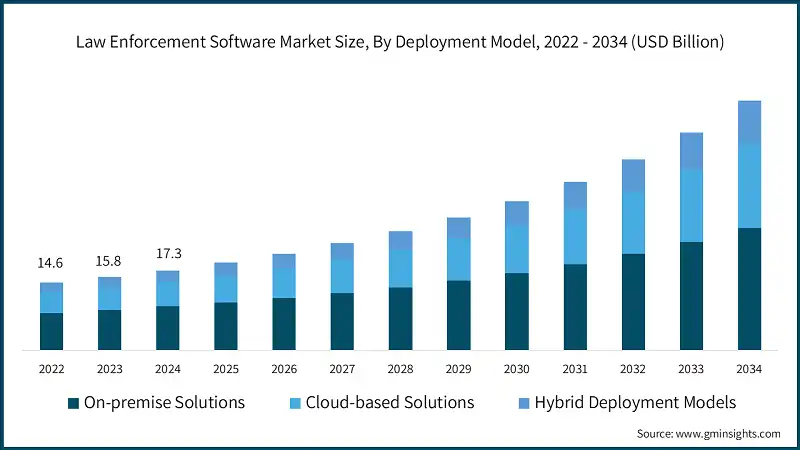
Based on deployment model, the law enforcement software market is divided into on-premises solutions, cloud-based solutions and hybrid deployment models. The on-premises solutions segment dominated the market, accounting for around 55.1% in 2024 and is expected to grow at a CAGR of over 11% through 2034.
- On-premises solutions represent the largest segment in the law enforcement software market, driven by agencies’ preference for direct control over sensitive data, legacy system integration, and compliance with stringent security and privacy regulations. These solutions include locally hosted case management systems, digital evidence repositories, and command and control applications that are critical for mission-critical law enforcement operations.
- Leading providers like Motorola Solutions, NEC Corporation, and Hexagon AB continue to innovate in on-premises software, offering secure, customizable platforms with enhanced encryption, real-time data processing, and integration capabilities. Modular architecture, advanced user interfaces, and interoperability with existing public safety communication systems are key factors sustaining this segment’s dominance. For instance, in January 2025, Motorola Solutions released an upgraded version of its on-premises records management system featuring AI-driven analytics and enhanced audit trails tailored for regulatory compliance.
- The cloud-based solutions segment, while smaller, is rapidly gaining traction as law enforcement agencies prioritize scalability, remote accessibility, and cost-efficiency. Cloud deployments offer benefits such as automatic updates, AI-powered analytics, and multi-jurisdictional data sharing, which are increasingly critical in a digitally connected environment.
- Providers like Axon Enterprise, IBM Corporation, and Microsoft Azure are expanding their cloud offerings with law enforcement-specific platforms, including digital evidence management and AI-driven crime prediction tools. For instance, in March 2025, IBM launched a cloud-native law enforcement analytics platform designed for hybrid cloud environments, providing agencies with scalable compute power and real-time insights while ensuring compliance with data residency laws.
- The hybrid deployment models segment is emerging as a flexible alternative, combining the security of on-premises systems with the agility of cloud solutions. Hybrid models enable law enforcement agencies to retain sensitive workload locally while leveraging cloud resources for AI analytics, backup, and disaster recovery.
- Industry players are focusing on hybrid architectures that facilitate seamless data synchronization, role-based access controls, and zero-downtime migration strategies. In February 2025, Hexagon AB introduced a hybrid command and control platform that integrates on-premises dispatch systems with cloud-based situational awareness tools, enhancing operational resilience and inter-agency collaboration.
Learn more about the key segments shaping this market
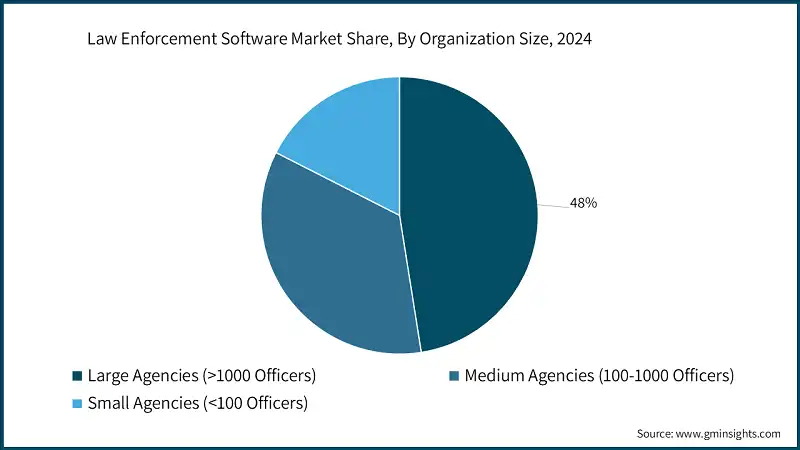
Based on organization size, the law enforcement software market is segmented into large agencies (>1000 officers), medium agencies (100-1000 officers), small agencies (<100 officers). The large agencies (>1000 officers) segment dominates the market with 48% share in 2024 and is expected to grow at a CAGR of over 10.9% from 2025 to 2034.
- Large agencies require robust, scalable software solutions that support integrated case management, real-time intelligence sharing, AI-powered analytics, and comprehensive digital evidence handling. For instance, in March 2025, Motorola Solutions deployed an AI-enhanced records management system for the New York Police Department (NYPD), enabling faster crime analysis and interdepartmental coordination.
- Medium agencies (100-1000 officers) are rapidly adopting modern cloud-based and hybrid solutions to enhance operational efficiency and improve resource allocation. For example, in January 2025, the Dallas Police Department upgraded to a hybrid cloud case management platform from IBM, which improved data accessibility and enabled predictive policing capabilities while ensuring compliance with local data regulations.
- Small agencies (<100 officers), while representing a smaller market share, are increasingly leveraging SaaS (Software as a Service) models and lightweight applications for core law enforcement functions like records management and mobile reporting. For instance, in February 2025, the Santa Fe County Sheriff’s Office adopted Microsoft Azure’s cloud-based incident reporting software, allowing officers to submit and review reports remotely with minimal IT overhead.
Based on components, the law enforcement software market is segmented into records management systems (RMS), computer-aided dispatch (CAD) systems, evidence management systems, case management software, crime analytics and intelligence software, mobile police software, training and simulation software and other. The records management systems (RMS) segment is expected to dominate the market.
- The records management systems (RMS) segment is expected to dominate the market, driven by the critical need for efficient data organization, secure information sharing, and regulatory compliance across law enforcement agencies.
- RMS platforms serve as the backbone of law enforcement operations by centralizing criminal records, incident reports, and investigative data. For example, in April 2025, Tyler Technologies upgraded the RMS platform for the Chicago Police Department, introducing AI-powered search capabilities and enhanced interoperability with other public safety systems.
- Computer-aided dispatch (CAD) systems are also vital, enabling real-time incident reporting, resource allocation, and emergency response coordination. In February 2025, Hexagon AB implemented a next-generation CAD solution for the London Metropolitan Police, improving dispatch accuracy and response times through geospatial intelligence integration.
- Evidence management systems and case management software are rapidly gaining adoption as agencies prioritize secure digital evidence handling and streamlined investigative workflows. In March 2025, Axon Enterprise expanded its cloud-based evidence management platform with advanced chain-of-custody tracking and AI-assisted video analysis, supporting multiple U.S. law enforcement agencies.
Based on technology, the law enforcement software market is segmented into Cloud Computing and SaaS, Artificial Intelligence and Machine Learning, Mobile and Wireless Technologies, Blockchain and Distributed Ledger, IoT and Connected Devices and Biometric and Recognition Technologies. The Cloud Computing and SaaS segment dominates the market with 27.3% share in 2024.
- The cloud computing and SaaS segment dominates the law enforcement software market, driven by growing demand for scalable, cost-effective, and remotely accessible solutions that can support multi-jurisdictional data sharing, AI analytics, and real-time operational coordination.
- Cloud-based deployments allow agencies to rapidly implement new features, integrate with existing systems, and maintain compliance with evolving data residency and security regulations without significant on-premises infrastructure investment. For instance, in February 2025, Axon Enterprise rolled out an expanded SaaS-based digital evidence management platform enabling seamless collaboration across law enforcement agencies in North America.
Based on applications, the law enforcement software market is segmented into criminal investigation and forensics, crime prevention and patrol, traffic management and enforcement, emergency response and dispatch, court and legal proceedings and corrections and rehabilitation. The criminal investigation and forensics segment dominates the market with 29.8% share in 2024.
- The criminal investigation and forensics segment dominates the market, driven by the rising need for advanced investigative tools, digital evidence management platforms, and AI-powered forensic analysis to address increasingly complex and data-rich criminal cases.
- Law enforcement agencies are investing heavily in criminal investigation and forensic software to enhance evidence collection, integrate multiple data sources, and accelerate case resolution while maintaining compliance with legal and procedural standards.
- These solutions offer advanced features such as automated evidence indexing, biometric identification, chain-of-custody tracking, and predictive analytics, enabling investigators to improve accuracy, efficiency, and case outcomes.
- Meanwhile, segments such as crime prevention and patrol, traffic management and enforcement, and emergency response and dispatch continue to serve critical operational needs, particularly for proactive policing, road safety, and rapid incident coordination. However, the depth of functionality, scalability, and strategic importance of criminal investigation and forensics solutions are driving their leading market share.
Based on end use, the law enforcement software market is segmented into police departments, federal law enforcement agencies, sheriff's offices, other law enforcement agencies and courts and justice system. The police department’s segment dominates the market with 27.9% share in 2024.
- The police department’s segment dominates the market, driven by their widespread adoption of digital policing platforms, records management systems, and real-time crime analysis tools to improve operational efficiency and public safety outcomes.
- Police departments are investing in advanced law enforcement software to support activities ranging from patrol and dispatch to criminal investigations and community engagement. The scale of operations, diverse case types, and growing need for data-driven decision-making are accelerating the adoption of integrated, cloud-enabled platforms within this segment.
- These solutions provide enhanced capabilities such as mobile reporting, AI-powered crime prediction, and interoperable communication systems, enabling officers to respond faster, improve coordination, and maintain transparency with the public.
- Federal law enforcement agencies, sheriff’s offices, and courts and justice systems continue to expand their technology adoption to meet specialized operational needs. However, the broad mandate, high interaction with communities, and constant demand for frontline responsiveness position police departments as the leading segment in market share.
Based on integration level, the law enforcement software market is segmented into fully integrated platforms, standalone solutions, partially integrated systems and enterprise-wide ecosystems. The fully integrated platforms segment dominates the market with 44.4% share in 2024.
- The fully integrated platforms segment dominates the market, driven by law enforcement agencies’ growing preference for unified software environments that seamlessly connect multiple operational functions, from records management and dispatch to evidence handling and analytics.
- Fully integrated platforms enable real-time data sharing, reduce duplication of effort, and improve cross-departmental collaboration, making them highly effective for agencies seeking to modernize workflows and enhance operational visibility.
- Standalone solutions, partially integrated systems, and enterprise-wide ecosystems continue to serve specific agency needs, particularly in smaller organizations or specialized units. However, the operational efficiency, scalability, and comprehensive functionality offered by fully integrated platforms are driving their leading market share.
Looking for region specific data?
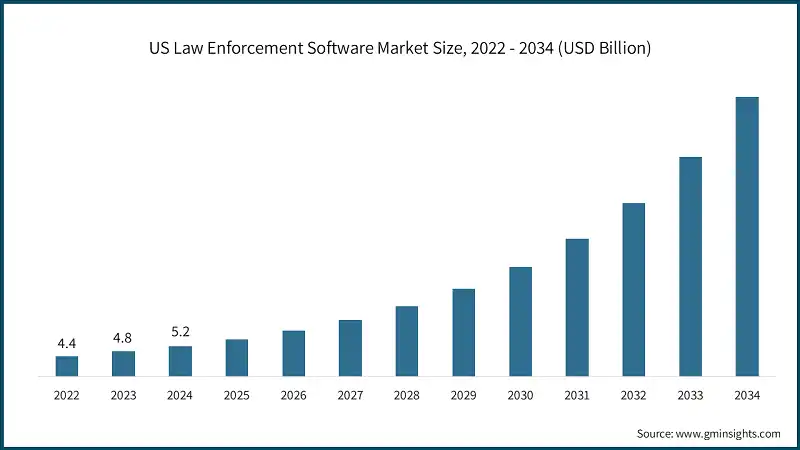
US dominated the law enforcement software market in North America with 81.6% share in 2024 and generated USD 5.2 billion in revenue.
- Law enforcement software industry in US, driven by its advanced digital infrastructure, high public safety budgets, and strong adoption of cloud-based and AI-enabled policing solutions. The country serves as both the largest consumer and primary innovation hub for law enforcement software, with widespread deployment across federal, state, and local agencies.
- Leading solution providers such as Motorola Solutions, Axon Enterprise, and IBM Corporation continue to expand their U.S. operations by delivering fully integrated platforms, advanced digital evidence management tools, and AI-powered crime analytics. For instances, in March 2025, Motorola Solutions launched an upgraded nationwide records management platform for multiple U.S. police departments, integrating predictive analytics and mobile reporting for improved operational efficiency.
- U.S. market dominance is further supported by favorable funding programs, strong cybersecurity regulations, and a well-developed technology ecosystem. Vendors are heavily investing in automation, cloud-native platforms, and mobile-first solutions to meet growing demand for real-time, data-driven public safety capabilities.
- The United States also benefits from strategic collaborations between government agencies, academic institutions, and technology companies to advance innovation in digital policing, interoperability standards, and officer safety solutions—ensuring continued leadership in the North American market.
The law enforcement software market in the Germany is expected to experience significant and promising growth from 2025 to 2034.
- This expansion is being driven by the country’s strong commitment to digitalizing public safety operations, strict compliance with EU data protection regulations, and increasing adoption of AI-driven investigative and crime prevention tools.
- German federal and state police forces are accelerating investments in records management systems (RMS), computer-aided dispatch (CAD) platforms, and digital evidence management solutions to enhance operational efficiency, inter-agency coordination, and public safety outcomes. For instance, in January 2025, NEC Corporation partnered with the Bavarian State Police to implement an advanced biometric identification system, enabling faster suspect verification and case resolution.
- Growth is further supported by Germany’s leadership role in EU-funded smart city initiatives, its robust cybersecurity infrastructure, and ongoing modernization programs within law enforcement agencies. The integration of cloud-based platforms, predictive analytics, and mobile policing applications is expected to solidify Germany’s position as a key growth engine for the European market over the next decade.
The law enforcement software market in China is expected to experience strong growth from 2025 to 2034.
- The law enforcement software market growth in China is fueled by rapid urbanization, rising public safety needs, and the government’s heavy investment in smart policing initiatives. The country’s large population, expanding surveillance infrastructure, and increasing deployment of AI-powered crime analytics platforms are accelerating the adoption of advanced law enforcement software across municipal, provincial, and national levels.
- Chinese law enforcement agencies are investing in integrated records management systems, real-time monitoring platforms, and facial recognition technologies to improve crime prevention, emergency response, and forensic investigation capabilities. For instance, in July 2024, Huawei Technologies announced a partnership with a major municipal police bureau to roll out a cloud-based video evidence management system, enhancing both storage efficiency and investigative speed.
- Growth in China is also supported by strong domestic technology providers, government-backed R&D programs, and an extensive rollout of IoT-connected devices in public spaces. With rising demand for predictive policing tools, mobile policing applications, and integrated command-and-control centers, China is set to remain one of the most dynamic and rapidly evolving markets for law enforcement software in the Asia-Pacific region.
The law enforcement software market in Brazil is expected to experience high growth from 2025 to 2034.
- Brazil is expected to experience high growth in the law enforcement software market, fueled by increasing digitalization across public safety agencies, rising cloud adoption, and government initiatives supporting modernization of law enforcement IT infrastructure and data connectivity improvements.
- Major global and regional law enforcement software providers are expanding their footprint with deployments in key cities like São Paulo and Rio de Janeiro, focusing on scalable, secure, and AI-enabled platforms to meet growing demands. For instance, in April 2025, a partnership between IBM Corporation and the São Paulo Police Department led to the deployment of an AI-powered crime analytics platform aimed at predictive policing and resource optimization.
- Brazil’s expanding public safety modernization programs, rising internet penetration, and mobile device adoption are driving the need for robust, cloud-based law enforcement solutions to support crime prevention, emergency response, and digital evidence management across the country.
The law enforcement software market in UAE is expected to experience strong growth from 2025 to 2034.
- The law enforcement software market in the United Arab Emirates (UAE) is expected to experience strong growth, driven by ambitious smart city initiatives, extensive government investment in public safety modernization, and increasing adoption of AI and cloud-based technologies across federal and local law enforcement agencies.
- Leading global and regional vendors are partnering with UAE authorities to deploy advanced records management systems, real-time surveillance platforms, and biometric identification solutions that enhance crime prevention, emergency response, and inter-agency collaboration. For instance, in May 2025, Microsoft Azure partnered with the Dubai Police to deploy a cloud-based crime analytics platform, leveraging AI and machine learning to enhance predictive policing and real-time incident response across the city.
- Growth is supported by the UAE’s strategic focus on digital transformation, robust ICT infrastructure, and regulatory frameworks that encourage innovation while ensuring data security and privacy. With increasing investments in mobile policing applications and predictive crime analytics, the UAE is positioned as a key growth market for law enforcement software in the Middle East region.
Law Enforcement Software Market Share
The top 7 companies in the law enforcement software industry are Axon Enterprise, Hexagon, IBM, Motorola Solutions, NEC, Nice, and Tyler Technologies, contributing around 38% of the market in 2024.
- Motorola Solutions is the leader in law enforcement software, offering comprehensive public safety platforms that integrate dispatch, records management, and video security systems. For instance, in January 2025, Motorola launched its enhanced command central predict platform with advanced machine learning capabilities, deployed across multiple U.S. states to improve crime forecasting and emergency response coordination.
- Axon Enterprise is a key innovator in digital evidence management and body-worn camera solutions, providing cloud-based platforms that support law enforcement transparency and efficiency. For instance, in March 2025, Axon released a major upgrade to its Evidence.com platform, incorporating AI-powered video analytics and automated redaction features to enhance investigative workflows and privacy compliance.
- Hexagon offers advanced geospatial and public safety software, including computer-aided dispatch (CAD), records management, and AI-driven crime analytics. For instance, in February 2025, Hexagon unveiled its Smart M.App Public Safety suite, delivering integrated command and control center capabilities with real-time data visualization for European law enforcement agencies.
- IBM provides enterprise-grade AI-driven law enforcement software and analytics tailored for public safety and justice departments worldwide. For instance, in April 2024, IBM partnered with the New York Police Department (NYPD) to launch an AI-powered crime prediction and case management platform, enabling faster investigations and data-driven policing strategies.
- NEC is a leader in biometric identification and video analytics solutions for law enforcement, supporting agencies primarily in Asia-Pacific. For instance, in March 2025, NEC deployed a large-scale biometric system for the Tokyo Metropolitan Police, enhancing suspect tracking and border security operations.
- Nice specializes in analytics, incident recording, and digital evidence management software for public safety agencies. For instance, in May 2025, Nice launched its AI-enabled Public Safety platform across several U.S. cities, providing real-time crime detection and improved situational awareness through integrated data feeds.
- Tyler Technologies delivers end-to-end software solutions for courts, corrections, and law enforcement, including case management and digital evidence systems. For instance, in February 2025, Tyler deployed its cloud-based Evidence Management System for the Texas Department of Public Safety, improving evidence chain-of-custody and cross-agency collaboration.
Law Enforcement Software Market Companies
Major players operating in the law enforcement software industry are:
- Axon Enterprise
- Cellebrite DI
- Genetec
- Hexagon
- IBM
- Motorola Solutions
- NEC
- Nice
- Resolver
- Tyler Technologies
- Motorola Solutions has aggressively gained market share in the law enforcement software market through sustained investment in integrated communication systems, AI-driven dispatch platforms, and cloud-native evidence management. Motorola maintains a dominant presence worldwide, leveraging its comprehensive public safety software portfolio and secure infrastructure footprint.
- Motorola Solutions continues to expand in emerging regions such as Latin America and Southeast Asia, investing in interoperability, cybersecurity, and mobile command solutions. Motorola is also partnering with governments and agencies to deliver hybrid and secure cloud platforms tailored to sector-specific needs.
- Axon Enterprise has adopted a diversified market strategy focusing on digital evidence management, body-worn cameras, and AI-enabled analytics across North America, Europe, and Asia-Pacific. Axon emphasizes cloud-based software solutions that enhance transparency, operational efficiency, and accountability. Its investments in AI-driven automation and secure cloud storage align with rising regulatory demands. Axon’s ongoing rollout of real-time data access and integrated platform services strengthens its appeal to law enforcement agencies worldwide.
- IBM Corporation continues to scale its law enforcement software presence through AI-powered crime analytics, hybrid cloud deployments, and secure case management solutions. IBM’s global data centers, especially in Europe and North America, are increasingly designed for compliance with data privacy laws and optimized for large-scale AI workloads. IBM’s focus on open architecture, hybrid cloud integration, and intelligent automation supports enterprise digital transformation within public safety sectors.
Law Enforcement Software Industry News
- In April 2025, Axon Enterprise, Inc. launched its latest cloud-based evidence management software designed for scalability and enhanced cybersecurity. The platform features AI-driven transcription and automated case tagging, aimed at improving data accuracy and reducing processing times for law enforcement agencies globally.
- In March 2025, IBM Corporation expanded its law enforcement software portfolio with the introduction of a hybrid cloud analytics suite tailored for crime prevention and forensic investigations. Deployed initially in Germany and Canada, the solution offers AI-enhanced data fusion capabilities compliant with strict data privacy regulations.
- In February 2025, Hexagon AB unveiled a new geospatial intelligence platform integrating IoT sensor data and AI-powered predictive analytics, targeting European law enforcement agencies. The platform facilitates proactive crime prevention and resource allocation, supporting smarter policing initiatives.
- In January 2025, NEC Corporation announced the deployment of its next-generation biometric recognition systems across several Southeast Asian law enforcement agencies. The systems offer improved accuracy and privacy compliance, aiding in criminal identification and border security operations.
- In December 2024, Nice Ltd. introduced an AI-driven digital evidence management solution designed to streamline case workflows and enhance collaboration between law enforcement and judicial entities. Initial deployments in Australia and the UK have shown significant improvements in case processing efficiency.
- In November 2024, Tyler Technologies, Inc. released a cloud-native court and corrections management platform with enhanced interoperability features. The platform supports integrated case management and reporting for U.S. justice systems, facilitating smoother data exchange and reducing administrative overhead.
The law enforcement software market research report includes in-depth coverage of the industry with estimates & forecast in terms of revenue (USD Billion) from 2021 to 2034, for the following segments:
Market, By Component
- Records management systems (RMS)
- Computer-aided dispatch (CAD) systems
- Evidence management systems
- Case management software
- Crime analytics and intelligence software
- Mobile police software
- Training and simulation software
- Others
Market, By Deployment Model
- On-premises solutions
- Cloud-based solutions
- Hybrid deployment models
Market, By Technology
- Cloud computing and SaaS
- Artificial intelligence and machine learning
- Mobile and wireless technologies
- Blockchain and distributed ledger
- IoT and connected devices
- Biometric and recognition technologies
Market, By Application
- Criminal investigation and forensics
- Crime prevention and patrol
- Traffic management and enforcement
- Emergency response and dispatch
- Court and legal proceedings
- Corrections and rehabilitation
Market, By End Use
- Police departments
- Federal law enforcement agencies
- Sheriff's offices
- Other law enforcement agencies
- Courts and justice system
Market, By Integration Level
- Fully integrated platforms
- Standalone solutions
- Partially integrated systems
- Enterprise-wide ecosystems
Market, By Organization Size
- Large agencies (>1000 Officers)
- Medium agencies (100-1000 Officers)
- Small agencies (<100 Officers)
The above information is provided for the following regions and countries:
- North America
- US
- Canada
- Europe
- UK
- Germany
- France
- Italy
- Spain
- Russia
- Nordics
- Asia Pacific
- China
- India
- Japan
- Australia
- South Korea
- Southeast Asia
- South America
- Brazil
- Mexico
- Argentina
- MEA
- South Africa
- Saudi Arabia
- UAE
Frequently Asked Question(FAQ) :
How much revenue did the on-premises solutions segment generate in 2024?
The on-premises solutions segment generated approximately 55.1% of the market share in 2024 and is expected to witness over 11% CAGR through 2034.
What was the valuation of the cloud computing and SaaS segment in 2024?
The cloud computing and SaaS segment accounted for 27.3% of the market share in 2024.
What is the growth outlook for large agencies from 2025 to 2034?
The large agencies segment (with over 1000 officers) is set to expand at a CAGR of over 10.9% till 2034.
Which region leads the law enforcement software sector?
The U.S. leads the market in North America, holding an 81.6% share and generating USD 5.2 billion in revenue in 2024.
What are the upcoming trends in the law enforcement software market?
Trends include AI analytics, cloud platforms, IoT integration, sustainability, stronger cybersecurity, and vendor–government collaborations for data sharing and prediction.
Who are the key players in the law enforcement software industry?
Key players include Axon Enterprise, Cellebrite DI, Genetec, Hexagon, IBM, Motorola Solutions, NEC, Nice, Resolver, and Tyler Technologies.
What is the market size of the law enforcement software in 2024?
The market size was USD 17.3 billion in 2024, with a CAGR of 12.3% expected through 2034. The growth is driven by the adoption of digital policing technologies, AI-powered analytics.
What is the projected value of the law enforcement software market by 2034?
The market is poised to reach USD 53.9 billion by 2034, fueled by advancements in predictive policing, scalable software platforms, and increasing public safety demands.
Law Enforcement Software Market Scope
Related Reports