Summary
Table of Content

Laser Technology Market
Get a free sample of this report
Form submitted successfully!
Error submitting form. Please try again.
Thank you!
Your inquiry has been received. Our team will reach out to you with the required details via email. To ensure that you don't miss their response, kindly remember to check your spam folder as well!
Request Sectional Data
Thank you!
Your inquiry has been received. Our team will reach out to you with the required details via email. To ensure that you don't miss their response, kindly remember to check your spam folder as well!
Form submitted successfully!
Error submitting form. Please try again.
Laser Technology Market Size
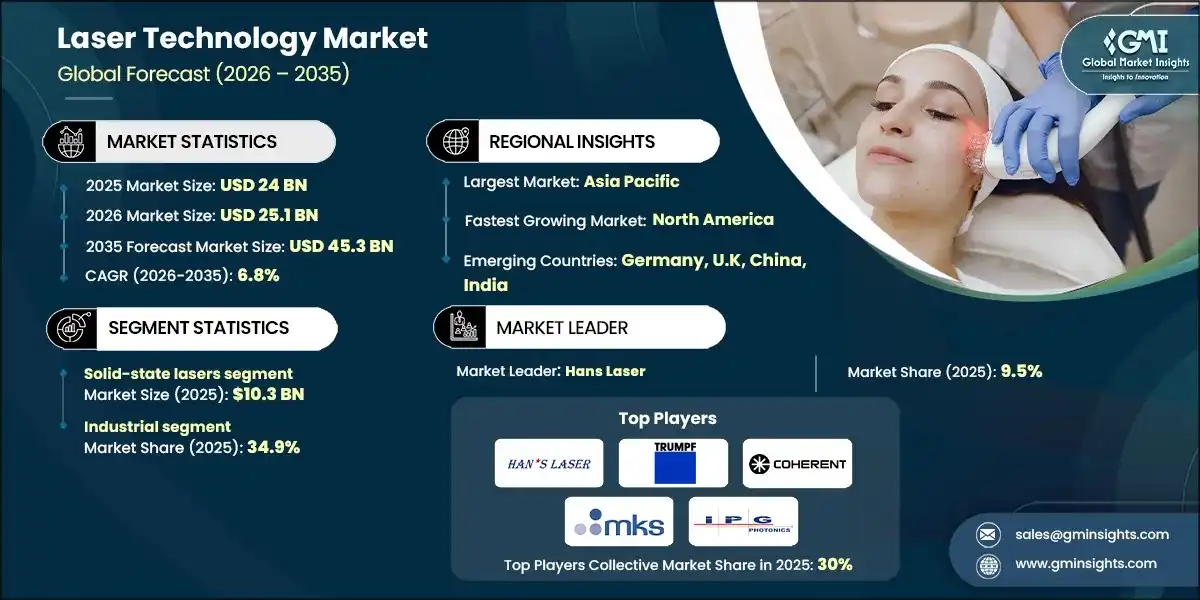
The laser technology market was valued at USD 24 billion in 2025. The market is expected to grow from USD 25.1 billion in 2026 to USD 45.3 billion in 2035, at a CAGR of 6.8%, according to latest report published by Global Market Insights Inc.
Laser Technology Market Key Takeaways
Market Size & Growth
- 2025 Market Size: USD 24 Billion
- 2026 Market Size: USD 25.1 Billion
- 2035 Forecast Market Size: USD 45.3 Billion
- CAGR (2026–2035): 6.8%
Key Market Drivers
- Increasing applications across industries.
- Demand for precision and efficiency.
- Rising use in communication technology.
Challenges
- Technical complexity.
- Limited awareness and adoption.
Opportunity
- Growth in medical & aesthetic applications.
- Expansion in industrial automation & smart manufacturing.
Key Players
- Market Leader: Hans Laser led with over 9.5% market share in 2025.
- Leading Players: Top 5 players in this market include Hans Laser, Trumpf, Coherent, MKS Instruments, IPG Photonics, which collectively held a market share of 30% in 2025.
Get Market Insights & Growth Opportunities
Rapid growth is occurring within the laser technology industry, which is fuelled by rising usage of lasers within various sectors such as manufacturing, telecommunications, health care, defence, automotive and consumer electronics. Manufacturing operations commonly utilise lasers for their accuracy and speed; thus, it has been estimated that the current size of the manufacturing production workforce in America has increased from 2.49 million workers in May 2020 to 2.45 million at present, which suggests that increased demand for laser tools could also see increased job creation for its employees.
Technological innovations are driving significant market growth for laser technology through the development of new types of lasers, such as fibre lasers, ultrafast lasers, and diode lasers, which provide greater efficiency, power, and compact size compared to traditional laser types. Some companies leading the way in introducing advanced laser systems designed for specific industrial applications are Coherent and IPG Photonics. IPG Photonics' fibre lasers have been successfully used in automotive manufacturing due to their high reliability and precision.
Government initiatives and investments in research and development (R&D) are also positively influencing the laser technology market. For example, in 2023, the European Union made available funds through the Horizon Europe program for photonics and laser technology innovations totalling USD 1.2 billion. These types of investments stimulate the creation of new technologies as well as expand the number of applications for existing technologies, which drives overall growth in the laser technology market.
However, the high initial investment required for advanced laser systems remains a challenge, particularly for Small and Medium-sized Enterprises (SMEs). Additionally, supply chain disruptions for critical components like semiconductors and rare-earth elements can lead to production delays and increased costs. For example, the global semiconductor shortage in 2023 impacted laser system manufacturers, causing delays in product deliveries.
Despite these challenges, the laser technology market is poised for significant growth during the forecast period, supported by continuous innovation, government backing, and the increasing adoption of lasers across industries. The market's trajectory highlights its critical role in driving technological advancements and industrial efficiency.
To get key market trends
Laser Technology Market Trends
Changing innovation and technology transformation are important for the growth of the laser technology industry.
- Today, the fiber laser market is driving growth as a result of the rapid increase in recognition of the benefits of fiber laser technology such as compactness, prominent levels of efficiency, and prominent levels of performance of application in material processing. For example, the fiber laser technology developed by IPG Photonics is at the forefront of delivering the highest performance fibers.
- As the demand for advanced healthcare solutions continues to steadily grow, the healthcare community is experiencing a significant increase in the use of laser technology in the fields of surgery, dermatology, ophthalmology and dental procedures. This increase in use of laser technology is driven by the need for greater precision and less invasive procedures and is supported by the estimated annual growth rate of 8% for the growing global demand for minimally invasive surgical procedures, according to the World Health Organization (WHO).
- Laser technologies are currently used in industry 4.0 and smart manufacturing are reshaping the future of laser technology use in automated and robotic systems. Lasers are being used as essential components of precision manufacturing, quality control, and additive manufacturing. An example of this is TRUMPF's continuous addition of laser technology into their smart manufacturing solutions to increase productivity and improve precision
- With recent advancements related to lasers’ ability to make use of new material components like the newest advanced laser crystals, optical fibers, and semiconductor materials, laser systems’ performance and reliability have improved significantly over time. Thus, many more opportunities exist for new laser applications, while optimizing and improving existing processes associated with lasers. For example, the European Union invested USD 1.6 billion in the Horizon Europe Program, helping advance both photonics and laser technologies.
- Overall, the laser technology market will continue to see substantial growth as a result of the increased application of laser technologies in multiple industries, alongside continual improvements in laser technology from leading companies that continue to drive laser adoption in industrial, healthcare, and manufacturing companies.
Laser Technology Market Analysis
Learn more about the key segments shaping this market
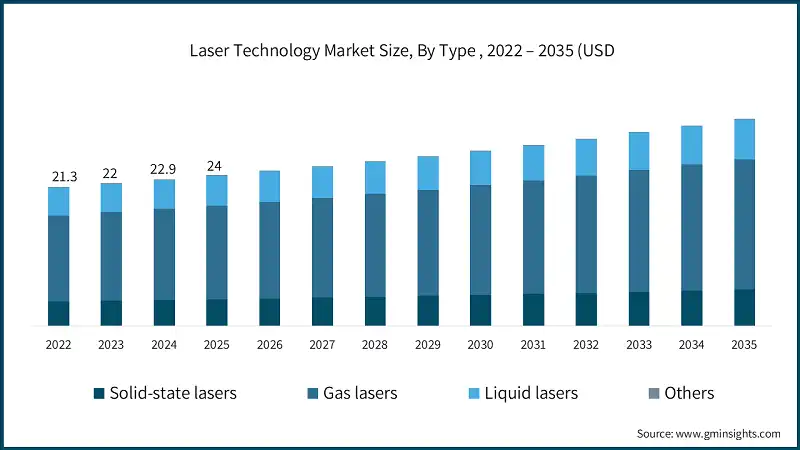
Based on type, the market is divided into solid-state lasers, gas lasers, liquid lasers, and others. The solid-state lasers segment accounts for revenue of around USD 10.3 billion in 2025 and is expected to reach USD 19.9 billion by 2035.
- Solid-state lasers are the leading choice in the field of laser technology because of their versatility, efficient performance, and ability to be adapted into numerous industries. Solid-state lasers are widely used throughout many areas including, but not limited to- material processing, medical uses, scientific research, and defence systems. Due to the ability to provide high levels of precision and power, these types of lasers are among the most commonly used technologies in critical applications.
- The U.S. Government and private sector investments & initiatives have played a major role in the growth of solid-state laser adoption. In 2023, the United States Department of Defence committed more than USD 1 billion to develop new technologies in directed energy weapon systems, including laser technologies. Furthermore, the European Union has made substantial investments into laser-based research and development through the Horizon Europe Program, which will continue to help drive market growth.
- Technological advancements are a significant contributor to the increased growth of solid-state lasers. Advances in thin disk, fibre, and ultra-fast laser technology have increased performance, increased efficiency, and reduced the size of solid-state lasers. Continued improvements in the capabilities of solid-state lasers will provide further opportunity for these technologies to be utilized in a variety of applications, including microelectronics manufacturing, advanced medical procedures, and industrial applications.
- Prominent companies like IPG Photonics, Coherent Corp., and Trumpf Group are leading the market with innovative solutions. For example, IPG Photonics is the leader in developing fibre lasers, which have uses in industrial and medical applications, while Trumpf Group is focused on providing high-power laser systems to the automotive and aerospace.
- The solid-state laser industry has strong government support, continual technology improvements, and an increasing level of adoption in various industries. This combination of factors will allow the industry to experience rapid growth during the foreseeable future and will also advance the technologies associated with solid-state lasers across many industry sectors.
Learn more about the key segments shaping this market
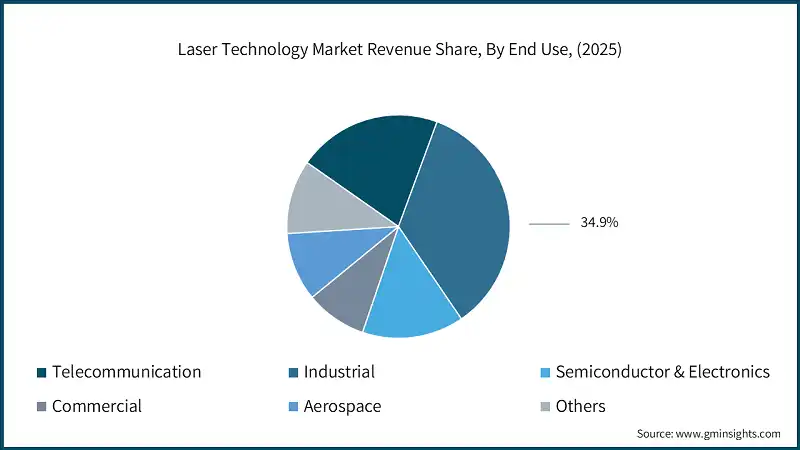
Based on the end-user, the laser technology market is bifurcated into telecommunication, industrial, semiconductor & electronics, commercial, aerospace and others. The industrial segments held around 34.9% of the market share in 2025.
- The automotive, aerospace, metalworking, textiles, and other industries rely heavily on the use of laser technology for many applications, such as cutting, welding, marking, engraving, drilling, and additive manufacturing. In these industries, there is a need for precise methods of fabrication; therefore, the industrial segment represents the largest part of the market for laser technologies.
- The data from government agencies illustrates that the adoption of laser technologies by manufacturers is primarily driven by the industrial sector. For instance, the U.S. Manufacturing sector contributed ~11% of the GDP of the United States, which demonstrates how important this sector is to the U.S. economy. Furthermore, the introduction of laser technologies into manufacturing has enabled manufacturers to increase their productivity, minimize waste, and provide higher quality outputs.
- The industrial segment's prominence in the laser technology market is enhanced by various government-backed initiatives to encourage manufacturers to adopt advanced manufacturing processes with lasers. For example, the Manufacturing USA Programme promotes the adoption of advanced manufacturing technologies, including lasers, so that American manufacturers can increase their domestic manufacturing capacity using innovative means. This trend benefits the increasing demand for both automation and precision in industrial processes.
- Fiber laser cutting machines and laser welding machines are important to many types of manufacturing industries and especially in automotive where products manufactured by the use of fibre laser cutting machines allows manufacturers to efficiently design and manufacture complex and appropriate components at high speed and repeatability as well as producing parts to a specified quality level through accuracy and reliability.
- Laser technology is widely utilized in industrial applications as a result of the advancement that has occurred in laser technology and as well government assistance to manufacturers for the growth and development of this industry.
Looking for region specific data?
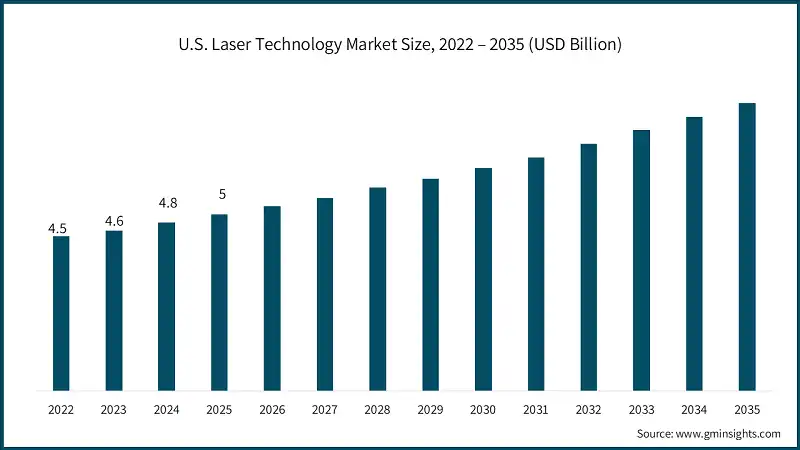
In 2025, the U.S. dominated the laser technology market growth in North America, accounting for 74.9% of the share in the region.
- The U.S. dominates due to strong investments in advanced manufacturing and defense technologies. Programs like the Manufacturing USA initiative and Defense Advanced Research Projects Agency (DARPA) funding have accelerated adoption of laser systems for precision cutting, welding, and directed-energy applications.
- Healthcare and medical aesthetics also drive growth, supported by FDA approvals for laser-based surgical and dermatology devices. Rising demand for minimally invasive procedures and government-backed healthcare modernization programs have expanded the use of laser technology in hospitals and clinics.
Asia Pacific laser technology market is expected to grow at 7.1% CAGR during the forecast period.
- Rapid industrialization and government-led smart manufacturing initiatives, such as China’s “Made in China 2025” and India’s Production Linked Incentive (PLI) scheme, are fueling demand for laser cutting and welding systems. The region’s booming electronics and automotive sectors, coupled with investments in fiber-optic infrastructure for 5G, further strengthen laser adoption.
Europe laser technology market is expected to grow at 6.5% CAGR during the forecast period.
- Europe’s growth is driven by strong emphasis on Industry 4.0 adoption and sustainability goals under the European Green Deal. Laser technology is widely used in lightweight automotive manufacturing and renewable energy applications, such as solar panel production. Germany, home to TRUMPF and Jenoptik, leads innovation with government-supported R&D programs for advanced photonics and additive manufacturing.
Middle East and Africa laser technology market is expected to grow at 6.1% CAGR during the forecast period.
- The region is growth is due to various government diversification strategies, such as Saudi Vision 2030 and UAE’s industrial modernization plans, are promoting high-tech manufacturing and infrastructure projects. Lasers are increasingly used in oil & gas pipeline maintenance, aerospace component fabrication, and defence applications.
Laser Technology Market Share
The top companies in the laser technology industry include Hans Laser, Trumpf, Coherent, MKS Instruments and IPG Photonics and collectively hold a share of 30% of the market in 2025. These prominent players are proactively involved in strategic endeavors, such as mergers & acquisitions, facility expansions & collaborations, to expand their product portfolios, extend their reach to a broad customer base, and strengthen their market position.
- Hans Laser provides advanced laser cutting, welding, and marking systems tailored for automotive, electronics, and precision engineering sectors. Its solutions integrate intelligent automation and real-time monitoring for enhanced productivity and quality assurance. The portfolio includes high-power fiber lasers, CNC platforms, and digital control systems for predictive maintenance and operational efficiency.
- TRUMPF delivers high-performance laser machines for cutting, welding, and additive manufacturing, serving industries such as aerospace, automotive, and medical devices. Its systems feature AI-driven optimization, IoT connectivity, and automated material handling to maximize throughput. TRUMPF’s offerings include fiber and disk lasers, smart software platforms, and integrated solutions for Industry 4.0 environments.
- Coherent specializes in precision laser sources and systems for microelectronics, semiconductor, and medical applications. Its portfolio includes excimer, diode, and ultrafast lasers designed for high-accuracy material processing. Coherent integrates advanced beam delivery, process monitoring, and automation tools to support demanding production environments and next-generation technologies.
Laser Technology Market Companies
Major players operating in the laser technology industry are:
- AIDA
- Amada Press System
- Beckwood Press
- Bliss-Bret
- Bruderer
- Isgec Heavy Engineering
- Komatsu
- Macrodyne Technologies
- Nidec Minster
- Schuler Group
- Shieh Yih Machinery Industry
- SMS Group
- Stamtec
- Sutherland Presses
- Yangli Group
MKS Instruments offers laser-based solutions for semiconductor manufacturing, photonics, and industrial processing. Its systems combine precision optics, motion control, and real-time diagnostics to ensure consistent performance. The portfolio includes ultrafast lasers, beam shaping modules, and integrated platforms for high-volume production and advanced material applications.
IPG Photonics is a global leader in fiber laser technology, delivering solutions for cutting, welding, and 3D printing across automotive, aerospace, and energy sectors. Its products feature high-power fiber lasers, beam delivery systems, and intelligent monitoring tools for superior efficiency and reliability. IPG’s platforms enable predictive maintenance and seamless integration with automated production lines.
Laser Technology Market Report Attributes
| Key Takeaway | Details |
|---|---|
| Market Size & Growth | |
| Base Year | 2025 |
| Market Size in 2025 | USD 24 Billion |
| Market Size in 2026 | USD 25.1 Billion |
| Forecast Period 2026-2035 CAGR | 6.8% |
| Market Size in 2035 | USD 45.3 Billion |
| Key Market Trends | |
| Drivers | Impact |
| Increasing applications across industries | Laser systems are being adopted in automotive, electronics, healthcare, and defense, driving multi-sector demand. This diversification ensures steady growth and resilience against sector-specific downturns. |
| Demand for precision and efficiency | Manufacturers prefer lasers for high-speed, accurate cutting and welding, reducing material waste and improving productivity. Aligning with Industry 4.0 and smart manufacturing goals. |
| Rising use in communication technology | Optical fiber networks and 5G infrastructure rely on laser-based components for high-speed data transmission. This creates strong demand in telecom and data center markets. |
| Pitfalls & Challenges | Impact |
| Technical complexity | High installation and maintenance costs, along with skilled labor requirements, limit adoption among small and mid-sized enterprises. This slows penetration in emerging markets. |
| Limited awareness and adoption | In developing regions, lack of knowledge about laser benefits and ROI hampers market expansion. Education and training programs are critical to overcome this barrier. |
| Opportunities: | Impact |
| Growth in medical & aesthetic applications | Demand for laser-based surgeries and cosmetic treatments is surging due to minimally invasive procedures. This opens lucrative avenues in healthcare and beauty sectors. |
| Expansion in industrial automation & smart manufacturing | Laser technology is integral to automated production lines, additive manufacturing, and precision engineering. Adoption will accelerate as factories transition to smart systems. |
| Market Leaders (2025) | |
| Market Leaders |
9.5% market share |
| Top Players |
|
| Competitive Edge |
|
| Regional Insights | |
| Largest Market | Asia Pacific |
| Fastest Growing Market | North America |
| Emerging Country | Germany, U.K, China, India |
| Future Outlook |
|
What are the growth opportunities in this market?
Laser Technology Industry News
- In October 2025, Bystronic signed an agreement to acquire Coherent’s Tools for Materials Processing business unit. This move expands Bystronic’s portfolio into micro material processing, marking, and drilling, targeting medical devices and semiconductor markets.
- In September 2025, Amada introduced the REGIUS 3015 AJ e Series with 26kW fiber laser and advanced automation, and the ORSUS 3015 AJ e Series with 6kW fiber laser. These systems feature autonomous operation and integrated material handling for high-speed cutting.
- In June 2025, Coherent unveiled the LEAP 600C, the first 600 W excimer laser optimized for Pulsed Laser Deposition (PLD) in high-temperature superconducting tape production. This innovation supports fusion energy and next-gen power grids.
- In June 2025, At Laser World of Photonics Munich, IPG introduced the LDD-1000-DS, an advanced OCT-based system for real-time deep weld keyhole imaging, enabling closed-loop autofocus for high-power scanners.
- In April 2025, TRUMPF launched an AI-based Cutting Assistant for TruLaser machines (≥6kW), which optimizes cutting parameters using edge quality analysis. This solution addresses skilled labor shortages and boosts productivity.
The laser technology market research report includes in-depth coverage of the industry, with estimates & forecasts in terms of revenue (USD Million) (from 2022 to 2035), for the following segments:
Market, By Type
- Solid-state lasers
- Gas lasers
- Liquid lasers
- Others
Market, By Configuration
- Fixed
- Moving
- Hybrid
- Rack-integrated systems
Market, By Power range
- Low Power (<1 kW)
- Medium Power (1–10 kW)
- High Power (>10 kW
Market, By Wavelength
- Infrared
- Visible
- Ultraviolet
Market, By Application
- Laser processing
- Optical communication
- Optoelectronic devices
- Others
Market, By End Use
- Telecommunication
- Industrial
- Semiconductor & Electronics
- Commercial
- Aerospace
- Others
The above information is provided for the following regions and countries:
- North America
- U.S.
- Canada
- Europe
- Germany
- France
- UK
- Italy
- Spain
- Asia Pacific
- China
- Japan
- India
- Australia
- South Korea
- Latin America
- Brazil
- Mexico
- Argentina
- MEA
- Saudi Arabia
- UAE
- South Africa
Frequently Asked Question(FAQ) :
What is the market size of the laser technology in 2025?
The market size was USD 24 billion in 2025, with a CAGR of 6.8% expected through 2035 driven by rising laser adoption across manufacturing, telecommunications, healthcare, defense, automotive, and consumer electronics sectors.
What is the projected value of the laser technology market by 2035?
The laser technology market is expected to reach USD 45.3 billion by 2035, propelled by precision manufacturing demands, Industry 4.0 integration, and expanding medical and aesthetic applications.
What is the current laser technology market size in 2026?
The market size is projected to reach USD 25.1 billion in 2026.
How much revenue did the solid-state lasers segment generate in 2025?
Solid-state lasers generated USD 10.3 billion in 2025 and are expected to reach USD 19.9 billion by 2035 due to their versatility, efficiency, and applications across material processing, medical uses, scientific research, and defense systems.
What was the market share of the industrial end-use segment in 2025?
The industrial segment held 34.9% market share in 2025, supported by laser applications in cutting, welding, marking, engraving, drilling, and additive manufacturing across automotive, aerospace, metalworking, and textile industries.
What is the growth outlook for Asia Pacific laser technology market from 2026 to 2035?
Asia Pacific laser technology market is projected to grow at a 7.1% CAGR through 2035, fueled by rapid industrialization, smart manufacturing initiatives like China's
Which region leads the laser technology market?
The U.S. held 74.9% share of the laser technology market in 2025, supported by strong investments in advanced manufacturing through the Manufacturing USA initiative, DARPA funding for defense applications, and FDA approvals for laser-based medical devices.
What are the upcoming trends in the laser technology market?
Key trends include growth of fiber laser technology with high efficiency, AI-driven optimization for smart manufacturing, increasing healthcare applications for minimally invasive procedures, and integration of IoT-enabled monitoring for predictive maintenance aligned with Industry 4.0 standards.
Who are the key players in the laser technology market?
Key players include Hans Laser, TRUMPF, Coherent, MKS Instruments, IPG Photonics, AIDA, Amada Press System, Beckwood Press, Bliss-Bret, Bruderer, Isgec Heavy Engineering, Komatsu, Macrodyne Technologies, Nidec Minster, and Schuler Group.
Laser Technology Market Scope
Related Reports