Summary
Table of Content

Lactate Meters Market
Get a free sample of this report
Form submitted successfully!
Error submitting form. Please try again.
Thank you!
Your inquiry has been received. Our team will reach out to you with the required details via email. To ensure that you don't miss their response, kindly remember to check your spam folder as well!
Request Sectional Data
Thank you!
Your inquiry has been received. Our team will reach out to you with the required details via email. To ensure that you don't miss their response, kindly remember to check your spam folder as well!
Form submitted successfully!
Error submitting form. Please try again.
Lactate Meters Market Size
High market growth can be attributed to the rising prevalence of chronic and critical conditions and increased focus on athletic performance monitoring, among other contributing factors.
Lactate Meters Market Key Takeaways
Market Size & Growth
- 2025 Market Size: USD 170.9 Million
- 2026 Market Size: USD 185.1 Million
- 2035 Forecast Market Size: USD 403.9 Million
- CAGR (2026–2035): 9.1%
Regional Dominance
- Largest Market: North America
- Fastest Growing Region: Asia Pacific
Key Market Drivers
- Rising prevalence of chronic and critical conditions.
- Advancements in wearable technology.
- Increased focus on athletic performance monitoring.
Challenges
- Lack of awareness about lactate monitoring.
Opportunity
- Lack of awareness about lactate monitoring.
Key Players
- Market Leader: Abbott led with over 15% market share in 2025.
- Leading Players: Top 5 players in this market include Abbott, arkray, COSMED, nova biomedical, VivaChek, which collectively held a market share of 37% in 2025.
Get Market Insights & Growth Opportunities
Lactate meters are medical tools used to measure lactate levels in the blood or other biological samples. Lactate is a biomarker that indicates tissue oxygenation and metabolic activity, and its levels are critical in diagnosing conditions such as sepsis, cardiac arrest, and lactic acidosis.
The key players in the lactate meters market are Abbott, arkray, COSMED, nova biomedical, and VivaChek. These players compete through continuous product innovation, broad lactate meter portfolios, and strong relationships with healthcare providers supported by clinical training and education programs.
The market has increased from USD 126.6 million in 2022 to USD 156.7 million in 2024, with a historic growth rate of 11.2%. The market has shown steady expansion in recent years, supported by the rising prevalence of chronic and critical conditions.
As populations age and lifestyles become more sedentary, unhealthy dietary habits are leading to a global surge in chronic diseases like diabetes, cardiovascular disorders, and kidney disease. According to the World Health Organization (WHO), as of 2023, approximately 422 million people worldwide have diabetes, and cardiovascular diseases account for nearly 17.9 million deaths annually. Regular monitoring of lactate levels is crucial for patients with these conditions, helping assess metabolic function and catch early signs of complications. Therefore, the growing prevalence of these diseases is fueling the adoption of lactate meters.
The global lactate meters market was valued at USD 170.9 million in 2025. The market is expected to grow from USD 185.1 million in 2026 to USD 403.9 million in 2035, growing at a CAGR of 9.1% during the forecast period, according to the latest report published by Global Market Insights Inc.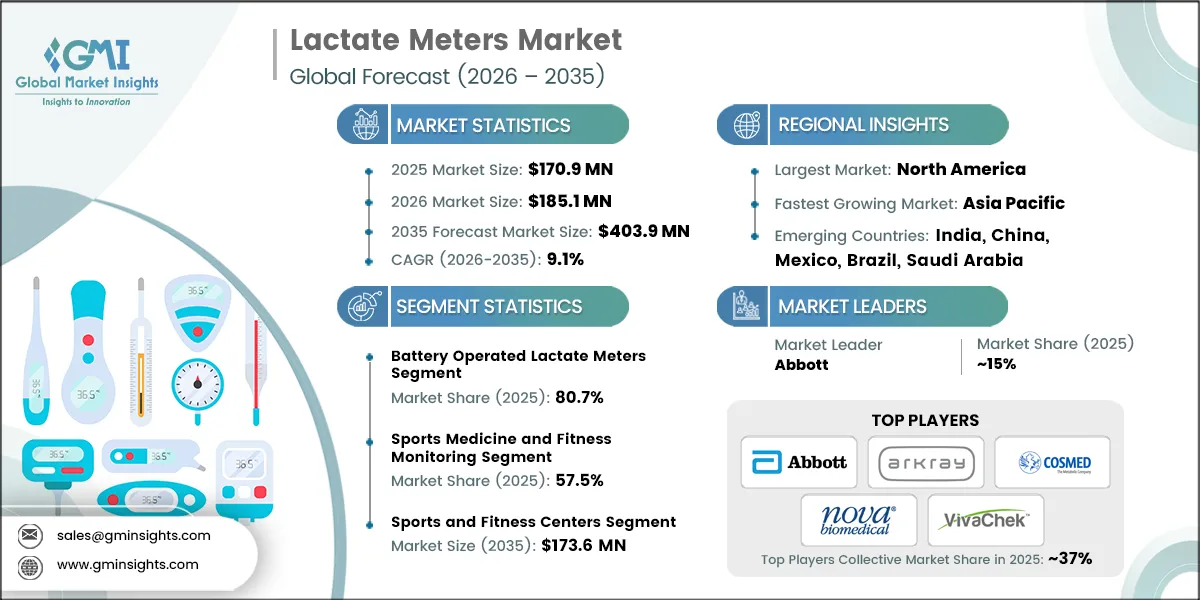
To get key market trends
Lactate Meters Market Trends
Wearable lactate monitors have revolutionized the way lactate levels are measured, providing real-time data, enhanced convenience, and improved user experience. These innovations are driving adoption across diverse sectors, including healthcare, sports, and fitness, contributing to the robust growth of the market.
- Wearable lactate monitoring devices provide continuous, real-time tracking of lactic acid levels, offering critical insights into metabolic status. This functionality is particularly beneficial in clinical settings for managing patients with chronic or acute conditions and in athletic performance optimization. The ability to monitor lactate trends dynamically is a key factor driving demand.
- Additionally, modern sports wearables are designed to be compact, lightweight, and comfortable, enabling users to wear them during prolonged activities or medical monitoring. These features make them highly appealing for both professional athletes and patients managing chronic conditions at home, significantly expanding the user base of lactate monitoring devices.
Lactate Meters Market Analysis

Learn more about the key segments shaping this market
Based on the product type, the market is segmented into battery operated lactate meters and chargeable lactate meters. The battery operated lactate meters segment has asserted its dominance in the market by securing a significant share of 80.7% in 2025, owing to their portability, ease of use, and widespread adoption in sports performance monitoring, clinical diagnostics, and point-of-care testing settings. The segment is expected to exceed USD 320.9 million by 2035, growing at a CAGR of 8.9% during the forecast period.
- Battery-operated lactate meters are compact and lightweight, allowing users to measure lactate levels conveniently in any setting. This portability is especially valued in sports environments, fieldwork, and home healthcare, where access to traditional laboratory equipment is not feasible. Their ease of use contributes to their dominance in the market.
- These devices deliver quick and precise lactate readings, making them indispensable for applications requiring immediate results, such as critical care monitoring and athletic performance assessments. Their accuracy and ability to provide instant feedback give them a significant advantage over other types of lactate monitoring systems.
- The chargeable lactate meters segment was valued at USD 33.1 million in 2025 and is expected to reach USD 83 million by 2035, driven by the increasing demand for cost-efficient and environmentally sustainable diagnostic devices. Growing adoption in sports training facilities, research laboratories, and clinical settings for continuous lactate monitoring is further supporting segment growth.
Based on the application, the lactate meters market is segmented into sports medicine and fitness monitoring, critical care monitoring, and other applications. The sports medicine and fitness monitoring segment dominated the market with a revenue share of 57.5% in 2025.
- Lactate monitoring is a crucial tool for athletes and fitness enthusiasts aiming to enhance performance. By measuring lactate levels during exercise, users can identify their anaerobic threshold, allowing them to tailor training programs that improve endurance and efficiency. This capability has made lactate monitoring devices indispensable in sports science, contributing to the segment's dominance.
- Incorporating lactate monitoring into fitness routines helps athletes understand recovery patterns and avoid overtraining, which can lead to fatigue or injury. The demand for real-time data on recovery and metabolic stress has surged, making lactate monitoring devices a preferred choice in rehabilitation and training programs.
- The critical care monitoring segment was valued at USD 59.9 million in 2025 and is expected to grow at a CAGR of 9.4% during the forecast period. The growth is driven by the increasing use of lactate testing in intensive care units to assess tissue hypoxia, sepsis progression, and patient metabolic status. Rising focus on rapid bedside diagnostics and improved patient monitoring in emergency and critical care settings is further supporting segment expansion.
- The other applications segment was valued at USD 12.8 million in 2025 and is expected to reach USD 22.2 million by 2035, driven by expanding use of lactate meters in sports science research, veterinary diagnostics, and academic laboratories. Increasing focus on performance monitoring and metabolic assessment across diverse clinical and non-clinical settings is further supporting steady segment growth.
Learn more about the key segments shaping this market
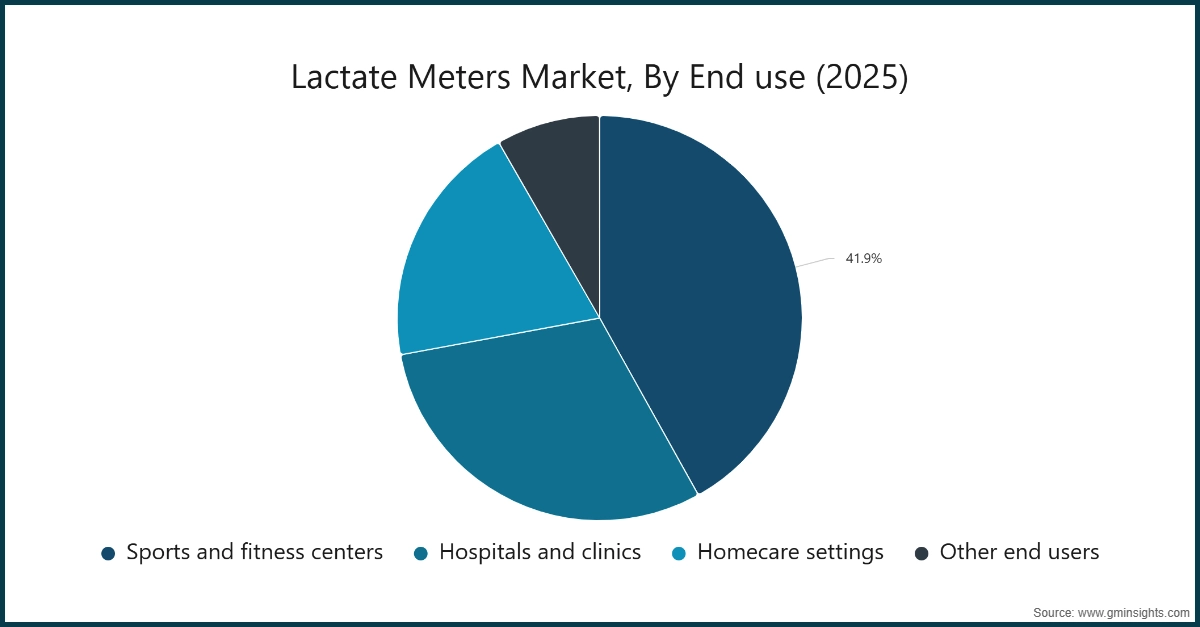
Based on end use, the lactate meters market is segmented into sports and fitness centers, hospitals and clinics, homecare settings, and other end users. The sports and fitness centers segment dominated the market in 2025 and is anticipated to reach USD 173.6 million by 2035.
- Sports and fitness centers are prioritizing the use of advanced tools, such as lactate meters, to offer personalized training regimens. By measuring lactic acid levels during workouts, trainers can optimize programs tailored to individual fitness goals, whether for endurance improvement, anaerobic threshold enhancement, or recovery optimization.
- The shift toward evidence-based and scientific approaches to fitness has significantly boosted the adoption of lactate meters in sports and fitness centers. These devices provide trainers and athletes with actionable data on metabolic performance, making them essential for structured and result-oriented training programs.
- The hospitals and clinics segment was valued at USD 51.7 million in 2025 and is expected to reach USD 118.5 million by 2035, driven by increasing adoption of lactate meters for rapid bedside testing in emergency and critical care settings. The growing prevalence of sepsis, trauma, and other metabolic conditions requiring timely lactate monitoring is further supporting segment growth.
- The homecare settings segment was valued at USD 33.4 million in 2025 and is expected to reach USD 83.5 million by 2035, driven by the increasing adoption of portable lactate meters for personal health monitoring and sports performance tracking. Growing preference for home-based diagnostics and advancements in user-friendly point-of-care devices are further supporting segment growth.
- The other end users segment was valued at USD 14.2 million in 2025 and is expected to reach USD 28.3 million by 2035, driven by increasing adoption of lactate meters in sports training centers, research institutes, and academic laboratories. Growing focus on performance optimization and metabolic assessment is further supporting steady segment growth.
Looking for region specific data?
North America Lactate Meters Market
North America dominated 40.5% share of lactate meters industry in 2025.
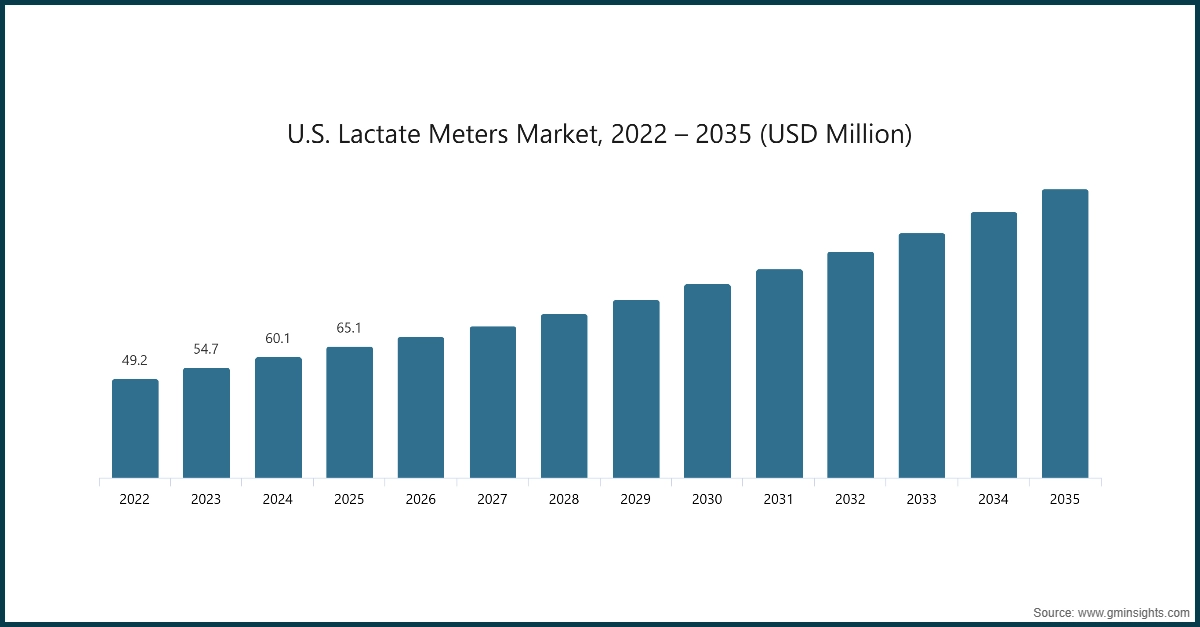
- The U.S. market was valued at USD 49.2 million and USD 54.7 million in 2022 and 2023, respectively. The market size reached USD 65.1 million in 2025, growing from USD 60.1 million in 2024, and is anticipated to grow at a CAGR of 8.3% from 2026 to 2035.
- The country's strong presence of key market players and well-established distribution channels ensures the widespread availability of advanced lactate monitoring solutions.
- In addition to clinical applications, the growing fitness culture in the U.S., characterized by a surge in fitness centers, sports teams, and individual athletes, drives the demand for portable and wearable lactate monitors.
- The U.S. also benefits from favorable reimbursement policies and increasing awareness of the role of lactate monitoring in managing chronic and critical conditions, further consolidating its market leadership.
Europe Lactate Meters Market
Europe market accounted for USD 47.6 million in 2025 and is anticipated to show lucrative growth over the forecast period.
- Europe accounted for a significant share of the lactate meters market, supported by the strong presence of advanced healthcare infrastructure and high adoption of point-of-care diagnostic technologies. Hospitals and critical care units across countries such as Germany, the U.K., and France widely utilize lactate monitoring for early detection of sepsis, tissue hypoxia, and metabolic disorders, which is driving steady demand for lactate meters.
- Additionally, the region’s well-developed sports ecosystem and growing emphasis on athletic performance monitoring are further contributing to market growth. Increasing investments in sports science research, along with rising awareness of lactate testing for endurance training and recovery assessment, continue to strengthen the adoption of lactate meters across clinical and sports applications.
Asia Pacific Lactate Meters Market
The Asia Pacific market is anticipated to grow at the highest CAGR of 10.3% during the analysis timeframe.
- Asia Pacific held a considerable share of the lactate meters market and is expected to witness the fastest growth over the forecast period. Rapid expansion of healthcare infrastructure, increasing healthcare expenditure, and rising awareness regarding early diagnosis of metabolic and critical care conditions are key factors supporting regional market expansion.
- Moreover, growing participation in professional sports and fitness activities across countries such as China, Japan, Australia, and India is increasing the use of lactate meters for performance monitoring and training optimization. The rising adoption of portable diagnostic devices and expanding access to point-of-care testing solutions are further driving growth in the region.
Latin America Lactate Meters Market
The Latin America market accounted for USD 8.8 million in 2025 and is anticipated to show lucrative growth over the forecast period.
- Latin America captured a moderate share of the lactate meters market, supported by improving healthcare infrastructure and growing awareness regarding early detection of critical conditions such as sepsis and trauma. Countries such as Brazil and Mexico are witnessing increasing investments in hospital modernization and diagnostic equipment, which is supporting the adoption of lactate monitoring devices.
- Additionally, the region’s growing sports culture and increasing focus on athletic performance monitoring are contributing to the rising demand for portable lactate meters. Expanding private healthcare facilities and the gradual adoption of point-of-care testing technologies are expected to support steady market growth across the region.
Middle East and Africa Lactate Meters Market
The Middle East and Africa market accounted for USD 5.3 million in 2025 and is anticipated to show lucrative growth over the forecast period.
- The Middle East & Africa region accounted for a smaller but steadily growing share of the lactate meters market. Increasing healthcare infrastructure development, particularly in GCC countries such as Saudi Arabia and the UAE, is driving demand for advanced diagnostic and monitoring technologies in hospitals and critical care settings.
- Furthermore, the rising prevalence of critical illnesses, growing investments in healthcare modernization, and increasing focus on emergency and trauma care are supporting the adoption of lactate monitoring systems. Gradual improvements in diagnostic capabilities and expanding access to point-of-care testing solutions are expected to contribute to sustained regional market growth.
Lactate Meters Market Share
Leading companies, including Abbott, arkray, COSMED, nova biomedical, and VivaChek, collectively accounted for approximately 37% of the global market share in 2025. Companies are investing heavily in R&D to develop advanced lactate meters with enhanced features such as advancements in miniaturization and portability, integration with smart technology, and growth of digital health ecosystems. Additionally, partnerships with healthcare providers are being forged to improve product accessibility in emerging markets. Regulatory compliance and adherence to international quality standards are crucial aspects of the strategies employed by these companies to cater to a global market. These developments are helping companies meet the increasing demand for safe and efficient lactate meters.
Lactate Meters Market Companies
A few of the prominent players operating in the lactate meters industry include:
- Abbott
- arkray
- B-ARM
- COSMED
- EFK
- nova biomedical
- pkvitality
- SENSA CORE
- TECOM
- VivaChek
- Abbott
Abbott holds a strong competitive position in the lactate meters market through its i‑STAT handheld point‑of‑care (POC) testing platform, which delivers rapid, lab‑quality lactate results directly at the bedside, enabling faster clinical decision‑making in emergency, critical care, and hospital settings. Its longstanding expertise in POC diagnostics, extensive test‑menu integration, and proven reliability across diverse clinical scenarios give Abbott a significant advantage in high‑acuity environments.
COSMED differentiates itself with its Lactate Pro 2 analyzer, a portable, ultra‑fast, and high‑precision lactate testing device widely used in sports science and performance monitoring. The device delivers results in as little as 15 seconds from a 0.3 µL blood sample, offering lab‑grade accuracy in a compact form factor, making it exceptionally valuable for coaches, sport physiologists, and high‑performance training environments. Its ease of use and proven reliability have positioned COSMED as a trusted brand in elite athletic testing.
VivaChek secures a strong competitive edge in the lactate meters market through its high‑precision, athlete‑centric Lactate Analyzer, engineered specifically for performance optimization and real‑time training assessment. The device delivers accurate lactate measurements in just 10 seconds, requiring only a 0.5 μL blood sample, which significantly reduces discomfort and enables frequent testing during high‑intensity sessions. With its compact, lightweight design and powerful performance consistency, VivaChek positions itself as a preferred choice for athletes, sports institutions, and performance coaches seeking portable, lab‑grade lactate insights on the field.
Lactate Meters Market Report Attributes
| Key Takeaway | Details |
|---|---|
| Market Size & Growth | |
| Base Year | 2025 |
| Market Size in 2025 | USD 170.9 Million |
| Market Size in 2026 | USD 185.1 Million |
| Forecast Period 2026-2035 CAGR | 9.1% |
| Market Size in 2035 | USD 403.9 Million |
| Key Market Trends | |
| Drivers | Impact |
| Rising prevalence of chronic and critical conditions | Drives higher adoption of lactate meters as hospitals use lactate levels for early detection and management of severe conditions. |
| Advancements in wearable technology | Boosts market growth by enabling continuous, real‑time lactate monitoring through portable and user‑friendly devices. |
| Increased focus on athletic performance monitoring | Expands demand as athletes rely on lactate testing to optimize training intensity and recovery. |
| Pitfalls & Challenges | Impact |
| Lack of awareness about lactate monitoring | Limits market penetration as many potential users remain unfamiliar with the diagnostic value of lactate testing. |
| Opportunities: | Impact |
| Lack of awareness about lactate monitoring | Limits market penetration as many potential users remain unfamiliar with the diagnostic value of lactate testing. |
| Market Leaders (2025) | |
| Market Leader |
Market share ~15% |
| Top Players |
Collective market share ~37% |
| Competitive Edge |
|
| Regional Insights | |
| Largest Market | North America |
| Fastest growing market | Asia Pacific |
| Emerging countries | India, China, Mexico, Brazil, Saudi Arabia |
| Future outlook |
|
What are the growth opportunities in this market?
Lactate Meters Industry News
- In August 2024, EKF Diagnostics launched the Biosen C-Line, an advanced version of its rapid benchtop glucose and lactate analyzer. This new device is designed to enhance usability with a modern color touch screen and advanced connectivity options, allowing seamless integration with hospital and laboratory IT systems via EKF Link.
The lactate meters market research report includes an in-depth coverage of the industry with estimates and forecasts in terms of revenue in USD Million from 2022 – 2035 for the following segments:
Market, By Product Type
- Battery operated lactate meters
- Chargeable lactate meters
Market, By Application
- Sports medicine and fitness monitoring
- Critical care monitoring
- Other applications
Market, By End Use
- Sports and fitness centers
- Hospitals and clinics
- Homecare settings
- Other end users
The above information is provided for the following regions and countries:
- North America
- U.S.
- Canada
- Europe
- Germany
- UK
- France
- Spain
- Italy
- Netherlands
- Asia Pacific
- China
- Japan
- India
- Australia
- South Korea
- Latin America
- Brazil
- Mexico
- Argentina
- Middle East and Africa
- South Africa
- Saudi Arabia
- UAE
Frequently Asked Question(FAQ) :
What is the market size of the lactate meters in 2025?
The market size was valued at USD 170.9 million in 2025, with a CAGR of 9.1% expected through 2035 supported by rising prevalence of chronic and critical conditions and increased focus on athletic performance monitoring.
What is the projected value of the lactate meters industry by 2035?
The lactate meters market is expected to reach USD 403.9 million by 2035, driven by advancements in wearable technology, digital health ecosystems, and growing demand across clinical and sports applications.
What is the current lactate meters industry size in 2026?
The market size is projected to reach USD 185.1 million in 2026.
How much revenue did the battery operated lactate meters segment generate in 2025?
Battery operated lactate meters dominated the market with an 80.7% share in 2025, owing to their portability, ease of use, and widespread adoption in sports performance monitoring.
What was the valuation of the sports medicine and fitness monitoring segment in 2025?
The sports medicine and fitness monitoring segment dominated with a revenue share of 57.5% in 2025, driven by growing reliance on lactate testing to identify anaerobic thresholds and optimize training programs.
What is the growth outlook for the critical care monitoring segment from 2026 to 2035?
The critical care monitoring segment was valued at USD 59.9 million in 2025, is projected to grow at a CAGR of 9.4% till 2035, driven by increasing use of lactate testing in ICUs to assess tissue hypoxia and sepsis progression.
Which region leads the lactate meters market?
North America dominated the lactate meters market with a 40.5% share in 2025. The U.S. market reached USD 65.1 million in 2025, supported by strong market players, favorable reimbursement policies, and a growing fitness culture.
What are the upcoming trends in the lactate meters market?
Key trends include the rapid adoption of wearable lactate monitoring devices for real-time tracking, integration with AI-powered analytics and digital health ecosystems.
Who are the key players in the lactate meters market?
Key players include Abbott, arkray, B-ARM, COSMED, EFK, nova biomedical, pkvitality, SENSA CORE, TECOM, and VivaChek.
Lactate Meters Market Scope
Related Reports