Summary
Table of Content

Kids Tricycle Market
Get a free sample of this report
Form submitted successfully!
Error submitting form. Please try again.
Thank you!
Your inquiry has been received. Our team will reach out to you with the required details via email. To ensure that you don't miss their response, kindly remember to check your spam folder as well!
Request Sectional Data
Thank you!
Your inquiry has been received. Our team will reach out to you with the required details via email. To ensure that you don't miss their response, kindly remember to check your spam folder as well!
Form submitted successfully!
Error submitting form. Please try again.
Kids Tricycle Market Size
- The increasing disposable income levels and the increasing number of premium purchases of children's products is contributing to the growth of the tricycle market for children. More parents feel that the recreational products they purchase for their children should be high quality and safe. Having higher annual incomes gives parents the ability to invest in a durable and feature-rich tricycle. Purchasing premium tricycles generally causes consumers to choose branded tricycles due to the additional safety and design features offered. Many consumers prefer a tricycle that has ergonomic seating, adjustable parts, and bright colors.
- Higher disposable income also allows consumers to purchase innovative and multifunctional riding toys. Parents typically look at high-quality tricycles as providing their children with the ability to develop their balance and motor skills. Retailers have responded to this trend by expanding their product offerings to include more advanced and customizable tricycle options. Wealthy families can also afford to buy multiple types of recreational products for their children to use for leisure. Increased willingness to spend money has led to many households adopting technologically advanced and themed tricycles. Market demand will continue to increase as the focus on child safety, quality, and enjoyment continues to grow.
- Urbanization growth and a rising trend toward safe outdoor play are increasing the kids' tricycle market. Urban families are facing limited options when it comes to outdoor space, causing consumers to prefer compact and safe riding toys. Tricycles can assist with controlled mobility options for children in confined residential environments and yard areas. Parents are generally concerned with purchasing products that offer safety features. Additionally, parents are increasingly aware of accident prevention and search for certified and kid-friendly products. Further investment by urban communities in outdoor recreational space is complementary to children's opportunities for active play.
- As a result, many tricycles represent a good solution for supervised outdoor activities and will encourage children's physical and mental growth. As urban development leads to increased numbers of families living at higher density in more central areas, tricycles will continue to provide a versatile and portable means of transportation for children. As more retailers focus on expanding their product selection of safe and ergonomic designed tricycles, the strength of safe outdoor play environments will continue to contribute to the overall growth of the kids tricycle market segments across urban centers globally.
- The traditional/classical tricycle plays a major role in the kids tricycle market due to its timeless image. Durable metal construction, with basic pedal mechanisms, make these products safe and provide longevity for young riders. Parents buy the traditional/classical tricycle for its dependability and ease of use. The price point of these tricycles allows them to be purchased by most families that fall within the middle-income range.
- The bright colour choices and overall appearance attract toddlers, preschoolers and older children. Due to the minimum amount of maintenance required, traditional/classical tricycles can be used well in adulthood. The availability of traditional/classical tricycles in toy stores and specialty retailers helps support a continually increasing market for traditional/classical tricycles around the world.
The kids tricycle market was estimated at USD 4.8 billion in 2025. The market is expected to grow from USD 4.9 billion in 2026 to USD 7.5 billion in 2035, at a CAGR of 4.2%, according to latest report published by Global Market Insights Inc.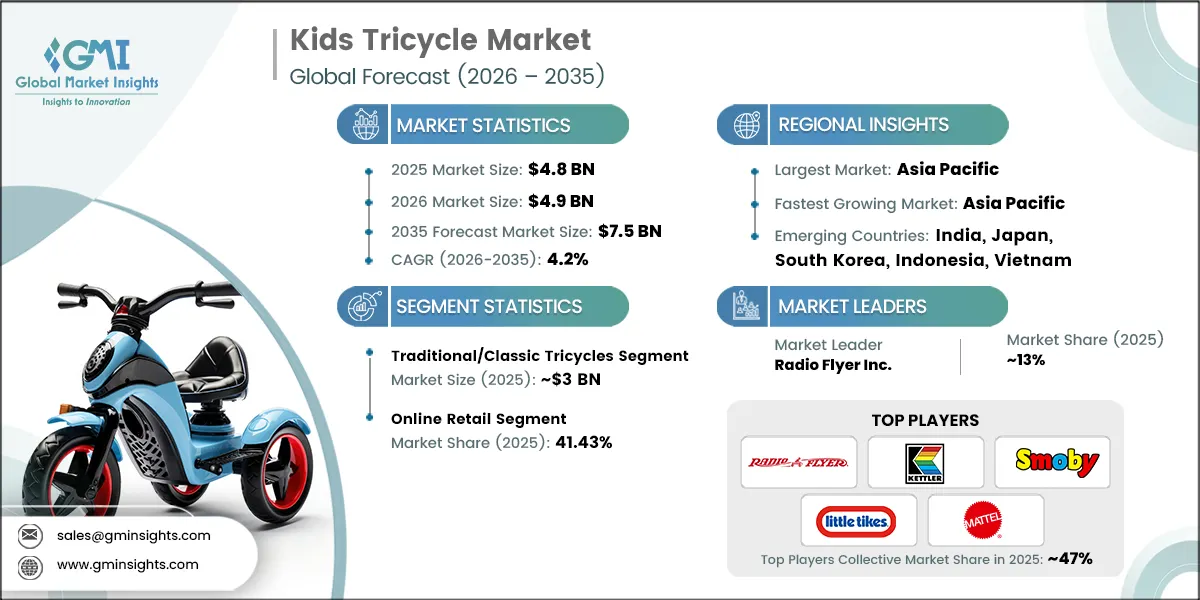
Kids Tricycle Market Key Takeaways
Market Size & Growth
- 2025 Market Size: USD 4.8 Billion
- 2026 Market Size: USD 4.9 Billion
- 2035 Forecast Market Size: USD 7.5 Billion
- CAGR (2026–2035): 4.2%
Regional Dominance
- Largest Market: Asia Pacific
- Fastest Growing Region: Asia Pacific
Key Market Drivers
- Rising focus on early childhood development and motor skills.
- Increasing urbanization and demand for safe outdoor play equipment.
- Growing disposable income and premium spending on kids’ products.
Challenges
- Safety and quality compliance concerns.
- Intense competition from low cost unbranded products.
Opportunity
- Integration of smart features and interactive elements.
- Eco friendly and sustainable material designs.
Key Players
- Market Leader: Radio Flyer Inc. led with over 13% market share in 2025.
- Leading Players: Top 5 players in this market include Radio Flyer Inc., Little Tikes, Mattel Inc., Smoby Toys, Kettler, which collectively held a market share of 47% in 2025.
Get Market Insights & Growth Opportunities
To get key market trends
Kids Tricycle Market Trends
- There is a growing trend among parents to purchase child tricycles that provide greater levels of safety and stability. For example, manufacturers now produce tricycles with broader bases, non-slip pedals and secure harness systems to help keep children safe while using the tricycle. By incorporating these features into their designs, manufacturers help children develop riding skills without sustaining injuries or falling off the tricycle during the early stages of use. The additional attention to detail helps parents feel confident in their purchases, which translates into more sales.
- As children outgrow each stage of riding, there is a growing demand for adjustable and convertible tricycles that will grow with the child’s needs. Parents are increasingly seeking out models that allow them to transition from parent‑controlled push trikes to full-independence pedaling as their child develops new skills. The ability to adjust the seat, handlebars, and the ability to remove the push handle allows parents to have a longer lasting use of these products.
- The evolution of tricycles for kids includes adding an interactive component such as music, lights, or a storage/carrying basket. These types of features help to create a more engaging play experience and encourage the child to ride longer outdoors. The vivid color selection and playful styles are very attractive to young children.
- Access to a large variety of kids tricycle models and brands through online marketplaces is easing access for families to compare the features, price points, and reviews of products to make an informed purchasing decision. Many e‑commerce platforms provide home delivery and no hassle returns which are helpful for busy parents, thus further expanding the overall geographic reach and accelerating the sales growth of kids tricycles across geographic regions through the digital retail expansion.
- There is also greater value placed on activities that provide an opportunity for outdoor play and contribute to children’s physical development and ability to coordinate. Riding a tricycle contributes to developing balance, motor skills, and confidence during the early childhood years, therefore caregivers are more inclined to spend money on products that will help their children have fun while gaining developmental benefits.
Kids Tricycle Market Analysis
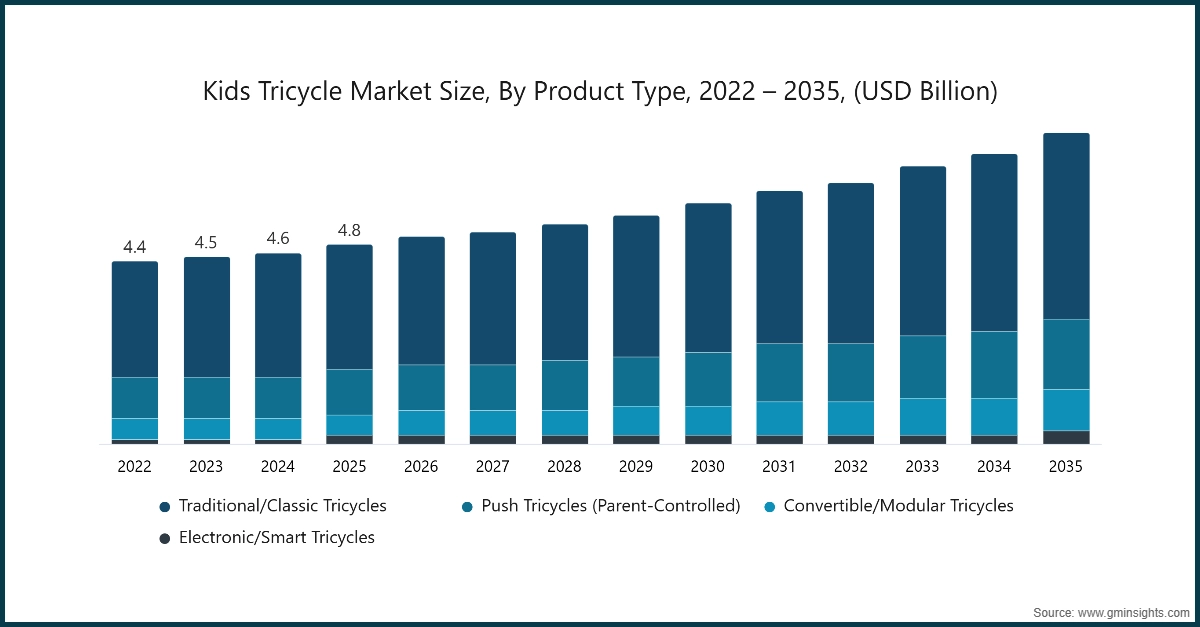
Learn more about the key segments shaping this market
Based on product type, the kids tricycle market is categorized into traditional/classic tricycles, push tricycles, convertible/modular tricycles, and electronic/smart tricycles. The traditional/classic tricycles segment accounted for revenue of around USD 3 billion in 2025 and is anticipated to grow at a CAGR of 3.7% from 2026 to 2035.
- Traditional or classic tricycles dominate the kids tricycle market due to durable construction and simple design. Sturdy frames and stable three-wheel structure ensure safety for toddlers and preschoolers. Parents prefer these models for reliability and long-term usability. Affordable pricing supports widespread adoption across middle-income households.
- Easy pedal operation helps children develop coordination and balance skills. Wide availability in toy stores and specialty outlets strengthens sales volumes. Consistent consumer trust reinforces the leading position of traditional tricycles globally.
Based on price range, of kids tricycle market consists of economy (<$50), mid-range ($50-$150), and premium (>$150). The mid-range ($50-$150) emerged as leader and held 44.31%of the total market share in 2025 and is anticipated to grow at a CAGR of 4.4% from 2026 to 2035.
- The mid-range price segment leads the kids tricycle market due to balanced affordability and quality. Parents seek durable products that offer safety without premium pricing. Mid-range models often include improved seat comfort and sturdy frame construction. Attractive designs and added features enhance value perception among buyers.
- Retail promotions and seasonal discounts further increase accessibility within this range. Broad product availability across online and offline channels supports strong sales performance. Consistent demand from middle-income households reinforces segment leadership.
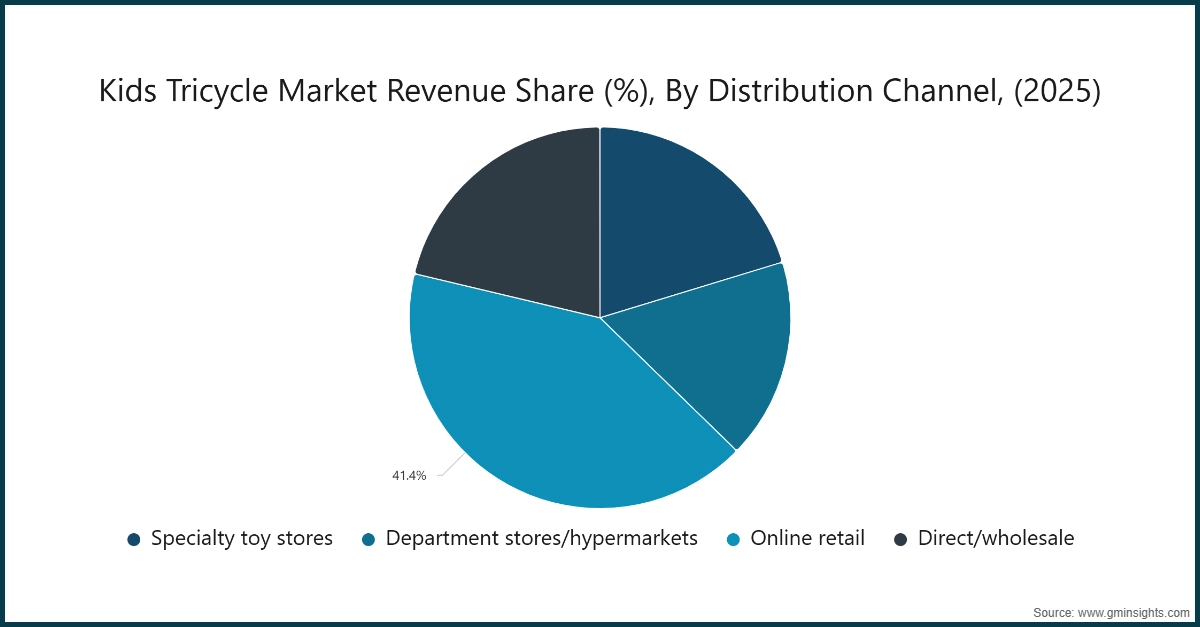
Learn more about the key segments shaping this market
Based on distribution channel, kids tricycle market consists of specialty toy stores, department stores/hypermarkets, online retail, and direct/wholesale. The online retail emerged as leader and held 41.43% of the total market share in 2025 and is anticipated to grow at a CAGR of 5.6% from 2026 to 2035.
- Online retail emerged as the leading distribution channel in the kids tricycle market due to growing digital shopping adoption. Parents prefer online platforms for convenient comparison of features and prices. Detailed product descriptions and customer reviews improve purchase confidence. Competitive discounts and bundled offers enhance value perception.
- Home delivery services reduce the need for store visits. Wider product assortment supports access to multiple brands and designs. Increasing smartphone penetration strengthens online retail dominance across urban and semi-urban regions.
Asia Pacific Kids Tricycle Market
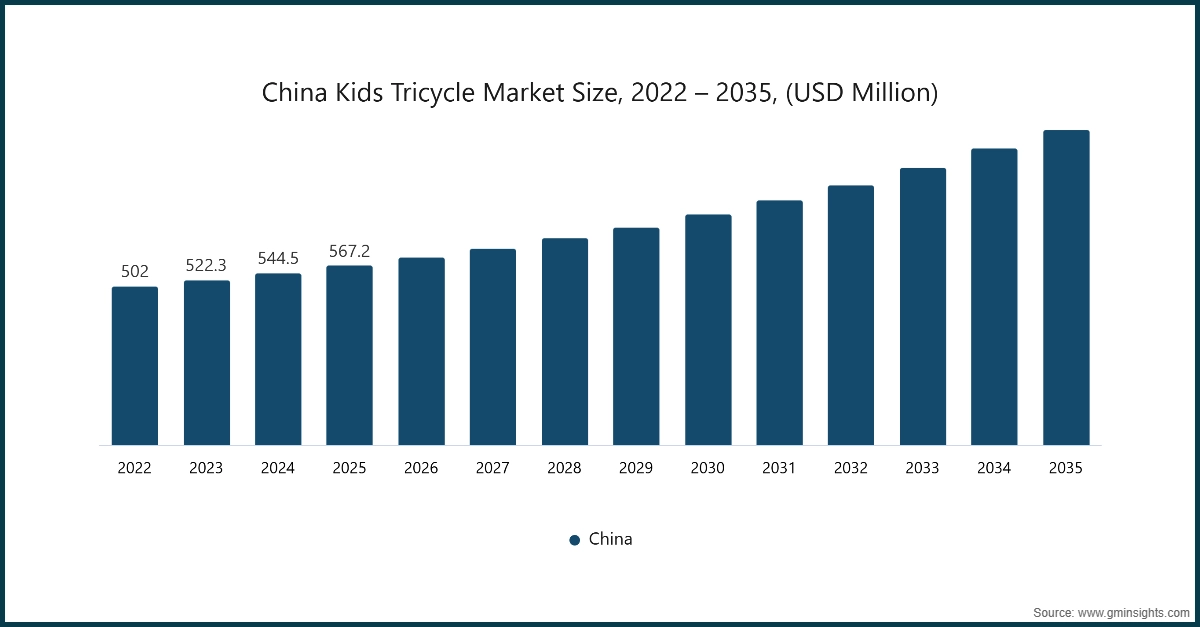 Looking for region specific data?
Looking for region specific data?
China dominates an overall Asia Pacific kids tricycle market and valued at USD 0.6 billion in 2025 and is estimated to grow at a CAGR of 6% from 2026 to 2035.
- The China kids tricycle industry benefits from strong domestic manufacturing capabilities. Rising disposable income supports demand for premium and feature-rich tricycles. Urban parents prioritize safety features and durable construction materials. Online marketplaces accelerate nationwide product distribution and brand visibility.
- Demand for multifunctional tricycles with adjustable designs continues to rise. Government focus on child welfare encourages compliance with safety regulations. Competitive pricing intensifies market competition among local brands. Continuous product innovation sustains replacement purchases across urban households.
North America Kids Tricycle Market
In the North America kids tricycle industry , the U.S. held 82.57% market share in 2025 and is anticipated to grow at a CAGR of 4.6% from 2026 to 2035.
- The North America kids tricycle industry is driven by strong spending on early childhood products. Parents prioritize safety-certified designs with stable frames and secure harness systems. Suburban housing patterns support outdoor play equipment demand. Established toy retailers ensure consistent product availability across states.
- Seasonal promotions during holidays significantly influence purchase cycles. Preference for branded and durable products shapes consumer choices. Rising interest in eco-friendly materials encourages wooden tricycle adoption. High product replacement rates support steady market performance.
Europe Kids Tricycle Market
In the Europe kids tricycle industry, Germany is expected to experience significant and promising growth from 2026 to 2035.
- The Europe kids tricycle market benefits from emphasis on child mobility and outdoor activity. Compact urban living encourages demand for lightweight and foldable designs. Strict safety standards influence product manufacturing and certification compliance. Parents prefer ergonomically designed tricycles supporting developmental needs.
- Sustainable manufacturing practices drive demand for recyclable materials. Specialty toy stores maintain strong presence across major cities. Premium product segments perform well in Western European markets. Cultural focus on early physical activity sustains consistent demand.
Middle East and Africa Kids Tricycle Market
In the Middle East and Africa kids tricycle industry, UAE held a significant market share in 2025 promising growth from 2026 to 2035.
- The Middle East and Africa kids tricycle industry grows through rising urbanization and retail expansion. Young population demographics increase demand for children’s recreational products. Import-driven supply provides a wide range of affordable models. Shopping malls serve as key distribution channels in Gulf countries.
- Price sensitivity shapes purchasing behavior in developing African markets. Demand for durable products remains high in warm climatic conditions. Growth of organized retail improves product accessibility in urban centers. Expanding middle-income households support gradual market expansion.
Kids Tricycle Market Share
- In 2025, the prominent manufacturers in kids tricycle industry are Radio Flyer Inc., Little Tikes, Mattel Inc., Smoby Toys, and Kettler collectively held the market share of ~47%.
- Radio Flyer Inc. is a leading global manufacturer of kids’ ride-on toys, especially tricycles and wagons. The company emphasizes durable construction, safety features, and innovative designs. Radio Flyer combines traditional charm with modern ergonomic engineering to appeal to both children and parents. Its strong brand heritage, retail presence, and e-commerce accessibility help maintain leadership in the tricycle segment worldwide.
- Little Tikes specializes in durable, colorful, and safe ride-on toys for toddlers, including tricycles. The company focuses on ergonomic design, easy-to-use features, and outdoor activity promotion. Little Tikes leverages brand trust, licensing partnerships, and global distribution networks. Its emphasis on safety certification and long-lasting materials strengthens its position in the competitive preschool ride-on market.
Kids Tricycle Market Companies
Major players operating in the kids tricycle industry include:
- Alpha Group
- Coby Haus
- Dorel Industries
- Globber
- Goodbaby International Holdings Ltd.
- Guangdong Lopal Tech Co., Ltd.
- Kettler
- Little Tikes
- Mattel Inc.
- People Co., Ltd.
- Radio Flyer Inc.
- Smoby Toys
- TOMY Company Ltd.
- Toyshine
- Zhongshan Baobaohao Industrial Co., Ltd.
Mattel Inc. participates in the kids’ tricycle market through its branded ride-on products, including character-themed designs. The company integrates licensed properties and fun features to appeal to children. Mattel emphasizes safety, durability, and global retail reach. Its strong brand equity and marketing expertise support growth in both North American and international tricycle segments.
Smoby Toys is a European manufacturer of plastic ride-on toys, including tricycles, scooters, and small bikes. The company focuses on safety, child-friendly ergonomics, and innovative outdoor play features. Smoby leverages regional distribution networks, licensing partnerships, and brand recognition in European markets. Its commitment to quality and compliance with European toy safety standards strengthens its competitive positioning.
Kettler manufactures premium tricycles and ride-on toys, emphasizing durable materials, ergonomic design, and engineering quality. The company targets higher-end consumers and safety-conscious parents. Kettler focuses on outdoor activity promotion, innovative frame designs, and long-lasting products. Its strong reputation in Europe and selective international presence supports steady adoption among families seeking quality ride-on toys.
Kids Tricycle Market Report Attributes
| Key Takeaway | Details |
|---|---|
| Market Size & Growth | |
| Base Year | 2025 |
| Market Size in 2025 | USD 4.8 Billion |
| Market Size in 2026 | USD 4.9 Billion |
| Forecast Period 2026-2035 CAGR | 4.2% |
| Market Size in 2035 | USD 7.5 Billion |
| Key Market Trends | |
| Drivers | Impact |
| Rising focus on early childhood development and motor skills | Parents increasingly seek tricycles to support balance, coordination, and physical activity in early years, boosting product demand. |
| Increasing urbanization and demand for safe outdoor play equipment | As urban communities prioritize safe play areas and outdoor activity, demand for tricycles as recreational transport rises. |
| Growing disposable income and premium spending on kids’ products | Higher household income levels enable families to purchase quality and feature rich tricycles, expanding market revenue. |
| Pitfalls & Challenges | Impact |
| Safety and quality compliance concerns | Failure to meet safety standards leads to recalls or consumer hesitation, increasing costs and slowing product adoption. |
| Intense competition from low cost unbranded products | Cheaper, lower quality tricycles can undercut branded offerings, pressuring prices and brand loyalty. |
| Opportunities: | Impact |
| Integration of smart features and interactive elements | Tricycles with lights, music, or app connected tracking can attract tech savvy parents and differentiate products. |
| Eco friendly and sustainable material designs | Growing demand for non toxic, recyclable, or eco friendly children’s products opens a premium niche for sustainable tricycles. |
| Market Leaders (2025) | |
| Market Leader |
Market share of ~13% |
| Top Players |
Collective market share of ~47% |
| Competitive Edge |
|
| Regional Insights | |
| Largest Market | Asia Pacific |
| Fastest Growing Market | Asia Pacific |
| Emerging Countries | India, Japan, South Korea, Indonesia, Vietnam |
| Future Outlook |
|
What are the growth opportunities in this market?
Kids Tricycle Machine Industry News
- In August 2025, Mattel expanded the Fisher-Price Ride-On range with the Fisher-Price Wild Wheels Trike, designed with extra-wide wheels and interactive play features. The launch aimed at the preschool segment across North America and Europe.
- In June 2025, Kettler released its Kettcar Classic Trike with updated frame geometry and pedestrian-friendly design, optimized for toddler comfort and maneuverability.
- In May 2025, Little Tikes introduced the Grow-With-Me Trike, a multi-stage tricycle that transitions from push-trike to pedal tricycle. The announcement highlighted enhanced comfort seating and easy-to-use steering for toddlers and preschoolers.
- In March 2025, Radio Flyer announced the launch of its All-Terrain 4-in-1 Tricycle featuring an adjustable design that converts as children grow. The new model includes rugged tires, a removable push/pull handle, and a safety harness system.
The kids tricycle market research report includes in-depth coverage of the industry, with estimates & forecast in terms of revenue (USD Billion) and volume (Thousand Units) from 2022 to 2035, for the following segments:
Market, By Product Type
- Traditional/Classic Tricycles
- Push Tricycles (Parent-Controlled)
- Convertible/Modular Tricycles
- Electronic/Smart Tricycles
Market, By Age Group
- 3-5 yrs
- 5-8 yrs
- 8-12 yrs
Market, By Price Range
- Economy (<$50)
- Mid-Range ($50-$150)
- Premium (>$150)
Market, By Distribution Channel
- Specialty toy stores
- Department stores/hypermarkets
- Online retail
- Direct/wholesale
The above information is provided for the following regions and countries:
- North America
- U.S.
- Canada
- Europe
- Germany
- UK
- France
- Italy
- Spain
- Asia Pacific
- China
- Japan
- India
- South Korea
- Australia
- Latin America
- Brazil
- Mexico
- Argentina
- MEA
- Saudi Arabia
- UAE
- South Africa
Frequently Asked Question(FAQ) :
What was the market size of the kids tricycle in 2025?
The market size was USD 4.8 billion in 2025, with a CAGR of 4.2% expected through 2035. Rising disposable incomes and increased demand for premium children's products are driving market growth.
What is the projected value of the kids tricycle market by 2035?
The market is poised to reach USD 7.5 billion by 2035, driven by the growing focus on child safety, quality, and innovative product features.
What is the expected size of the kids tricycle industry in 2026?
The market size is projected to reach USD 4.9 billion in 2026.
How much revenue did the traditional/classic tricycles segment generate in 2025?
The traditional/classic tricycles segment generated approximately USD 3 billion in 2025 and is anticipated to grow at a CAGR of 3.7% from 2026 to 2035.
What was the market share of the mid-range tricycles segment in 2025?
The mid-range tricycles segment, priced between $50-$150, held 44.31% of the total market share in 2025 and is set to expand at a CAGR of 4.4% till 2035.
What was the valuation of the online retail segment in 2025?
The online retail segment accounted for 41.43% of the total market share in 2025 and is projected to observe around 5.6% CAGR up to 2035.
Which region leads the kids tricycle sector?
China dominates the Asia Pacific market, valued at USD 0.6 billion in 2025, and is estimated to grow at a CAGR of 6% through 2035.
What are the upcoming trends in the kids tricycle market?
Trends include rising demand for enhanced safety features, adjustable and convertible designs, interactive elements, and growing online retail availability.
Who are the key players in the kids tricycle industry?
Key players include Alpha Group, Coby Haus, Dorel Industries, Globber, Goodbaby International Holdings Ltd., Guangdong Lopal Tech Co., Ltd., Kettler, Little Tikes, Mattel Inc., and People Co., Ltd.
Kids Tricycle Market Scope
Related Reports