Summary
Table of Content

Isolation Tank Market
Get a free sample of this report
Form submitted successfully!
Error submitting form. Please try again.
Thank you!
Your inquiry has been received. Our team will reach out to you with the required details via email. To ensure that you don't miss their response, kindly remember to check your spam folder as well!
Request Sectional Data
Thank you!
Your inquiry has been received. Our team will reach out to you with the required details via email. To ensure that you don't miss their response, kindly remember to check your spam folder as well!
Form submitted successfully!
Error submitting form. Please try again.
Isolation Tank Market Size
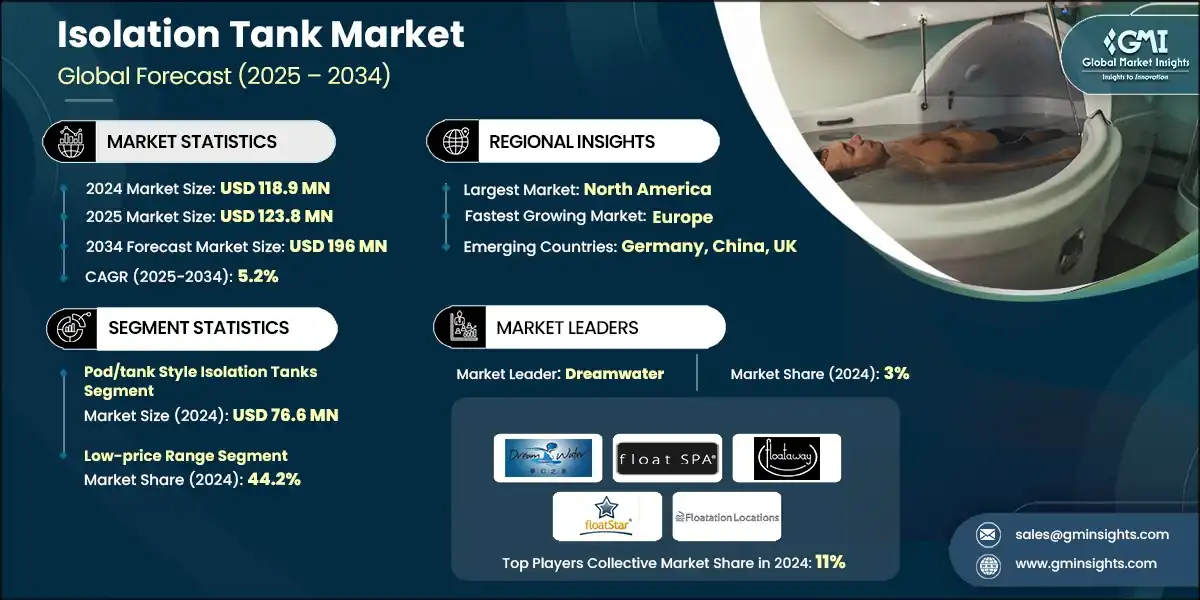
The global isolation tank market size was estimated at USD 118.9 million in 2024. The market is expected to grow from USD 123.8 million in 2025 to USD 196 million in 2034, at a CAGR of 5.2%, according to latest report published by Global Market Insights Inc.
Isolation Tank Market Key Takeaways
Market Size & Growth
- 2024 Market Size: USD 118.9 Million
- 2025 Market Size: USD 123.8 Million
- 2034 Forecast Market Size: USD 196 Million
- CAGR (2025–2034): 5.2%
Regional Dominance
- Largest Market: North America
- Fastest Growing Region: Europe
Key Market Drivers
- Rising demand for mental wellness & stress relief.
- Expansion of wellness tourism & luxury spa industry.
- Technological advancements.
Challenges
- High initial investment and maintenance costs.
- Limited awareness.
Opportunity
- Home wellness market expansion.
- Integration with digital platforms.
Key Players
- Market Leader: Dreamwater led with over 3% market share in 2024.
- Leading Players: Top 5 players in this market include Dreamwater, Float SPA, Floataway, FloatStar, High-Tech Floatation, which collectively held a market share of 11% in 2024.
Get Market Insights & Growth Opportunities
Isolation tanks, renowned for their ability to promote deep relaxation through sensory deprivation, are increasingly aligning with the growing wellness trend. The global focus on mental health and wellness has significantly driven the demand for activities that reduce stress and enhance relaxation. According to the Global Wellness Institute, the wellness economy is projected to grow at an annual rate of 9.9% through 2025, reflecting the increasing consumer interest in mental and physical well-being. This trend directly supports the rising adoption of isolation tanks.
The increasing awareness of mindfulness practices, meditation, and stress management techniques has significantly driven the demand for tools and environments that facilitate these activities. Isolation tanks, which provide a controlled and sensory-reduced environment, have emerged as a highly effective solution for promoting mindfulness, relaxation, and overall mental well-being. These tanks are designed to minimize external stimuli, creating an ideal setting for individuals seeking stress relief and mental clarity.
Research studies have consistently demonstrated the benefits of floatation therapy, which is facilitated by isolation tanks. For instance, a study published in the journal "BMC Complementary Medicine and Therapies" revealed that floatation therapy significantly reduced stress and anxiety levels, with 37% of participants reporting long-term improvements in mental health. Additionally, the American Float Tank Association (AFTA) reported that over 60% of floatation therapy users experienced enhanced sleep quality, while 45% noted a reduction in chronic pain symptoms. These findings underscore the growing recognition of floatation therapy as a valuable tool for mental and physical health management.
Additionally, the buoyancy of the water in isolation tanks, combined with the absence of external stimuli, has been shown to alleviate muscle tension and joint pain. This has made isolation tanks particularly appealing for individuals seeking pain recovery solutions. The increasing prevalence of chronic pain conditions, which the World Health Organization estimates affect approximately 20% of the global population, has further driven the adoption of floatation therapy as a complementary treatment option.
The establishment and expansion of floatation centers and spas offering isolation tank experiences have also contributed to market growth. These facilities have made the therapy more accessible to the public, with the number of floatation centers worldwide increasing by an estimated 15% annually. However, despite this growth, the industry faces several challenges. Establishing a floatation center requires significant upfront investment, including the purchase of isolation tanks, construction, and facility setup. The cost of a single isolation tank can range from USD 10,000 to USD 30,000, creating a financial barrier for new entrants.
Another challenge is the lack of widespread awareness and understanding of floatation therapy's benefits. Many potential users remain unaware of how isolation tanks can improve mental and physical health, necessitating industry efforts to educate the public. Despite these challenges, the market is poised for significant growth during the forecast period, driven by increasing consumer demand for wellness solutions and ongoing research into the benefits of floatation therapy. As the wellness industry continues to expand, isolation tanks are expected to play a pivotal role in addressing the growing need for stress relief, pain management, and overall mental well-being.
To get key market trends
Isolation Tank Market Trends
The Isolation tanks are increasingly integrating advanced smart features such as app-based controls, biometric sensors, and AI-driven session customization. These technological innovations significantly enhance user experience, safety, and personalization, aligning with the growing consumer demand for tech-enabled wellness solutions.
- The adoption of smart features is expected to attract tech-savvy consumers and wellness centers seeking data-driven solutions. By leveraging these advancements, floatation therapy will become more engaging, accessible, and appealing to a broader demographic, driving market expansion and fostering innovation in the sector.
- The post-pandemic era has brought about a significant shift in consumer behavior, with a notable rise in demand for home wellness equipment, including compact and portable isolation tanks. Consumers are increasingly investing in personal health infrastructure to reduce reliance on external facilities. This trend is anticipated to unlock a new consumer segment, encouraging manufacturers to design affordable, space-efficient models tailored for residential use. The residential market for isolation tanks is poised for substantial growth, driven by the rising preference for at-home wellness solutions and the increasing awareness of self-care practices.
- Scientific research continues to validate the therapeutic benefits of floatation therapy for conditions such as stress, anxiety, PTSD, and chronic pain. Studies published in journals like the BMC Complementary Medicine and Therapies have demonstrated that floatation therapy can reduce stress levels by up to 30% and improve sleep quality by 25%. Healthcare professionals are increasingly exploring its integration into holistic medicine, rehabilitation programs, and mental health treatments. As clinical credibility strengthens, isolation tanks are expected to transition from luxury wellness tools to recognized therapeutic devices. This shift will expand their adoption in hospitals, clinics, and mental health centers, creating new opportunities for manufacturers to cater to the healthcare sector.
- Additionally, it will create opportunities for strategic partnerships between manufacturers and hospitality brands, further enhancing the appeal of floatation therapy in the luxury wellness market. The integration of floatation therapy into wellness tourism is expected to contribute significantly to the sector's overall growth
- Consumers are increasingly prioritizing sustainability in their purchasing decisions, prompting isolation tank manufacturers to adopt eco-friendly materials, energy-efficient systems, and water-saving technologies. According to the International WELL Building Institute (IWBI), 78% of consumers are willing to pay a premium for sustainable products. Sustainable design will emerge as a key differentiator in the market, particularly among environmentally conscious buyers and businesses aiming to achieve green certification standards.
Isolation Tank Market Analysis
Learn more about the key segments shaping this market
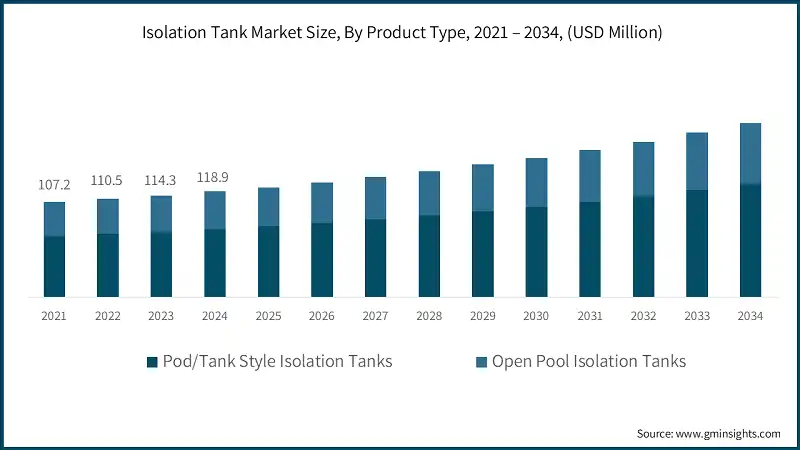
Based on product type, the market is segmented into pod/tank style isolation tanks and open pool isolation tanks. The pod/tank style isolation tanks segment held the major market share, generating a revenue of USD 76.6 million in 2024.
- Pod and tank-style isolation tanks are designed to provide users with a private and enclosed space, making them ideal for individuals seeking complete isolation during floatation sessions. Pod-style tanks often feature customizable settings, such as adjustable lighting and music, which enhance the user experience by offering a personalized and controlled environment. These features are particularly appealing to users who prioritize tailored floatation experiences, contributing to the growing adoption of pod-style tanks in wellness centers and spas. Additionally, the International Spa Association (ISPA) highlights that over 70% of spa-goers prefer customizable wellness treatments, further supporting the demand for pod-style isolation tanks.
- In contrast, Open pool tanks are also gaining popularity in commercial floatation centers and spas due to their ability to accommodate multiple clients efficiently. This operational advantage enables businesses to maximize the number of sessions offered, thereby increasing revenue potential. Industry data indicates that open pool tanks account for approximately 40% of the market share, reflecting their widespread adoption in commercial settings. Furthermore, a report by the Global Wellness Institute (GWI) states that wellness tourism, which includes floatation therapy, is expected to grow by 20.9% annually through 2025, further driving the adoption of open pool tanks in commercial establishments.
- The rising awareness of mental health and wellness, coupled with the increasing prevalence of stress-related disorders, is driving the demand for floatation therapy globally. According to the Global Wellness Institute, the wellness economy is projected to reach USD 7 trillion by 2025, with floatation therapy playing a significant role in this growth. Both pod-style and open pool isolation tanks are anticipated to benefit from this trend, as they cater to diverse consumer preferences and needs.
Learn more about the key segments shaping this market
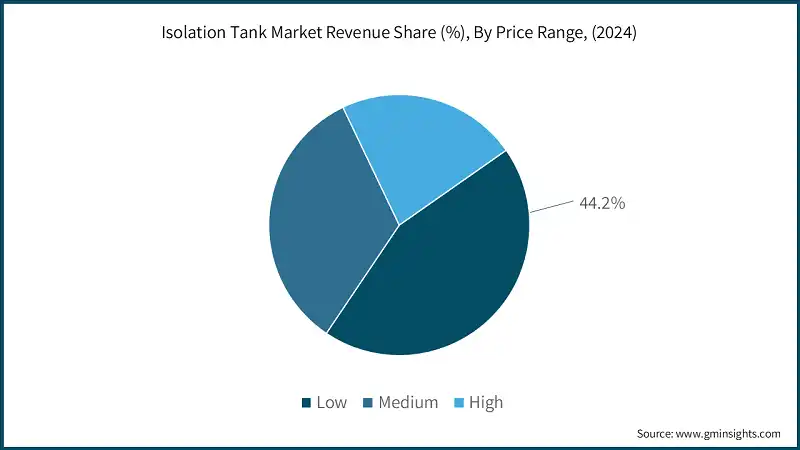
Based on the price range, the isolation tank market is segmented into low, medium, high. The low-price range segment held the largest share, accounting for 44.2% of the global market in 2024.
- Low-priced isolation tanks continue to dominate the market, driven by their accessibility and appeal to a wide consumer base. According to the International Floatation Therapy Association (IFTA), the global floatation therapy market is projected to grow at a CAGR of 10.5% during the forecast period (2024-2029), with low-cost models playing a significant role in this expansion.
- As floatation therapy gains traction, individuals and small wellness businesses are increasingly seeking affordable entry points. These cost-effective models provide users with the core benefits of sensory deprivation without the financial burden associated with high-end equipment, making them particularly suitable for home use and budget-conscious startups.
- The growing trend of DIY wellness and home-based health routines has further fueled the demand for compact and affordable isolation tanks. These models often feature simplified designs and minimal technological integrations, which not only reduce manufacturing costs but also make them easier to install and maintain. For instance, manufacturers like Zen Float Co. and DreamPod have introduced entry-level tanks that cater to this demand, offering products that are both cost-effective and user-friendly.
- In the long term, the increasing popularity of low-priced tanks is expected to normalize floatation therapy and drive mass-market growth. As more users become familiar with the practice through these accessible models, opportunities arise for manufacturers to upsell premium features and expand the ecosystem with complementary products such as accessories, mobile apps, and wellness subscriptions.
Looking for region specific data?
North America Isolation Tank Market
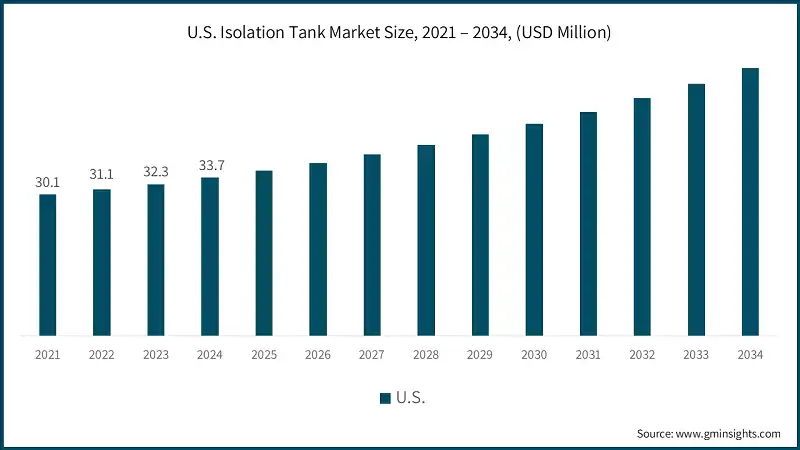
In 2024, the U.S contributed significantly to the market growth in North America, accounting for 68% share in the region.
- North America dominates the market, driven by high consumer awareness, a strong wellness culture, and the widespread adoption of alternative therapies.
- The United States boasts a mature spa and fitness industry, where floatation therapy is increasingly integrated into mental health and recovery programs. According to the International Spa Association (ISPA), the U.S. spa industry generated over $20 billion in revenue in 2023, with floatation therapy contributing significantly to this growth. Key manufacturers such as Float Pod Technologies, Zen Float Co., and Superior Float Tanks are leading the market with innovations like smart tanks, app-based experiences, and customizable features.
Asia Pacific Isolation Tank Market
Asia Pacific market is expected to grow at 5.1% during the forecast period.
- Asia-Pacific is emerging as a high-growth region for isolation tanks, driven by expanding urban populations, rising disposable incomes, and a growing interest in wellness lifestyles. Countries such as China, Japan, South Korea, and Australia are witnessing increased demand, particularly in luxury spas and wellness resorts.
- While awareness of floatation therapy is still developing in some areas, the region's rapid digital adoption and booming wellness tourism sector present major growth prospects. Leading manufacturers like i-sopod and Oasis Relaxation Systems are focusing on local customization, affordability, and strategic partnerships to capture market share. For example, i-sopod has partnered with several luxury spa chains in Japan and South Korea to introduce premium floatation experiences.
Europe Isolation Tank Market
Europe market is expected to grow at 5.4% during the forecast period.
- Europe's market is experiencing steady growth, supported by a rising focus on mental well-being, stress management, and sustainable living. Countries such as Germany, the United Kingdom, and Scandinavian nations are witnessing increased adoption in both commercial wellness centers and private residences.
- According to the European Spa Association, the wellness industry in Europe grew by 7% in 2023, with isolation tanks gaining traction as a preferred therapy for stress relief and relaxation. European consumers place a high value on eco-conscious designs and scientific validation, prompting manufacturers like Floataway and Dreamwater Float Co. to innovate with sustainable materials and clinically backed features.
- Regulatory support for wellness therapies, coupled with their integration into holistic healthcare systems, further enhances the region's long-term potential. For instance, Germany's healthcare system has begun reimbursing certain wellness therapies, including floatation therapy, under specific conditions.
Isolation Tank Market Shares
- The top companies in the market include Dreamwater, Float SPA, Floataway, FloatStar, High-Tech Floatation collectively hold a share of 10-15% in the market. These prominent players are proactively involved in strategic endeavors, such as mergers & acquisitions, facility expansions & collaborations, to expand their product portfolios, extend their reach to a broad customer base, and strengthen their market position.
- Dreamwater's Dreampod series is recognized for its sleek, modern design and robust engineering, making it one of the most visually appealing and durable float tanks in the market. The company offers a wide range of models tailored for both commercial and residential use, supported by intuitive control systems and exceptional customer service. According to the International Floatation Therapy Association (IFTA), Dreamwater holds a significant market share, with its tanks present in over 1,000 businesses globally. The brand’s focus on promoting total mental and physical recovery has made it a leader in the floatation therapy market.
- Float SPA stands out for its advanced hygiene and water filtration systems, which include a 4+1 step cleaning process and separate water reservoir tanks. These features make it a preferred choice for wellness centers that prioritize cleanliness and operational efficiency. The company also provides ROI-focused planning tools and flexible pricing models, making it particularly attractive to entrepreneurs entering the floatation therapy market.
- Floataway has established itself as a leader in clinical-grade float tanks and open pool designs, catering specifically to medical research and therapeutic applications. Collaborations with renowned institutions, such as the Laureate Institute for Brain Research, have positioned Floataway as a pioneer in Floatation-REST technology. The company’s tanks feature advanced functionalities, including chromotherapy, sonotherapy, and remote-controlled doors, offering a deeply immersive and customizable experience.
Isolation Tank Market Companies
Major players operating in the market are:
- Dream Pod
- Float SPA
- Floataway
- FloatOne
- FloatStar
- High-Tech Floatation
- Next Wellness
- Restingwell AB
- Royal Spa
- Samadhi Tank Co., Inc.
- Shanghai Rejuvelab Biotechnology
- Stenal
- Trautwein
- Umbra Heavy Industries
- Zen Float Co.
FloatStar demonstrates exceptional adaptability to market dynamics, appealing to both therapeutic and recreational segments. The brand strategically targets wellness centers, spas, and individual users by offering products that balance affordability with functionality. FloatStar leverages this growth by providing versatile solutions that cater to diverse consumer needs while maintaining high standards of quality and reliability.
High-Tech Floatation differentiates itself through cutting-edge engineering and modular designs, often incorporating advanced features such as customizable filtration systems and smart controls. These innovations cater to both commercial operators and high-end residential users, offering tanks that are not only easy to maintain but also seamlessly integrate with modern wellness platforms. The floatation therapy market's growth is further supported by technological advancements, with manufacturers like High-Tech Floatation, Float Lab, and Superior Float Tanks leading the way in performance and durability.
Isolation Tank Market Report Attributes
| Key Takeaway | Details |
|---|---|
| Market Size & Growth | |
| Base Year | 2024 |
| Market Size in 2024 | USD 118.9 Million |
| Market Size in 2025 | USD 123.8 Million |
| Forecast Period 2025 - 2034 CAGR | 5.2% |
| Market Size in 2034 | USD 196 Million |
| Key Market Trends | |
| Drivers | Impact |
| Rising demand for mental wellness & stress relief | Increasing awareness of mental health and the need for stress management are driving consumers toward alternative therapies like floatation therapy. Isolation tanks offer a drug-free, calming experience that appeals to wellness-conscious individuals. |
| Expansion of wellness tourism & luxury spa industry | The global rise in wellness tourism and luxury spa services is boosting demand for high-end isolation tanks. Resorts and wellness retreats are integrating floatation therapy to attract premium clientele seeking holistic experiences. |
| Technological advancements | Innovations such as smart controls, temperature regulation, and biometric monitoring are enhancing user experience and safety. These features are making isolation tanks more appealing to both commercial and residential users. |
| Pitfalls & Challenges | Impact |
| High initial investment and maintenance costs | The cost of purchasing, installing, and maintaining isolation tanks can be prohibitive for small businesses or individual users. This limits market penetration, especially in developing regions. |
| Limited awareness | Despite growing popularity, many consumers are still unaware of the benefits of floatation therapy or associate it with pseudoscience. This lack of education hinders broader adoption. |
| Opportunities: | Impact |
| Home wellness market expansion | With more people investing in home wellness solutions post-pandemic, compact and portable isolation tanks present a strong growth opportunity. Manufacturers can tap into this trend with affordable, space-saving models. |
| Integration with digital platforms | Linking isolation tanks with mobile apps for session tracking, meditation guidance, and health analytics can attract tech-savvy users. This opens doors for partnerships with wellness platforms and wearable tech companies. |
| Market Leaders (2024) | |
| Market Leaders |
3% market share |
| Top Players |
The collective market share in 2024 is 11% |
| Competitive Edge |
|
| Regional Insights | |
| Largest Market | North America |
| Fastest Growing Market | Europe |
| Emerging Countries | Germany, China, UK |
| Future outlook |
|
What are the growth opportunities in this market?
Isolation Tank Industry News
- In July 2025, The Float Tank Association (FTA) released updated North American Float Tank Standards. These include enhanced sanitation protocols, microbiological testing, and UV/ozone guidelines, aiming to boost public trust and professionalize the industry.
- In July 2025, Urban Float, a U.S.-based float therapy brand, expanded its footprint after securing a deal on Shark Tank. In 2025, the company opened new locations across the U.S. and announced plans for international growth, reflecting rising consumer interest in floatation therapy.
- In April 2024, Dreamwater launched the Dreampod Home Pro, a compact and affordable float tank designed for residential use. It features enhanced soundproofing, UV sanitation, and energy-efficient heating, making float therapy accessible at home. This move significantly expanded Dreampod’s reach into the growing home wellness market.
- In 2023, Float Now app was acquired by Mindful Holdings, this major acquisition signals the growing mainstream acceptance of isolation tank therapy. Float Now, a leading float center chain, joins forces with Mindful Holdings, a mental wellness platform, paving the way for wider accessibility and integration into holistic well-being programs.
The isolation tank market research report includes in-depth coverage of the industry with estimates & forecast in terms of revenue (USD Million) and volume (Thousand Units) from 2021 to 2034, for the following segments:
Market, By Product Type
- Pod/tank style isolation tanks
- Open pool isolation tanks
Market, By Type
- Manual
- Semi-automatic
- Automatic
Market, By Material
- Fiberglass
- Stainless steel
- Composite
Market, By Price range
- Low
- Medium
- High
Market, By End Use
- Residential
- Commercial spas & wellness centers
- Fitness centers & gyms
- Medical & rehabilitation clinics
- Residential/home use
- Hotels & resorts
- Military & defense
- Research institutions
Market, By Distribution channel
- Online
- E-commerce
- Company websites
- Offline
- Fitness & recovery studio
- Spa & wellness centers
- Specialty wellness stores
- Others (trade shows & wellness Exhibitions, etc.)
The above information is provided for the following regions and countries:
- North America
- U.S.
- Canada
- Europe
- Germany
- UK
- France
- Spain
- Italy
- Asia Pacific
- China
- Japan
- India
- Australia
- South Korea
- Latin America
- Brazil
- Mexico
- Argentina
- MEA
- South Africa
- Saudi Arabia
- UAE
Frequently Asked Question(FAQ) :
What is the market size of the isolation tank market in 2024?
The global market size for isolation tank was valued at USD 118.9 million in 2024, driven by increasing demand for stress relief, mindfulness, and wellness therapies.
What is the projected value of the isolation tank market by 2034?
The market is projected to reach USD 196 million by 2034, growing at a CAGR of 5.2% from 2025 to 2034, supported by expanding wellness tourism, luxury spa integration, and adoption of smart floatation systems.
What is the market valuation for 2025?
The market is expected to reach USD 123.8 million in 2025, reflecting the early momentum of wellness-focused consumer behavior and rising floatation center openings worldwide.
Which product segment led the isolation tank market in 2024?
The pod/tank-style isolation tanks segment led the market, generating USD 76.6 million in 2024, due to high demand in commercial wellness centers for personalized, enclosed floatation experiences.
Which price range segment held the largest share in 2024?
Which price range segment held the largest share in 2024?
Which region leads the isolation tank industry?
North America dominated the market with a 68% share in 2024, led by the U.S., where strong wellness culture, spa industry growth, and early technology adoption drive market leadership.
Which region is expected to grow the fastest through 2034?
Europe is projected to grow at a 5.4% CAGR, supported by rising demand for sustainable wellness products, stress management therapies, and healthcare integration.
Who are the leading companies in the isolation tank market?
Key players include Dream Pod, Float SPA, Floataway, FloatStar, High-Tech Floatation, Next Wellness, Zen Float Co., and Royal Spa—focusing on innovation, hygiene, and residential-friendly designs.
Isolation Tank Market Scope
Related Reports