Summary
Table of Content

Interventional Radiology Market
Get a free sample of this report
Form submitted successfully!
Error submitting form. Please try again.
Thank you!
Your inquiry has been received. Our team will reach out to you with the required details via email. To ensure that you don't miss their response, kindly remember to check your spam folder as well!
Request Sectional Data
Thank you!
Your inquiry has been received. Our team will reach out to you with the required details via email. To ensure that you don't miss their response, kindly remember to check your spam folder as well!
Form submitted successfully!
Error submitting form. Please try again.
Interventional Radiology Market Size
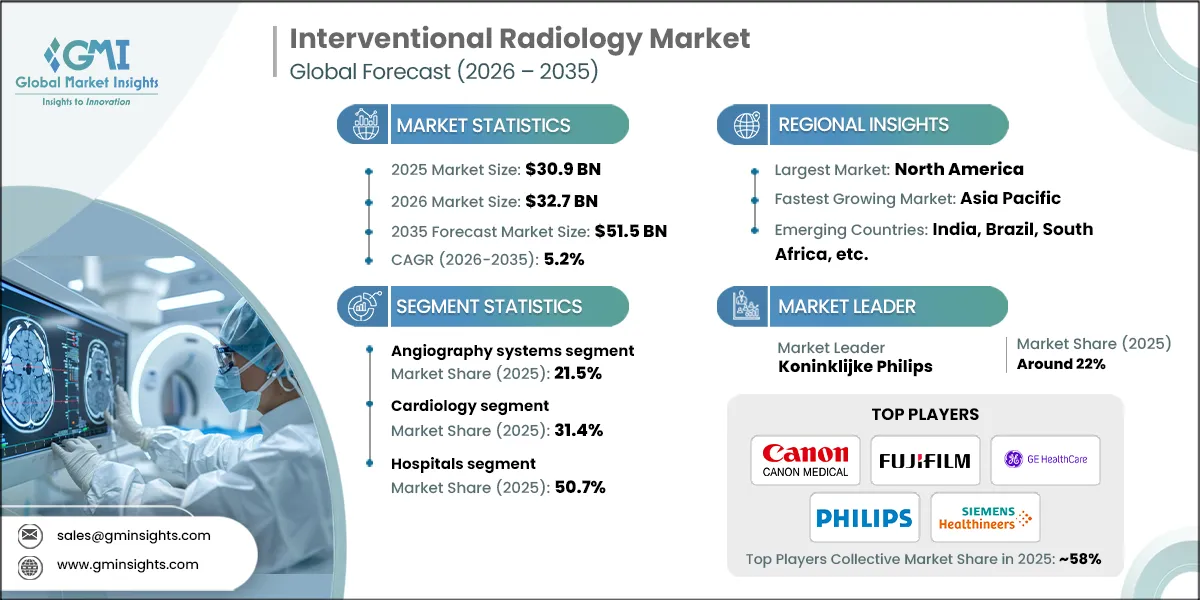
The global interventional radiology market was estimated at USD 30.9 billion in 2025. The market is expected to grow from USD 32.7 billion in 2026 to USD 51.5 billion in 2035, at a CAGR of 5.2% during the forecast period, according to the latest report published by Global Market Insights Inc.
To get key market trends
The interventional radiology market is driven by numerous factors such as the rising prevalence of chronic diseases worldwide, growing elderly population base, technological advancements in imaging technology, and rising demand for minimally invasive procedures, among other factors.
Expansion of IR applications in oncology, advancements in 3D/4D imaging and navigation systems, and growing adoption of image-guided therapies globally are among the key factors propelling the industry demand. Canon Medical Systems, Fujifilm Corporation, GE Healthcare, Koninklijke Philips, and Siemens Healthineers are among the leading players operating in the market. These players mainly focus on product innovation and integration, geographic expansion, adoption of advanced technologies in devices, and collaboration with local or regional healthcare providers, among others.
Interventional Radiology Market Report Attributes
| Key Takeaway | Details |
|---|---|
| Market Size & Growth | |
| Base Year | 2025 |
| Market Size in 2025 | USD 30.9 Billion |
| Market Size in 2026 | USD 32.7 Billion |
| Forecast Period 2026-2035 CAGR | 5.2% |
| Market Size in 2035 | USD 51.5 Billion |
| Key Market Trends | |
| Drivers | Impact |
| Rising prevalence of chronic disease worldwide | Increasing cases of cancer, cardiovascular and metabolic disorders significantly boost demand for interventional radiology as physicians rely more on image-guided, minimally invasive treatments. |
| Technological advancements in medical imaging | Improved CT, MRI, and ultrasound systems enhance diagnostic accuracy and procedure precision, driving immediate adoption of advanced interventional practices across hospitals and clinics. |
| Increasing demand for minimally invasive procedures | Patient preference for faster recovery and reduced hospital stays directly accelerates utilization of catheter based and image guided therapies across multiple specialties. |
| Growing elderly population base | Aging populations require more vascular, oncologic, and orthopedic interventions, increasing daily caseloads and expanding reliance on minimally invasive radiology services. |
| Pitfalls & Challenges | Impact |
| High cost associated with product | Expensive imaging systems and interventional equipment limit adoption among smaller facilities, slowing technology upgrades and restricting access in cost-sensitive regions. |
| Complex regulatory scenario | Strict approval pathways and compliance requirements delay new device introductions, creating administrative burdens for providers and slowing technology integration. |
| Opportunities: | Impact |
| AI- and robotics-enabled image-guided interventions | AI‑driven navigation and robotic precision will streamline complex procedures, reduce operator variability, expand treatment capabilities, and enhance outcomes across high‑volume clinical settings. |
| Increasing investments in hybrid operating rooms | More hybrid ORs will enable seamless integration of surgery and imaging, supporting advanced IR procedures, improving workflow efficiency, and expanding multidisciplinary treatment options. |
| Development of low-radiation and radiation-free imaging technologies | Next‑generation imaging will reduce exposure risks, enable safer repeat procedures, broaden screening eligibility, and support long‑term expansion of minimally invasive therapeutic applications. |
| Market Leaders (2025) | |
| Market Leaders |
Around 22% |
| Top Players |
|
| Competitive Edge |
|
| Regional Insights | |
| Largest Market | North America |
| Fastest growing Market | Asia Pacific |
| Emerging countries | India, Brazil, South Africa, etc. |
| Future outlook |
|
What are the growth opportunities in this market?
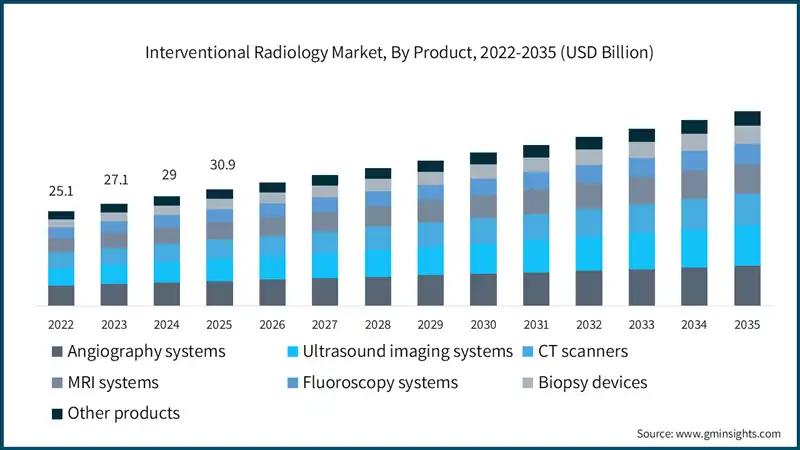
The market has increased from USD 25.1 billion in 2022 and reached USD 29 billion in 2024, with the historic growth rate of 7.5%. The trend of increasing numbers of people with chronic diseases around the world, especially with regard to heart disease, cancers, and end-stage renal failure diseases, is driving demand for the provision of interventional radiology. For example, as per the World Health Organization (WHO), cardiovascular diseases caused around 17.9 million deaths worldwide per year. Thus, a significant percentage of patients suffering from cardiovascular disease are expected to need the intervention of a physician through techniques such as angioplasty, stents, and embolizations.
Similarly, cancer is also one of the major chronic diseases, with an estimated 20 million new cases of cancer reported in 2022, according to the data reported by the International Agency for Research on Cancer (IARC). These patients require interventional oncology procedures such as tumor ablation, transarterial chemoembolization, and image-guided biopsies. Hence, the growing prevalence of chronic diseases is projected to fuel the industry growth over the analysis period.
Additionally, the continued advancement of imaging hardware and software continues to provide new technical capabilities and novel clinical uses for interventional radiology. Modern angiographic systems have superior spatial and temporal resolution compared to older systems, with additional tools such as cone beam computed tomography (CT), fused images, and 3D roadmaps contributing to improved planning of procedures and support for real-time navigation throughout procedures.
Furthermore, the availability of portable imaging systems (point of care) has enabled interventional radiology to extend its services into areas such as intensive care units (ICU), emergency departments, and places with limited resources. Thus, with the combination of these advances in technology, interventional radiology is expected to witness an increase in the number of different types of procedures and the ability to perform them with higher rates of success and with minimum complication.
Interventional radiology covers minimally invasive, image-guided procedures that diagnose and treat conditions across multiple organ systems, enabling shorter recoveries and fewer complications relative to open surgery.
Interventional Radiology Market Trends
AI- and robotics-enabled image-guided interventions, strong clinical evidence supporting IR effectiveness, the development of low-radiation and radiation-free imaging technologies and increasing investments in hybrid operating rooms are among the key trends shaping the industry's growth.
- The integration of artificial intelligence algorithms and robotic assistance platforms into interventional radiology workflows has emerged as a transformative trend. AI-powered image analysis systems enable real-time anatomical recognition, automated needle trajectory planning, and predictive procedural guidance, reducing operator variability and improving procedural success rates.
- Healthcare facilities worldwide are making substantial capital investments in hybrid operating room infrastructure that combines advanced imaging capabilities with traditional surgical environments. In addition, the hybrid OR concept has gained particular traction in cardiovascular, neurovascular, and oncological applications where complex cases may require both endovascular and surgical approaches.
- Furthermore, growing awareness of cumulative radiation exposure risks for both patients and healthcare providers has accelerated innovation in dose reduction technologies and radiation-free imaging alternatives. Real-time dose monitoring systems and comprehensive radiation safety programs have become standard in modern interventional radiology departments, reflecting regulatory emphasis and professional society guidelines.
Interventional Radiology Market Analysis
Learn more about the key segments shaping this market
Based on product, the global interventional radiology market is segmented into angiography systems, ultrasound imaging systems, CT scanners, MRI systems, fluoroscopy systems, biopsy devices, and other products. The angiography systems segment accounted for a leading share of 21.5% in 2025. Growing adoption of image-guided therapies globally is anticipated to fuel the segmental growth. The segment is expected to reach USD 10.6 billion by 2035, growing at a CAGR of 4.7% during the forecast period.
- These sophisticated X-ray imaging platforms provide real-time, high-resolution visualization of blood vessels and internal anatomy during minimally invasive procedures. Modern angiography systems have evolved from simple fluoroscopy units into comprehensive interventional imaging platforms incorporating flat-panel detector technology, advanced image processing, cone-beam CT capabilities, and fusion imaging that overlays pre-procedural CT or MRI data onto live fluoroscopy.
- Additionally, the segment is anticipated to demonstrate steady growth driven by cardiovascular procedure volume increases, expanding endovascular applications in peripheral arterial disease and stroke treatment, and growing adoption of interventional oncology procedures.
- The ultrasound imaging systems segment is anticipated to record the fastest growth with a CAGR of 6.1% over the forecast period. Interventional ultrasound applications span vascular access, biopsies, drainage procedures, ablations, and therapeutic injections across multiple anatomical sites.
- Further, technological advances, including contrast-enhanced ultrasound, elastography, fusion imaging, and 3D/4D visualization, have expanded ultrasound capabilities into applications traditionally requiring CT or fluoroscopic guidance.
- Artificial intelligence integration is enhancing image acquisition quality, automating measurements, and providing real-time procedural guidance.
- The CT scanner segment was valued at USD 5.1 billion in 2025. CT scanners serve dual roles in interventional radiology, providing pre-procedural diagnosis and planning as well as real-time or near-real-time guidance for selecting interventional procedures.
- Furthermore, CT-guided biopsies, drain placements, and ablations offer exceptional spatial resolution and anatomical visualization, particularly for deep or complex anatomical targets.
- The MRI systems segment was valued at USD 4.6 billion in 2025. Interventional MRI applications include targeted biopsies of suspicious breast or prostate lesions, thermal ablations of tumors in the liver, kidney, and bone, and emerging neurosurgical and cardiac electrophysiology procedures.
- Moreover, the segment growth is driven by expanding interventional radiology adoption in oncology, where MRI's superior soft tissue characterization enables precise targeting and treatment monitoring, and growing patient and provider preference for radiation-free procedures.
Based on application, the global interventional radiology market is segmented into cardiology, oncology, gynecology, obstetrics, urology, gastroenterology, and other applications. The cardiology segment accounted for a majority share of 31.4% in 2025.
- The cardiology segment is driven by high global prevalence of cardiovascular disease, substantial procedure volumes, and continuous expansion of interventional treatment options. It benefits from extensive clinical evidence supporting interventional approaches, well-established treatment guidelines, comprehensive reimbursement, and growing adoption of heart team approaches integrating interventional and surgical cardiology expertise.
- Additionally, technological innovation continues with newer-generation drug-eluting stents, transcatheter valve technologies, and advanced imaging, including intravascular ultrasound and optical coherence tomography, expanding treatable patient populations.
- The oncology segment is anticipated to record the fastest growth with a CAGR of 5.9% over the forecast period. Oncology applications demonstrate the fastest growth rate, reflecting the expanding role of interventional oncology in comprehensive cancer care pathways.
- Technology advances in image guidance, ablation zone control, and combination approaches integrating interventional techniques with systemic therapies or immunotherapy drive clinical capability expansion, supports the market growth.
- Furthermore, the segment benefits from favorable reimbursement in developed markets and growing acceptance in emerging economies.
Learn more about the key segments shaping this market
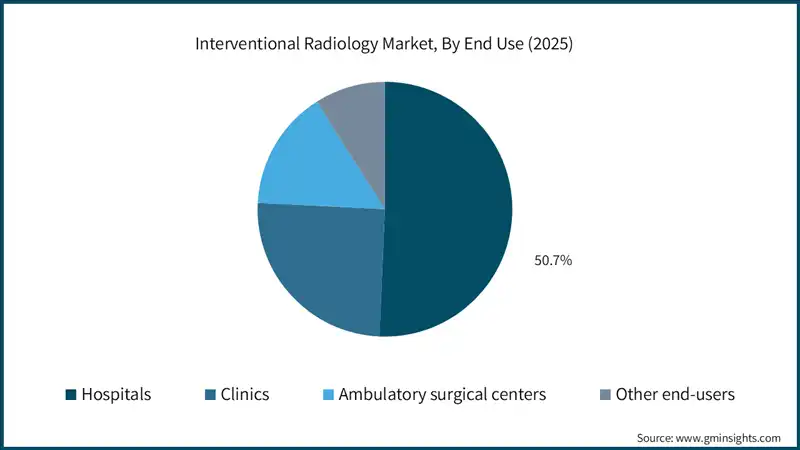
Based on end use, the interventional radiology market is segmented into hospitals, clinics, ambulatory surgical centers and other end-users. The hospitals segment accounted for the leading market share of 50.7% in 2025.
- Hospitals represent the major end-use segment, driven by their comprehensive infrastructures supporting complex interventional procedures, multidisciplinary care teams, emergency case capabilities, and capital resources for advanced equipment investments.
- Large tertiary academic medical centers and high-volume community hospitals perform the majority of interventional radiology procedures, particularly complex cases requiring sophisticated technology, specialized expertise, or inpatient support services.
- In addition, hospitals benefit from established reimbursement structures, the ability to leverage equipment across multiple service lines and specialties, and referral networks driving case volumes.
- The clinics segment was valued at USD 7.8 billion in 2025. Clinics contribute to IR market growth by expanding patient access to minimally invasive, image-guided procedures in outpatient environments. Specialized IR clinics, such as those operated within major health systems, offer focused expertise, advanced imaging equipment, and streamlined patient evaluation, supporting faster referrals and reducing hospital burden.
- Additionally, these settings help manage a wide spectrum of conditions, from vascular diseases to oncologic interventions, broadening IR utilization across patient populations.
- Further, clinics drive adoption by offering patient-centered care, shorter wait times, and efficient follow-up for chronic disease management. Their integration with larger hospital networks enables seamless coordination for diagnostic imaging, biopsies, and minimally invasive treatments. This distributed model increases procedural volume and enhances accessibility to cutting-edge IR techniques.
Looking for region specific data?
North America Interventional Radiology Market
North America market accounted for majority share of 36% in 2025 in the global market and is anticipated to show notable growth over the forecast period.
- North America maintains market leadership driven by advanced healthcare infrastructure, high procedure volumes, established reimbursement frameworks supporting interventional approaches, early technology adoption patterns, and concentration of leading medical device manufacturers.
- In addition, the region benefits from the world's highest per-capita healthcare expenditure, comprehensive insurance coverage through Medicare, Medicaid, and private insurance, and a sophisticated medical device regulatory environment balancing innovation access with patient safety.
- Further, major academic medical centers maintain comprehensive interventional radiology programs with subspecialty expertise across vascular, oncologic, neurologic, and other applications.
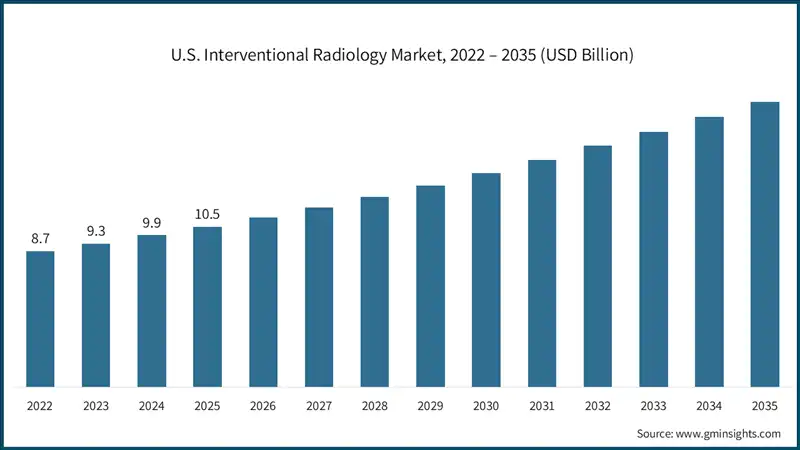
The U.S. interventional radiology market was valued at USD 8.7 billion and USD 9.3 billion in 2022 and 2023, respectively. In 2025 the market size was valued at USD 10.5 billion from USD 9.9 billion in 2024. Collaboration between medtech companies and hospitals for IR innovation is projected to fuel the market growth.
- The U.S. continues to advance interventional radiology through rapid adoption of AI-enhanced imaging, generative models for reporting, and expanding access to technology-driven diagnostic services.
- Growing radiologist shortages are accelerating reliance on automation, cloud-based platforms, and multimodal AI that supports clinical decision-making and improves workflow efficiency.
- Additionally, emerging innovations such as next-generation CT/MR techniques, immune-modulating cancer therapies, and precision ablation tools reflect the U.S. market’s strong emphasis on minimally invasive oncology and vascular interventions.
- Further, economic and regulatory changes, including new reimbursement frameworks, shape investment patterns as hospitals prioritize scalable, AI-driven imaging ecosystems. The increased focus on personalized imaging pathways and whole-body advanced modalities further strengthens the country’s leadership in interventional radiology.
Europe Interventional Radiology Market
Europe accounted for a significant share of the global interventional radiology market and was valued at USD 7.8 billion in 2025.
- The European market is characterized by heterogeneous healthcare systems ranging from centralized national health services to mixed public-private models, high healthcare quality standards, universal coverage providing broad population access, and a strong medical device regulatory framework.
- Western European countries, including Germany, France, and the UK, account for the majority of regional market value, with well-developed interventional radiology capabilities and established practice patterns.
- Further, the European regulatory environment, particularly the Medical Device Regulation implementation, creates rigorous post-market surveillance and documentation requirements affecting manufacturer strategies.
Germany held significant share of the European interventional radiology market, showcasing strong growth potential.
- Germany’s interventional radiology landscape is shaped by strong healthcare infrastructure, high adoption of minimally invasive cancer therapies, and expanding use of advanced imaging technologies such as CT, MR, PET-CT, and hybrid systems.
- German oncology centers lead in precision image-guided treatments, including ablation, embolization, and vascular interventions, making IR central to cancer management.
- In addition, the demand is reinforced by an aging population, rising chronic disease burden, and growing investment in imaging-driven minimally invasive procedures.
- Furthermore, technological advancement is a key driver, with imaging systems and catheter-based tools experiencing steady growth across hospitals and diagnostic centers. Digital transformation, telehealth integration and evolving regulatory harmonization across Europe further support product adoption.
Asia Pacific Interventional Radiology Market
The Asia Pacific market accounted for a substantial share of the market and was valued at USD 9.2 billion in 2025.
- The Asia Pacific region demonstrates the highest growth momentum globally, driven by a large population base, rapidly expanding healthcare access, a rising chronic disease burden due to westernization of lifestyle patterns, substantial government investments in healthcare infrastructure modernization, and a growing medical tourism industry.
- China is among the fastest-growing markets within the region, driven by population scale, government healthcare reform initiatives including the Healthy China 2030 strategy, and expanding insurance coverage through national and provincial programs.
- Similarly, the Indian government's Ayushman Bharat program aims to provide health coverage for over 500 million citizens, potentially expanding access to advanced procedures, including interventional radiology.
- Further, medical tourism represents a significant driver in countries such as Thailand and Malaysia, with modern private hospitals offering international-standard care attracting patients regionally and globally.
China interventional radiology market is estimated to grow with a robust CAGR, in the Asia Pacific market.
- China is experiencing rapid expansion in interventional radiology fueled by rising healthcare investment, government-backed modernization of hospital infrastructure, and strong demand for minimally invasive therapies. Growth is driven by increasing prevalence of chronic diseases, especially cancer, cardiovascular, and neurological conditions, which heighten the need for advanced IR imaging and therapeutic capabilities.
- Additionally, the country’s IR imaging systems market is growing substantially through adoption of high-precision CT, MRI, and hybrid modalities supported by AI-driven diagnostics and large-scale healthcare digitalization.
- Government initiatives aimed at improving access, workforce training, and early detection further accelerate penetration.
Latin America Interventional Radiology Market
Brazil leads the Latin American market, exhibiting remarkable growth during the analysis period.
- Brazil’s interventional radiology ecosystem is expanding along with growth driven by increasing chronic disease incidence, a growing elderly population, and improved healthcare infrastructure.
- In addition, IR services, including angiography, biopsies, and minimally invasive oncologic and vascular procedures, play a key role across all healthcare facilities, including hospitals, diagnostic centers, and ambulatory settings.
- Investments in digital imaging, AI adoption, and the shift from analog to cloud-based platforms are boosting procedural accuracy and efficiency.
- Further, growing demand for minimally invasive cardiac, oncologic, and neurological procedures is driving adoption of interventional imaging systems in hospitals and specialized centers. With both public and private sectors expanding radiology capacity, Brazil continues to strengthen its position as a major Latin American hub for IR services.
Middle East and Africa Interventional Radiology Market
Saudi Arabia market to experience substantial growth in the Middle East and Africa market in 2025.
- Saudi Arabia is rapidly expanding interventional radiology capacity driven by major healthcare investments, increasing demand for minimally invasive treatments, and nationwide infrastructure modernization.
- Government-funded hospital growth, rising chronic disease prevalence, and high adoption of oncology-focused interventions such as ablation, embolization, and vascular therapies support market expansion.
- Comprehensive IR units, like those at King Faisal Specialist Hospital, offer a broad spectrum of endovascular and non-vascular procedures, reflecting the country’s strong clinical commitment to advanced IR care.
- Moreover, professional bodies such as the Saudi Interventional Radiology Society further enhance training, awareness, and integration of best global practices.
Interventional Radiology Market Share
The interventional radiology industry is characterized by substantial concentration, including major global manufacturers, mid-tier firms, and specialized companies competing to improve their market share in the industry. The market structure creates significant barriers to entry for companies, which include technological complexity, regulatory requirements, research and development capital requirements, long-standing relationships with customers, and dedicated service and maintenance support infrastructure. At the same time, it enables specialized firms to compete within specific product types, geographies, or specialty applications.
Various factors that intensify the competition in the market include technology developments such as continuous feature improvements, artificial intelligence integration, and new clinical uses developed through R&D; pricing pressure from customers taking advantage of competitive dynamics and Group Purchasing Organizations to negotiate better pricing, among others. Service differences such as increased equipment uptime, rapid resolution of technical problems, predictive maintenance, workflow efficiency, and total cost of ownership are additional parameters supporting industry growth.
Additionally, market share trends favor established leaders who possess the resources to continue to invest in research and development, work within difficult regulatory frameworks, provide complete value propositions, and offer opportunities for niche competitors who provide unique or differentiated technology, superior service, or value-based alternatives.
Further, emerging markets have different dynamics when compared to developed markets. Price sensitivity and local product requirements may create advantages for regional manufacturers or existing companies that have localized operations in emerging markets. However, premium segments of developed markets continue to benefit companies that are technologically advanced and have the latest device capabilities.
Interventional Radiology Market Companies
A few of the prominent players operating in the global interventional radiology industry include:
- Agfa-Gevaert Group
- Canon Medical Systems
- Carestream Health Inc.
- Cook
- Esaote SPA
- Fujifilm Corporation
- GE Healthcare
- Hologic, Inc.
- Koninklijke Philips
- Mindray
- Olympus Corporation
- Samsung Healthcare
- Shimadzu Corporation
- Siemens Healthineers
- Teleflex
- Koninklijke Philips
Philips drives cloud-based, AI-enabled diagnostic imaging through strategic partnerships, integrated enterprise imaging platforms, advanced MR innovations, and workflow-optimization solutions aimed at improving precision diagnosis, operational efficiency, and health system productivity globally.
Canon Medical is expanding its imaging portfolio through strategic realignment, strengthening product integration, and accelerating growth in major markets. It is also enhancing R&D, production, and service capabilities to drive localized innovation and customer-focused solutions.
GE HealthCare advances AI-driven imaging, cloud-enabled enterprise solutions, and precision care ecosystems, supported by strong R&D investment, digital platforms like Edison, strategic partnerships, and expanded enterprise imaging collaborations to enhance workflow efficiency and clinical outcomes.
Interventional Radiology Industry News:
- In December 2025, Philips agreed to acquire SpectraWAVE Inc., a key innovator in Enhanced Vascular Imaging (EVI) of coronary arteries, angiography-based physiology assessments, and the use of AI in medical imaging. This acquisition will help Philips expand its existing intravascular imaging device portfolio and further improve its market position.
- In September 2025, Siemens Healthineers and Cook Medical announced a strategic commercial partnership that combined Siemens real-time MRI with Cook Medical’s interventional procedure expertise, along with new medical devices developed by Cook specifically for the MRI environment. This collaboration is designed to accelerate iMRI adoption and advance clinical impact in interventional radiology.
- In July 2025, Teleflex Incorporated announced that it had completed the previously announced acquisition of the majority of the vascular intervention business of BIOTRONIK SE & Co. KG. This development will allow the company to improve its industry position through an expanded product portfolio.
The global interventional radiology market research report includes an in-depth coverage of the industry with estimates and forecasts in terms of revenue in (USD Million) from 2022 - 2035 for the following segments:
Market, By Product
- Angiography systems
- Ultrasound imaging systems
- CT scanners
- MRI systems
- Fluoroscopy systems
- Biopsy devices
- Other products
Market, By Application
- Cardiology
- Oncology
- Gynecology
- Obstetrics
- Urology
- Gastroenterology
- Other applications
Market, By End Use
- Hospitals
- Clinics
- Ambulatory surgical centers
- Other end use
The above information is provided for the following regions and countries:
- North America
- U.S.
- Canada
- Europe
- Germany
- UK
- France
- Spain
- Italy
- Netherlands
- Asia Pacific
- China
- Japan
- India
- Australia
- South Korea
- Latin America
- Brazil
- Mexico
- Argentina
- MEA
- South Africa
- Saudi Arabia
- UAE
Frequently Asked Question(FAQ) :
Which region leads the interventional radiology market?
North America led the market with a 36% share in 2025, supported by strong healthcare infrastructure, technological advancements, and high adoption rates of interventional radiology procedures.
Who are the key players in the interventional radiology market?
Key players include Agfa-Gevaert Group, Canon Medical Systems, Carestream Health Inc., Cook, Esaote SPA, Fujifilm Corporation, GE Healthcare, Hologic, Inc., Koninklijke Philips, and Mindray.
What are the upcoming trends in the interventional radiology market?
Key trends include the integration of AI and robotics in image-guided interventions, the development of low-radiation and radiation-free imaging technologies, and increased investments in hybrid operating rooms for complex procedures.
What was the valuation of the hospitals segment in the interventional radiology market?
The hospitals segment held a 50.7% market share and generated significant revenue in 2025, driven by the increasing adoption of advanced imaging technologies in hospital settings.
What is the projected size of the interventional radiology market in 2026?
The market is expected to reach USD 32.7 billion in 2026.
How much revenue did the angiography systems segment generate?
The angiography systems segment accounting for a 21.5% market share, and is projected to grow at a CAGR of 4.7% through 2035.
What is the projected value of the interventional radiology market by 2035?
The market is expected to reach USD 51.5 billion by 2035, fueled by investments in hybrid operating rooms, AI integration, and the growing prevalence of chronic diseases.
What was the market size of the interventional radiology market in 2025?
The market size was USD 30.9 billion in 2025, with a CAGR of 5.2% expected during the forecast period, driven by advancements in imaging technologies and increasing adoption of image-guided therapies.
Interventional Radiology Market Scope
Related Reports